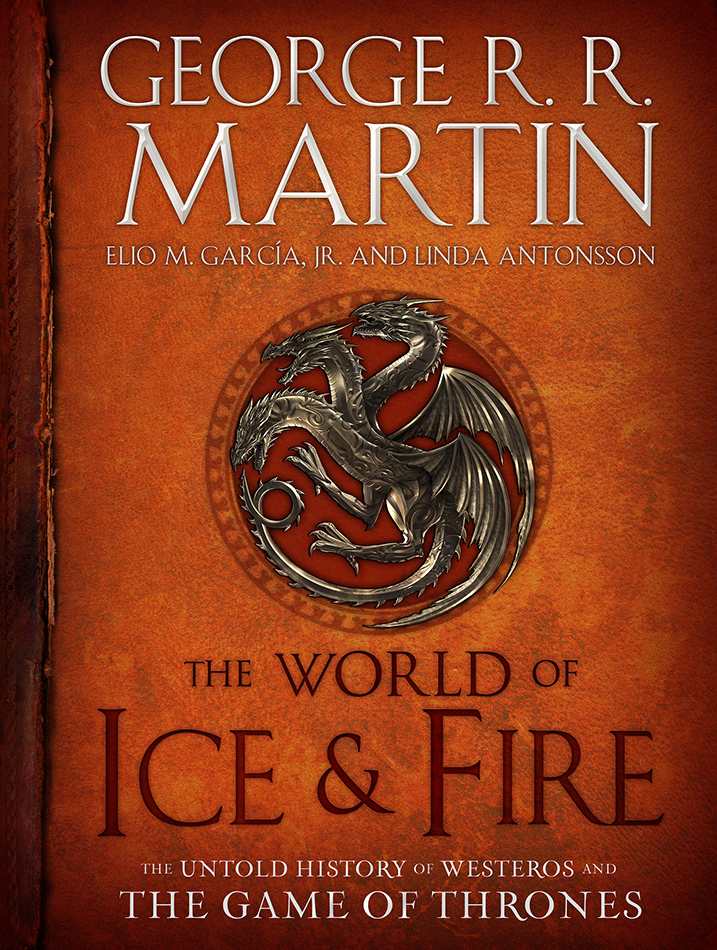
The World of Ice & Fire: The Untold History of Westeros and the Game of Thrones
About this book
Presented as a history assembled for King Tommen, the book begins before written records and follows the Children of the Forest, the First Men, the Andal invasion, and the rise and ruin of civilizations beyond Westeros.
Its middle reaches the Targaryen conquest and the dynasty's civil wars before turning to the rule of Robert Baratheon. Regional chapters then survey the North, the riverlands, the Vale, the Iron Islands, the Reach, the stormlands, Dorne, and the lands across the narrow sea.
The conceit matters: this is knowledge filtered through Citadel scholarship, courtly caution, disputed testimony, and occasional gaps. Competing legends are recorded without forcing every mystery into a single official answer.
The World of Ice & Fire is an illustrated companion rather than a novel. It rewards readers who already know the main series and want the political geography, family histories, and older conflicts behind names that appear briefly in the story.
Read a sample
5,127 words
Plain text
From the opening
IT IS SAID with truth that every building is constructed stone by stone, and the same may be said of knowledge, extracted and compiled by many learned men, each of whom builds upon the works of those who preceded him. What one of them does not know is known to another, and little remains truly unknown if one seeks far enough. Now I, Maester Yandel, take my turn as mason, carving what I know to place one more stone in the great bastion of knowledge that has been built over the centuries both within and without the confines of the Citadel—a bastion raised by countless hands that came before, and which will, no doubt, continue to rise with the aid of countless hands yet to come.
I was a foundling from my birth in the tenth year of the reign of the last Targaryen king, left on a morning in an empty stall in the Scribe’s Hearth, where acolytes practiced the art of letters for those who had need. The course of my life was set that day, when I was found by an acolyte who took me to the Seneschal of that year, Archmaester Edgerran. Edgerran, whose ring and rod and mask were silver, looked upon my squalling face and announced that I might prove of use. When first told this as a boy, I took it to mean he foresaw my destiny as a maester; only much later did I come to learn from Archmaester Ebrose that Edgerran was writing a treatise on the swaddling of infants and wished to test certain theories.
But inauspicious as that may seem, the result was that I was given to the care of servants and received the occasional attention of maesters. I was raised as a servant myself amongst the halls and chambers and libraries, but I was given the gift of letters by Archmaester Walgrave. Thus did I come to know and love the Citadel and the knights of the mind who guarded its precious wisdom. I desired nothing more than to become one of them—to read of far places and long-dead men, to gaze at the stars and measure the passing of the seasons.
And so I did. I forged the first link in my chain at three-and-ten, and other links followed. I completed my chain and took my oaths in the ninth year of the reign of King Robert, the First of His Name, and found myself blessed to continue at the Citadel, to serve the archmaesters and aid them in all that they did. It was a great honor, but my greatest desire was to create a work of mine own, a work that humble but lettered men might read—and read to their wives and children—so that they would learn of things both good and wicked, just and unjust, great and small, and grow wiser as I had grown wiser amidst the learning of the Citadel. And so I set myself to work once more at my forge, to make new and notable matter around the masterworks of the long-dead maesters who came before me. What follows herein sprang from that desire: a history of deeds gallant and wicked, peoples familiar and strange, and lands near and far.
THE D AWN A GE
THERE ARE NONE who can say with certain knowledge when the world began, yet this has not stopped many maesters and learned men from seeking the answer. Is it forty thousand years old, as some hold, or perhaps a number as large as five hundred thousand—or even more? It is not written in any book that we know, for in the first age of the world, the Dawn Age, men were not lettered.
We can be certain that the world was far more primitive, however—a barbarous place of tribes living directly from the land with no knowledge of the working of metal or the taming of beasts. What little is known to us of those days is contained in the oldest of texts: the tales written down by the Andals, by the Valyrians, and by the Ghiscari, and even by those distant people of fabled Asshai. Yet however ancient those lettered races, they were not even children during the Dawn Age. So what truths their tales contain are difficult to find, like seeds among chaff.
What can most accurately be told about the Dawn Age? The eastern lands were awash with many peoples—uncivilized, as all the world was uncivilized, but numerous. But on Westeros, from the Lands of Always Winter to the shores of the Summer Sea, only two peoples existed: the children of the forest and the race of creatures known as the giants.
Of the giants in the Dawn Age, little and less can be said, for no one has gathered their tales, their legends, their histories. Men of the Watch say the wildlings have tales of the giants living uneasily alongside the children, ranging where they would and taking what they wanted. All the accounts claim that they were huge and powerful creatures, but simple. Reliable accounts from the rangers of the Night’s Watch, who were the last men to see the giants while they still lived, state that they were covered in a thick fur rather than simply being very large men as the nursery tales hold.
There is considerable evidence of burials among the giants, as recorded in Maester Kennet’s Passages of the Dead—a study of the barrow fields and graves and tombs of the North in his time of service at Winterfell, during the long reign of Cregan Stark. From bones that have been found in the North and sent to the Citadel, some maesters estimate that the largest of the giants could reach fourteen feet, though others say twelve feet is nearer the truth. The tales of long-dead rangers written down by maesters of the Watch all agree that the giants did not make homes or garments, and knew of no better tools or weapons than branches pulled from trees.
Continue reading the sampleClose the sample
The giants had no kings and no lords, made no homes save in caverns or beneath tall trees, and they worked neither metal nor fields. They remained creatures of the Dawn Age even as the ages passed them by, men grew ever more numerous, and the forests were tamed and dwindled. Now the giants are gone even in the lands beyond the Wall, and the last reports of them are more than a hundred years old. And even those are dubious—tales that rangers of the Watch might tell over a warm fire.
The children of the forest were, in many ways, the opposites of the giants. As small as children but dark and beautiful, they lived in a manner we might call crude today, yet they were still less barbarous than the giants. They worked no metal, but they had great art in working obsidian (what the smallfolk call dragonglass, while the Valyrians knew it by a word meaning “frozen fire”) to make tools and weapons for hunting. They wove no cloths but were skilled in making garments of leaves and bark. They learned to make bows of weirwood and to construct flying snares of grass, and both of the sexes hunted with these.
Their song and music was said to be as beautiful as they were, but what they sang of is not remembered save in small fragments handed down from ancient days. Maester Childer’s Winter’s Kings, or the Legends and Lineages of the Starks of Winterfell contains a part of a ballad alleged to tell of the time Brandon the Builder sought the aid of the children while raising the Wall. He was taken to a secret place to meet with them, but could not at first understand their speech, which was described as sounding like the song of stones in a brook, or the wind through leaves, or the rain upon the water. The manner in which Brandon learned to comprehend the speech of the children is a tale in itself, and not worth repeating here. But it seems clear that their speech originated, or drew inspiration from, the sounds they heard every day.
The gods the children worshipped were the nameless ones that would one day become the gods of the First Men—the innumerable gods of the streams and forests and stones. It was the children who carved the weirwoods with faces, perhaps to give eyes to their gods so that they might watch their worshippers at their devotions. Others, with little evidence, claim that the greenseers—the wise men of the children—were able to see through the eyes of the carved weirwoods. The supposed proof is the fact that the First Men themselves believed this; it was their fear of the weirwoods spying upon them that drove them to cut down many of the carved trees and weirwood groves, to deny the children such an advantage. Yet the First Men were less learned than we are now, and credited things that their descendants today do not; consider Maester Yorrick’s Wed to the Sea, Being an Account of the History of White Harbor from Its Earliest Days, which recounts the practice of blood sacrifice to the old gods. Such sacrifices persisted as recently as five centuries ago, according to accounts from Maester Yorrick’s predecessors at White Harbor.
A giant. (illustration credit 10)
This is not to say that the greenseers did not know lost arts that belong to the higher mysteries, such as seeing events at a great distance or communicating across half a realm (as the Valyrians, who came long after them, did). But mayhaps some of the feats of the greenseers have more to do with foolish tales than truth. They could not change their forms into those of beasts, as some would have it, but it seems true that they were capable of communicating with animals in a way that we cannot now achieve; it is from this that legends of skinchangers, or beastlings, arose.
In truth, the legends of the skinchangers are many, but the most common—brought from beyond the Wall by men of the Night’s Watch, and recorded at the Wall by septons and maesters of centuries past—hold that the skinchangers not only communicated with beasts, but could control them by having their spirits mingle. Even among the wildlings, these skinchangers were feared as unnatural men who could call on animals as allies. Some tales speak of skinchangers losing themselves in their beasts, and others say that the animals could speak with a human voice when a skinchanger controlled them. But all the tales agree that the most common skinchangers were men who controlled wolves—even direwolves—and these had a special name among the wildlings: wargs.
Legend further holds that the greenseers could also delve into the past and see far into the future. But as all our learning has shown us, the higher mysteries that claim this power also claim that their visions of the things to come are unclear and often misleading—a useful thing to say when seeking to fool the unwary with fortune-telling. Though the children had arts of their own, the truth must always be separated from superstition, and knowledge must be tested and made sure. The higher mysteries, the arts of magic, were and are beyond the boundaries of our mortal ability to examine.
Yet no matter the truths of their arts, the children were led by their greenseers, and there is no doubt that they could once be found from the Lands of Always Winter to the shores of the Summer Sea. They made their homes simply, constructing no holdfasts or castles or cities. Instead they resided in the woods, in crannogs, in bogs and marshes, and even in caverns and hollow hills. It is said that, in the woods, they made shelters of leaves and withes up in the branches of trees—secret tree “towns.”
It has long been held that they did this for protection from predators such as direwolves or shadowcats, which their simple stone weapons—and even their vaunted greenseers—were not proof against. But other sources dispute this, stating that their greatest foes were the giants, as hinted at in tales told in the North, and as possibly proved by Maester Kennet in the study of a barrow near the Long Lake—a giant’s burial with obsidian arrowheads found amidst the extant ribs. It brings to mind a transcription of a wildling song in Maester Herryk’s History of the Kings-Beyond-the-Wall, regarding the brothers Gendel and Gorne. They were called upon to mediate a dispute between a clan of children and a family of giants over the possession of a cavern. Gendel and Gorne, it is said, ultimately resolved the matter through trickery, making both sides disavow any desire for the cavern, after the brothers discovered it was a part of a greater chain of caverns that eventually passed beneath the Wall. But considering that the wildlings have no letters, their traditions must be looked at with a jaundiced eye.
A child of the forest. (illustration credit 11)
The beasts of the woods and the giants were eventually joined by other, greater dangers, however.
THE C OMING OF THE F IRST M EN
According to the most well-regarded accounts from the Citadel, anywhere from eight thousand to twelve thousand years ago, in the southernmost reaches of Westeros, a new people crossed the strip of land that bridged the narrow sea and connected the eastern lands with the land in which the children and giants lived. It was here that the First Men came into Dorne via the Broken Arm, which was not yet broken. Why these people left their homelands is lost to all knowing, but when they came, they came in force. Thousands entered and began to settle the lands, and as the decades passed, they pushed farther and farther north. Such tales as we have of those migratory days are not to be trusted, for they suggest that, within a few short years, the First Men had moved beyond the Neck and into the North. Yet, in truth, it would have taken decades, even centuries, for this to occur.
What does seem to be accurate from all the tales, however, is that the First Men soon came to war with the children of the forest. Unlike the children, the First Men farmed the land and raised up ringforts and villages. And in so doing, they took to chopping down the weirwood trees, including those with carved faces, and for this, the children attacked them, leading to hundreds of years of war. The First Men—who had brought with them strange gods, horses, cattle, and weapons of bronze—were also larger and stronger than the children, and so they were a significant threat.
The hunters among the children—their wood dancers—became their warriors as well, but for all their secret arts of tree and leaf, they could only slow the First Men in their advance. The greenseers employed their arts, and tales say that they could call the beasts of marsh, forest, and air to fight on their behalf: direwolves and monstrous snowbears, cave lions and eagles, mammoths and serpents, and more. But the First Men proved too powerful, and the children are said to have been driven to a desperate act.
A carved weirwood. (illustration credit 12)
Legend says that the great floods that broke the land bridge that is now the Broken Arm and made the Neck a swamp were the work of the greenseers, who gathered at Moat Cailin to work dark magic. Some contest this, however: the First Men were already in Westeros when this occurred, and stemming the tide from the east would do little more than slow their progress. Moreover, such power is beyond even what the greenseers are traditionally said to have been capable of … and even those accounts appear exaggerated. It is likelier that the inundation of the Neck and the breaking of the Arm were natural events, possibly caused by a natural sinking of the land. What became of Valyria is well-known, and in the Iron Islands, the castle of Pyke sits on stacks of stone that were once part of the greater island before segments of it crumbled into the sea.
Regardless, the children of the forest fought as fiercely as the First Men to defend their lives. Inexorably, the war ground on across generations, until at last the children understood that they could not win. The First Men, perhaps tired of war, also wished to see an end to the fighting. The wisest of both races prevailed, and the chief heroes and rulers of both sides met upon the isle in the Gods Eye to form the Pact. Giving up all the lands of Westeros save for the deep forests, the children won from the First Men the promise that they would no longer cut down the weirwoods. All the weirwoods of the isle on which the Pact was forged were then carved with faces so that the gods could witness the Pact, and the order of green men was made afterward to tend to the weirwoods and protect the isle.
With the Pact, the Dawn Age of the world drew to a close, and the Age of Heroes followed.
The children of the forest and the First Men forming the Pact. (illustration credit 13)
THE A GE OF H EROES
THE AGE OF HEROES lasted for thousands of years, in which kingdoms rose and fell, noble houses were founded and withered away, and greet deeds were accomplished. Yet what we truly know of those ancient days is hardly more than what we know of the Dawn Age. The tales we have now are the work of septons and maesters writing thousands of years after the fact—yet unlike the children of the forest and the giants, the First Men of this Age of Heroes left behind some ruins and ancient castles that can corroborate parts of the legends, and there are stone monuments in the barrow fields and elsewhere marked with their runes. It is through these remnants that we can begin to ferret out the truth behind the tales.
What is commonly accepted is that the Age of Heroes began with the Pact and extended through the thousands of years in which the First Men and the children lived in peace with one another. With so much land ceded to them, the First Men at last had room to increase. From the Land of Always Winter to the shores of the Summer Sea, the First Men ruled from their ringforts. Petty kings and powerful lords proliferated, but in time some few proved to be stronger than the rest, forging the seeds of the kingdoms that are the ancestors of the Seven Kingdoms we know today. The names of the kings of these earliest realms are caught up in legend, and the tales that claim their individual rules lasted hundreds of years are to be understood as errors and fantasies introduced by others in later days.
Names such as Brandon the Builder, Garth Greenhand, Lann the Clever, and Durran Godsgrief are names to conjure with, but it is likely that their legends hold less truth than fancy. Elsewhere, I shall endeavor to sift what grain can be found from the chaff, but for now it is enough to acknowledge the tales.
And besides the legendary kings and the hundreds of kingdoms from which the Seven Kingdoms were born, stories of such as Symeon Star-Eyes, Serwyn of the Mirror Shield, and other heroes have become fodder for septons and singers alike. Did such heroes once exist? It may be so. But when the singers number Serwyn of the Mirror Shield as one of the Kingsguard—an institution that was only formed during the reign of Aegon the Conqueror—we can see why it is that few of these tales can ever be trusted. The septons who first wrote them down took what details suited them and added others, and the singers changed them—sometimes beyond all recognition—for the sake of a warm place in some lord’s hall. In such a way does some long-dead First Man become a knight who follows the Seven and guards the Targaryen kings thousands of years after he lived (if he ever did). The legion of boys and youths made ignorant of the past history of Westeros by these foolish tales cannot be numbered.
A ruined ringfort of the First Men. (illustration credit 14)
THE L ONG N IGHT
AS THE FIRST MEN established their realms following the Pact, little troubled them save their own feuds and wars, or so the histories tell us. It is also from these histories that we learn of the Long Night, when a season of winter came that lasted a generation—a generation in which children were born, grew into adulthood, and in many cases died without ever seeing the spring. Indeed, some of the old wives’ tales say that they never even beheld the light of day, so complete was the winter that fell on the world. While this last may well be no more than fancy, the fact that some cataclysm took place many thousands of years ago seems certain. Lomas Longstrider, in his Wonders Made by Man, recounts meeting descendants of the Rhoynar in the ruins of the festival city of Chroyane who have tales of a darkness that made the Rhoyne dwindle and disappear, her waters frozen as far south as the joining of the Selhoru. According to these tales, the return of the sun came only when a hero convinced Mother Rhoyne’s many children—lesser gods such as the Crab King and the Old Man of the River—to put aside their bickering and join together to sing a secret song that brought back the day.
It is also written that there are annals in Asshai of such a darkness, and of a hero who fought against it with a red sword. His deeds are said to have been performed before the rise of Valyria, in the earliest age when Old Ghis was first forming its empire. This legend has spread west from Asshai, and the followers of R’hllor claim that this hero was named Azor Ahai, and prophesy his return. In the Jade Compendium, Colloquo Votar recounts a curious legend from Yi Ti, which states that the sun hid its face from the earth for a lifetime, ashamed at something none could discover, and that disaster was averted only by the deeds of a woman with a monkey’s tail.
However, if this fell winter did take place, as the tales say, the privation would have been terrible to behold. During the hardest winters, it is customary for the oldest and most infirm amongst the northmen to claim they are going out hunting—knowing full well they will never return and thus leaving a little more food for those likelier to survive. Doubtless this practice was common during the Long Night.
Yet there are other tales—harder to credit and yet more central to the old histories—about creatures known as the Others. According to these tales, they came from the frozen Land of Always Winter, bringing the cold and darkness with them as they sought to extinguish all light and warmth. The tales go on to say they rode monstrous ice spiders and the horses of the dead, resurrected to serve them, just as they resurrected dead men to fight on their behalf.
The Others mounted on ice spiders and dead horses, as the legends claim. (illustration credit 15)
How the Long Night came to an end is a matter of legend, as all such matters of the distant past have become. In the North, they tell of a last hero who sought out the intercession of the children of the forest, his companions abandoning him or dying one by one as they faced ravenous giants, cold servants, and the Others themselves. Alone he finally reached the children, despite the efforts of the white walkers, and all the tales agree this was a turning point. Thanks to the children, the first men of the Night’s Watch banded together and were able to fight—and win—the Battle for the Dawn: the last battle that broke the endless winter and sent the Others fleeing to the icy north. Now, six thousand years later (or eight thousand as True History puts forward), the Wall made to defend the realms of men is still manned by the sworn brothers of the Night’s Watch, and neither the Others nor the children have been seen in many centuries.
The dragonlords of Valyria. (illustration credit 16)
THE R ISE OF V ALYRIA
AS WESTEROS RECOVERED from the Long Night, a new power was rising in Essos. The vast continent, stretching from the narrow sea to the fabled Jade Sea and faraway Ulthos, seems to be the place where civilization as we know it developed. The first of these (not withstanding the dubious claims of Qarth, the YiTish legends of the Great Empire of the Dawn, and the difficulties of finding any truth in the tales of legendary Asshai) was rooted in Old Ghis: a city built upon slavery. The legendary founder of the city, Grazdan the Great, remains so revered that men of the slaver families are still often given his name. It was he who, according to the oldest histories of the Ghiscari, founded the lockstep legions with their tall shields and three spears, which were the first to fight as disciplined bodies. Old Ghis and its army proceeded to colonize its surroundings, then, pressing on, to subjugate its neighbors. Thus was the first empire born, and for centuries it reigned supreme.
It was on the great peninsula across from Slaver’s Bay that those who brought an end to the empire of Old Ghis—though not to all of their ways—originated. Sheltered there, amidst the great volcanic mountains known as the Fourteen Flames, were the Valyrians, who learned to tame dragons and make them the most fearsome weapon of war that the world ever saw. The tales the Valyrians told of themselves claimed they were descended from dragons and were kin to the ones they now controlled.
The great beauty of the Valyrians—with their hair of palest silver or gold and eyes in shades of purple not found amongst any other peoples of the world—is well-known, and often held up as proof that the Valyrians are not entirely of the same blood as other men. Yet there are maesters who point out that, by careful breeding of animals, one can achieve a desirable result, and that populations in isolation can often show quite remarkable variations from what might be regarded as common. This may be a likelier answer to the mystery of the Valyrian origins although it does not explain the affinity with dragons that those with the blood of Valyria clearly had.
The Valyrians had no kings but instead called themselves the Freehold because all the citizenry who held land had a voice. Archons might be chosen to help lead, but they were elected by the lords freeholder from amongst their number, and only for a limited time. It was rare for Valyria to be swayed by one freeholding family alone although it was not entirely unknown either.
The five great wars between the Freehold and Old Ghis when the world was young are the stuff of legend—conflagrations that ended each time in the victory of the Valyrians over the Ghiscari. It was during the fifth and final war that the Freehold chose to make sure there would be no sixth war. The ancient brick walls of Old Ghis, first erected by Grazdan the Great in ancient days, were razed. The colossal pyramids and temples and homes were given over to dragonflame. The fields were sown with salt, lime, and skulls. Many of the Ghiscari were slain, and still others were enslaved and died laboring for their conquerors. Thus the Ghiscari became but another part of the new Valyrian empire, and in time they forgot the tongue that Grazdan spoke, learning instead High Valyrian. So do empires end and others arise.
The fall of Old Ghis. (illustration credit 17)
V ALYRIA’S C HILDREN
THE VALYRIANS LEARNED one deplorable thing from the Ghiscari: slavery. The Ghiscari whom they conquered were the first to be thus enslaved, but not the last. The burning mountains of the Fourteen Flames were rich with ore, and the Valyrians hungered for it: copper and tin for the bronze of their weapons and monuments; later iron for the steel of their legendary blades; and always gold and silver to pay for it all.
None can say how many perished, toiling in the Valyrian mines, but the number was so large as to surely defy comprehension. As Valyria grew, its need for ore increased, which led to ever more conquests to keep the mines stocked with slaves. The Valyrians expanded in all directions, stretching out east beyond the Ghiscari cities and west to the very shores of Essos, where even the Ghiscari had not made inroads.
It was this first bursting forth of the new empire that was of paramount importance to Westeros and the future Seven Kingdoms. As Valyria sought to conquer more and more lands and peoples, some fled for safety, retreating before the Valyrian tide. On the shores of Essos, the Valyrians raised cities, which we know today as the Free Cities. Their origins were diverse.
Qohor and Norvos were founded following religious schisms. Others, such as Old Volantis and Lys, were trading colonies first and foremost, founded by wealthy merchants and nobles who purchased the right to rule themselves as clients of the Freehold rather than subjects. These cities chose their own leaders rather than receiving archons dispatched from Valyria (often on dragonback) to oversee them. It is claimed in some histories that Pentos and Lorath were of a third type—cities already extant before the Valyrians came whose rulers paid homage to Valyria and thus retained their right to native rule. In these cities, what influx of Valyrian blood there was came from migrants from the Freehold, or political marriages used to better bind these cities to Valyria. Yet most of the histories that recount this take as their source Gessio Haratis’s Before the Dragons. Haratis was himself from Pentos, and at the time, Volantis was threatening to restore the Valyrian empire under its control, so the notion of an independent Pentos with origins distinct from Valyria was a most politic convenience.