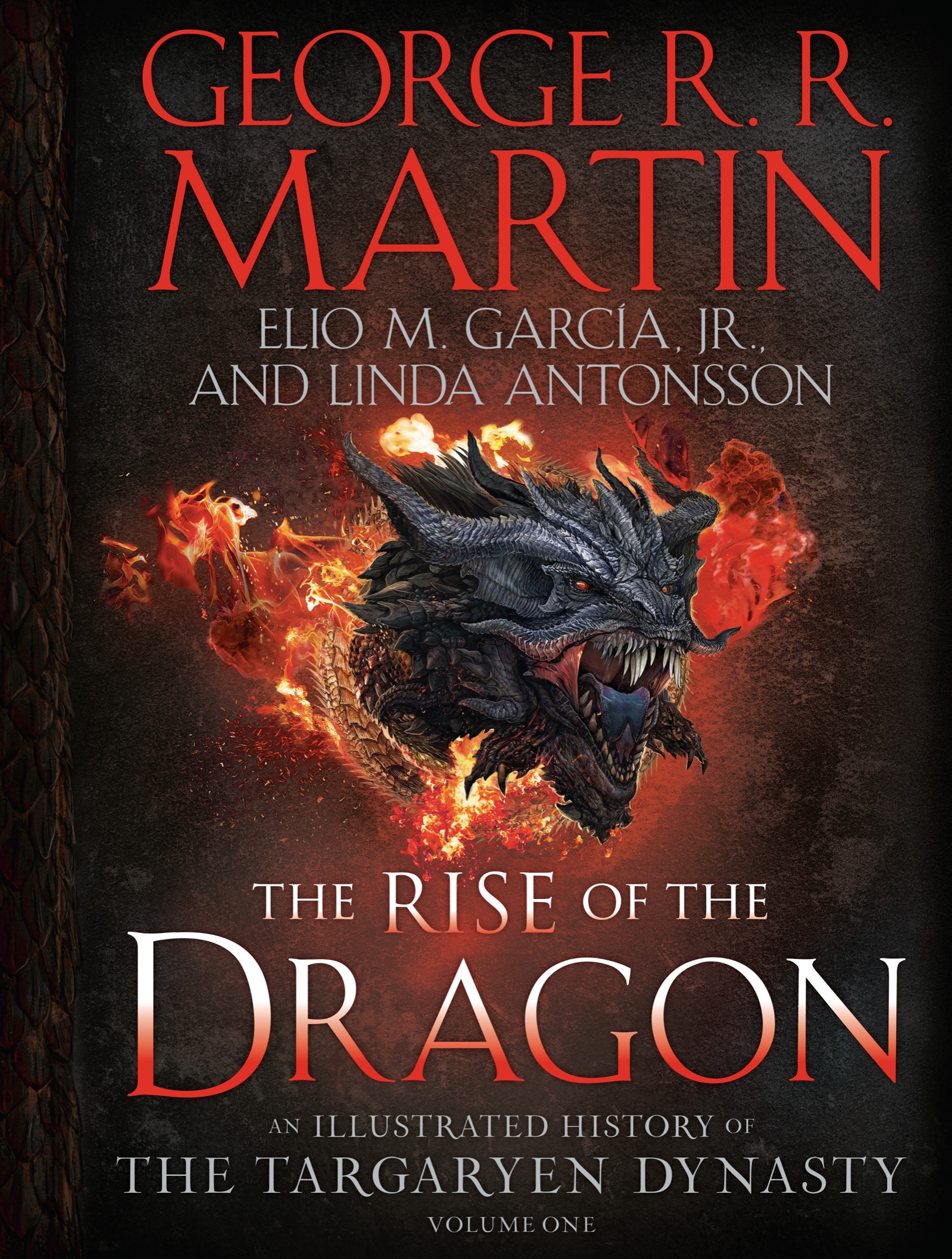
The Rise of the Dragon: An Illustrated History of the Targaryen Dynasty, Volume One
About this book
The surviving dragonlords of Valyria arrive in Westeros with three dragons and a claim no existing kingdom can ignore. Aegon, Visenya, and Rhaenys begin a dynasty whose legitimacy will depend on conquest, marriage, succession, and fear.
Successive reigns bring rebellion, disputed heirs, formidable queens, weak kings, and the accumulation of grievances that becomes the Dance of the Dragons. The visual format keeps the family tree and the changing balance of power close at hand.
This is not a new novel and does not reproduce Fire & Blood in full. It retells the first volume's Targaryen history in a more compact form built around portraits, battles, castles, and dragons.
The Rise of the Dragon works best as an illustrated reference for readers of A Song of Ice and Fire or viewers who want a clear account of the generations surrounding House of the Dragon.
Read a sample
5,037 words
Plain text
From the opening
THE HISTORY OF Westeros stretches back thousands of years, but the period in which House Targaryen unified the various realms into the Seven Kingdoms as we know them covers less than three hundred. The history of the family goes back further than that, however, to its beginnings in the Freehold of Valyria. The Targaryens were an ancient and noble lineage—dragonlords who bred and rode the great beasts that had extended the Freehold’s power across western Essos—yet they were still a relatively minor family among the great Valyrian houses. When Aenar Targaryen sold his lands and properties and moved his entire family and their dragons to Valyria’s westernmost outpost, the isle called Dragonstone in the narrow sea, his rivals thought him a coward. Little did they know that his daughter, Daenys the Dreamer, had foretold the Doom of Valyria. Twelve years later, the Freehold was destroyed in a cataclysm when the volcanic Fourteen Flames erupted, shattering the Valyrian peninsula and the empire along with it. In the chaos that followed, all the dragonlords of Valyria perished, along with their dragons…apart from the Targaryens on their rocky isle of Dragonstone.
What follows in this book is a guide to the first half of that period, beginning with Aegon’s Conquest through the end of the regency of Aegon III Dragonbane.
The Field of Fire.
A map of Westeros.
BEGINNING IN THE year 2 BC (Before the Conquest), Aegon Targaryen and his sisters launched their invasion of Westeros with the intention of unifying the entire continent under their rule. Opposing them were seven individual kingdoms, each with a unique history stretching back thousands of years. Before discussing the events of the conquest, it seems prudent to take a moment to examine each of these varying realms, and their rulers, as they existed at the time.
The Stormlands
The stormlands are centered around the rainwood—the heavily forested southeastern region of Westeros—and are bordered to the north by the Blackwater River, to the south by the Dornish Marches, and to the west by the Reach. Legends claim that the first Storm King was Durran Godsgrief, who gained the enmity of the gods of wind and sea when he won the love of their daughter, Elenei. Durran raised a succession of castles for himself and his Elenei that the gods then repeatedly destroyed, until a young boy helped Durran raise a seventh castle. Due to its massive curtain walls and drum tower, this castle could withstand the gods’ fury, and was ever after known as Storm’s End. The boy would become Bran the Builder, and House Durrandon ruled for thousands of years from its seat at Storm’s End.
The Storm King Arlan III expanded the realm by conquering the riverlands some four hundred years before the Conquest, stretching the domain of House Durrandon from the narrow sea to the Sunset Sea. Yet three centuries later, the Storm King Arrec lost the riverlands to Harwyn Hoare, a king of the Iron Islands. Arrec’s two subsequent attempts to regain the riverlands failed, and a third attempt—under Arrec’s son, Arlan V—ended in Arlan’s death. Arlan V’s successor was his young son Argilac, later known as Argilac the Arrogant, who would be the last of the Storm Kings.
As a boy, Argilac turned back an attempted Dornish invasion, and his reputation only grew from there. He joined an alliance with several of the Free Cities against Volantis and killed King Garse VII Gardener at the Battle of Summerfield. His only heir at the time of the Conquest was his daughter, Argella.
Argilac the Arrogant.
The Kingdom of the Isles and the Rivers
Although the histories of Westeros seem certain that the Iron Islands were settled by the First Men, the priests of the Drowned God on the Iron Islands claim that the ironborn are a people apart, created in the image of their god. Whatever the truth, the Iron Islands have a long history of maritime activity, fishing the rich waters, trading tin and iron ore, and sending reavers and pirates to pillage and make war on the “greenlands.”
The archipelago contains thirty-one islands, of which there are seven major inhabited ones. Legends claim that the Grey King ruled the isles in the Age of Heroes, but any details of his reign are lost to the mists of time. What is more certain is that each isle had a salt king and a rock king, each elected to these offices, until the priest Galon Whitestaff convinced the ironborn to unify by electing a High King at the first ever kingsmoot.
The centuries-long era of these High Kings—called the driftwood kings for their wooden crowns—brought the Iron Islands to the apex of their power. During the reign of Qhored the Cruel, the ironborn held much of the western shore of Westeros under their dominion. These gains were slowly lost, however—especially after Urron Greyiron and his supporters slaughtered his rivals at the last kingsmoot, establishing the first hereditary high kingship. The turmoil that followed on the Iron Islands made it easier for the mainland kingdoms to drive out the ironborn, until the great Kingdom of the Isles and the Rivers was reduced once more to just the Iron Islands.
It would take centuries, and House Hoare succeeding the Greyirons as kings, for the ironborn to begin to reclaim their lost ground in the riverlands. Most notably, King Harwyn Hoare, known as Hardhand, launched an invasion of the riverlands, driving out the Storm Kings who then controlled the Trident. Harwyn’s grandson, Harren the Black, would rule the united Kingdom of the Isles and the Rivers until the Conquest, beggaring the riverlords by erecting an enormous castle by the Gods Eye. This castle, Harrenhal, took forty years to complete—and the histories say that the massive fortress was finished on the very day that Aegon Targaryen and his sisters set foot on Westeros at the start of the Conquest.
Continue reading the sampleClose the sample
The Reach
The most fertile and populous region in the Seven Kingdoms, the Reach, is also one of the largest (though dwarfed by the size of the North). It dominates the southwestern portion of the continent, bordered by the foothills of the westerlands to its north, the Red Mountains of Dorne to the south, and the marches of the stormlands to the east. The Kingdom of the Reach claims an ancient connection to the first High King of all the First Men, Garth Greenhand. Powerful and potent, Garth allegedly fathered scores of children from whom many houses of the Reach claim descent. The most notable of these was House Gardener, who established their seat at Highgarden beside the mighty river known as the Mander. Over the centuries, the Gardeners would expand their domain beyond the central plains of the Reach, stretching from the shores of the Sunset Sea in the west to the stormlands in the east, and from the foothills of the westerlands and the Blackwater in the north to the Red Mountains of Dorne in the south.
The Gardener kings ruled their Green Realm for millennia, weathering the arrival of the Andals by adopting their ways and making the Reach the birthplace of chivalry and knighthood in Westeros. Mern IX was the latest in a long line of kings (and one queen) to rule the Reach when the Targaryens first appeared in Westeros. The future of House Gardener seemed secure against this latest invasion, however, as Mern commanded the greatest army in Westeros, as well as having sons and grandsons to spare to secure his succession—and many other male kinsmen besides.
King Mern IX, King Loren I, and their armies.
The Westerlands
A land of rugged hills in the west of the continent, the westerlands at the time of the Conquest stretched from the shores of the Sunset Sea in the west to the foothills from which the rivers Tumblestone and Red Fork issue in the east, and were bounded to the north by Ironman’s Bay, while the lands of the Reach bordered them to the south. In ancient times, the First Men discovered plentiful gold and silver in the rugged hills and rolling plains of the westerlands.
The Casterlys were among the most powerful lords of the west, secure at Casterly Rock: the huge stone hill riddled with seemingly endless gold mines beneath it. But legends hold that Lann the Clever tricked the Casterlys out of control of their castle. His descendants were plentiful, but chief among these were the Lannisters, who would carve out a kingdom from their seat at Casterly Rock. When the Andals arrived, the Lannisters initially made war against them, but soon began to use them as mercenaries and allies in order to expand their realm. Before long, the Lannisters controlled the whole of the westerlands instead of just the port city of Lannisport and the lands around the Rock.
Many wars wracked the Seven Kingdoms before the Conquest and the Kings of the Rock were frequently at the center of these conflicts. They regularly battled the kings of the riverlands, the Iron Islands, and the Reach. Sometimes, however, these kings formed shifting alliances, uniting against a common enemy.
At the time Aegon Targaryen was turning his attention to Westeros, the King of the Rock was Loren I, who oversaw a brief period of peace with the Kingdom of the Reach.
The Vale
When the Andals invaded Westeros, it was in the Vale that they first settled. The fertile valley surrounded by the Mountains of the Moon would soon come to be ruled by House Arryn, considered the oldest and purest line of Andal nobility. The founder of the dynasty was Ser Artys Arryn, who in later centuries would often be confused with the legendary Artys Arryn, the Winged Knight, of the Age of Heroes. Ser Artys defeated the existing High King of the Vale, Robar II Royce—who had attempted to expel the Andals—at the Battle of Seven Stars and became Artys I, King of Mountain and Vale. The First Men that survived the battle and did not submit to Artys’s rule fled into the Mountains of the Moon, becoming the ancestors of the lawless clans that still call the mountains their home.
Over time, Artys and his descendants extended their rule beyond the Vale and the Fingers, seeking control over various nearby isles both great and small. Most notably, the Arryns spent centuries fighting the northmen for control of the Three Sisters—and ultimately succeeded in incorporating the islands into their domain.
At the time of the Conquest, the wearer of the Falcon Crown of the Vale was Ronnel Arryn, a mere boy. He was the eldest son of Sharra Arryn, who ruled as Queen Regent in her son’s name.
Torrhen Stark.
The North
The North is—and always has been—the largest region of the Seven Kingdoms, stretching unbroken from the swamps of the Neck all the way to the Wall, and from the Sunset Sea to the narrow sea. Though continuously inhabited since the arrival of the First Men, the North remains the least populous of the Seven Kingdoms, due to the harshness of its climate and its often deadly winters.
Many lords and petty kings have claimed dominion over patches of the North, but it was the Starks of Winterfell—claiming descent from the legendary Bran the Builder—who succeeded in unifying the region through both alliances and warfare. They conquered the Barrow Kings in the Thousand Years War, and also the Warg King, the Marsh Kings, the Red Kings of House Bolton, and the barbarous men of the island of Skagos. Under the rule of the legendary Theon Stark, the North was the only realm of First Men to survive the coming of the Andals—not only throwing them back, but even launching their own attacks on Andalos, according to legend.
The Starks would be known thereafter as the Kings in the North and the Kings of Winter. Their chief enemies were the ever-present reavers from the Iron Islands and the wildling raiders from beyond the Wall. At one time they also fought the War Across the Water—a conflict of several generations in which the Starks attempted to seize control of the Three Sisters while the Kings of Mountain and Vale opposed them—but the Starks ultimately withdrew from that conflict. The King in the North prior to the Conquest was Torrhen Stark.
Dorne
As the southernmost region of Westeros, Dorne is a harsh land of wide deserts, dangerous coasts, and high red mountains. Much of the land is parched, save for the more temperate regions in the mountains and those watered by the rivers Greenblood, Vaith, and Scourge. The histories say that the First Men first came to Dorne over the land bridge that connected Essos to Westeros—a bridge that the children of the forest, according to legend, then destroyed with their magic to stem the tide of the invaders. The Broken Arm, as it became known, formed the easternmost part of the region, which then stretched all the way west to the Sunset Sea, and north to the Marches. Like the First Men, the Andals made incursions into Dorne as well, though they also never gained dominion.
Unlike the other regions of Westeros, Dorne remained a patchwork of petty kingdoms for thousands of years, with many royal houses rising and falling. The strangest such kingship was the confederation that formed along the Greenblood, where a dozen noble houses would elect a High King from among their number—though this kingdom eventually fell into warfare, fracturing into lesser petty realms.
Some seven hundred years prior to the arrival of Aegon Targaryen, Dorne eventually coalesced under the rule of Nymeria—a Rhoynish princess who led her people (mostly women, old men, and youths) out of Essos following the Valyrian destruction of both the Rhoynar cities and army. Wedding herself to Lord Mors Martell—an ambitious nobleman in the south of Dorne—Nymeria and her people joined with the Martell forces and set about subduing rival lords and kings, unifying Dorne under their rule. Forever after, women have been included in the Dornish laws of inheritance, holding equal status to men.
In the centuries after, the Martells maintained their rule over Dorne, warring with the Storm Kings and the Kings of the Reach across the Dornish Marches. At the time Aegon Targaryen’s gaze fell on Westeros, the Princess of Dorne was Meria Martell: an aged, fat woman derisively called “the Yellow Toad” by her rivals.
Meria Martell.
Dragonstone.
THE FIRST MEN and then the Andals both settled the rocky isles of Blackwater Bay, making themselves lords and living by piracy and fishing. The largest of these islands, dominated by the volcanic Dragonmont, would come to be known as Dragonstone.
Two hundred years before the Doom, the Freehold of Valyria sent an expedition to seize Dragonstone and make it the westernmost outpost of its vast empire. The citadel that they raised there to guard their new possession was shaped by Valyrian magic into an imposing structure impossible to create by any other means—with towers shaped like dragons, doorways that gaped like the mouths of dragons, and hundreds of gargoyles adorning the wall, forming a menagerie of fanciful beasts that bristled from the stone.
Twelve years prior to the Doom, Aenar Targaryen moved his kin, treasures, and dragons to Dragonstone after his maiden daughter, Daenys the Dreamer, foretold the destruction of Valyria. The Targaryens thus became the only dragonlords to survive both the Doom and the war-torn years called the Century of Blood that followed. Over that century, the Targaryens looked more to the east than to the west, however, busy with the various machinations and wars between the Free Cities in the aftermath of the Doom.
The Targaryens continued the Valyrian custom of wedding brother to sister, but when Aegon Targaryen came of age, he chose to wed not one but two of his sisters: his elder sister Visenya, stern and rumored to practice sorcery, and his younger sister Rhaenys, vibrant and impulsive. All three were dragonriders, each commanding their own great dragon.
Aegon Targaryen had initially made his reputation by joining a grand alliance against Volantis, commanding his dragon Balerion—known as the Black Dread—to burn a Volantene fleet threatening the Free City of Lys. But unlike his predecessors, Aegon showed more interest in Westeros after the fighting in Essos began to abate, exploring the Reach and possibly the Westerlands as well. It was at his command that the Painted Table was made, carved in the shape of the continent and painted to show the mountains, forests, castles, towns, and rivers of Westeros. Notably, however, no borders were ever painted to mark the different kingdoms, presaging what Aegon must have been planning—bringing all of Westeros under his rule.
Aegon joins the grand alliance.
Balerion burning Harrenhal.
THOUGH THE END of Targaryen involvement in the wars between the Free Cities enabled Aegon and his sisters to look to the west, it’s not clear why they decided to take the risk of invading Westeros. The only clear precipitating event seems to be when Argilac the Arrogant, the Storm King, offered the hand of his only daughter Argella to Aegon, along with a dowry of lands beyond the Blackwater. Argilac made this offer in hopes of finding an ally against Harren the Black—the cruelest and most feared king in Westeros at the time. The ironborn had seized the riverlands from the Storm Kings three generations earlier, and Argilac wanted the territory back.
Aegon noted that he already had two wives and did not need a third, so he countered by offering his boon companion and bastard half-brother, Orys Baratheon, as a husband for Argella instead. Misunderstanding the bond between Aegon and Orys, Argilac saw the offer of this baseborn man as an insult, and responded by chopping off Aegon’s envoy’s hands and sending them back to Dragonstone in a box. In response, Aegon gathered his vassals and allies at Dragonstone. Among them were two nominal vassals of the Storm King—Lords Massey and Bar Emmon—who had for many years been more closely associated with the Targaryens.
Six days of debate followed, and on the seventh day ravens flew to every corner of Westeros to announce that Aegon would now be the only king in the land. Shortly after, Aegon and his sisters set sail from their island fortress of Dragonstone with their dragons and a small army—no more than three thousand strong, though some accounts number it more like a few hundred—to begin the Conquest on the mainland. They arrived unopposed at the mouth of the Blackwater Rush, where three hills rose tall above a small fishing village. There the Targaryens erected a simple earth-and-timber palisade upon the highest of the hills, and proceeded to gain control of the river’s mouth and the surrounding lands.
This region had been fought over for centuries, traded off between the kings of the riverlands and the Storm Kings. Some lords submitted to Aegon swiftly, but the Darklyns of Duskendale and the Mootons of Maidenpool joined together with three thousand men and marched on the Targaryen position. Orys Baratheon met them by land while Aegon descended on them from above on Balerion, and both lords were killed while the men they led surrendered and bent the knee.
After this, Aegon had himself crowned by Visenya, and hailed as the King of All Westeros by Rhaenys, in a ceremony witnessed by a handful of lords and knights at the Aegonfort—the crude castle on what would come to be called Aegon’s High Hill. And there he first displayed the banner of the three-headed red dragon on black that would be borne by his descendants. Accepting the fealty of those who surrendered, he also granted offices to his most loyal supporters, establishing his court. The rest of the Seven Kingdoms responded to this brash act by readying for war against their new king—or, in the case of Dorne and the Vale, making overtures of alliance, which Aegon then rejected.
Aegon’s campaign to conquer the Seven Kingdoms began in earnest a few days later. He divided his forces into three parts, each attacking a different enemy. Orys Baratheon and Queen Rhaenys, riding on Meraxes, led the main host south across the Blackwater, invading Argilac’s domain. The newly named admiral, Daemon Velaryon, led the Targaryen fleet against the Vale, accompanied by Queen Visenya on Vhagar. And King Aegon on Balerion flew above a smaller army marching northwest against King Harren the Black.
The Velaryons were a lesser house of Valyrian descent, and thus always closely aligned with their more powerful Targaryen allies. Like the Targaryens, they shared the same silver-blonde hair and purple eyes so characteristic of those with High Valyrian blood, though they possessed no dragons.
Each of these armies met resistance and setbacks. At the Battle of the Gullet, two-thirds of the Targaryen fleet was destroyed or captured, and the master of ships himself, Lord Velaryon, lost his life. At the crossing of the Wendwater, when the Storm King’s vassals fell on Orys Baratheon’s forces, a thousand men perished. And at the Battles of the Reeds, Harren the Black’s forces led a series of attacks against Aegon’s host, while two of Harren’s sons led longships across the Gods Eye to fall on Aegon’s rear at the Wailing Willows.
But complete disaster was averted each time thanks to the Targaryen dragons. Visenya’s Vhagar burned many of the Vale’s ships, as well as the Braavosi sellsails Queen Regent Sharra had hired, before she withdrew with the remaining Targaryen fleet. Rhaenys’s dragon Meraxes set the rainwood ablaze and destroyed the holdings of the stormlords Errol, Buckler, and Fell. And Balerion the Black Dread burned the longships carrying Harren’s briefly victorious sons, sending them both to watery graves.
Yet even as these battles were ongoing, others saw opportunity in the Targaryen invasion. Pirates and Dornish raiders beset the lands of the Storm King while Argilac was distracted; the Three Sisters rose in rebellion and crowned Marla Sunderland as their queen while the Vale was otherwise occupied; and the long-suffering riverlords rose up against Harren the Black under the leadership of Lord Edmyn Tully. Allying themselves with Aegon, the riverlords renounced House Hoare, forcing Harren and his army to take refuge in the enormous Harrenhal, only recently completed. Harren offered great rewards to any man who could slay Balerion, but to no avail. In the dead of night, Aegon and Balerion descended on Harrenhal from above. The dragon’s black flames were hot enough to melt stone, and Harren the Black and all his line perished in the conflagration. In the aftermath, Aegon named Edmyn Tully Lord Paramount of the Trident, making the rest of the riverlords his vassals.
Meanwhile, Orys Baratheon and Queen Rhaenys continued their march into the stormlands, despite the early setback at the Wendwater. King Argilac gathered a large army at Storm’s End, and—ignoring warnings about Rhaenys and Meraxes—chose battle. Rhaenys saw his army from the sky and delivered word to Orys, who placed his forces in a strong defensive position in the hills south of Bronzegate. The battle that followed, called the Last Storm, took place during increasingly heavy rainfall. Argilac, however, continued the attack, trusting in his numbers—for he had nearly twice the men, and almost four times the knights and horses. The battle raged into night, with Argilac personally leading three charges against Orys Baratheon’s positions and gaining ground each time. But at the fourth charge on the final hill, Argilac’s forces met Rhaenys and Meraxes on the ground, where the rain proved incapable of stopping a dragon’s fires.
The Last Storm.
Though Argilac’s forces were in disarray and he himself was thrown from his horse, still he fought on. At the end, after the old warrior king had slain half a dozen men, Orys Baratheon faced him in single combat. Each wounded the other, but Argilac was slain and his followers surrendered. His daughter and heir, Argella, attempted to hold Storm’s End against the Targaryen host, declaring herself the Storm Queen, but her men betrayed her and delivered her chained and naked to Orys Baratheon. Orys freed her of her bonds and treated her kindly, and as a reward was granted Storm’s End and its domains, and Argella as his wife. He took the Durrandon sigil, a crowned stag, and their words—Ours is the Fury—for his own.
Now in control of two of the Seven Kingdoms, the Targaryens became much more of a threat. An alliance between Mern IX Gardener of the Reach and Loren I Lannister of the Rock—known to history as the Two Kings—enabled them to field an enormous army, five times greater than Aegon’s own. This great host marched from their meeting place at Goldengrove, traveling northeast toward the riverlands. Aegon advanced to meet them, joined by his sisters at Stoney Sept. Queen Rhaenys had come from Storm’s End, while Queen Visenya arrived from Crackclaw Point, where she had already received the fealty of those minor knights and lords.
Aegon’s forces and the Two Kings’ host came together on a plain south of the Blackwater Rush, with Mern and Loren both fully confident in their superior forces. But the plains they fought on were dry—the grass parched and the wheat ripe for harvest—so Aegon and his sisters set the field alight with dragonfire. What followed was forever after known as the Field of Fire. Four thousand men burned, and a thousand more were killed in combat—including King Mern and all the sons, brothers, uncles, grandsons, and cousins he had brought with him. House Gardener came to an abrupt and bloody end that day—and House Lannister only survived because King Loren abandoned the field when he knew the battle was lost. In the aftermath, he surrendered to Aegon Targaryen and became the first Warden of the West, and was afterward remembered as Loren the Last. The toll of the battle was steep—but not for the Targaryens, who lost fewer than one hundred men. From there, Aegon traveled to Highgarden, where the Gardener steward, Harlan Tyrell, yielded the castle to Aegon and in turn was granted Highgarden and its domains and named Lord Paramount of the Mander.
Before Aegon could march on to secure the rest of the Reach and begin to subdue Dorne, however, he learned that Torrhen Stark, the King in the North, had finally marched south with thirty thousand northmen. So Aegon gathered his new vassals and his queens and went to meet Stark at the Trident with a force forty-five thousand strong. The ruins of Harrenhal and the rumor of what had befallen the Two Kings at the Field of Fire made Torrhen hesitant to attack. Some of his bannermen urged him to fight, while his bastard half-brother, Brandon Snow, suggested he could cross the Trident at night and slay all three dragons before the Targaryens knew what had happened. Brandon Snow did cross the river, but as Torrhen’s envoy—and the next morning the King of Winter became the King Who Knelt, bending the knee to Aegon. In turn, he was granted continued dominion over his lands as the Warden of the North.
The Targaryen siblings then resumed their separate campaigns. Visenya took flight on Vhagar to the Vale of Arryn and the Eyrie, where Queen Sharra and her son, King Ronnel, had sought refuge. The castle high on the Giant’s Lance proved no barrier to a dragon, however, and Visenya landed unopposed in the castle’s courtyard. By the time Sharra and her knights arrived, Visenya had the boy king Ronnel on her knee, begging to fly on her dragon. Sharra was forced to submit while her son got his promised flight, circling the Eyrie three times on Vhagar’s back—taking off as a little king and landing as a little lord.
Rhaenys, meanwhile, turned her attention to Dorne, and like Visenya chose to fly deep into the heart of Dornish power rather than make war in the treacherous deserts and mountain passes. Yet each castle she arrived at was deserted, their lords gone—and the Planky Town was similarly deserted, with only old women and children remaining in the floating city at the mouth of the river Greenblood. At Sunspear itself, however, Rhaenys found the ancient Meria Martell in residence—fat, blind, and wizened but still keen of mind. Meria informed Rhaenys that Dorne had no king, and would neither bow, bend, nor break for the Targaryens. So Rhaenys was forced to depart with Dorne unconquered.
At the time, the greatest city in Westeros was Oldtown: the ancient seat of the wealthy House Hightower, and home to both the Starry Sept, where the High Septon ruled over the Faith, and the Citadel, where the maesters trained. Aegon now turned his attention to that city, for the Hightowers had been conspicuously absent from King Mern’s host yet had not allied with Aegon either. Aegon brought an army, expecting to lay siege to the city, but instead found its gates open and its lord, Manfred Hightower, riding out to meet him. Lord Hightower swiftly surrendered the city. For as it happened, when Aegon and his sisters had first landed in Westeros, the High Septon had fasted and prayed and, in return, received a vision that Oldtown and the Starry Sept would burn if they opposed the Targaryens—which convinced the pious Lord Manfred to stay clear of the fighting.
Welcomed with open arms into Oldtown and the Starry Sept, Aegon Targaryen was crowned a second time by the High Septon three days later, having successfully conquered six of the existing seven kingdoms. Hundreds of lords and knights from throughout the newly forged realm witnessed this coronation, and tens of thousands of smallfolk acclaimed the king in the city. Though many expected—and even hoped—that Aegon would make Oldtown the royal seat, he instead announced that the Aegonfort and the new town of King’s Landing, growing amidst the three tall hills, would be his seat in the Seven Kingdoms.