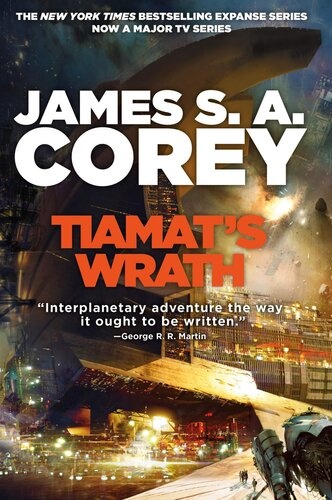
Tiamat's Wrath
About this book
James Holden lives as a political prisoner on Laconia, close enough to observe the imperial court and influence it only through small, patient interventions. Elsewhere Naomi coordinates a resistance whose cells must act together without presenting the empire a single target.
Elvi Okoye leads a scientific mission investigating the vanished ring builders and the entities that destroyed them. Laconia treats the unknown as another strategic opponent, and an experiment intended to establish deterrence risks answering a question humanity does not understand.
The novel joins intimate bereavement to battles across systems, giving younger characters greater responsibility while the original crew is divided. Intelligence, loyalty, and grief become resources that neither side can fully command.
Tiamat’s Wrath is the eighth Expanse novel and the middle of its final arc. James S. A. Corey brings resistance and alien mystery together, showing that imperial confidence is most dangerous when it mistakes an unanswered phenomenon for a negotiable enemy.
Read a sample
5,017 words
Plain text
From the opening
Prologue: Holden
Chrisjen Avasarala was dead.
She’d passed in her sleep on Luna four months earlier. A long, healthy life, a brief illness, and she left humanity very different than she’d found it. The newsfeeds all had obituaries and remembrances prerecorded and ready to spin out across the thirteen hundred systems to which humanity was heir. The chyrons and headlines had been hyperbolic: The Last Queen of Earth and Death of a Tyrant and Avasarala’s Final Farewell.
No matter what they said, they hit Holden just as hard. It was impossible to imagine a universe that wouldn’t bow to the little old woman’s will. Even when the confirmation came to Laconia that the reports were true, Holden still believed deep in his bones that she was out there somewhere, irritated and profane and pushing herself past all human limits to bend history just another fraction of a degree away from atrocity. It was almost a month between the moment he heard the news and the first time he let himself accept that it was true. Chrisjen Avasarala was dead.
But that didn’t mean she was finished.
A state funeral had been planned on Earth before Duarte intervened. Avasarala’s time as secretary-general of the United Nations had been a critical period in history, and her service not only to her world but to the whole human project had earned her a place of honor that could never be forgotten. The high consul of Laconia thought it only right and proper that she find her final resting place at the heart of the new empire. The funeral would be at the State Building. A memorial would be built to her so that she would never be forgotten.
The part where Duarte was complicit in the vast slaughter on Earth that defined Avasarala’s career got skipped over. History was in the process of being rewritten by the winners. Holden was pretty sure that even though it didn’t make it into the press releases and state newsfeeds, everyone remembered that she and Duarte had been on opposite sides, back in the day. And if they didn’t, he certainly did.
The mausoleum—her mausoleum, since there wasn’t anyone else of sufficient stature to share it with her yet—was white stone polished micron-smooth. The great doors were closed now, the service concluded. A portrait of Avasarala filled the center panel on the north face of the structure. It was etched into the stone along with the dates of her birth and death and a few lines of poetry he didn’t recognize. The hundreds of chairs arrayed around the podium where the priest had spoken were only about half-filled now. People had come from across the empire to be here, and now that they were, they mostly broke into little clumps with whoever they already knew. The grass around the crypt wasn’t like the stuff back on Earth, but it filled the same ecological niche and behaved similarly enough that they called it grass. The breeze was warm enough to be comfortable. With the palace behind him, Holden could almost pretend that he might walk out to the wilderness beyond the palace grounds and go wherever he chose.
His clothes were of Laconian military cut, blue with the spread wings that Duarte had picked for his imperial icon. The collar was high and stiff. It scraped the skin along the side of Holden’s neck. The place where his insignia of rank would have gone was blank. Empty was apparently the symbol of the honored prisoner.
“Will you be going in to the reception, sir?” a guard asked.
Holden wondered what exactly the escalation tree looked like when he said no. That he was a free man, and rejected the hospitality of the palace. Whatever it was, he was pretty sure it had already been practiced and rehearsed. And he probably wouldn’t enjoy it.
“In a minute,” Holden said. “I just want to . . .” He gestured vaguely at the tomb as if the inevitability of death was a kind of universal hall pass. A reminder that all human rules were tentative.
“Of course, sir,” the guard said, and faded back into the crowd. Holden didn’t have any sense that he was free, though. Unobtrusively confined was as much as he could hope for.
One woman stood alone at the base of the mausoleum, looking up at Avasarala’s portrait. Her sari was a vibrant blue that was just close enough to the Laconian color scheme to be polite and just far enough from it to make it perfectly clear that the politeness was insincere. Even if she hadn’t looked like her grandmother, the subtle-not-subtle fuck you would have identified her. Holden ambled over.
Her skin was darker than Avasarala’s had been, but the shape of her eyes when she glanced over at him and the thinness of her smile were familiar.
“I’m sorry for your loss,” Holden said.
“Thank you.”
“We haven’t been introduced. I’m—”
“James Holden,” the woman said. “I know who you are. Nani talked about you sometimes.”
“Ah. Well, that must have been something to hear. She didn’t always see things the way I did.”
“No, she did not. I’m Kajri. She called me Kiki.”
“She was an amazing woman.”
They were silent for the space of two long breaths together. The breeze made the fabric of Kajri’s sari ripple like a flag. Holden was about to step away when she spoke again.
Continue reading the sampleClose the sample
“She would have hated this,” she said. “Hauled into the camp of her enemies to be celebrated now that she can’t crack their balls anymore. Co-opted as soon as she couldn’t fight back. You could power a planet by hooking a turbine to her right now. That’s how much she’s spinning in this grave.”
Holden made a small sound that could have been agreement.
Kajri shrugged. “Or maybe not. She might have just thought it was funny. I could never be sure with her.”
“I owed her a lot,” Holden said. “I didn’t always realize it at the time, but she did what she could to help me. I never got the chance to thank her. Or . . . I did, I guess, but I didn’t take it. If there’s anything I can do for you or your family . . .”
“You don’t seem to be in a position to do people favors, Captain Holden.”
Holden looked back at the palace. “Yeah, I’m not really at my best these days. But I wanted to say it all the same.”
“I appreciate the sentiment,” Kajri said. “And from what I’ve heard, you’ve managed to have some influence? The prisoner with the emperor’s ear.”
“I don’t know about that. I talk a lot, but I don’t know that anyone listens. Except the security detail. I assume they listen to everything.”
She chuckled, and it was a warmer, more sympathetic sound than he’d expected. “It isn’t easy, having no part of your life for just yourself. I grew up knowing that everything I said would be monitored, cataloged, filed, and judged for its potential to compromise me or my family. There’s a record in the intelligence service archives somewhere of every time I’ve had my period.”
“Because of her?” Holden said, nodding to the tomb.
“Because of her. But she gave me the tools to live through it too. She taught us to use everything shameful in our lives as a weapon to humiliate people who would diminish us. That’s the secret, you know.”
“What’s the secret?”
Kajri smiled. “The people who have power over you are weak too. They shit and bleed and worry that their children don’t love them anymore. They’re embarrassed by the stupid things they did when they were young that everyone else has forgotten. And so they’re vulnerable. We all define ourselves by the people around us, because that’s the kind of monkey we are. We can’t transcend it. So when they watch you, they hand you the power to change what they are too.”
“And she taught you that?”
“She did,” Kajri said. “But she didn’t know it.”
As if to prove the point, a guard moved across the grass toward them, keeping a respectful distance until he was sure they’d seen him and then gave them time to finish what they were saying before coming closer. Kajri turned to him, lifting her eyebrow.
“The reception is going to begin in twenty minutes, ma’am,” the guard said. “The high consul specifically hoped to meet you.”
“I wouldn’t dream of disappointing him,” she said with a smile Holden had seen before on other lips. Holden offered his arm, and Kajri took it. As they walked away, he nodded toward the tomb and the words written on it. IF LIFE TRANSCENDS DEATH, THEN I WILL SEEK FOR YOU THERE. IF NOT, THEN THERE TOO.
“It’s an interesting quote,” he said. “I feel like I should recognize it. Who wrote it?”
“I don’t know,” she said. “She only told us to put it on her grave. She didn’t say where it came from.”
Everyone who was anyone had come to Laconia. That was true on several levels. Duarte’s plan to shift the center of humanity away from Sol system to the heart of his own empire had found a level of cooperation and consent that shocked Holden at first and then left him with a permanent sense of mild disappointment in humans as a species. The most prestigious scientific research institutes had all moved their headquarters to Laconia. Four different ballet companies threw off centuries of rivalry to share the same Laconian Institute of Art. Celebrities and scholars rushed to new, palatial, state-subsidized estates in the capital city. There were already movies being made there. The soft power of culture set on speed scrub, ready to flood the networks and feeds with the reassuring messages of High Consul Duarte and the permanence of Laconia.
Business came too. Duarte had banks and office campuses pre-built and ready for tenants. The Association of Worlds wasn’t just Carrie Fisk in a shitty office on Medina Station anymore. It was a cathedral in the center of the capital city with a lobby bigger than a hangar bay and stained glass walls that seemed to rise up forever. The Transport Union’s central authority was there too, in a lesser building with fewer amenities so that it was clear physically and socially who was in favor and who was on notice. Holden watched it all from the State Building that was his home and his prison, and it left him thinking of living on an island.
Within the boundary of the city, Laconia was cleaner, newer, brighter, and more controlled than most space stations Holden had been on. Just outside it was wilderness like he’d only seen in storybooks. Ancient forests and alien ruins that would take generations to tame and explore. Holden had heard gossip and rumors about the remnant technologies brought to shambling life by the early work with the protomolecule: boring worms the size of spacecraft, doglike repair drones that made no distinction between mechanism and flesh, crystalline caves with piezoelectric effects that induced hallucinations of music and crippling vertigo. Even as the capital city became synonymous with humanity as a whole, the planet around it stayed alien. An island of the profoundly familiar in a sea of we-don’t-understand-that-yet. In a way, it was reassuring that Duarte, for all his god-emperor reach, couldn’t achieve everything in just a few decades.
In another way, it was terrifying.
The reception hall was grand, but not overblown. If Laconia had been built in Duarte’s image, there was a weird thread of personal restraint in the high consul’s soul. However grand the city was, however overwhelming his ambitions, Duarte’s palatial compound and home wasn’t gaudy or even particularly ornate. The ballroom was all clean lines and a neutral palette that reached for elegance without being too concerned with what anyone thought. Couches and chairs were placed here and there where people could rearrange them. Young people in military uniform served glasses of wine and spiced tea. More than power, Duarte made everything that surrounded him seem born of confidence. It was a good trick, because even after Holden saw through it, it still worked.
Holden accepted a glass of wine from a young woman and strolled through the shifting crowd. A few of the people, he recognized instantly. Carrie Fisk of the Association of Worlds, holding court at a long table, with the governors of half a dozen colonies fighting to be the first one laughing at her jokes. Thorne Chao, the face of the most popular newsfeed coming out of Bara Gaon. Emil-Michelle Li in the flowing green dress that was her trademark when she wasn’t in a movie. And for every face Holden could put a name to, there were a dozen more who looked vaguely familiar.
He moved though the thin social fog of polite smiles and nods of recognition that fell short of actual engagement. He was here because Duarte wanted him seen here, but the Venn diagram of people eager to curry favor with the high consul but also willing to risk his displeasure by cozying up to the state’s highest-profile prisoner didn’t have much overlap.
But it did have some.
“I’m not drunk enough for this.”
Transport Union President Camina Drummer leaned against a standing table, her hands wrapped around a glass. Her face looked older in person. He could see the lines around her eyes and mouth more clearly when there weren’t a camera, a screen, and several billion kilometers between them. She shifted a degree, making room for him at the table, and he accepted the invitation.
“I’m not sure what drunk enough for this looks like,” he said. “Blackout drunk? Fighting drunk? Weeping-in-the-corner drunk?”
“You don’t seem even tipsy.”
“I’m not. I’m mostly off of alcohol these days.”
“Keeping your wits about you?”
“And it bothers my stomach.”
Drummer smiled and coughed out a laugh. “They’ve let the honored prisoner out among the people. Makes me think you’re not as useful to them anymore. Have they squeezed all the juice out of you?”
The way she said it, it could have been teasing between two old colleagues, fallen from power together and living in the twilight of political acceptability. Or it could have been something more. A way to ask if he’d been forced to betray the underground on Medina yet. If they’d decided to break him. Drummer knew as well as he did who was listening, even here.
“I’ve been helping as much as I can with the alien threat issue. Anything else he asks me about, all my answers would be yesterday’s news anyway. And I assume I’m here now because Duarte thinks I’m useful to him here.”
“Just part of the donkey show.”
“Dog and pony,” Holden said. Then, seeing her reaction. “The phrase is dog and pony show.”
“Sure it is,” she said.
“What about you? How’s the dismantling of the Transport Union going?”
Drummer’s eyes brightened and her smile widened. She answered in a perfect newsfeed-ready voice, crisp and warm and false as a carved acorn. “I am very pleased with the smooth transition to fuller oversight by the Laconian authority and the Association of Worlds. Our focus is to keep all of the old practices that were working and streamline and integrate new procedures that will cut away the dead wood. We have been able to maintain and even increase the efficiency of trade without compromising the security that the greater destiny of humanity requires.”
“That bad?”
“I shouldn’t bitch. It could be worse. As long as I’m a good little soldier and Duarte thinks I’ll be useful bringing Saba in from the cold, I won’t end up in a pen.”
A murmur rose from the main entrance, and a disturbance in the crowd. All through the ballroom, attention shifted like iron filings aligning to a magnet. Holden didn’t have to look to know that Winston Duarte had arrived, but he did anyway.
Duarte’s uniform was almost the same as Holden’s. He had the same affable calm that he seemed to carry everywhere. His security detail was more obvious than whatever surveillance was on Holden, though. Two thick-bodied guards with sidearms and eyes that flickered with implanted tech. Cortázar had arrived with him too, but stood apart with the air of a teenager pulled away from a game for family dinner. The actual teenager—Duarte’s daughter, Teresa—walked at her father’s side like a shadow.
Carrie Fisk scurried up to Duarte, her coterie of governors abandoned, and shook his hand. They talked for a moment before Fisk turned to Teresa and shook the girl’s hand too. A little crowd had started coalescing behind Fisk as people tried to be unobtrusive about jockeying for a position to meet the great man.
“Creepy son of a bitch, isn’t he?” Drummer said.
Holden grunted. He didn’t know what she was talking about. It might have been just the way everyone around him was so trained to obeisance. That would have been enough. But maybe she saw something of what Holden did: the stuttering of his eyes, the pearlescent shadow under his skin. Holden had seen the protomolecule in action as much as anyone who wasn’t in Cortázar’s lab. That was probably why the side effects of Duarte’s treatments were more obvious to him.
He realized he was staring. More than that, he realized that everyone was staring, and he was being drawn along by the pressure of their attention. He looked back at Drummer, making the conscious effort to turn away. It was harder than he liked to admit.
He wanted to ask if there was news of the underground, whether Duarte’s reign seemed as inevitable out in the wide vacuum between the worlds as it did here in his home.
“Any news of the underground?” he asked.
“There are always going to be some malcontents,” she said, walking the line between innocuous and meaningful. “What about you? How is the famed Captain James Holden spending his days? Going to parties? Waving tiny fists in impotent rage?”
“Nope. Just plotting and waiting for my moment to strike,” Holden said. They both grinned as if it had been a joke.
Chapter One: Elvi
The universe is always stranger than you think.
That had been the favorite phrase of a professor of Elvi’s back in her graduate study days. Professor Ehrlich, a grumpy old German with a long white beard who’d always made Elvi think of garden gnomes, repeated it every time someone was surprised by the results their lab test delivered. At the time, Elvi had found the catchphrase true to the point of triteness. Of course the universe had unexpected surprises.
Professor Ehrlich was almost certainly dead. He’d been at the edge of what anti-aging technology could achieve when Elvi was in her early twenties. She had a daughter older than that now. But if he’d still been alive, Elvi would have sent him a lengthy and heartfelt apology.
The universe wasn’t just stranger than you knew, it was stranger than you could know. Every new wonder, no matter how astonishing, just laid the foundation for an even more astounding discovery later. The universe and its constantly shifting definition of what was considered strange. The discovery of what everyone thought was alien life when the protomolecule was found on Phoebe had shaken people to their foundations, and was somehow still less disturbing than the discovery that the protomolecule wasn’t an alien so much as it was an alien’s tool. Their version of a wrench, only a wrench that converted the entire asteroid station of Eros into a spaceship, hijacked Venus, created the ring gate, and gave sudden access to thirteen hundred worlds beyond.
The universe is always stranger than you think. God damn right, Professor.
“What,” her husband Fayez said, “is that?”
They were on the bridge of her ship, the Falcon. The ship that the Laconian Empire had given her. On the screen in front of them, a high-resolution image of what everyone was calling the object slowly filled in. It was a planetary body a little larger than Jupiter and nearly transparent, like an enormous crystal ball with a faintly greenish hue. The only structure in the Adro system.
“Passive spectrometry says almost entirely carbon,” Travon Barrish said, not even looking up from his work screen as the data scrolled by. He was the team’s materials scientist, and the most literal person Elvi had ever met. Of course he gave Fayez the factual answer to his question. She knew that wasn’t what her husband had been asking. He’d been asking, Why is that?
“It’s packed into a dense lattice,” Jen Lively, the team’s physicist, said. “It . . .”
She trailed off, so Elvi finished for her. “It’s a diamond.”
When she was seven years old, Elvi Okoye had returned to Nigeria with her mother when her great-aunt, a woman Elvi had never met, died. As her mother worked to take care of funeral arrangements, Elvi wandered through her house. It became a game of sorts, seeing how much of a picture of the dead woman she could create by looking at the objects she’d left behind. On a shelf next to the bed, a picture of a smiling young man with dark skin and pale eyes who could have been a husband, or a brother, or a son. In the tiny bathroom, among the scattered packages of cheap soaps and cleansers, one beautiful crystal bottle filled with mysterious green liquid. Perfume? Poison? Without having known the woman herself, all the objects she’d left behind were fantastic and compelling.
Many years later, while rinsing her mouth, the smell triggered a memory and she realized the green liquid in the bottle had almost certainly been mouthwash. One mystery solved, but new questions arose. Why had she put mouthwash in such a beautiful bottle instead of just leaving it in the recyclable container it came in? Where had the bottle come from originally? Had she used it as mouthwash, or was there some hidden function mouthwash could perform that Elvi had never thought of? Without the dead woman to explain, it would forever remain a mystery. Some things could only ever be understood in context.
On the view screen, a single faintly green diamond with a machine-perfect smooth surface floating in a solar system with no other planets, orbiting one fading white dwarf star. A bottle of mouthwash in cut crystal, surrounded by cheap soap on a dirty bathroom counter. Fayez was right. The only question that mattered was why, but everyone who knew was dead. The only answer she had left was Professor Ehrlich’s.
The Falcon had been specially designed at the request of High Consul Duarte specifically for her, and it had only one mission: to visit the gate network’s “dead systems” and see if they held any clues about the nameless enemy that had destroyed the protomolecule builders’ civilization or the weird nonphysical bullets that they—or it, or whatever pronoun you used for an extradimensional alocal antecedent—had left behind.
The Falcon had visited three of those systems so far. Every time it had been a wonder. Elvi didn’t like the phrase dead system. People had started calling them that because they contained no planets capable of sustaining life. She found the classification annoying and simplistic. Yes, it wasn’t possible for any life they understood to live on a Jupiter-sized diamond floating around a white dwarf. But there was also no conceivable natural process that could account for such an artifact. Someone had made it. Engineering on a scale that was awesome in the classical sense of the word. Inspiring both wonder and dread in equal proportion. To write it off as dead because plants didn’t grow on it felt like the dread winning out over the wonder.
“They swept up everything,” Fayez said. He was flipping through telescope and radar images of the solar system. “There isn’t even a cometary belt clear out to a light-year from the star. They grabbed every bit of material in this entire solar system, turned it into carbon, and mashed it into a fucking diamond.”
“People used to give diamonds as gifts before proposing marriage,” Jen said. “Maybe someone wanted to be sure the answer wasn’t no.”
Travon’s head snapped up from his console, and he blinked at Jen for several seconds. His rigid literalism meant he was also chemically free of anything resembling a sense of humor, and Elvi had watched Jen’s flippant irony put him into vapor lock more than once.
“I don’t think—” Travon started, but Elvi cut him off.
“Stay focused on the job, people. We need to know everything about this system before we bring the catalyst online and start breaking things.”
“Copy that, boss,” Fayez said, and gave her a wink no one else could see.
The rest of her team, the very best scientists and technicians from across the empire, handpicked and placed under her command by the high consul himself, turned back to their displays. In scientific matters related to their current mission, her orders had the full force of imperial law. No one on the team ever argued.
The caveat being, of course, that not everyone was on her team, and not everything was considered a scientific matter.
“You want to tell him that we’re pushing the rollout,” Fayez said, “or should I?”
She looked at the screen again with a kind of longing. There were probably structures in the diamond. Traces like pale ink in a dead script that could point them a little further toward the next mystery, the next revelation, the next unutterable strangeness. She didn’t want to tell anyone about anything. She wanted to look.
“I’ll take care of it,” Elvi said, and headed for the lift.
Admiral Mehmet Sagale was a mountain of a man with coal-black eyes in a dinner plate–flat face. As the military commander of their mission, he mostly left the scientists alone. But when something fell into an area where his orders specified he was in charge, he was as implacable and immovable as his size suggested. And something about sitting in his spartan office always felt disciplinary. Like being sent to the headmaster for cheating on a test. Elvi hated playing the role of supplicant to a military figurehead. But in the Laconian Empire, the military always sat at the top of the authority chart.
“Dr. Okoye,” Admiral Sagale said. He rubbed the bridge of his nose with the tips of sausage-sized fingers and gazed at her with the same mix of affection and patronizing annoyance she had once given her children when they were doing something stupid. “We are woefully behind schedule, as you know. My orders are to—”
“This system is incredible, Met,” she said. Using the nickname was a little aggression, but one he tolerated. “It’s too incredible to just throw away out of impatience. We need to spend time really studying this artifact before you trot out the catalyst and wait to see if something blows up!”
“Major Okoye,” Sagale replied, using her military title to not so subtly remind her of their relative positions in the chain of command. “As soon as your team finishes their preliminary data collection, we will bring out the catalyst and see if this system has any military value, as per our orders.”
“Admiral,” Elvi said, knowing aggression would fail on him when he was in this mood and trying for a placating respect instead. “I just want a little more time. We can make up the schedule on our trip out. Duarte gave me the fastest science ship in human history so I could spend more time on the science and less on the travel. Exactly like I’m asking you to do now.”
Reminding Sagale that she had a direct line to the high consul, and that he valued her work enough to build her a ship for it. How was that for not so subtle.
Sagale was unmoved.
“You have twenty hours to finish gathering your data,” he said, folding his hands across his wide belly like a Buddha. “And not one minute more. Inform your team.”
“This sort of rigid thinking is precisely why it’s impossible to do good science under Laconian rule,” Elvi said. “I should be running a university biology department somewhere. I’m too old to be good at taking orders.”
“I agree,” Fayez said. “But here we are.”
She and Fayez were in her quarters to shower and catch a quick bite of food before Sagale and his storm troopers trotted out their live sample of protomolecule and risked destroying a billions-of-years-old artifact just to see if it went boom in a useful manner. “If it won’t build them a better bomb, who cares if they break it!”
She whirled toward Fayez as she said it, and he took a half step away from her. She realized she was still holding her dinner plate in one hand. “I’m not going to throw it,” she said. “I don’t throw things.”
“You have,” he replied. He’d gotten older too. His once-black hair was almost totally gray now, and laugh lines spread out from the corners of his eyes. She didn’t mind. She liked that he smiled more than he frowned. He was smiling now. “Things have been thrown.”
“I never—” she started, wondering if he was actually afraid she’d throw a plate at him out of frustration or just teasing her to lighten the mood. Even after decades together, she sometimes couldn’t tell what went on in his head.
“Bermuda, just after Ricki left home for university, we took our first real vacation in years and you—”
“There was a roach. A roach crawled on my plate!”
“It nearly took my head off when you hurled it.”
“Well,” she said, “I was startled.”
She laughed. Fayez was grinning like he’d won a prize. So, of course, making her laugh had been the goal all along. She put the plate down.