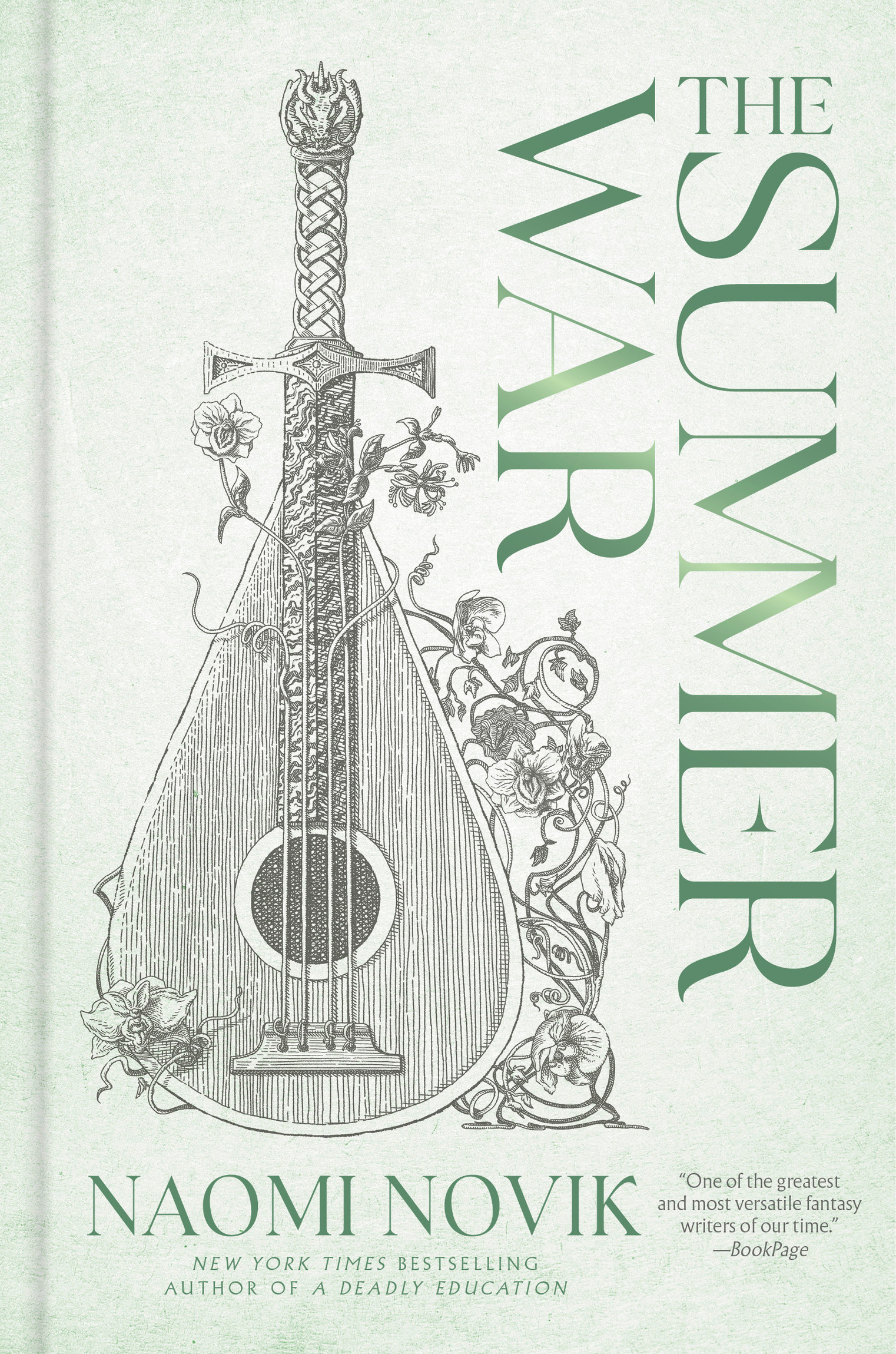
The Summer War
About this book
Celia discovers her magic when her older brother Argent leaves their war-torn home. Feeling abandoned, she curses him without understanding that her words carry prophecy.
Argent becomes incapable of choosing the love and belonging he wants, compelled instead toward fame and heroic danger. Celia grows into her power while searching for a way to undo a sentence that has shaped his life.
The solution lies in the older conflict between Celia's people and the immortal summerlings. What the family remembers as victory may depend on a version of the war that makes reconciliation—and therefore release from the curse—impossible.
The Summer War is a standalone fantasy novella. Naomi Novik treats a childish outburst with the seriousness of a binding spell and follows its consequences across the years required to understand it.
Read a sample
5,085 words
Plain text
From the opening
Celia was twelve years old on the day she cursed her brother. She had two brothers, but she didn’t count Roric, the middle child, because no one did. He was a thin sour weasel who glared at her whenever he saw her, and almost not a real son of the house. His mother—there had been three wives in a row, one to get each child—had just been a temporary mistress, common-born; Father hadn’t meant to marry her at all. Everyone knew that her son didn’t really matter.
But Celia’s oldest brother, Argent, whose mother had been the daughter of an earl, mattered in every way there was. He was Father’s heir and the best knight in the world, so everyone said. Argent was very handsome, too, with black hair that curled and blue-grey eyes, and he’d played with Celia ever since she’d been born. He’d been trained at home, instead of being sent to the king’s circle, and she’d run after him as soon as she could run.
The summer war had been over since before Celia had been born—Father had won it for Prosper, which was how he had become Grand Duke Veris—and now only the summer games took place instead, but Argent trained just as hard as if his life depended on it. Each day Celia hurried through her work so she could go sit in the hall that faced the training yard, even though it was cold in winter and hot in summer, and watch him at his endless sword and javelin drills and riding exercises. Sometimes he would toss her shrieking in delight up into the air, and run around the yard carrying her on his back, and he dressed her up and braided her hair like a doll, and when she was older, he taught her how to dance and ride and shoot a bow. She never got very good with the bow, but he was patient, and even when all her arrows ended up scattered flat over the ground, at least ten feet away from the target, he only laughed and said, “Don’t worry, Celie; if anyone ever tries to hurt you, I’ll be there to stop them.” And she said, “Do you promise?” and he said, “On my honor, my lady,” and bowed to her deeply, just like a knight out of a summer story.
When Argent turned nineteen, Father armed him in fine steel and let him go to the summer games, and almost at once every song-spinner who came to Castle Todholme—and many of them came, because they all hoped to get a bit of story from Father, or at least to be able to say, “Grand Duke Veris, who lately hosted me at Todholme,” the next time they told one of the stories about the end of the summer war—began to say that he was the best knight in the world. He had won three challenges against summer knights on his first day, and they’d started quarreling amongst themselves for the right to face him.
Celia would rather have had him back home, but it was a consolation to have such stories about him. And they pleased her father, who was very hard to please. She could only please him herself with courtesy, if guests came and she hosted for him like a great lady, so their cups were always filled and the conversation never flagged, and they told her father that she would grace the tables of a king. Then when they left he would tell her, “You behaved well,” and give her some money to buy a new dress, and she would use half the money for the dress, and the rest to buy a book full of summer stories. But her father was even more pleased when people told him that Argent was the best knight in the world.
Summer in Prosper lasted almost five months, longer than in the rest of the mortal world, because they shared a border with the Summer Lands. They could grow an extra crop each year, and make wine and silk and sugar, so it had made them much richer than all their other neighbors. But that year Celia grudged every minute of sun and summer rains, and flicked away every gleambug that she saw, just in case the superstition about them getting annoyed and ending summer early might be true. She was so happy the day she woke up with the wind blowing too-sharp through her bed hangings and heard the servants putting up the autumn walls outside.
But Argent didn’t come home right away. After two weeks, a song-spinner brought them the news that he’d been an honored guest at the closing feast, and Summer Prince Elithyon had given him a magnificent gift: “ ‘For the champion Sir Argent, a blade to match his virtues,’ ” the spinner said grandly, quoting the prince, “ ‘silver his name, gold his grace, and steel his courage,’ ” and said that it had been woven of all three metals together by a great summerling spell-smith.
It was two more weeks after that song-spinner had been and gone, with a fat purse and a firsthand account of one of Father’s battles to reward him for rushing to bring them the news, before Argent finally came home. The weather had truly turned; when autumn did come to Prosper, it came with a vengeance. Celia had moved to her rooms in the winter towers, and that night she was kneeling at the windowsill with her candle already blown out so her nurse wouldn’t lecture her about staying up again. She saw him coming along the road in the moonlight, and she knew it was him by his riding, even though he was alone when he should have had an escort of her father’s men, and he went to the small gate by the stables to be let in.
Continue reading the sampleClose the sample
She didn’t even stop to put on slippers or a gown over her shift; she dashed down the stairs to the mezzanine landing, and saw him standing below in the hall. She was going to call down to him, but then she didn’t, hesitating. He looked different and somehow strange. He’d grown, and was wearing new armor, and his face was very hard and beautiful and still. She heard old Unter tell him that Father was in the library, so instead she crept along the mezzanine, shadowing them as they walked to the next hall and peeking over at Argent some more all the way, hoping he would stop seeming strange to her.
But in the library, as Father rose to greet him—he was even smiling a little, more emotion than he almost ever let himself show—Argent waited by the door, holding it open until Unter, disappointed, went back out instead of staying with them for the welcoming cup. Then Argent went and stood before Father, and he didn’t take the cup when Father held it out.
Father stood holding it another moment, and then the same hard stillness came into his face, too. It was familiar there, though. He put the cup down. “Well?” he said.
Argent said, “I’m not staying.” He paused a moment and then said, “Do you remember when you took me to the town court, when I was a boy?” Father didn’t answer, but peering down at his face through the narrow bars of the mezzanine railing, Celia could tell that he knew exactly what Argent was talking about. Argent didn’t wait for him to say anything. “You almost never went there at all. That was work for your magistrates to do, not you yourself. But that day we went, and you judged the first case yourself. They’d—taken two men together.”
Drawing away a little from the railing, Celia huddled herself in small and close, arms wrapped tightly around her knees. She knew what Argent was talking about, and she also knew she didn’t want to hear any more of what he was going to say. She wanted to leave, and she couldn’t bear to leave.
“One of them was the son of one of your men at arms. The other one…I think he was a merchant’s son. I remember them begging you for mercy. You didn’t give it. You ordered them caned on the spot, right there in the court. I remember every blow, the screaming. And afterwards, you stripped them of their names, to spare their families the shame of them. And you ordered them taken to the border of your lands and thrown out, never to return, on pain of death.” Argent said it all so calmly, so steadily, like giving a patrol report, one dull thing after another, but Celia wept for him, her mouth pressed tight to keep the sound in, tears leaking down her face and falling hot on her shift. Her belly was aching.
“I was only twelve,” Argent went on. “I barely even knew, yet. I didn’t understand what you were trying to do. All I understood was that there was something wrong with me, the same thing that was wrong with them, and you were showing me what it meant. What you had to do about it. And I didn’t see anything I could do to stop being wrong, because I hadn’t done anything to start. So afterwards, I was only waiting for you to come and take me, to do the same.”
Father flinched. The small jerk of movement was loud as bells. Father never moved except when he meant to; he never fidgeted or twitched or stirred except to say something, even just with a raised brow or a tilt of his head, and then he always meant to say it. But he hadn’t meant to flinch.
“I was so terrified,” Argent was saying, with an odd sound of wonder in his voice, as if he couldn’t believe the scale of his own fear even now. “Nothing has ever frightened me since. Everyone calls me brave, but it’s only that nothing else comes close enough to that fear. I lived with it for three days and three nights, waiting, until I couldn’t bear it any longer. And then I went into the gardens and I took nightshade, which Father Mullin had told us never to eat, because it was poison, and I ate a handful of it. I didn’t want to die, I was afraid of dying, but I thought it would be better to be dead. Do you remember? I was very ill after.”
Yes, Celia wanted to whisper. Yes, I remember. It was a vague, half-forgotten terror in her mind: the time when Argent had almost died. She’d been five years old, and she’d already loved him more than anyone else in the world. She remembered the hushed voices and the priest and the physician coming and going and talking, and her father simply vanishing out of the world, into Argent’s room, for three days and nights, until they had been told that Argent would live.
“When I woke, you were there,” Argent said. “And I thought you’d come to take me.” Father flinched again. “I remember begging you: please, don’t. I swore I wouldn’t ever. I couldn’t tell you what I wouldn’t do, because I didn’t really know. But I would have said anything, promised anything. And then,” his voice dropped almost to a whisper, so low that Celia could barely hear it, and only because there wasn’t another sound; if Father breathed, she couldn’t tell, “you kissed my brow. You told me to hush. You said that everything would be well, and I only needed to rest and get my strength back. It felt like—a pardon. A miracle. I was—grateful.”
He was silent after, for a long time, and Father didn’t speak either. He didn’t say a word at all. “I do understand, now, what you meant to do,” Argent said finally. “You didn’t mean to frighten me to death. You only meant to teach me, so I’d never forget, what I wasn’t allowed to have. To want. And it worked well. I did understand, afterwards, that the only thing I could want was the sword. That if I wanted anything else…” He didn’t finish. He paused a moment, and then he went on, a little unsteadily, “So from this day, I will never again use your name, to spare you my shame. And I return to you the sword you let me carry, so long as I was fit to be your son.”
He had two swords on his belt, one on either side, which Celia had half noticed. He took one off, the sword Father had given him when he’d ridden away to war, in its sheath of leather and silver, and he laid it on the table. The other one he wore had a narrow hilt made all of metal, three bands that gleamed in different colors of gold and steel and silver, woven together like a braid. “And I will go now, away beyond the border of your lands, and never return again. Farewell, Your Grace.”
He turned and walked out of the library, and left the door open behind him. Father still didn’t say anything. He didn’t tell Argent to stop or to wait, and didn’t tell him he was sorry. He only stood behind the table, looking down at the sword, and his face was as blank as an unwritten page.
But Celia crept along the mezzanine back to the hall, and then as fast as she could, she ran down the stair and through the inner court, bare feet slapping on the stones and the wind biting through her shift. She just made it out into the stable yard as Argent reached his horse, tied up and waiting, and she called out desperately, “Argent!”
He stopped. His hands were on his saddle, and for a moment she almost thought he would just finish mounting and go, that he wouldn’t even answer. Then he did turn to look at her, slowly. But his face was still so hard and strange, and she halted in the middle of the yard halfway to him, forlorn. He stared at her almost as if he didn’t know her. “Celia,” he said slowly, and it was—polite; he might as well have said Lady Celia instead, the way the guests and the servants did.
She couldn’t say anything back to that. She only stood and stared at him dumbly, and the prickling tears started out of her eyes and came down her face. But he moved a little when he saw them, a small jerking that made him look more like himself. “Celie,” he said again, a little wavering, and then he was Argent again, not just a stranger with his face.
“I’ve been waiting for you to come home,” she said, half pleading, half accusatory. “I’ve been waiting all summer.”
He said slowly, “I’m sorry,” but she knew at once, with a terrible hollowness like someone had scooped out a space under her ribs, that it was just more politeness. He didn’t mean it truly.
“No, you’re not,” she said, barely above a whisper, her throat tight. “It doesn’t really matter to you. I don’t. If I mattered, you couldn’t go away forever, without even saying anything.” It was horrible to know that she didn’t matter to him, but she saw it too clearly not to know. He hadn’t given her a single thought. He’d only come to take revenge on Father and go away again. The only reason she even knew he’d come at all was because she’d been up. Waiting. She asked helplessly, even knowing it was stupid and would only make it worse, “Why don’t I matter?”
“You do,” he said, and she wanted to believe him, but then he said, “Celie, I can’t stay, it’s his castle—” and she lost her temper and ran at him and hit him with both her fists, high on his chest.
“Shut up!” she said. “Shut up, you liar.” He caught her wrists, holding her hands away from him so she wouldn’t bruise them on his armor, but she glared up at him past them. “Do you think I’m stupid? What if I say I want to go too? What if I ask you to take me away with you, so I don’t have to marry that fat old duke?” He stared back, caught without an answer. “I’m not stupid. Now that you’ve cast off your name, you don’t owe anything to Father, to anyone. You’re going to take your magic sword and go have adventures, and all the boys you like, and you’re casting me off, too, because I’d only get in your way,” she said, savagely, and was glad to see Argent flinch, the same way that Father had flinched. She was burning with anger, more because he’d tried to lie to her than anything else. It was bad enough that he was casting her off; it was bad enough that he didn’t care. He didn’t need to tell her insultingly stupid lies on top of it.
“Celie,” he said, his voice cracking. “No—that’s not—” But that was it, no matter how hard he pretended it wasn’t, and when she stared at him and refused to go along with the lie, he sputtered to a halt. But then he tried again, like a mouse scurrying desperately in another direction, trying to find another hole. He said, “I’m not going to be safe. I’m going to the Summer Lands—”
“Stop it!” she said. “If you won’t even be honest to me, if you won’t let me matter even that littlest bit, just go!” She jerked her hands free and stepped back and away from him. “Go to the Summer Lands! Go ride a shaihul, fight a dragon, be the greatest knight who ever lived. Just see if it makes you happy! I hope you meet a hundred beautiful summerling boys and none of them love you. I hope no one else is ever stupid enough to love you again!”
She ran away from him and back inside the stable door, so he wouldn’t see her crying, but as soon as she was over the threshold and out of sight, she burst into a huge sob that shook her whole body when she gulped it down painfully to keep the sound in, and another one wanted to come right after it. She bent over her aching belly and then just sank down on her knees in the dirty corridor and crawled herself over to huddle against the wall next to the mucking shovels and pitchforks. She pressed her head against her knees and her mouth against her folded arms to keep quiet, listening as hard as she could until she heard the horrible sound of the horse’s hooves clattering as Argent rode away forever, and then she could let the rage and misery come burning out of her in tears.
She wanted to believe, afterwards, that she wouldn’t have said the curse if she’d known that it would work. She loved Argent more than she hated him, even in the moment. But oh—she wanted so much for the words to hurt him a little, to stick in his head like a pebble in his shoe, so he would have to take her, some part of her, away with him for just a little while, until he cast even that off and found himself some summer lord to fall in love with, in their courts of endless green, and lived happily ever after for a hundred years, likely forgetting the whole mortal world and her along with it.
Celia had been taught over and over not to ill-wish. Father reminded her often, to make her proud, that she was of the bloodline of the great Witch-Queen Selina, who had founded Prosper’s line of kings. His third wife, her mother, had been the bastard sister of the king, and the great tapestry in their dining hall, which Father had commissioned after her birth, showed Selina’s Seventh Wyrd: Queen Selina standing stern and beautiful on a mountaintop, looking down on the army of the shadowlords, and the summerlings and the mortal armies of Prosper united behind her, about to be drowned in darkness.
And Celia also had a book that showed Selina’s First Wyrd: the illustration of Selina holding her hands out to her parents, her mouth open in a wail of horror and grief, while they stretched their own out to her in return, with stone twining itself up around their bodies like a winding sheet. Celia had read it over and over; she’d played private games in the gardens, whispering pretend spells, imagining that when she became a woman, she would be the one, the next sorceress of Prosper.
But more than sixty girls descended of Witch-Queen Selina had been born over the long years since her death without another sorceress flowering in the line, and Celia didn’t feel anything like a woman at the moment. She felt like the opposite—a stupid angry little child, deceived and hurt and crying in a corner, trying to nurse her wounded heart and pride. Even after Argent rode away, Celia still didn’t know that she’d cursed him. She didn’t even know that her courses had started.
She sat in the dark weeping with her head against her knees, thinking the cold and wet and pain were only sorrow, until one of the grooms came yawning on his way to the stables and thought he saw a servant girl in a shift crying and said in rough kindness, “Here, lambkin, what’s the blubbing for? Someone’s hurt ye?”
She jerked her head up and stared at him as he came closer with his candle, and he went pale as a bleached sheet and said, “Gods, milady!” and turned and shouted down the hall, “Here! Here’s milady hurt! Rouse up the house, come quick, go tell the duke!” and he ran to her even as a bell started clanging.
He knelt and put the candle down and reached halfway out with his hands, not quite daring to touch her, full of worry. “Where is’t, milady, where are you hurt?” he asked, and she looked down at herself and in the candlelight she saw the blood, bright crimson spreading like a terrible flower through the soft white linen of her shift, and felt the dreadful chill of power spreading through her body with it. She stared at it, and then she realized what she’d done. She screamed just as three guards came running from the gate, and they all fell down and covered their heads in terror as their swords turned to glass and shattered in their hands.
The summer war had gone for a hundred years before Father had finally won it. There hadn’t been endless fighting all of that time; the summerlings only ever attacked during summer, and sometimes they forgot about the war and didn’t turn up for years at a time, and all the king’s men just sat in the border keeps along the Meanwhile River, bored and drinking and sweltering in summer heat. But Prosper still had to have an army ready every year, because every so often the summerlings did remember about the Betrayal, and as soon as they did, they all blazed up with rage and came storming across the border, swords out for every man, woman, and child in Prosper.
The summerlings had been something like their friends before the war. For as long as anyone had lived in Prosper—or at least as long as anyone knew about—each year the summerlings had come across the Green Bridge to trade “silk and leather and wine and cake for beautiful things of summer make,” as it went in the song. Summerlings couldn’t be bothered to grow crops or tend animals, but they made things no mortal could: enchanted glass as clear as water, arms of hardened gold and silver, jewels that glowed with cool light. They’d fought together against the shadowlords, and after Witch-Queen Selina and the Summer King had died winning the final battle against them, Summer Prince Elithyon had given his sister in marriage to Selina’s son Sherdan, the new king of Prosper.
But the summerlings weren’t mortal. They lived in the simplicity of grand towering stories filled with magic and endless high beauty, and for them pride and love were tangled so close together that they couldn’t pry them apart. During the wedding feast, Princess Eislaing saw King Sherdan look at song-spinner Minata as she sang, and she instantly realized that not only hadn’t her new husband fallen in desperate love with her on first sight the way he should have, he was in love with someone else—an ordinary mortal woman, who wasn’t radiantly beautiful and didn’t even sing perfectly on-key. So as soon as the feast ended, Eislaing went straight up to the highest tower of the royal castle and threw herself off. Her story had gone all wrong, and she couldn’t see anything else to do.
Prince Elithyon and all the summerlings had loved their princess as the greatest treasure of their realm. To them, King Sherdan and the horrible people of Prosper, who hadn’t appreciated the impossibly glorious gift they’d been given, had driven her to a hideous death. The only possible response was to avenge her. And as far as Elithyon was concerned, that was going to take the blood of everyone in the entire kingdom.
So he’d started the summer war, and for a long time, no one had been able to end it. Prosper couldn’t invade them in return. If an army of mortal men marched into the Summer Lands, half of the soldiers wandered out again the next day, fifty years older, and the other half wandered out again ten years later not having aged a day and having forgotten who they were. The lords and generals came out gibbering mad. Only heroes and song-spinners could go into the Summer Lands, and half of those didn’t come back either—some because they’d died heroically, and some because a summerling had seduced them and persuaded them to stay. Summer lords didn’t seem to find anything odd about welcoming individual knights from Prosper into their halls as honored guests, even if they would have slaughtered them without mercy on the other side.
But even on the three occasions when the summerlings had broken through the wall of border keeps and started rampaging through Prosper, razing every town and slaughtering every person in their path, they’d only kept going until autumn. When the leaves started turning colors and falling from the trees, their magic and immortality started fading along with them, and they all panicked and fled pell-mell back to the Summer Lands in terror, abandoning all the ground they’d taken. And then they completely forgot all about autumn until the next time it happened.
So it seemed as though the summer war would just keep going forever and ever, and everyone in Prosper was just doomed to live under the threat of bursts of slaughter, until Father arrived on the border and changed everything, because he started winning.
Father always knew the right thing to do. He was born the son of a poor landless knight from the backwater of Prosper, the northern mountain country, all the way on the other side from the Summer Lands. His only inheritance was some patchy armor, a badly sized sword, a thin horse, and a lowly position with the local earl. But when the king sent one of his periodic demands for soldiers for the summer war, Father asked the earl to let him have the command. The request was granted with alacrity; no one lucky enough to live in the north wanted to be sent down to the summer war.
The strategy that Prosper had relied on for more than a hundred years by then was simple. The king maintained a ring of stone-walled forts all along the border. The forts were hideously uncomfortable, each one built of a few winter towers, naked with no autumn halls or shady summer gardens outside, and joined together by stone walls with almost no openings, except for one entrance just big enough to ride a single horse through at a time. They were oven-hot when the sun was out, full of greenish mold and mosquitoes when the summer rains fell, and often both at the same time. But they were hard to take without siege equipment, which the summerlings almost never managed to finish building.
The men hunkered miserably down inside the forts and the commanders sent out their most gifted knights and well-arrayed companies to offer the summerlings individual challenges and small battles, just often enough to keep them from getting bored and organizing a more concerted advance. It worked reasonably well. Usually only two or three forts got overrun each season, and at worst only a few villages and towns got butchered before autumn came: acceptable losses.
Father’s assigned fort was an especially uncomfortable one: only three towers, all too stubby to risk a window bigger than an arrow-slit even on the topmost floors, and the stone walls were uneasily low and thin. The previous summer’s defenders had prudently dug a ditch around the whole thing to make a bit more of an obstacle, which was already filling up with water as the rains began, and stank to high heaven, since all the castle’s waste got thrown over the back wall and fell right into it.
But Father didn’t sit there waiting to be besieged. Instead, he scouted out the nearest ford over the river, and when the spring mists began to clear, he took his men out and hid halfway along the way. When a small company of summer knights rode by on their way to besiege him—a shining troop in their armor of hardened silver, singing in clear voices about the joy of death in battle—he and his men threw muck and shit and small rocks at them from cover, shouting insults. The summerlings charged after them at once and fell straight into a prepared pit trap, where Father had them ignominiously butchered by a crew of peasants he’d rounded up from the nearest villages, who stood on the edge and stabbed them with spears from a safe distance.