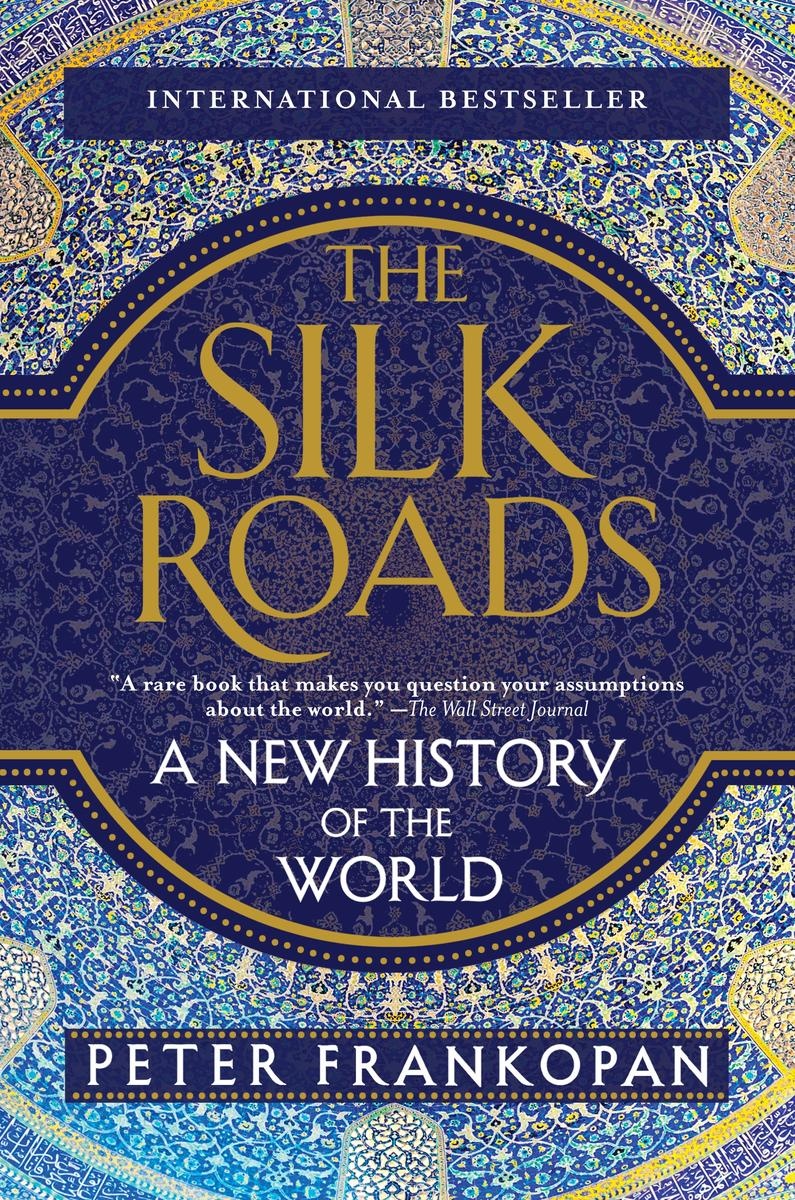
The Silk Roads: A New History of the World
About this book
The title refers not to one road but to networks carrying goods, people, religions, technologies, disease, armies, and information. Cities and states across Central Asia and the eastern Mediterranean appear as central nodes rather than remote edges of a European story.
Chapters follow different routes—faith, fur, slaves, gold, wheat, oil, and others—across long periods. Repeated attention to geography shows why the same corridors matter under empires with very different languages, institutions, and beliefs.
The wide scale necessarily compresses local histories and invites disagreement over emphasis, but it makes familiar events look different when viewed through trade and connection. The twentieth century's wars and energy politics emerge from older strategic patterns rather than a separate modern world.
The Silk Roads: A New History of the World is a narrative synthesis designed to shift the reader's map. Peter Frankopan's strongest question is positional: which places become central when history follows movement across Eurasia instead of radiating outward from the Atlantic.
Read a sample
5,105 words
Plain text
From the opening
1
The Creation of the Silk Road
From the beginning of time, the centre of Asia was where empires were made. The alluvial lowlands of Mesopotamia, fed by the Tigris and Euphrates, provided the basis for civilisation itself—for it was in this region that the first towns and cities took shape. Systematised agriculture developed in Mesopotamia and across the whole of the “Fertile Crescent,” a band of highly productive land with access to plentiful water, stretching from the Persian Gulf to the Mediterranean coast. It was here that some of the first recorded laws were disseminated nearly 4,000 years ago by Hammurabi, King of Babylon, who detailed his subjects’ obligations and set out fierce punishments for their transgressions.1
Although many kingdoms and empires sprang up from this crucible, the greatest of all was that of the Persians. Expanding quickly in the sixth century BC from a homeland in what is now southern Iran, the Persians came to dominate their neighbours, reaching the shores of the Aegean, conquering Egypt and expanding eastwards as far as the Himalayas. Their success owed much to their openness, to judge from the Greek historian Herodotus. “The Persians are greatly inclined to adopt foreign customs,” he wrote: the Persians were prepared to abandon their own style of dress when they concluded that the fashions of a defeated foe were superior, leading them to borrow styles from the Medes as well as from the Egyptians.2
The willingness to adopt new ideas and practices was an important factor in enabling the Persians to build an administrative system that allowed the smooth running of an empire which incorporated many different peoples. A highly educated bureaucracy oversaw the efficient administration of the day-to-day life of the empire, recording everything from payments made to workers serving the royal household, to validating the quality and quantity of goods bought and sold in market places; they also took charge of the maintenance and repair of a road system criss-crossing the empire that was the envy of the ancient world.3
A road network that linked the coast of Asia Minor with Babylon, Susa and Persepolis enabled a distance of more than 1,600 miles to be covered in the course of a week, an achievement viewed with wonder by Herodotus, who noted that neither snow, rain, heat nor darkness could slow the speedy transmission of messages.4 Investment in agriculture and the development of pioneering irrigation techniques to improve crop yields helped nurture the growth of cities by enabling increasingly large populations to be supported from surrounding fields—not only in the rich agricultural lands to either side of the Tigris and Euphrates, but also in valleys served by the mighty Oxus and Iaxartes rivers (now known as the Amy Darya and Syr Darya), as well as in the Nile delta after its capture by Persian armies in 525 BC. The Persian Empire was a land of plenty that connected the Mediterranean with the heart of Asia.
Persia presented itself as a beacon of stability and fairness, as a trilingual inscription hewn into a cliff face at Behistun demonstrates. Written in Persian, Elamite and Akkadian, it records how Darius the Great, one of Persia’s most famous rulers, put down revolts and uprisings, drove back invasions from abroad and wronged neither the poor nor the powerful. Keep the country secure, the inscription commands, and look after the people righteously, for justice is the bedrock of the kingdom.5 Tolerance of minorities was legendary, with one Persian ruler referred to as the “Messiah,” and the one whom the “Lord, the God of Heaven” had blessed, as the result of his policies that included the release of the Jews from their Babylonian exile.6
Trade flourished in ancient Persia, providing revenues that allowed rulers to fund military expeditions targeting locations that brought yet more resources into the empire. It also enabled them to indulge notoriously extravagant tastes. Spectacular buildings were erected in the huge cities of Babylon, Persepolis, Pasargadae and Susa, where King Darius built a magnificent palace using the highest-quality ebony and silver from Egypt and cedar from Lebanon, fine gold from Bactria, lapis and cinnabar from Sogdiana, turquoise from Khwarezm and ivory from India.7 The Persians were famous for their love of pleasure and, according to Herodotus, only had to hear of a new luxury to yearn to indulge it.8
Underpinning the commercial commonwealth was an aggressive military that helped extend the frontiers, but was also needed to defend them. Persia faced persistent problems from the north, a world dominated by nomads who lived with their livestock on semi-arid grassland belts, known as steppes, stretching from the Black Sea across Central Asia as far as Mongolia. These nomads were famed for their ferocity—they were said to drink the blood of their enemies and make clothes of their scalps, and in some cases to eat the flesh of their own fathers. Interaction with the nomads was complex though, for despite stock descriptions of them as chaotic and unpredictable, they were important partners in the supply of animals, and especially fine horses. But the nomads could be the cause of disaster, such as when Cyrus the Great, the architect of the Persian Empire in the 6th century BC, was killed trying to subjugate the Scythians; his head was then carried around in a skin filled with blood, said one writer, so that the thirst for power that had inspired him could now be quenched.9
Continue reading the sampleClose the sample
Nevertheless, this was a rare setback that did not stall Persia’s expansion. Greek commanders looked east with a combination of fear and respect, seeking to learn from the Persians’ tactics on the battlefield and to adopt their technology. Authors like Aeschylus used successes against the Persians as a way of celebrating military prowess and of demonstrating the favour of the gods, commemorating heroic resistance to the attempted invasions of Greece in epic plays and literature.10
“I have come to Greece,” says Dionysus in the opening lines of the Bacchae, from the “fabulously wealthy East,” a place where Persia’s plains are bathed in sunshine, where Bactria’s towns are protected by walls, and where beautifully constructed towers look out over coastal regions. Asia and the East were the lands that Dionysus “set dancing” with the divine mysteries long before those of the Greeks.11
None was a keener student of such works than Alexander of Macedon. When he took the throne in 336 BC following the assassination of his father, the brilliant King Philip, there was no question about which direction the young general would head in his search for glory. Not for a moment did he look to Europe, which offered nothing at all: no cities, no culture, no prestige, no reward. For Alexander, as for all ancient Greeks, culture, ideas and opportunities—as well as threats—came from the east. It was no surprise that his gaze fell on the greatest power of antiquity: Persia.
After dislodging the Persian governors of Egypt in a lightning strike in 331 BC, Alexander set off for an all-out assault on the empire’s heartlands. The decisive confrontation took place later in 331 on the dusty plains of Gaugamela, near the modern town of Erbil in Iraqi Kurdistan, where he inflicted a spectacular defeat on the vastly superior Persian army under the command of Darius III—perhaps because he was fully refreshed after a good night’s sleep: according to Plutarch, Alexander insisted on resting before engaging the enemy, sleeping so deeply that his concerned commanders had to shake him awake. Dressing in his favoured outfit, he put on a fine helmet, so polished that “it was as bright as the most refined silver,” grasped a trusted sword in his right hand and led his troops to a crushing victory that opened the gates of an empire.12
Tutored by Aristotle, Alexander had been brought up with high hopes resting on his shoulders. He did not disappoint. After the Persian armies had been shattered at Gaugamela, Alexander advanced east. One city after another surrendered to him as he took over the territories controlled by his defeated rivals. Places of legendary size, wealth and beauty fell before the young hero. Babylon surrendered, its inhabitants covering the road leading to the great city with flowers and garlands, while silver altars heaped with frankincense and perfumes were placed on either side. Cages with lions and leopards were brought to be presented as gifts.13 Before long, all the points along the Royal Road that linked the major cities of Persia and the communication network that connected the coast of Asia Minor with Central Asia had been taken by Alexander and his men.
Although some modern scholars have dismissed him as a “drunken juvenile thug,” Alexander appears to have had a surprisingly delicate touch when it came to dealing with newly conquered territories and peoples.14 He was often emollient when it came to local religious beliefs and practices, showing tolerance and also respect: for example, he was reportedly upset by the way the tomb of Cyrus the Great had been desecrated, and not only restored it but punished those who had defiled the shrine.15 Alexander ensured that Darius III was given a funeral befitting his rank and buried alongside other Persian rulers after his body had been found dumped in a wagon following his murder by one of his own lieutenants.16
Alexander was also able to draw more and more territory under his sway because he was willing to rely on local elites. “If we wish not just to pass through Asia but to hold it,” he is purported to have said, “we must show clemency to these people; it is their loyalty which will make our empire stable and permanent.”17 Local officials and old elites were left in place to administer towns and territories that were conquered. Alexander himself took to adopting traditional titles and wearing Persian clothing to underline his acceptance of local customs. He was keen to portray himself not so much as an invading conqueror, but as the latest heir of an ancient realm—despite howls of derision from those who told all who would listen that he had brought misery and soaked the land with blood.18
It is important to remember that much of our information about Alexander’s campaigns, successes and policies derives from later historians, whose accounts are often highly idealised and breathless with enthusiasm in the coverage of the young general’s exploits.19 Nevertheless, even if we need to be cautious about the way the collapse of Persia is covered in the sources, the speed with which Alexander kept extending the frontiers further east tells its own story. He was an energetic founder of new cities, usually named after himself, that are now more often known by other names, such as Herat (Alexandria in Aria), Kandahar (Alexandria in Arachosia) and Bagram (Alexandria ad Caucasum). The construction of these staging posts—and the reinforcement of others further north, stretching to the Fergana valley—were new points running along the spine of Asia.
New cities with powerful defences, as well as standalone strongholds and forts, were primarily built to defend against the threat posed by tribes of the steppes who were adept at launching devastating attacks on rural communities. Alexander’s programme of fortification was designed to protect new areas that had only recently been conquered. Similar concerns met with similar responses further east at precisely this time. The Chinese had already developed a concept of huaxia, representing the civilised world, set against the challenges of the peoples from the steppes. An intensive building programme expanded a network of fortifications into what became known as the Great Wall of China, and were driven by the same principle as that adopted by Alexander: expansion without defence was useless.20
Back in the fourth century BC, Alexander himself continued to campaign relentlessly, circling back through the Hindu Kush and marching down the Indus valley, again founding new strongholds with garrisons—although by now meeting with regular cries of protest from his weary and homesick men. From a military perspective, his achievements by the time he died at the age of thirty-two in Babylon in 323 BC, in circumstances that remain shrouded in mystery, were nothing short of sensational.21 The speed and extent of his conquests were staggering. What was no less impressive—though much more often ignored—is the scale of the legacy he left behind, and how the influences of ancient Greece blended with those of Persia, India, Central Asia and eventually China too.
Although Alexander’s sudden death was followed by a period of turbulence and infighting between his senior commanders, a leader soon emerged for the eastern half of the new territories: an officer born in northern Macedonia named Seleucus who had taken part in all the king’s major expeditions. Within a few years of his patron’s death, he found himself governor of lands that stretched from the Tigris to the Indus river; the territories were so large that they resembled not a kingdom but an empire in its own right. He founded a dynasty, known as the Seleucids, that was to rule for nearly three centuries.22 Alexander’s victories are often and easily dismissed as a brilliant series of short-term gains, his legacy widely thought of as ephemeral and temporary. But these were no transitory achievements; they were the start of a new chapter for the region lying between the Mediterranean and the Himalayas.
The decades that followed Alexander’s death saw a gradual and unmistakable programme of Hellenisation, as ideas, themes and symbols from ancient Greece were introduced to the east. The descendants of his generals remembered their Greek roots and actively emphasised them, for example on the coinage struck in the mints of the major towns that were located in strategically important points along the trade routes or in agriculturally vibrant centres. The form of these coins became standardised: an image of the current ruler on the obverse with ringlets held by a diadem, and invariably looking to the right as Alexander had done, with an image of Apollo on the reverse, identified by Greek letters.23
The Greek language could be heard—and seen—all over Central Asia and the Indus valley. At Ai Khanoum in northern Afghanistan—a new city founded by Seleucus—maxims from Delphi were carved on to a monument, including:
As a child, be well-behaved.
As a youth, be self-controlled.
As an adult, be just.
As an elder, be wise.
As one dying, be without pain.24
Greek was in daily use by officials more than a century after Alexander’s death, as tax receipts and documents relating to soldiers’ pay from Bactria from around 200 BC show.25 Indeed, the language penetrated deep into the Indian subcontinent. Some of the edicts issued by Maurayan ruler Ashoka, the greatest of the early Indian rulers, were made with parallel Greek translations, evidently for the benefit of the local population.26
The vibrancy of the cultural exchange as Europe and Asia collided was astonishing. Statues of the Buddha started to appear only after the cult of Apollo became established in the Gundhara valley and western India. Buddhists felt threatened by the success of new religious practices and began to create their own visual images. Indeed, there is a correlation not only in the date of the earliest statues of the Buddha, but also in their appearance and design: it seems that it was Apollo that provided the template, such was the impact of Greek influences. Hitherto, Buddhists had actively refrained from visual representations; competition now forced them to react, to borrow and to innovate.27
Stone altars adorned with Greek inscriptions, the images of Apollo and exquisite miniature ivories depicting Alexander from what is now southern Tajikistan reveal just how far influences from the west penetrated.28 So too did the impressions of the cultural superiority brought from the Mediterranean. The Greeks in Asia were widely credited in India, for example, for their skill in the sciences: “they are barbarians,” says the text known as the Gārgī Samhitā, “yet the science of astronomy originated with them and for this they must be reverenced like gods.”29
According to Plutarch, Alexander made sure that Greek theology was taught as far away as India, with the result that the gods of Olympus were revered across Asia. Young men in Persia and beyond were brought up reading Homer and “chanting the tragedies of Sophocles and Euripides,” while the Greek language was studied in the Indus valley.30 This may be why it is possible that borrowings can be detected across great works of literature. It has been suggested, for instance, that the Rāmāyaṇa, the great early Sanskrit epic, owes a debt to the Iliad and to the Odyssey, with the theme of the abduction of Lady Sita by Rāvaṇa a direct echo of the elopement of Helen with Paris of Troy. Influences and inspiration flowed in the other direction too, with some scholars arguing that the Aeneid was in turn influenced by Indian texts such as the Mahābhārata.31 Ideas, themes and stories coursed through the highways, spread by travellers, merchants and pilgrims: Alexander’s conquests paved the way for the broadening of the minds of the populations of the lands he captured, as well as those on the periphery and beyond who came into contact with new ideas, new images and new concepts.
Even cultures on the wild steppes were influenced, as is clear from the exquisite funerary objects buried alongside high-ranking figures found in the Tilya Tepe graves in northern Afghanistan which show artistic influences being drawn from Greece—as well as from Siberia, India and beyond. Luxury objects were traded into the nomad world, in return for livestock and horses, and on occasion as tribute paid in return for peace.32
The linking up of the steppes into an interlocking and interconnecting world was accelerated by the growing ambitions of China. Under the Han dynasty (206 BC–AD 220), waves of expansion had pushed frontiers ever further, eventually reaching a province then called Xiyu (or “western regions”), but today known as Xinjiang (“new frontierland”). This lay beyond the Gansu corridor, a route 600 miles long linking the Chinese interior with the oasis city of Dunhuang, a crossroads on the edge of the Taklamakan desert. At this point, there was a choice of a northern or a southern route, both of which could be treacherous, which converged at Kashgar, itself set at the junction point of the Himalayas, the Pamir mountains, the Tien Shan range and the Hindu Kush.33
This expansion of China’s horizons linked Asia together. These networks had hitherto been blocked by the Yuezhi and above all the Xiongnu, nomadic tribes who like the Scythians in Central Asia were a source of constant concern but were also important trading partners for livestock: Han authors wrote in the second century BC of tens of thousands of head of cattle being bought from the peoples of the steppes.34 But it was Chinese demand for horses that was all but insatiable, fuelled by the need to keep an effective military force on standby to maintain internal order within China, and to be able to respond to attacks and raids by the Xiongnu or other tribes. Horses from the western region of Xinjiang were highly prized, and could make fortunes for tribal chieftains. On one occasion, a Yuezhi leader traded horses for a large consignment of goods that he then sold on to others, making ten times his investment.35
The most famous and valuable mounts were bred in the Fergana valley to the far side of the spectacular Pamir mountain range that straddles what is now eastern Tajikistan and north-eastern Afghanistan. Much admired for their strength, they are described by Chinese writers as being sired by dragons and are referred to as hanxue ma or “sweating blood”—the result of their distinctive red perspiration that was caused either by a local parasite or by the horses’ having unusually thin skin and therefore being prone to blood vessels bursting during exertion. Some particularly fine specimens became celebrities in their own right, the subject of poems, sculpture and pictures, frequently referred to as tianma—heavenly or celestial horses.36 Some were even taken with their owner to the next life: one emperor was buried alongside eighty of his favoured steeds—their burial place guarded by statues of two stallions and a terracotta warrior.37
Relations with the Xiongnu, who held sway across the steppes of Mongolia and across the grasslands to China’s north, were not always easy. Contemporary historians wrote of the tribe as barbaric, willing to eat raw meat and drink blood; truly, said one writer, they are a people who “have been abandoned by heaven.”38 The Chinese proved willing to pay tribute rather than risk attacks on their cities. Envoys were regularly dispatched to visit the nomads (who were trained from infancy to hunt rats and birds and then foxes and hares), where the Emperor would politely ask after the health of the supreme leader.39 A formal system of tribute developed whereby the nomads were given luxury gifts including rice, wine and textiles in return for peace. The most important item that was given was silk, a fabric that was treasured by the nomads for its texture and its lightness as a lining for bedding and clothing. It was also a symbol of political and social power: being swathed in voluminous quantities of precious silk was an important way that the chanyu (the tribes’ supreme leader) emphasised his own status and rewarded those around him.40
The sums paid in return for peace were substantial. In 1 BC, for example, the Xiongnu were given 30,000 rolls of silk and a similar amount of raw material, as well as 370 items of clothing.41 Some officials liked to believe that the tribe’s love of luxury would prove its undoing. “Now [you have] this fondness for Chinese things,” one envoy brashly told a tribal leader. Xiongnu customs were changing, he said. China, he predicted confidently, “will in the end succeed in winning over the whole Xiongnu nation.”42
This was wishful thinking. In fact, the diplomacy that maintained peace and good relations took a toll both financially and politically: paying tribute was expensive and a sign of political weakness. So in due course the Han rulers of China resolved to deal with the Xiongnu once and for all. First, a concerted effort was made to take control of the agriculturally rich western regions of Xiyu; the nomads were driven back as the Chinese took control of the Gansu corridor in a decade-long series of campaigns that ended in 119 BC. To the west lay the Pamir mountains and, beyond them, a new world. China had opened a door leading on to a trans-continental network; it was the moment of the birth of the Silk Roads.
The expansion of China saw a surge of interest in what lay beyond. Officials were commissioned to investigate and write reports about the regions beyond the mountains. One such account survives as the Shi Ji (Historical Records), written by Sima Qian, son of the imperial court’s Grand Historian (Taishi), who continued to work on this account even after he had been disgraced and castrated for daring to defend an impetuous young general who had led troops to defeat.43 He carefully set out what he had been able to discover about the histories, economies and armies of the peoples in the Indus valley, Persia and Central Asia. The kingdoms of Central Asia were weak, he noted, because of pressure from nomads displaced by Chinese forces who had turned their attention elsewhere. The inhabitants of these kingdoms were “poor in the use of arms,” he wrote, “but clever at commerce,” with flourishing markets in the capital Bactra, “where all sorts of goods are bought and sold.”44
Trade between China and the world beyond developed slowly. Negotiating the routes along the edge of the Gobi desert was not easy, especially beyond the Jade Gate, the frontier post past which caravans of traders travelled on their way west. Passing from one oasis to another across treacherous terrain was difficult whether their route took them through the Taklamakan desert or through the passes of the Tian Shan mountains or through the Pamirs. Extremes of temperature had to be negotiated—one reason why the Bactrian camel was so valued. Hardy enough to brave the harsh conditions of the desert, these animals have advance knowledge of deadly sandstorms, one writer observed, and “immediately stand snarling together”—a sign for the traders and caravan leaders to “cover their noses and mouths by wrapping them in felt.” The camel was clearly a fallible weathervane, however; sources talk of passing large numbers of dead animals and skeletons along the routes.45 In such tough circumstances, rewards had to be high for the risks to be worth taking. Although bamboo and cloth made in Sichuan could be found for sale thousands of miles away in the markets of Bactria, it was primarily rare and high-value goods that were transported over long distances.46
Chief among these was the trade in silk. Silk performed a number of important roles in the ancient world apart from its value to nomadic tribes. Under the Han dynasty, silk was used alongside coins and grain to pay troops. It was in some ways the most reliable currency: producing money in sufficient quantities was a problem, as was the fact that not all of China was fully monetised; this presented a particular difficulty when it came to military pay since theatres of action were often in remote regions, where coins were all but useless. Grain, meanwhile, went rotten after a time. As a result, bolts of raw silk were used regularly as currency, either as pay or, as in the case of one Buddhist monastery in Central Asia, as a fine for monks who broke the foundation’s rules.47 Silk became an international currency as well as a luxury product.
The Chinese also regulated trade by creating a formal framework for controlling merchants who came from outside territories. A remarkable collection of 35,000 texts from the garrison town of Xuanquan, not far from Dunhuang, paints a vivid picture of the everyday goings-on in a town set at the neck of the Gansu corridor. From these texts, written on bamboo and wooden tablets, we learn that visitors passing into China had to stick to designated routes, were issued with written passes and were regularly counted by officials to ensure that all who entered the country also eventually made their way home. Like a modern hotel guest folio, records were kept for each visitor, noting how much they spent on food, what their place of origin was, their title and in which direction they were headed.48
These measures are to be understood not as a form of suspicious surveillance, but rather as a means of being able to note accurately who was entering and leaving China, as well as what they were doing there, and above all to record the value of the goods that were bought and sold for customs purposes. The sophistication of the techniques and their early implementation reveal how the imperial courts at the capital in Chang’an (modern Xi’an) and from the first century AD at Luoyang dealt with a world that seemed to be shrinking before their eyes.49 We think of globalisation as a uniquely modern phenomenon; yet 2,000 years ago too, it was a fact of life, one that presented opportunities, created problems and prompted technological advance.
As it happened, developments many thousands of miles away served to stimulate demand for luxury items—and the ability to pay for them. In Parthia, the descendants of Seleucus were deposed around 247 BC by one Arsaces, a man whose background is obscure. His descendants, known as the Arsacids, consolidated their hold on power and then set about extending it across western Asia into Persia, skilfully expropriating history to fuse Greek and Persian ideas into an increasingly coherent and robust new identity. The result was a time of stability and prosperity.50
But it was what was happening in the Mediterranean that provided the greatest stimulus of all. A small town in an unpromising location halfway up the west coast of Italy had slowly managed to turn itself from a provincial backwater into a regional power. Taking over one coastal city-state after another, Rome came to dominate the western Mediterranean. By the middle of the first century BC, its ambitions were expanding dramatically. And attention was focused firmly on the east.
Rome had evolved into an intensely competitive state, one that glorified the military and acclaimed violence and killing. Gladiatorial games were the bedrock of public entertainment, a place where mastery over foreign peoples and over nature was brutally celebrated. Triumphal arches all over the city provided daily reminders of military victories to its bustling population. Militarism, fearlessness and the love of glory were carefully cultivated as the key characteristics of an ambitious city whose reach was stretching forever further.51
The backbone of Roman power was the army, honed and conditioned to demanding standards. Soldiers were expected to be able to march more than twenty miles in five hours, hauling at least fifty pounds of equipment with them at the same time. Marriage was not only frowned on but specifically prohibited in order to keep recruits bonded to each other. Corps of highly trained, fit and intense young men who had been brought up confident in their ability and assured of their destiny were the rock on which Rome was built.52
The conquest of Gaul (broadly the area of modern France, the Low Countries and part of western Germany) in 52 BC brought substantial spoils, enough to cause a correction in the price of gold in the Roman Empire.53 But there were only so many other places to take on in Europe—and few of them looked promising. What made empires great were large numbers of cities, producing taxable revenues; what made them culturally spectacular were artisans and craftsmen who developed new ideas when wealthy patrons competed with each other for their services and rewarded them for their skills. It was unlikely that places like Britain would provide lucrative additions to Rome’s territories: as slate letters sent home by soldiers stationed in Britain attest, this province was a byword for grim and fruitless isolation.54