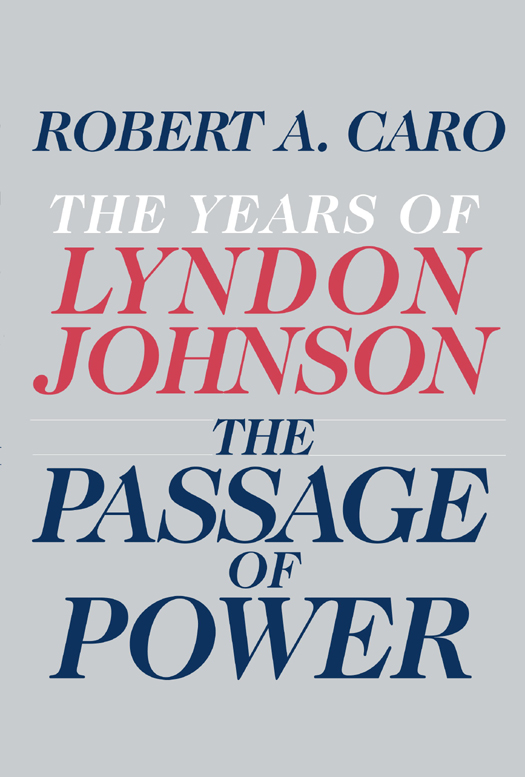
The Passage of Power: The Years of Lyndon Johnson, Vol. IV
About this book
Johnson accepts the vice presidency expecting influence and finds himself excluded by Kennedy's circle. The powers he mastered in the Senate no longer apply, and years of frustrated ambition unfold beside the administration's public glamour.
Dallas changes the constitutional role and the human situation in an afternoon. Caro follows Johnson's assumption of authority, his treatment of Jacqueline Kennedy and the Kennedy staff, and the legislative drive that begins immediately afterward.
The Passage of Power is the fourth volume of The Years of Lyndon Johnson. It ends in 1964, after civil-rights and tax legislation demonstrate how quickly the new president could convert grief, experience, and momentum into action.
Read a sample
5,338 words
Plain text
From the opening
Introduction
“What the hell’s the presidency for?”
AIR FORCE ONE, the President’s plane, is divided, behind the crew’s cockpit, into three compartments. In the first of them, just behind the cockpit, women sat weeping and Secret Service agents were trying to hold back tears (“You’ve heard of strong men crying; well, we had it there that day,” recalls a reporter) as the pilot lifted the big jet off the Dallas runway in a climb so steep that to a man standing on the ground it seemed “almost vertical,” leveled off for a few minutes, and then, warned that there were tornadoes between him and Washington, put the plane into another climb to get above them. In the rear compartment the widow, her suit stained with blood, was sitting next to the coffin of the dead President. And in the center compartment was the new President.
Lyndon Johnson hadn’t been aboard Air Force One on the trip down to Texas. He had long since given up asking John F. Kennedy if he could accompany him on the presidential plane when they were flying to the same destination (“You don’t mean to say that Mr. Johnson is again insisting on riding with me?” Kennedy had once asked his secretary in an exasperated tone), as he had given up on all his attempts to obtain some measure of recognition, or at least dignity, as Vice President. Once, as Senate Majority Leader, he had been a mighty figure—“the second most powerful man in the country”—but that seemed a long time ago now. Although initially he had been favored to win the Democratic nomination for President, he had been outmaneuvered by the younger man, and, having accepted the vice presidency, had, in that post, become not just powerless but a figure of ridicule. The gibe (“Whatever became of Lyndon Johnson?”) that had started over Georgetown dinner tables was now in headlines over articles about his predicament. He himself was worried about whether or not he would be retained on the 1964 Democratic ticket, and was convinced that whether he was or not, his dreams of becoming President one day were over. He had advised more than one aide whom he would have wanted with him were he to run for or become President to leave his staff. “My future is behind me,” he told one member of his staff. “Go,” he said to another. “I’m finished.” But he was on Air Force One now.
IN PART, this book is the story of the five years—from late 1958, when Johnson began campaigning for the presidency, to November 22, 1963—before that flight from Dallas to Washington: a story of how a man who all his life had yearned for the presidency failed in his great chance to attain that goal, of how, to a large degree because of aspects of his character that crippled him in his efforts to attain it, he allowed the prize for which he had planned and schemed and worked (worked with a tirelessness that made an ally say “I never thought it was possible for anyone to work that hard”) to be snatched away from him. It is a story of not only failure but humiliation, of how, after he had lost the presidential nomination in 1960, he had taken a gamble—giving up the Senate leadership to accept the vice presidential nomination—because he felt that was his only remaining chance to achieve his goal, and of what followed after he became Vice President. Although Kennedy might not have won in 1960 without his presence on the ticket and his old-fashioned, whistle-stop campaigning—a fact that Kennedy himself privately acknowledged—he received no credit for that. “Power is where power goes,” he had boasted in explaining why he had traded in the Senate leadership: he would be able, through his political gifts, to transform the traditionally powerless vice presidency. But when, not long after the election, he had made two attempts—one with the Senate, one with Kennedy himself—to grab powers no previous Vice President had enjoyed, both were carried out in ways so clumsy and embarrassing that it was obvious that not his old skills but only desperation was behind them. And during the three years since Kennedy had turned aside, with contemptuous ease, Johnson’s attempt to maneuver him into ceding a portion of presidential power, Vice President Johnson had become among Kennedy’s White House aides the object of dislike and distrust, and of derision embodied in the mocking nicknames by which they often referred to him: “Uncle Cornpone” or “Rufus Cornpone.” These nicknames, and a hundred other slights, make this part of the book also a story about what being without power can mean in a city in which power is the name of the game; in a city as cruel as Washington. That part of the story—the five-year part—had ended when Kennedy’s aide Kenneth O’Donnell had walked into the cubicle in Dallas’ Parkland Hospital in which Lyndon Johnson, standing all but motionless against a wall, had been waiting for long minutes for definitive word on the President’s fate. Seeing the stricken “face of Kenny O’Donnell who loved him so much,” I knew, Lady Bird Johnson was to say, even before O’Donnell said, “He’s gone.”
And in part this book is the story of a period that began during that flight, for it was on Air Force One, after he had sworn the oath of office with Jacqueline Kennedy standing beside him in a sweltering, dimly lit cabin, its window shades closed to foil would-be assassins, that his first presidential decisions were made: that the transition between the Kennedy Administration and that of Lyndon Baines Johnson began.
Continue reading the sampleClose the sample
THAT STORY—the transition story, a story just seven weeks long: its end came, as will be seen, on January 8, 1964—is a story of a period in Lyndon Johnson’s life very unlike that of the preceding five years.
Although seven times previously in the history of the American republic a presidential transition had come about not through election but through death, the death of a President in office, and in three of those seven instances, death had come by assassination rather than through natural causes, the Johnson transition took place in circumstances that made it in some ways different from—and in some ways more difficult than—any of its predecessors. The very jolt of the news was different. As the first assassination to take place in the age of television, it was the first an entire nation learned about almost at the same moment: by the time Air Force One touched down in Washington, after a flight of two hours and six minutes, 92 percent of the American people had heard the news, which crossed the country, Newsweek said, “like a shock wave.” Tens of millions of Americans saw the coffin, escorted by Jacqueline and Robert Kennedy, descend from the plane on an hydraulic lift. And hard on the first shock came others. Forty minutes into Air Force One’s flight, it was announced that a Dallas policeman had been shot, and, a few minutes later, that a twenty-four-year-old man had been arrested for questioning, and a half hour later that he was “a definitive suspect in the assassination,” and on the heels of Lee Harvey Oswald’s name came rumors that seemed to link him to both Cuba and the Soviet Union. With America barely a year past the Cuban Missile Crisis, the fears that had accompanied the realization in October, 1962, that the country was on the very brink of a nuclear confrontation with those two countries were still fresh in America’s mind. And then, two days later, the assassin was assassinated—on live television. The shadowy figure lunging onto the screen from the right; glimpses of a pistol; “He’s been shot! He’s been shot! Lee Harvey Oswald has been shot!” “For one moment of total horror,” the New York Times said, “nothing could quite compare with the killing of … Oswald … before the live cameras of the National Broadcasting Company.” Concern that John F. Kennedy’s assassination was the work not of a lone gunman but of a conspiracy escalated—as did concern about where (in Russia? in Cuba?) the conspiracy might have originated. “Lyndon Johnson’s ascent to the presidency,” says presidential historian Henry Graff, “came at the most traumatic moment in American political history.” And the assassination’s impact was magnified by television during the next three days, days of funeral ceremonies for the dead President unrivaled in American history for their pageantry and poignance. During the day of the assassination and the three days following, television in the average American home was tuned to the Kennedy funeral ceremonies for almost eight hours a day. The events in modern American history most comparable in their impact on the public, social scientists found, were Pearl Harbor and Franklin Roosevelt’s death, but, the scientists also found that because these events had occurred before the television age, they were not in fact comparable. The pervasiveness as well as the immediacy of television coverage—“There were times during those days when a majority of all Americans were apparently looking at the same events and hearing the same words … participating together … in a great national event,” the scientists concluded; “Nothing like this on such a scale had ever occurred before”—made the assassination and the ceremonies following it an event “probably without parallel in history.”
Adding to the difficulties was the attitude toward the new President among many—most, in fact—of the late President’s advisers, the men on whom Johnson would have to rely for advice and for the operation of the government. So smoothed over have their feelings been during the intervening decades that in recollections today they bear little resemblance to reality, which was that at the time Lyndon Johnson stepped into office, these men not only disliked and despised him—held him in contempt remarkable in its depth and intensity—but were aware also of what they considered indications of how President Kennedy himself had felt about him, feelings also not at all like those that have come down to us in history; it was a matter of common knowledge around the White House, for instance, that although the Vice President was a member of the group (ExComm, it was called) convened to advise John Kennedy during the Cuban Missile Crisis, the Vice President had been excluded from the meeting at which the final decision about the American response had been made. And there was yet another circumstance that made this transition unique in American history. The murdered President had a brother, who hated the new President—as the new President hated him. This book is therefore also the story of Lyndon Johnson and Robert Kennedy—one of the great blood feuds in American political history. It was a feud that arose out of something visceral, something deep within both men—those who witnessed their first face-to-face encounter, in the Senate cafeteria in 1953, when Robert Kennedy was only a young Senate staffer and Lyndon Johnson was the Senate’s Democratic leader, would never forget it—and over the years, it had only intensified: Lyndon Johnson never forgot or forgave, could never, until he died, stop talking about, Robert Kennedy’s visits to his hotel room during the 1960 Democratic convention to try to force him off the ticket. Possessing during his brother’s presidency the power to humiliate Johnson, Bobby Kennedy had taken many opportunities to do so. And now, in a single instant, in the crack of a Dallas gunshot, their positions had been reversed, tables turned completely, and Lyndon Johnson had the power to repay the favor—which he soon began to do. Adding still another element to the feud was a factor that seemed likely to make the transition especially problematical. During the final year before the assassination, it had become apparent that the brother had set his sights on becoming President himself one day, perhaps on succeeding John Kennedy after his presidency was over. Should he decide now to mount a challenge to Johnson, he might have on his side, in addition to the Kennedy name and aura, and the sympathy engendered by the assassination, the support of most of his brother’s White House staff and Cabinet, as well as of political leaders across the country who had been members of the Kennedy camp since 1960. While ordinarily a sitting President could easily turn back any challenge to his renomination from within his party, this would be no ordinary challenge, particularly if, with November, 1964, so close upon him—Jack Kennedy’s death was also the first death of a President to have occurred so late in his term; the “challenge of assuming office and then running for election in the same first year” made Johnson’s transition “unprecedented” in American history, says presidential historian Richard Neustadt—the new President should prove unable to quickly unify the Democratic Party behind him. Years later, during his retirement, Johnson would speak of “the thing I feared from the first day of my presidency”: an announcement by Robert Kennedy of “his intention to reclaim the throne in memory of his brother.”
Were these not enough complications to imperil a transition? There was yet another: scandal, scandal on the grand scale.
A pair of scandals on that scale had been looming over the Vice President for months and were both coming to a head on the morning of November 22. One, involving Johnson’s protégé Bobby Baker (known in Washington as “Little Lyndon”), had during the weeks before the assassination become a sensational cover story in national magazines. Baker was later to say that if he had talked, Johnson “might have incurred a mortal wound by these revelations.… They could have driven him from office,” but he hadn’t talked yet. Nor had any of his associates, and as a result the Vice President had not been directly implicated. But on the morning of November 22, at the very time that the motorcade was carrying Kennedy and Johnson through Dallas, back in Washington, that had been about to change. And at the same time, the other scandal—potentially even larger in scope—was escalating to a new stage in New York, in a conference at the offices of Life magazine, where a team of nine reporters had been working for weeks on a series of articles, with the working title of “Lyndon Johnson’s Money.” Editors were dividing up areas for final investigation, and trying to decide whether to run the first article in the next week’s issue, which would shortly go to press, when suddenly, all over Life’s newsroom, phones began ringing frantically, and a secretary ran into the office shouting the news.
And finally—and most significantly—there was the situation on Capitol Hill.
For all John F. Kennedy’s remarkable ability—his eloquence on the podium, whether for a speech or a press conference—to inspire a nation, to rally it to its better, most humane, aspirations, and for all his triumphs in dealing with the rest of the world—the Peace Corps, the Nuclear Test Ban Treaty, the Cuban Missile Crisis—few of his domestic goals that required legislation had been turned into reality, and at the time of his death, every major Administration bill that was before Congress was stalled, even the two bills that in 1963 the young President had lumped together as his “first priority”: a civil rights bill and a tax reduction bill vital not only to expansion of the economy but to liberal aims, since economic expansion, and the resultant increase in tax revenues, were necessary if government was to fund new social welfare programs. The coalition blocking his bills—the southern Democrat-Republican coalition, the conservative coalition, that had ruled Capitol Hill for a quarter of a century—in November, 1963, was ruling Capitol Hill still. During the last week or two before the President’s trip to Texas, in fact, the stalemate in Congress—the press had taken to calling it a “logjam”—had escalated to new, historic levels; both the bills were stalled, caught in a logjam that on the day John F. Kennedy died gave no signs of breaking up.
But the story of Lyndon Johnson’s transition is a story not only of difficulties he faced but how he surmounted them.
He not only broke the congressional logjam, he broke it up fast, and he broke it up on civil rights.
Civil rights had always crystallized liberals’ doubts about Lyndon Johnson. What they knew about him—besides his southern roots and accent, the “magnolia drawl” that raised the hackles on liberal necks—was his southern record, a twenty-year record that had begun with his arrival in Congress in 1937 and lasted through 1956, on civil rights: a perfect 100 percent record of voting against every civil rights bill that had ever made it to the floor, even bills aimed at ending lynching, and a record, moreover, as a southern strategist, protégé of the chieftain of the mighty Southern Caucus, Richard Brevard Russell, who had helped Russell ensure that most civil rights bills never made it to the floor. In 1957, in a dramatic reversal of that record, Majority Leader Johnson had rammed through the first civil rights bill to pass Congress since 1875. Significant though that breakthrough was, however, and though he passed another civil rights bill in 1960, liberal antagonism toward him had been softened scarcely at all since the bills were weak, only meagre advances toward social justice, and because his championing of them was regarded by most liberals as mere political opportunism: an attempt to lessen northern opposition to his presidential candidacy.
But although the cliché says that power always corrupts, what is seldom said, but what is equally true, is that power always reveals. When a man is climbing, trying to persuade others to give him power, concealment is necessary: to hide traits that might make others reluctant to give him power, to hide also what he wants to do with that power; if men recognized the traits or realized the aims, they might refuse to give him what he wants. But as a man obtains more power, camouflage is less necessary. The curtain begins to rise. The revealing begins. When Lyndon Johnson had accumulated enough power to do something—a small something—for civil rights in the Senate, he had done it, inadequate though it may have been. Now, suddenly, he had a lot more power, and it didn’t take him long to reveal at least part of what he wanted to do with it. On the evening of November 26, the advisers gathered around the dining room table in his home to draft the speech he was to deliver the following day to a joint session of Congress were arguing about the amount of emphasis to be given to civil rights in that speech, his first major address as President. As Johnson sat silently listening, most of these advisers were warning that he must not emphasize the subject because it would antagonize the southerners who controlled Congress, and whose support he would need for the rest of his presidency—and because a civil rights bill had no chance of passage anyway. And then, in the early hours of the morning, as one of those advisers recalls, “one of the wise, practical people around the table” told him to his face that a President shouldn’t spend his time and power on lost causes, no matter how worthy those causes might be.
“Well, what the hell’s the presidency for?” Lyndon Johnson replied.
IN HIS SPEECH the next day, sympathy for the martyred President was enlisted to advance the cause, as was America’s desire for continuity, for stability, for reassurance that the government was holding to a firm course despite the loss of the man who had sat at its head. Invoking Kennedy’s name, he said that “No words are strong enough to express our determination to continue the forward thrust of America that he began,” that “This is our challenge … to continue on our course,” and that “no memorial oration or eulogy could more eloquently honor President Kennedy’s memory than the earliest possible passage of the civil rights bill for which he fought so long. We have talked long enough in this country about equal rights. We have talked for one hundred years or more. It is time now to write the next chapter, and to write it in the books of law.”
Writing it into these books would require more than sympathy, always a highly fungible emotion in politics anyway, and, as will be seen, one that had no influence whatsoever on the southern committee chairmen who ruled Congress. Strategy was necessary, too, a strategy on the grand scale, and, as will be seen, Johnson had one, a brilliant overview of a means of getting a civil rights bill passed, that he had urged on Kennedy, only to be ignored. As he had demonstrated in the Senate, moreover, it was not only strategy but tactics of which he was a master. Identifying and throwing his weight behind a seldom-used procedural lever—perhaps the only lever that could have worked—within a month after he had taken office he had broken the civil rights bill free of the congressional logjam. The bill wouldn’t be passed until 1964. It would be passed then only after a half year of struggle (whose heroes included not only liberal congressmen and senators, but the men, women and children who marched and protested, and who, many of them, were beaten and tortured—and, some of them, murdered—on the streets of the South. But it was a struggle whose strategy and day-by-day tactics were laid out and directed by him, and by the end of that first month it was at least on the road to passage.
By the end of that month, the tax cut bill was also on the road to passage. And by the end of that month, by the time he left Washington for a Christmas vacation on his Texas ranch, he had won another victory, on a third bill—defeating a seemingly innocuous measure, involving the sale of wheat to Russia, that would have curtailed the President’s authority in foreign affairs. Grasping the instant he heard about the bill that it had been introduced because conservatives, emboldened by their victories over Kennedy, were confident that they could defeat a President—that, as he put it, “They’ve got the bit in their teeth,” and thought they “could bully me” the way they believed they had bullied Kennedy—he decided in that instant that the way to yank out the bit was to make the bill a test of strength with Congress, and to win the test. A simple majority wasn’t going to be enough to teach Congress a lesson. “I hope that [bill] gets murdered,” he snarled, and, sitting in the Oval Office, he kept telephoning senator after senator, cajoling, bullying, threatening, charming, long after he had the majority, to make the vote overwhelming enough to ensure the lesson was clear. The vote was overwhelming, and when, a week later, conservatives attempted a maneuver that would have overturned it, Johnson had a maneuver of his own ready. His tactic was so risky that congressional leaders warned him not to use it; he used it—and murdered the bill once and for all. “At that moment the power of the federal government began flowing back to the White House,” he was to say—and boastful though that statement might be, it was true. To watch Lyndon Johnson deal with Congress during the transition—to watch him break the unbreakable conservative coalition—is to see a President fighting not merely with passion and determination but with something more: with a particular talent, a talent for winning the passage of legislation (in this case legislation that would write into the books of law a measure of justice for millions of people to whom justice had been too long denied) that was more than talent, that was a gift, and a very rare one. To watch Lyndon Johnson during the transition is to see political genius in action.
He handled all the problems—the Kennedy men’s antipathy, the Kennedy brother’s hatred, the rumors over the assassination that, had they not been defused, might have escalated into international crisis—with the same sureness of touch. If the story of the five years is a story of failure, the story of the seven weeks is a story of what rose out of failure: triumph. So on one level, the bio-graphical level, the recounting of the life of Lyndon Baines Johnson, the two stories in this book are really one story: a narrative with a single, sweeping arc. It rises from the depths of a man’s life, a period in which utterly without power he stands naked to his enemies, a period in which a man who dreads above all else what he calls “humiliation” suffers what he dreads day after day. It sweeps up to the heights of that life, as he is catapulted in an instant, in a gunshot, into the power he had always wanted—and he proceeds to demonstrate, almost in the instant he attains that power, how much he is capable of accomplishing with it.
IF IT IS to succeed in its purposes, however, this book must explore another level as well.
This is the fourth in a series of volumes that I call The Years of Lyndon Johnson because it attempts to portray not only his life but his years: the era in which he lived, rose to the presidency and finally abandoned the presidency—America in the middle decades of the twentieth century, in other words. It tries most particularly to focus on and examine a specific, determinative aspect of that era—political power; to explore, through the life of its protagonist, the acquisition and use of various forms of that power during that half century of American history, and to ascertain also the fundamental realities of that power; to learn what lay, beneath power’s trappings, at power’s core.
The transition period covered in this book is particularly well suited to that purpose, for a way to gain insight into the most fundamental realities of any form of power is to observe it during its moments of deepest crisis, during its most intense struggles, when, under maximum stress, its every resource must be brought to bear—with the undiluted pragmatism born of absolute necessity—if the challenges facing it are to be met. It is at such moments that every one of those resources, every component of that power, is not only visible but, being used to its utmost, can be observed in all its facets. In trying to understand presidential power, one would find that the transition of 1963—the seven-week-long passage of power between John Fitzgerald Kennedy and Lyndon Baines Johnson—is one of those moments. Because of the difficult—in some ways unique—challenges facing the incoming chief executive, it was a moment in which the use of presidential power to the limits of its practical, pragmatic possibilities was necessary if the transition was to be successful. Johnson used that power to those limits. To watch him deal with Congress, deal with the Kennedys, confront a dozen other challenges for which there was no precedent—for which he had to create his own precedents—is to watch a President, in very difficult circumstances, triumph over them, and it is therefore a means of gaining new insight into some fundamental realities about the pragmatic potential in the American presidency.
AND ABOUT POTENTIAL beyond the pragmatic.
Brief though the transition period was, during it Lyndon Johnson not only rescued his predecessor’s programs but launched one of his own. Barely into his second month in office he seized on a concept that had just begun to surface—a suggestion, a gleam in the eyes of a few members of the Kennedy Administration, that the late President had endorsed in theory but had done almost nothing to push forward—seized on it the moment a Kennedy adviser mentioned it to him, seized on it with such passion (“so spontaneous … instinctive and intuitive and uncalculated”) that the adviser knew in that moment that he had been very wrong about Lyndon Johnson. Enlarging it far beyond anything previously envisioned, he pushed it forward, prodded his advisers into bringing their imagination to bear on it, and, in the second major speech of his presidency, the State of the Union address he delivered to Congress on January 8, 1964, announced it, and it was a program whose title, however hyperbolic, made clear that he viewed it—this crude, coarse, ruthless, often cruel man, who all his life had made a mantra of pragmatism (“It’s not the job of a politician to go around saying principled things”)—as nothing less than a crusade. It was a crusade for a noble end. The speech made clear on whose behalf the crusade would be launched. “Unfortunately, many Americans live on the outskirts of hope—some because of their poverty, and some because of their color, and all too many because of both,” he said in that State of the Union address. “Our task is to help replace their despair with opportunity. This administration today, here and now, declares unconditional war on poverty in America.” The speech made clear also the weapons he was going to deploy in the crusade, and the enemies—ancient enemies, hitherto invincible, whom he named by name—that he intended the crusade to conquer. “Our chief weapons … will be better schools, and better health, and better homes, and better training, and better job opportunities to help more Americans, especially young Americans, escape from squalor and misery and unemployment,” he said. And the speech announced also the crusade’s goal, which was revolutionary: “not only to relieve the symptom of poverty, but to cure it and, above all, to prevent it.” By the time Lyndon Johnson stepped down from the dais after that speech, it was apparent that the program to which he was committing his still-infant Administration was one whose purpose was to right, on a vast scale, vast wrongs, to use to an extent rare in history a great nation’s wealth to ameliorate the harshness of life for a portion of its citizens (a substantial portion: one-fifth of America’s 150 million citizens in 1964 was 30 million people) too often overlooked by government in the past. It was clear that it was a program whose aim was to launch America on a course toward social justice that, were it to be completed, would result in nothing less than a society’s transformation. If, as Martin Luther King Jr. had said, “The arc of the moral universe is long, but it bends toward justice,” during the two centuries since the United States of America had come into existence, the arc had bent slowly indeed. During those transition weeks (and, in fact, during the following years, as Lyndon Johnson widened the War on Poverty by introducing legislation on a dozen fronts to transform not just low-income America but the nation as a whole into “the Great Society”) one can see the new President trying to bend it faster. That State of the Union speech—delivered forty-seven days, just short of seven weeks, after the assassination of John Kennedy—marked the moment when Lyndon Johnson, moving beyond a continuation of Kennedy’s policies, made the presidency fully his own, so it is therefore the event that signifies the end of the transition, the moment when the passage of power from Kennedy to Johnson is completed. And to see Lyndon Johnson take hold of presidential power, and so quickly begin to use it for ends so monumental is to see, with unusual clarity, the immensity of the potential an American President possesses to effect transformative change in the nation he leads.