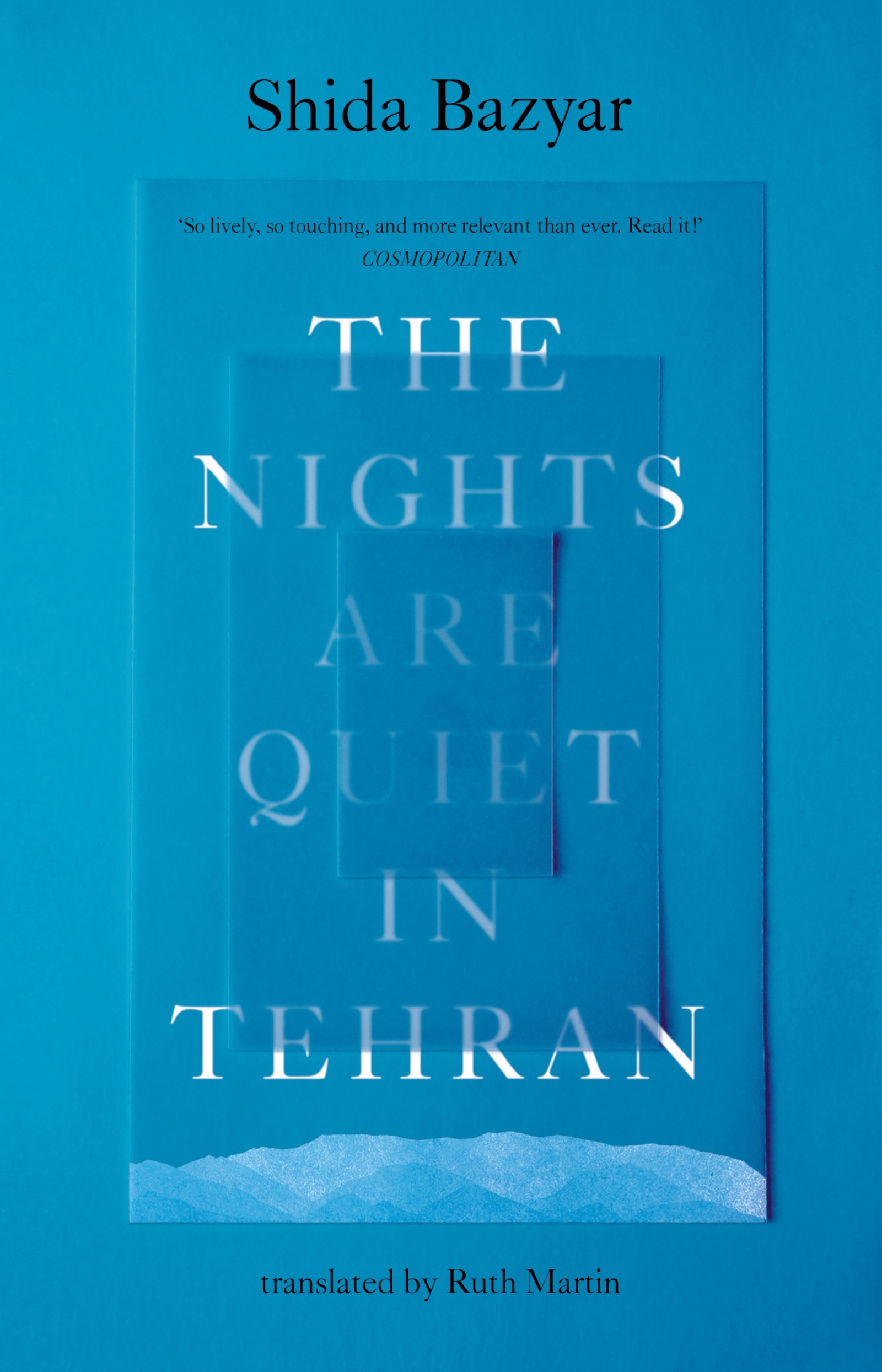
The Nights Are Quiet in Tehran
About this book
In 1979, Behsad joins communist friends working for a new Iran after the Shah’s departure and falls in love with Nahid. The revolution’s promise narrows under the Islamic Republic, pushing the couple toward exile in West Germany.
Later sections move through 1989, 1999, and 2009 as their children inherit a country through radio reports, family stories, visits, and political events they experience from Europe. Laleh’s return to Tehran exposes the distance between memory and daily life; Mo’s German concerns are interrupted by the Green Movement.
Shida Bazyar gives each generation its own voice, allowing the same choices to appear as courage, secrecy, burden, or unfinished history. Exile preserves political commitments while also changing the language in which a family can discuss them.
The Nights Are Quiet in Tehran is a polyphonic family novel translated by Ruth Martin. It links intimate loyalties to the long aftermath of revolution without reducing either Iran or Germany to a single political position.
Read a sample
5,074 words
Plain text
From the opening
1979
Behzad
King of kings they called him, and they said, We rejoice in him, we rejoice in his wife and her beauty; they said, We love this country, and then we said, We love this country. We had to rejoice in his newborn son, for longer than we ever would a birth in our own family, his newborn son, in the far-off Palace of Flowers.
Our parents had been told that the oil, the Americans, the English, were part and parcel of the same thing, with the Shah, against us. Our parents stopped working, took to the streets, and then went home again; they were afraid of the secret service and they said nothing more, said nothing against the Shah ever again. Sent us to school and said, We love this country; now you love its schools.
His haughty gaze above the teacher’s desk. We learned what we had to learn, got older, and decided that whatever was written in our schoolbooks, we wanted the opposite. We read Long live the Shah and thought, Death to the Shah. We heard All work is owed to the king and said, The work belongs to the workers. And when we read He leads us to prosperity, we spit on his palaces and on the English and the Americans. We smuggle books, copy them, learn them by heart, pass them on to the next person and the next. We have read and read and read, kept quiet at home and made a noise on the streets, cursed our parents and died for our children. The Shah has gone because he was sick, and the statues have fallen because the people didn’t believe in them.
The Revolution is getting older every week, and we love this country more than ever. The schoolbooks have been changed, in no time at all; we ripped out the pages about the Shah, and took his photo down off the wall. Here’s to no photo of any individual being put up in a classroom again, says Peyman. Here’s to the Ayatollah being put up there soon, back from exile, says his mother. Here’s to Marx and Engels, Che Guevara and Castro, Mao and Lenin being put up in these rooms soon, Sohrab and I say to each other at break time; we even say it in the staffroom now, louder than we ever could before. We’re just waiting for the moment when we’ll decide who fills the empty walls.
The Revolution is getting older every week, but it hasn’t even begun yet. The Shah has gone, and we’re at the beginning of a new age, a new system, a new freedom for which we are now preparing ourselves.
What remains is the turmoil on the streets, still euphoric, but a little less so with each passing week. What remains are the meetings of our movement, the plans, the pamphlets, the teaching units, the guerrilla exercises. They may once have been secret, but now they are ever more public, and we are ever more certain of victory — though sometimes our mood is more reflective, and sometimes more radical, and always with one eye on those people who also call themselves revolutionaries, but are religious with it. The real revolution, however, is still to come: the people’s revolution in the institutions. All that has happened so far is just the first step.
Long live socialism, long live our homeland, our pearl, our Iran!
The Revolution is a month old, and Dayeh is making stuffed vine leaves. They’re all sitting on the floor, my mother, my sisters, my cousins, my aunts. The wives of my older brothers. They have laid the sofrehs out on the living-room floor and are sitting around them with bowls full of rice and minced meat, herbs, lentils, and they are folding vine leaves, one after another, and laying them in a pot and talking and laughing and talking and laughing.
There were just as many women when we were little, though they were different women. Our dayeh would send my sisters and me outside; we weren’t supposed to hear the women’s conversation, to interrupt the neighbourhood gossip. You mustn’t bother people while they’re cooking, we were told, or the food will take longer to make, and we went outside, where we played marbles or pretended to shoot down the murderer of the great and oh-so-honourable Imam Hossein. That was Sohrab’s favourite game. Sohrab didn’t have any siblings of his own yet, and he would always hang around outside the house so that we and the other children would come and release him from his boredom. He’ll be waiting for me again in a few hours. Not bored, not any longer, but driven by a restlessness that we have carried within us since the first stirrings of the Revolution and since it broke out and for the whole of the past month — and which we know we must hide. Restlessness is uncertainty, and future leaders must not show any uncertainty. Only someone who has known Sohrab since he was a child can see it in him.
Dayeh doesn’t send me out these days, though she would like me to leave. Everything about her eyes, her posture says that I shouldn’t be here, that I should only come into contact with the vine leaves once they land hot and cooked and round and gleaming on the sofreh, and I shouldn’t talk about them before that, either, because before that they have no business being in my world. Dayeh has a look that is just for me. For me, sitting in the corner and smoking, a man who needs to leave already so that the women can have the interesting conversations they’ve been looking forward to all morning. Even as a child, I quite quickly realised that it was more interesting with the women. The men either talked about the politics of ages past or played cards, and I wasn’t allowed to join the game. But the women talked about real people and real problems. Which neighbour had argued with her mother-in-law; whose daughter was engaged to whose son but had shown herself to be immoral; which families had drifted into an American lifestyle; which market vendor sold the best-tasting eggplant.
Continue reading the sampleClose the sample
My nieces and nephews run and play between the women, knowing that the moment is approaching when first I and then they will be sent out and they will have to find a new game. There isn’t much to snack on when vine leaves are being stuffed; the rice mixture isn’t very interesting, and the leaves don’t taste good without their filling. When there’s nothing to snack on, you can make a nuisance of yourself. My niece is the smallest, and she wants the smallest dolmeh. My brother Mehrdad is the fattest, and he wants the fattest dolmeh. The women give in with a laugh, planting kisses on the children’s cheeks.
If I were a mother, a sister, an aunt, I would be sitting there doing the same; I would take every opportunity to kiss these little souls, because they’re so joyful, and no matter what is happening outside, no matter what they’re learning at school, no matter that their schoolbooks are suddenly endorsing the opposite of what they did a few weeks previously, no matter if a while ago their parents were still spending their nights on the roof and their days on the streets, returning with bloodied clothes — the children still spend their days laughing, questioning, eating, interrupting, sleeping. They deserve all the kisses in the world, I think, but maybe the life that is just around the corner, still wavering a little — maybe that is the much greater gift.
I could collar my brother Mehrdad, the fat one, could kiss him and tell him the new life isn’t wavering, we aren’t wavering, it just needs a bit more time, that’s all. But Mehrdad is currently pulling his sister’s plaits and being scolded loudly by our mother. He won’t understand what he has to thank us for until later, a few years, a few decades from now, when he’s leading the free and fair life that is his due. When it won’t be the modest house he grew up in, but his own actions and learning that pave the way to his place in society; when he’ll enjoy an education far removed from any propaganda and will exercise his freedom of thought; when he’ll work and take our country forward without lining a dictator’s pockets; when no one will be above or below him.
Dayeh’s look has changed since I stopped being Behzad the snacking thief. I was quicker at swiping food than my nieces and nephews are now, and I interrupted sooner, always interrupted. He’s a nuisance, but what can I do. He’s so clever, you can’t be cross with him, they said. Dayeh used to have a special look for us children, a severe look that went with her upright posture. Her head was always slightly raised, majestic, and her lips pressed purposefully together. There was a small, tender, almost imperceptible smile in her large, warm eyes. She is looking at me now, too, now that I have lit my second cigarette, the one that signals I have no intention of leaving yet, and her look is that of a woman who wants to do everything right for her guests, and I am the speck of dust she has overlooked while cleaning, the smell of food from the day before yesterday that just can’t be disguised, the rumour about us hanging in the air that no one dares speak aloud. But rumours about the movement aren’t things to be discussed in daylight with the neighbours; they aren’t things to be examined for how much truth is in them. They are whispered behind your hand to people you trust, because no one knows what is yet to come.
Behzadjan, go and help your father in the shop, my mother calls out to me. The women look over, and I laugh, shake my head, and flick ash into the glass ashtray by my feet. And take the little ones with you, my aunt says, with a long-suffering look that makes the others laugh. And since when do we smoke while food is being prepared? my eldest aunt says — but not to amuse the others, just to show once more what she thinks of me, this woman who didn’t remove her hijab even after they were banned by Reza Shah. The women go on smiling into their vine leaves as their hands wrap dextrously, daintily. How many hands wrap just like this, day after day in this country, I wonder, how many knead, how many knot, how many dig, how many shoot, how many lose their fingernails in the battle for names? The women’s hands are small and quick and wrinkled.
My eldest aunt carefully smooths her hair back under her hijab, a pointedly bored look travels in my direction, and she says to the group, Behzadjan, you still haven’t told us how you liked my friend’s daughter! Twice I brought her with me, such a nice, polite girl, and I’m sure she’s waiting for you to propose. My aunts and cousins smile into their vine leaves. Khalejan, I say, I have no idea who you’re talking about — the most honourable and upright women are sitting here right now around this sofreh, how am I supposed to notice any other girl? My aunt grouses. I smile and say, Maybe you need to invite her again, and Dayeh clicks her tongue. Don’t take him seriously, she says, He has nothing in his head but his books and his friends, no woman will want him. The other women laugh. I stub out my cigarette, stand up, straighten my shirt, nod to them all, and say, If you’ll excuse me, and they hiss me out of the room. Appealing to romantic feelings in these times only takes away from the struggle, but if they want to start inviting women to meet me, then why not the one with the serious eyes and the loud laugh, the one I’ve seen more often recently, whose name I am still trying to find out?
In the yard I put on my shoes — they are old and worn and Dayeh scolds me every time she sees them. What do you want from me? I say then, They’re the same shoes my pupils wear. And then she gives me that new look, every time. Though she still holds herself very straight, she suddenly looks so much smaller than me, and she has suddenly stopped trying to conceal the fact that she is, now. I’m twenty-seven years old, the only one of her four grown-up sons who still lives at home, bringing in money, looking after the girls, giving the boys a clip round the ear. Her head is proudly raised, as it always has been, only now she has to do it in order to look up at me. As if she’s trying to memorise my face, as if she wishes I would just go into another room and not out into the city streets, as if she can see the blood, all the blood we don’t mention to her, but which she knows about all the same. Khoda negahdar, she says then, just a phrase you use to bid someone farewell, God protect you, except she doesn’t say it like everyone else. She says it like a fresh realisation, making an effort to look not at my worn-out shoes but into my eyes.
Sohrab and I meet outside the university. Our meeting points have changed, and places we never used to frequent have become increasingly important to us in the past month. I spot him from a distance. Short, thin, his hands in his trouser pockets, the back of his military shirt drenched in sweat, his hair rather longer than his mother would like. He turns and doesn’t smile. We don’t let on that we are comrades, that we are together, that we fight side by side, that we each used to be reprimanded by the other’s mother, and taken to the barber by the other’s father.
The pavement is covered in plastic jerry cans. You queue for petrol, and you meet up with friends and neighbours while the jerry cans keep your place, serried ranks of brightly coloured plastic. It’s Peyman’s turn to go for petrol today — he, too, was always in and out of our parents’ houses, but was somehow always slower than Sohrab and me. Slower taking off his shoes, slower to greet my mother, slower stumbling into the room. Peyman doesn’t meet up with anyone when he goes for petrol; he just stands there, eavesdropping on what other people say.
Nowhere are you closer to them, he’ll say afterwards, We can’t keep sitting in our living rooms talking about the people if we don’t know the people. I always just give him a little nod and think, if you need that, Peyman, if you want to listen to all the stuff that’s doing the rounds and is believed by all those who were denied an education from the very start, then go ahead, queue for petrol and walk among the people and listen to the gossip. They’re saying that Mossadegh was a member of the Tudeh Party, that the communists want to share everything, first and foremost their wives, that the assassination attempt against Ayatollah Khomeini failed because all his bodyguards suddenly morphed into him — you go ahead and listen to that, Peyman.
Though I don’t actually think it’s so wrong, what he says; we should know what people are saying about our movement. But there are more important things to be doing right now. And anyway, how could we not know the people? We are the people. Peyman’s parents can’t read, my grandparents still live in the countryside with no running water, and my pupils have lice, no matter how often I shave their heads — who are the people, if not us?
Peyman, like so many, wasn’t at all political before the Revolution. When Sohrab and I made new friends after we finished school, he wasn’t interested in their ideas, and when we read Gorky and Rousseau in secret, he wasn’t interested in their books. When we were writing our flyers, not long before the Revolution, he wasn’t interested in their demands. He always just smiled and said, We need to make sure there is food, there is water, and that the children are going to school, and then a people can stage a revolution. We need to make sure there are books, I replied, books from which we can learn how others did it before us, and we need to make sure the weapons don’t remain in the soldiers’ hands. Peyman’s smile is the smile of a man who has understood something, but isn’t managing to convince everyone else.
And because he is silently, conscientiously queuing for petrol, today Sohrab and I are the only ones going to the rallies at Tehran University, and when the two of us meet, it’s different from when the three of us do, because even if the Revolution has somehow politicised everyone, even Peyman, Sohrab and I joined the movement first and will remain members until our deaths. I move closer to Sohrab and he gives me a sideways glance, then looks away again, at his feet perhaps, his shoes the same as mine. His leg is now fully healed.
You walk quickly at the demonstrations; we walked quickly that day, too, the day before the day when the Shah left and the Revolution celebrated its victory. A day we said we’d tell our children about: where we were and what we were doing when we heard that the Shah was leaving the country; we left our houses like we did every day then, with the momentum that drew us out, that still draws us out. It was no longer a conscious decision; in a revolution, the crowd takes over your thinking, the crowd replaces your judgement. There were Sohrab and I, outside the house — I can’t even remember if we’d arranged to meet. We looked like we always did, and the streets looked like they always did, but everything was overlaid with a kind of enchantment, with a song, as at Eid Nowruz maybe — only, I have thought for a long time what a shame it is that Eid Nowruz is now just a memory of what it was like when I was a child, the smell of the hyacinths, the magic of new clothes, the first days of spring and the beginning of a new year. Everything in me was crying out that a revolution is different, it isn’t just children who are moved by a revolution. Sohrab and I, keeping pace with one another — we always walk fast, we’re always in a hurry — met the others on the streets of our beloved city, men and women from the neighbourhood whom we didn’t know before, and who all became our brothers and sisters in the days and weeks when things were getting easier, less covert. Sweets and kisses on the streets, and you didn’t even notice the transition: one minute we were sitting side by side and silent at home, and the next we were part of the crowd, part of the roiling, bellowing crowd, part of the movement, part of the struggle, and we flung our fists up at the sky. As if to reward us for all the times before, like a sprint you are running for the hundredth time when you suddenly break the record; like flooring the same man in a koshti bout for the hundredth time, but today he hasn’t deliberately made it easy for you because he’s your father or your uncle — you have won because you are finally old enough and strong enough to be a real wrestler. Sohrab’s voice and mine flung the slogans into the cold winter sky, our smoky voices, no longer the voices of children, and so accustomed to mingling with one another. I raised my arm, and my arm was his arm, arms everywhere around us, black heads in front of us, behind us, military shirts and sweat, full beards and moustaches, hijabs and dyed hair, cigarette smoke and perfume, marching in step towards freedom, no questions anymore, no questions anywhere, all around us nothing but the answer we had prophesied for so long. I prophesied it, yelled a voice in my head, I said it after the first page of Marx, I said it after the first page of Lenin, and I’ll say it until I die, until they burn me in hell or until they realise there is no path other than the one history prescribes, that it is pointless to oppose us, that we are mightier — my fist shot into the air, Long live international solidarity. But then suddenly Sohrab’s fist was no longer my fist, suddenly his fist was no longer raised, and it was only then that I heard the echo of the shot that had felled him, and how small a person is when they fall to the ground in a crowd. He wasn’t looking at me, just at his leg, his eyes filled with pain, and he was crying, Khoda! I never asked him about it later, and maybe he’s forgotten it himself — but in a moment of terrible pain, he cried out to a god we don’t believe in. And if there is one thing we learned in all those days on the streets of Tehran, then it is that someone is always a doctor. The shot to Sohrab’s leg like a shot to my heart, and around me people with beards that had a touch of frost on them, and Sohrab’s leg wouldn’t stop bleeding, and for a second I thought, maybe this is the moment when someone dies right beside me, the moment when the photo of the martyr we raise aloft isn’t some unknown hero, but just Sohrab. Sohrab was not to become a martyr, though; Sohrab got up, helped by strangers who took him into a doorway. Comrade, Sohrab shouted, keep marching, we need more of us among the people. And he said it even though the men helping him could hear, men carrying pictures of Khomeini. I nodded to them, resolutely, nodded to Sohrab, and hurried away. We are brothers, we are comrades, I thought, but the battle will not be fought in doorways down side streets, and I looked for the others, who two days before had cleared out the barracks and were defending their barricades, and I thought, if I throw a grenade today, hurl a Molotov cocktail, if I get a gun today, then I’ll throw, then I’ll shoot, at everyone’s feet.
Since the Revolution, we have been venturing into buildings we didn’t know before. Before, we were in living rooms, sometimes in secret offices, sometimes on buses, visiting the movement in other cities. Since the Revolution, all doors seem to have opened, to let everyone in everywhere. Evin Prison, open to visitors. The place to which we lost our brothers and sisters in all those years of struggle against the monarchy — a place that was actually never a place, but a parallel world, a parallel hell. The people who came out didn’t talk about what had gone on inside; the people who came out had done their talking inside, and perhaps that was the most sinister thing about it. Evin Prison, a place that consumes people, a place almost too much discussed to be true. Suddenly the doors were open. Suddenly we were going in. Suddenly it was no longer a place of torture, but of the greatest derision. This Shah isn’t coming back, every wall, every door screamed out.
Today, then, the university. Sohrab’s leg has completely healed. He moves with pride and ease along the campus paths, and so do I.
We never studied here; we did our military service, because that’s what the state wanted from us, and it gave our parents money. We learned how to use weapons, and we remembered those lessons. We used all the resources the military had, enlightened the other soldiers, rebelled against our commanders, and rejoiced when we heard: the military is no longer on the Shah’s side — from now on, the military is neutral. Because the military had changed from within, and that was something we had helped to achieve. We used the military to become teachers, to learn all the things we wanted to learn, to receive permission to go out to the villages and teach the children what we wanted to teach them — for as long as the SAVAK permitted each time.
We didn’t need university for any of this, but we need it now, when the doors are open, so that we can walk these paths with pride and ease. I don’t know if Sohrab is walking like this because I am, if we are both walking like this because the other people in our movement do, and if the members of other movements walk like our own comrades. In fact, I believe I’d begun walking like this even before the others came into my life. Before the car, the gleaming white Paykan, stopped outside my school and a future comrade asked me to get in and I wasn’t suspicious, because I felt, I sensed that this wasn’t the SAVAK driving me out into the mountains, this man who looked at the forests with me and said, Think about it, comrade. And in fact, I would have been amazed if they’d never asked me.
The university campus is large and confusing; we follow the walls, looking at the posters and pamphlets. All these groups suddenly emerged a few weeks ago as if from nowhere. To proclaim what our country’s future could be now and what their aims are, their ideals, and what kind of state they want to see, now that anything seems possible. As we walk and observe, Sohrab and I don’t show any emotion. The days of the underground are over, but as yet no one has fired the starter’s pistol, no one has said to our movement, Let yourselves be known, no one has given us permission.
The texts on the flyers are so different in what they say, and so similar in how they sound. And I don’t have to read them; I think it’s roughly the same waste of time as queuing for petrol in order to listen to the rumours about us. We don’t need to read the things we’re pointing out to each other; we just have to keep fighting, to create a new Cuba, a new Soviet Union.
Sohrab leads and I follow; Sohrab chooses the groups we listen to, the followers of the Ayatollah, the Tudeh, the Mojahedin. In the struggle and on the streets, they were our brothers and sisters, united against the monarchy, against oppression and American imperialism. We were many, and we were strong, and we still are. Even if some believe in a divine power and armed struggle, and others in The Communist Party Manifesto and pacifism. Cooperation was the first step, but after this, we will lead the way. Sohrab listens to the speakers for a while, not showing any emotion, then walks on. I follow, and we leave the university.
Outside, we smoke a cigarette. How’s your leg? I could ask, but we don’t ask these things. How did you find it in there? he could ask me, but we don’t ask these things. Which group did you find most convincing? I could ask, but we really don’t ask these things. We don’t ask questions anymore. Since the Revolution, it feels as though everyone used to ask us questions, and the Revolution was our answer. Does your mother scold you about your shoes? I hear myself asking. Sohrab looks at his feet. It’s bourgeois to talk about clothes, he says, stubbing his cigarette out on the grey wall of the building.
What actually happens after a revolution? I could ask, though we’ve answered that too many times already for the question still to be asked: class struggle, radical change in the institutions, a dictatorship of the proletariat. But actually, Sohrab and I have just spent the last few days walking around prisons and universities, and actually, for the last few weeks, my comrades and I have been holding the same meetings we did before. Actually, there were only a few days when our songs and chants were aired publicly, and actually every program is now full of Ayatollah Khomeini. Sending the religious leader into exile all those years ago was probably the Shah’s gravest error; the Ayatollah led his and our people from abroad, and now he’s back and calling himself the leader of the Revolution.
One day my children can ask me how a revolution happens, and I’ll serve them up the answer on a silver platter engraved with a gun and a sickle. What actually, really happens after a revolution is something I’ve never heard anyone ask out loud.
Dayeh made dolmeh today, I say. Sohrab nods. My mother loves him like her own son. Peyman is certain to have delivered the petrol to her by now. I’m hungry.
Peyman takes photos. His camera is large and makes him look even smaller than he is. We act like it bothers us that he’s taking photos of our meetings, like it’s just kitsch and vanity. And yet no one stops him; I don’t know where the prints end up. All I know is that Che Guevara and Castro wouldn’t be up on our walls if one of their comrades hadn’t had a camera to hand as well.
Today’s meeting is over; it was about the clerics’ current activities, and Sohrab and I gave a brief report on the rallies at the university. As so often, the conclusion of the meeting is far from being the end of the evening. There are no sleeping family members to consider, no one to suggest we get a good night’s sleep for the sake of the Revolution. It’s just us, with our cigarettes, our talk — which for a few moments is permitted to grow less serious — laughter and black tea.