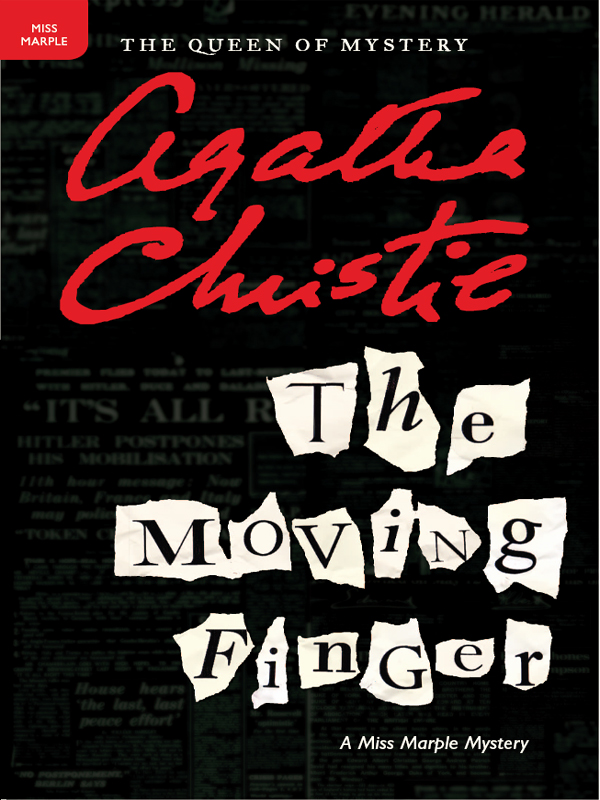
The Moving Finger: A Miss Marple Mystery
About this book
Jerry Burton moves to Lymstock to recover from an injury, bringing his sister Joanna. Their peaceful routine is interrupted by a crude letter alleging that the siblings are not related.
Other residents have received similar messages. When a solicitor's wife is found dead beside one of them, the village assumes shame caused suicide, but the letters may have been designed to prepare a different conclusion.
Jerry narrates the social investigation as gossip exposes marriages, households, and resentments. Miss Marple arrives late but recognizes that obscenity can be camouflage for a very specific practical motive.
The Moving Finger is the third Miss Marple novel, though she appears only in the later part of the book. The central case is self-contained and can be read independently.
Read a sample
5,001 words
Plain text
From the opening
One
I
When at last I was taken out of the plaster, and the doctors had pulled me about to their hearts’ content, and nurses had wheedled me into cautiously using my limbs, and I had been nauseated by their practically using baby talk to me, Marcus Kent told me I was to go and live in the country.
“Good air, quiet life, nothing to do—that’s the prescription for you. That sister of yours will look after you. Eat, sleep and imitate the vegetable kingdom as far as possible.”
I didn’t ask him if I’d ever be able to fly again. There are questions that you don’t ask because you’re afraid of the answers to them. In the same way during the last five months I’d never asked if I was going to be condemned to lie on my back all my life. I was afraid of a bright hypocritical reassurance from Sister. “Come now, what a question to ask! We don’t let our patients go talking in that way!”
So I hadn’t asked—and it had been all right. I wasn’t to be a helpless cripple. I could move my legs, stand on them, finally walk a few steps—and if I did feel rather like an adventurous baby learning to toddle, with wobbly knees and cotton wool soles to my feet—well, that was only weakness and disuse and would pass.
Marcus Kent, who is the right kind of doctor, answered what I hadn’t said.
“You’re going to recover completely,” he said. “We weren’t sure until last Tuesday when you had that final overhaul, but I can tell you so authoritatively now. But—it’s going to be a long business. A long and, if I may so, a wearisome business. When it’s a question of healing nerves and muscles, the brain must help the body. Any impatience, any fretting, will throw you back. And whatever you do, don’t ‘will yourself to get well quickly.’ Anything of that kind and you’ll find yourself back in a nursing home. You’ve got to take life slowly and easily, the tempo is marked Legato. Not only has your body got to recover, but your nerves have been weakened by the necessity of keeping you under drugs for so long.
“That’s why I say, go down to the country, take a house, get interested in local politics, in local scandal, in village gossip. Take an inquisitive and violent interest in your neighbours. If I may make a suggestion, go to a part of the world where you haven’t got any friends scattered about.”
I nodded. “I had already,” I said, “thought of that.”
I could think of nothing more insufferable than members of one’s own gang dropping in full of sympathy and their own affairs.
“But Jerry, you’re looking marvellous—isn’t he? Absolutely. Darling, I must tell you—What do you think Buster has done now?”
No, none of that for me. Dogs are wise. They crawl away into a quiet corner and lick their wounds and do not rejoin the world until they are whole once more.
So it came about that Joanna and I, sorting wildly through houseagents’ glowing eulogies of properties all over the British Isles, selected Little Furze, Lymstock, as one of the “possibles” to be viewed, mainly because we had never been to Lymstock, and knew no one in that neighbourhood.
And when Joanna saw Little Furze she decided at once that it was just the house we wanted.
It lay about half a mile out of Lymstock on the road leading up to the moors. It was a prim low white house, with a sloping Victorian veranda painted a faded green. It had a pleasant view over a slope of heather-covered land with the church spire of Lymstock down below to the left.
It had belonged to a family of maiden ladies, the Misses Barton, of whom only one was left, the youngest, Miss Emily.
Miss Emily Barton was a charming little old lady who matched her house in an incredible way. In a soft apologetic voice she explained to Joanna that she had never let her house before, indeed would never have thought of doing so, “but you see, my dear, things are so different nowadays—taxation, of course, and then my stocks and shares, so safe, as I always imagined, and indeed the bank manager himself recommended some of them, but they seem to be paying nothing at all these days—foreign, of course! And really it makes it all so difficult. One does not (I’m sure you will understand me, my dear, and not take offence, you look so kind) like the idea of letting one’s house to strangers—but something must be done, and really, having seen you, I shall be quite glad to think of you being here—it needs, you know, young life. And I must confess I did shrink from the idea of having Men here!”
At this point, Joanna had to break the news of me. Miss Emily rallied well.
“Oh dear, I see. How sad! A flying accident? So brave, these young men. Still, your brother will be practically an invalid—”
The thought seemed to soothe the gentle little lady. Presumably I should not be indulging in those grosser masculine activities which Emily Barton feared. She inquired diffidently if I smoked.
“Like a chimney,” said Joanna. “But then,” she pointed out, “so do I.”
Continue reading the sampleClose the sample
“Of course, of course. So stupid of me. I’m afraid, you know, I haven’t moved with the times. My sisters were all older than myself, and my dear mother lived to be ninety-seven—just fancy!—and was most particular. Yes, yes, everyone smokes now. The only thing is, there are no ashtrays in the house.”
Joanna said that we would bring lots of ashtrays, and she added with a smile, “We won’t put down cigarette ends on your nice furniture, that I do promise you. Nothing makes me so mad myself as to see people do that.”
So it was settled and we took Little Furze for a period of six months, with an option of another three, and Emily Barton explained to Joanna that she herself was going to be very comfortable because she was going into rooms kept by an old parlourmaid, “my faithful Florence,” who had married “after being with us for fifteen years. Such a nice girl, and her husband is in the building trade. They have a nice house in the High Street and two beautiful rooms on the top floor where I shall be most comfortable, and Florence so pleased to have me.”
So everything seemed to be most satisfactory, and the agreement was signed and in due course Joanna and I arrived and settled in, and Miss Emily Barton’s maid Partridge having consented to remain, we were well looked after with the assistance of a “girl” who came in every morning and who seemed to be half-witted but amiable.
Partridge, a gaunt dour female of middle age, cooked admirably, and though disapproving of late dinner (it having been Miss Emily’s custom to dine lightly off a boiled egg) nevertheless accommodated herself to our ways and went so far as to admit that she could see I needed my strength building up.
When we had settled in and been at Little Furze a week Miss Emily Barton came solemnly and left cards. Her example was followed by Mrs. Symmington, the lawyer’s wife, Miss Griffith, the doctor’s sister, Mrs. Dane Calthrop, the vicar’s wife, and Mr. Pye of Prior’s End.
Joanna was very much impressed.
“I didn’t know,” she said in an awestruck voice, “that people really called—with cards.”
“That is because, my child,” I said, “you know nothing about the country.”
“Nonsense. I’ve stayed away for heaps of weekends with people.”
“That is not at all the same thing,” I said.
I am five years older than Joanna. I can remember as a child the big white shabby untidy house we had with the fields running down to the river. I can remember creeping under the nets of raspberry canes unseen by the gardener, and the smell of white dust in the stable yard and an orange cat crossing it, and the sound of horse hoofs kicking something in the stables.
But when I was seven and Joanna two, we went to live in London with an aunt, and thereafter our Christmas and Easter holidays were spent there with pantomimes and theatres and cinemas and excursions to Kensington Gardens with boats, and later to skating rinks. In August we were taken to an hotel by the seaside somewhere.
Reflecting on this, I said thoughtfully to Joanna, and with a feeling of compunction as I realized what a selfish, self-centred invalid I had become:
“This is going to be pretty frightful for you, I’m afraid. You’ll miss everything so.”
For Joanna is very pretty and very gay, and she likes dancing and cocktails, and love affairs and rushing about in high-powered cars.
Joanna laughed and said she didn’t mind at all.
“As a matter of fact, I’m glad to get away from it all. I really was fed up with the whole crowd, and although you won’t be sympathetic, I was really very cut up about Paul. It will take me a long time to get over it.”
I was sceptical over this. Joanna’s love affairs always run the same course. She has a mad infatuation for some completely spineless young man who is a misunderstood genius. She listens to his endless complaints and works like anything to get him recognition. Then, when he is ungrateful, she is deeply wounded and says her heart is broken—until the next gloomy young man comes along, which is usually about three weeks later!
So I did not take Joanna’s broken heart very seriously. But I did see that living in the country was like a new game to my attractive sister.
“At any rate,” she said, “I look all right, don’t I?”
I studied her critically and was not able to agree.
Joanna was dressed (by Mirotin) for le Sport. That is to say she was wearing a skirt of outrageous and preposterous checks. It was skintight, and on her upper half she had a ridiculous little shortsleeved jersey with a Tyrolean effect. She had sheer silk stockings and some irreproachable but brand new brogues.
“No,” I said, “you’re all wrong. You ought to be wearing a very old tweed skirt, preferably of dirty green or faded brown. You’d wear a nice cashmere jumper matching it, and perhaps a cardigan coat, and you’d have a felt hat and thick stockings and old shoes. Then, and only then, you’d sink into the background of Lymstock High Street, and not stand out as you do at present.” I added: “Your face is all wrong, too.”
“What’s wrong with that? I’ve got on my Country Tan Makeup No. 2.”
“Exactly,” I said. “If you lived in Lymstock, you would have on just a little powder to take the shine off your nose, and possibly a soupçon of lipstick—not very well applied—and you would almost certainly be wearing all your eyebrows instead of only a quarter of them.”
Joanna gurgled and seemed much amused.
“Do you think they’ll think I’m awful?” she said.
“No,” I said. “Just queer.”
Joanna had resumed her study of the cards left by our callers. Only the vicar’s wife had been so fortunate, or possibly unfortunate, as to catch Joanna at home.
Joanna murmured:
“It’s rather like Happy Families, isn’t it? Mrs. Legal the lawyer’s wife, Miss Dose the doctor’s daughter, etc.” She added with enthusiasm: “I do think this is a nice place, Jerry! So sweet and funny and old-world. You just can’t think of anything nasty happening here, can you?”
And although I knew what she said was really nonsense, I agreed with her. In a place like Lymstock nothing nasty could happen. It is odd to think that it was just a week later that we got the first letter.
II
I see that I have begun badly. I have given no description of Lymstock and without understanding what Lymstock is like, it is impossible to understand my story.
To begin with, Lymstock has its roots in the past. Somewhere about the time of the Norman Conquest, Lymstock was a place of importance. That importance was chiefly ecclesiastical. Lymstock had a priory, and it had a long succession of ambitious and powerful priors. Lords and barons in the surrounding countryside made themselves right with Heaven by leaving certain of their lands to the priory. Lymstock Priory waxed rich and important and was a power in the land for many centuries. In due course, however, Henry the Eighth caused it to share the fate of its contemporaries. From then on a castle dominated the town. It was still important. It had rights and privileges and wealth.
And then, somewhere in seventeen hundred and something, the tide of progress swept Lymstock into a backwater. The castle crumbled. Neither railways nor main roads came near Lymstock. It turned into a little provincial market town, unimportant and forgotten, with a sweep of moorland rising behind it, and placid farms and fields ringing it round.
A market was held there once a week, on which day one was apt to encounter cattle in the lanes and roads. It had a small race meeting twice a year which only the most obscure horses attended. It had a charming High Street with dignified houses set flat back, looking slightly incongruous with their ground-floor windows displaying buns or vegetables or fruit. It had a long straggling draper’s shop, a large and portentous ironmonger’s, a pretentious post office, and a row of straggly indeterminate shops, two rival butchers and an International Stores. It had a doctor, a firm of solicitors, Messrs. Galbraith, Galbraith and Symmington, a beautiful and unexpectedly large church dating from fourteen hundred and twenty, with some Saxon remains incorporated in it, a new and hideous school, and two pubs.
Such was Lymstock, and urged on by Emily Barton, anybody who was anybody came to call upon us, and in due course Joanna, having bought a pair of gloves and assumed a velvet beret rather the worse for wear, sallied forth to return them.
To us, it was all quite novel and entertaining. We were not there for life. It was, for us, an interlude. I prepared to obey my doctor’s instructions and get interested in my neighbours.
Joanna and I found it all great fun.
I remembered, I suppose, Marcus Kent’s instructions to enjoy the local scandals. I certainly didn’t suspect how these scandals were going to be introduced to my notice.
The odd part of it was that the letter, when it came, amused us more than anything else.
It arrived, I remember, at breakfast. I turned it over, in the idle way one does when time goes slowly and every event must be spun out to its full extent. It was, I saw, a local letter with a typewritten address.
I opened it before the two with London postmarks, since one of them was a bill and the other from a rather tiresome cousin.
Inside, printed words and letters had been cut out and gummed to a sheet of paper. For a minute or two I stared at the words without taking them in. Then I gasped.
Joanna, who was frowning over some bills, looked up.
“Hallo,” she said, “what is it? You look quite startled.”
The letter, using terms of the coarsest character, expressed the writer’s opinion that Joanna and I were not brother and sister.
“It’s a particularly foul anonymous letter,” I said.
I was still suffering from shock. Somehow one didn’t expect that kind of thing in the placid backwater of Lymstock.
Joanna at once displayed lively interest.
“No? What does it say?”
In novels, I have noticed, anonymous letters of a foul and disgusting character are never shown, if possible, to women. It is implied that women must at all cost be shielded from the shock it might give their delicate nervous systems.
I am sorry to say it never occurred to me not to show the letter to Joanna. I handed it to her at once.
She vindicated my belief in her toughness by displaying no emotion but that of amusement.
“What an awful bit of dirt! I’ve always heard about anonymous letters, but I’ve never seen one before. Are they always like this?”
“I can’t tell you,” I said. “It’s my first experience, too.”
Joanna began to giggle.
“You must have been right about my makeup, Jerry. I suppose they think I just must be an abandoned female!”
“That,” I said, “coupled with the fact that our father was a tall, dark lantern-jawed man and our mother a fair-haired blue-eyed little creature, and that I take after him and you take after her.”
Joanna nodded thoughtfully.
“Yes, we’re not a bit alike. Nobody would take us for brother and sister.”
“Somebody certainly hasn’t,” I said with feeling.
Joanna said she thought it was frightfully funny.
She dangled the letter thoughtfully by one corner and asked what we were to do with it.
“The correct procedure, I believe,” I said, “is to drop it into the fire with a sharp exclamation of disgust.”
I suited the action to the word, and Joanna applauded.
“You did that beautifully,” she added. “You ought to have been on the stage. It’s lucky we still have fires, isn’t it?”
“The wastepaper basket would have been much less dramatic,” I agreed. “I could, of course, have set light to it with a match and slowly watched it burn—or watched it slowly burn.”
“Things never burn when you want them to,” said Joanna. “They go out. You’d probably have had to strike match after match.”
She got up and went towards the window. Then, standing there, she turned her head sharply.
“I wonder,” she said, “who wrote it?”
“We’re never likely to know,” I said.
“No—I suppose not.” She was silent a moment, and then said: “I don’t know when I come to think of it that it is so funny after all. You know, I thought they—they liked us down here.”
“So they do,” I said. “This is just some half-crazy brain on the borderline.”
“I suppose so. Ugh— Nasty!”
As she went out into the sunshine I thought to myself as I smoked my after-breakfast cigarette that she was quite right. It was nasty. Someone resented our coming here—someone resented Joanna’s bright young sophisticated beauty—somebody wanted to hurt. To take it with a laugh was perhaps the best way—but deep down it wasn’t funny….
Dr. Griffith came that morning. I had fixed up for him to give me a weekly overhaul. I liked Owen Griffith. He was dark, ungainly, with awkward ways of moving and deft, very gentle hands. He had a jerky way of talking and was rather shy.
He reported progress to be encouraging. Then he added:
“You’re feeling all right, aren’t you. Is it my fancy, or are you a bit under the weather this morning?”
“Not really,” I said. “A particularly scurrilous anonymous letter arrived with the morning coffee, and it’s left rather a nasty taste in the mouth.”
He dropped his bag on the floor. His thin dark face was excited.
“Do you mean to say that you’ve had one of them?”
I was interested.
“They’ve been going about, then?”
“Yes. For some time.”
“Oh,” I said, “I see. I was under the impression that our presence as strangers was resented here.”
“No, no, it’s nothing to do with that. It’s just—” He paused and then asked, “What did it say? At least—” he turned suddenly red and embarrassed— “perhaps I oughtn’t to ask?”
“I’ll tell you with pleasure,” I said. “It just said that the fancy tart I’d brought down with me wasn’t my sister—not ’alf! And that, I may say, is a Bowdlerized version.”
His dark face flushed angrily.
“How damnable! Your sister didn’t—she’s not upset, I hope?”
“Joanna,” I said, “looks a little like the angel off the top of the Christmas tree, but she’s eminently modern and quite tough. She found it highly entertaining. Such things haven’t come her way before.”
“I should hope not, indeed,” said Griffith warmly.
“And anyway,” I said firmly. “That’s the best way to take it, I think. As something utterly ridiculous.”
“Yes,” said Owen Griffith. “Only—”
“Quite so,” I said. “Only is the word!”
“The trouble is,” he said, “that this sort of thing, once it starts, grows.”
“So I should imagine.”
“It’s pathological, of course.”
I nodded. “Any idea who’s behind it?” I asked.
“No, I wish I had. You see, the anonymous letter pest arises from one of two causes. Either it’s particular—directed at one particular person or set of people, that is to say it’s motivated, it’s someone who’s got a definite grudge (or thinks they have) and who chooses a particularly nasty and underhand way of working it off. It’s mean and disgusting but it’s not necessarily crazy, and it’s usually fairly easy to trace the writer—a discharged servant, a jealous woman—and so on. But if it’s general, and not particular, then it’s more serious. The letters are sent indiscriminately and serve the purpose of working off some frustration in the writer’s mind. As I say, it’s definitely pathological. And the craze grows. In the end, of course, you track down the person in question—it’s often someone extremely unlikely, and that’s that. There was a bad outburst of the kind over the other side of the county last year—turned out to be the head of the millinery department in a big draper’s establishment. Quiet, refined woman—had been there for years. I remember something of the same kind in my last practice up north—but that turned out to be purely personal spite. Still, as I say, I’ve seen something of this kind of thing, and, quite frankly, it frightens me!”
“Has it been going on long?” I asked.
“I don’t think so. Hard to say, of course, because people who get these letters don’t go round advertising the fact. They put them in the fire.”
He paused.
“I’ve had one myself. Symmington, the solicitor, he’s had one. And one or two of my poorer patients have told me about them.”
“All much the same sort of thing?”
“Oh yes. A definite harping on the sex theme. That’s always a feature.” He grinned. “Symmington was accused of illicit relations with his lady clerk—poor old Miss Ginch, who’s forty at least, with pince-nez and teeth like a rabbit. Symmington took it straight to the police. My letters accused me of violating professional decorum with my lady patients, stressing the details. They’re all quite childish and absurd, but horribly venomous.” His face changed, grew grave. “But all the same, I’m afraid. These things can be dangerous, you know.”
“I suppose they can.”
“You see,” he said, “crude, childish spite though it is, sooner or later one of these letters will hit the mark. And then, God knows what may happen! I’m afraid, too, of the effect upon the slow, suspicious uneducated mind. If they see a thing written, they believe it’s true. All sorts of complications may arise.”
“It was an illiterate sort of letter,” I said thoughtfully, “written by somebody practically illiterate, I should say.”
“Was it?” said Owen, and went away.
Thinking it over afterwards, I found that “Was it?” rather disturbing.
Two
I
I am not going to pretend that the arrival of our anonymous letter did not leave a nasty taste in the mouth. It did. At the same time, it soon passed out of my mind. I did not, you see, at that point, take it seriously. I think I remember saying to myself that these things probably happen fairly often in out-of-the-way villages. Some hysterical woman with a taste for dramatizing herself was probably at the bottom of it. Anyway, if the letters were as childish and silly as the one we had got, they couldn’t do much harm.
The next incident, if I may put it so, occurred about a week later, when Partridge, her lips set tightly together, informed me that Beatrice, the daily help, would not be coming today.
“I gather, sir,” said Partridge, “that the girl has been Upset.”
I was not very sure what Partridge was implying, but I diagnosed (wrongly) some stomachic trouble to which Partridge was too delicate to allude more directly. I said I was sorry and hoped she would soon be better.
“The girl is perfectly well, sir,” said Partridge. “She is Upset in her Feelings.”
“Oh,” I said rather doubtfully.
“Owing,” went on Partridge, “to a letter she has received. Making, I understand, Insinuations.”
The grimness of Partridge’s eye, coupled with the obvious capital I of Insinuations, made me apprehensive that the insinuations were concerned with me. Since I would hardly have recognized Beatrice by sight if I had met her in the town so unaware of her had I been—I felt a not unnatural annoyance. An invalid hobbling about on two sticks is hardly cast for the role of deceiver of village girls. I said irritably:
“What nonsense!”
“My very words, sir, to the girl’s mother,” said Partridge. “‘Goings On in this house,’ I said to her, ‘there never have been and never will be while I am in charge. As to Beatrice,’ I said, ‘girls are different nowadays, and as to Goings On elsewhere I can say nothing.’ But the truth is, sir, that Beatrice’s friend from the garage as she walks out with got one of them nasty letters too, and he isn’t acting reasonable at all.”
“I have never heard anything so preposterous in my life,” I said angrily.
“It’s my opinion, sir,” said Partridge, “that we’re well rid of the girl. What I say is, she wouldn’t take on so if there wasn’t something she didn’t want found out. No smoke without fire, that’s what I say.”
I had no idea how horribly tired I was going to get of that particular phrase.
II
That morning, by way of adventure, I was to walk down to the village. (Joanna and I always called it the village, although technically we were incorrect, and Lymstock would have been annoyed to hear us.)
The sun was shining, the air was cool and crisp with the sweetness of spring in it. I assembled my sticks and started off, firmly refusing to permit Joanna to accompany me.
“No,” I said, “I will not have a guardian angel teetering along beside me and uttering encouraging chirrups. A man travels fastest who travels alone, remember. I have much business to transact. I shall go to Galbraith, Galbraith and Symmington, and sign that transfer of shares, I shall call in at the baker’s and complain about the currant loaf, and I shall return that book we borrowed. I have to go to the bank, too. Let me away, woman, the morning is all too short.”
It was arranged that Joanna should pick me up with the car and drive me back up the hill in time for lunch.
“That ought to give you time to pass the time of day with everyone in Lymstock.”
“I have no doubt,” I said, “that I shall have seen anybody who is anybody by then.”
For morning in the High Street was a kind of rendezvous for shoppers, when news was exchanged.
I did not, after all, walk down to the town unaccompanied. I had gone about two hundred yards, when I heard a bicycle bell behind me, then a scrunching of brakes, and then Megan Hunter more or less fell off her machine at my feet.
“Hallo,” she said breathlessly as she rose and dusted herself off.
I rather liked Megan and always felt oddly sorry for her.
She was Symmington the lawyer’s stepdaughter, Mrs. Symmington’s daughter by a first marriage. Nobody talked much about Mr. (or Captain) Hunter, and I gathered that he was considered best forgotten. He was reported to have treated Mrs. Symmington very badly. She had divorced him a year or two after the marriage. She was a woman with means of her own and had settled down with her little daughter in Lymstock “to forget,” and had eventually married the only eligible bachelor in the place, Richard Symmington. There were two boys of the second marriage to whom their parents were devoted, and I fancied that Megan sometimes felt odd man out in the establishment. She certainly did not resemble her mother, who was a small anaemic woman, fadedly pretty, who talked in a thin melancholy voice of servant difficulties and her health.
Megan was a tall awkward girl, and although she was actually twenty, she looked more like a schoolgirlish sixteen. She had a shock of untidy brown hair, hazel green eyes, a thin bony face, and an unexpected charming one-sided smile. Her clothes were drab and unattractive and she usually had on lisle thread stockings with holes in them.
She looked, I decided this morning, much more like a horse than a human being. In fact she would have been a very nice horse with a little grooming.
She spoke, as usual, in a kind of breathless rush.
“I’ve been up to the farm—you know, Lasher’s—to see if they’d got any duck’s eggs. They’ve got an awfully nice lot of little pigs. Sweet! Do you like pigs? I even like the smell.”
“Well-kept pigs shouldn’t smell,” I said.
“Shouldn’t they? They all do round here. Are you walking down to the town? I saw you were alone, so I thought I’d stop and walk with you, only I stopped rather suddenly.”
“You’ve torn your stocking,” I said.