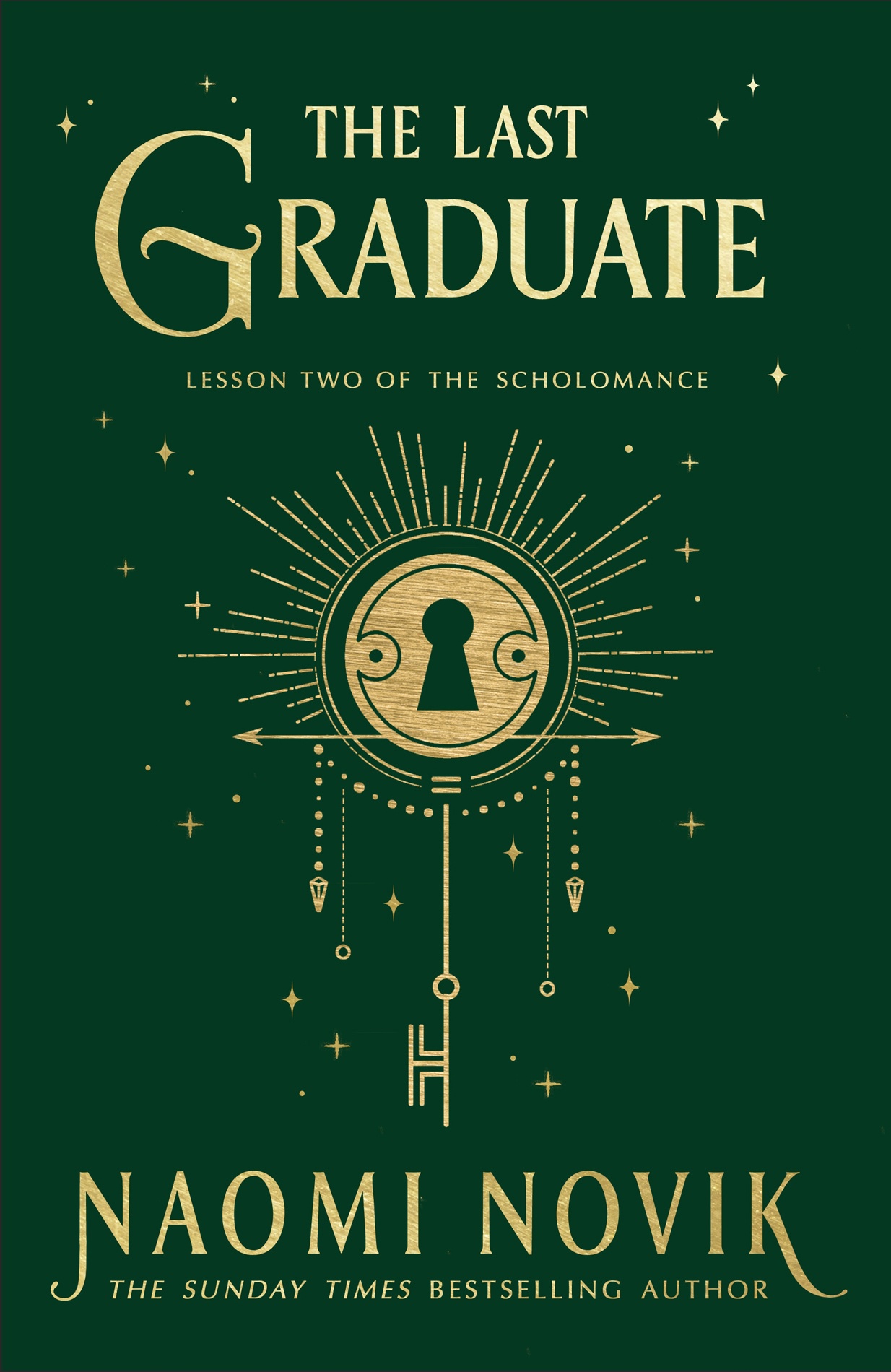
The Last Graduate
About this book
After years of planning for a solitary escape, El has allies and a clearer understanding of how the school directs danger. The change creates an impossible opportunity: graduate not only the students with protection and resources, but everyone.
Building that plan requires cooperation across enclave lines and a use for El’s catastrophic power that does not fulfil the destructive destiny others expect from her. Orion’s compulsion to fight monsters remains invaluable and increasingly alarming.
The novel treats graduation as an engineering and political problem. Routes, mana, practice groups, and trust have to function together, and a heroic individual cannot substitute for hundreds of people learning to protect one another.
The Last Graduate is the second Scholomance novel and begins immediately after A Deadly Education. Its final event leads directly into The Golden Enclaves.
Read a sample
5,071 words
Plain text
From the opening
Keep far away from Orion Lake.
Most of the religious or spiritual people I know—and to be fair, they’re mostly the sort of people who land in a vaguely pagan commune in Wales, or else they’re terrified wizard kids crammed into a school that’s trying to kill them—regularly beseech a benevolent and loving all-wise deity to provide them with useful advice through the medium of miraculous signs and portents. Speaking as my mother’s daughter, I can say with authority that they wouldn’t like it if they got it. You don’t want mysterious unexplained advice from someone you know has your best interests at heart and whose judgment is unerringly right and just and true. Either they’ll tell you to do what you want to do anyway, in which case you didn’t need their advice, or they’ll tell you to do the opposite, in which case you’ll have to choose between sullenly following their advice, like a little kid who has been forced to brush her teeth and go to bed at a reasonable hour, or ignoring it and grimly carrying on, all the while knowing that your course of action is guaranteed to lead you straight to pain and dismay.
If you’re wondering which of those two options I picked, then you must not know me, as pain and dismay were obviously my destination. I didn’t even need to think about it. Mum’s note was infinitely well-meant, but it wasn’t long: My darling girl, I love you, have courage, and keep far away from Orion Lake. I read the whole thing in a single glance and tore it up into pieces instantly, standing right there among the little freshmen milling about. I ate the scrap with Orion’s name on it myself and handed the rest out at once.
“What’s this?” Aadhya said. She was still giving me narrow-eyed indignation.
“It lifts the spirits,” I said. “My mum put it in the paper.”
“Yes, your mum, Gwen Higgins,” Aadhya said, even more coolly. “Who you’ve mentioned so often to us all.”
“Oh, just eat it,” I said, as irritably as I could manage after having just downed my own piece. The irritation wasn’t as hard to muster up as it might’ve been. I can’t think of anything I’ve missed in here, including the sun, the wind, or a night’s sleep in safety, nearly as much as I’ve missed Mum, so that’s what the spell gave me: the feeling of being curled up on her bed with my head in her lap and her hand stroking gently over my hair, the smell of the herbs she works with, the faint croaking of frogs outside the open door, and the wet earth of a Welsh spring. It would’ve lifted my spirits enormously if only I hadn’t been worrying deeply at the same time what she was trying to tell me about Orion.
The fun possibilities were endless. The best one was that he was doomed to die young and horribly, which given his penchant for heroics was reasonably predictable anyway. Unfortunately, falling in something or other with a doomed hero isn’t the sort of thing Mum would warn me off. She’s very much of the gather ye rosebuds while ye may school of thought.
Mum would only warn me off something bad, not something painful. So obviously Orion was the most brilliant maleficer ever, concealing his vile plans by saving the lives of everyone over and over just so he could, I don’t know, kill them himself later on? Or maybe Mum was worried that he was so annoying that he’d drive me to become the most brilliant maleficer ever, which was probably more plausible, since that’s supposedly my own doom anyway.
Of course, the most likely option was that Mum didn’t know herself. She’d just had a bad feeling about Orion, for no reason she could’ve told me even if she’d written me a ten-page letter on both sides. A feeling so bad that she’d hitchhiked all the way to Cardiff to find the nearest incoming freshman, and she’d asked his parents to send me her one-gram note. I reached out and poked Aaron in his tiny skinny shoulder. “Hey, what did Mum give your parents for bringing the message?”
He turned round and said uncertainly, “I don’t think she did? She said she didn’t have anything to pay with, but she asked to talk to them in private, and then she gave it to me and my mam squeezed a bit of my toothpaste out to make room.”
That might sound like nothing, but nobody wastes any of their inadequate four-year weight allowance on ordinary toothpaste; I brush with baking soda out of the alchemy lab supply cabinets myself. If Aaron had brought any at all, it was enchanted in some way: useful when you aren’t going to see a dentist for the next four years. He could have traded that one squeeze of it to someone with a bad toothache for a week of extra dinners, easily. And his parents had taken that away from their own kid—Mum had asked his parents to take that away from their own kid—just to get me the warning. “Great,” I said bitterly. “Here, have a bite.” I gave him one of the pieces of the note, too. He probably needed it as much as ever in his life, after just being sucked into the Scholomance. It’s better than the almost inevitable death waiting for wizard kids outside, but not by much.
Continue reading the sampleClose the sample
The food line opened up just then, and the ensuing stampede interfered with my brooding, but Liu asked me quietly, “Everything okay?” as we lined up.
I just stared at her blankly. It wasn’t mindreading or anything—she had an eye for small details, putting things together, and she indicated my pocket, where I’d put the last scrap of the note—the note whose actual contents I hadn’t shared, even while I’d passed out pieces with an enchantment that should have precluded all brooding. My confusion was because—she’d asked. I wasn’t used to anyone inquiring after me, or for that matter even noticing when I’m upset. Unless I’m sufficiently upset that I start conveying the impression that I’m about to set everyone around me on fire, which does in fact happen on a not infrequent basis.
I had to think about it to decide that I didn’t, actually, want to talk about the note. I’d never had the option. And having it meant—that I was telling Liu the truth when I nodded to say yes, everything’s okay, and smiled at her, the expression feeling a bit odd and stretchy round my mouth, unfamiliar. Liu smiled back, and then we were in the line, and we all focused on the job of filling our trays.
We’d lost our freshmen in the shuffle: they go last, obviously, and we now had the dubious privilege of going first. But nothing stops you taking extra for their benefit, if you can afford it, and at least for today we could. The walls of the school were still a bit warm from the end-of-term cleansing cycle. Any of the maleficaria that hadn’t been crisped to fine ash were all just starting to creep out of the various dark corners they’d hidden in, and the food was as unlikely to be contaminated as it ever was. So Liu took extra milk cartons for her cousins, and I took seconds of pasta for Aaron, a bit grudgingly. Technically he wasn’t owed anything for bringing the note, not by me; by Scholomance etiquette, that’s all settled outside. But he hadn’t got anything for it outside, after all.
It was odd being almost first out of the queue into the nearly empty cafeteria, with the enormously long tail of kids still snaking along the walls, tripled up, the sophomores poking the freshmen and pointing them at the ceiling tiles and the floor drains and the air vents on the walls, which they’d want to keep an eye on in the future. The last of the folded-up tables were scuttling back into the open space that had been left for the freshman rush, and unfolding back into place with squeals and thumps. My friend Nkoyo—could I think of her as a friend, too? I thought perhaps I could, but I hadn’t been handed a formal engraved notice yet, so I’d be doubtful a while longer—had got out in front with her best mates; she was at a prime table, positioned in the ring that’s exactly between the walls and the line, under only two ceiling tiles, with the nearest floor drain four tables away. She was standing up tall and waving us over, easy to spot: she was wearing a brand-new top and baggy trousers, each in a beautiful print of mixed wavy lines that I was fairly sure had enchantments woven in. This is the day of the year when everyone breaks out the one new outfit per year most of us brought in—my own extended wardrobe sadly got incinerated freshman year—and she had clearly been saving this one for senior year. Jowani was bringing over two big jugs of water while Cora did the perimeter wards.
It was odd, walking through the cafeteria over to join them. Even if we hadn’t been offered an actual invitation, there were loads of good tables still open, and all the bad ones. I’ve occasionally ended up with my pick of tables before, but that’s always been a bad and risky move born of getting to the cafeteria too early, usually as an act of desperation when I’d had too many days of bad luck with my meals. Now it was just the ordinary course of things. Everyone else going to the tables around me was a junior, too, or rather a senior; I knew most of them by face if not by name. Our numbers had been whittled down to roughly a thousand at this point, from a start of sixteen hundred. Which sounds horrifying, except there’re normally fewer than eight hundred kids left by the start of senior year. And normally, less than half of those make it out of graduation.
But our year had thrown a substantial wrench into the works, and he was sitting down at the table next to me. Nkoyo barely waited for me and Orion to take our seats before she burst out, “Did it work? Did you get the machinery fixed?”
“How many mals were down there?” Cora blurted over her at the same time, sliding into her own seat out of breath, still capping the small clay jug she’d used to drip a perimeter spell round the table.
They weren’t being rude, by Scholomance standards of etiquette: they were entitled to ask us, since they’d got the table; that’s more than a fair trade for first-hand information. Other seniors were busily occupying all the neighboring tables—giving us a solid perimeter of security—the better to listen in; the further ones were shamelessly leaning over and cupping their ears while friends watched their backs for them.
Everyone in the school already knew one very significant bit of information, namely that Orion and I had improbably made it back alive from our delightful excursion to the graduation hall this morning. But I’d spent the rest of the day holed up in my room, and Orion mostly avoided human beings unless they were being eaten by mals at the time, so anything else they’d heard had come to them filtered through the school gossip chain, and that’s not a confidence-inspiring source of information when you’re relying on it to stay alive.
I wasn’t enthusiastic about reliving the recent experience, but I knew they had a right to what I could give them. And it was indisputably me who had it to give, because before the food line had opened, I’d already overheard one of the other New York seniors asking Orion a similar question, and he’d said, “I think it went okay? I didn’t really see much. I just kept the mals off until they were done, and then we yanked back up.” It wasn’t even bravado; that was literally what he thought of the enterprise. Slaughtering a thousand mals in the middle of the graduation hall, just another day’s work. I could almost have felt sorry for Jermaine, who’d worn the expression of a person trying to have an important conversation with a brick wall.
“A lot,” I said to Cora, dryly. “The place was crammed, and they were all ravenous.” She swallowed, biting her lip, but nodded. Then I told Nkoyo, “The senior artificers thought they’d got it, anyway. And it took them an hour and change, so I hope they weren’t just faffing around.”
She nodded, her whole face intent. It wasn’t at all an academic question. If we really had fixed the equipment down in the graduation hall, then the same engines that run the cleansing up here twice a year, to burn out the mals infesting the corridors and classrooms, ran down there, too, and presumably wiped out a substantial number of the much larger and worse mals hanging round in the hall waiting for the graduation feast of seniors. Which meant that probably loads of the graduating class had made it. And much more to the point, that loads of our graduating class would have a better chance to make it.
“Do you think they really made it out okay? Clarita and the others?” Orion said, frowning into the churned mess of potatoes and peas and beef he was making out of what the cafeteria had called shepherd’s pie but was thankfully just cottage pie. On a bad day it would turn out to be made of shepherd. Regardless of name, it was actually still hot enough to steam, not that Orion was appreciating its miraculous state.
“We’ll find out at the end of term, when it’s our turn through the mill,” I said. If we hadn’t got it working, of course, then instead the seniors in front of us had been dumped into a starving and worked-up horde of already-vicious maleficaria, and had probably been ripped apart en masse before ever getting to the doors. And our class would have just as good a time of it, in three hundred sixty-five days and counting. Which was a delightful thought, and I was telling myself as much as Orion when I added, “And since we can’t find out sooner, there’s absolutely no point brooding about it, so will you stop mangling your innocent dinner? It’s putting me off mine.”
He rolled his eyes at me and shoved a giant heaped spoonful into his mouth dramatically by way of response, but that gave his brain a chance to notice that he was an underfed teenage boy, and he began hoovering his plate clean with real attention.
“If it did work, how long do you think it will last?” one of Nkoyo’s other friends asked, a girl from Lagos enclave who’d taken a seat one from the end of the table just to have access. Another good question I hadn’t any answer to, since I wasn’t an artificer myself. The only thing I’d known about the work going on behind my back—in Chinese, which I didn’t speak—was the rate of words coming out of the artificers that had sounded like profanity. Orion hadn’t known that much: he’d been out in front of us all, killing mals by the dozen.
Aadhya answered for me. “The times Manchester enclave repaired the graduation hall machinery, the repairs held up for at least two years, sometimes three. I’d bet on it working this year at least, and maybe the one after.”
“But not…more than that,” Liu said softly, looking across the room at her cousins, who were at their own table now, along with Aaron and Pamyla, the girl who’d brought in Aadhya’s letter, and a good, solid crowd of other freshmen kids clustered around them: the kind of group that mostly only enclave kids got. Which surprised me, until I realized they’d picked up some glow-by-association from getting that close to Orion, hero of the hour. And then it occurred to me, possibly even a bit of glow might have come from me, since to all of the freshmen I was now a lofty senior who’d also been on the run down to the hall, and not the creepy outcast of my year.
And—I wasn’t the creepy outcast by anyone’s standards anymore. I had a graduation alliance with Aadhya and Liu, one of the first formed in our year. I’d been invited to sit at one of the safest tables in the cafeteria, by someone who had other choices. I had friends. Which felt even more unreal than surviving long enough to become a senior, and I owed that, I owed every last bit of it, to Orion Lake, and I didn’t care, actually, what the price tag was going to be. There’d be one, no question. Mum hadn’t warned me for no reason. But I didn’t care. I’d pay it back, whatever it was.
As soon as I put it in those terms inside my head, I stopped worrying over my note. I didn’t even have to wish anymore that Mum hadn’t sent it. Mum had to send it, because she loved me and she didn’t know Orion from a cold welshcake; she couldn’t help but warn me off if she knew I was on a bad road for his sake. And I could hold her love close to me and feel it, and still decide I was ready to pay. I put my fingers into my pocket to touch the last scrap I’d saved, the piece that said courage, and I ate it that night before I went to sleep, lying in my narrow bed on the lowest floor of the Scholomance, and I dreamed of being small again, running in a wide-open field of overgrown grass and tall purple-belled flowers around me, knowing Mum was nearby and watching me and glad that I was happy.
The lovely warm feeling lasted five seconds into the next morning, which is how long it took me to finish waking up. In most schools, you get holidays after term-end. Here, it’s graduation in the morning, induction in the evening, you congratulate yourself and your surviving friends that you’ve all lived that long, and the next day it’s the start of the new term. The Scholomance isn’t really conducive to holiday-making, to be fair.
On the first day of term, we have to go to our new homeroom and get our schedules lined up before breakfast. I was still feeling like moldy bread: it tends to slightly aggravate a half-healed gut wound when you get yourself bungeed around by yanker spells et cetera. I’d deliberately set an alarm to wake me five minutes before the end of morning curfew, because I was absolutely sure that wherever I was assigned for homeroom, it was going to take forever getting there. And sure enough, when the slip of paper with my assignment slid under my door at 5:59 a.m., it was for room 5013. I glared at it. Seniors hardly ever get any classroom assignments above the third floor, so you might think I should have been pleased, except it was only homeroom, and I was sure I’d never get a real class assigned that high. As far as I knew, there weren’t any classrooms on that floor—fifth floor is the library. Probably I was being sent to some filing closet deep in the stacks with a handful of other luckless strangers.
I didn’t even clean my teeth. I just swished my mouth out with water from my jug and started off on the slog while the first other seniors up were still shambling off to the loo. I didn’t bother asking round to see if anyone else was going the same way: I was sure nobody I knew well enough to speak to would be. I just waved to Aadhya in passing as she came out of her room with her bathroom bag, and she nodded back in immediate understanding and gave me a thumbs-up for encouragement as she continued on to collect up Liu: we’re all sadly familiar with the hazard of a long slog to a classroom, and our year now had the longest slogs of all.
There was no more down for us: yesterday, just as the seniors’ res hall went rotating down to the graduation hall, ours had followed to take their place, at the lowest level of the school. I had to trot round to the stairway landing, then make my extremely cautious way through the workshop level—yes, it was the day after the cleansing, but it’s never a good thing to be first onto a classroom floor in the morning—and then begin on the five steep double flights of stairs straight up.
They all felt at least twice as long as usual. Distances in the Scholomance are extremely flexible. They can be long, agonizingly long, or approaching the infinite, depending largely on how much you’d like them to be otherwise. It also didn’t help that I was so early. I didn’t even see another kid until I was panting my way up past the sophomore res hall, where the early risers had started trickling onto the stairs in small groups, mostly alchemy and artifice students hoping to nab better seats in the workshop and the labs. By the time I reached the freshman floor, the regular morning exodus was in full swing, but since they were all freshmen on their first day with no real idea where they were going, that didn’t speed the stairs up at all.
The only saving grace of the whole painful trip was that I kept my storing crystal tightly clenched in my fist the whole time, concentrating on pushing mana into it. By the end of the final flight, where my gut was throbbing and my thighs were burning in counterpoint, every single deliberate step made a noticeable increase in the glow coming from between my fingers, and I had filled a good quarter of it by the time I came up into the completely empty reading room.
I badly needed to catch my breath, but as soon as I stopped moving, the five-minute warning bell rang from below. Stumbling around through the stacks looking for a classroom I had never even glimpsed before was a recipe for arriving late, not a good idea, so I grudgingly spent a bit of my hard-won mana on a finding spell. It cheerfully pointed me straight into a completely dark section of the stacks. I looked back without much hope at the stairs, but no one else was showing up to join me.
The reason for that became clear when I finally got to the classroom, which was behind a single dark wooden door almost invisible between two big cabinets full of ancient yellowing maps. I opened the door expecting to find something really horrible inside, and I did: eight freshmen, all of whom turned and stared at me like a herd of small and especially pitiful deer about to be mown down by a massive lorry. There wasn’t so much as a sophomore among the lot. “You’ve got to be joking,” I said with revulsion, and then I stalked to the front row and sat down in the best seat in the place, fourth from the near end. Which I could get without even a nudge, because they’d left the front row nearly wide open like they were still in primary school and worried about looking like teacher’s pets. The only teachers in here are the maleficaria, and they don’t have pets, they have lunch.
The desks were charming Edwardian originals, by which I mean ancient, too small for five-foot-ten me, and incredibly uncomfortable. They were made of wrought iron and would be hard to move in an emergency; the attached desk on mine, slightly too small to hold a sheet of normal-sized writing paper, had been very nicely polished and smooth roughly 120 years ago. It had since been scarified so thoroughly that kids had started writing on top of other kids’ graffiti just to have room for their messages of despair. One had written LET ME OUT over and over in a neat red ink border all around the entire L-shaped surface, and another had done a highlighter pass over it in yellow.
There was only one other kid in the front row, and she’d taken what would have been the best seat, sixth from the far end—smarter to get a bit more distance from the door—except for the air vent in the floor just two seats behind it. Which was currently covered by a stupider kid’s bookbag, so you couldn’t know it was there unless you spotted that the other three air vents in the floor were laid out in a square pattern that needed a fourth one there. She watched me coming in as if she expected me to kick her out of her seat: age hath its prerogatives, and seniors are rarely shy about taking them. When I took the real best seat, she looked behind herself, realized her mistake, then hurriedly collected up her bag and moved down the row and said, “Is this seat taken?” gesturing to the one next to me, with a sort of anxious air.
“No,” I said back to her irritably. I was annoyed because it made sense for me to let her sit next to me, since that only improved my odds by upping the nearby targets, and yet I didn’t particularly want to. She was an enclave kid, no question. That was a shield holder of some kind on her wrist, the deceptively dull-looking ring on her finger was almost certainly a power-sharer, and she’d come in actively drilled on Scholomance strategy, such as how to identify the best seats in a room, even on the first day of class when you’re too dazed to remember all the advice your parents gave you and instead just huddle with the other little kids like a zebra trying to hide in the herd. Also, the maths textbook in her bag was in Chinese, but she had good old Introductory Alchemy in English, and her notebooks were labeled in Thai script, meaning she was fluent enough to take magic coursework in not one but two foreign languages. Given the consequences of making even minor mistakes, that’s a tall order for a fourteen year old. Likely she’d been in the most expensive language classes enclave wealth could buy from the age of two. She’d probably been planning to turn round in a moment and tell the other kids they were sitting in bad and dangerous seats, so they’d understand where they all stood in the pecking order: beneath her. I was only surprised she hadn’t already made it clear.
Then one of the other kids behind us said tentatively, “Hello, El?” and I realized he was one of Liu’s cousins. “It’s Guo Yi Zheng,” he added, which was helpful, as I’d gone out of induction day in perfect confidence that I wouldn’t be seeing any of the freshmen I’d met ever again except by pure accident, and I hadn’t tried to remember their names. There’s not a lot of cross-year mingling in here. Our schedules make sure of that. Seniors spend almost all of our time on the lower levels, and freshmen get the safer classrooms higher up. If you’re a freshman who regularly spends time hanging round the places where seniors are, you’re asking to get eaten, and some maleficaria will grant your request.
But on the other hand, if you are somewhere with an upperclassman in range, you’d rather be closer to them than not. Zheng was already collecting up his bag and hustling over, which was just as well, because he’d been nearest the door until then. “May I sit with you?”
“Yeah, fine,” I said. I didn’t mind him. Liu being my ally didn’t give her freshman cousin a claim on me, but he didn’t need it to. She was my friend. “Watch out for air vents, even on the library level,” I added. “And you were too close to the door.”
“Oh. Yes, of course, I was just—” he said, looking over at the other kids, but I cut him off.
“I’m not your mum,” I said, deliberately rude: you do freshmen no favors by letting them imagine there are heroes in here, Orion Lake notwithstanding. I couldn’t be his savior; I had enough to do saving myself. “I don’t need an excuse. I’ve just told you. Listen or don’t.” He shut it and sat down, a bit abashed.
Of course, he was right to stick close to the other kids: there’s a reason zebras hang out in herds. But it isn’t worth letting the other zebras put you in a really bad position. If you were unlucky, you learned that lesson when the lion ate you instead of them. If you were me, you learned it when you saw the lion eat someone else, one of the loser kids who wasn’t quite as much a loser as you were, and who therefore had been allowed to sit on the end of the row, between the door and the kids who mattered.
And he had no business letting them put him on the end of the row, because he was one of the kids who mattered, or closer to it than anyone else here but the enclave girl. It’s widely known that Liu’s family are really close to founding an enclave of their own. They’re already a big enough group that Liu got a box of hand-me-downs from an extended family member when she came in, and she’d given Zheng and his twin brother Min each a bag of stuff out of it, with the rest to come at the end of this year. They weren’t enclavers, but they weren’t losers either. But for the moment, he was still behaving as though he were an ordinary human being, instead of a student in the Scholomance.