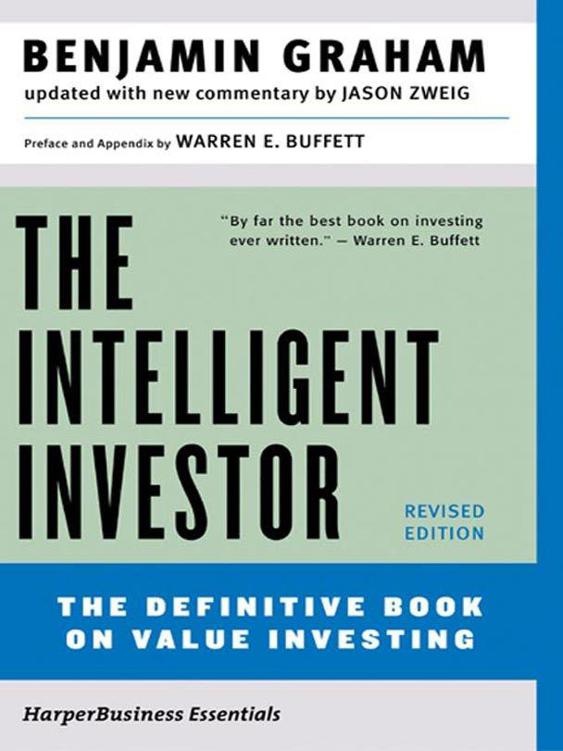
The Intelligent Investor: A Book of Practical Counsel
About this book
Graham writes for the lay investor choosing policies rather than for the professional analyst valuing every security. He distinguishes defensive and enterprising approaches, showing that the appropriate portfolio depends on effort, knowledge, and emotional capacity as well as expected return.
Mr. Market gives changing prices the form of an unreliable business partner whose offers can be accepted or ignored. The metaphor shifts attention from predicting mood to comparing price with value, while margin of safety makes room for error in any estimate.
This revised edition preserves Graham's original chapters and pairs them with Jason Zweig's later commentary. The two historical layers are useful precisely because market products and examples change while incentives, overconfidence, fear, and the pressure to follow a crowd recur.
The Intelligent Investor: A Book of Practical Counsel is not a promise of quick stock selection. Its durable lesson is behavioural: a sound method provides little protection if the investor abandons it whenever the market makes patience look foolish.
Read a sample
5,135 words
Plain text
From the opening
Introduction:What This Book Expects to Accomplish
The purpose of this book is to supply, in a form suitable for laymen, guidance in the adoption and execution of an investment policy. Comparatively little will be said here about the technique of analyzing securities; attention will be paid chiefly to investment principles and investors’ attitudes. We shall, however, provide a number of condensed comparisons of specific securities—chiefly in pairs appearing side by side in the New York Stock Exchange list—in order to bring home in concrete fashion the important elements involved in specific choices of common stocks.
But much of our space will be devoted to the historical patterns of financial markets, in some cases running back over many decades. To invest intelligently in securities one should be forearmed with an adequate knowledge of how the various types of bonds and stocks have actually behaved under varying conditions—some of which, at least, one is likely to meet again in one’s own experience. No statement is more true and better applicable to Wall Street than the famous warning of Santayana: “Those who do not remember the past are condemned to repeat it.”
Our text is directed to investors as distinguished from speculators, and our first task will be to clarify and emphasize this now all but forgotten distinction. We may say at the outset that this is not a “how to make a million” book. There are no sure and easy paths to riches on Wall Street or anywhere else. It may be well to point up what we have just said by a bit of financial history—especially since there is more than one moral to be drawn from it. In the climactic year 1929 John J. Raskob, a most important figure nationally as well as on Wall Street, extolled the blessings of capitalism in an article in the Ladies’ Home Journal, entitled “Everybody Ought to Be Rich.”* His thesis was that savings of only $15 per month invested in good common stocks—with dividends reinvested—would produce an estate of $80,000 in twenty years against total contributions of only $3,600. If the General Motors tycoon was right, this was indeed a simple road to riches. How nearly right was he? Our rough calculation—based on assumed investment in the 30 stocks making up the Dow Jones Industrial Average (DJIA)—indicates that if Raskob’s prescription had been followed during 1929–1948, the investor’s holdings at the beginning of 1949 would have been worth about $8,500. This is a far cry from the great man’s promise of $80,000, and it shows how little reliance can be placed on such optimistic forecasts and assurances. But, as an aside, we should remark that the return actually realized by the 20-year operation would have been better than 8% compounded annually—and this despite the fact that the investor would have begun his purchases with the DJIA at 300 and ended with a valuation based on the 1948 closing level of 177. This record may be regarded as a persuasive argument for the principle of regular monthly purchases of strong common stocks through thick and thin—a program known as “dollar-cost averaging.”
Since our book is not addressed to speculators, it is not meant for those who trade in the market. Most of these people are guided by charts or other largely mechanical means of determining the right moments to buy and sell. The one principle that applies to nearly all these so-called “technical approaches” is that one should buy because a stock or the market has gone up and one should sell because it has declined. This is the exact opposite of sound business sense everywhere else, and it is most unlikely that it can lead to lasting success on Wall Street. In our own stock-market experience and observation, extending over 50 years, we have not known a single person who has consistently or lastingly made money by thus “following the market.” We do not hesitate to declare that this approach is as fallacious as it is popular. We shall illustrate what we have just said—though, of course this should not be taken as proof—by a later brief discussion of the famous Dow theory for trading in the stock market.*
Since its first publication in 1949, revisions of The Intelligent Investor have appeared at intervals of approximately five years. In updating the current version we shall have to deal with quite a number of new developments since the 1965 edition was written. These include:
These phenomena will have our careful consideration, and some will require changes in conclusions and emphasis from our previous edition. The underlying principles of sound investment should not alter from decade to decade, but the application of these principles must be adapted to significant changes in the financial mechanisms and climate.
The last statement was put to the test during the writing of the present edition, the first draft of which was finished in January 1971. At that time the DJIA was in a strong recovery from its 1970 low of 632 and was advancing toward a 1971 high of 951, with attendant general optimism. As the last draft was finished, in November 1971, the market was in the throes of a new decline, carrying it down to 797 with a renewed general uneasiness about its future. We have not allowed these fluctuations to affect our general attitude toward sound investment policy, which remains substantially unchanged since the first edition of this book in 1949.
Continue reading the sampleClose the sample
The extent of the market’s shrinkage in 1969–70 should have served to dispel an illusion that had been gaining ground during the past two decades. This was that leading common stocks could be bought at any time and at any price, with the assurance not only of ultimate profit but also that any intervening loss would soon be recouped by a renewed advance of the market to new high levels. That was too good to be true. At long last the stock market has “returned to normal,” in the sense that both speculators and stock investors must again be prepared to experience significant and perhaps protracted falls as well as rises in the value of their holdings.
In the area of many secondary and third-line common stocks, especially recently floated enterprises, the havoc wrought by the last market break was catastrophic. This was nothing new in itself—it had happened to a similar degree in 1961–62—but there was now a novel element in the fact that some of the investment funds had large commitments in highly speculative and obviously overvalued issues of this type. Evidently it is not only the tyro who needs to be warned that while enthusiasm may be necessary for great accomplishments elsewhere, on Wall Street it almost invariably leads to disaster.
The major question we shall have to deal with grows out of the huge rise in the rate of interest on first-quality bonds. Since late 1967 the investor has been able to obtain more than twice as much income from such bonds as he could from dividends on representative common stocks. At the beginning of 1972 the return was 7.19% on highest-grade bonds versus only 2.76% on industrial stocks. (This compares with 4.40% and 2.92% respectively at the end of 1964.) It is hard to realize that when we first wrote this book in 1949 the figures were almost the exact opposite: the bonds returned only 2.66% and the stocks yielded 6.82%.2 In previous editions we have consistently urged that at least 25% of the conservative investor’s portfolio be held in common stocks, and we have favored in general a 50–50 division between the two media. We must now consider whether the current great advantage of bond yields over stock yields would justify an all-bond policy until a more sensible relationship returns, as we expect it will. Naturally the question of continued inflation will be of great importance in reaching our decision here. A chapter will be devoted to this discussion.*
In the past we have made a basic distinction between two kinds of investors to whom this book was addressed—the “defensive” and the “enterprising.” The defensive (or passive) investor will place his chief emphasis on the avoidance of serious mistakes or losses. His second aim will be freedom from effort, annoyance, and the need for making frequent decisions. The determining trait of the enterprising (or active, or aggressive) investor is his willingness to devote time and care to the selection of securities that are both sound and more attractive than the average. Over many decades an enterprising investor of this sort could expect a worthwhile reward for his extra skill and effort, in the form of a better average return than that realized by the passive investor. We have some doubt whether a really substantial extra recompense is promised to the active investor under today’s conditions. But next year or the years after may well be different. We shall accordingly continue to devote attention to the possibilities for enterprising investment, as they existed in former periods and may return.
It has long been the prevalent view that the art of successful investment lies first in the choice of those industries that are most likely to grow in the future and then in identifying the most promising companies in these industries. For example, smart investors—or their smart advisers—would long ago have recognized the great growth possibilities of the computer industry as a whole and of International Business Machines in particular. And similarly for a number of other growth industries and growth companies. But this is not as easy as it always looks in retrospect. To bring this point home at the outset let us add here a paragraph that we included first in the 1949 edition of this book.
Such an investor may for example be a buyer of air-transport stocks because he believes their future is even more brilliant than the trend the market already reflects. For this class of investor the value of our book will lie more in its warnings against the pitfalls lurking in this favorite investment approach than in any positive technique that will help him along his path.*
The pitfalls have proved particularly dangerous in the industry we mentioned. It was, of course, easy to forecast that the volume of air traffic would grow spectacularly over the years. Because of this factor their shares became a favorite choice of the investment funds. But despite the expansion of revenues—at a pace even greater than in the computer industry—a combination of technological problems and overexpansion of capacity made for fluctuating and even disastrous profit figures. In the year 1970, despite a new high in traffic figures, the airlines sustained a loss of some $200 million for their shareholders. (They had shown losses also in 1945 and 1961.) The stocks of these companies once again showed a greater decline in 1969–70 than did the general market. The record shows that even the highly paid full-time experts of the mutual funds were completely wrong about the fairly short-term future of a major and nonesoteric industry.
On the other hand, while the investment funds had substantial investments and substantial gains in IBM, the combination of its apparently high price and the impossibility of being certain about its rate of growth prevented them from having more than, say, 3% of their funds in this wonderful performer. Hence the effect of this excellent choice on their overall results was by no means decisive. Furthermore, many—if not most—of their investments in computer-industry companies other than IBM appear to have been unprofitable. From these two broad examples we draw two morals for our readers:
The author did not follow this approach in his financial career as fund manager, and he cannot offer either specific counsel or much encouragement to those who may wish to try it.
What then will we aim to accomplish in this book? Our main objective will be to guide the reader against the areas of possible substantial error and to develop policies with which he will be comfortable. We shall say quite a bit about the psychology of investors. For indeed, the investor’s chief problem—and even his worst enemy—is likely to be himself. (“The fault, dear investor, is not in our stars—and not in our stocks—but in ourselves….”) This has proved the more true over recent decades as it has become more necessary for conservative investors to acquire common stocks and thus to expose themselves, willy-nilly, to the excitement and the temptations of the stock market. By arguments, examples, and exhortation, we hope to aid our readers to establish the proper mental and emotional attitudes toward their investment decisions. We have seen much more money made and kept by “ordinary people” who were temperamentally well suited for the investment process than by those who lacked this quality, even though they had an extensive knowledge of finance, accounting, and stock-market lore.
Additionally, we hope to implant in the reader a tendency to measure or quantify. For 99 issues out of 100 we could say that at some price they are cheap enough to buy and at some other price they would be so dear that they should be sold. The habit of relating what is paid to what is being offered is an invaluable trait in investment. In an article in a women’s magazine many years ago we advised the readers to buy their stocks as they bought their groceries, not as they bought their perfume. The really dreadful losses of the past few years (and on many similar occasions before) were realized in those common-stock issues where the buyer forgot to ask “How much?”
In June 1970 the question “How much?” could be answered by the magic figure 9.40%—the yield obtainable on new offerings of high-grade public-utility bonds. This has now dropped to about 7.3%, but even that return tempts us to ask, “Why give any other answer?” But there are other possible answers, and these must be carefully considered. Besides which, we repeat that both we and our readers must be prepared in advance for the possibly quite different conditions of, say, 1973–1977.
We shall therefore present in some detail a positive program for common-stock investment, part of which is within the purview of both classes of investors and part is intended mainly for the enterprising group. Strangely enough, we shall suggest as one of our chief requirements here that our readers limit themselves to issues selling not far above their tangible-asset value.* The reason for this seemingly outmoded counsel is both practical and psychological. Experience has taught us that, while there are many good growth companies worth several times net assets, the buyer of such shares will be too dependent on the vagaries and fluctuations of the stock market. By contrast, the investor in shares, say, of public-utility companies at about their net-asset value can always consider himself the owner of an interest in sound and expanding businesses, acquired at a rational price—regardless of what the stock market might say to the contrary. The ultimate result of such a conservative policy is likely to work out better than exciting adventures into the glamorous and dangerous fields of anticipated growth.
The art of investment has one characteristic that is not generally appreciated. A creditable, if unspectacular, result can be achieved by the lay investor with a minimum of effort and capability; but to improve this easily attainable standard requires much application and more than a trace of wisdom. If you merely try to bring just a little extra knowledge and cleverness to bear upon your investment program, instead of realizing a little better than normal results, you may well find that you have done worse.
Since anyone—by just buying and holding a representative list—can equal the performance of the market averages, it would seem a comparatively simple matter to “beat the averages”; but as a matter of fact the proportion of smart people who try this and fail is surprisingly large. Even the majority of the investment funds, with all their experienced personnel, have not performed so well over the years as has the general market. Allied to the foregoing is the record of the published stock-market predictions of the brokerage houses, for there is strong evidence that their calculated forecasts have been somewhat less reliable than the simple tossing of a coin.
In writing this book we have tried to keep this basic pitfall of investment in mind. The virtues of a simple portfolio policy have been emphasized—the purchase of high-grade bonds plus a diversified list of leading common stocks—which any investor can carry out with a little expert assistance. The adventure beyond this safe and sound territory has been presented as fraught with challenging difficulties, especially in the area of temperament. Before attempting such a venture the investor should feel sure of himself and of his advisers—particularly as to whether they have a clear concept of the differences between investment and speculation and between market price and underlying value.
A strong-minded approach to investment, firmly based on the margin-of-safety principle, can yield handsome rewards. But a decision to try for these emoluments rather than for the assured fruits of defensive investment should not be made without much self-examination.
A final retrospective thought. When the young author entered Wall Street in June 1914 no one had any inkling of what the next half-century had in store. (The stock market did not even suspect that a World War was to break out in two months, and close down the New York Stock Exchange.) Now, in 1972, we find ourselves the richest and most powerful country on earth, but beset by all sorts of major problems and more apprehensive than confident of the future. Yet if we confine our attention to American investment experience, there is some comfort to be gleaned from the last 57 years. Through all their vicissitudes and casualties, as earth-shaking as they were unforeseen, it remained true that sound investment principles produced generally sound results. We must act on the assumption that they will continue to do so.
Note to the Reader: This book does not address itself to the overall financial policy of savers and investors; it deals only with that portion of their funds which they are prepared to place in marketable (or redeemable) securities, that is, in bonds and stocks. Consequently we do not discuss such important media as savings and time desposits, savings-and-loan-association accounts, life insurance, annuities, and real-estate mortgages or equity ownership. The reader should bear in mind that when he finds the word “now,” or the equivalent, in the text, it refers to late 1971 or early 1972.
Commentary on the Introduction
If you have built castles in the air, your work need not be lost; that is where they should be. Now put the foundations under them.
—Henry David Thoreau, Walden
Notice that Graham announces from the start that this book will not tell you how to beat the market. No truthful book can.
Instead, this book will teach you three powerful lessons:
Back in the boom years of the late 1990s, when technology stocks seemed to be doubling in value every day, the notion that you could lose almost all your money seemed absurd. But, by the end of 2002, many of the dot-com and telecom stocks had lost 95% of their value or more. Once you lose 95% of your money, you have to gain 1,900% just to get back to where you started. 1 Taking a foolish risk can put you so deep in the hole that it’s virtually impossible to get out. That’s why Graham constantly emphasizes the importance of avoiding losses—not just in Chapters 6, 14, and 20, but in the threads of warning that he has woven throughout his entire text.
But no matter how careful you are, the price of your investments will go down from time to time. While no one can eliminate that risk, Graham will show you how to manage it—and how to get your fears under control.
Are You an Intelligent Investor?
Now let’s answer a vitally important question. What exactly does Graham mean by an “intelligent” investor? Back in the first edition of this book, Graham defines the term—and he makes it clear that this kind of intelligence has nothing to do with IQ or SAT scores. It simply means being patient, disciplined, and eager to learn; you must also be able to harness your emotions and think for yourself. This kind of intelligence, explains Graham, “is a trait more of the character than of the brain.”2
There’s proof that high IQ and higher education are not enough to make an investor intelligent. In 1998, Long-Term Capital Management L.P., a hedge fund run by a battalion of mathematicians, computer scientists, and two Nobel Prize–winning economists, lost more than $2 billion in a matter of weeks on a huge bet that the bond market would return to “normal.” But the bond market kept right on becoming more and more abnormal—and LTCM had borrowed so much money that its collapse nearly capsized the global financial system. 3
And back in the spring of 1720, Sir Isaac Newton owned shares in the South Sea Company, the hottest stock in England. Sensing that the market was getting out of hand, the great physicist muttered that he “could calculate the motions of the heavenly bodies, but not the madness of the people.” Newton dumped his South Sea shares, pocketing a 100% profit totaling £7,000. But just months later, swept up in the wild enthusiasm of the market, Newton jumped back in at a much higher price—and lost £20,000 (or more than $3 million in today’s money). For the rest of his life, he forbade anyone to speak the words “South Sea” in his presence. 4
Sir Isaac Newton was one of the most intelligent people who ever lived, as most of us would define intelligence. But, in Graham’s terms, Newton was far from an intelligent investor. By letting the roar of the crowd override his own judgment, the world’s greatest scientist acted like a fool.
In short, if you’ve failed at investing so far, it’s not because you’re stupid. It’s because, like Sir Isaac Newton, you haven’t developed the emotional discipline that successful investing requires. In Chapter 8, Graham describes how to enhance your intelligence by harnessing your emotions and refusing to stoop to the market’s level of irrationality. There you can master his lesson that being an intelligent investor is more a matter of “character” than “brain.”
A Chronicle of Calamity
Now let’s take a moment to look at some of the major financial developments of the past few years:
Much of this damage could have been (and was!) avoided by investors who learned and lived by Graham’s principles. As Graham puts it, “while enthusiasm may be necessary for great accomplishments elsewhere, on Wall Street it almost invariably leads to disaster.” By letting themselves get carried away—on Internet stocks, on big “growth” stocks, on stocks as a whole—many people made the same stupid mistakes as Sir Isaac Newton. They let other investors’ judgments determine their own. They ignored Graham’s warning that “the really dreadful losses” always occur after “the buyer forgot to ask ‘How much?’” Most painfully of all, by losing their self-control just when they needed it the most, these people proved Graham’s assertion that “the investor’s chief problem—and even his worst enemy—is likely to be himself.”
The Sure Thing That Wasn’T
Many of those people got especially carried away on technology and Internet stocks, believing the high-tech hype that this industry would keep outgrowing every other for years to come, if not forever:
All these so-called experts ignored Graham’s sober words of warning: “Obvious prospects for physical growth in a business do not translate into obvious profits for investors.” While it seems easy to foresee which industry will grow the fastest, that foresight has no real value if most other investors are already expecting the same thing. By the time everyone decides that a given industry is “obviously” the best one to invest in, the prices of its stocks have been bid up so high that its future returns have nowhere to go but down.
For now at least, no one has the gall to try claiming that technology will still be the world’s greatest growth industry. But make sure you remember this: The people who now claim that the next “sure thing” will be health care, or energy, or real estate, or gold, are no more likely to be right in the end than the hypesters of high tech turned out to be.
The Silver Lining
If no price seemed too high for stocks in the 1990s, in 2003 we’ve reached the point at which no price appears to be low enough. The pendulum has swung, as Graham knew it always does, from irrational exuberance to unjustifiable pessimism. In 2002, investors yanked $27 billion out of stock mutual funds, and a survey conducted by the Securities Industry Association found that one out of 10 investors had cut back on stocks by at least 25%. The same people who were eager to buy stocks in the late 1990s—when they were going up in price and, therefore, becoming expensive—sold stocks as they went down in price and, by definition, became cheaper.
As Graham shows so brilliantly in Chapter 8, this is exactly backwards. The intelligent investor realizes that stocks become more risky, not less, as their prices rise—and less risky, not more, as their prices fall. The intelligent investor dreads a bull market, since it makes stocks more costly to buy. And conversely (so long as you keep enough cash on hand to meet your spending needs), you should welcome a bear market, since it puts stocks back on sale. 8
So take heart: The death of the bull market is not the bad news everyone believes it to be. Thanks to the decline in stock prices, now is a considerably safer—and saner—time to be building wealth. Read on, and let Graham show you how.
Chapter 1Investment versus Speculation: Results to Be Expected by the Intelligent Investor
This chapter will outline the viewpoints that will be set forth in the remainder of the book. In particular we wish to develop at the outset our concept of appropriate portfolio policy for the individual, nonprofessional investor.
Investment versus Speculation
What do we mean by “investor”? Throughout this book the term will be used in contradistinction to “speculator.” As far back as 1934, in our textbook Security Analysis,1 we attempted a precise formulation of the difference between the two, as follows: “An investment operation is one which, upon thorough analysis promises safety of principal and an adequate return. Operations not meeting these requirements are speculative.”
While we have clung tenaciously to this definition over the ensuing 38 years, it is worthwhile noting the radical changes that have occurred in the use of the term “investor” during this period. After the great market decline of 1929–1932 all common stocks were widely regarded as speculative by nature. (A leading authority stated flatly that only bonds could be bought for investment.2) Thus we had then to defend our definition against the charge that it gave too wide scope to the concept of investment.
Now our concern is of the opposite sort. We must prevent our readers from accepting the common jargon which applies the term “investor” to anybody and everybody in the stock market. In our last edition we cited the following headline of a front-page article of our leading financial journal in June 1962:
SMALL INVESTORS BEARISH, THEY ARE SELLING ODD-LOTS SHORT
In October 1970 the same journal had an editorial critical of what it called “reckless investors,” who this time were rushing in on the buying side.
These quotations well illustrate the confusion that has been dominant for many years in the use of the words investment and speculation. Think of our suggested definition of investment given above, and compare it with the sale of a few shares of stock by an inexperienced member of the public, who does not even own what he is selling, and has some largely emotional conviction that he will be able to buy them back at a much lower price. (It is not irrelevant to point out that when the 1962 article appeared the market had already experienced a decline of major size, and was now getting ready for an even greater upswing. It was about as poor a time as possible for selling short.) In a more general sense, the later-used phrase “reckless investors” could be regarded as a laughable contradiction in terms—something like “spendthrift misers”—were this misuse of language not so mischievous.
The newspaper employed the word “investor” in these instances because, in the easy language of Wall Street, everyone who buys or sells a security has become an investor, regardless of what he buys, or for what purpose, or at what price, or whether for cash or on margin. Compare this with the attitude of the public toward common stocks in 1948, when over 90% of those queried expressed themselves as opposed to the purchase of common stocks.3 About half gave as their reason “not safe, a gamble,” and about half, the reason “not familiar with.”* It is indeed ironical (though not surprising) that common-stock purchases of all kinds were quite generally regarded as highly speculative or risky at a time when they were selling on a most attractive basis, and due soon to begin their greatest advance in history; conversely the very fact they had advanced to what were undoubtedly dangerous levels as judged by past experience later transformed them into “investments,” and the entire stock-buying public into “investors.”
The distinction between investment and speculation in common stocks has always been a useful one and its disappearance is a cause for concern. We have often said that Wall Street as an institution would be well advised to reinstate this distinction and to emphasize it in all its dealings with the public. Otherwise the stock exchanges may some day be blamed for heavy speculative losses, which those who suffered them had not been properly warned against. Ironically, once more, much of the recent financial embarrassment of some stock-exchange firms seems to have come from the inclusion of speculative common stocks in their own capital funds. We trust that the reader of this book will gain a reasonably clear idea of the risks that are inherent in common-stock commitments—risks which are inseparable from the opportunities of profit that they offer, and both of which must be allowed for in the investor’s calculations.