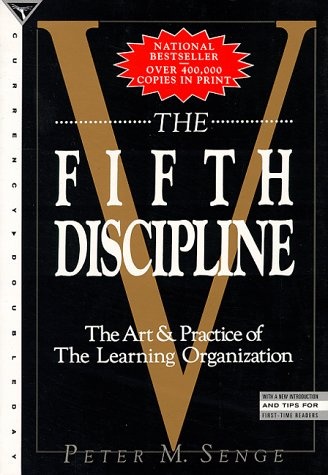
The Fifth Discipline: The Art & Practice of The Learning Organization
About this book
The five disciplines are personal mastery, mental models, shared vision, team learning, and systems thinking. The last connects the others by examining feedback, delay, accumulation, and the ways apparently local decisions generate behaviour elsewhere.
Recurring patterns such as shifting the burden, limits to growth, and fixes that fail give managers a vocabulary for problems that return despite repeated intervention. The method asks readers to map relationships and time rather than search immediately for one person or event to blame.
Senge also treats learning as a social practice requiring inquiry, reflection, and the capacity to surface assumptions. A vision cannot be shared by announcement alone, and a team does not learn simply because its members individually possess expertise.
The Fifth Discipline is a management classic first published in 1990; this revised edition adds later cases and reflections. Its diagrams are tools for forming better questions, not proof that a complex organisation can be predicted from one elegant model.
Read a sample
5,071 words
Plain text
From the opening
THE PREVAILING SYSTEM OF MANAGEMENT
In the spring of 1990, shortly after the writing and editing of the original edition of The Fifth Discipline was completed and publication was imminent, my editor at Doubleday asked me who I wanted to write a comment for the book jacket. As a first time author, I had never considered this. After thinking for a while I realized that there was no one I would rather have write something than Dr. W. Edwards Deming, revered around the world as a pioneer in the quality management revolution. I knew of no one who had had a greater impact on management practice. But I had never met Deming. I doubted that a letter with such a request from an unknown author, referring to work with which Deming was unfamiliar, would get a favorable response. Fortunately, through mutual friends at Ford, a copy of the manuscript did reach him. A few weeks later, to my surprise, a letter arrived at my home.
When I opened it I found a short paragraph written by Dr, Deming. Reading the first sentence, I stopped to catch my breath. Somehow he had said in a sentence what I had struggled to put into four hundred pages. It is amazing, I thought, how clear and direct you can be when you reach the end of your years (Deming was then almost 90). As I took in the totality of what he had written, I slowly started to realize he had unveiled a deeper layer of connections, and a bigger task, than I had previously understood:
Our prevailing system of management has destroyed our people. People are born with intrinsic motivation, self-respect, dignity, curiosity to learn, joy in learning. The forces of destruction begin with toddlers—a prize for the best Halloween costume, grades in school, gold stars—and on up through the university. On the job, people, teams, and divisions are ranked, reward for the top, punishment for the bottom. Management by Objectives, quotas, incentive pay, business plans, put together separately, division by division, cause further loss, unknown and unknowable.
As I subsequently learned, Deming had almost completely stopped using the terminology of “Total Quality Management,” “TQM” or “TQ” because he believed it had become a superficial label for tools and techniques. The real work, which he simply called the “transformation of the prevailing system of management,” lay beyond the aims of managers seeking only short-term performance improvements. This transformation, he believed, required “profound knowledge” largely untapped in contemporary institutions. Only one element of this profound knowledge, “theory of variation” (statistical theory and method), was associated with the common understanding of TQM. The other three elements, to my amazement, mapped almost directly onto the five disciplines: “understanding a system,” “ theory of knowledge” (the importance of mental models), and “psychology,” especially “intrinsic motivation” (the importance of personal vision and genuine aspiration).
These elements of Deming’s “profound knowledge” led eventually to the simplest and, today, most widely used way to present the five learning disciplines, a way that was not evident when the original book was completed. The five disciplines represent approaches (theories and methods) for developing three core learning capabilities: fostering aspiration, developing reflective conversation, and understanding complexity. Building on an idea from the original book, that the fundamental learning units in an organization are working teams (people who need one another to produce an outcome), we came to refer to these as the “core learning capabilities of teams” and symbolically represented them as a three-legged stool, to visually convey the importance of each—the stool would not stand if any of the three were missing.
Even more important for me was Deming’s idea that a common “system of management” governed modern institutions, and in particular formed a deep connection between work and school. He would often say, “We will never transform the prevailing system of management without transforming our prevailing system of education. They are the same system.” So far as I know, his insight into this connection between work and school was original.
I believe that Deming came to this realization late in his life, in part as a way to make sense of why so few managers seemed able to actually implement real Quality Management as he conceived it. People failed, he realized, because they had been socialized in ways of thinking and acting that were embedded in their most formative institutional experiences. “The relationship between a boss and subordinate is the same as the relationship between a teacher and student,” he said. The teacher sets the aims, the student responds to those aims. The teacher has the answer, the student works to get the answer. Students know when they have succeeded because the teacher tells them. By the time all children are 10 they know what it takes to get ahead in school and please the teacher—a lesson they carry forward through their careers of “pleasing bosses and failing to improve the system that serves customers.” After Dr. Deming passed away in 1993, I spent many years thinking and talking with colleagues about what constituted this prevailing system of management as Deming understood it, eventually settling on eight basic elements:1
– Focusing on short-term metrics
– Devaluing intangibles
(“You can only measure 3 percent of what matters” – W.E. Deming)
– Getting ahead by pleasing the boss
– Management by fear
– Management sets targets
– People are held accountable for meeting management targets (regardless of whether they are possible within existing system and processes)
– Technical problem solving is emphasized
– Diverging (systemic) problems are discounted
– Diversity is a problem to be solved
– Conflict is suppressed in favor of superficial agreement
– To manage is to control
– The “holy trinity of management” is planning, organizing, controlling
– Competition between people is essential to achieve desired performance
– Without competition among people there is no innovation
(“We’ve been sold down the river by competition” – W.E. Deming)
– Fragmentation
– Local innovations do not spread
Today, most managers probably regard the “Quality Management revolution,” like the organizational learning fad of the early 1990s, as history, far from the frontiers of today’s challenges. But is that because we have achieved or abdicated the transformation Deming advocated? It is hard for me to contemplate a list like this one and not feel that these maladies still afflict most organizations today, and that it will take generations, not years, to change such deeply embedded beliefs and behaviors. Indeed, perhaps the most obvious question for many of us is: “Will this system of management ever change on a large scale?” Answering deep questions like this about the future requires looking carefully at the present.
Continue reading the sampleClose the sample
A TIME OF CROSSCURRENTS
In the decade and a half since The Fifth Discipline was first published much has changed in the world. Our economies are more global than ever; consequently, so is business. Among businesses competing globally, cost and performance pressures are relentless. The time available for people to think and reflect is scarcer, if anything, and in many organizations, resources available for developing people are scarcer still. But there is more to think about than just accelerating change. The globalization of business and industrial development is raising the material standards of living for many, but also creating significant side effects in the form of a host of social and environmental sustainability challenges. All too often, the production of financial capital seems to occur at the expense of social and natural capital. Gaps between “haves” and “have-nots” are widening in many countries. Local environmental stresses, always a feature of industrial development, are now matched by problems on a larger scale, like global warming and weather instability. While the advocates for global industrial growth trumpet its benefits, people around the world are reacting, nonviolently and violently, to losses in traditional ways of living—and this shifting context is getting onto the strategic radar screen of many businesses.
At the same time, the interconnected world creates a greater awareness of others than has ever before existed. It is an unprecedented time of cultures colliding and in many instances learning from one another, and the promise of truly generative “dialogue among civilizations” holds great hope for the future. Young people around the world are creating a web of relationships that has never existed before. The frontiers of Western science, the underpinning of our modern worldview, are revealing a living world of flux and interdependency strangely familiar to aboriginal and native cultures, and one that might, in the words of cosmologist Brian Swimme, once again show us that we have “a meaningful place in the universe.” And, as illustrated below, the organizational learning practices that were limited to a few pioneers fifteen years ago have taken deeper root and spread.
In short, it is a time of dramatically conflicting forces. Things are getting better and things are getting worse. The comments of former Czech president Vaclav Havel’s to the U.S. Congress in the mid-1990s summarize these perilous times aptly:
Today, many things indicate that we are going through a transitional period, when it seems that something is on the way out and something else is painfully being born. It is as if something were crumbling, decaying and exhausting itself, while something else, still indistinct, were arising from the rubble.
The shape of Havel’s “something else” being born and the sorts of management and leadership skills it might require remain as fuzzy today as they were when he made these remarks a decade ago.
These conflicting forces play out within organizations as well, creating environments in which the need and possibility for learning capabilities are greater than ever, but so too are the challenges of building such capabilities. On one hand, building enterprises capable of continually adapting to changing realities clearly demands new ways of thinking and operating. So do the sustainability challenges, in many ways the archetypal organizational learning challenge of this era. In addition, organizations are becoming more networked, which is weakening traditional management hierarchies and potentially opening up new capacity for continual learning, innovation, and adaptation. On the other hand, the dysfunctions of the traditional management system keep many organizations in perpetual fire-fighting mode, with little time or energy for innovation. This frenzy and chaos also undermines the building of values-based management cultures and opens the door for opportunistic grabs at individual power and wealth.
VOICES FROM THE FRONT
When I was invited by Doubleday to create this new edition of The Fifth Discipline, I was initially ambivalent but then became excited. One of the great joys of the past fifteen years has been getting to know countless gifted practitioners of organizational learning—managers, school principals, community organizers, police chiefs, business and social entrepreneurs, military leaders, teachers—people who have somehow found an infinite array of imaginative ways to work with and utilize the five disciplines, even if they had never heard of or read the original book. A few of these figured prominently in the first book, like Arie de Geus and the recently deceased Bill O’Brien. Since then, the worldwide growth of the Society for Organizational Learning (SoL) has brought me in touch with hundreds more such practitioners. In their own ways, each has created an alternative system of management based on love rather than fear, curiosity rather than an insistence on “right” answers, and learning rather than controlling. Now I could use the excuse of this revised edition to talk with many of them.
Those interviews and conversations led to my making many changes in the text of this book and to a new section, Part IV, “Reflections from Practice.” The interviews provided fresh insights into how master practitioners initiate change and deal creatively with the challenges of sustaining momentum. In addition to many business successes, people revealed a host of new possibilities in applying organizational learning tools and principles in areas few of us could have imagined fifteen years ago: from growing more environmentally sound businesses and industries to addressing societal problems like gang violence, transforming school systems, promoting economic development, undertaking the improvement of global food production, and reducing poverty. In all these settings, openness, reflection, deeper conversations, personal mastery, and shared visions uniquely energize change; and understanding the systemic causes of problems is crucial.
The interviews also clarified core ideas that implicitly bound together the original work.
I believe that, the prevailing system of management is, at its core, dedicated to mediocrity. It forces people to work harder and harder to compensate for failing to tap the spirit and collective intelligence that characterizes working together at their best. Deming saw this clearly, and I believe that now, so do a growing number of leaders committed to growing organizations capable of thriving in and contributing to the extraordinary challenges and possibilities of the world we are living into.
PART IHow Our ActionsCreate Our Reality …and How We CanChange It
1“GIVE ME A LEVERLONG ENOUGH…ANDSINGLE-HANDED ICAN MOVE THEWORLD”
From a very early age, we are taught to break apart problems, to fragment the world. This apparently makes complex tasks and subjects more manageable, but we pay a hidden, enormous price. We can no longer see the consequences of our actions; we lose our intrinsic sense of connection to a larger whole. When we then try to “see the big picture,” we try to reassemble the fragments in our minds, to list and organize all the pieces. But, as physicist David Bohm says, the task is futile—similar to trying to reassemble the fragments of a broken mirror to see a true reflection. Thus, after a while we give up trying to see the whole altogether.
The tools and ideas presented in this book are for destroying the illusion that the world is created of separate, unrelated forces. When we give up this illusion—we can then build “learning organizations,” organizations where people continually expand their capacity to create the results they truly desire, where new and expansive patterns of thinking are nurtured, where collective aspiration is set free, and where people are continually learning how to learn together.
As the world becomes more interconnected and business becomes more complex and dynamic, work must become more “learningful.” It is no longer sufficient to have one person learning for the organization, a Ford or a Sloan or a Watson or a Gates. It’s just not possible any longer to figure it out from the top, and have everyone else following the orders of the “grand strategist.” The organizations that will truly excel in the future will be the organizations that discover how to tap people’s commitment and capacity to learn at all levels in an organization.
Learning organizations are possible because, deep down, we are all learners. No one has to teach an infant to learn. In fact, no one has to teach infants anything. They are intrinsically inquisitive, masterful learners who learn to walk, speak, and pretty much run their households all on their own. Learning organizations are possible because not only is it our nature to learn but we love to learn. Most of us at one time or another have been part of a great team, a group of people who functioned together in an extraordinary way—who trusted one another, who complemented one anothers’s strengths and compensated for one another’s limitations, who had common goals that were larger than individual goals, and who produced extraordinary results. I have met many people who have experienced this sort of profound teamwork—in sports, or in the performing arts, or in business. Many say that they have spent much of their life looking for that experience again. What they experienced was a learning organization. The team that became great didn’t start off great—it learned how to produce extraordinary results.
One could argue that the entire global business community is learning to learn together, becoming a learning community. Whereas once many industries were dominated by a single, undisputed leader—one IBM, one Kodak, one Xerox—today industries, especially in manufacturing, have dozens of excellent companies. American, European, or Japanese corporations are pulled forward by innovators in China, Malaysia, or Brazil, and they in turn, are pulled by the Koreans and Indians. Dramatic improvements take place in corporations in Italy, Australia, Singapore—and quickly become influential around the world.
There is also another, in some ways deeper, movement toward learning organizations, part of the evolution of industrial society. Material affluence for the majority has gradually shifted people’s orientation toward work—from what Daniel Yankelovich called an “instrumental” view of work, where work was a means to an end, to a more “sacred” view, where people seek the “intrinsic” benefits of work.1 “Our grandfathers worked six days a week to earn what most of us now earn by Tuesday afternoon,” says Bill O’Brien, former CEO of Hanover Insurance. “The ferment in management will continue until we build organizations that are more consistent with man’s higher aspirations beyond food, shelter and belonging.”
Moreover, many who share these values are now in leadership positions. I find a growing number of organizational leaders who, while still a minority, feel they are part of a profound evolution in the nature of work as a social institution. “Why can’t we do good works at work?” asked Edward Simon, former president of Herman Miller, a sentiment I often hear repeated today. In founding the “Global Compact,” UN Secretary General Kofi Annan invited businesses around the world to build learning communities that elevate global standards for labor rights, and social and environmental responsibility.
Perhaps the most salient reason for building learning organizations is that we are only now starting to understand the capabilities such organizations must possess. For a long time, efforts to build learning organizations were like groping in the dark until the skills, areas of knowledge, and paths for development of such organizations became known. What fundamentally will distinguish learning organizations from traditional authoritarian “controlling organizations” will be the mastery of certain basic disciplines. That is why the “disciplines of the learning organization” are vital.
DISCIPLINES OF THE LEARNING ORGANIZATION
On a cold, clear morning in December 1903, at Kitty Hawk, North Carolina, the fragile aircraft of Wilbur and Orville Wright proved that powered flight was possible. Thus was the airplane invented; but it would take more than thirty years before commercial aviation could serve the general public.
Engineers say that a new idea has been “invented” when it is proven to work in the laboratory. The idea becomes an “innovation” only when it can be replicated reliably on a meaningful scale at practical costs. If the idea is sufficiently important, such as the telephone, the digital computer, or commercial aircraft, it is called a “basic innovation,” and it creates a new industry or transforms an existing industry. In these terms, learning organizations have been invented, but they have not yet been innovated.
In engineering, when an idea moves from an invention to an innovation, diverse “component technologies” come together. Emerging from isolated developments in separate fields of research, these components gradually form an ensemble of technologies that are critical to one another’s success. Until this ensemble forms, the idea, though possible in the laboratory, does not achieve its potential in practice.2
The Wright brothers proved that powered flight was possible, but the McDonnel Douglas DC-3, introduced in 1935, ushered in the era of commercial air travel. The DC-3 was the first plane that supported itself economically as well as aerodynamically. During those intervening thirty years (a typical time period for incubating basic innovations), myriad experiments with commercial flight had failed. Like early experiments with learning organizations, the early planes were not reliable and cost-effective on an appropriate scale.
The DC-3, for the first time, brought together five critical component technologies that formed a successful ensemble. They were: the variable-pitch propeller, retractable landing gear, a type of lightweight molded body construction called “monocque,” a radial air-cooled engine, and wing flaps. To succeed, the DC-3 needed all five; four were not enough. One year earlier, the Boeing 247 was introduced with all of them except wing flaps. Boeing’s engineers found that the plane, lacking wing flaps, was unstable on takeoff and landing, and they had to downsize the engine.
Today, I believe, five new component technologies are gradually converging to innovate learning organizations. Though developed separately, each will, I believe, prove critical to the others’ success, just as occurs with any ensemble. Each provides a vital dimension in building organizations that can truly “learn,” that can continually enhance their capacity to realize their highest aspirations:
Systems Thinking. A cloud masses, the sky darkens, leaves twist upward, and we know that it will rain. We also know the storm runoff will feed into groundwater miles away, and the sky will clear by tomorrow. All these events are distant in time and space, and yet they are all connected within the same pattern. Each has an influence on the rest, an influence that is usually hidden from view. You can only understand the system of a rainstorm by contemplating the whole, not any individual part of the pattern.
Business and other human endeavors are also systems. They, too, are bound by invisible fabrics of interrelated actions, which often take years to fully play out their effects on each other. Since we are part of that lacework ourselves, it’s doubly hard to see the whole pattern of change. Instead, we tend to focus on snapshots of isolated parts of the system, and wonder why our deepest problems never seem to get solved. Systems thinking is a conceptual framework, a body of knowledge and tools that has been developed over the past fifty years, to make the full patterns clearer, and to help us see how to change them effectively.
Though the tools are new, the underlying worldview is extremely intuitive; experiments with young children show that they learn systems thinking very quickly.
Personal Mastery. “Mastery” might suggest gaining dominance over people or things. But mastery can also mean a special level of proficiency. A master craftsman doesn’t dominate pottery or weaving. People with a high level of personal mastery are able to consistently realize the results that matter most deeply to them—in effect, they approach their life as an artist would approach a work of art. They do that by becoming committed to their own lifelong learning.
Personal mastery is the discipline of continually clarifying and deepening our personal vision, of focusing our energies, of developing patience, and of seeing reality objectively. As such, it is an essential cornerstone of the learning organization—the learning organization’s spiritual foundation. An organization’s commitment to and capacity for learning can be no greater than that of its members. The roots of this discipline lie in both Eastern and Western spiritual traditions, and in secular traditions as well.
But surprisingly few organizations encourage the growth of their people in this manner. This results in vast untapped resources: “People enter business as bright, well-educated, high-energy people, full of energy and desire to make a difference,” says Hanover’s O’Brien. “By the time they are 30, a few are on the fast track and the rest ‘put in their time’ to do what matters to them on the weekend. They lose the commitment, the sense of mission, and the excitement with which they started their careers. We get damn little of their energy and almost none of their spirit.”
And surprisingly few adults work to rigorously develop their own personal mastery. When you ask most adults what they want from their lives, they often talk first about what they’d like to get rid of: “I’d like my mother-in-law to move out,” they say, or “I’d like my back problems to clear up.” The discipline of personal mastery starts with clarifying the things that really matter to us, of living our lives in the service of our highest aspirations.
Here, I am most interested in the connections between personal learning and organizational learning, in the reciprocal commitments between individual and organization, and in the special spirit of an enterprise made up of learners.
Mental Models. “Mental models” are deeply ingrained assumptions, generalizations, or even pictures or images that influence how we understand the world and how we take action. Very often, we are not consciously aware of our mental models or the effects they have on our behavior. For example, we may notice that a co-worker dresses elegantly, and say to ourselves, “She’s a country club person.” About someone who dresses shabbily, we may feel, “He doesn’t care about what others think.” Mental models of what can or cannot be done in different management settings are no less deeply entrenched. Many insights into new markets or outmoded organizational practices fail to get put into practice because they conflict with powerful, tacit mental models.
For example, in the early 1970s, Royal Dutch/Shell, became one of the first large organizations to understand how pervasive was the influence of hidden mental models. Shell’s success in the 1970s and 1980s (rising from one of the weakest of the big seven oil companies to one of the strongest along with Exxon) during a period of unprecedented changes in the world oil business—the formation of OPEC, extreme fluctuations in oil prices and availability, and the eventual collapse of the Soviet Union—came in large measure from learning how to surface and challenge managers’ mental models as a discipline for preparing change. Arie de Geus, Shell’s Coordinator of Group Planning during the 80s, said that continuous adaptation and growth in a changing business environment depends on “institutional learning, which is the process whereby management teams change their shared mental models of the company, their markets, and their competitors. For this reason, we think of planning as learning and of corporate planning as institutional learning.”3
The discipline of working with mental models starts with turning the mirror inward; learning to unearth our internal pictures of the world, to bring them to the surface and hold them rigorously to scrutiny. It also includes the ability to carry on “learningful” conversations that balance inquiry and advocacy, where people expose their own thinking effectively and make that thinking open to the influence of others.
Building Shared Vision. If any one idea about leadership has inspired organizations for thousands of years, it’s the capacity to hold a shared picture of the future we seek to create. One is hard-pressed to think of any organization that has sustained some measure of greatness in the absence of goals, values, and missions that become deeply shared throughout the organization. IBM had “service”; Polaroid had instant photography; Ford had public transportation for the masses and Apple had “computers for the rest of us.”4 Though radically different in content and kind, all these organizations managed to bind people together around a common identity and sense of destiny.
When there is a genuine vision (as opposed to the all-too-familiar “vision statement”), people excel and learn, not because they are told to, but because they want to. But many leaders have personal visions that never get translated into shared visions that galvanize an organization. All too often, a company’s shared vision has revolved around the charisma of a leader, or around a crisis that galvanizes everyone temporarily. But, given a choice, most people opt for pursuing a lofty goal, not only in times of crisis but at all times. What has been lacking is a discipline for translating individual vision into shared vision—not a “cookbook” but a set of principles and guiding practices.
The practice of shared vision involves the skills of unearthing shared “pictures of the future” that foster genuine commitment and enrollment rather than compliance. In mastering this discipline, leaders learn the counterproductiveness of trying to dictate a vision, no matter how heartfelt.
Team Learning. How can a team of committed managers with individual IQs above 120 have a collective IQ of 63? The discipline of team learning confronts this paradox. We know that teams can learn; in sports, in the performing arts, in science, and even, occasionally, in business, there are striking examples where the intelligence of the team exceeds the intelligence of the individuals in the team, and where teams develop extraordinary capacities for coordinated action. When teams are truly learning, not only are they producing extraordinary results, but the individual members are growing more rapidly than could have occurred otherwise.
The discipline of team learning starts with “dialogue,” the capacity of members of a team to suspend assumptions and enter into a genuine “thinking together.” To the Greeks dialogos meant a free-flowing of meaning through a group, allowing the group to discover insights not attainable individually. Interestingly, the practice of dialogue has been preserved in many “primitive” cultures, such as that of the American Indian, but it has been almost completely lost to modern society. Today, the principles and practices of dialogue are being rediscovered and put into a contemporary context. (Dialogue differs from the more common “discussion,” which has its roots with “percussion” and “concussion,” literally a heaving of ideas back and forth in a winner-takes-all competition.)
The discipline of dialogue also involves learning how to recognize the patterns of interaction in teams that undermine learning. The patterns of defensiveness are often deeply ingrained in how a team operates. If unrecognized, they undermine learning. If recognized and surfaced creatively, they can accelerate learning.
Team learning is vital because teams, not individuals, are the fundamental learning unit in modern organizations. This is where the rubber meets the road; unless teams can learn, the organization cannot learn.
If a learning organization were an engineering innovation, such as the airplane or the personal computer, the components would be called “technologies.” For an innovation in human behavior, the components need to be seen as disciplines. By “discipline,” I do not mean an “enforced order” or “means of punishment,” but a body of theory and technique that must be studied and mastered to be put into practice. A discipline (from the Latin disciplina, to learn) is a developmental path for acquiring certain skills or competencies. As with any discipline, from playing the piano to electrical engineering, some people have an innate gift, but anyone can develop proficiency through practice.
To practice a discipline is to be a lifelong learner. You never arrive; you spend your life mastering disciplines. You can never say, “We are a learning organization,” any more than you can say, “I am an enlightened person.” The more you learn, the more acutely aware you become of your ignorance. Thus, a corporation cannot be “excellent” in the sense of having arrived at a permanent excellence; it is always in the state of practicing the disciplines of learning, of getting better or worse.