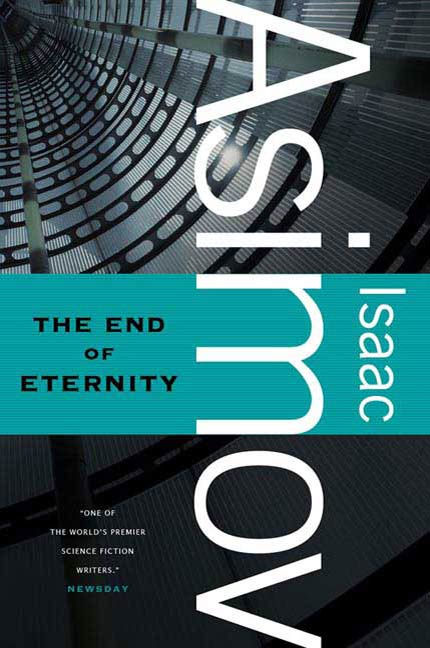
The End of Eternity
About this book
Andrew Harlan belongs to Eternity, an organization outside ordinary time. Its specialists move between centuries and make carefully calculated changes intended to reduce war, suffering, and instability.
Harlan accepts the system until he meets Noÿs Lambent and learns that an upcoming Reality Change will erase the life he knows. Protecting her draws him into forbidden centuries and into doubts about the institution's hidden history.
The central puzzle is larger than a paradox. If humanity is continually protected from dangerous choices, it may also be protected from ambition, discovery, and the futures that require risk.
The End of Eternity is a standalone time-travel novel. Asimov builds its suspense from rules, motives, and causal reversals rather than from a conventional action plot.
Read a sample
5,122 words
Plain text
From the opening
1. TECHNICIAN
Andrew Harlan stepped into the kettle. Its sides were perfectly round and it fit snugly inside a vertical shaft composed of widely spaced rods that shimmered into an unseeable haze six feet above Harlan’s head. Harlan set the controls and moved the smoothly working starting lever.
The kettle did not move.
Harlan did not expect it to. He expected no movement; neither up nor down, left nor right, forth nor back. Yet the spaces between the rods had melted into a gray blankness which was solid to the touch, though nonetheless immaterial for all that. And there was the little stir in his stomach, the faint (psychosomatic?) touch of dizziness, that told him that all the kettle contained, including himself, was rushing upwhen through Eternity.
He had boarded the kettle in the 575th Century, the base of operations assigned him two years earlier. At the time the 575th had been the farthest upwhen he had ever traveled. Now he was moving upwhen to the 2456th Century.
Under ordinary circumstances he might have felt a little lost at the prospect. His native Century was in the far downwhen, the 95th Century, to be exact. The 95th was a Century stiffly restrictive of atomic power, faintly rustic, fond of natural wood as a structural material, exporters of certain types of distilled potables to nearly everywhen and importers of clover seed. Although Harlan had not been in the 95th since he entered special training and became a Cub at the age of fifteen, there was always that feeling of loss when one moved outwhen from “home.” At the 2456th he would be nearly two hundred forty millennia from his birth when and that is a sizable distance even for a hardened Eternal.
Under ordinary circumstances all this would be so.
But right now Harlan was in poor mood to think of anything but the fact that his documents were heavy in his pocket and tense, a little confused.
It was his hands acting by themselves that brought the kettle to the proper halt at the proper Century.
Strange that a Technician should feel tense or nervous about anything. What was it that Educator Yarrow had once said:
“Above all, a Technician must be dispassionate. The Reality Change he initiates may affect the lives of as many as fifty billion people. A million or more of these may be so drastically affected as to be considered new individuals. Under these conditions, an emotional make-up is a distinct handicap.”
Harlan put the memory of his teacher’s dry voice out of his mind with an almost savage shake of his head. In those days he had never imagined that he himself would have the peculiar talent for that very position. But emotion had come upon him after all. Not for fifty billion people. What in Time did he care for fifty billion people? There was just one. One person.
He became aware that the kettle was stationary and with the merest pause to pull his thoughts together, put himself into the cold, impersonal frame of mind a Technician must have, he stepped out. The kettle he left, of course, was not the same as the one he had boarded, in the sense that it was not composed of the same atoms. He did not worry about that any more than any Eternal would. To concern oneself with the mystique of Time-travel, rather than with the simple fact of it, was the mark of the Cub and newcomer to Eternity.
He paused again at the infinitely thin curtain of non-Space and non-Time which separated him from Eternity in one way and from ordinary Time in another.
This would be a completely new section of Eternity for him. He knew about it in a rough way, of course, having checked upon it in the Temporal Handbook. Still, there was no substitute for actual appearance and he steeled himself for the initial shock of adjustment.
He adjusted the controls, a simple matter in passing into Eternity (and a very complicated one in passing into Time, a type of passage which was correspondingly less frequent). He stepped through the curtain and found himself squinting at the brilliance. Automatically he threw up his hand to shield his eyes.
Only one man faced him. At first Harlan could see him only blurrily.
The man said, “I am Sociologist Kantor Voy. I imagine you are Technician Harlan.”
Harlan nodded and said, “Father Time! Isn’t this sort of ornamentation adjustable?”
Voy looked about and said tolerantly, “You mean the molecular films?”
“I certainly do,” said Harlan. The Handbook had mentioned them, but had said nothing of such an insane riot of light reflection.
Harlan felt his annoyance to be quite reasonable. The 2456th Century was matter-oriented, as most Centuries were, so he had a right to expect a basic compatibility from the very beginning. It would have none of the utter confusion (for anyone born matter-oriented) of the energy vortices of the 300’s, or the field dynamics of the 600’s. In the 2456th, to the average Eternal’s comfort, matter was used for everything from walls to tacks.
To be sure, there was matter and matter. A member of an energy-oriented Century might not realize that. To him all matter might seem minor variations on the theme that was gross, heavy, and barbaric. To matter-oriented Harlan, however, there was wood, metal (subdivisions, heavy and light), plastic, silicates, concrete, leather, and so on.
Continue reading the sampleClose the sample
But matter consisting entirely of mirrors!
That was his first impression of the 2456th. Every surface reflected and glinted light. Everywhere was the illusion of complete smoothness; the effect of a molecular film. And in the ever-repeated reflection of himself, of Sociologist Voy, of everything he could see, in scraps and wholes, in all angles, there was confusion. Garish confusion and nausea!
“I’m sorry,” said Voy, “it’s the custom of the Century, and the Section assigned to it finds it good practice to adopt the customs where practical. You get used to it after a time.”
Voy walked rapidly upon the moving feet of another Voy, upside down beneath the floor, who matched him stride for stride. He reached to move a hair-contact indicator down a spiral scale to point of origin.
The reflections died; extraneous light faded. Harlan felt his world settle.
“If you’ll come with me now,” said Voy.
Harlan followed through empty corridors that, Harlan knew, must moments ago have been a riot of made light and reflection, up a ramp, through an anteroom, into an office.
In all the short journey no human being had been visible. Harlan was so used to that, took it so for granted, that he would have been surprised, almost shocked, if a glimpse of a human figure hurrying away had caught his eyes. No doubt the news had spread that a Technician was coming through. Even Voy kept his distance and when, accidentally, Harlan’s hand had brushed Voy’s sleeve, Voy shrank away with a visible start.
Harlan was faintly surprised at the touch of bitterness he felt at this. He had thought the shell he had grown about his soul was thicker, more efficiently insensitive than that. If he was wrong, if his shell had worn thinner, there could only be one reason for that.
Noÿs!
Sociologist Kantor Voy leaned forward toward the Technician in what seemed a friendly enough fashion, but Harlan noted automatically that they were seated on opposite sides of the long axis of a fairly large table.
Voy said, “I am pleased to have a Technician of your reputation interest himself in our little problem here.”
“Yes,” said Harlan with the cold impersonality people would expect of him. “It has its points of interest.” (Was he impersonal enough? Surely his real motives must be apparent, his guilt be spelled out in beads of sweat on his forehead.)
He removed from an inner pocket the foiled summary of the projected Reality Change. It was the very copy which had been sent to the Allwhen Council a month earlier. Through his relationship with Senior Computer Twissell (the Twissell, himself) Harlan had had little trouble in getting his hands on it.
Before unrolling the foil, letting it peel off onto the table top where it would be held by a soft paramagnetic field, Harlan paused a split moment.
The molecular film that covered the table was subdued but was not zero. The motion of his arm fixed his eye and for an instant the reflection of his own face seemed to stare somberly up at him from the tabletop. He was thirty-two, but he looked older. He needed no one to tell him that. It might be partly his long face and dark eyebrows over darker eyes that gave him the lowering expression and cold glare associated with the caricature of the Technician in the minds of all Eternals. It might be just his own realization that he was a Technician.
But then he flicked the foil out across the table and turned to the matter at hand.
“I am not a Sociologist, sir.”
Voy smiled. “That sounds formidable. When one begins by expressing lack of competence in a given field, it usually implies that a flat opinion in that field will follow almost immediately.”
“No,” said Harlan, “not an opinion. Just a request. I wonder if you won’t look over this summary and see if you haven’t made a small mistake somewhere here.”
Voy looked instantly grave. “I hope not,” he said.
Harlan kept one arm across the back of his chair, the other in his lap. He must let neither hand drum restless fingers. He must not bite his lips. He must not show his feelings in any way.
Ever since the whole orientation of his life had so changed itself, he had been watching the summaries of projected Reality Changes as they passed through the grinding administrative gears of the Allwhen Council. As Senior Computer Twissell’s personally assigned Technician, he could arrange that by a slight bending of professional ethics. Particularly with Twissell’s attention caught ever more tightly in his own overwhelming project. (Harlan’s nostrils flared. He knew now a little of the nature of that project.)
Harlan had had no assurance that he would ever find what he was looking for in a reasonable time. When he had first glanced over projected Reality Change 2456-2781, Serial Number V-5, he was half inclined to believe his reasoning powers were warped by wishing. For a full day he had checked and rechecked equations and relationships in a rattling uncertainty, mixed with growing excitement and a bitter gratitude that he had been taught at least elementary psycho-mathematics.
Now Voy went over those same puncture patterns with a half-puzzled, half-worried eye.
He said, “It seems to me; I say, it seems to me that this is all perfectly in order.”
Harlan said, “I refer you particularly to the matter of the courtship characteristics of the society of the current Reality of this Century. That’s sociology and your responsibility, I believe. It’s why I arranged to see you when I arrived, rather than someone else.”
Voy was now frowning. He was still polite, but with an icy touch now. He said, “The Observers assigned to our Section are highly competent. I have every certainty that those assigned to this project have given accurate data. Have you evidence to the contrary?”
“Not at all, Sociologist Voy. I accept their data. It is the development of the data I question. Do you not have an alternate tensor-complex at this point, if the courtship data is taken properly into consideration?”
Voy stared, and then a look of relief washed over him visibly. “Of course, Technician, of course, but it resolves itself into an identity. There is a loop of small dimensions with no tributaries on either side. I hope you’ll forgive me for using picturesque language rather than precise mathematical expressions.”
“I appreciate it,” said Harlan dryly. “I am no more a Computer than a Sociologist.”
“Very good, then. The alternate tensor-complex you refer to, or the forking of the road, as we might say, is non-significant. The forks join up again and it is a single road. There was not even any need to mention it in our recommendations.”
“If you say so, sir, I will defer to your better judgment. However, there is still the matter of the M.N.C.”
The Sociologist winced at the initials as Harlan knew he would. M.N.C.—Minimum Necessary Change. There the Technician was master. A Sociologist might consider himself above criticism by lesser beings in anything involving the mathematical analysis of the infinite possible Realities in Time, but in matters of M.N.C. the Technician stood supreme.
Mechanical computing would not do. The largest Computaplex ever built, manned by the cleverest and most experienced Senior Computer ever born, could do no better than to indicate the ranges in which the M.N.C. might be found. It was then the Technician, glancing over the data, who decided on an exact point within that range. A good Technician was rarely wrong. A top Technician was never wrong.
Harlan was never wrong.
“Now the M.N.C. recommended,” said Harlan (he spoke coolly, evenly, pronouncing the Standard Intertemporal Language in precise syllables), “by your Section involves induction of an accident in space and the immediate death by fairly horrible means of a dozen or more men.”
“Unavoidable,” said Voy, shrugging.
“On the other hand,” said Harlan, “I suggest that the M.N.C. can be reduced to the mere displacement of a container from one shelf to another. Here!” His long finger pointed. His white, well-cared-for index nail made the faintest mark along one set of perforations.
Voy considered matters with a painful but silent intensity.
Harlan said, “Doesn’t that alter the situation with regard to your unconsidered fork? Doesn’t it take advantage of the fork of lesser probability, changing it to a near-certainty, and does that not then lead to—”
“—to virtually the M.D.R.” whispered Voy.
“To exactly the Maximum Desired Response,” said Harlan.
Voy looked up, his dark face struggling somewhere between chagrin and anger. Harlan noted absently that there was a space between the man’s large upper incisors which gave him a rabbity look quite at odds with the restrained force of his words.
Voy said, “I suppose I will be hearing from the Allwhen Council?”
“I don’t think so. As far as I know, the Allwhen Council does not know of this. At least, the projected Reality Change was passed over to me without comment.” He did not explain the word “passed,” nor did Voy question it.
“You discovered this error, then?”
“Yes.”
“And you did not report it to the Allwhen Council?”
“No, I did not.”
Relief first, then a hardening of countenance. “Why not?”
“Very few people could have avoided this error. I felt I could correct it before damage was done. I have done so. Why go any further?”
“Well—thank you, Technician Harlan. You have been a friend. The Section’s error which, as you say, was practically unavoidable, would have looked unjustifiably bad in the record.”
He went on after a moment’s pause. “Of course, in view of the alterations in personality to be induced by this Reality Change, the death of a few men as preliminary is of little importance.”
Harlan thought, detachedly: He doesn’t sound really grateful. He probably resents it. If he stops to think, he’ll resent it even more, this being saved a downstroke in rating by a Technician. If I were a Sociologist, he would shake my hand, but he won’t shake the hand of a Technician. He defends condemning a dozen people to asphyxiation, but he won’t touch a Technician.
And because waiting to let resentment grow would be fatal, Harlan said without waiting, “I hope your gratitude will extend to having your Section perform a slight chore for me.”
“A chore?”
“A matter of Life-Plotting. I have the data necessary here with me. I have also the data for a suggested Reality Change in the 482nd. I want to know the effect of the Change on the probability-pattern of a certain individual.”
“I am not quite sure,” said the Sociologist slowly, “that I understand you. Surely you have the facilities for doing this in your own Section?”
“I have. Nevertheless, what I am engaged in is a personal research which I don’t wish to appear in the records just yet. It would be difficult to have this carried out in my own Section without—” He gestured an uncertain conclusion to the unfinished sentence.
Voy said, “Then you want this done not through official channels.”
“I want it done confidentially. I want a confidential answer.”
“Well, now, that’s very irregular. I can’t agree to it.”
Harlan frowned. “No more irregular than my failure to report your error to the Allwhen Council. You raised no objection to that. If we’re going to be strictly regular in one case, we must be as strict and as regular in the other. You follow me, I think?”
The look on Voy’s face was proof positive of that. He held out his hand. “May I see the documents?”
Harlan relaxed a bit. The main hurdle had been passed. He watched eagerly as the Sociologist’s head bent over the foils he had brought.
Only once did the Sociologist speak. “By Time, this is a small Reality Change.”
Harlan seized his opportunity and improvised. “It is. Too small, I think. It’s what the argument is about. It’s below critical difference, and I’ve picked an individual as a test case. Naturally, it would be undiplomatic to use our own Section’s facilities until I was certain of being right.”
Voy was unresponsive and Harlan stopped. No use running this past the point of safety.
Voy stood up. “I’ll pass this along to one of my Life-Plotters. We’ll keep this private. You understand, though, that this is not to be taken as establishing a precedent.”
“Of course not.”
“And if you don’t mind, I’d like to watch the Reality Change take place. I trust you will honor us by conducting the M.N.C. personally.”
Harlan nodded. “I will take full responsibility.”
Two of the screens in the viewing chamber were in operation when they entered. The engineers had focused them already to the exact coordinates in Space and Time and then had left. Harlan and Voy were alone in the glittering room. (The molecular film arrangement was perceptible and even a bit more than perceptible, but Harlan was looking at the screens.)
Both views were motionless. They might have been scenes of the dead, since they pictured mathematical instants of Time.
One view was in sharp, natural color; the engine room of what Harlan knew to be an experimental spaceship. A door was closing, and a glistening shoe of a red, semi-transparent material was just visible through the space that remained. It did not move. Nothing moved. If the picture could have been made sharp enough to picture the dust motes in the air, they would not have moved.
Voy said, “For two hours and thirty-six minutes after the viewed instant, that engine room will remain empty. In the current Reality, that is.”
“I know,” murmured Harlan. He was putting on his gloves and already his quick eyes were memorizing the position of the critical container on its shelf, measuring the steps to it, estimating the best position into which to transfer it. He cast one quick look at the other screen.
If the engine room, being in the range described as “present” with respect to that Section of Eternity in which they now stood, was clear and in natural color, the other scene, being some twenty-five Centuries in the “future,” carried the blue luster all views of the “future” must.
It was a spaceport. A deep blue sky, blue-tinged buildings of naked metal on blue-green ground. A blue cylinder of odd design, bulge-bottomed, stood in the foreground. Two others like it were in the background. All three pointed cleft noses upward, the cleavage biting deeply into the vitals of the ship.
Harlan frowned. “They’re queer ones.”
“Electro-gravitic,” said Voy. “The 2481st is the only Century to develop electro-gravitic space travel. No propellants, no nucleonics. It’s an aesthetically pleasing device. It’s a pity we must Change away from it. A pity.” His eyes fixed themselves on Harlan with distinct disapproval.
Harlan’s lips compressed. Disapproval, of course! Why not? He was the Technician.
To be sure, it had been some Observer who had brought in the details of drug addiction. It had been some Statistician who had demonstrated that recent Changes had increased the addiction rate until now it was the highest in all the current Reality of man. Some Sociologist, probably Voy himself, had interpreted that into the psychiatric profile of a society. Finally, some Computer had worked out the Reality Change necessary to decrease addiction to a safe level and found that, as a side effect, electro-gravitic space travel must suffer. A dozen, a hundred men of every rating in Eternity had had a hand in this.
But then, at the end, a Technician such as himself must step in. Following the directions all the others had combined to give him, he must be the one to initiate the actual Reality Change. And then, all the others would stare in haughty accusation at him. Their stares would say: You, not we, have destroyed this beautiful thing.
And for that, they would condemn and avoid him. They would shift their own guilt to his shoulders and scorn him.
Harlan said harshly, “Ships aren’t what count. We’re concerned with those things.”
The “things” were people, dwarfed by the spaceship, as Earth and Earth’s society is always dwarfed by the physical dimensions of spaceflight.
They were little puppets in clusters, these people. Their tiny arms and legs were in raised, artificial-looking positions, caught in the frozen instant of Time.
Voy shrugged.
Harlan was adjusting the small field-generator about his left wrist. “Let’s get this job done.”
“One minute. I want to get in touch with the Life-Plotter and find out how long this job for you will take. I want to get that job done, too.”
His hands worked cleverly at a little movable contact and his ear listened astutely to the pattern of clicks that came back. (Another characteristic of this Section of Eternity, thought Harlan—sound codes in clicks. Clever, but affected, like the molecular films.)
“He says it won’t take more than three hours,” said Voy at length. “Also, by the way, he admires the name of the person involved. Noÿs Lambent. It is a female, isn’t it?”
There was a dryness in Harlan’s throat. “Yes.”
Voy’s lips curled into a slow smile. “Sounds interesting. I’d like to meet her, sight unseen. Haven’t had any women in this Section for months.”
Harlan didn’t trust himself to answer. He stared a moment at the Sociologist and turned abruptly.
If there was a flaw in Eternity, it involved women. He had known the flaw for what it was from almost his first entrance into Eternity, but he felt it personally only that day he had first met Noÿs. From that moment it had been an easy path to this one, in which he stood false to his oath as an Eternal and to everything in which he had believed.
For what?
For Noÿs.
And he was not ashamed. It was that which really rocked him. He was not ashamed. He felt no guilt for the crescendo of crimes he had committed, to which this latest addition of the unethical use of confidential Life-Plotting could rank only as a peccadillo.
He would do worse than his worst if he had to.
For the first time the specific and express thought came to him. And though he pushed it away in horror, he knew that, having once come, it would return.
The thought was simply this: That he would ruin Eternity, if he had to.
The worst of it was that he knew he had the power to do it.
2. OBSERVER
Harlan stood at the gateway to Time and thought of himself in new ways. It had been very simple once. There were such things as ideals, or at least catchwords, to live by and for. Every stage of an Eternal’s life had a reason. How did “Basic Principles” start?
“The life of an Eternal may be divided into four parts . . .”
It all worked out neatly, yet it had all changed for him, and what was broken could not be made whole again.
Yet he had gone faithfully through each of the four parts of an Eternal’s life. First, there was the period of fifteen years in which he was not an Eternal at all, but only an inhabitant of Time. Only a human being out of Time, a Timer, could become an Eternal; no one could be born into the position.
At the age of fifteen he was chosen by a careful process of elimination and winnowing, the nature of which he had no conception of at the time. He was taken beyond the veil of Eternity after a last agonized farewell to his family. (Even then it was made clear to him that whatever else happened he would never return. The true reason for that he was not to learn till long afterward.)
Once within Eternity, he spent ten years in school as a Cub, and then graduated to enter his third period as Observer. It was only after that that he became a Specialist and a true Eternal. The fourth and last part of the Eternal’s life: Timer, Cub, Observer and Specialist.
He, Harlan, had gone through it all so neatly. He might say, successfully.
He could remember, so clearly, the moment that Cubhood was done, the moment they became independent members of Eternity, the moment when, even though un-Specialized, they still rated the legal title of “Eternal.”
He could remember it. School done, Cubhood over, he was standing with the five who completed training with him, hands clasped in the small of his back, legs a trifle apart, eyes front, listening.
Educator Yarrow was at a desk talking to them. Harlan could remember Yarrow well: a small, intense man, with ruddy hair in disarray, freckled forearms, and a look of loss in his eyes. (It wasn’t uncommon, this look of loss in the eyes of an Eternal—the loss of home and roots, the unadmitted and unadmittable longing for the one Century he could never see.)
Harlan could not remember Yarrow’s exact words, of course, but the substance of it remained sharp.
Yarrow said, in substance, “You will be Observers now. It isn’t a highly regarded position. Specialists look upon it as a boy’s job. Maybe you Eternals” (he deliberately paused after that word to give each man a chance to straighten his back and brighten at the glory of it) “think so too. If so, you are fools who don’t deserve to be Observers.
“The Computers would have no Computing to do, Life-Plotters no lives to Plot, Sociologists no societies to profile; none of the Specialists would have anything to do, if it weren’t for the Observer. I know you’ve heard this said before, but I want you to be very firm and clear in your mind about it.
“It will be you youngsters who will go out into Time, under the most strenuous conditions, to bring back facts. Cold, objective facts uncolored by your own opinions and likings, you understand. Facts accurate enough to be fed into Computing machines. Facts definite enough to make the social equations stand up. Facts honest enough to form a basis for Reality Changes.
“And remember this, too. Your period as Observer is not something to get through with as quickly and as unobtrusively as possible. It is as an Observer that you will make your mark. Not what you did in school, but what you will do as an Observer will determine your Specialty and how high you will rise in it. This will be your post-graduate course, Eternals, and failure in it, even small failure, will put you into Maintenance no matter how brilliant your potentialities now seem. That is all.”
He shook hands with each of them, and Harlan, grave, dedicated, proud in his belief that the privileges of being an Eternal contained its greatest privilege in the assumption of responsibility for the happiness of all the human beings who were or ever would be within the reach of Eternity, was deep in self-awe.
Harlan’s first assignments were small and under close direction, but he sharpened his ability on the honing strap of experience in a dozen Centuries through a dozen Reality Changes.
In his fifth year as Observer he was given a Senior’s rating in the field and assigned to the 482nd. For the first time he would be working unsupervised, and knowledge of that fact robbed him of some of his self-assurance when he first reported to the Computer in charge of the Section.
That was Assistant Computer Hobbe Finge, whose pursed, suspicious mouth and frowning eyes seemed ludicrous in such a face as his. He had a round button of a nose, two larger buttons of cheeks. He needed only a touch of red and a fringe of white hair to be converted into the picture of the Primitive myth of St. Nicholas.
(—or Santa Claus or Kriss Kringle. Harlan knew all three names. He doubted if one Eternal out of a hundred thousand had heard of any one of them. Harlan took a secret, shamefaced pride in this sort of arcane knowledge. From his earliest days in school he had ridden the hobby horse of Primitive history, and Educator Yarrow had encouraged it. Harlan had grown actually fond of those odd, perverted Centuries that lay, not only before the beginning of Eternity in the 27th, but even before the invention of the Temporal Field, itself, in the 24th. He had used old books and periodicals in his studies. He had even traveled far downwhen to the earliest Centuries of Eternity, when he could get permission, to consult better sources. For over fifteen years he had managed to collect a remarkable library of his own, almost all in print-on-paper. There was a volume by a man called H. G. Wells, another by a man named W. Shakespeare, some tattered histories. Best of all there was a complete set of bound volumes of a Primitive news weekly that took up inordinate space but that he could not, out of sentiment, bear to reduce to micro-film.