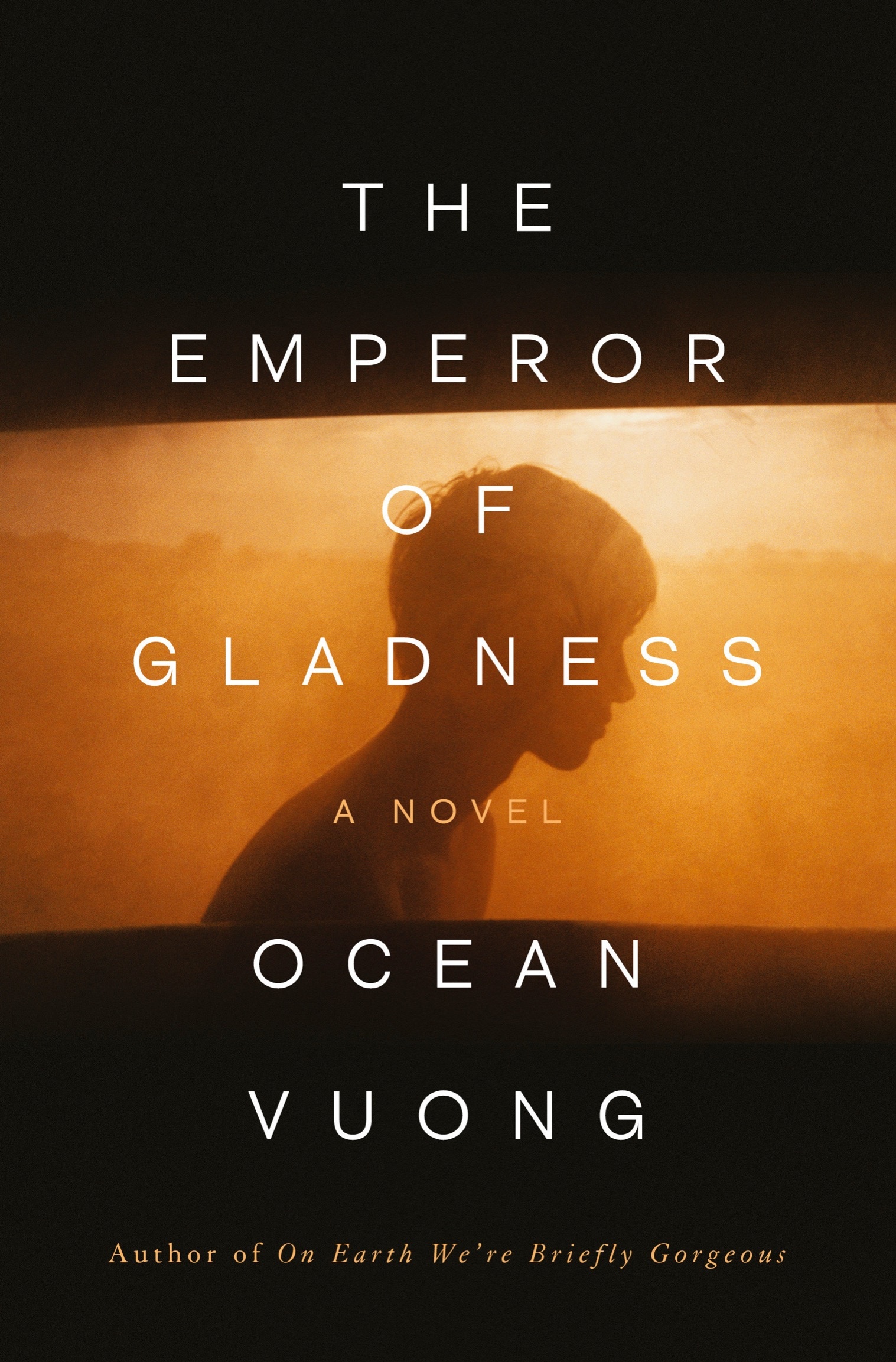
The Emperor of Gladness
About this book
Hai stands above the river in East Gladness ready to end his life when Grazina, an elderly widow watching from the bank, interrupts him. He crosses into her home instead, and a single night becomes an arrangement in which each provides care the other cannot easily request.
Grazina's memory moves through war, migration, and the present without reliable borders. Hai, himself carrying addiction and disappointment, takes work at a fast-food restaurant where employees on the edge of economic security build another imperfect form of family.
The novel attends to medication, shifts, meals, stories, and the bodily labour of keeping another person alive. Humour and tenderness arrive without turning poverty or dementia into lessons, and survival remains repetitive rather than triumphantly solved.
The Emperor of Gladness expands Ocean Vuong's interest in language, work, memory, and chosen kin into a broad social novel. Its centre is the dignity created when people who feel disposable become responsible for one another, even when care cannot guarantee rescue.
Read a sample
5,016 words
Plain text
From the opening
1
The hardest thing in the world is to live only once.
But it’s beautiful here, even the ghosts agree. Mornings, when the light rinses this place the shade of oatmeal, they rise as mist over the rye across the tracks and stumble toward the black-spired pines searching for their names, names that no longer live in any living thing’s mouth. Our town is raised up from a scab of land along a river in New England. When the prehistoric glaciers melted, the valley became a world-sized lake, and when that dried up it left a silvery trickle along the basin called the Connecticut: Algonquin for “long tidal river.” The sediment here is rich with every particle welcoming to life. As you approach, you’ll be flanked by wide stretches of thumb-sized buds shooting lucent through April mud. Within months these saplings will stand as packed rows of broadleaf tobacco and silver queen corn. Beyond the graveyard whose stones have lost their names to years, there’s a covered bridge laid over a dried-up brook whose memory of water never reached this century. Cross that and you’ll find us. Turn right at Conway’s Sugar Shack, gutted and shuttered, with windows blown out and the wooden sign that reads We Sweeten Soon as the Crocus Bloom, rubbed to braille by wind. In spring the cherry blossoms foam across the county from every patch of green unclaimed by farms or strip malls. They came to us from centuries of shit, dropped over this place by geese whenever summer beckons their hollow bones north.
Our lawns are overrun with ragweed and quack grass, one of them offering a row of red and pink tulips each spring, heads snared through the chain-link they lean on. The nearby porch overflows with rideable plastic toys, a wagon, tricycles, a fire truck, their primary colors now faded to Easter hues. A milk crate with a flap of old tire nailed across its opening is a mailbox set on a rotted sideboard, Ramirez 47 written on the rubber in Wite-Out. Beside this is a tin bird feeder the shape of Bill Clinton’s head. Seeds spill from his laughing mouth and fall like applause each time the wind comes off the freighter that blows through this place in the night’s unseen hours. Though the train never stops in our town, its whistle can be heard in every living room three miles out. Nothing stops here but us, really. Hartford, the capital built on insurance firms, firearms, and hospital equipment, bureaucracies of death and catastrophe, is only twelve minutes by car down the interstate, and everyone rushes past us, either on their way in or to get the hell out. We are the blur in the windows of your trains and minivans, your Greyhounds, our faces mangled by wind and speed like castaway Munch paintings. The only things we share with the city are the ambulances, being close enough to Hartford for them to come fetch us when we’re near dead or rattling away on steel gurneys without next of kin. We live on the edges but die in the heart of the state. We pay taxes on every check to stand on the sinking banks of a river that becomes the morgue of our dreams.
Down our back roads, the potholes are so wide and deep that, days after a summer downpour, minnows dart freely in the green-clear pools. And out of the dark of an unlit porch, someone’s laugh cuts the air so quick you could mistake it for a gasped-back sob. That beige shack flanked by goldenrods is the WWII Club, a bar with three stools and a wood-paneled vending machine stocked only with Marlboros and honey buns. Across from that are brick row houses. First built for men who worked the paper mill on Jennings Road, they now house veterans who come home from every battlefield you can think of to sit on plastic lawn chairs staring at the mountain ridge before shuffling back into smoky rooms where mini-TVs, the size of human torsos, lull them to sleep.
Look how the birches, blackened all night by starlings, shatter when dawn’s first sparks touch their beaks. How the last crickets sing through fog hung over pastures pungent now with just-laid manure. In August, the train tracks blaze so hot the rubber on your soles would melt if you walked on them for more than a minute. Despite this heat everything green grows as if in retribution for the barren, cauterized winter, moss so lush between the wooden rail ties that, at a certain angle of thick, verdant light, it looks like algae, like the glacial flood returned overnight and made us into what we were becoming all along: biblical.
Follow the tracks till they fork off and sink into a path of trampled weeds leading to a junkyard packed with school buses in various stages of amnesia, some so old they’re no longer yellow but sit grey as shipwrecks. Furred with ivy, their dented hoods pooled with crisp leaves, they are relics of our mislearning. Walk through this yard—as some have done on their way home from the night shift at the Myers sock factory or just out wandering on Sunday afternoons alone with their minds—and you walk through generations of wanderlust burned between faux-leather seats. At the lot’s far edge lies the week-old roadkill, its eye socket filled with warm Coca-Cola, the act of a girl who, bored on her way from school, poured her drink into that finite dark of sightless visions.
Continue reading the sampleClose the sample
If you aim for Gladness and miss, you’ll find us. For we are called East Gladness. Gladness itself being no more, renamed to Millsap nearly a century ago after Tony Millsap, the boy who returned from the Great War with no limbs and became a hero—proof you could lose almost all of yourself in this country and still gain a whole town. A handful of us wanted to be East Millsap to soak the shine and fill the stores, but the rest were too proud to name ourselves after a kid whose wheelchair never glided over our sidewalks.
Lasting seven months, winter begins by late September, when the frost glitters on the courthouse lawn and over the hoods of cars banked along the roads. As maples, poplars, and sassafras sway, the light filters amber through their leaving leaves. Even the steeple of the boarded-up Lutheran church grows from dove-white to day-old butter by noon.
Though skeptical, we are not ambivalent to hope. Under all this our main drag glows with its two Irish bars, a diner, a florist, the God First beauty salon, the Panda Gate China Wok, a hole-in-the-wall taco joint with no name, a funeral home painted sky blue to comfort the ravages that lie in its calling, a laundromat whose back entrance leads to a basement housing exactly three coin-operated porn booths. Two doors down is the American Legion, where they sell Saran-wrapped slices of pumpkin bread and black coffee every Friday under a windblown tarp. There’s the migrant farm laborer’s law office behind the YMCA, which last year finally had one of its wings converted to a needle exchange. There’s the huge Victorian on Lilac and Main. Home to our first mayor, it’s now a halfway house for recovering addicts, the walkway lined with polyester roses that poke out blue and violet from snowbanks after blizzards.
There’s the two-story Cape on the corner painted only high as the eldest son could reach, then abandoned the winter he joined the Marines, leaving it half olive green for the past seven years. In late July, a black mini-fridge sits by the road, an extension cord running to the house. Inside, rows of blueberries sweat in green paper pints beside a coffee can with a Post-it that reads Blueberries $5 Pay What You Can.
It’s a town where high school kids, having nowhere to go on Friday nights, park their stepfathers’ trucks in the unlit edges of the Walmart parking lot, drinking Smirnoff out of Poland Spring bottles and blasting Weezer and Lil Wayne until they look down one night to find a baby in their arms and realize they’re thirtysomething and the Walmart hasn’t changed except for its logo, brighter now, lending a bluish glow to their time-gaunt faces. It’s where fathers in blue jeans flecked with wood stain stand at the edges of football fields, watching their sons steam in the reddened dawn, one hand in their pocket, the other gripping a cup of Dunkin’ Donuts. They could be statues for what it means to wait for a boy to crush himself into manhood. And each morning you’d sit on the frost-dusted bleachers, a worn copy of To the Lighthouse on your lap, and watch the players on the field, blue tomahawks shivering on their jerseys, their plastic pads crackling in the mist. And when you’d turn the page it would slip right off the binding, flutter through the field, gathering inky blotches through the wet grass until it tangles between the boys’ legs and disintegrates under a pair of black cleats. The words gone to ground. That town.
Against all odds, we have a library. It used to be an armory that once housed a group of runaway slaves en route to Nova Scotia, cause for the bronze statue of Sojourner Truth at the center fountain, three years now without water. Across from that statue stands the four-foot-eight Lego model of a red T-Rex, the pieces glued into permanence. It is the height of a boy named Adam Munsey, who, a few feet away, was crushed by the very school bus that was to pick him up, the driver shit-faced on a handle of Southern Comfort after staying up all night to watch the Patriots win the 2002 Super Bowl. Further up, where the street widens into Route 4 and the sidewalk crumbles to dust and patches of northern poppy and blue asters spray over the green to your right, you’ll find the Colt factory where the founder, Samuel Colt, became one of the wealthiest men in America, selling revolvers to both sides during the Civil War. Now it’s a Coca-Cola plant where polished red trucks line the old brick loading bays as the sun slips behind the mountains in the west.
There’s Cumberland Road, which takes you to York County Women’s Corrections, lined this time of year with pumpkins that flush the drab fields with stretches of ochre—bounties for jackrabbits and starved possums hoarding for winter. Hugging the river beyond are slabs of sandstone pocked with Podokesaurus footprints, made over 195 million years ago, running right up to the Wendy’s parking lot. Then the other franchises: Burger King, AutoZone, Mattress Firm, Family Dollar, Dollar General. Then the Nite-E-Nite Motel with its five babyshit yellow doors facing the Kahoots nightclub across the street, which promises New Girls Every Seven Months! Beyond that are the hand-painted signs: Bryon’s Insta-Bail, Firewood $25 Off Your First Cord, No Fracking in the Name of Jesus, a faded Martha Bean for 2006 City Comptroller. And one in elegant red script that reads, as if in prophecy, Guns Ahead.
What do you really know about what you know of New England?
Past the concrete slab where the Citgo once stood, a deer steps cautious into a grove of milkweed, as if the last of its kind, then leaps into the brush where the creek spills into the river flowing under King Philip’s Bridge. A freighter bridge named for the Wampanoag chief who led a rebellion here to take back his land from Puritans, its cement abutment loops with colorful graffiti that reads SpyKids 2, Guerra a los ricos, Free Mumia Abu-Jamal!!!, Laura & Jonny ’92, niños malos, and 9/11 was an inside job.
It is also the last way out of town.
And it’s the very bridge the boy crossed one afternoon on September 15 in 2009. Rain pelted the oversize UPS jacket draped over his shoulders as he walked cradled in the heart of the valley, the land sweeping away from him toward boulderous clouds sinking into the horizon. He was nineteen, in the midnight of his childhood and a lifetime from first light. He had not been forgiven and neither are you. The sky a benevolent grey as the afternoon drained to evening and the cold turned his breath to fog. Under his boots the tracks hummed from steady gales slamming the steel straps. Yes, it is beautiful here, which is why the ghosts never leave. I need you to know this as the town rinsed to a blur behind him. I need you to understand, as black water churned like chemically softened granite below, the lights coming on one by one along the cobalt banks, that the boy belonged to a cherished portion of this world as he glanced over his shoulder and saw the phone lines sagging with crows resigned to dusk and the red water tower in the distance announcing us—East Gladness—in faded white paint, before he turned from this place, swung one leg over the rail and decided, like a good son, to jump.
2
Though it was true the boy had run out of paths to take, out of ways to salvage his failures, he never planned on jumping off King Philip’s Bridge that evening. It was only when he glimpsed, between the rail ties, the river swirling so massive below, a place you could slip cleanly into, that something in him both jolted and withered at once. They would say he drowned, of course, like that sophomore from Hebron they fetched from the shallows last summer, who got wasted at a house party and waded out past midnight singing to himself, only to wash ashore the next morning dressed in everything but his shoes. There was no shame, the boy thought, in losing yourself to something as natural as gravity—where one doesn’t jump but is pulled, blameless, toward the sea. If nothing else, this would hurt his mother least.
But once he raised his leg and lifted himself over the railing, he spotted the second platform below, jutting far enough to make the leap impossible. He paused, stared across the swirling valley charred by the gloam, and glimpsed the spot where the river turned toward Chester County, where the towns are so small you could light a cigarette as you drive in and be someplace else before you blow your first drag out the window. He sucked in a breath, let it mist over him, then toed his way to the lower platform, where he thumbed off his pack until a mute white splash winked below and it was gone. Grasping the steel cables, he inched himself toward the bridge’s center, where the fall would be highest, the current below churning through the metal beams.
A few yards in, he paused. The bridge was over a hundred feet tall, he knew, from a field trip back in middle school. It was once the town’s most prized achievement, meant to bring passenger trains and money into the heart of Main Street. But the trains never stopped, passing the town on their way to Boston, Providence, Buffalo, Portland, even Montreal. Now only the freighters cut through, carrying strapped lumber or barrels of grain from Ontario. The bridge was painted bright yellow to signal this errant optimism, the color gone now save for a few bolts buried deep enough in the beams to be spared from weather.
Streetlights had come on over the mud shelves hugging the bank, giving the water the brushstroked glow of sunlight touching wet pavement on summer mornings—the kind of light you’d see nowhere else. “Sorry,” he whispered to no one over the rush as the wires slickened under his palms. The rain, pouring steady for three days, drenched his hair and ran cold down his neck. The girl back at New Hope had mentioned, without him asking, that if you dive after breaking the surface and rush to touch the river bottom, it’ll be enough, that the rapids will drag you forward and all you have to do is close your eyes until the icy water grows warm and quiet in your lungs and your pineal gland floods your brain with DMT and before you know it you’re flying in a clear, windless sky, free from the human cage of your body.
What she didn’t mention was that when you come up to the edge, there’ll be another edge, inside you, one that’s both passable and insurmountable at once. He swallowed hard and looked down at his boot wobbling over the beam. That’s when he saw the corpse floating toward him, its limbs stretched and opaque beneath the river’s surface. The face staring skyward with shut eyes and its clothes billowing from the thin frame. He gasped and wiped the rain from his eyes with both hands and looked again, blinking. But it was still there, clearer even. He hid his face in his sleeve and clung fast to the wire when a voice called out from somewhere across the water. He thought it came from his own head until he heard it again. “Come back. Come back now! Jesus Mother Mary, not now, not today.”
He searched the bluffs and saw, set on the riverbank, a two-story clapboard house leaning toward the river. Attached to it was a wrought iron fire escape where a woman was waving her arms about, fighting with some sort of laundry line. He glanced back at the water and realized it wasn’t a corpse at all but a bedsheet twisting through the current. A blast of wind ripped another sheet out of her arms and carried it a ways before it wilted around a nearby maple.
“Hey, your blankets!” he shouted from instinct, and quickly regretted it. He stepped back under the beam’s shadow, making himself small. But too late.
The woman stopped, leaned over, and squinted at the bridge. Her glasses, reflecting the nearby streetlamp, flickered gold. From her shoulder-length white hair and stooped gait, she seemed elderly.
“Who’s there?” She shielded her eyes and called through the rain suturing around her. The boy pressed himself against the struts, a steel bolt digging between his shoulders, and kept still.
“My goodness!” she gasped, eyes wide. “What are you doing? You crazy or what? Father in heaven help us. Get the hell out of there!”
Shivering, he leaned into the cone of light, somehow more troubled that a stranger had caught him on the edge of his life than by his own impulse to end it. “It’s not what you think,” he yelled back. “I was—I was just studying the water.” He pulled back his hood and offered her, like a caught criminal, his boned face, pale as a newt’s and framed by a black bowl cut, a girlish but useless tenderness softening his eyes. It was pitiful, being found like this. What kind of idiot puts himself, on a whim, under a bridge and must now convince an old woman that it was all—what, exactly?
“Don’t be stupid.” She glanced around and pushed her glasses up with her middle finger. “You can’t die in front of my house, okay? I don’t need any more spirits around here.” She made the sign of the cross and gripped the railing as a slew of foreign words droned out of her. Her sheets had all blown away save for one blue towel whipping beside her face.
“Okay, okay! Listen.” He held out his hand as if they were steps from each other and not halfway across a river. “I’m not gonna do it. I promise. I…I’m just inspecting the bridge. I’m a student—and wanna be an engineer one day.” By now his lies came so easily, they rolled off his tongue like train cars heading off a cliff.
“Just get the hell down. I’m serious. Or I call the police.”
“Okay, alright. Relax.” Gently, he scooted across the beam toward her side of the bank. The woman disappeared into the house, then stuck her head out the next window closer to him, tracking him as he went. At one point his boot juddered over a rivet and she yelped, cursing in her native tongue.
“Put your foot over there. No, there.” She was halfway out the window, pointing to a spot he couldn’t see. “Now move to the left. Yes, wait—that other left. Good. There’s a ladder over there. Go to it and climb. Climb, boy. Hurry.” She jabbed her thumb at the sky. “Up, up! That’s it.”
He footed toward a metal ladder soldered to the bridge and pulled himself, arms jumping from cold, back to track level, then leaned over the rail and gathered his breath. “Thank you, okay?” He waved the woman off. “It’s all good. I just wanted to see the girders up close. I’m heading home now, don’t worry.”
“Bullshit! You wanna die. Come over here.” She pointed with her chin toward the shore. “Get over here or you can explain it to the cops. You think I’m kidding?” Her hair was matted from the downpour and a ring of water had darkened the collar of her gown.
The boy rose and scuffed across the bridge as she followed him from window to window, muttering to herself. When the dirt embankment appeared under the platform, he hopped over the rail and hurried toward the house. The street was flanked on both sides by shambled row houses that resembled a set from a war movie. Through the exposed walls, where pink insulation had spilled out, he glimpsed into moldy, moss-lined living rooms. One house was half burnt, its interior filled with grimy clumps of furniture where a young tree had taken root through the floorboards, its top branches clawing a gash in the second floor.
The woman’s house was on the river’s side, her back door just yards from the water. Through the decades, it had acquired the hues of the riverbank itself, slate grey and beige-speckled, the paint on the clapboard long stripped. As he reached the front steps, the main door opened and a shock of white hair poked above the screen door’s frame. She was struggling with the lock, so he gave the handle a yank and the door flew open, revealing a woman who must’ve been at least eighty. She was tall as his eyes, had a square jaw and a bulbous nose under wire-rimmed glasses that covered her entire face save for a chin that resembled the end of a dinner roll.
His own tortoise frames were beaded with rain, and he saw her as only a smear of beige colors. They watched each other a moment, the dark settling around them as he swayed on his feet.
“I’m sorry,” the boy said again, dripping. “I’m not gonna jump off that bridge no more, okay? I promise. Can I go now?”
“Come in. But take off your shoes. My husband put down these floors.” The woman disappeared into the house. The boy hesitated, looking down the empty street. The rain was picking up again. He stepped onto the porch, water running off him in rivulets, took off his boots, and followed her inside.
A creaky rail house built by freight workers over a century ago, the home was one large hallway divided into three rooms: a parlor, a dining room, and a kitchen, whose dim light now glowed at the far end like the hearth of an ancient cave. Furnished in a style the boy had seen only in the black-and-white TV series Lassie, whose reruns he watched on a three-channel Panasonic as a kid, the house had the stuffy odor of rooms whose windows rarely opened undercut with the mildewy rank of crawl spaces. As his eyes adjusted, amorphous furniture upholstered in sprawling pale florals came to view. The walls were wood-paneled and adorned with cheap landscape paintings in gilded frames. As he passed the transom that divided the parlor from the dining room, he looked up and saw what was once a white cross, now phantom-grey from decades of dust. On one wall, lit by streetlights, a cluster of grim-faced portraits stared out from an era he couldn’t locate. He paused at the kitchen’s threshold, water falling from his chin and hair on the laminate floor.
The woman sat down at a small table and nodded toward an empty chair. “Go on, sit. You look like a dunked cookie.”
He sat carefully, his eyes taking in the room. Not knowing what to do with his hands, the boy placed them, palms up, on the table but withdrew them to his lap when he realized this looked psychotic.
“Here, dry yourself.” She handed him a dish towel. It smelled of raw onions but he wiped his face anyway, his eyes quickly stinging.
“Poor kid,” she mumbled to herself. “Hey, it’s all over now, okay? Whatever happened is over. But don’t you cry, boy. Tears deplete your iron, you know.” She grabbed the rag, leaned over and dabbed his eyes some more, deepening the burn. He winced and turned away. “Okay, you’re not a boy. You’re a man and don’t need nobody to wipe your tears.”
The kitchen was the size of a large shed and contained a stovetop browned with grime-stuck grease, a sink, and a portion of countertop the size of a cutting board. They sat at a round table covered in plaid plastic meant to look like picnic cloth. From its center, a fabric-shaded lamp trimmed with tulle emitted a sickly amber glow.
She grabbed a nearby pack of cigarettes, a brand he didn’t recognize, slipped one between her lips, and put a lighter to it. “I normally don’t smoke.” She took a drag and stared at him, not unkindly, then leaned over and pushed aside a large stack of magazines. They were decades old and printed in a language he couldn’t make out.
“Lithuanian,” she said, clocking his curiosity. “Know what that is?”
He shook his head, wiping the onion tears from his cheeks.
“An old country, far away, where I was born.” She waved the cigarette about and took a drag. “But all countries are old, if you think about it.”
But he had never thought about it. He had rarely thought about any country, least of all the one he was born in—only that it, too, was far away.
“Want one?” She handed him a cigarette.
Before he could answer she placed it in his mouth and lit it.
“You like my owls?” She pointed over her shoulder where an armoire loomed behind her. Behind its glass doors was a fleet of owl figurines of many shapes and sizes, some porcelain and shining, others the matte of wood or clay. “Every owl was made in a free country. None of my owls,” she leaned back, “came from Communists. Understand?”
He lied by nodding.
Above the armoire were three paintings of owl portraits, their faces bloated as old mobsters, each one depicting, like a Rembrandt study, a new angle to the bird’s face. In fact, owl knickknacks, tchotchkes, and icons stared at him from nearly every surface. “I collect them. Don’t know why really,” she shrugged. “People started giving them to me long ago. Now it’s my calling card.” She smiled weakly through the smoke. “What’s your name anyway?”
“Thanks for this.” The boy took a long drag from the bogie. “But I should go.”
“Easy, little lamb. I invite you in my home, give you cigarette. And look,” she tilted the pack to show him, “I only have two left. I even let you cry in my kitchen. You know it’s bad luck to cry in the kitchen, right? You can at least tell me your name.”
He stared at the plastic coverlet on the table pocked with holes and considered the name his mother gave him, the thought of it sinking him. It wasn’t that he didn’t like his name—only that he had been willing to toss it in the river. He had never wanted to throw his name out, just the breath attached to it. The name, after all, was the only thing his mother gave him that he was able to keep without destroying.
“Hai,” he mumbled.
“And hello to you too. But—”
“No, Hai. It’s—”
“Okay,” she breathed, “but who am I saying hello to?”
“My name is Hai.”
“Your name is Hello?”
He decided to nod. “Sure.”
“Ah.” She brightened and pointed a crooked finger at him. “So your name is Labas!”
“What?”
“Labas means ‘hello’ in my country.” She extended her hand across the table for him to shake. “Hello, Labas. I’m Grazina. Means ‘beautiful.’ ” She grinned, the cigarette smoldering through her yellow teeth.
He shook her hand, cracked dry and warm. “Hello.”
“Now we know who’s who. So, you were delivering packages and decided that today’s the day you had enough, huh? That what they mean when they say you guys go postal?”
Hai looked down at his UPS jacket. “Oh,” he said. “No, a friend gave me this. I don’t deliver anything. But I’m sorry about your sheets.”
“Ack.” She waved him off. “You live long as I do and everything’s a rag.”
He stared out the window at the bridge where he’d stood only a half hour ago. Now dark, its row of lights stretched to the other side. “I’m sorry again for all the trouble. But I’m okay now, really.”
“Don’t be sorry. Living all these years next to a bridge, you see crazy things on it. One time, on Christmas morning, a whole container of chickens tipped over as the train crossed, the top rows falling over the sides. Poor things. They drowned in their cages. But some got loose and swam. Can you believe chickens can swim? Beats being eaten, no?” She let herself laugh. “But I’m glad that you, Mr. Hello, you didn’t become another chicken, huh?”