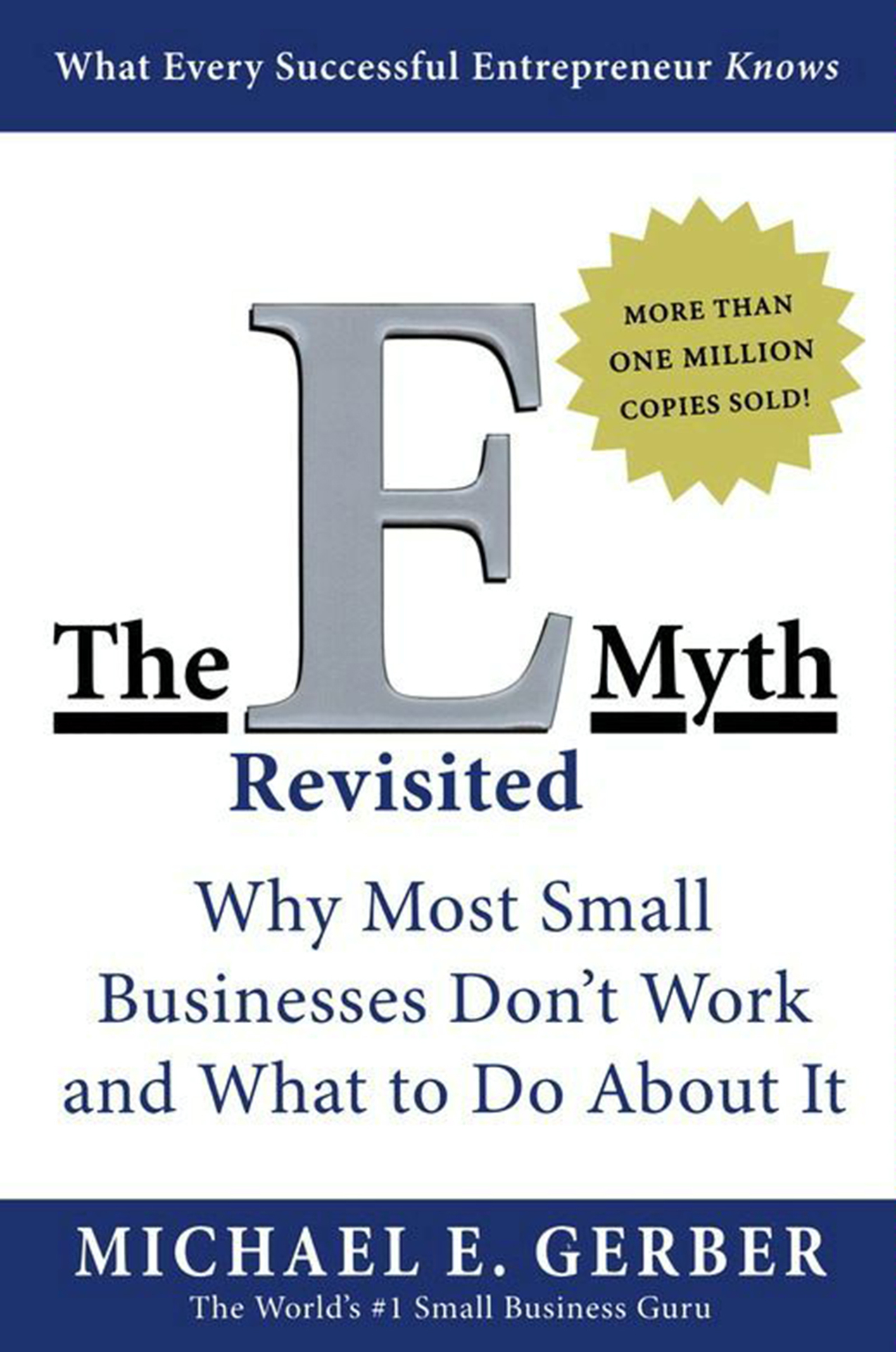
The E-Myth Revisited
About this book
The ‘E-Myth’ is the entrepreneurial myth that knowing how to perform the core technical work means knowing how to run the business around it. Gerber divides the owner’s competing roles into Entrepreneur, Manager, and Technician, each necessary and each capable of dominating the others.
Through the example of a struggling bakery, the book develops the idea of working on the business as well as in it. Documented processes, clear roles, measurable standards, and a replicable operating model are presented as ways to make quality less dependent on one exhausted person.
The franchise prototype is used as a design discipline even for companies that never intend to franchise. It asks what experience the business promises and whether the system can deliver that experience through ordinary employees on ordinary days.
The E-Myth Revisited is an accessible small-business classic rather than a complete guide to finance, hiring, or market demand. Its enduring value is the distinction between personal craft and the system required to turn that craft into a durable company.
Read a sample
5,008 words
Plain text
From the opening
FOREWORD
It has been fifteen years since The E-Myth was first published. In my case, fifteen full years. A lot has happened in the interim—with my family, my business, my life. Many wonderful things, many good things, many painful things. And, if it’s true what Don Juan said in Tales of Power, that “The basic difference between an ordinary man and a warrior is that a warrior takes everything as a challenge while an ordinary man takes everything either as a blessing or a curse,” then I am as guilty of being an ordinary man as the next guy, and, on occasion, have ascended to the warrior state when God saw fit to provide me with the power.
In these fifteen years, I have experienced near financial and business disaster as well as incredible victories; have built a 16-year marriage into an exquisite partnership with my wife, Ilene; have become the father of two extraordinary children, Sam and Alex Olivia (the total is now five, ages nine years to thirty-eight years); have entered the anointed state of grandfatherhood thanks to my daughter Kim and my son-in-law John, who have blessed us with Sarah, Elijah, Noah, Hannah, and Isaiah; have traveled throughout the world speaking to hundreds of thousands of small business owners in Australia, Canada, Spain, New Zealand, Japan, Puerto Rico, Mexico, Indonesia, and, of course, in almost every major city in the United States. And, through it all, I have been the grateful recipient of unrestrained support and caring from many of those whose lives I have in some way managed to touch and whose paths I have crossed.
In short, the years have been exhilarating, challenging, frustrating, exhausting, debilitating, boring, enlightening, rewarding, and, after all is said and done, a handful for anyone, especially for a guy my age with a penchant for going to the wall without concern for the damage I do to the leading parts of my body.
This book, then, is a product of the last fifteen years, as well as a product of the fifteen years that preceded them. It was almost exactly eight years before The E-Myth was published that I founded our company, E-Myth Worldwide, which has provided the fuel and experience for the point of view I have shared with those of you who have read The E-Myth, and with those of you who are about to read this book.
In the years since The E-Myth was published, many of my readers—as well as many of our small business clients—have asked me to clarify specific aspects of The E-Myth point of view so they could better apply it to their businesses. This book answers many questions that The E-Myth has raised over the years, offering both new and previous readers the opportunity to approach their businesses with renewed vigor and a sharpened mindset through an expanded experience of The E-Myth principles.
Toward that end, I have attempted to answer the most important questions I have been asked about the principles covered in each chapter by means of a running dialogue with a wonderful woman named Sarah (not her real name) with whom I’ve spent quite a bit of time over the past year. Sarah’s experience in business, her patience, intelligence, and passion have helped me to address the challenging issues of our small business clients in the reorganization of their minds as well as their businesses. It is in response to Sarah’s frustrations, and her very personal inquiry, that I have endeavored to clarify for the reader the E-Myth Point of View. I hope that Sarah and her questions are as engaging to you as they have been to me.
But, before I introduce you to Sarah, I’d like to share with you some thoughts about small businesses and the people who own them.
The question has often been asked of me, “What do the owners of extraordinary businesses know that the rest don’t?”
Contrary to popular belief, my experience has shown me that the people who are exceptionally good in business aren’t so because of what they know but because of their insatiable need to know more.
The problem with most failing businesses I’ve encountered is not that their owners don’t know enough about finance, marketing, management, and operations—they don’t, but those things are easy enough to learn—but that they spend their time and energy defending what they think they know. The greatest businesspeople I’ve met are determined to get it right no matter what the cost.
And by getting it right, I’m not just talking about the business.
I mean that there is something uplifting, some vision, some higher end in sight that “getting it right” would serve.
An ethical certainty, a moral principle, a universal truth.
Which is not to say that those I’m inclined to think of as extraordinary would necessarily communicate it that way. Many can’t. Even if they had the inclination, they simply don’t have the words for it. But it’s still there all the same. You can see it in their eyes, feel it radiating from their bodies, hear it in the timbre of their voices.
On the other hand, notwithstanding the search for “something higher,” the best of the best I have known are extraordinarily grounded people; they are compulsive about detail, pragmatic, down-to-earth, in touch with the seamy reality of ordinary life. They know that a business doesn’t miss the mark by failing to achieve greatness in some lofty, principled way, but in the stuff that goes on in every nook and cranny of the business—on the telephone, between the customer and a salesperson, on the shipping dock, at the cash register.
Continue reading the sampleClose the sample
And so the great ones I have known seem to possess an intuitive understanding that the only way to reach something higher is to focus their attention on the multitude of seemingly insignificant, unimportant, and boring things that make up every business. (And that make up every life, for that matter!)
Those mundane and tedious little things that, when done exactly right, with the right kind of attention and intention, form in their aggregate a distinctive essence, an evanescent quality that distinguishes every great business you’ve ever done business with from its more mediocre counterparts whose owners are satisfied to simply get through the day.
Yes, the simple truth about the greatest businesspeople I have known is that they have a genuine fascination for the truly astonishing impact little things done exactly right can have on the world.
It is to that fascination that this book is dedicated.
This book is a guide for those who see the development of an extraordinary business as a never-ending inquiry, an ongoing investigation, an active engagement with a world of forces, within us and without, that continually amaze and confound the true seekers among us with awesome variety, unending surprises, and untold complexity.
While it may seem obvious, this fascination with the development of an extraordinary business is not the same as a fascination with success.
Certainly not the success we normally think of. Some end point which, having reached it, enables one to say, “I did it!” Because my experience has taught me only too well that end points in the development of an extraordinary business are instantly replaced by beginning points.
So, this book is not about endings, but about beginnings, about the never-ending game, the delightful and exhilarating process, the continuous evolution of our senses, of our consciousness—of our humanness—which only comes from being present in the moment, from being attentive to what’s going on.
I believe that our business can provide us with a mirror to see ourselves as we are, to see what we truly know and what we don’t know, to see ourselves honestly, directly, and immediately.
I believe that our business can become an exciting metaphor for “The Way.”
A wise person once said, “Know thyself.” To that honorable dictum I can only add for the businessperson on the path of discovery, good traveling and good luck.
I might also add a few instructive words from another wise man, Anthony Greenbank, who said in The Book of Survival, “To live through an impossible situation, you don’t need the reflexes of a Grand Prix driver, the muscles of a Hercules, the mind of an Einstein. You simply need to know what to do.”
Good reading.
Michael E. Gerber
Santa Rosa, California
June, 2001
INTRODUCTION
I think that maybe inside any business, there is someone slowly going crazy.
Joseph Heller
Something Happened
If you own a small business, or if you want to own a small business, this book was written for you.
It represents many thousands of hours of work we have done at E-Myth Worldwide over the past twenty-four years.
It illustrates a belief, created and supported by the experiences we have had with the thousands of small business owners with whom we’ve worked.
It is a belief that says small businesses in the United States simply do not work; the people who own them do.
And what we have also discovered is that the people who own small businesses in this country work far more than they should for the return they’re getting.
Indeed, the problem is not that the owners of small businesses in this country don’t work; the problem is that they’re doing the wrong work.
As a result, most of their businesses end up in chaos—unmanageable, unpredictable, and unrewarding.
Just look at the numbers.
Businesses start and fail in the United States at an increasingly staggering rate. Every year, over a million people in this country start a business of some sort. Statistics tell us that by the end of the first year at least 40 percent of them will be out of business.1
Within five years, more than 80 percent of them—800,000—will have failed.
And the rest of the bad news is, if you own a small business that has managed to survive for five years or more, don’t breathe a sigh of relief. Because more than 80 percent of the small businesses that survive the first five years fail in the second five.
Why is this?
Why do so many people go into business, only to fail?
What lesson aren’t they learning?
Why is it that with all the information available today on how to be successful in small business, so few people really are?
This book answers those questions.
It’s about four profound ideas, which, if you understand and take them to heart, will give you the power to create an extraordinarily exciting, and personally rewarding, small business.
Ignore them, and you will likely join the hundreds of thousands of people every year who pour their energy and capital—and life—into starting a small business and fail, or the many others who struggle along for years simply trying to survive.
IDEA #1 There is a myth in this country—I call it the E-Myth—which says that small businesses are started by entrepreneurs risking capital to make a profit. This is simply not so. The real reasons people start businesses have little to do with entrepreneurship. In fact, this belief in the Entrepreneurial Myth is the most important factor in the devastating rate of small business failure today. Understanding the E-Myth, and applying that understanding to the creation and development of a small business, can be the secret to any business’s success.
IDEA #2 There’s a revolution going on today in American small business. I call it the Turn-Key Revolution. Not only is it changing the way we do business in this country and throughout the world but it is changing who goes into business, how they do it, and the likelihood of their survival.
IDEA #3 At the heart of the Turn-Key Revolution is a dynamic process we at E-Myth Worldwide call the Business Development Process. When it is systematized and applied purposely by a small business owner, the Business Development Process has the power to transform any small business into an incredibly effective organization. Our experience has shown us that when a small business incorporates this process into its every activity and uses it to control its destiny, that company stays young and thrives. When a small business ignores this process—as most unfortunately do—it commits itself to Management by Luck, stagnation, and, ultimately, failure. The consequences are inevitable.
IDEA #4 The Business Development Process can be systematically applied by any small business owner in a step-by-step method that incorporates the lessons of the Turn-Key Revolution into the operation of that business. This process then becomes a predictable way to produce results and vitality in any small business whose owner is willing to give it the time and attention it requires to flourish.
Since the founding of E-Myth Worldwide in 1977, we have assisted over 25,000 small business owners with the implementation of our Business Development Process through their enrollment in our unique E-Myth Mastery ProgramTM, and I have seen it succeed thousands of times.
I would venture to guess that no organization has had more direct experience applying the lessons of the Turn-Key Revolution and the Business Development Process to the development of a small business than we have had at E-Myth Worldwide. And, while the process is no “magic bullet” and does require hard work, it is always gratifying work and the only work I know that will give you the level of control you need to get what you want from your small business. Indeed, it will change your business and it will change your life.
This book, then, is about producing results—not simply “how to do it.” Because both of us know that books like that don’t work. People do.
And what makes people work is an idea worth working for, along with a clear understanding of what needs to be done.
It is only when such an idea becomes firmly integrated into the way you think and operate your business that “how to do it” becomes meaningful.
This book is about such an idea—an idea that says your business is nothing more than a distinct reflection of who you are.
If your thinking is sloppy, your business will be sloppy.
If you are disorganized, your business will be disorganized.
If you are greedy, your employees will be greedy, giving you less and less of themselves and always asking for more.
If your information about what needs to be done in your business is limited, your business will reflect that limitation.
So if your business is to change—as it must continuously to thrive—you must change first. If you are unwilling to change, your business will never be capable of giving you what you want.
The first change that needs to take place has to do with your idea of what a business really is and what it takes to make one work.
Once you fully understand the relationship every owner must have with his or her business if it is to work, I can assure you that your business and your life will take on new vitality and new meaning.
You’ll know why so many people fail to get what they want from a business of their own.
You’ll see the almost magical opportunities available to anyone who starts a small business in the right way, with a true understanding, with the necessary tools.
I’ve seen it happen thousands of times, in every kind of business imaginable, with people who knew nothing about business when they started.
My wish is that by the time you are through reading this book, it will have started to happen to you.
PART I
The E-Myth and American Small Business
1
THE ENTREPRENEURIAL MYTH
They intoxicate themselves with work so they won’t see how they really are.
Aldous Huxley
The E-Myth is the myth of the entrepreneur. It runs deep in this country and rings of the heroic.
Picture the typical entrepreneur and Herculean pictures come to mind: a man or woman standing alone, wind-blown against the elements, bravely defying insurmountable odds, climbing sheer faces of treacherous rock—all to realize the dream of creating a business of one’s own.
The legend reeks of nobility, of lofty, extra-human efforts, of a prodigious commitment to larger-than-life ideals.
Well, while there are such people, my experience tells me they are rare.
Of the thousands of businesspeople I have had the opportunity to know and work with over the past two decades, few were real entrepreneurs when I met them.
The vision was all but gone in most.
The zest for the climb had turned into a terror of heights.
The face of the rock had become something to cling to rather than to scale.
Exhaustion was common, exhilaration rare.
But hadn’t all of them once been entrepreneurs? After all, they had started their own business. There must have been some dream that drove them to take such a risk.
But, if so, where was the dream now? Why had it faded?
Where was the entrepreneur who had started the business?
The answer is simple: the entrepreneur had only existed for a moment.
A fleeting second in time.
And then it was gone. In most cases, forever.
If the entrepreneur survived at all, it was only as a myth that grew out of a misunderstanding about who goes into business and why.
A misunderstanding that has cost us dearly in this country—more than we can possibly imagine—in lost resources, lost opportunities, and wasted lives.
That myth, that misunderstanding, I call the E-Myth, the myth of the entrepreneur.
And it finds its roots in this country in a romantic belief that small businesses are started by entrepreneurs, when, in fact, most are not.
Then who does start small businesses in America?
And why?
The Entrepreneurial Seizure
To understand the E-Myth and the misunderstanding at its core, let’s take a closer look at the person who goes into business. Not after he goes into business, but before.
For that matter, where were you before you started your business? And, if you’re thinking about going into business, where are you now?
Well, if you’re like most of the people I’ve known, you were working for somebody else.
What were you doing?
Probably technical work, like almost everybody who goes into business.
You were a carpenter, a mechanic, or a machinist.
You were a bookkeeper or a poodle clipper; a drafts-person or a hairdresser; a barber or a computer programmer; a doctor or a technical writer; a graphic artist or an accountant; an interior designer or a plumber or a salesperson.
But whatever you were, you were doing technical work.
And you were probably damn good at it.
But you were doing it for somebody else.
Then, one day, for no apparent reason, something happened. It might have been the weather, a birthday, or your child’s graduation from high school. It might have been the paycheck you received on a Friday afternoon, or a sideways glance from the boss that just didn’t sit right. It might have been a feeling that your boss didn’t really appreciate your contribution to the success of his business.
It could have been anything; it doesn’t matter what. But one day, for apparently no reason, you were suddenly stricken with an Entrepreneurial Seizure. And from that day on your life was never to be the same.
Inside your mind it sounded something like this: “What am I doing this for? Why am I working for this guy? Hell, I know as much about this business as he does. If it weren’t for me, he wouldn’t have a business. Any dummy can run a business. I’m working for one.”
And the moment you paid attention to what you were saying and really took it to heart, your fate was sealed.
The excitement of cutting the cord became your constant companion.
The thought of independence followed you everywhere.
The idea of being your own boss, doing your own thing, singing your own song, became obsessively irresistible.
Once you were stricken with an Entrepreneurial Seizure, there was no relief.
You couldn’t get rid of it.
You had to start your own business.
The Fatal Assumption
In the throes of your Entrepreneurial Seizure, you fell victim to the most disastrous assumption anyone can make about going into business.
It is an assumption made by all technicians who go into business for themselves, one that charts the course of a business—from Grand Opening to Liquidation—the moment it is made.
That Fatal Assumption is: if you understand the technical work of a business, you understand a business that does that technical work.
And the reason it’s fatal is that it just isn’t true.
In fact, it’s the root cause of most small business failures!
The technical work of a business and a business that does that technical work are two totally different things!
But the technician who starts a business fails to see this.
To the technician suffering from an Entrepreneurial Seizure, a business is not a business but a place to go to work.
So the carpenter, or the electrician, or the plumber becomes a contractor.
The barber opens up a barber shop.
The technical writer starts a technical writing business.
The hairdresser starts a beauty salon.
The engineer goes into the semiconductor business.
The musician opens up a music store.
All of them believing that by understanding the technical work of the business they are immediately and eminently qualified to run a business that does that kind of work.
And it’s simply not true!
In fact, rather than being their greatest single asset, knowing the technical work of their business becomes their greatest single liability.
For if the technician didn’t know how to do the technical work of the business, he would have to learn how to get it done.
He would be forced to learn how to make the business work, rather than to do the work himself.
The real tragedy is that when the technician falls prey to the Fatal Assumption, the business that was supposed to free him from the limitations of working for somebody else actually enslaves him.
Suddenly the job he knew how to do so well becomes one job he knows how to do plus a dozen others he doesn’t know how to do at all.
Because although the Entrepreneurial Seizure started the business, it’s the technician who goes to work.
And suddenly, an entrepreneurial dream turns into a technician’s nightmare.
See the young Woman Baking Pies.
See the Young Woman Start a Business baking Pies.
See the Young Woman Become an Old Woman.
I met Sarah after she had been in business for three years. She told me, “They have been the longest three years of my life.”
Sarah’s business was named All About Pies (not its real name).
But, in truth, Sarah’s business wasn’t really all about pies—it was really all about work. The work Sarah did. The work Sarah used to love to do more than anything else. Plus the work Sarah had never done in her life.
“In fact,” Sarah said to me, “not only do I hate to do all this [she spread her arms, taking in the small shop in which we stood] but I hate [she emphasized the word almost fiercely]—I hate baking pies. I can’t stand the thought of pies. I can’t stand the smell of pies. I can’t stand the sight of pies.” And then she started crying.
The sweet fresh aroma of pies filled the air.
It was 7 A.M. and All About Pies was to open in thirty minutes. But Sarah’s mind was someplace else.
“It’s seven o’clock,” she said, wiping her eyes with her apron, as though reading my mind. “Do you realize I’ve been here since three o’clock this morning? And that I was up at two to get ready? And that by the time I get the pies ready, open for business, take care of my customers, clean up, close up, do the shopping, reconcile the cash register, go to the bank, have dinner, and get the pies ready for tomorrow’s bake, it’ll be nine-thirty or ten o’clock tonight, and by the time I do all that, by the time any normal person, for God’s sake, would say that the day was done, I will then also need to sit down and begin to figure out how I’m going to pay the rent next month?
“And all this [she spread her arms wearily again, as though to accentuate everything she had just said] because my very best friends told me I was crazy not to open a pie shop because I was so damn good at it? And, what’s worse, I believed them! I saw a way out of the horrible job I used to have. I saw a way to get free, doing work I loved to do, and doing it all for me.”
She was on a tear that I didn’t want to interrupt. I waited quietly to hear what she would say next.
Instead, she kicked the huge black oven in front of her with her right foot.
“Damn!” she exploded.
“Damn, Damn, Damn!”
For emphasis, she kicked the oven again. And then slumped, sighed deeply, and hugged herself, almost desperately.
“What do I do now?” she said, almost in a whisper. Not really asking me, I knew, but asking herself.
Sarah leaned against the wall and remained there quietly for a long moment, staring at her feet. The large clock on the wall ticked loudly in the empty shop. I could hear the cars driving by on the busy street in front of the shop as the city came awake. The sun shone harshly through the spotless windows, sweeping the gleaming oak floor in front of the counter.
I could see the dust in the stream of light, hanging suspended as though waiting for Sarah to speak.
She was deep in debt.
She had spent everything she had, and more, to create this lovely little shop.
The floors were the best oak.
The ovens were the best ovens.
The displays were charming, the very best money could buy.
She had put her heart into this place, just as she had put her heart into her pies, falling in love with baking as a young girl, mentored by her aunt who had lived with her family while Sarah was growing up.
Her aunt had filled her family’s kitchen, Sarah’s childhood, with the delicious, sweet aroma of freshly baked pies. Her aunt had introduced her to the magic of the process: the kneading of the dough, the cleaning of the oven, the sprinkling of the flour, the preparation of the trays, the careful cutting of the apples, the cherries, the rhubarb, the peaches. It was a labor of love.
Her aunt had corrected her when, in her haste, Sarah had hurried the process.
Her aunt had told her, time and time again, “Sarah, dear, we have all the time in the world. Baking pies is not about getting done. It’s about baking pies.”
And Sarah thought she understood her.
But now Sarah knew that baking pies was about “getting done.” Baking pies was ruined for her. At least she thought it was.
The clock continued its emphatic ticking.
I watched as Sarah seemed to shrink even closer to herself.
I knew how oppressive it must be for her to find herself so deeply in debt, to feel so helpless in the face of it. Where was her aunt now? Who was going to teach her what to do next?
“Sarah,” I said as carefully as I could.
“It’s time to learn all about pies all over again.”
The technician suffering from an Entrepreneurial Seizure takes the work he loves to do and turns it into a job. The work that was born out of love becomes a chore, among a welter of other less familiar and less pleasant chores. Rather than maintaining its specialness, representing the unique skill the technician possesses and upon which he started the business, the work becomes trivialized, something to get through in order to make room for everything else that must be done.
I told Sarah that every technician suffering from an Entrepreneurial Seizure experiences exactly the same thing.
First, exhilaration; second, terror; third, exhaustion; and, finally, despair. A terrible sense of loss—not only the loss of what was closest to them, their special relationship with their work, but the loss of purpose, the loss of self.
Sarah looked at me with a sense of relief, as though she felt seen but not judged.
“You’ve got my number,” she said. “But what do I do now?”
“You take this one step at a time,” I answered.
“The technician isn’t the only problem you’ve got to deal with here.”
2
THE ENTREPRENEUR, THE MANAGER, AND THE TECHNICIAN
Thus, in the course of his life, one man acquires many personal qualities, many personages, many ‘I’s’ (because each, speaking for itself independently of the others says ‘I,’ ‘me,’ when it appears).
Jean Vaysse
Toward Awakening
No, The Technician isn’t the only problem.
The problem is more complicated than that.
The problem is that everybody who goes into business is actually three-people-in-one: The Entrepreneur, The Manager, and The Technician.
And the problem is compounded by the fact that while each of these personalities wants to be the boss, none of them wants to have a boss.
So they start a business together in order to get rid of the boss. And the conflict begins.
To show you how the problem manifests itself in all of us, let’s examine the way our various internal personalities interact. Let’s take a look at two personalities we’re all familiar with: The Fat Guy and The Skinny Guy.
Have you ever decided to go on a diet?
You’re sitting in front of the television set one Saturday afternoon, watching an athletic competition, awed by the athletes’ stamina and dexterity.
You’re eating a sandwich, your second since you sat down to watch the event two hours before.