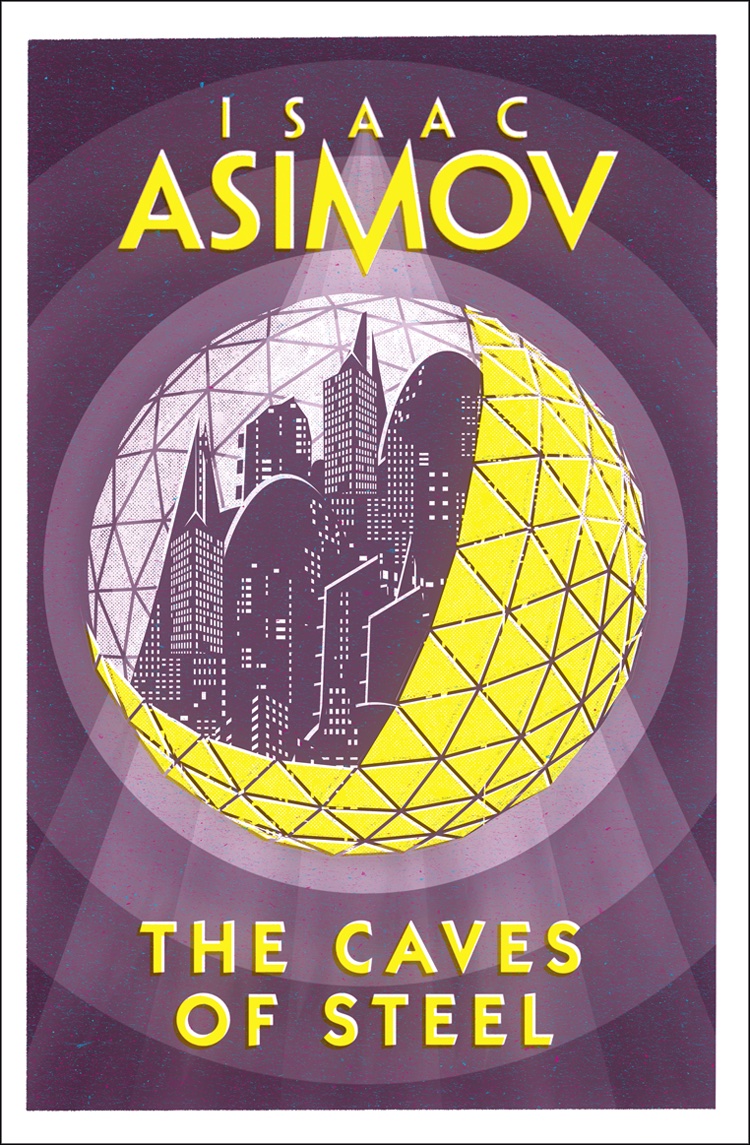
The Caves of Steel
About this book
Earth's population lives beneath steel and concrete, packed into enormous enclosed Cities whose inhabitants rarely see open sky. Elijah Baley is a plainclothes detective in New York when a Spacer scientist is murdered just outside the City. The case is politically dangerous, and Baley is given a partner he does not want: R. Daneel Olivaw, a robot built to look human.
The investigation moves through a society uneasy about its own future. Earthpeople resent the long-lived Spacers and fear that robots will take scarce jobs; the Spacers regard Earth as crowded, diseased, and backward. Baley shares many of those prejudices, even while the success of the case depends on his learning how Daneel observes, reasons, and obeys the Three Laws.
The Caves of Steel works as a closed-circle murder mystery on the scale of a city. Interviews and deductions matter, but so do public kitchens, moving expressways, communal habits, and the pressure of living without privacy. The physical design of the City is not background—it shapes what witnesses notice and what suspects believe possible.
This is the first Elijah Baley and R. Daneel Olivaw novel. It provides its own introduction to the Robot world, combining detective procedure with a larger argument about whether a civilization can remain safe by remaining closed.
Read a sample
5,018 words
Plain text
From the opening
1
Conversation with a Commissioner
Lije Baley had just reached his desk when he became aware of R. Sammy watching him expectantly.
The dour lines of his long face hardened. ‘What do you want?’
‘The boss wants you, Lije. Right away. Soon as you come in.’
‘All right.’
R. Sammy stood there blankly.
Baley said, ‘I said, all right. Go away!’
R. Sammy turned on his heel and left to go about his duties. Baley wondered irritably why those same duties couldn’t be done by a man.
He paused to examine the contents of his tobacco pouch and make a mental calculation. At two pipefuls a day, he could stretch it to next quota day.
Then he stepped out from behind his railing (he’d rated a railed corner two years ago) and walked the length of the common room.
Simpson looked up from a merc-pool file as he passed. ‘Boss wants you, Lije.’
‘I know. R. Sammy told me.’
A closely coded tape reeled out of the merc-pool’s vitals as the small instrument searched and analyzed its ‘memory’ for the desired information stored in the tiny vibration patterns of the gleaming mercury surface within.
‘I’d kick R. Sammy’s behind if I weren’t afraid I’d break a leg,’ said Simpson. ‘I saw Vince Barrett the other day.’
‘Oh?’
‘He was looking for his job back. Or any job in the Department. The poor kid’s desperate, but what could I tell him. R. Sammy’s doing his job and that’s all. The kid has to work a delivery tread on the yeast farms now. He was a bright boy, too. Everyone liked him.’
Baley shrugged and said in a manner stiffer than he intended or felt, ‘It’s a thing we’re all living through.’
The boss rated a private office. It said JULIUS ENDERBY on the clouded glass. Nice letters. Carefully etched into the fabric of the glass. Underneath, it said COMMISSIONER OF POLICE, CITY OF NEW YORK.
Baley stepped in and said, ‘You want to see me, Commissioner?’
Enderby looked up. He wore spectacles because his eyes were sensitive and couldn’t take the usual contact lenses. It was only after one got used to the sight of them that one could take in the rest of the face, which was quite undistinguished. Baley had a strong notion that the Commissioner valued his glasses for the personality they lent him and suspected that his eyeballs weren’t as sensitive as all that.
The Commissioner looked definitely nervous. He straightened his cuffs, leaned back, and said, too heartily, ‘Sit down, Lije. Sit down.’
Baley sat down stiffly and waited.
Enderby said, ‘How’s Jessie? And the boy?’
‘Fine,’ said Baley, hollowly. ‘Just fine. And your family?’
‘Fine,’ echoed Enderby. ‘Just fine.’
It had been a false start.
Baley thought: Something’s wrong with his face.
Aloud, he said, ‘Commissioner, I wish you wouldn’t send R. Sammy out after me.’
‘Well, you know how I feel about those things, Lije. But he’s been put here and I’ve got to use him for something.’
‘It’s uncomfortable, Commissioner. He tells me you want me and then he stands there. You know what I mean. I have to tell him to go or he just keeps on standing there.’
‘Oh, that’s my fault, Lije. I gave him the message to deliver and forgot to tell him specifically to get back to his job when he was through.’
Baley sighed. The fine wrinkles about his intensely brown eyes grew more pronounced. ‘Anyway, you wanted to see me.’
‘Yes, Lije,’ said the Commissioner, ‘but not for anything easy.’
He stood up, turned away, and walked to the wall behind his desk. He touched an inconspicuous contact switch and a section of the wall grew transparent.
Baley blinked at the unexpected insurge of grayish light
The Commissioner smiled. ‘I had this arranged specially last year, Lije. I don’t think I’ve showed it to you before. Come over here and take a look. In the old days, all rooms had things like this. They were called “windows.” Did you know that?’
Baley knew that very well, having viewed many historical novels.
‘I’ve heard of them,’ he said.
‘Come here.’
Baley squirmed a bit, but did as he was told. There was something indecent about the exposure of the privacy of a room to the outside world. Sometimes the Commissioner carried his affectation of Medievalism to a rather foolish extreme.
Like his glasses, Baley thought.
That was it! That was what made him look wrong!
Baley said, ‘Pardon me, Commissioner, but you’re wearing new glasses, aren’t you?’
The Commissioner stared at him in mild surprise, took off his glasses, looked at them and then at Baley. Without his glasses, his round face seemed rounder and his chin a trifle more pronounced. He looked vaguer, too, as his eyes failed to focus properly.
He said, ‘Yes.’
He put his glasses back on his nose, then added with real anger, ‘I broke my old ones three days ago. What with one thing or another I wasn’t able to replace them till this morning. Lije, those three days were hell.’
‘On account of the glasses?’
‘And other things, too. I’m getting to that.’
He turned to the window and so did Baley. With mild shock, Baley realized it was raining. For a minute, he was lost in the spectacle of water dropping from the sky, while the Commissioner exuded a kind of pride as though the phenomenon were a matter of his own arranging.
Continue reading the sampleClose the sample
‘This is the third time this month I’ve watched it rain. Quite a sight, don’t you think?’
Against his will, Baley had to admit to himself that it was impressive. In his forty-two years he had rarely seen rain, or any of the phenomena of nature, for that matter.
He said, ‘It always seems a waste for all that water to come down on the city. It should restrict itself to the reservoirs.’
‘Lije,’ said the Commissioner, ‘you’re a modernist. That’s your trouble. In Medieval times, people lived in the open. I don’t mean on the farms only. I mean in the cities, too. Even in New York. When it rained, they didn’t think of it as waste. They gloried in it. They lived close to nature. It’s healthier, better. The troubles of modern life come from being divorced from nature. Read up on the Coal Century, sometimes.’
Baley had. He had heard many people moaning about the invention of the atomic pile. He moaned about it himself when things went wrong, or when he got tired. Moaning like that was a built-in facet of human nature. Back in the Coal Century, people moaned about the invention of the steam engine. In one of Shakespeare’s plays, a character moaned about the invention of gunpowder. A thousand years in the future, they’d be moaning about the invention of the positronic brain.
The hell with it.
He said, grimly, ‘Look, Julius.’ (It wasn’t his habit to get friendly with the Commissioner during office hours, however many ‘Lijes’ the Commissioner threw at him, but something special seemed called for here.) ‘Look, Julius, you’re talking about everything except what I came in here for, and it’s worrying me. What is it?’
The Commissioner said, ‘I’ll get to it, Lije. Let me do it my way. It’s – it’s trouble.’
‘Sure. What isn’t on this planet? More trouble with the R’s?’
‘In a way, yes, Lije. I stand here and wonder how much more trouble the old world can take. When I put in this window, I wasn’t just letting in the sky once in a while. I let in the City. I look at it and I wonder what will become of it in another century.’
Baley felt repelled by the other’s sentimentality, but he found himself staring outward in fascination. Even dimmed by the weather, the City was a tremendous thing to see. The Police Department was in the upper levels of City Hall, and City Hall reached high. From the Commissioner’s window, the neighboring towers fell short and the tops were visible. They were so many fingers, groping upward. Their walls were blank, featureless. They were the outer shells of human hives.
‘In a way,’ said the Commissioner, ‘I’m sorry it’s raining. We can’t see Spacetown.’
Baley looked westward, but it was as the Commissioner said. The horizon closed down. New York’s towers grew misty and came to an end against blank whiteness.
‘I know what Spacetown is like,’ said Baley.
‘I like the picture from here,’ said the Commissioner. ‘It can just be made out in the gap between the two Brunswick Sectors. Low domes spread out. It’s the difference between us and the Spacers. We reach high and crowd close. With them, each family has a dome for itself. One family: one house. And land between each dome. Have you ever spoken to any of the Spacers, Lije?’
‘A few times. About a month ago, I spoke to one right here on your intercom,’ Baley said, patiently.
‘Yes, I remember. But then I’m getting philosophical. We and they. Different ways of life.’
Baley’s stomach was beginning to constrict a little. The more devious the Commissioner’s approach, the deadlier he thought might be the conclusion.
He said, ‘All right. But what’s so surprising about it? You can’t spread eight million people over Earth in little domes. They’ve got space on their worlds, so let them live their way.’
The Commissioner walked to his chair and sat down. His eyes looked unblinkingly at Baley, shrunken a bit by the concave lenses in his spectacles. He said, ‘Not everyone is that tolerant about differences in culture. Either among us or among the Spacers.’
‘All right So what?’
‘So three days ago, a Spacer died.’
Now it was coming. The corners of Baley’s thin lips raised a trifle, but the effect upon his long, sad face was unnoticeable. He said, ‘Too bad. Something contagious, I hope. A virus. A cold, perhaps.’
The Commissioner looked startled. ‘What are you talking about?’
Baley didn’t care to explain. The precision with which the Spacers had bred disease out of their societies was well known. The care with which they avoided, as far as possible, contact with disease-riddled Earthmen was even better known. But then, sarcasm was lost on the Commissioner.
Baley said, ‘I’m just talking. What did he die of?’ He turned back to the window.
The Commissioner said, ‘He died of a missing chest. Someone had used a blaster on him.’
Baley’s back grew rigid. He said, without turning, ‘What are you talking about?’
‘I’m talking about murder,’ said the Commissioner, softly. ‘You’re a plain-clothes man. You know what murder is.’
And now Baley turned. ‘But a Spacer! Three days ago?’
‘Yes.’
‘But who did it? How?’
‘The Spacers say it was an Earthman.’
‘It can’t be.’
‘Why not? You don’t like the Spacers. I don’t. Who on Earth does? Someone didn’t like them a little too much, that’s all.’
‘Sure, but—’
‘There was the fire at the Los Angeles factories. There was the Berlin R-smashing. There were the riots in Shanghai.’
‘All right.’
‘It all points to rising discontent. Maybe to some sort of organization.’
Baley said, ‘Commissioner, I don’t get this. Are you testing me for some reason?’
‘What?’ The Commissioner looked honestly bewildered.
Baley watched him. ‘Three days ago a Spacer was murdered and the Spacers think the murderer is an Earthman. Till now,’ his finger tapped the desk, ‘nothing’s come out. Is that right? Commissioner, that’s unbelievable. Jehoshaphat, Commissioner, a thing like this would blow New York off the face of the planet if it really happened.’
The Commissioner shook his head. ‘It’s not as simple as that. Look, Lije, I’ve been out three days. I’ve been in conference with the Mayor. I’ve been out to Spacetown. I’ve been down in Washington, talking to the Terrestrial Bureau of Investigation.’
‘Oh? And what do the Terries have to say?’
‘They say it’s our baby. It’s inside city limits. Spacetown is under New York jurisdiction.’
‘But with extraterritorial rights.’
‘I know. I’m coming to that.’ The Commissioner’s eyes fell away from Baley’s flinty stare. He seemed to regard himself as having been rudely demoted to the position of Baley’s underling, and Baley behaved as though he accepted the fact.
‘The Spacers can run the show,’ said Baley.
‘Wait a minute, Lije,’ pleaded the Commissioner. ‘Don’t rush me. I’m trying to talk this over, friend to friend. I want you to know my position. I was there when the news broke. I had an appointment with him – with Roj Nemennuh Sarton.’
‘The victim?’
‘The victim.’ The Commissioner groaned. ‘Five minutes more and I, myself, would have discovered the body. What a shock that would have been. As it was, it was brutal, brutal. They met me and told me. It started a three-day nightmare, Lije. That on top of having everything blur on me and having no time to replace my glasses for days. That won’t happen again, at least. I’ve ordered three pairs.’
Baley considered the picture he conjured up of the event. He could see the tall, fair figures of the Spacers approaching the Commissioner with the news and breaking it to him in their unvarnished emotionless way. Julius would remove his glasses and polish them. Inevitably, under the impact of the event he would drop them, then look down at the broken remnants with a quiver of his soft, full lips. Baley was quite certain that for five minutes anyway, the Commissioner was much more disturbed over his glasses than over the murder.
The Commissioner was saying, ‘It’s a devil of a position. As you say, the Spacers have extraterritorial rights. They can insist on their own investigation, make whatever report they wish to their home governments. The Outer Worlds could use this as an excuse to pile on indemnity charges. You know how that would sit with the population.’
‘It would be political suicide for the White House to agree to pay.’
‘And another kind of suicide not to pay.’
‘You don’t have to draw me a picture,’ said Baley. He had been a small boy when the gleaming cruisers from outer space last sent down their soldiers into Washington, New York, and Moscow to collect what they claimed was theirs.
‘Then you see. Pay or not pay, it’s trouble. The only way out is to find the murderer on our own and hand him over to the Spacers. It’s up to us.’
‘Why not give it to the TBI? Even if it is our jurisdiction from a legalistic viewpoint, there’s the question of interstellar relations—’
‘The TBI won’t touch it This is hot and it’s in our lap.’ For a moment, he lifted his head and gazed keenly at his subordinate. ‘And it’s not good, Lije. Every one of us stands the chance of being out of a job.’
Baley said, ‘Replace us all? Nuts. The trained men to do it with don’t exist.’
‘R’s,’ said the Commissioner. ‘They exist.’
‘What?’
‘R. Sammy is just a beginning. He runs errands. Others can patrol the expressways. Damn it man, I know the Spacers better than you do, and I know what they’re doing. There are R’s that can do your work and mine. We can be declassified. Don’t think differently. And at our age, to hit the labor pool …’
Baley said, gruffly, ‘All right.’
The Commissioner looked abashed. ‘Sorry, Lije.’
Baley nodded and tried not to think of his father. The Commissioner knew the story, of course.
Baley said, ‘When did all this replacement business come up?’
‘Look, you’re being naïve, Lije. It’s been happening all along. It’s been happening for twenty-five years, ever since the Spacers came. You know that. It’s just beginning to reach higher, that’s all. If we muff this case, it’s a big, long step toward the point where we can stop looking forward to collecting our pension-tab booklets. On the other hand, Lije, if we handle the matter well, it can shove that point far into the future. And it would be a particular break for you.’
‘For me?’ said Baley.
‘You’ll be the operative in charge, Lije.’
‘I don’t rate it, Commissioner. I’m a C-5, that’s all.’
‘You want a C-6 rating, don’t you?’
Did he? Baley knew the privileges a C-6 rating carried. A seat on the expressway in the rush hour, not just from ten to four. Higher up on the list-of-choice at the Section kitchens. Maybe even a chance at a better apartment and a quota ticket to the Solarium levels for Jessie.
‘I want it,’ he said. ‘Sure. Why wouldn’t I? But what would I get if I couldn’t break the case?’
‘Why wouldn’t you break it, Lije?’ the Commissioner wheedled. ‘You’re a good man. You’re one of the best we have.’
‘But there are half a dozen men with higher ratings in my department section. Why should they be passed over?’
Baley did not say out loud, though his bearing implied it strongly, that the Commissioner did not move outside protocol in this fashion except in cases of wild emergency.
The Commissioner folded his hands. ‘Two reasons. You’re not just another detective to me, Lije. We’re friends, too. I’m not forgetting we were in college together. Sometimes it may look as though I have forgotten, but that’s the fault of rating. I’m Commissioner, and you know what that means. But I’m still your friend and this is a tremendous chance for the right person. I want you to have it.’
‘That’s one reason,’ said Baley, without warmth.
‘The second reason is that I think you’re my friend. I need a favor.’
‘What sort of favor?’
‘I want you to take on a Spacer partner in this deal. That was the condition the Spacers made. They’ve agreed not to report the murder; they’ve agreed to leave the investigation in our hands. In return, they insist one of their own agents be in on the deal, the whole deal.’
‘It sounds like they don’t trust us altogether.’
‘Surely you see their point. If this is mishandled, a number of them will be in trouble with their own governments. I’ll give them the benefit of the doubt, Lije. I’m willing to believe they mean well.’
‘I’m sure they do, Commissioner. That’s the trouble with them.’
The Commissioner looked blank at that, but went on. ‘Are you willing to take on a Spacer partner, Lije?’
‘You’re asking that as a favor?’
‘Yes, I’m asking you to take the job with all the conditions the Spacers have set up.’
‘I’ll take a Spacer partner, Commissioner.’
‘Thanks, Lije. He’ll have to live with you.’
‘Oh, now, hold on.’
‘I know. I know. But you’ve got a large apartment, Lije. Three rooms. Only one child. You can put him up. He’ll be no trouble. No trouble at all. And it’s necessary.’
‘Jessie won’t like it. I know that.’
‘You tell Jessie,’ the Commissioner was earnest, so earnest that his eyes seemed to bore holes through the glass discs blocking his stare, ‘that if you do this for me, I’ll do what I can when this is all over to jump you a grade. C-7, Lije. C-7!’
‘All right, Commissioner, it’s a deal.’
Baley half rose from his chair, caught the look on Enderby’s face, and sat down again.
‘There’s something else?’
Slowly, the Commissioner nodded. ‘One more item.’
‘Which is?’
‘The name of your partner.’
‘What difference does that make?’
‘The Spacers,’ said the Commissioner, ‘have peculiar ways. The partner they’re supplying isn’t – isn’t …’
Baley’s eyes opened wide. ‘Just a minute!’
‘You’ve got to, Lije. You’ve got to. There’s no way out.’
‘Stay at my apartment? A thing like that?’
‘As a friend, please!’
‘No. No!’
‘Lije, I can’t trust anyone else in this. Do I have to spell it out for you? We’ve got to work with the Spacers. We’ve got to succeed, if we’re to keep the indemnity ships away from Earth. But we can’t succeed just any old way. You’ll be partnered with one of their R’s. If he breaks the case, if he can report that we’re incompetent, we’re ruined, anyway. We, as a department. You see that, don’t you? So you’ve got a delicate job on your hands. You’ve got to work with him, but see to it that you solve the case and not he. Understand?’
‘You mean co-operate with him 100 per cent, except that I cut his throat? Pat him on the back with a knife in my hand?’
‘What else can we do? There’s no other way out.’
Lije Baley stood irresolute. ‘I don’t know what Jessie will say.’
‘I’ll talk to her, if you want me to.’
‘No, Commissioner.’ He drew a deep, sighing breath. ‘What’s my partner’s name?’
‘R. Daneel Olivaw.’
Baley said, sadly, ‘This isn’t a time for euphemism, Commissioner. I’m taking the job, so let’s use his full name. Robot Daneel Olivaw.’
2
Round Trip on an Expressway
There was the usual, entirely normal crowd on the expressway: the standees on the lower level and those with seat privileges above. A continuous trickle of humanity filtered off the expressway, across the decelerating strips to localways or into the stationaries that led under arches or over bridges into the endless mazes of the City Sections. Another trickle, just as continuous, worked inward from the other side, across the accelerating strips and onto the expressway.
There were the infinite lights: the luminous walls and ceilings that seemed to drip cool, even phosphorescence; the flashing advertisements screaming for attention: the harsh, steady gleam of the ‘light-worms’ that directed THIS WAY TO JERSEY SECTIONS, FOLLOW ARROWS TO EAST RIVER SHUTTLE, UPPER LEVEL FOR ALL WAYS TO LONG ISLAND SECTIONS.
Most of all there was the noise that was inseparable from life: the sound of millions talking, laughing, coughing, calling, humming, breathing.
No directions anywhere to Spacetown, thought Baley.
He stepped from strip to strip with the ease of a lifetime’s practice. Children learned to ‘hop the strips’ as soon as they learned to walk. Baley scarcely felt the jerk of acceleration as his velocity increased with each step. He was not even aware that he leaned forward against the force. In thirty seconds he had reached the final sixty-mile-an-hour strip and could step aboard the railed and glassed-in moving platform that was the expressway.
No directions to Spacetown, he thought.
No need for directions. If you’ve business there, you know the way. If you don’t know the way, you’ve no business there. When Spacetown was first established some twenty-five years earlier, there was a strong tendency to make a showplace out of it. The hordes of the City herded in that direction.
The Spacers put a stop to that. Politely (they were always polite), but without any compromise with tact, they put up a force barrier between themselves and the City. They established a combination Immigration Service and Customs Inspection. If you had business, you identified yourself, allowed yourself to be searched, and submitted to a medical examination and a routine disinfection.
It gave rise to dissatisfaction. Naturally. More dissatisfaction than it deserved. Enough dissatisfaction to put a serious spoke in the program of modernization. Baley remembered the Barrier Riots. He had been part of the mob that had suspended itself from the rails of the expressways, crowded onto the seats in disregard of their rating privileges, run recklessly along and across the strips at the risk of a broken body, and remained just outside the Spacetown barrier for two days, shouting slogans and destroying City property out of sheer frustration.
Baley could still sing the chants of the time if he put his mind to it. There was ‘Man Was Born on Mother Earth, Do You Hear?’ to an old folk tune with the gibberish refrain, ‘Hinky-dinky-parley-voo.’
‘Man was born on Mother Earth, do you hear?
Earth’s the world that gave him birth, do you hear?
Spacer, get off the face
Of Mother Earth and into space.
Dirty Spacer, do you hear?’
There were hundreds of verses. A few were witty, most were stupid, many were obscene. Every one, however, ended with ‘Dirty Spacer, do you hear?’ Dirty, dirty. It was the futile throwing back in the face of the Spacers their most keenly felt insult: their insistence on considering the natives of Earth as disgustingly diseased.
The Spacers didn’t leave, of course. It wasn’t even necessary for them to bring any of their offensive weapons into play. Earth’s outmoded fleet had long since learned that it was suicide to venture near any Outer World ship. Earth planes that had ventured over the Spacetown area in the very early days of its establishment had simply disappeared. At the most, a shredded wing tip might tumble down to Earth.
And no mob could be so maddened as to forget the effect of the subetheric hand disruptors used on Earthmen in the wars of a century ago.
So the Spacers sat behind their barrier, which itself was the product of their own advanced science, and that no method existed on Earth of breaking. They just waited stolidly on the other side of the barrier until the City quieted the mob with somno vapor and retch gas. The below-level penitentiaries rattled afterward with ringleaders, malcontents, and people who had been picked up simply because they were nearest at hand. After a while they were all set free.
After a proper interval, the Spacers eased their restrictions. The barrier was removed and the City Police entrusted with the protection of Spacetown’s isolation. Most important of all, the medical examination was more unobtrusive.
Now, thought Baley, things might take a reverse trend. If the Spacers seriously thought that an Earthman had entered Spacetown and committed murder, the barrier might go up again. It would be bad.
He lifted himself onto the expressway platform, made his way through the standees to the tight spiral ramp that led to the upper level, and there sat down. He didn’t put his rating ticket in his hatband till they passed the last of the Hudson Sections. A C-5 had no seat rights east of the Hudson and west of Long Island, and although there was ample seating available at the moment, one of the way guards would have automatically ousted him. People were increasingly petty about rating privileges and in all honesty, Baley lumped himself in with ‘people.’
The air made the characteristic whistling noise as it frictioned off the curved windshields set up above the back of every seat It made talking a chore, but it was no bar to thinking when you were used to it.
Most Earthmen were Medievalists in one way or another. It was an easy thing to be when it meant looking back to a time when Earth was the world and not just one of fifty. The misfit one of fifty at that.
Baley’s head snapped to the right at the sound of a female shriek. A woman had dropped her handbag; he saw it for an instant, a pastel pink blob against the dull gray of the strips. A passenger hurrying from the expressway must inadvertently have kicked it in the direction of deceleration and now the owner was whirling away from her property.
A corner of Baley’s mouth quirked. She might catch up with it, if she were clever enough to hurry to a strip that moved slower still and if other feet did not kick it this way or that. He would never know whether she would or not. The scene was half a mile to the rear, already.
Chances were she wouldn’t. It had been calculated that, on the average, something was dropped on the strips every three minutes somewhere in the City and not recovered. The Lost and Found Department was a huge proposition. It was just one more complication of modem life.
Baley thought: It was simpler once. Everything was simpler. That’s what makes Medievalists.
Medievalism took different forms. To the unimaginative Julius Enderby, it means the adoption of archaisms. Spectacles! Windows!
To Baley, it was a study of history. Particularly the history of folkways.
The City now! New York City in which he lived and had his being. Larger than any City but Los Angeles. More populous than any but Shanghai. It was only three centuries old.
To be sure, something had existed in the same geographic area before then that had been called New York City. That primitive gathering of population had existed for three thousand years, not three hundred, but it hadn’t been a City.
There were no Cities then. There were just huddles of dwelling places large and small, open to the air. They were something like the Spacer’s Domes, only much different, of course. These huddles (the largest barely reached ten million in population and most never reached one million) were scattered all over Earth by the thousands. By modern standards, they had been completely inefficient, economically.
Efficiency had been forced on Earth with increasing population. Two billion people, three billion, even five billion could be supported by the planet by progressive lowering of the standard of living. When the population reaches eight billion, however, semistarvation becomes too much like the real thing. A radical change had to take place in man’s culture, particularly when it turned out that the Outer Worlds (which had merely been Earth’s colonies a thousand years before) were tremendously serious in their immigration restrictions.
The radical change had been the gradual formation of the Cities over a thousand years of Earth’s history. Efficiency implied bigness. Even in Medieval times that had been realized, perhaps unconsciously. Home industry gave way to factories and factories to continental industries.
Think of the inefficiency of a hundred thousand houses for a hundred thousand families as compared with a hundred-thousand-unit Section; a book-film collection in each house as compared with a Section film concentrate; independent video for each family as compared with video-piping systems.
For that matter, take the simple folly of endless duplication of kitchens and bathrooms as compared with the thoroughly efficient diners and shower rooms made possible by City culture.