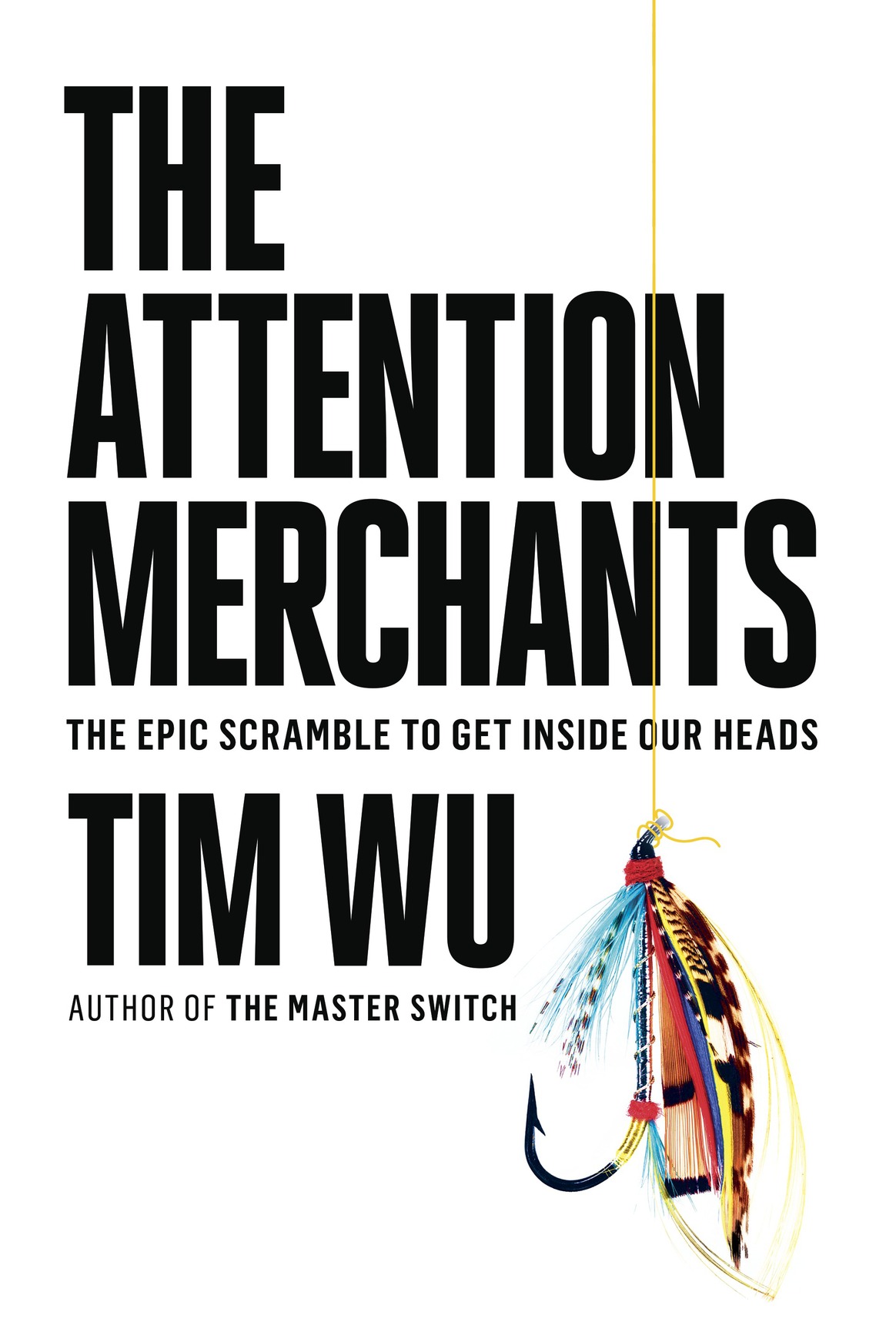
The Attention Merchants: The Epic Scramble to Get Inside Our Heads
About this book
Tim Wu traces the attention business through penny papers, propaganda, radio, television, celebrity, email, search, and social platforms. Each new medium begins with a promise to users and eventually discovers pressure to increase the volume and precision of advertising.
The history turns on bargains that feel free because payment is indirect. Audiences receive information or entertainment; advertisers fund it; publishers learn to shape content around the attention that can be captured and resold.
The Attention Merchants connects familiar media eras without pretending their technologies are identical. Its central resource is the same throughout: finite hours of human awareness.
Read a sample
5,088 words
Plain text
From the opening
INTRODUCTION
HERE’S THE DEAL
In 2011, the Twin Rivers school district in central California faced a tough situation. The district, never wealthy, was hit hard by the housing crisis of the early 2000s and the state government’s own financial meltdown. By the 2010s, schools were cutting not only extracurricular activities but even some of the basics, like heat. One day in winter, a student posted a picture of a classroom thermostat reading 44 degrees Fahrenheit.
Such were the circumstances when the Twin Rivers board was approached by a company named “Education Funding Partners.” EFP offered a tantalizing new way to help solve the district’s financial problems, using what it called “the power of business to transform public education.” Acting as broker, the firm promised that it could bring the district as much as $500,000 in private money per year. And, EFP stressed, its services would cost nothing. “EFP is paid solely out of corporate contributions,” the pitch explained, “essentially providing a free service to districts.”
To gain this free bounty, the board didn’t actually have to do anything. It needed only to understand something: that the schools were already holding an asset more lucrative than any bake sale. That asset, simply stated, was their students, who by the very nature of compulsory education were a captive audience. If the schools could seize their attention for the purpose of educating them, why not sell off a bit of it for the sake of improving the educational experience? Specifically, EFP was proposing that Twin Rivers allow corporate advertising within the schools. Moreover, EFP explained, it would bundle students from Twin Rivers with those in other school districts around the nation so as to appeal to bigger brands—the Fortune 500 companies—with deeper pockets.
If EFP was promising the district free money, its pitch to corporate advertisers was no less seductive: “Open the schoolhouse doors,” it said, promising “authentic access and deep engagement with audiences in the school environment.” Advertisers have long coveted direct access to the young, who are impressionable and easier to influence. Establishing a warm association with Coca-Cola or McDonald’s at an early age can yield payoffs that last a lifetime—or, in the lingo, “drive purchase decisions and build brand awareness.” That in essence is what EFP offered its clients: “an unparalleled system for engagement in the K–12 market”—a chance to mold the consumers of the future.
Twin Rivers soon began to see the light. “We need to be innovative about the assets we have and learn how to bring in more revenue,” said a spokeswoman. In other parts of the country, the prospect of opening schools to commercial advertising had prompted public debate. Not so in Twin Rivers, where the administrators seemed to regard signing the deal, which they did in 2012, as a matter of duty. “In these challenging economic times,” said the chief business officer, “our students are counting on us to find ways to make our resources stretch further than ever before.” EFP, for its part, promised all messaging would be “responsible” and “educational.” With that, the school doors were thrown open.
Twin Rivers is only one of the many school districts in the United States—mostly in poor or middle-class areas—that have begun to rely on selling access to their students as an essential revenue source. Some schools plaster ads across student lockers and hallway floors. One board in Florida cut a deal to put the McDonald’s logo on its report cards (good grades qualified you for a free Happy Meal). In recent years, many have installed large screens in their hallways that pair school announcements with commercials. “Take your school to the digital age” is the motto of one screen provider: “everyone benefits.”
What is perhaps most shocking about the introduction of advertising into public schools is just how uncontroversial and indeed logical it has seemed to those involved. The deals are seen as a win-win, yielding money that it would be almost irresponsible to refuse. Yet things were not always this way. There was once a time when, whether by convention or technological limitation, many parts of life—home, school, and social interaction among them—were sanctuaries, sheltered from advertising and commerce. Over the last century, however, we have come to accept a very different way of being, whereby nearly every bit of our lives is commercially exploited to the extent it can be. As adults, we are hardly ever unreachable; seldom away from a screen of some kind; rarely not being solicited or sold to. From this perspective, the school administrators are merely giving students a lesson in reality, exposing them to what is, after all, the norm for adults. But where did the norm come from? And how normal is it?
This book explains how our current state of affairs came to be. It is the consequence of the dramatic and impressive rise of an industry that barely existed a century ago: the Attention Merchants. Since its inception, the attention industry, in its many forms, has asked and gained more and more of our waking moments, albeit always, in exchange for new conveniences and diversions, creating a grand bargain that has transformed our lives. In the process, as a society and individually, we have accepted a life experience that is in all of its dimensions—economic, political, social, any way you can think of—mediated as never before in human history. And if each bargain in isolation seems a win-win, in their grand totality they have come to exert a more ambiguous though profound influence on how we live.
Continue reading the sampleClose the sample
Who exactly are the attention merchants? As an industry, they are relatively new. Their lineage can be traced to the nineteenth century, when in New York City the first newspapers fully dependent on advertising were created; and Paris, where a dazzling new kind of commercial art first seized the eyes of the person in the street. But the full potential of the business model by which attention is converted into revenue would not be fully understood until the early twentieth century, when the power of mass attention was discovered not by any commercial entity but by British war propagandists. The disastrous consequences of propaganda in two world wars would taint the subsequent use of such methods by government, at least in the West. Industry, however, took note of what captive attention could accomplish, and since that time has treated it as a precious resource, paying ever larger premiums for it.
If the attention merchants were once primitive, one-man operations, the game of harvesting human attention and reselling it to advertisers has become a major part of our economy. I use the crop metaphor because attention has been widely recognized as a commodity, like wheat, pork bellies, or crude oil. Existing industries have long depended on it to drive sales. And the new industries of the twentieth century turned it into a form of currency they could mint. Beginning with radio, each new medium would attain its commercial viability through the resale of what attention it could capture in exchange for its “free” content.
As we shall see, the winning strategy from the beginning has been to seek out time and spaces previously walled off from commercial exploitation, gathering up chunks and then slivers of our un-harvested awareness. Within living memory it was thought that families would never tolerate the intrusion of broadcasting in the home. An earlier generation would find it astonishing that, without payment or even much outcry, our networks of family, friends, and associates have been recruited via social media to help sell us things. Now, however, most of us carry devices on our bodies that constantly find ways to commercialize the smallest particles of our time and attention. Thus, bit by bit, what was once shocking became normal, until the shape of our lives yielded further and further to the logic of commerce—but gradually enough that we should now find nothing strange about it.
This book shares with my previous one, The Master Switch, the basic objective of making apparent the influence of economic ambition and power on how we experience our lives. As in that book, I’d like to pose at the outset the cynic’s eternal question: What difference does the rise of the Attention Merchants make to me? Why should I care? Quite simply because this industry, whose very business is the influence of consciousness, can and will radically shape how our lives are lived.
It is no coincidence that ours is a time afflicted by a widespread sense of attentional crisis, at least in the West—one captured by the phrase “homo distractus,” a species of ever shorter attention span known for compulsively checking his devices. Who has not sat down to read an email, only to end up on a long flight of ad-laden clickbaited fancy, and emerge, shaking his or her head, wondering where the hours went?
While allowing that many of us are perpetually distracted, spend too much time on social media or watching television, and consequently consume more advertising than could ever serve our own useful purposes, the cynic may still ask: But isn’t it simply our choice to live this way? Of course it is—it is we who have voluntarily, or somewhat voluntarily, entered into this grand bargain with the attentional industry, and we enjoy the benefits. But it is essential that we fully understand the deal. Certainly some of our daily attentional barters—for news, good entertainment, or useful services—are good deals. But others are not. The real purpose of this book is less to persuade you one way or the other, but to get you to see the terms plainly, and, seeing them plainly, demand bargains that reflect the life you want to live.
For the history also reveals that we are hardly powerless in our dealings with the attention merchants. Individually, we have the power to ignore, tune out, and unplug. At certain times over the last century, the industry has asked too much and offered too little in return, or even been seen to violate the public’s trust outright. At such moments, the bargain of the attention merchants is beset with a certain “disenchantment,” which, if popular grievance is great enough, can sometimes turn into a full-fledged “revolt.” During those revolts—of which there have been several over the last century—the attention merchants and their partners in the advertising industry have been obliged to present a new deal, revise the terms of the arrangement. We may, in fact, be living in such a time today, at least in those segments of the population committed to cord-cutting, ad-avoiding, or unplugging. We are certainly at an appropriate time to think seriously about what it might mean to reclaim our collective consciousness.
Ultimately, it is not our nation or culture but the very nature of our lives that is at stake. For how we spend the brutally limited resource of our attention will determine those lives to a degree most of us may prefer not to think about. As William James observed, we must reflect that, when we reach the end of our days, our life experience will equal what we have paid attention to, whether by choice or default. We are at risk, without quite fully realizing it, of living lives that are less our own than we imagine. The goal of what follows is to help us understand more clearly how the deal went down and what it means for all of us.
PART I
MASTERS OF BLAZING MODERNITIES
Since the rise of capitalism, it has been known that capturing someone’s attention could cause him to part with some money. Even before that, there was paid spectacle, like the modern theater. But as recently as the late nineteenth century, the first real industries of attention capture were still embryonic, though by then, printed matter like books and broadsheets had joined live spectacle as mental fodder created for profit.
From the 1890s through the 1920s, there arose the first means for harvesting attention on a mass scale and directing it for commercial effect, thanks to what is now familiar to us in many forms under the name of advertising. At its inception it was as transformative as the cotton gin. For advertising was the conversion engine that, with astonishing efficiency, turned the cash crop of attention into an industrial commodity. As such, attention could be not only used but resold, and this is where our story begins.
CHAPTER 1
THE FIRST ATTENTION MERCHANTS
In the summer of 1833, with The New York Times and The Wall Street Journal both decades from their first editions, New York City’s leading newspaper was The Morning Courier and New York Enquirer, a four-page daily with circulation of just 2,600 in a city of almost 300,000.1 At 6 cents, it was something of a luxury item, which was just as well, since like several of its rivals, including The Journal of Commerce, it was aimed at the city’s business and political elite. Most New Yorkers, in fact, did not read newspapers at all; “they went their way, if not entirely unaware of their presence, at least untouched by their influence,” as one historian put it. “There was little or nothing about these papers to attract the average reader.”2
In this sluggish market a young man named Benjamin Day thought he spied an opportunity. A print shop proprietor who had once worked at a newspaper, the twenty-three-year-old Day decided he’d try publishing a paper of his own. The venture was risky, for his motives were different from those of many other newspapermen of his time. Day did not have a particular political agenda, nor was he a rich man subsidizing a vanity press for the presentation of his views. As one might gather from a painting of him scowling in a tall stovepipe hat, Day saw himself as a businessman, not a journalist. “He needed a newspaper not to reform, not to arouse, but to push the printing business of Benjamin H. Day.”
Day’s idea was to try selling a paper for a penny—the going price for many everyday items, like soap or brushes. At that price, he felt sure he could capture a much larger audience than his 6-cent rivals. But what made the prospect risky, potentially even suicidal, was that Day would then be selling his paper at a loss. What Day was contemplating was a break with the traditional strategy for making profit: selling at a price higher than the cost of production. He would instead rely on a different but historically significant business model: reselling the attention of his audience, or advertising. What Day understood—more firmly, more clearly than anyone before him—was that while his readers may have thought themselves his customers, they were in fact his product.
It wasn’t, of course, as if newspapers had never tried advertising as a revenue source. Since the first dailies in the early eighteenth century, there had been forms of advertising or paid notices. But the line between news and advertising could be blurry, and so it’s hard to identify the first true advertisement. (In 1871, The New York Times would assign the distinction—in English at least—to a publication announcement of the heroic poem “Irenodia Gratulatoria” in 1652.) Indeed, the earliest newspapers “treated advertising as a form of news…presumably because it was considered interesting to readers.” Unlike the persuasive, rhetorical advertisements to come, early ads were purely informational. Most were what we’d call classifieds—lost items, things for sale, job openings, and private notices of various kinds.
Day’s idea was not to offer such a notice board but rather to sell his readers’ attention en bloc to more substantial advertisers. But for such undifferentiated attention to be valuable to anyone, he would have to amass a giant readership. That would mean making the New York Sun alluring to the broadest segment of society—by any means necessary.
The New York Sun first appeared on September 3, 1833: all text and in smaller format than the broadsheets, to save on costs. Day did it all—he was “proprietor, publisher, editor, chief pressman, and mailing clerk.” For the paper’s first issue, he took the unusual step of filling it with advertisements from businesses he had never solicited. You might say that he ran advertisements, in effect, to try and find advertisers. Such could also be understood from his statement on the front page: “The object of this paper,” he wrote, “is to lay before the public, at a price within the means of every one, ALL THE NEWS OF THE DAY, and at the same time afford an advantageous medium for advertising.” His plan for delivering on the promise of such a broad readership was to feature stories from which no one could look away.
“MELANCHOLY SUICIDE—a Mr. Fred A. Hall…put an end to his life on Sunday last by taking laudanum,” read the first headline in the very first issue. Young Mr. Hall, the story revealed, was about to be shipped off to Indonesia by his father to end a romance. Unable to bear the separation, he took his life. “He was about twenty-four years of age, of engaging manners and amiable disposition, and one whose loss, even under less affecting circumstances, would have been deeply lamented.”
The first issue of the Sun told also the story of William Scott and Charlotte Grey. Scott was jailed for assaulting Grey, his female companion. Brought before the magistrate, Scott was offered release on one condition: that he promise to marry Grey, the injured party. “Mr. Scott cast a sheep’s eye towards the girl, and then looking out of the window, gave the bridewell a melancholy survey. [He] was hesitating which he should choose—a wife or prison. The Justice insisted on an immediate answer. At length he concluded that he ‘might as well marry the critter,’ and they left the office apparently satisfied.”
On its first day, the New York Sun reportedly sold about three hundred copies. It was a start, but still a money-loser; to get it off the ground Day would have to do much better. He continued to find his best stories at New York’s police court, with its “dismal parade of drunkards and wife beaters, con men and petty thieves, prostitutes and their johns.” Copying a British publication, therefore, he hired a man called George Wisner (for $4 a week) just to cover the court, creating quite possibly “the first full-time news reporter in U.S. history.” Day’s man went to court every day, returning with a wealth of lurid or comic material from the proceedings, such as the following testimony from “a little curly-pated fellow by the name of John Lawler,” who was brought before the court on a charge of kicking over the mead stand belonging to Mary Lawler, the complainant:
MAGISTRATE: Well, let’s hear your story. Do you know the boy?
COMPLAINANT: The boy, did you say? Indeed, sir, divil a bit o’boy is here about the baste, nor man neither, barring he drinks brandy like a fish. (loud laughter)
MAGISTRATE: Did you ever see him before?
COMPLAINANT: Indeed, I guess I did. Many years ago he was my husband, but your honor sees, I gave him a divorce. That is, ye see, I gave him a bit of paper stating that I would live with him no longer. (laughter)
PRISONER: It’s no such thing, yer honor. She used to go off with other men, so I sold her for a gill of rum.
Unlike other papers, the Sun also offered detailed coverage of New York’s slave trade, including stories of captured runaways (despite having abolished slavery in 1827, New York still honored the property rights of slave state residents) and of the misery of slave marriages sundered by the auction block. Though otherwise apolitical and nonpartisan, the New York Sun, mainly owing to Wisner, took a consistent principled stand in favor of abolition. “We believe the day is not far distant,” the Sun said, “when the clanking of slavery’s chains will be heard no more—and Americans stand before the world practicing, as well as preaching, the glorious doctrine that all men are created free and equal.”
Such stories gained Day the audience and attention he sought. Within just three months, he was selling thousands of copies a day, threatening the established papers. The more copies he printed, however, the more money he lost based on the penny price alone.3 So it all depended on the advertising revenue, which was growing as well. At some magical moment during that first year, it happened: the lift generated by paid advertising exceeded the gravity of costs. And at that point, like the Wrights’ aeroplane, the New York Sun took flight, and the world was never really the same again.
By the end of 1834, the New York Sun claimed five thousand readers a day, making it the city’s leading paper. Day had wanted only to bolster his modest income, but he wound up proving that newspapers could work as a freestanding business. The Sun’s success showed that a paper need not serve as a party organ, need not rely on a rich patron to fund its losses. For their part, rival papers could not at first fathom how the Sun was able to charge less, provide more news, reach a larger audience, and still come out ahead. What Day had figured out was that newsstand earnings were trivial; advertising revenue could make it all happen.
Besides striking it rich, Day accomplished something else, too. For even more than the business model, the long-term social consequences of a newspaper for the masses were profound. Large numbers of people taking in daily news gave rise to what Jürgen Habermas has called a “public sphere”4—a more quotidian term for this effect is “public opinion,” but by whatever name, it was a new phenomenon, and one dependent on the nascent but growing attention industry.
Unfortunately for Day, the competition eventually figured out how he was doing it. And soon his business model faced copycats. One of them, the New York Transcript, an evening paper, became an early ancestor of ESPN by focusing on sports coverage, which at the time was limited to horse races and prizefights. But the greatest challenge came from The Morning Herald, another penny paper first published in 1835 by a former schoolmaster named James Gordon Bennett. Severely cross-eyed, Bennett was a strange man—a shameless braggart who promoted himself as a paragon of gentility while also feeding the public’s appetite for the lurid and debauched. One historian would call him “a flagrant charlatan—but always a charlatan who accomplished his ends.” In his paper’s second issue Bennett announced that his mission was “to give a correct picture of the world…wherever human nature and real life best displays their freaks and vagaries.”
From the beginning, The Herald established a specialty in the coverage of violent death. By one count, it reported in its first two weeks “three suicides, three murders, a fire that killed five persons, an accident in which a man blew off his head, descriptions of a guillotine execution in France, a riot in Philadelphia, and the execution of Major John André half a century earlier.” Bennett would pioneer on-the-scene crime reporting, beginning with his sensational account of the murder of Helen Jewett, a prostitute killed with a hatchet and left on a burning bed. Bennett was let in to see the naked corpse:
It was the most remarkable sight I ever beheld….“My God” I exclaimed, “how like a statue!” The body looked as white, as full, as polished as the purest marble. The perfect figure, the exquisite limbs, fine face, the full arms, the beautiful bust, all surpassed, in every respect, the Venus de Medici….For a few moments I was lost in admiration of the extraordinary sight….I was recalled to her horrid destiny by seeing the dreadful bloody gashes on the right temple.
When not chronicling death in its many forms, Bennett loved to gain attention for his paper by hurling insults and starting fights. Once he managed in a single issue to insult seven rival papers and their editors. He was perhaps the media’s first bona fide “troll.” As with contemporary trolls, Bennett’s insults were not clever. He attacked the older, 6-cent Courier and Herald and its portly editor, respectively, as “bloated” and “big-bellied.” The Sun’s editors he condemned as the “garbage of society,” and the paper as “too indecent, too immoral for any respectable person to touch, or any family to take in.” Taking notice of its support for the complete abolition of slavery, he blasted it as a “decrepit, dying penny paper, owned and controlled by a set of woolly-headed and thick-lipped Negroes.”
As politicians, professional wrestlers, and rappers know well, trash-talking remains an effective way of getting attention, and it worked well for Bennett. Like those practitioners of the art in our own time, he did not hesitate to tout his own magnificence. His New York Herald, he proclaimed, “would outstrip everything in the conception of man,” for he was making The Herald into “the great organ of social life, the prime element of civilization, the channel through which native talent, native genius, and native power may bubble up daily, as the pure sparkling liquid of the Congress fountain at Saratoga bubbles up from the centre of the earth, till it meets the rosy lips of the fair.”
Bennett’s blend of murder and highfalutin beatdown was evidently worth a penny to many, and in less than a year, The Herald claimed a circulation of seven thousand, drawing roughly even with the Sun. The race was on to see which paper—and which kind of appeal—would harvest the most attention in New York.
In the ensuing contest we can observe a very basic and perhaps eternal dynamic of the attention industries. We’ve already seen the attention merchant’s basic modus operandi: draw attention with apparently free stuff and then resell it. But a consequence of that model is a total dependence on gaining and holding attention. This means that under competition, the race will naturally run to the bottom; attention will almost invariably gravitate to the more garish, lurid, outrageous alternative, whatever stimulus may more likely engage what cognitive scientists call our “automatic” attention as opposed to our “controlled” attention, the kind we direct with intent.5 The race to a bottomless bottom, appealing to what one might call the audience’s baser instincts, poses a fundamental, continual dilemma for the attention merchant—just how far will he go to get his harvest? If the history of attention capture teaches us anything, it is that the limits are often theoretical, and when real, rarely self-imposed.
In the case of the New York Sun, however, there is little evidence of even theoretical limits. For in reacting to its new competitors, the paper readily discarded what we would consider the paramount journalistic ethic, that of being bound by facts.
In 1835, not long after the launch of The Herald, the Sun ran a headline story, styled as a reprint from an Edinburgh newspaper, of “astronomical discoveries” by the famous scientist Sir John Herschel. Herschel, son of another famous astronomer, had in fact moved to the Cape of Good Hope in 1834 to build a new telescope. From the Southern Hemisphere, the Sun reported, “[he] has obtained a distinct view of objects in the moon, fully equal to that which the unaided eye commands of terrestrial objects of the distance of a hundred yards.”6 Over the next several weeks, a five-part series reported all that Herschel had discovered: the moon was covered with great seas and canyons, pillars of red rock and lunar trees, unlike any other, save the “largest kind of yews in English churchyards, which they in some respects resemble.” But Herschel’s greatest discovery was life on the moon, or more precisely: large, winged creatures, which when not borne aloft could pass for humans:
Certainly they were like human beings, for their wings had now disappeared, and their attitude in walking was both erect and dignified….They averaged four feet in height, were covered, except on the face, with short and glossy copper-coloured hair, and had wings composed of a thin membrane, without hair, lying snugly upon their backs. We scientifically denominated them as Vespertilio-homo, or man-bat; and they are doubtless innocent and happy creatures, notwithstanding that some of their amusements would but ill comport with our terrestrial notions of decorum.
The depiction of the moon, and one with life on it (not just life, but unicorns and flying man-bats with insistent libidos), was, apparently, widely accepted, in part thanks to the scientific style of the correspondent, the pretense that the story was reprinted from a respectable Edinburgh journal, and the impossibility of replicating with the naked eye the findings of the world’s largest telescope. The series was, understandably, a sensation, and the initial runs of the newspaper sold out, with crowds surrounding its offices, hungrily awaiting the next installment. When the dust settled, the New York Sun, founded just two years prior, had driven its circulation to a very precise-sounding 19,360, sailing past not only the other New York dailies but even the London dailies founded decades earlier, to take its place as the most widely read newspaper in the world.
Having decisively demonstrated that a business could be founded on the resale of human attention, Benjamin Day became the first attention merchant worthy of the title. There might have been good reason to doubt the circulation claims of a newspaper that had just reported the discovery of life on the moon. But it cannot be denied that the Sun succeeded or that the model Day conceived would spawn generations of imitators, from radio networks and broadcast television to Google and Facebook.
Posters had been around since 1796. But no one had ever seen the likes of those that began to appear in Paris in the late 1860s, some of them seven feet high, with beautiful, half-dressed women gamboling over fields of vibrant color. “Luminous, brilliant, even blinding,” one journalist wrote, marveling at the “vivid sensations and intense emotions, rapidly blunted, [only] to be revived again.” Contemporaries marveled at what was happening to the Paris cityscape. It was “the education of everyone through the retina…instead of the bare wall, the wall attracts, as a kind of chromolithographic salon.”