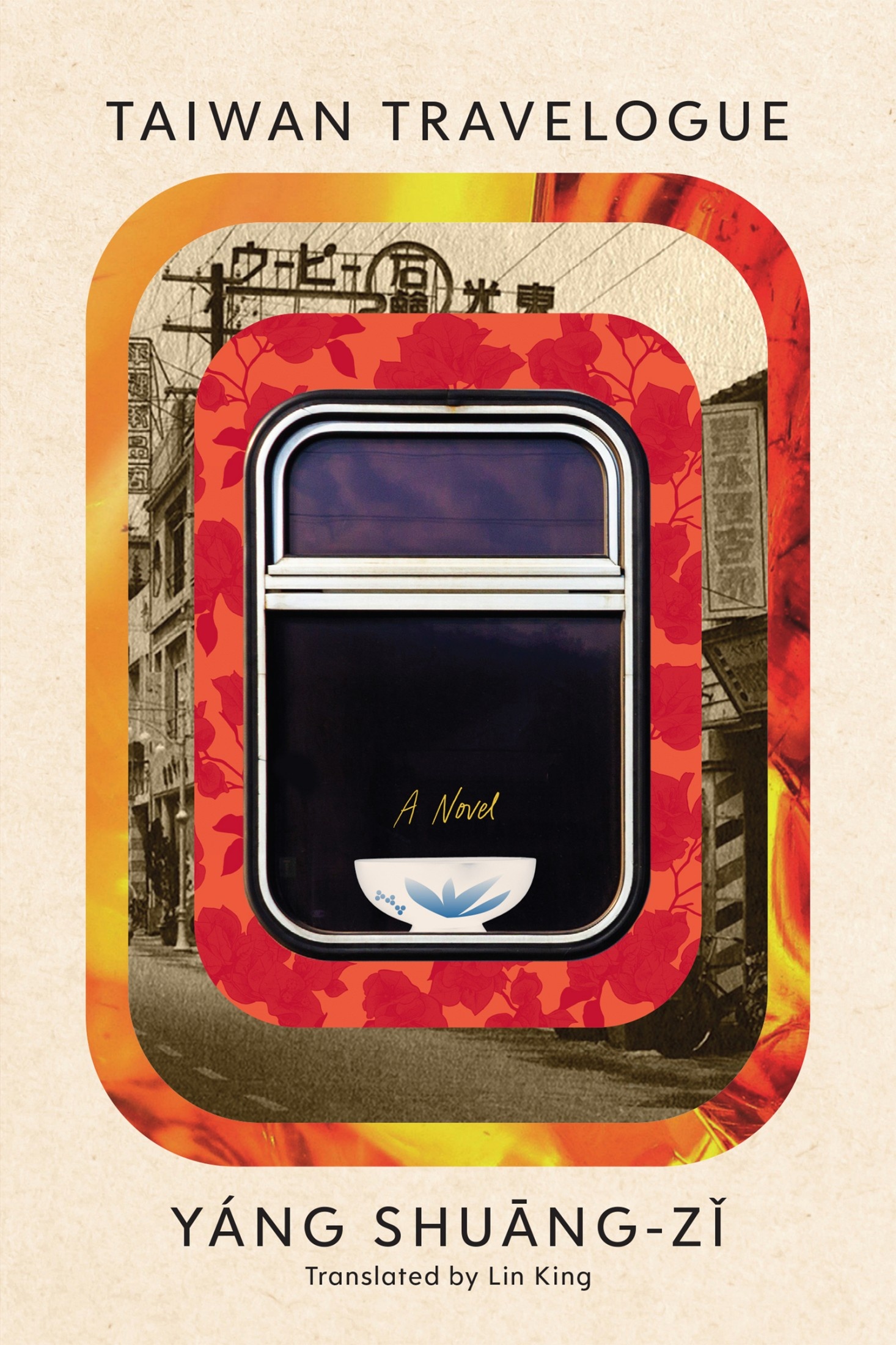
Taiwan Travelogue
About this book
In 1938, Aoyama Chizuko arrives from Nagasaki under the sponsorship of the Japanese government ruling Taiwan. She avoids official banquets and asks instead to encounter the island through its food and ordinary life.
A Taiwanese woman named Chizuru becomes her interpreter, guide, and exceptional cook. Their journeys produce intimacy and a rich culinary record, while language and colonial privilege create facts Chizuko can consume without fully recognising.
Yáng Shuāng-zǐ constructs the novel as a layered historical document, making authorship and translation part of its inquiry. Appetite opens a path toward affection but cannot by itself overcome the political inequality determining who may speak and who will be remembered.
Taiwan Travelogue is translated by Lin King. It is a bittersweet novel about two women, Taiwanese cuisine, Japanese colonial rule, and the responsibility of a traveller to examine the power enabling her view.
Read a sample
5,003 words
Plain text
From the opening
Introduction to Taiwan Travelogue, New Mandarin Chinese Edition, 2020
A Truncated Dream, a Foreign Splendorland
Hiyoshi Sagako
My affiliation with this new translation of Taiwan Travelogue began in 2015, when I heard via word of mouth that Ms. Yáng Ruò-huī, a translator, was seeking a copy of the first Mandarin translation, published in 1977. I found this an unusual quest, considering that the book had been out of print in Taiwan for many years and even academics had difficulty securing a single copy. As it happened, I was in possession of not only the first translation but also the Japanese original; I therefore asked a staff member at the National Museum of Taiwan Literature to pass along my contact information to Ms. Yáng. At the time, it did not occur to me that my actions would catalyze the birth of a new translation. The tributaries of fate have met and merged into a coursing river, one that enabled this book to be reintroduced to the world at a time when the world needed it most.
Interestingly, I did not learn until the Taiwanese publisher asked me to write an introduction that the museum staff had described me to Ms. Yáng as a “Japanese scholar.” When I heard this, I did not know whether to feel amused or offended. The word that I would use to describe myself, 灣生, is pronounced wānshēng in Mandarin Chinese, wansei in Japanese, and uansing in Taiwanese Hokkien. Being catalogued as simply “Japanese” seemed to exclude me from Taiwan entirely. However, perhaps my unusual origins make me unusually suited to introduce this novel to contemporary readers.
The term wānshēng originated when Taiwan was under Japanese colonial rule, and its meaning is exactly what the Han characters imply: Japanese people born in Taiwan. By blood we belonged to the great Yamato race, but as Japanese citizens we were “subpar”; growing up on the subtropical island, our use of the national language, Japanese, was often nonstandard, and few of us had ever seen snow or truly experienced the four seasons. Even if our bloodlines were “pure,” many Japanese argued that we could not possibly possess the true “spirit” of the Japanese people. Thus, the wānshēng were often regarded as inferior.
No matter how much the Japanese administration in Taiwan promoted their official stance that all Taiwanese peoples were as much the children of the Emperor as any Japan-born person, the reality was that Taiwanese “Islanders” were second-class citizens compared to Japanese “Mainlanders,” and the wānshēng drifted somewhere between the two classes with no means of finding belonging in either. Some of us regarded Taiwan as home, whereas others abused the Islanders all the more ruthlessly for their own inferiority complexes.
In many senses, the wānshēng are homeless, casteless ghosts. However, there are perspectives to which only ghosts are privy. For instance, there are certain things that only we ghosts would notice within Aoyama Chizuko’s novel.
Let us now turn to the novel’s background. Aoyama Chizuko, the author of Taiwan Travelogue, was born in Taishō Year 2 (1913) and made her literary debut at the age of nineteen. She became an instant star, with her first novel adapted for the silver screen. In Shōwa Year 13 (1938), the Japanese Government-General of Taiwan invited this renowned writer to Taiwan for a lecture tour. While this seemed at first glance a tasteful proposal, in reality tensions were already building toward the Second World War, and imperialist and expansionist propaganda was no doubt one of the government’s primary motives for sponsoring Aoyama-sensei’s trip.
During her stay in Taiwan, Aoyama-sensei published dispatches from her travels in Mainland newspapers and magazines; these essays and articles were presented as a series titled Taiwan Travelogue. However, this Taiwan Travelogue has little overlap with the novel Taiwan Travelogue, and was instead a precursor to the novel. The novel Taiwan Travelogue was published in Shōwa Year 29 (1954), fifteen years after Aoyama-sensei’s trip. Presented as fiction, it forsook all traces of nationalist agenda and instead focused on the relationship between Aoyama-sensei and her interpreter, Ms. Wáng Chiēn-hò (Ông Tshian-hóh in Taiwanese, Ō Chizuru in Japanese).
I will admit that, back when I first read Aoyama-sensei’s serialized essays, I had assumed that Ms. Wáng must have been a fictional character. These articles were inextricable from their propagandistic undertones, and Ms. Wáng’s presence in them seemed too conspicuously counterpropagandistic. I therefore deduced that Ms. Wáng must have been a clever metaphor, a vessel through which Aoyama could imply her true views under the veil of patriotic writing. This was not unheard of as a technique: Satō Haruo, well known for his writings on Taiwan, once created a servant-girl character in his “Tale of the ‘Precepts for Women’ Fan” as a metaphor for the inequality between the colonizers and the colonized.
Today, there is no longer any doubt that Ms. Wáng was very real indeed; those who attended Aoyama’s lectures testified to seeing Ms. Wáng at her side. But while Aoyama’s motives for publishing the book were rooted in her relationship with the real Ms. Wáng, she ultimately chose to present the work as fiction, and the novel’s very premise rests on the fictionality of Ms. Wáng as a character. For better or worse, Ms. Wáng has become a metaphor—one without which the novel Taiwan Travelogue cannot stand as a work of literature.
Continue reading the sampleClose the sample
There is also the interesting matter of the book’s twelfth and final chapter, “Kam-Á-Bi’t / Fruit and Jelly Ice.” For the novel’s reprint published in Shōwa Year 45 (1970), Aoyama Chizuko’s adopted daughter, Aoyama Yōko, writes in an afterword that there was no chapter twelve in the original manuscript that she first read. Why would this critical conclusion have been excluded from the first draft? Why was it added?
I present a conjecture: maybe Aoyama-sensei did meet with Ms. Wáng in Shōwa Year 14 (1939), but that encounter may not have been as neat as what was depicted in the novel. At the very least, Aoyama-sensei left the conversation feeling that she still needed to apologize. She may have therefore added the twelfth chapter, intending it as a letter of repentance specifically addressed to Ms. Wáng. Through this chapter, she asks: If I had been able to reach these conclusions back then, would things have been different? Would Ms. Wáng acknowledge that this different outcome was possible? Aoyama-sensei must have sent this love letter of a novel with much anxiety over its reception, even if it was too late to turn back the clock.
If my theory is correct, then the majority of “Kam-Á-Bt” has been fictionalized. But there is no need to chastise Aoyama Chizuko, for the lofty barrier that stood between these two women was not only the power imbalance between the colonizer and the colonized, but also Japan’s loss of the Pacific War and the subsequent division of Taiwan and Japan from one country into two. This is a cruel fate that perhaps deserves a happy modification. “Kam-Á-Bt” is a dream that had the potential of becoming reality, yet this dream was cut short.
I will not divulge much more out of consideration for first-time readers; I do not wish to begrudge readers of the right to form their own interpretations of the text. However, I would like to draw attention to one crucial point: that power imbalance is more subtle and delicate—as well as more ubiquitous—than most people imagine. Therefore, when reading this book, please remain cognizant of Aoyama Chizuko’s status as one of the colonizers within the story.
I have made the bold choice to publish this bumbling memorial to my travels, which I hereby dedicate to:
Madame Takada Sumako, formerly of the Taichū Prefecture Nisshinkai in Taiwan
Mr. Mishima Aizō, of Taichū City Hall, Taichū Prefecture, Taiwan Government-General
and
Miss Ông Tshian-hóh, of Chōkyōshitō, Taichū City, Taichū Prefecture
Your hospitality and generosity will never be forgotten.
Aoyama Chizuko
January, Shōwa Year 29
Sketches of the Yana River cottage by Aoyama Chizuko
Floor plan of the Yana River cottage by Aoyama Chizuko
1. Foyer
2. Drawing room
3. Engawa veranda
4. Zashiki main room
5. Tsugi secondary room
6. Toilet
7. Bathroom
8. Kitchen
9. Side door
10. Storeroom
11. Servant’s room
12. Dining room
13. Study
14. Garden stepping stones
TAIWAN TRAVELOGUE
CHAPTER I
Kue-Tsí / Roasted Seeds
“Hold on. What’s going on here?”
I couldn’t help but voice the thought out loud.
For, in that moment, I seemed to have been transported back into the midst of Shōkyokusai Tenkatsu’s Magic Troupe.1
I’d crossed paths with Tenkatsu’s troupe long ago, before I’d started high school. They had been on tour, and on the day they arrived in Nagasaki, my aunt Kikuko and I happened upon the opening parade.
The procession comprised a majestic formation of rickshaws, rows and rows of them with no end in sight—enough to rival an army regiment. The band rode at the frontmost rickshaws, performing with remarkable gusto; after them came the women magicians, beaming and waving at the crowd in exquisite maquillage; they were followed by the male magicians in top hats. Other troupe members went on foot, encircling the rickshaws and ushering them along. They held up long poles with brightly colored flags—streaks of crimson, white, violet, and azure that were no less commanding than the band’s spirited music. My chest thrummed and lifted, as though something had been strung from my navel all the way up into the sky.
And here I was, decades later, on the outpost island of Taiwan, reliving this old reverie. It was May, in the thirteenth year of Shōwa,2 yet the sights and sounds coursing before me were just like those of Tenkatsu’s Magic Troupe.
Rows of red-brick Shina-style3 buildings stretched endlessly into the distance.
Round vermilion lanterns hung from the roofs alongside sunset-colored ones shaped like seeds.
Squares of white tarp blossomed overhead.
Kanji signs of all colors and patterns flashed past my sightline.
And then the stalls: vegetables—utterly alien to me—piled into green, yellow, white hills.
Blood-red meat carved into strips, hanging from hooks like flesh tapestries.
Mud-brown and swamp-green herbs bound into bundles, or else scattered in wicker baskets, or else stewed into inky, emerald concoctions.
One vendor had an imposing spread of large glass jars that glinted in the light. Each contained treats I could not name: pale red, dark red, light yellow, deep yellow, pitch black, bone white.
There were several stalls where people stood eating desserts from soup bowls, which contained nugget-like delicacies. Some were white and soft and others yellow and semitransparent; still others were like the darkest of pearls.
Inside one greengrocer’s shop, bunches of bananas dangled over tea-green and lacquer-red fruits. I was only able to identify a few of them—watermelon, peach, and something that was perhaps namuka.4
My eyes did not know where to turn first.
Outside the stately Taichū Station,5 the ribbon-like Midori River threaded its way across Tachibana District. On the other side of the riverbank stood First Market and Taichū Hotel. The crowds, too, were like water; I’d come here, to Kanjō Bridge Avenue,6 because I’d been told that it was where the Islanders gathered, and the sheer number of pedestrians proved my source correct. Thick willows lined the river on both sides, and the stream itself glittered with undulating ripples. I felt dizzied and dazzled—the May sun was a wheel of searing light that made every color more saturated and every scent more fragrant. The smell of the river, plants, raw meat, herbs, fruits—everything teemed and surged toward me under the cobalt sky.
There was something else mixed into that current: voices, speaking an Island language that I couldn’t understand.
“XXXXXX XXXXXXX XXXXXXXX?”
“X XXXXXXXX XXXXXXXXX!”
“XXXXX XXXXXXXXXX.”
My gut somersaulted to my chest. The corners of my mouth couldn’t help but curl with glee.
Ah—so this was Taiwan, Land of the South!
—
No matter what, I must visit Taiwan at least once in my life.
I’d first made this resolution while standing out back on the deck of a large passenger ship heading home to Kyūshū Island from Okinawa. I’d been wondering whether the hazy shore I could see in the distance was Miyako Island or Ishigaki Island—or was it in fact Taiwan Island, right there, just across the water?
After my novel was adapted into a film, my royalties saw a notable increase. Leading up to my Okinawa trip, magazines I’d never worked with came to my door offering, quite literally, handfuls of cash.
“If Aoyama-sensei is amenable, you can feel free to leave all the arrangements to us—the travel expenses, everything. We would love for you to write a serialized novel set in the South Pacific,” said Editor F of a certain magazine, flashing an eager smile. “I have heard that Aoyama-sensei is an avid traveler. This is a wonderful opportunity, is it not?”
“A story set in the South Pacific … is that meant to complement the Southern Expansion Policy?”
“I—I am not quite sure what Aoyama-sensei means.”
“I beg your pardon. I only mean that, if the premise of the novel is to promote the Empire of the Sun, I am afraid I will be a poor candidate. You see, I do not believe I can produce any interesting work on the subject, which would be a shame for the magazine as well as for its readers—do you not agree, sir?” I pushed the neat stack of bills back toward Editor F’s knees. “Besides, I have already purchased tickets to my next destination, Okinawa, which would mean delaying your project—that is, unless you are interested in serializing a historical tale of the Ryūkyū Kingdom.”
“Ah … but if Aoyama-sensei is fond of Okinawa, then would you not consider visiting Taiwan in the future? It is also an Island of the Southern Country.”
I didn’t wish to continue this pesky song and dance and put an end to the meeting without making any promises. But ever since that conversation, Taiwan, Island of the Southern Country, became a small seed in the field of my heart.
As fall deepened into winter that year, I concluded my brief trip to Okinawa. Ryūkyū, the chain of islands that stretched from Kyūshū to Taiwan and a Kingdom of the South in its own right, boasted a warm climate, and as I stood homebound on the deck, the salt-laced sea breeze brought no chill to my skin. Taiwan was even deeper in the South—what was it like in November? I recalled the large cargo ships that passed through Moji Port in Kyūshū, bringing crates of bananas from Taiwan day in and day out. The memory was enough to fill the air around me with that fresh yet fragrant scent.
A thought germinated and took root. The next time I travel, it will be to Taiwan.
Once I returned to Nagasaki, I began researching for this future journey. I’d learned my lesson from an earlier trip up north to Hokkaido that, to be sufficiently immersed in any locale, the stay must be substantial—half a year or more, ideally. But six months’ worth of transportation, lodging, and, most important, dining expenses was no negligible sum. After completing an estimate, I clutched my head in frustration.
“Aunt Kikuko …”
I entered the earthen-floored kitchen, where my aunt and our young servant Haruno were hard at work. Steam was wafting from a clay pot; from the scent alone, I could tell that the white rice cooking within was of a caliber that would be delicious with a sprinkle of sesame salt and nothing else. Watching the pot was enough to make my stomach groan.
“Chizuko-san, dinner is not ready yet,” Haruno said, giving me a knowing smile.
Hmph! As if I was here to ask about dinner!
“Aunt Kikuko … do we have five hundred yen for me to go to Taiwan?”
Haruno’s jaw dropped.
Aunt Kikuko looked at me sedately. “What are you talking about, silly child?”
“I hardly look like a child, dear aunt.” Age aside, I was tall enough to walk shoulder to shoulder with the foreigners in Nagasaki’s streets. My nickname back in my school days was the Great Cedar.
Aunt Kikuko gave a gentle “hmm” and said, “Didn’t that magazine editor say they’d be happy to finance you?”
“But all that Southern Expansion stuff—I can’t write about something like that.”
“Then go to Kumamoto and make an appeal to the head family.”
“The head family! Forget about going to Taiwan, the Aoyamas in Kumamoto will be dragging me to the altar.”
“It is high time you got married.”
“Please oh please—”
“What a bothersome child. Maybe you should visit the shrine and ask the gods for your travel funds.”
Now here was a conundrum. I hadn’t anticipated that my babyish begging would have absolutely no effect whatsoever. Sighing, I said, “Can it be true? Is it possible that Suwa Shrine is my only ally? Ah! But they do sell delectable Castella cakes and Siberia cakes over there.7 Surely the gods cannot refuse me—not with such offerings!”
“Chizuko-san is just naming her personal favorites,” Haruno said, blowing my cover.
“Oh, dear gods, why oh why is our Chizuko such a hopeless glutton?” Aunt Kikuko asked.
Despite such ruthless attacks on my strategy, the gods did appear to accept my bribe of desserts. Not long after, at a time when I wasn’t expecting it, I received an invitation from the Government-General of Taiwan and a Taiwan-based women’s group.
—
As it turned out, Taiwan, like Mainland Japan, was going through a film craze. My timely invitation came thanks to the film adaptation of my novel A Record of Youth, which had premiered in Tōkyō two years before and had made its way to Taiwan, whereupon members of the Nisshinkai women’s organization based in Taichū Prefecture were so moved that they funded the film’s wider release. This apparently received such a warm reception from viewers that the Nisshinkai decided to invite me on a lecture tour. The Government-General of Taiwan had always been fond of bringing Mainlander authors to Taiwan, and thus the two parties sent a joint invitation, naming Taichū City Hall as my official host. Even without the lectureship compensation, their offer to cover transportation, housing, and dining immediately dispelled all of my financial woes. After a number of telegrams and telephone calls, I set off in the beginning of summer.
Departing from Moji Port in the north of Kyūshū, I took the Domestic Taiwan Route passenger ship and docked at Kīrun Port. I’d declined the Nisshinkai and Taichū City Hall’s offer to have one of their staffers meet me at the port, and instead made my own way into Taihoku City, spent the night, and boarded the train from Taihoku Main Station down to Taichū alone. The express only took three and a half hours. I thought to myself: Now this is what traveling is all about.
The train departed at 9:30 and I simply could not wait until Taichū to have lunch. At Tōen Station at 10:05, I saw someone on the platform selling railroad bento boxes and bought one. Inside, I found pearly white rice, deep-fried fish, pan-fried fish, pickled radish, and unagi burdock rolls. It was hardly discernable from what I could get back home on the Mainland.
11:01, Shinchiku Station. I bought something from a platform vendor called bí-hún-tshá.8 I asked a lady sitting next to me what it was, and she explained that it was something akin to yakisoba. (In fact, it was utterly different.)
About twenty minutes later, we arrived at Chikunan Station, and I carefully appraised the remaining capacity of my stomach.
11:47, Byōritsu Station. The bento here also seemed of the Mainland variety, so I only bought five salted duck eggs and a couple of plain onigiri. People boarded and alighted the train as we chugged along. The farther south we went, the more I heard my fellow passengers speaking the local language—I was fascinated, and looked forward to the journey ahead even more.
1:03, Taichū Station.
Sparrows darted in my chest.
I had an appointment to meet a City Hall staff member at 2:00, but I couldn’t bear to just sit and twiddle my thumbs. From the window at the station’s waiting area, I could see the sun beating down on the glossy leaves of palm trees, setting the green alight with gold. The day was far too hot; people made their way down the street by shuffling from one pocket of shade to another. Western automobiles and man-powered rickshaws passed by, as well as hefty wagons dragged by water buffalo. A little farther off, under the shelter of some trees, stood a row of vendors’ carts.
“Excuse me. Is there some shopping area nearby where the Taiwanese go?”
The ticket collector was momentarily stumped by my question. “The Taiwanese … do you mean the Islanders?”
“Islanders—yes, the Islanders.”
He gave me instructions that brought me to Kanjō Bridge Avenue—the thoroughfare that so vividly evoked Tenkatsu’s Magic Troupe for me.
Without being too aware of what I was doing, I found myself buying some unknown, prickly fruit, a transaction made through charades-like gesturing that I decided to count as an auspicious beginning to my communication with the locals. Just as I thought the purchase complete, however, the baby-faced youth selling me the fruit began repeating—slowly, deliberately, and very seriously—a series of words. “X, X, X, X, X?”
“I’m sorry, I don’t understand Taiwanese! What do these words mean—what on earth do you mean?” I waved my hands and wagged my head.
The boy looked equally defeated. “XXXXXXXXX,” he said, and brought over a wooden container with a label on top. With impressive dexterity, he bundled the fruits into a charming gift box.
“Ah, I see! You were asking if I’d like them wrapped?” I hurried to take out some coins. “Say, is ten sen enough for the packaging?”
He looked at the coin in my hand, then back at me. “X, XXXXX? XXXXXX?”
I pointed at the box in his hand, then back at the coin. “This—is—for—the—packaging.”
“X, XXXXXXX, XX!”
“Pack—a—ging!”
“XX! XX!” The boy’s face reddened with effort.
“Oh, what can this mean?” I, too, grew flushed.
Hehe. A gentle chuckle to my side.
“I beg your pardon—would you like any assistance?”
I followed this flawless Japanese to its source: the face of a petite young woman who came up to around my jaw. Silken cheeks like an infant’s—and two dimples that punctuated them when she smiled.
“The boy means to say that the wrapping is free of charge. He asks that you kindly put the coin away.”
“You speak the national language! Oh, fantastic! Would you kindly tell him for me in dialect that I’d like him to keep the ten sen—for his time and trouble?”
She looked at me with some surprise.
The back of my head warmed with embarrassment. “You see, I’ve been badgering this poor boy for a very long time!”
The young woman chuckled and turned to exchange a few words with the boy in Taiwanese. He, at last, relaxed his face and broke into a smile. He pressed something into her hand, which she then passed to me. It was a thin paper packet; I peeled it open to find a handful of small, black, shard-like objects.
“He wishes to give this to you as thanks. Perhaps they will help you pass the time on your journey.”
“I am very grateful, but—what is it?”
“Ah,” the young woman tilted her head, grinning. “I forget that it is not something familiar to Mainlanders. We call it kue-tsí.”
“Is it edible? How do you eat it?”
When it came to food, my enthusiasm soared higher than most people’s. I leaned closer to the paper packet, which immediately filled my nose with a salty yet sweet scent. I picked up a few pieces and squeezed the hard surface between the flats of my fingers. Could one really eat this?
“No, not like that. In order to eat the kernel inside, you must first crack the shell with your teeth.”
“The shell? With your teeth?”
The young woman took a piece from my hand. “Like this.” With fingers that looked blue-white against the pitch-black kuetsí, she raised the shard to the corner of her mouth and bit down gently with dainty, gleaming teeth. With a ringing clack the shell broke cleanly in two. The young woman fished out the ivory kernel and showed it to me. “I must warn you, cracking kue-tsí requires quite a bit of practice for a novice.”
“Amazing!” I exclaimed. “What a marvel!”
She smiled. Her cheeks grew even rosier.
“Excuse me, would you be Aoyama Chizuko-sensei?” A man’s voice, in Japanese.
He was young and wore a summer suit. He had thick eyebrows, thick eyelashes to match, and a broad forehead adorned with heavy beads of sweat.
“I am Mishima, from Taichū City Hall.”
I let out a low “Ah.”
2:00 at Taichū Station.
I had completely forgotten.
—
Mishima explained that he’d been informed of my physical appearance beforehand and, unable to find anyone of my description at the train station, had asked the ticket collector. Once he arrived at Kanjō Bridge Avenue, he had spotted his target easily: at one hundred sixty-five centimeters, I, the Great Cedar, stood taller than most men.
“The automobile is right around the corner,” Mishima said, picking up my luggage and gesturing ahead. “This way, please.”
“I am so sorry.”
“Please do not apologize,” he said with a perfectly straight face, patting away sweat with a handkerchief.
It wasn’t until I was seated in the taxicab that I felt again the thin paper packet in the crook of my arm and recalled the young woman. When had she disappeared? I hadn’t even thanked her properly.
My attention was redirected toward the new world speeding past the car window: the Shina- and Western- and Japanese-style buildings, the occasional interlude of rice paddies and banana fields, the bright reds and deep greens. Warm Southern Country breeze wafted into the car, bringing to my mind again the market, the crowds, the young woman’s dimples, the young man’s flushed face.
“Mishima-san, the Island is truly a picturesque place! It is so full of life!”
“Indeed.”
“And the Islanders are so friendly, so kind!”
“Very true.”
“I saw so many fascinating things in the market earlier—I am positive now that the rest of the trip will be most enjoyable.”
“Most certainly.”
Even the flatness of his textbook responses could not diminish my good mood. What an enchanting place!
Mishima launched into an explanation of logistics. First, we would head to the Takada residence in Muhō outside the city, where Madame Takada, the representative of the Nisshinkai women’s group, awaited us. While my invitation had nominally been issued by Taichū City Hall, in practice my true host remained the Nisshinkai.
“Whenever Aoyama-sensei is traveling, there will be a local government staff member assigned to be your guide, which includes arranging lodging and dining as well as any of your other needs,” Mishima said, twisting toward me as much as the front passenger seat allowed and bowing formally. “While you are in Taichū, I will have the privilege of acting as your interpreter and guide. However, your room and board here have already been arranged for by Madame Takada.”
“Thank you so much for your trouble.” After a beat, I asked, “If Mishima-san is to act as my guide, may I also ask you general questions about the Island?”
“Yes, of course.”
“In that case, what exactly is this fruit that I bought?”
“It is a pineapple.”
“And what do the Islanders call it?”
“In the Taiwanese dialect, it is called ông-lâi.”
“What about the concoction that people were drinking next to the herb vendor? Is it Shina medicine? Do the Islanders go to the market instead of the doctor when they are ill?”
“No, that is not medicine. It is a local beverage called tshenn-tsháu-à tea.”
“I also saw people eating a half-translucent, yellowish dessert. What might that be?”
“That would be either ò-giô or hún-kué.”
“Are the two similar?”
“They are similar in appearance but not in taste.”
“What about those small, black, pearl-like beads?”
“That would be hún-înn.”9
“Mishima-san knows so much about Islander culture! Have you been working in Taiwan very long?”
He hesitated for a second. “I was born on the Island.”
“Ah, I see! Excellent!” I grew even more excited. “I would love to taste all those Islander foods. Could you arrange that for me?”
When he turned to me this time, his thick eyebrows were slightly furrowed. The man was likely grumbling What is this impertinent woman going on about? in his head. But I didn’t care—I was used to such reactions from others.
Soon enough, he neutralized his facial expression and said, “I will do my best.”
“Can I get some by tonight? Maybe the herb tea—the tshenn-tsháu-à tea.”
“Aoyama-sensei need not worry. We have arranged a firstrate dinner to welcome you.”
Madame Takada had prepared a large, orderly Western-style room for me. In the afternoon, she hosted a tea party where I met some of the Nisshinkai’s core members. After that, we all headed into bustling Taichū City for a banquet that S-san, a high-ranking member at the City Hall, had arranged at an establishment called Baishunen—a restaurant of Taiwanese cuisine catered toward Mainlander guests.10
Mishima had spoken the truth. I was indeed treated to a luxurious feast that night.