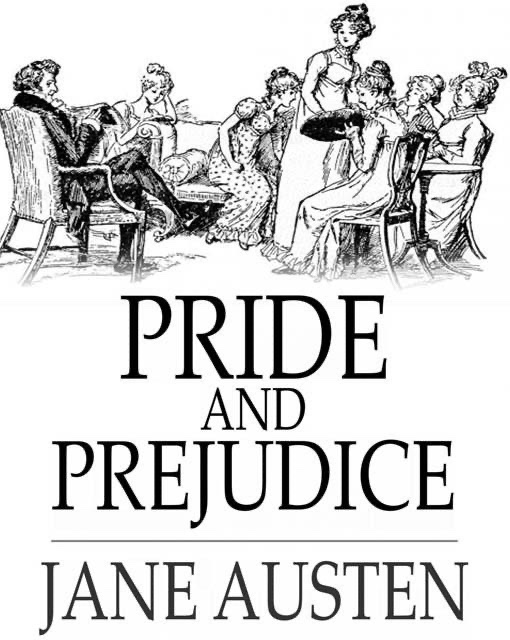
Pride and Prejudice
About this book
The Bennet family has five daughters and, in Mrs. Bennet's view, one overriding problem: they must all be married, and married well, because the family estate is entailed away to a cousin. When the wealthy Mr. Bingley rents a house nearby and brings his richer, prouder friend Mr. Darcy with him, the neighborhood's matchmaking machinery starts turning at full speed.
Elizabeth Bennet, the second daughter, meets Darcy's coldness with a wit that refuses to be intimidated. She forms her opinion of him early and firmly — and then spends the rest of the novel discovering, with real discomfort, how much of that opinion was built on first impressions and wounded vanity. Austen lets the reader watch both of them being wrong in ways that feel painfully familiar.
Around the central pair moves a cast of people drawn with comic precision: the oily Mr. Collins, the desperate Lydia, the formidable Lady Catherine, and Mr. Bennet, who treats his own family largely as entertainment. The plot runs on balls, letters, visits, and rumors, and Austen turns each of these small social events into something that matters.
First published in 1813, the novel has kept its edge for two centuries because its comedy is inseparable from its economics. Love, money, class, and self-respect are all on the table at once, and Austen never pretends they can be neatly separated.
Read a sample
4,841 words
Plain text
From the opening
It is a truth universally acknowledged, that a single man in possession of a good fortune must be in want of a wife. (page 5)
“You mistake me, my dear. I have a high respect for your nerves. They are my old friends. I have heard you mention them with consideration these twenty years at least.” (page 7)
“Pride relates more to our opinion of ourselves; vanity to what we would have others think of us.” (page 21)
“Happiness in marriage is entirely a matter of chance.” (page 24)
“I wonder who first discovered the efficacy of poetry in driving away love!” (page 45)
“To find a man agreeable whom one is determined to hate! Do not wish me such an evil.” (page 91)
“Those who do not complain are never pitied.” (page 113)
Without thinking highly either of men or of matrimony, marriage had always been her object: it was the only honourable provision for well-educated young women of small fortune, and, however uncertain of giving happiness, must be their pleasantest preservative from want. (page 122)
“Stupid men are the only ones worth knowing, after all.” (page 154)
They parted at last with mutual civility, and possibly a mutual desire of never meeting again. (page 229)
She found, what has been sometimes found before, that an event to which she had looked forward with impatient desire, did not, in taking place, bring all the satisfaction she had promised herself. It was consequently necessary to name some other period for the commencement of actual felicity; to have some other point on which her wishes and hopes might be fixed, and by again enjoying the pleasure of anticipation, console herself for the present, and prepare for another disappointment. (page 232)
“How strange this is! And for this we are to be thankful. That they should marry, small as is their chance of happiness, and wretched as is his character, we are forced to rejoice!” (page 294)
She was convinced that she could have been happy with him, when it was no longer likely they should meet. (page 301)
“You must learn some of my philosophy. Think only of the past as its remembrance gives you pleasure.” (page 356)
“I am the happiest creature in the world. Perhaps other people have said so before, but no one with such justice. I am happier even than Jane; she only smiles, I laugh.” (page 369)
Pride and Prejudice (Barnes & Noble Classics Series)
Pride and Prejudice (Barnes & Noble Classics Series)
Published by Barnes & Noble Books
122 Fifth Avenue
New York, NY 10011
www.barnesandnoble.com/classics
Pride and Prejudice was first published in 1813.
Originally published in mass market paperback format in 2003 by Barnes &
Noble Classics with new Introduction, Notes, Biography, Chronology,
Inspired By, Comments & Questions, and For Further Reading.
Trade paperback edition published in 2004.
Introduction, Notes, and For Further Reading
Copyright © 2003 by Carol Howard.
Note on Jane Austen, The World of Jane Austen and Pride and Prejudice ,
Inspired by Pride and Prejudice , and Comments & Questions
Copyright © 2003 by Barnes & Noble, Inc.
All rights reserved. No part of this publication may be reproduced or transmitted in any form or by any means, electronic or mechanical, including photocopy, recording, or any information storage and retrieval system, without the prior written permission of the publisher.
Barnes & Noble Classics and the Barnes & Noble Classics
colophon are trademarks of Barnes & Noble, Inc.
Pride and Prejudice
ISBN-13: 978-1-59308-201-7 ISBN-10: 1-59308-201-0
eISBN : 978-1-411-43296-3
LC Control Number 2004100759
Produced and published in conjunction with:
Fine Creative Media, Inc.
322 Eighth Avenue
New York, NY 10001
Michael J. Fine, President and Publisher
Printed in the United States of America
Pride and Prejudice (Barnes & Noble Classics Series)
Jane Austen
The English novelist Jane Austen was born December 16, 1775, the seventh of eight children, in the Parsonage House of Steventon, Hampshire, where she spent her first twenty-five years. During her brief lifetime Austen witnessed political unrest, revolution, war, and industrialization, yet these momentous events are not the central subjects of her finely focused novels. Rather, Austen wrote of her immediate experience: the microcosm of the country gentry and its class-conscious insularity. Jane’s father, the Reverend George Austen, was the erudite country rector of Steventon, and her mother, Cassandra (née Leigh), was descended from an aristocratic line of learned clergymen. By no means wealthy, the Austens nonetheless enjoyed a comfortable, socially respectable life, and greatly prized their children’s education.
Jane and her beloved elder (and only) sister, Cassandra, were schooled in Southampton and Reading for a short period, but most of their education took place at home. Private theatrical performances in the barn at Steventon complemented Jane’s studies of French, Italian, history, music, and eighteenth-century fiction. An avid reader from earliest childhood, Jane began writing at age twelve, no doubt encouraged by her cultured and affectionate family. Indeed, family and writing were her great loves; despite a fleeting engagement in 1802, Austen never married. Her first two novels, “Elinor and Marianne” and “First Impressions,” were written while at Steventon but never published in their original form.
Following her father’s retirement, Jane moved in 1801 with her parents and sister to Bath. That popular watering hole, removed from the country life Jane preferred, presented the sociable young novelist with a wealth of observations and experience that would later emerge in her novels. Austen moved to Southampton with her mother and sister after the death of her father in 1805. Several years later the three women settled in Chawton Cottage in Hampshire, where Austen resided until the end of her life. She relished her return to the countryside and, with it, a renewed artistic vigor that led to the revision of her early novels. Sense and Sensibility , a reworking of “Elinor and Marianne,” was published in 1811, followed by Pride and Prejudice , a reworking of “First Impressions,” two years later.
Continue reading the sampleClose the sample
Austen completed four more novels ( Mansfield Park , Emma , Northanger Abbey , and Persuasion ) in the Chawton sitting room. Productive and discreet, she insisted that her work be kept secret from anyone outside the family. All of her novels were published anonymously, including the posthumous release, thanks to her brother Henry, of Northanger Abbey and Persuasion .
The last years of Austen’s life were relatively quiet and comfortable. Her final, unfinished work, Sanditon , was put aside in the spring of 1817, when her health sharply declined and she was taken to Winchester for medical treatment of what appears to have been Addison’s disease or a form of lymphoma. Jane Austen died there on July 18, 1817, and is buried in Winchester Cathedral.
Pride and Prejudice (Barnes & Noble Classics Series)
The World of Jane Austen and Pride and Prejudice
1775 The American Revolution begins in April. Jane Austen is born on December 16 in the Parsonage House in Steventon, Hampshire, England, the seventh of eight children (two girls and six boys). 1778 Frances (Fanny) Burney publishes Evelina , a seminal work in the development of the novel of manners. 1781 German philosopher Immanuel Kant publishes his Critique of Pure Reason . 1782 The American Revolution ends. Fanny Burney’s novel Cecilia is published. 1783 Cassandra and Jane Austen begin their formal education in Southampton, followed by study in Reading. 1788 King George III of England suffers his first bout of mental illness, leaving the country in a state of uncertainty and anxiety. George Gordon, Lord Byron, is born. 1789 George III recuperates. The French Revolution begins. William Blake’s Songs of Innocence is published. 1791 American political philosopher Thomas Paine publishes the first part of The Rights of Man . 1792 Percy Bysshe Shelley is born. Mary Wollstonecraft publishes A Vindication of the Rights of Woman . 1793 A shock wave passes though Europe with the execution of King Louis XVI of France and, some months later, his wife, Marie-Antoinette; the Reign of Terror begins. England declares war on France. Two of Austen’s brothers, Francis (1774-1865) and Charles (1779- 1852), serve in the Royal Navy, but life in the countryside of Steventon remains relatively tranquil.
1795 Austen begins her first novel, “Elinor and Marianne,” written as letters (the fragments of this early work are now lost); she will later revise the material to become the novel Sense and Sensibility . John Keats is born. 1796-1797 Austen authors a second novel, “First Impressions,” which was never published; it will later become Pride and Prejudice . 1798 Poets Samuel Taylor Coleridge and William Wordsworth publish The Lyrical Ballads . 1801 Jane’s father, the Reverend George Austen, retires, and with the Napoleonic Wars looming in the background of British consciousness, he and his wife and two daughters leave the quiet country life of Steventon for the bustling, fashionable town of Bath. Many of the characters and depictions of society in Jane Austen’s subsequent novels are shaped by her experiences in Bath. 1803 Austen receives her first publication offer for her novel “Susan,” but the manuscript is subsequently returned by the publisher; it will later be revised and released as Northanger Abbey . The United States buys Louisiana from France. Ralph Waldo Emerson is born. 1804 Napoleon crowns himself emperor of France. Spain declares war on Britain. 1805 Jane’s father dies. Jane and her mother and sister subsequently move to Southampton. Sir Walter Scott publishes his Lay of the Last Minstrel . 1809 After several years of traveling and short-term stays in various towns, the Austen women settle in Chawton Cottage in Hampshire; in the parlor of this house Austen quietly composes her most famous works.
Charles Darwin and Alfred, Lord Tennyson, are born. 1811 Austen begins Mansfield Park in February. In November Sense and Sensibility , the romantic misadventures of two sisters, is published with the notation “By a Lady”; all of Austen’s subsequent novels are also brought out anonymously. George III is declared insane, and the morally corrupt Prince of Wales (the future King George IV) becomes regent. 1812 Fairy Tales by the Brothers Grimm and the first parts of Lord Byron’s Childe Harold are published. The United States declares war on Great Britain. 1813 Pride and Prejudice is published; it describes the conflict between the high-spirited daughter of a country gentleman and a wealthy landowner. Napoleon is exiled to Elba, and the Bourbons are restored to power. 1814 Mansfield Park is published; it is the story of the difficult though ultimately rewarded life of a poor relation who lives in the house of her wealthy uncle. 1815 Austen’s comic novel Emma is published, centering on the heroine’s misguided attempts at matchmaking. Napoleon is defeated at Waterloo. Charlotte Brontë is born. 1817 Austen begins the satiric novel Sanditon , but abandons it because of declining health. She dies on July 18 in Winchester and is buried in Winchester Cathedral. 1818 Northanger Abbey , a social satire with overtones of (parodied) terror, and Persuasion , about a reawakened love, are published under Austen’s brother Henry’s supervision.
Pride and Prejudice (Barnes & Noble Classics Series)
Introduction
Long before Austenmania overtook America and England in the mid-1990s, when major films and television miniseries were produced of Jane Austen’s most popular novel, Pride and Prejudice , and three other of the six novels Austen completed as an adult, fans reported a private, proprietary sense of “Jane,” as though the great English novelist were a close acquaintance. Rudyard Kipling exploited this phenomenon in his short story “The Janeites,” which describes several members of a secret Jane Austen society, a group of soldiers in the trenches of World War I, well versed in Austen trivia and gallant defenders of “Jane” and the world she created. Both the jealously guarded private fantasy and the recent popular cultural phenomenon may be attributed in part to the enduring power of Austen’s genius as a writer: her ability to create singular characters who linger in one’s imagination, her unparalleled sense of irony and wit, her brilliant dialogue, and her carefully woven plots. At the same time, Austen delivers a satisfying romance, more so in Pride and Prejudice than in her other novels, and the sheer happiness of her main characters at the novel’s end has its own appeal.
Above all though, and in Pride and Prejudice especially, Austen appeals to modern readers’ nostalgia for a world of social, moral, and economic stability, but one where characters are free to make their own choices and pursue their hearts’ desires. The formal civility, the carefully prescribed manners, and sexual and social restraint, set against a backdrop of village community, stately manor houses, and an English landscape devoid of industrial turmoil and the brisk pace of modern technology—these are a welcome escape for today’s reader. So, too, the heroine Elizabeth Bennet’s bold independence and insistence on placing individual preference above economic motive in marriage satisfies our desire for a plot shaped through the pursuit of personal fulfillment. A convention of morality tales of Austen’s time is that individuals’ personal freedoms and aspirations cannot be easily reconciled with their responsibilities to family and community. Austen overcomes this difficulty by employing the classic comic form: When wedding bells are about to ring at the story’s conclusion, we know that the two sets of main characters have made marriages of affection (Elizabeth’s sister Jane and Mr. Bingley) or even passion (Elizabeth and Mr. Darcy) and that these happy unions actually enhance the stability of society. That it appears to the reader reasonable that Elizabeth follows her heart and ends up fabulously wealthy attests to Austen’s powers of crafting a story in which early hostilities and inappropriate desires are deftly reconciled, and far more realistically so than in comedies by Shakespeare, where happy resolutions must be effected either by wildly improbable coincidences or supernatural forces.
It is sometimes said that Austen’s gift was to be a shrewd observer of her narrow, genteel social circle, that her experience and knowledge of the world were limited and her life sheltered, and that her novels realistically reflect the peaceful late-eighteenth-and early-nineteenth century village community and English countryside she inhabited. That Austen was a careful observer of human motivation and social interaction is certainly true. One should not assume, though, that her choice to write novels of manners means that she was unaware of or unaffected by the political and social upheaval of her day. The idea that she centers her novels on the social classes with which she was most familiar is not entirely the case, although she had occasion to observe members of the gentry and aristocracy whose circumstances resembled those of some of the characters who populate her novels. Whether her own life was perfectly serene is questionable: Most lives, no matter how uneventful in retrospect, have their vicissitudes.
At the very least, Austen and her family must have had concerns over the tumultuous historical events that unsettled the British nation during their lifetime. She was born in 1775, the year that marked the beginning of the American Revolution. Several decades later, she would read newspaper accounts of another British conflict with the new American nation in the War of 1812, which began as she finished revising Pride and Prejudice . What must have played significantly in Austen’s imagination, as in the mind of every Briton, was the ongoing war with Napoleon’s forces, which marked the culmination of a century of conflicts between Britain and France, and which ended, with the Battle of Waterloo in June 1815, six months before her fortieth birthday. The British fear of invasion by Napoleon, which endured until 1805, caused concern even in the towns and villages that seemed safest. Austen would have been aware of the billeting of British militia troops in the English countryside, and she certainly followed the career of her brother Henry, who had joined the Oxford militia in 1793, when Britain’s latest war with France erupted in the aftermath of the French Revolution. She must also have taken a personal interest in the campaigns of the British navy, which counted her brothers Francis and Charles among its officers. To what extent she cared about daily political events is difficult to discern, for her letters are marked by characteristic irony.
Of a newspaper report of an 1811 battle of the Peninsular War, when Napoleon invaded Spain and Portugal in an effort to close ports to British commerce, Austen declared, “How horrible it is to have so many people killed!—And what a blessing that one cares for none of them!” (Le Faye, Jane Austen’s Letters , p. 191; see “For Further Reading”).
If history and politics in general, and the war with France in particular, seem far removed from the affairs of Austen’s novels, it is worth remembering that the militia and army provide romantic distraction in the form of dashing young officers for the two youngest Bennet sisters, Kitty and Lydia, in Pride and Prejudice , while her final novel, Persuasion , centers on the romantic interests of British naval officers. A feature of Austen’s comic mode is that the events that produce the greatest instability within the British nation are tamed into the material of harmless social disarray that furthers the romantic plot. We find the same process at work in other of her novels. Several scholars have noted that the Bertram family estate of Mansfield Park must be supported by the West Indian slave economy and that Sir Thomas Bertram’s absence from his home in England in order to protect his interests in Antigua provides the occasion for the Bertram children and their friends to engage in the mildly improper behavior that promotes comic disorder. We are also reminded of local instability when Harriet Smith, of Emma , is accosted by a band of gypsies and must be rescued by Frank Churchill; the incident plays on commonly held fears of the vagrants and highway-men who traveled the roads of England.
Austen’s firsthand experiences of the world and its momentous events seem limited if we consider her life in terms of the travels that might have spurred her writer’s imagination. Unlike many of her contemporaries whose literary work was enriched by journeys to Scotland, Ireland, and the European continent, Austen spent most of her relatively short life—she died in 1817 at age forty-one, possibly of Addison’s disease or of a form of lymphoma—in the small villages and towns and countryside of the county of Hampshire, in the south of England. Despite several visits to London, vacation tours throughout southern England, and several years’ residence in the spa city of Bath and in the port town of Southampton, Austen can hardly be called cosmopolitan, and, in any case, she would have preferred to think of herself as provincial, a description that better suits her sense of her subject matter as a writer. In a letter to her niece Anna Austen, an aspiring novelist, she dispensed the now famous advice that “3 or 4 Families in a Country Village is the very thing to work on” ( Letters , p. 275).
Austen’s life appears to have been relatively untroubled, although there must have been painful episodes. The daughter of a respectable Anglican clergyman, she was the seventh of eight children in what appears to have been a happy, stable family. There were, however, financial troubles, and the Reverend George Austen was obliged to add to his income by establishing a boarding school for boys in the Austen home and by borrowing money from his sister and her husband. Further, as Austen’s biographer Claire Tomalin points out, even though the family was close, several of the children spent a considerable amount of time living away from home, which, though not unusual for the gentry and professional classes at this time, was probably disorienting for Austen and her siblings. One of her six brothers, George, was disabled—possibly a deaf-mute—and was sent from home for most of his long life. Jane, too, was sent from home, first to a village nurse and later to two boarding schools that, if they resembled the typical girls’ schools of that era, were characterized by bad food, dull teachers, and an atmosphere ripe for one epidemic or another. Along with her older sister, Cassandra, the seven-year-old Jane spent only two seasons at the first institution, where she nearly died from a contagious fever that spread through the school.
At age nine, she was sent to a second school, which, if not damaging, was not beneficial either. Although her parents chose to terminate her formal education when she was ten, her father gave her access to his library of some five hundred volumes, and he encouraged his daughter’s literary interests. It was he, in fact, who first tried, unsuccessfully, in 1797, to have an early version of Pride and Prejudice published.
Austen’s immediate family was solidly professional, unlike that of her heroine Elizabeth Bennet, whose father is a member of the gentry, which is to say that his wealth is inherited and tied to land ownership, rather than earned through work or commerce. Austen’s eldest brother, James, followed his father into the ministry, while Henry, the brother who served for several years in the militia, turned next to banking, and then, when his bank failed, followed his father and elder brother into the ministry. The two naval officers, Francis and Charles, both rose to the rank of admiral. Austen’s father and brothers were hardworking, responsible, family-oriented men, so it makes sense that in Pride and Prejudice Austen satirizes snobbish and frivolous members of those classes above hers, the gentry and the aristocracy, who would have looked down upon her own immediate family, just as she paints an unsympathetic portrait of the haughty social climber Caroline Bingley, who fancies herself a member of the gentry, even though her family’s wealth was made “in trade,” or through commerce. Nor, if we consider Austen’s own unaffected outlook, is it surprising that the most sensible characters in the novel, Mr. and Mrs. Gardiner, not only make their money in trade but are apparently not embarrassed to live near their warehouse. Elizabeth Bennet herself descends from lower gentry, on her father’s side, while her maternal grandfather was an attorney.
Despite her allegiance to professionals and businessmen, Austen clearly had respect for what she would have regarded as the nobler values of the landed gentry and aristocracy, particularly the sense of social responsibility and decorum that are implicitly endorsed by the narrator and main characters of the novel. Although these values are fostered through the preservation of a strict social hierarchy, they do not happen to thwart the aspirations of the fictional Elizabeth Bennet, and thus modern readers need never confront the injustices of an English society that remained wary of the new democratic values espoused in America and France and among English radicals. Moreover, even if Austen’s own immediate family fell socially and economically a degree below that of her central fictional characters, her family connections made the upper orders not wholly unknown to her. Austen’s mother, Cassandra Leigh Austen, was descended from a distinguished family and was related to the duke of Chandos. Austen’s first cousin, Eliza Hancock, was goddaughter to Warren Hastings, the eminent statesman and governor of British India, and wife to a member of the French nobility, Count Jean François Capot de Feuillide, who was guillotined during the Reign of Terror. Austen’s brother Edward was literally adopted into the British gentry when Thomas and Catherine Knight, second cousins of the Austens, took an interest in him, obtained permission to raise him, and, finding themselves childless, ultimately made him heir to their splendid estate of Godmersham Park in Kent.
Austen’s own situation in a family of well-connected professionals was somewhat precarious, for she remained unmarried in an age when women depended largely on male relatives for support. Her father and brothers, however, with their strong sense of family responsibility, must have made her feel more secure than the typical “spinster” would have felt. She and her sister Cassandra, who also remained unmarried and was Jane’s closest friend and confidante, were initially dependent on their father, and then, after his death in 1805, on a small annuity and on the generosity of their brothers. Jane Austen had always lived in her father’s house; upon his death, she, her sister, and their mother took up lodgings and visited extensively with relatives and friends for three years. The women eventually settled in the Hampshire village of Chawton, in a house made available to them by Edward. Austen spent the final eight years of her life at Chawton, and it was from this house that she published her novels.
Given how centered her novels are on the marriage plot and how family-oriented her immediate society was, it is worth commenting on Austen’s choice to remain single. In 1802, she received and accepted a proposal from Harris Bigg-Wither, a pleasant young man, Oxford educated and heir to the impressive Manydown estate in Hampshire, close to Austen’s family home at Steventon. She quickly changed her mind, however, and rejected the proposal the day after having accepted it. It seems that while Jane liked Harris, she was not in love with him, and this was enough to give her pause. Her decision was remarkable, for even though romantic love had increasingly become an acceptable incentive for marriage, Austen was a dutiful daughter who lived in an age when friendship, economic motive, family ties, and religious duty were at least as compelling as personal choice. In declining Harris Bigg-Wither’s proposal, Austen made a choice not nearly so dramatic in its disregard for economic considerations as that of her fictional heroine Elizabeth Bennet in declining Mr. Darcy, but one that was similarly impractical. It is hard to say whether Austen simply flew in the face of convention and unwisely put her economic future at risk, or whether she knew that with so many successful and dutiful brothers someone would maintain her somehow.
Claire Tomalin suggests that Austen compared Harris Bigg-Wither unfavorably to Tom Lefroy, to whom she had had a romantic attachment several years earlier, one severed by his relatives, who were concerned about the imprudence of such a match—Austen was, after all, no heiress. Now that she was heading into her late twenties and had grown accustomed to life as a spinster aunt, it is also possible that Austen took a long, hard look at motherhood and decided that its joys were not worth the grief. Throughout the eighteenth century and long afterward, the mortality rates for newborns and women during childbirth was high. The trend in British society to encourage frequent and numerous pregnancies put women at even greater risk. In 1808 Austen’s brother Edward’s wife, Elizabeth, died giving birth to her eleventh child. Her brother Charles’s wife, Fanny, died during childbirth in 1814, at age twenty-four, with her fourth child, who also died several weeks later. In 1823, a few years after Austen’s own death, her brother Francis’s wife, Mary, died giving birth to her eleventh child. Understandably, Austen’s letters demonstrate a mixed attitude toward marriage and motherhood. To her niece Fanny Knight, Austen wrote shortly before her own death that “Single Women have a dreadful propensity for being poor—which is one very strong argument in favour of Matrimony.”
On the other hand, she continued with sage advice, “Do not be in a hurry; depend upon it, the right Man will come at last. . . . And then, by not beginning the business of Mothering quite so early in life, you will be young in Constitution, spirits, figure & countenance.” Earlier she had cautioned Fanny against entering into a marriage of convenience by remarking, “When I consider . . . how capable you are . . . of being really in love . . . I cannot wish you to be fettered” ( Letters , pp. 332, 286).
While it was not unheard of for a woman to have both a family and a writing career in the eighteenth century, it was undoubtedly the case that Austen’s marital status made her writing life much easier. There is, however, no evidence to suggest that she deliberately chose to forsake marriage in order to write books about it. In fact, the extent to which Austen actually saw herself as a writer, as someone whose identity was shaped through her writing and who might have been interested in earning money or fame by doing so, is a matter of debate. She may have described herself, with alternating irony and seriousness, as someone who took up the pen in her idle hours, the way one might take up fancy needlework or china painting. Yet she clearly had a lifelong passion for writing—she authored an impressive collection of juvenilia as well as mature novels—and it seems difficult to believe that she regarded her art as a mere hobby, even if she did not flaunt her gifts publicly. If she did not claim the kind of psychological and material entitlement, the room of one’s own that in the early twentieth century Virginia Woolf would identify as essential for women writers, she did come to depend on the money her novels earned. She became, whether she wished it or not, a professional writer in an age when the market in novels by women and for women was already well established.