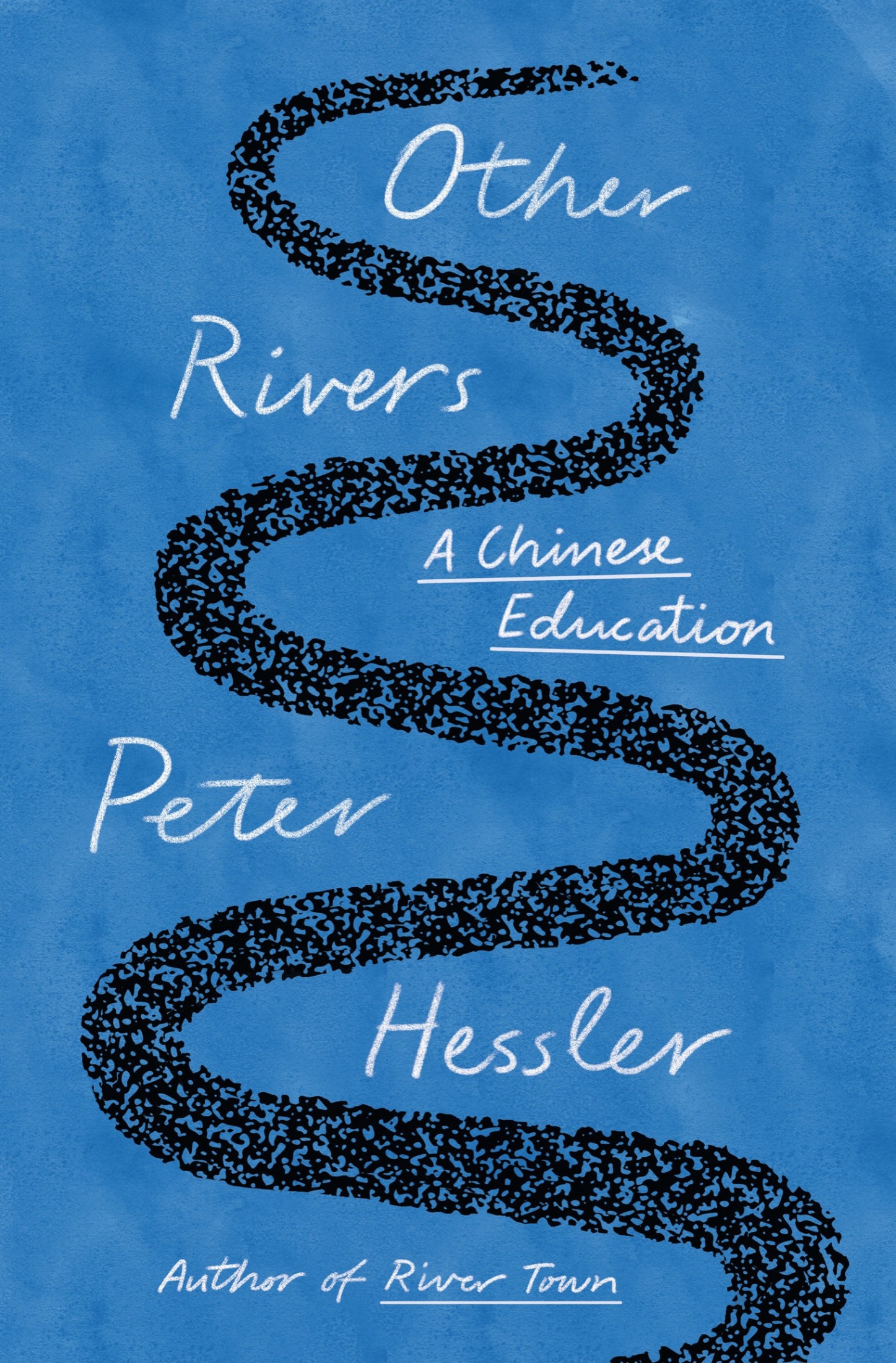
Other Rivers: A Chinese Education
About this book
More than twenty years after teaching in the small city of Fuling, Peter Hessler returns to China with his family in 2019. He teaches nonfiction at Sichuan University while his twin daughters attend a local public school, giving him two very different views of what Chinese education now asks of its students.
The young people in his classroom grew up in a richer, more urban, and more tightly governed country than his former students did. Their essays and conversations open onto class mobility, censorship, ambition, family expectations, and the intense competition compressed into the word involution.
Then Covid arrives. Campuses close, cities lock down, and ordinary routines become a record of how institutions and individuals respond to uncertainty. Hessler keeps the scale human: a rejected applicant, a former student writing from afar, a child's school assignment, a teacher deciding what can be discussed in class.
Other Rivers was published in 2024. It can be read as a return to the world of River Town, but it stands on its own as a portrait of two generations and of the changes that become visible only when someone comes back after a long absence.
Read a sample
5,077 words
Plain text
From the opening
Chapter One
Rejection
September 2019
The very last thing that any teacher wants to do—and the very first thing that I did at Sichuan University, even before I set foot on campus—is to inform students that they cannot take a class. Of course, some would say that rejection is a normal experience for young Chinese. From the start of elementary school, through a constant series of examinations, rankings, and cutoffs, children are trained to handle failure and disappointment. At a place like Sichuan University, it’s simply a matter of numbers: eighty-one million in the province, sixteen million in the city, seventy thousand at the university. Thirty spots in my classroom. The course title was Introduction to Journalism and Nonfiction, and I had chosen those words because, in addition to being simple and direct, they did not promise too much. Given China’s current political climate, I wasn’t sure what would be possible in such a class.
Some applicants considered the same issue. During the first semester that I taught, a literature major picked out one of the words in the title—nonfiction—and gave an introduction of her own:
In China, you will see a lot of things, but [often] you can’t say them. If you post something sensitive on social platforms, it will be deleted…. In many events, Non-Fiction description has disappeared. Although I am a student of literature, I don’t know how to express facts in words now.
Two years ago, on November 18th, 2017, a fire broke out in Beijing, killing 19 people. After the fire, the Beijing Municipal Government began a 40-day urban low-end population clean-up operation. At the same time, the “low-end population clean-up” became a forbidden word in China, and all Chinese media were not allowed to report it. I have not written an article related to this event, and it will always exist only in my memory.
As a student of Chinese literature, I have a hard time writing what I want to write because I am afraid what I write will probably be deleted.
Applicants handled this issue in different ways. I requested a writing sample in English, and most students sent papers that they had researched for other courses. Some titles suggested that the topics had been chosen because, by virtue of distance or obscurity, they were unlikely to be controversial: “Neoliberal Institutionalism in the Resolution of Yom Kippur War,” “The Motive of Life Writing for Aboriginal Women Writers in Australia.” Other students took the opposite approach, finding subjects close to home but following the government line; one applicant’s essay was titled “The Necessity of Internet Censorship.” There was also safety in ideology. A student from the College of Literature and Journalism submitted a Marxist interpretation of Madame Bovary. (“Capitalism has cleaned up the establishment of the old French society, and to some extent deconstructed various resistances that limit economic and social development.”) Another student abandoned every traditional subject—politics, business, culture, literature—and instead produced, in prose that was vaguely biblical, a five-hundred-word description of a pretty girl he had seen on campus:
She was a garden—her shoots are orchards of pomegranates, henna, saffron, calamus and cinnamon, frankincense and myrrh. She was a fountain in the garden—she was all the streams flowing from Lebanon, limpid and emerald, pacific and shimmering….
My first impressions were literary: I saw the words before I met the students. Their English tended to be slightly formal, but it wasn’t stiff; there were moments of emotion and exuberance. Sometimes they made a comment that pushed against the establishment. (“I am still under eighteen years old now, living in an ivory tower isolated from the world outside. I’m expecting to change it.”) All of them were undergraduates, and for the most part they had been born around the turn of the millennium. They had been middle school students in 2012, when Xi Jinping had risen to become China’s leader. Since then, Xi had consolidated power to a degree not seen since the days of Mao Zedong, and in 2018, the constitution was changed to abolish term limits. These college students were members of the first generation to come of age in a system in which Xi could be leader for life.
The last time I had arrived in Sichuan as a teacher was in 1996, when Deng Xiaoping was still alive. While reading applications, I imagined how it would feel to return to the classroom, and I copied sentences that caught my eye:
Only when a nation knows its own history and recognizes its own culture can it gain identity.
Just as Sartre said, men are condemned to be free. We are left with too many choices to struggle with, yet little guidance.
Actually, all of us are like screws in a big machine, small but indispensable. Only when everyone works hard will our country have a brighter future.
The range of topics made it virtually impossible to compare applications, but I did my best. I had to limit the enrollment to thirty, which was already too many for an intensive writing course. After selecting the students, I sent a note to everybody else, inviting them to apply again the following semester. But one rejected girl showed up on the first day of class. She sat near the front, which may have been why I didn’t notice; I assumed that anybody trying to sneak in would position herself near the last row. At the end of the second week, when she sent a long email, I still had no idea who she was or what she looked like.
Continue reading the sampleClose the sample
Dear teacher,
My name is Serena, an English major at Sichuan University, and I am writing in hope of your permission for me to attend, as an auditor, your Wednesday night class.
I failed to be selected. I have been in the class since the first week, and I sensed and figured my presence permissible.
I want to write. As Virginia Woolf thought, only life written is real life. I wish to be a skilled observer to present life or idealized images on paper, like resurrection or “in eternal lines to time thou growest.”…I started to appreciate writers’ diction not as a natural flow of expression but careful strategies and efforts, I began to put myself in the writers’ shoes, and set out to sharpen my ear as a way to hear the sound of writing—consonance or dissonance, jazz, chord, and finally symphony.
Perhaps I am being paranoid and no one will drag me out. If you can’t give me permission, I’ll still come to class in disguise until I am forced to leave.
Happy Mid-autumn Festival!
Thank you for your time.
Yours cordially,
Serena
I composed an email, explaining that I couldn’t accept auditors. But I hesitated before pressing “send.” I read Serena’s note once more, and then I erased my message. I wrote:
The college is concerned about auditing students, because the course needs to focus on those who are enrolled. But I much appreciate your enthusiasm, and I want to ask if you are willing to take the class as a full student, doing all of the coursework.
I was violating my own rules, but I sent the email anyway. It took her exactly three minutes to respond.
When I told other China specialists that I planned to return to Sichuan as a teacher, and that my wife, Leslie, and I hoped to enroll our daughters in a public school, some people responded: Why would you go back there now? Under Xi Jinping, there had been a steady tightening of the nation’s public life, and a number of activists and dissidents had been arrested. In Hong Kong, the Communist Party was reducing the former British colony’s already limited political freedoms. On the other side of the country, in the far western region of Xinjiang, the government was carrying out a policy of forced internment camps for more than a million Uighurs and other Muslim minorities. And all of this was happening against the backdrop of the Trump administration’s trade war against the People’s Republic.
It was different from the last time I had moved to Sichuan. In 1996, I knew virtually nothing about China, and almost all basic terms of my job were decided by somebody else. The Peace Corps sent me and another young volunteer, Adam Meier, to Fuling, a remote city at the juncture of the Yangtze and the Wu Rivers, in a region that would someday be partially flooded by the Three Gorges Dam. At the local teachers college, officials provided us with apartments, and they told us which classes to teach. I had no input on course titles or textbooks. The notion of selecting a class from student applications would have been unthinkable. Every course I taught was mandatory, and usually there were forty or fifty kids packed in the classroom. Most of my students had been born in 1974 or 1975, during the waning years of the Cultural Revolution and Mao Zedong’s reign.
In 1996, only one out of every twelve young Chinese was able to enter any kind of tertiary educational institution. Most of my Fuling students had been the first from their extended families to attend college, and in many cases their parents were illiterate. They typically had grown up on farms, which was true for the vast majority of Chinese. In 1974, the year many of my senior students were born, China’s population was 83 percent rural. By the mid-1990s, that percentage was falling fast, and my students were part of this change. During the college-enrollment process, the hukou, or household registration, of any young Chinese automatically switched from rural to urban. The moment my students entered college, they were transformed, legally speaking, into city people.
But inside the classroom it was obvious that they still had a long way to go. Most students were small, with sun-darkened skin, and they dressed in cheap clothes that they had to wash by hand. I learned to associate certain students with certain outfits, because their wardrobes were so limited. I also learned to recognize a chilblain—during winter, students often had the red-purple sores on their fingers and ears, the result of poor nutrition and cold living conditions. Much of my early information about these young people was physical. In that sense, it was the opposite of what I would later experience at Sichuan University. In Fuling, my students’ bodies and faces initially told me more than their words.
It took a long time to draw them out. They tended to be shy, and often they were overwhelmed by the transition to campus life. We were similar in age—at twenty-seven, I was only a few years older than my senior students—but none of them had ever met an American before. They had studied English for seven or more years, although many of them had trouble carrying on a basic conversation, because of lack of contact with native speakers. Their written English was much stronger, and in literature class I assigned Wordsworth poems, Shakespeare plays, stories by Mark Twain. In essays, they described themselves as “peasants,” and they wrote beautifully about their families and their villages:
In China, passing an entrance examination to college isn’t easy for the children of peasants…. The day before I came to Fuling, my parents urged me again and again. “Now you are college student,” my father said…. “The generation isn’t the same with the previous generation, when everyone fished in troubled waters. We have to make a living by our abilities nowadays. The advancement of a country depend on science and technology.”
My mother was a peasant, what she cared for wasn’t the future of China, just how to support the family. She didn’t know politics, either. In her eyes, so long as all of us lived better, she thought the nation was right…. But I see many rotten phenomenons in the society. I find there is a distance between the reality and the ideal, which I can’t shorten because I’m too tiny. Perhaps someday I’ll grow up.
I felt like we had just gotten to know one another well when my Peace Corps service ended, in the summer of 1998. Before leaving Fuling, I collected the mailing addresses of everybody in my classes, although I doubted that we would be able to stay in touch. Postage to the United States was prohibitively expensive for Chinese in the countryside, and none of the students had cell phones or access to the internet. After graduating, most of them would accept government-assigned positions as teachers in rural middle schools.
Before we parted, students gathered keepsakes: copies of class materials, photographs with me and Adam. They prepared memory books with pictures and farewell messages. During my last week on campus, one boy named Jimmy approached me with a cassette tape and asked if I would make a recording of all the poetry we had studied.
“Especially I want you to read ‘The Raven,’ and anything by Shakespeare,” he said. “This is so I can remember your literature class.”
Jimmy had grown up in the Three Gorges, where he would now return. The government had assigned him to a middle school on the banks of a small, fast-flowing tributary of the Yangtze. In the memory book, Jimmy had pasted a photograph of him standing on campus with a serious expression, dressed in a red Chicago Bulls jersey. The Bulls jersey was one of the outfits I associated with Jimmy. This was the era of Michael Jordan, and a number of boys wore cheap knockoff versions of Bulls paraphernalia. My pre-graduation gift to Jimmy and his classmates had been to change the schedule of their final exam, in June 1998. By pushing the exam back a few hours, I made it possible for all of us to watch live while Jordan hit a jumper with 5.2 seconds left, winning his sixth and last NBA title.
Jimmy had never been a particularly diligent student, but he had some Jordanesque qualities: he was a good athlete, and naturally bright, and things always seemed to go well for him. In the memory book, he wrote a message in neat Chinese calligraphy:
Keep Climbing All the Way
Farewell, Farewell, Dear Friend
When Jimmy asked me to record the poetry on the cassette, I was touched, and I promised to do it that evening.
“Also, after you finish the poems,” he said, grinning, “I want you to say all of the bad words you know in English and put them on the tape.”
When I returned to the United States, I often wondered how things would turn out for my students. For months, I received no updates; all I had were the photographs in the memory book and the characters on my address list. I imagined Jimmy in his Bulls jersey, surrounded by the cliffs of the Three Gorges, listening to the poems of Edgar Allan Poe and William Shakespeare punctuated by strings of curse words.
In 1999, I moved to Beijing as a freelance journalist. I no longer taught, but part of my life continued to operate on the Chinese academic schedule. At the beginning of every semester, in September and in February, I sent out a batch of letters that were hand-addressed to dozens of villages in Sichuan and Chongqing. Now that I was living in China again, it was easy for former students to write back. Their replies arrived in cheap brown paper envelopes postmarked with the names of places I had never heard of: Lanjiang, Yingye, Chayuan. Most students had beautiful handwriting—at the college, they had been forced to spend hours practicing with a traditional Chinese brush. Their graceful script contrasted with the harsh world they described:
The children show no interest in their studies. Poverty, foolishness are involved in the farmers in our hometown which is far from modern society. Several generations live with working by hand and using animals as labour force instead of tractors. The less they know, the poorer they become.
I often tell the students you must study or you won’t change your stupidness…. Most of the government cadres are incapable, most of them know little. In your America, that can’t be imagined. They only know eating, gambling, drinking, looking for official relations, whoring.
Over time, I was able to stay in touch with more than a hundred former students. Jimmy’s brown paper envelopes proved to be among the ones that arrived most regularly at my Beijing office. His postmark read Jiangkou—“mouth of the river” in Chinese. Jiangkou had always been poor and isolated, but soon Jimmy’s letters began to describe a life that he had never imagined possible:
In 1999, a charming girl came into my world, who worked in a restaurant then. In my eyes, she was so attractive that I fell in love with her, I promised I would love her forever. On March 15th, 2000, I married her eventually. Before we got married, she started to run a grand restaurant of her own. In my opinion, it is a hard work to do business, but she thinks it is a good job, which can develop her ability. At the beginning, we owed our relatives and friends much money. Now we also run a hotel, which cost us 170,000 yuan. To our joy, both restaurant and hotel are going very well…. On Sep. 5th, 2001, a baby called Chen Xi (means the rising sun) came into my family, who brought in much pleasure to us.
It was remarkable how quickly the letters changed. By the early 2000s, there were fewer descriptions of poverty, and writers referred to new highways and railroads that were being constructed in their hometowns. Details about money became common: loans, investments, side businesses. Occasionally, a former student sent a message from the factory towns of southeastern China, where so many rural people had migrated:
I am now going to Fujian. One of my cousins is working in Fujian’s Fuding city. He was injured in a toy factory there, so he is having a guansi [lawsuit]. And these days we are talking with the boss about the money he should pay for my cousin. I find this place interesting and much richer than Chongqing. And it’s easier to find a job with good salary.
Almost none of them had been born with any advantages in terms of family, finances, or geography. But their luck was historical—they couldn’t have had better timing. In 1978, when they were a few years old, Deng Xiaoping had initiated his Reform and Opening policy. My Fuling students had grown up alongside these economic and social changes, and they were part of what I came to think of as the Reform generation. Members of this cohort had participated in the largest internal migration in human history, with more than a quarter of a billion rural Chinese moving to the cities. In 2011, China’s population officially became majority urban. Since the beginning of the Reform era, an even greater number of citizens—nearly eight hundred million—had been lifted out of poverty.
From a distance, it was hard to grasp what these statistics meant at the human level. But the letters gave me a different perspective. In 2016, a man named David wrote and apologized because back in the 1990s, he had not been a particularly attentive student. It was true—in literature class, David had often slumped over his desk, half asleep. Two decades later, he finally explained the reasons for his malaise:
For three years, I did not eat and sleep well. I remember in 1996, for half a year, I just had one meal a day. I was a sad man. But now I am happy about my life.
Eventually, the brown envelopes gave way to emails and text messages. My own life moved on: for a while, Leslie and I lived in southwestern Colorado, where our twin daughters, Ariel and Natasha, were born in 2010. The following year, we moved to Egypt, where Leslie and I worked for half a decade as foreign correspondents. No matter where I was, I kept the old schedule of sending out a long message at the start of every Chinese semester. I always had a notion that someday, after twenty years or so, I would return to live at the familiar juncture of the Yangtze and the Wu. I liked the idea of teaching again at the Fuling college, and I was curious about the next generation of students.
In 2017, I inquired about a teaching job. Some of my old colleagues still served on the faculty, and they reported that the college wanted to hire me. I submitted an application, which was sent to be approved by educational authorities in Chongqing, the municipality that administers Fuling. And then—nothing.
There are many kinds of rejection in China. The simplest is financial: in the business world, a denial tends to be direct and blunt. Academics can also be straightforward, especially in the exam-driven culture of Chinese schools. But if the reason for rejection is political, and if a foreigner is involved, there may be no response at all. Nobody mentions a decision, and nobody gives an explanation. The absence of communication effectively means that there is neither a problem nor a solution. It’s as if the original application never happened.
After months of silence, I knew that the only chance of clarity was through a personal visit. I made the long journey from Colorado to Fuling, where I met with a well-connected friend. I asked if there was a problem with my writing—in 2001, I had published River Town, a book about my two years at the college. But he assured me that this wasn’t the reason.
“It’s because of Xi Jinping and Bo Xilai,” he said. Bo Xilai had been the highest Communist Party official in Chongqing until 2012, when he was involved in an explosive scandal that included, among other crimes, the murder of a British businessman at the command of Bo’s wife. Before Bo’s fall, he had been seen as a figure with national aspirations and as a potential rival to Xi Jinping. In 2013, shortly after Xi rose to power, Bo was sentenced to life in prison.
My Fuling friend explained that ever since the scandal, Chongqing officials had been under close watch by the national leadership. They were unlikely to approve anything that could be seen as a potential liability, including the appointment of a foreign writer to a teaching job.
“As long as Xi Jinping is in power,” my friend said, “you will never teach in Fuling.”
His tone was slightly dramatic, as if this were a command that had been issued by the Politburo itself. For a moment we sat in silence. Then I said, “So how is Xi Jinping’s health?”
“Hen hao!” he laughed. “Very good!”
During the 1990s, in an undeveloped place like Fuling, people had a distinctive way of discussing the country’s most powerful leaders. A former student named Emily, who had spent part of her childhood in a village not far from the city, once described the experience of listening to casual conversations:
They talked about big people and big events in a way that fascinated me. The big people and big events seemed both remote and near. They were remote because they had nothing to do with the villagers’ lives; they were near because the villagers seemed to know every detail.
This combination of distance and intimacy was especially true of Mao Zedong and Deng Xiaoping. Fuling residents spoke about these two figures all the time, and they quoted their sayings as casually as if remembering a conversation from last week. To a foreigner, it felt like living in a new land and learning about the gods that were worshipped there.
But Xi Jinping seemed to represent a new type of god. Early in his tenure, he initiated a strict crackdown on corruption, which appealed to many citizens, including my former students. Over time, as we settled into the rhythm of the semester letters, I started sending periodic surveys, in order to get a better understanding of their lives and their opinions. In 2017, I asked former students to name a political figure whom they admired, and Xi was by far the most popular choice:
Of course, Xi Jinping is the one I admire. I admire because he has let us benefit a lot, especially the farmers.
Honestly speaking, Xi is the first political figure in China that I admire. Under his leadership, the officials in the government are having much better service.
He is the best president in the history. He is strict with the leaders, and the leaders are behaving better now.
While praising Xi, they never mentioned personal characteristics. The old intimacy was gone; now they emphasized the ways in which the system functioned. This was part of what distinguished Xi from Mao and Deng, whose personalities and physical appearances had been central to their appeal. Mao—handsome and aloof, with a poet’s sensibility—had made Chinese people feel proud and capable of standing up to the outside world. And Deng, with his diminutive stature and Sichuanese toughness, had tapped into another part of the Chinese mindset, one that valued humility, pragmatism, and hard work. Both men had risen during the revolution, but now, after nearly seventy years of Communist Party rule, the country had reached another stage. The most powerful figure who emerged in this era was essentially bureaucratic—a god of the system.
When I met with my well-connected friend, he reminded me about this aspect of life in China. “You should try Sichuan,” he said. “They aren’t as nervous as officials in Chongqing.”
Originally, Chongqing had been part of Sichuan, but in 1997, the city and its surrounding region, including Fuling, had been designated as a separate political entity. And that was my friend’s suggestion: if you’re having trouble with Chongqing cadres, just cross the border. After our conversation, I abandoned my dream of living at the juncture of the Yangtze and the Wu. I went west: I applied to teach at an American-affiliated institute at Sichuan University. This time, the application was quickly approved, and in August 2019, I moved with my family to Chengdu.
We rented an apartment downtown, in a building that was situated on the eastern bank of the Fu River. Alongside the Fu, pleasant bike paths were shaded by century-old paper mulberry and white fig trees. The Fu was one branch of a network of small rivers and canals that, in modern times, had been given a lovely name: Jin Jiang, the Brocade River. The various streams of the Jin braided throughout downtown Chengdu, eventually continuing south to join the great rivers of lower Sichuan: first the Min, then the Yangtze. When I looked down from my Chengdu balcony onto the river, it made me happy to think that eventually, after nearly four hundred miles, that same water would flow past the city of Fuling.
Those were among my first lessons from the Xi Jinping era. Along with the new god, a new fear had permeated the government, and cadres were even more cautious than they had been in the past. But Xi remained a god of the system, which meant that the bureaucracy often operated with its own logic and momentum. If a request was rejected, it was worth trying a different office, a different cadre; in a country of such size, there were always other rivers.
At Sichuan University, I taught nonfiction in a section of campus that was still under construction. Our classroom window overlooked a stretch of mud and rubble that had yet to be landscaped, and there was often a pounding sound from workers who were installing cobblestones in a nearby courtyard. Next door, a brand-new building featured a four-story glass facade that was decorated with golden characters that read “College of Marxism.” The college had been designed with a large parking garage in the basement. Once, before an evening class, I wandered through the garage to see what the Marxists were driving to campus. Most of the cars were mid-level foreign brands, although I also saw one BMW and five Mercedes sedans.
The campus itself was enormous. From north to south, it spanned more than a mile, and the grounds were full of yellow and green rideshare bikes, to help the students cope with the distance. In the 1990s, this had all been farmland; back then, Sichuan University occupied a relatively small site on the banks of the Jin River. But the university had expanded into this rural area, which they called the Jiang’an Campus. From my downtown home, it took more than an hour by bus to get to Jiang’an. Suburban campuses had become common in Chinese cities, and Fuling had also constructed a brand-new complex, about ten miles upstream along the Yangtze.
In nonfiction class, there wasn’t a single student from the countryside. During the early weeks, I found it hard to identify physical markers among the people in my classroom. It wasn’t like the old days, when I could pick out Jimmy by his Bulls jersey, or a boy named Roger by his trademark tattered blue suit jacket, the tailor’s label still on the sleeve. At Sichuan University, there was a certain uniformity to students’ appearances. They dressed neatly, but not too well; nobody looked obviously poor and nobody looked obviously rich. The girls generally wore baggy jeans or loose skirts, and they almost never dressed in anything that was revealing or form-fitting. Few of them dyed their hair or used much makeup.
The boys’ shoes represented one of the few outward signs of prosperity. I never saw girls with flashy jewelry, but some boys wore the kind of high-top sneakers that are prized by aficionados. In every class that I taught, there was at least one student who collected throwback Nike Air Jordans. Often they wore styles that dated to the era of Jimmy and the Bulls knockoffs. But now the gear in a Chinese classroom was authentic: when I asked one first-year about his retro 1985 Air Jordans, he told me proudly that he had bought the shoes for the equivalent of $450. In nonfiction class, a sneaker-head student used “AJ” as his English name, in homage to Air Jordans.