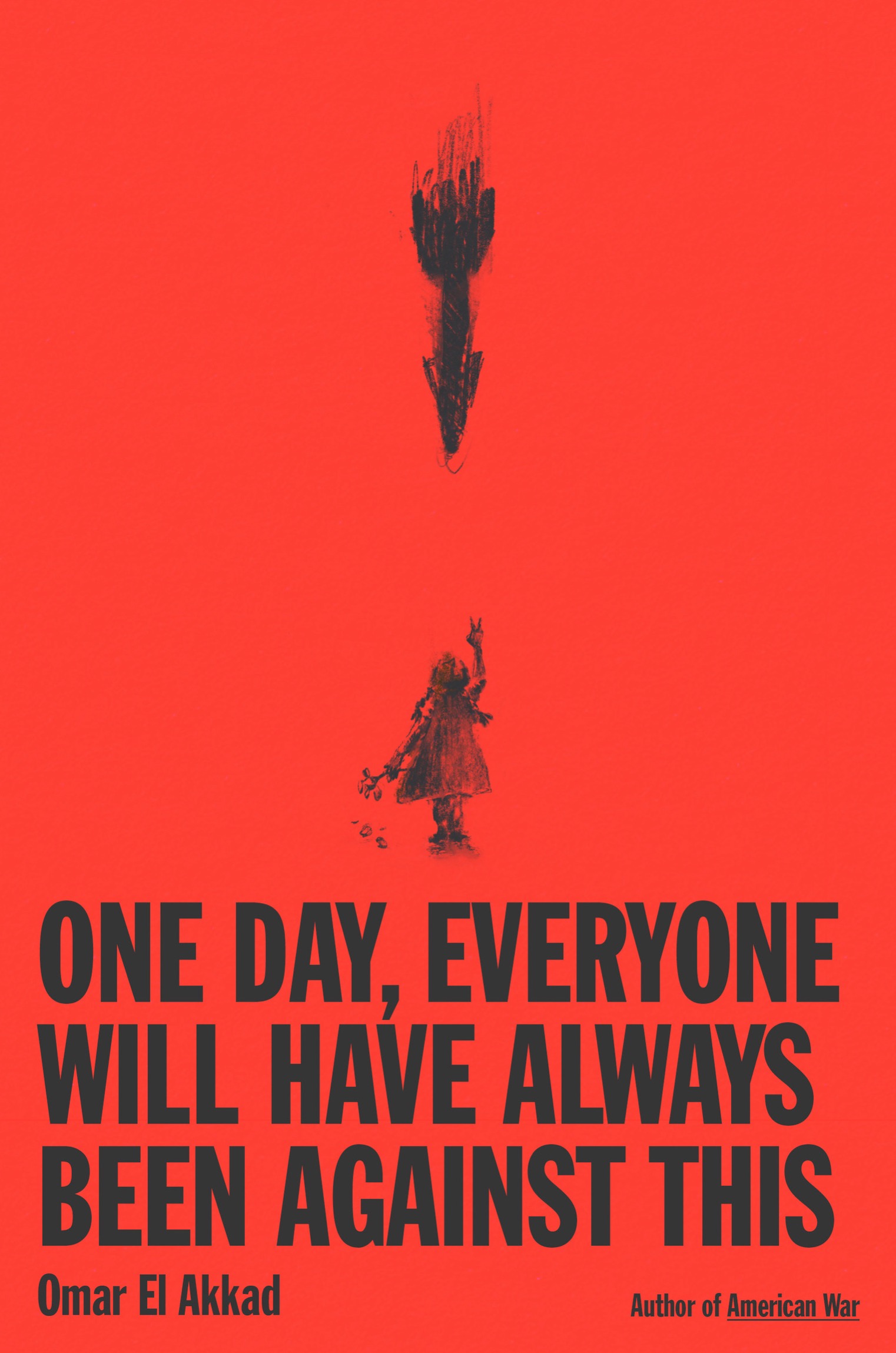
One Day, Everyone Will Have Always Been Against This
About this book
The book grows from his October 2023 observation that public opposition often becomes safe only after accountability is impossible. He writes as an immigrant, journalist, novelist, father, and citizen shaped by promises of liberal order.
Memoir and political essay move together through war reporting, migration, race, language, and the unequal distribution of whose suffering receives context. The subject is not only government policy but the stories institutions tell to preserve innocence.
El Akkad does not offer a neutral survey of the conflict. He records estrangement and anger while asking what solidarity and refusal can mean after the vocabulary of rights has been used selectively.
One Day, Everyone Will Have Always Been Against This is a memoir-manifesto written in response to current violence. It is argumentative, personal, and explicit about its standpoint.
Read a sample
5,079 words
Plain text
From the opening
She is fog-colored when they find her, she believes she has ended. Like porters in service of some grotesque nobility, half a dozen men carry the stretcher out of something cavernous, something that used to be a home, and she, a girl of nine or ten, is whisked away. Sitting on the stretcher, dazed and bloodied, she looks off to the side. She appears to be searching. The men who carry the stretcher move with urgency, as if the doing of care, of gentleness, can undo what has happened to this girl, to this place, to the bodies yet to be dug from beneath the rubble. Someone nearby asks God for revenge. Perhaps God is here somewhere, also searching.
A soldier I met years ago, who made the study of industrial violence his hobby, once told me the first thing that kills when a bomb goes off isn’t shrapnel or fire. It’s the overpressure wave: air forced violently outward from the site of the blast. What you’re supposed to do, he said, is drop to the ground and cover your ears, breathe out, empty your lungs before the air collides with and flattens them. Of course, if you’re close enough, nothing you do or don’t do will make any difference at all. He said the force of the overpressure wave weakens in proportion to the cube of the distance from the site of impact, which is to say, the most effective thing you can do to avoid getting killed by a missile or a mine or a grenade is to be far away when it goes off.
How do you do that? I asked.
Do what?
Know when a thing like that is about to happen. Know to be far away.
Well, he said, and trailed off. A few minutes later he was telling the story of a freak accident his daughter had suffered as a toddler, how carrying her to the emergency room was the scariest thing he’d ever experienced. Even in his line of work, even with all he’d seen, the scariest thing.
As the men carry the girl out of what used to be her home, she asks if they’re going to take her to the cemetery. One of the men says, Mashallah, mashallah.
In literal translation, the word means: What God wills. A closer approximation of meaning—of one meaning—is something like: What has happened is what God willed. But English, tasked with a word like this, turns stiff and monophonic, and Mashallah is orchestral. To any ear that grew up on this language, it is clear that what the man means when he says this word is something else entirely. Something instantly familiar to generations who’ve heard it spilling out of the mouths of beaming grandmothers at the end of piano recitals and graduation ceremonies and at the first sight of a newborn. Used this way, it finds its principal purpose, as an expression of joy. Look at this wonderful thing God has done.
ﷲ ءﺎﺷ ﺎﻣ
Language, too, forces the air from the lungs.
Beyond the high walls and barbed wire and checkpoints that pen this place, there is the empire. And the empire as well is cocooned inside its own fortress of language—a language through the prism of which buildings are never destroyed but rather spontaneously combust, in which blasts come and go like Chinooks over the mountain, and people are killed as though to be killed is the only natural and rightful ordering of their existence. As though living was the aberration. And this language might protect the empire’s most bloodthirsty fringe, but the fringe has no use for linguistic malpractice. It is instead the middle, the liberal, well-meaning, easily upset middle, that desperately needs the protection this kind of language provides. Because it is the middle of the empire that must look upon this and say: Yes, this is tragic, but necessary, because the alternative is barbarism. The alternative to the countless killed and maimed and orphaned and left without home without school without hospital and the screaming from under the rubble and the corpses disposed of by vultures and dogs and the days-old babies left to scream and starve, is barbarism.
The girl on the stretcher believes she has ended. A man says to her: Inti zay el amar.
You are like the moon. Again, translation fails. There is no English equivalent to the lineage of this phrase, a lineage that runs through generations of old movies and love songs and family gatherings. Listen to the sly setting joy and pleading, raw pleading that carries the words as this man tells the girl who lived when so many others died that she is beautiful beyond the bounds of this world.
رﻣﻘﻟا يز
Something has ended here. But something else begins. The dead dig wells in the living.
Continue reading the sampleClose the sample
Chapter One
Departure
An eighteen-month-old with a bullet wound to the forehead. Maybe the sniper was aiming elsewhere. Maybe there’s some explanation. Maybe it was necessary.
Portland, 2024:
Spring, nearing. My daughter has been building a city. Its Main Street runs the length of our hallway, from the front door to the dining room. She unspools a long sheet of paper and draws lane dividers and sidewalks, trees and shrubbery. Along the wall, near the little marks we’ve used to document her height since she could first stand, she has cut out and placed little storefronts made of pink and orange construction paper: supermarkets and coffee shops, a pet store. At the end of the road, at least a dozen stuffed animals sit solemnly within the confines of what I can only imagine is some kind of planned community. My daughter arranges them just so, gives each its space, starts building them a park. She turns seven soon, a hundred in dragon years. She is made of dreaming.
We live in the woods in Oregon. Wine and hazelnut country, somewhere in that strange middle space past where progressive Portland ends but before Trump Country begins. A year before my daughter was born, we tried to find a house in the city, couldn’t afford anything, and ended up looking further and further out. We spent weeks traversing all these little outposts on the east and north sides of the Willamette Valley, and across the Columbia River in southernmost Washington. After vetoing two other neighborhoods on account of Confederate flags flying in nearby yards, we landed here, next door to a World War II veteran on one side and, for a brief stretch of about three months, some guy who thought a home on a rural road with no sidewalks in the middle of nowhere, serenaded near-nightly by a chorus of coyotes, would make for a good Airbnb property. He sold after a couple of months.
This is the sixteenth or seventeenth home I’ve lived in, I’m not entirely sure. But it’s my children’s first. In stable orbit their lives spin around this house, this town, this country—some 7,000 miles from the places where their father’s childhood first came undone.
Occasionally I show them pictures, crack open my now-arthritic high school yearbook and say, yes, that’s me with the ridiculous curls, with a full head of hair. I show them pictures of their grandfather, who died before either of them were born. In one photo he’s parked on the side of a desert road next to his friend’s car. Both of them are driving those lean, early-’90s Mercedes sedans. I try to explain to a couple of children who have no idea what the hell I’m talking about that these cars were the status symbol of the time, proof my family had joined the ranks of the upper middle class. I see their eyes start to glaze over and all at once I’m struck by the absurdity—how did any of this ever seem important? I was roughly the same age my daughter is now when my dad got that Mercedes. I remember yelping. I did a little dance.
There’s an unbridgeable distance. I know it, and I think my children can already sense it. I tell my daughter one day I’ll take her to the place I was born, and she can see the pyramids for herself, figure out what’s really going on with the Sphinx’s nose. I tell her about the beaches along the north coast where the coral’s neon bright and you can swim right up and pet the fishies. I warn her it won’t be like anything she’s experienced before. You know how people stop at red lights here? I ask. Well, when we get there, don’t be surprised if…I pause, try to figure out how to prepare a child for what, relative to all she’s known so far in life, would come across as complete chaos. People there have made a language out of honking horns, I say, and she laughs, and I know deep down I might never take her back.
I’ve learned to justify it to myself, this severance. It’ll overwhelm her, confuse her, and anyway, I’ve been gone so long from the country of my blood that there’s really no point, no connection left. But there’s a fraudulence to those excuses, no different than when my wife and I found out we were having a girl, and I spent weeks and weeks considering baby names that would work in the West and the Middle East, that would allow her to pass through many worlds untroubled.
In truth, I lean away from the faraway side of my daughter’s lineage on her behalf because for more than forty years I’ve seen what carrying that weight means. I’ve seen cousins pulled into secondary at JFK on account of their Arabic accents; I’ve heard my own name mangled every which way, the letter ع turning to syrup in the throat if you haven’t been brought up hearing and saying it. I’ve explained, politely, to deeply well-meaning people that I don’t have a problem shaking hands with women—maybe other Muslims do, I couldn’t tell you; we don’t all know each other. I’ve sat through a wildly uncomfortable book tour interview once after I joked that I write all my novels in Arabic and then run them through Google Translate, and the interviewer believed me. I have on countless occasions been made to stand in for and speak on behalf of every Muslim, every Arab, every Brown person on earth, by people who are not monsters, not even actively malicious, but simply have no other point of reference to consult. I’ve smiled and nodded. I was nice about it.
None of this matters much, in the grand scheme of things. I’ve learned to deal with it—but why should she? In truth, I keep a distance between who my daughter is and what she comes from because it’ll be easier for her that way.
Which is to say, because I’m a coward.
My daughter pauses, midway through drawing the Vs of a swing set in the park of her stuffies’ imaginary suburb. She gets up, walks over to where I’m sitting in the living room scrolling through photographs and videos taken in the aftermath of yet another atrocity in Gaza. She wants to double-check the spelling of “Welcome.”
I shut my computer, quickly. In various browser tabs, there is footage of a girl not much older than my daughter, pulled out of the rubble after an Israeli airstrike. In another is a recording of a girl begging for help, shortly before her execution at the hands of Israeli snipers. I have more than twenty tabs open, a bloody carnival of the worst crimes ever livestreamed. I tell my daughter she’s spelled the word correctly. She returns to her park, light as air.
I am in possession of this, my first memory of war:
Autumn, 1990; third grade. The American International School in Doha, Qatar, was founded by the U.S. ambassador. His posting, I assume, came as such things do, a reward for some sufficiently large campaign donation. The AIS was built in part for his daughter, G., on whom I had my very first crush.
That fall, feeding on stray crumbs of adult conversation—things said indiscreetly just within earshot, the nightly news in the other room—I learned there was a war about to begin. Not here, but nearby. I remember watching my father place big Xs of duct tape across all our balcony windows, supposedly to keep them from shattering in the event of a blast. He made jokes about it, and I realize now it was to keep his son calm, to paint as trivial a thing that, had it come, would not be.
Still, we knew we were not in the middle of this war, the air would not be pushed out of our lungs. Quickly, the conflict eventually known as the Gulf War, and later the First Gulf War, transformed from a thing no one talked about to a normal mechanic of everyday life, no different than humidity or dusk. The endless footage on CNN that at first provoked such shock—these shadowed Baghdad cityscapes detonating sporadically in balls of pale white light—soon caused no reaction at all. It was just what happened to certain places, to certain people: they became balls of pale white light. What mattered was, it wasn’t us.
During the First Gulf War, the Americans arrived. There had been plenty of Americans before then, of course, plenty of expats from all over. (In the hierarchy of migration, “expat” is largely reserved for white Westerners who leave their homes for another country, usually because the money’s better there. When other people do this, they might be deemed “aliens” or “illegals” or at best “economic migrants.” As with most criteria of segregation, everyone knows, instinctively, how they will be labeled. It’s a matter of self-preservation, to know.) Qatar being home to some of the largest natural gas reserves on earth, it had for decades attracted foreigners looking for a life that, if you’ve never lived it, feels almost unreal. A life in which multiple housemaids and drivers and villas are not exclusive to the wealthiest few, but the normal trappings of upper-middle-class life. At the time I lived there, about 90 percent of Qatar’s residents were non-Qatari. Of these, most were “third country” laborers—people who had come from Pakistan and India and the Philippines and Bangladesh and Nepal (and, later, most every part of sub-Saharan Africa) to drive the cars and build the towers and clean the villas. It was on the backs of these people that much of the oil-rich Arabian Gulf was constructed and, to this day, they are afforded almost no rights at all, no ownership of the glittering fantasy that fossil fuel profits paid for and the bodies of these men and women made real.
But the Americans who showed up during the war had not come to live in the villas and work in the office towers. They occupied a small mess of tents on the outskirts of the city. They wore military fatigues, they looked like the Americans we’d seen in movies and on television. In class, our teacher had us write them thank-you letters that were later delivered to the base. I don’t remember what I was supposed to be grateful for, only that gratitude was important. That without these people, and what they were willing to do, the world would be a very different place.
Four years earlier, my father, then only thirty-one and working in the accounting department at the Cairo Sheraton in Egypt, was leaving the hotel one night when a couple of soldiers decided to give him a hard time.
The country was still sleepwalking through the ugly years following the assassination of President Anwar El-Sadat. After signing the Camp David Accords, formalizing peace between Egypt and Israel, Sadat was shot to death during a military parade in 1981 by an Islamic fundamentalist military officer. Of the few impressions of Egypt I suspect I share with my father, who has been dead now more than a decade, there is this sense that, more often than not, for people who are from the places we’re from, power changes hands this way: a killing, a coup, a successful revolution, a failed revolution. My father loved Egypt. He knew it for exactly what it was and loved it still.
Shortly after I was born, in 1982, the man who killed Sadat went before the firing squad, and for years the whole country lived under the suffocating gravity of martial law. To be outside at night required a formal reason, or else one risked harassment by the soldiers who seemed to make a military checkpoint out of every intersection. It is a hallmark of failing societies, I’ve learned, this requirement that one always be in possession of a valid reason to exist.
It was late, my father was done work for the night. Because he was technically part of the tourism industry, and the Egyptian economy has for a very long time depended on tourism to ward off complete collapse, he was afforded special dispensation to be out during curfew hours. The soldiers on the corner did not know this. Young, bored, tasked with what authoritarian regimes have ordered young, bored soldiers to do since time immemorial—stand there projecting the violent underpinning of political power—they also didn’t care. One of them stopped my father.
Your papers, he said.
My father pulled out his paperwork. Without reading it, the soldier tore it in half and threw it on the floor.
Your papers, he repeated.
In the forty or so years since that day, I have thought about this moment more than anything else in the stories my father told me. I’ve thought about it while shuffling my passport across the counter at border crossings; while running from RPG attacks in the dead of night; while sitting in a guesthouse in Kandahar listening to two Taliban officials explain, with utmost confidence, how the world should be run; while sitting in a courtroom in Guantánamo Bay watching highly educated men and women assign legitimacy they know is unearned to an ad hoc, hopelessly compromised legal system. It has been, for as long as I can remember, the memory that anchors my overarching view of political malice: an ephemeral relationship with both law and principle. Rules, conventions, morals, reality itself: all exist so long as their existence is convenient to the preservation of power. Otherwise, they, like all else, are expendable.
By chance, my father’s boss, who happened to be friends with one of the soldiers, was leaving the hotel a short while later and stumbled onto the scene. This is likely the only reason my father got out unscathed that night, avoided being dragged to some outpost of Egypt’s labyrinthine secret prison system, being made into an absence. It was that night, I think, that my father decided he had no choice but to leave the only home he’d ever known.
He’d been flirting with departure a long time. Egypt, like so many places trying to forge a path on the other side of colonialism, was a country in which the future had been exiled, governed by people who provided for the vast majority of their citizens no plausible avenue of progress from one’s current state to something better. Under foreign and then local rule, the central directive never changed: Know your place. It’s a frequent, nauseating political inheritance: come to experience the world under the reign of someone who thinks of you as subhuman, as undeserving of a future, and an ugly impression is settled that true power is the ability to do the same to someone else. The foreigners had departed; there was no one left to do it to but our own.
And so one day my father, who loved Egypt, who had marinated in its music and poetry and knew every street, every alley, who as a child had sat under the tables at Hagg El Feshawy’s coffee shop in El Hussein and listened to Naguib Mahfouz hold court decades before the Nobel, decided he needed to get out. Elsewhere has since been our lot to carry.
It was no unusual thing, for the likes of us to scatter. After a few months of looking, my father found a job abroad, the way so many Arab men did in those years and the years that followed. It was another accounting gig at a hotel in Libya. On the day his new life was supposed to begin, my father went to Cairo airport, handed his passport at security, and was promptly detained.
Naming conventions in much of the Arab world assign the father’s first name as the son’s middle name. My name is Omar Mohammed El Akkad. My father is Mohammed Ahmad El Akkad. My grandfather, a clothing merchant who died a few months before my father was born and whose funeral, I’m told, brought all of El Hussein to a standstill, is Ahmad Suleyman El Akkad. Unfortunately for my father, the name “Mohammed Ahmad” is about as ubiquitous as exists anywhere. It happens that the same name pops up on a Libyan terrorism watchlist. He is taken into secondary screening. My father’s age precludes him from being the same wanted man, but he’s denied entry into Libya anyway. We never end up going.
Not long after, another job offer arrives. This time it’s in a tiny peninsula called Qatar, a thoroughly ignored outpost of the British Empire that, not long before, had gained its independence and discovered massive fossil fuel deposits. It was one of the fastest-growing nations on the planet, flush with cash and in desperate need of workers. My father accepted a position at a hotel in the Qatari capital, Doha. He knew nothing about the place, had no desire to go beyond the money on offer. It paid better than anything he’d ever find in Egypt. (One of the more ironic facets of living in a place like Qatar—one of the safest nations on earth, at least from the middle class on up—is that so many people move to this place and are then granted a bonus, “hardship pay,” for living outside their home countries.) He had a family to support. And so we left; have been leaving ever since.
One of the hallmarks of Western liberalism is an assumption, in hindsight, of virtuous resistance as the only polite expectation of people on the receiving end of colonialism. While the terrible thing is happening—while the land is still being stolen and the natives still being killed—any form of opposition is terroristic and must be crushed for the sake of civilization. But decades, centuries later, when enough of the land has been stolen and enough of the natives killed, it is safe enough to venerate resistance in hindsight. I tell stories for a living, and there’s a thick thread of narrative by well-meaning white Westerners that exalts the native populations in so many parts of the world for standing up to the occupiers, makes of their narrative a neat reflexive arc in which it was always understood, by the colonized and (this part implied) the descendants of the colonizer, that what happened was wrong.
It’s a comforting thing, this narrative, and at my most susceptible to whatever the West is, I want so dearly to partake in it. But it’s a fiction, the most malicious kind: a fiction of moral convenience. Some, maybe most, might resist the wanting whims of empire, but all must figure out a way to survive them. And survival is not clean, does not subscribe to any one narrative. For every victim of colonialism who resisted, there might be another who, like countless members of my parents’ and grandparents’ generations, looked to the French and the British and thought: This is what winners look like. These are the languages they speak and these are the customs they practice and if our own children are to have any chance at all they must become fluent in these things because anything less than fluency is a sentence to a life of something lesser. It is this impulse, to give your child a fighting chance at privilege by immersing them in the myriad languages of the privileged world, that makes me who I am, that lands me in the American International School at age eight, writing thank-you letters to American soldiers.
We are all governed by chance. We are all subjects of distance.
The winter I turned sixteen, my best friend Donny got his driver’s license. There being not much to do in Doha during the late 1990s, we spent a lot of weekend nights driving around aimlessly—over to the drive-thru of the twenty-four-hour Dairy Queen, or the skeleton of that building by the Jedda overpass that was halted mid-construction when it became clear the residents in the upper floors would have an unobstructed view behind the walls of a sheikh’s neighboring estate.
One night, near where the Ramada roundabout used to be (we lived in one of those places where absolutely nobody used street names or numbers, only landmarks), we came across a fender bender. Two cars were parked on the side of the road. The one that had been rear-ended, a Mercedes, belonged to a man who, by his clothing, was almost certainly a local. The driver of the Daewoo that had done the rear-ending was Southeast Asian, likely Indian or Pakistani. We drove slowly past them, gawking as the man in the Mercedes stormed out of the car and, in what seemed like one swift movement, removed one of his sandals, rushed over to the driver of the Daewoo, and started pummeling him with it. Traffic slowed, something of a communal spectacle quickly developed. Passing drivers honked their horns, some kids not much older than us rolled down their windows and yelled something, laughing hysterically. We watched, we laughed. The whole thing must have lasted at most fifteen seconds. And yet I’ve never stopped thinking about it, about the rage in one man’s eyes and the fear in the other’s.
It came to me, a long time later, that the Southeast Asian man had done something worse than dent a fancy car’s bumper. He had violated the bounds of his assumed nonexistence. In this place, at this time, people who looked like him were to be invisible. They could perform labor and be paid wages, but as vessels of agency beyond the most necessary transactions, they quite simply did not exist. They were not subhuman, they were nonhuman, non-anything. To allow oneself to think otherwise risked having to contend with the reality that this whole place lived on top of people who looked just like this man. It risked an indictment of an entire narrative, a self-told story of being. It risked everything.
I return to the memory of that moment often, the way we watched and laughed, didn’t think for a second to stop, to interfere, as the man in the Mercedes assaulted someone whose existence he had been so rudely forced to acknowledge. It’s come to shape the way I think about every country, every community: Whose nonexistence is necessary to the self-conception of this place, and how uncontrollable is the rage whenever that nonexistence is violated?
Somewhere in the basement of my mother’s house in Ottawa there’s a CD rack I haven’t touched in about a quarter century. It is, as you’d expect, a truly embarrassing archival tower of 1990s cultural ephemera: Meatloaf’s second Bat Out of Hell album; the Letters to Cleo single with the near-indecipherable chorus; about half a dozen Now That’s What I Call Music! compilations full of the worst, most earwormy Brit-pop ever conceived. Among this mess are two Nirvana records I played to death when I first got my hands on them: Nevermind and In Utero. (There were no real record stores in Qatar back in the 1980s and early ’90s, only a small variety store of sorts on the ground floor of the Doha Sheraton that, occasionally and inexplicably, sold a random assortment of CDs.) On the cover of Nevermind, the naked baby in the pool has been blacked out by a government censor’s marker; on the cover of In Utero, only the angel’s head and wings are visible. Such was the experience of consuming culture throughout my adolescence, a tiring cat-and-mouse of books and films smuggled into the country from abroad at great personal risk, of magazines held up to the light bulb in the hopes of seeing through the black ink, of this impotent rage at some anonymous government hack who was deciding what was too dangerous for me to hear, to watch, to read. (I learned later that the chief government censor during those years was the mother of one of my closest friends—just the sweetest woman.) Brought up this way, I held on to the thought that elsewhere, in the part of the world where these books and films and songs that so shaped my life were made, things were different.
The mind outlines better than it shades. England, Canada, the United States, the West, these places—or rather ideas of places—became in my imagination the negative space of all I despised about the Middle East: the repression, the sheer docility expected of everyone on all matters political or social, the gaggle of idiot Dear Leaders whose embellished jawlines were plastered on most every vertical public surface. (I remember one visit back to Egypt where, upon leaving the airport and driving through the streets of Cairo, I looked out the window and saw a giant billboard with President Hosni Mubarak’s beaming face drawn on it, and a note from a sycophantic businessman congratulating him on winning the election. The election was still four months away.) All I knew about the other side of the planet, all I needed to know, was that it wasn’t like this. In the unfree world, the free world isn’t a place or a policy or a way of living; it’s a negation. National anthems and military flyovers and little flag lapel pins are all well and good, but for a life stunted by a particular kind of repression, the driving force will never be toward something better, but away from something worse. The harbor never as safe as the water is cold.