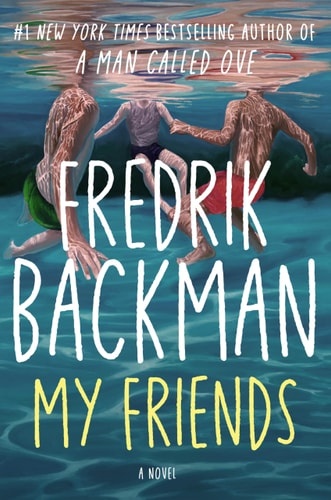
My Friends
About this book
Most viewers see a celebrated painting of the sea. Louisa notices three tiny figures at the end of its pier and believes they are the reason the picture matters. When the work unexpectedly comes into her care, she sets out to learn who they were.
Twenty-five years earlier, four teenagers spend a summer on an abandoned pier. Their jokes, arguments, small rebellions, and loyalty give them refuge from homes in which each is carrying more than the others initially know.
Louisa's journey toward the coast brings the two timelines together through the people who survived and the stories they have avoided telling. The painting becomes less a valuable object than evidence of what one group of friends gave an artist to see.
My Friends, translated from Swedish by Neil Smith, is a novel about art moving between strangers and friendship outlasting the moment that formed it. Fredrik Backman balances grief with comic observation, letting both belong to the same people rather than cancelling each other out.
Read a sample
5,048 words
Plain text
From the opening
ONE
Louisa is a teenager, the best kind of human. The evidence for this is very simple: little children think teenagers are the best humans, and teenagers think teenagers are the best humans, the only people who don’t think that teenagers are the best humans are adults. Which is obviously because adults are the worst kind of humans.
It’s one of the last days before Easter. Very soon Louisa is going to be thrown out of an art auction for vandalizing a valuable painting. Old ladies will shriek and the police will come and it really wasn’t planned. Not to brag, but Louisa did have a perfect plan, it wasn’t the plan’s fault that she didn’t stick to it. Because sometimes Louisa is a genius, but sometimes she isn’t a genius, and the problem is that the genius and the non-genius share a brain. But the plan? Perfect.
The auction is one where extremely rich people go to buy ridiculously expensive art, so teenagers aren’t welcome there, especially not teenagers with backpacks full of cans of spray paint. Rich adults have seen far too much news about “activists” who break in and vandalize famous paintings, so for that reason the entrance is protected by security guards weighing three hundred pounds with zero ounces of humor. They’re the sort of guards who have so much muscle that they have muscles that don’t even have Latin names, because back when people spoke Latin, idiots as big as this didn’t even exist yet. But that shouldn’t have been a problem, because the plan was for Louisa to get in without the guards even noticing she was there. The only problem with the plan was that Louisa was the person who was going to carry it out. But it started well, it has to be said, because the building where the auction is being held is an old church. We know that because all the rich people at the auction keep saying to each other: “Did you know this is an old church?” Because rich people love reminding each other about how incredibly rich they are, so rich that they can buy things from God.
In a couple of days, at the start of Easter, obviously no one in the room will spare a thought for God, because then God won’t have anything interesting to sell to them. But the thing that’s so incredible about God is that God understands people’s needs, so there are always bathrooms in churches, so Louisa broke in through one of the bathroom windows, in full accordance with the plan. Her friend Fish taught her how to do that. Fish is the best at everything. For instance, the best at losing things, and the best at breaking things, but she is the best of all at breaking into things. And Louisa? She’s bad at pretty much everything, but good at being angry. Not to brag, but she’s actually world-class at that. And she’s particularly angry about rich people buying art, because rich people are the worst sort of adults, and the worst way to vandalize art is actually to put a damn price tag on it. That’s why rich adults hate the sort of thing that Louisa paints on the walls of buildings, not because they love walls, but because they hate the fact that there are beautiful things that are free.
So Louisa got in through the window with a backpack full of cans of spray paint and a perfect plan. When she tumbled onto the floor inside the bathroom, she stopped for a while and painted a very realistic portrait of the guards on the wall. A more shallow artist might have chosen to portray them as bulls, seeing as their necks were so thick it was impossible to tell where their heads began, but Louisa would never do that. Because she can see inside people, so she painted the guards as jellyfish. Because jellyfish, like guards, have neither backbones nor brains.
Then she put on a white dress shirt and snuck into the crowd.
It has to be said that Louisa hates many things about herself, but most of all her height and her weight. She’s wished for many things throughout her childhood, but perhaps none greater than to be smaller. She doesn’t like her body because there’s too much of it, she doesn’t like her voice because it’s too deep, she doesn’t like her brain because it always tells her to talk when she’s nervous. Most of all she doesn’t like her heart because it’s always nervous. Stupid, stupid heart.
Bearing all this in mind, you might of course think that someone ought to have noticed her when she stepped into the old church, but first you have to realize that rich adults hardly ever notice anything, apart from mirrors. There are expensive paintings hanging on all the walls, each masterpiece followed by an even grander one, but the room is full of people busily trying to see their hairstyles in the reflection of their Champagne glasses. One group of cheerful women are taking photographs, not of the art, but of each other. A group of serious men are talking about their favorite paintings, not as works of art, but as investments, as if they were framed banknotes. Then the men start talking about golf instead, and the women laugh loudly at something fantastic, because everything in their lives is the best, everyone is so wonderful, and isn’t it amazing that this building is an old church? Obviously none of them dares to actually talk about the paintings on the walls, they’re far too frightened of accidentally thinking the wrong thing, someone else needs to think something first so they can know what they’re allowed to love. One of the women returns from the bathroom and looks horrified, because someone has painted “graffiti” on the walls in there, the paint smelled and now the woman has a migraine.
Continue reading the sampleClose the sample
“Graffiti? How awful! Vandalism!” one of the women exclaims, but one of the other women whispers:
“But… do you think the graffiti is part of the exhibition? Do you think it’s… art?”
Panic spreads through the group like pee in a tent. Because what if they’re wrong? The women hurry over to the men who are talking about golf to ask if it’s art. One of the men asks: “Is there a price tag?”
Then the women shake their heads and laugh. No price tag, no art, oh, what a relief! The men point at the walls and talk about investments again. When they talk about the very best investment in the whole church, they point at one painting and say, “The One of the Sea,” as if that’s all it is: blue and expensive.
Angry? Louisa can’t understand how she could possibly be anything else.
Around the men and women, waitstaff in white shirts circulate, serving hors d’oeuvres, because rich people love tiny food. Everything else should be big, except for taxes and sandwiches. No one looks the waitstaff in the eye, staff mean so little to rich adults that they don’t even react to the fact that one of them is carrying a backpack.
Louisa moves gently through the crowd, if you’ve always felt too big you get pretty good at not being in the way, so it isn’t until she catches sight of the painting she’s looking for that she suddenly starts to panic. Because it makes her so happy, she imagines everyone else there must be able to hear her stupid, stupid heart beating in her chest. But no one reacts. Not so strange, of course, because if you’re an adult, you’ve forgotten how that sounds.
The One of the Sea was painted by the world-famous artist “C. Jat.” It’s the most expensive painting in the whole auction, so everyone wants it, not for what it is, but because of its story. It is said to be the very first picture that C. Jat painted, at fourteen years old, a prodigy. That was how his career started. But the men talking about golf don’t care about that, they eagerly tell the women who are drinking Champagne that the picture, most of all, is such a “damn fine investment” because of other rumors altogether. Because the newspapers say that the artist is a drug addict, that he’s in such bad shape that he no longer goes out at all, so if the buyer is really lucky, he might die! Imagine what the painting would be worth then!
Everyone laughs. Louisa clenches her fists.
The painting is already expensive. So expensive, in fact, that there’s a velvet rope hanging in front of it. So incredibly special that if a poor person accidentally breathed too close to it, it might be offended. Next to the rope stands a small old woman draped in diamonds, looking very unhappy, which, in her defense, is probably the only way her face can look, seeing as it has had so much plastic surgery it looks like a sneaker that’s been tied too tightly.
“Here’s The One of the Sea!” she hisses unhappily to her husband, because the painting is smaller than she had imagined. Presumably the poor thing had imagined the sea being bigger.
Her husband, an old man with a watch the size of a grown turtle and pants so tight his butt looks like it has its own butt, doesn’t even look at the painting, he just reads the sign next to it to see the estimated auction price. He looks happy, because not just anyone can buy paintings like this, and that means the old man isn’t just anyone. The woman says it’s a shame that it isn’t orange, because they have a lot of orange furnishings in the summer house this year. She says this in a tone that suggests she is also irritated that ice cream isn’t more like pickles, or that doorknobs aren’t more like opera—as if it is rather rude of the world not to adapt to her every wish at all times.
“Perhaps we could put it in an orange frame, Charles?” she suggests, but the old man doesn’t answer, because his mouth is full of tiny sandwiches.
Louisa hates them all. The men who invest and the women who photograph, and the old woman who decorates and the old man who consumes. God, how she hates them. You have to know that, because otherwise you can’t understand what a painting can do to a person.
In her backpack Louisa has, apart from cans of spray paint, her passport and an old postcard which says, in very shaky handwriting: It’s so beautiful here, the sun shines every day. Miss you, see you soon. —Mom. You need to know that too, to understand that once Louisa has crept through the crowd and is finally standing by the rope in front of the painting that everyone else there thinks is of the sea, she is no longer standing in an old church. She isn’t alone. She isn’t even angry, not even with her friend Fish, who was so good at breaking into places but so bad at getting out again.
Once Fish and Louisa broke into a tattoo parlor in the middle of the night and they tattooed each other. Louisa drew a heart on Fish’s upper arm, and it was the most beautiful heart Fish had ever seen. Then Fish did a tattoo on Louisa’s lower arm, and it really was remarkably ugly, almost incomprehensibly hideous, because Fish was the best at almost everything, but terrible at drawing. It was a tattoo of a one-armed man in a tree, and Louisa has never loved any picture more. The first time she and Fish met, in a group foster home where no one dared to sleep, Fish had whispered jokes to her all night. Her favorite was: “How do you get a one-armed man down from a tree? You wave at him!”
No one could laugh at their own jokes the way Fish did, Louisa had never heard a better sound, or met a bigger person. Sometimes Fish broke into ice cream parlors at night, because there weren’t many things she liked more than ice cream, but more often she broke into paint shops, because Louisa needed cans of spray paint. One time she broke into a hardware shop because they needed screwdrivers, but a hundred times she broke into the back doors of movie theaters so they could sneak into late-night screenings, because there weren’t many things Louisa loved more than movies.
As seventeen-year-olds they would sleep next to each other almost every night in the foster home, with ice cream stains on their clothes and each other’s laughter in their lungs, a chest of drawers against the door, each clutching a screwdriver in case anyone tried to get in. You get used to so many strange things when you grow up without parents, you soon get so used to having one single person who you love that it’s impossible to shake the habit.
Louisa hurt, but Fish hurt more, Louisa hated reality, but Fish really couldn’t stand it. Louisa tried drugs a few times, but Fish couldn’t stop. Louisa was still seventeen when Fish turned eighteen and wasn’t allowed to stay at the foster home any longer. Fish promised Louisa that it would be all right, but Louisa was her only good person, and after enough nights apart, Fish found other types of people. She fled from reality, down into bottles, out into the fog. Adults always think they can protect children by stopping them from going to dangerous places, but every teenager knows that’s pointless, because the most dangerous place on earth is inside us. Fragile hearts break in palaces and in dark alleys alike.
Louisa has now been alone on the planet for three weeks, because that was when all the adults lied and said that Fish had committed suicide. It wasn’t true. No adult missed Fish when she died, no one does if you’re an orphan and grow up in ten different foster homes, it’s so easy then to just blame the fact that she took an overdose of pills. But Louisa knows the truth: Fish was murdered by reality. She was suffocated by the claustrophobia of being trapped on this planet, she died of being sad all the time.
You have to know all this about Louisa, otherwise you can’t understand what a painting can mean. That there is a speed at which a heart can beat that you can’t remember when you’ve stopped being young. There is art that can be so beautiful that it makes a teenager too big for her body. There is a sort of happiness so overwhelming that it is almost unbearable, your soul seems to kick its way through your bones. You can see a painting, and for a single moment of your life, just for a single breath, you can forget to be afraid. If you’ve ever experienced that, you know how it feels. If not, there probably isn’t any way to explain it.
Because it isn’t a painting of the sea. Only a damn adult would think that.
TWO
The old woman hasn’t noticed Louisa yet, that’s part of the plan. For someone who’s surprisingly tall, Louisa is surprisingly good at being invisible. The secret to that is knowing that you don’t mean anything to anyone. That you’re worthless.
The woman, who feels very important and is therefore very visible, also happens to be fully occupied at the moment, because she’s just caught sight of the men and women talking about investments, so she snorts: “Look, Charles! Apparently they let anyone in here these days, even those vulgar new-money social climbers. Look at them! No taste, no style!”
She says “new money” as if it were a terrible virus, because people like her like things to be old, she wants antique furniture and vintage wine and old money. The only things that should be new are sports cars and hip joints. The richer people like her get, the fewer things they like, until eventually they become so rich that they even hate other rich people, and that’s actually the only thing Louisa almost likes about them.
The woman looks at her husband in annoyance and asks: “Are you listening, Charles?”
The man replies: “Yes, yes, darling. I’m listening. We’ll buy that one of the sea. What’s the artist’s name? ‘C. Jat’? What sort of name is that? Do you think there are any more of those sandwiches anywhere?”
No one notices when Louisa opens the backpack full of cans of spray paint. No one notices when she ducks under the rope and walks closer to the painting. She will never be able to explain what she feels when she sees it. Maybe this is what it feels like to become a parent, she thinks: there are no words. Miss you, see you soon. —Mom, it says on the postcard in the backpack. Louisa reaches down to the bottom of the bag.
“You there! What do you think you’re doing! You’re not allowed to be that close to the painting!” a voice behind her suddenly exclaims.
It’s the old woman, she sounds very angry but if one has a face where the skin has been pulled back until the cheeks start just behind the ears, it’s hard for anyone else to know what one really feels. The woman pretty much has the emotional range of a lampshade.
That’s when Louisa stops following the plan. It isn’t the plan’s fault, it’s just that her brain sometimes gets a bit crowded with both the genius and the non-genius having to live there together. So Louisa turns around with tears in her eyes and snaps at the woman: “It isn’t a painting of the sea!”
The woman quickly takes two steps back and stares at Louisa as if she has just been attacked by a piece of furniture. Did it just speak to her?
“Are you… are you completely out of your… Step away from that painting at once!” she commands, well on her way to fainting from the effrontery of it all.
But Louisa remains standing calmly on the other side of the rope, blinking away her tears. She whispers:
“It isn’t a painting of the sea. You vulgar new-money social climber.”
The woman gets so angry that she almost suffocates, so she grabs her husband so hard that he chokes on a tiny sandwich and almost suffocates as well.
“Chaaarles!” the woman howls, and the old man splutters and spits bread all over her diamonds before pointing furiously at Louisa’s white shirt as if he imagines his index finger can shoot fire and thereby instantly instill fear in the world around him.
“You there! Stand still! I want to talk to your supervisor!” he commands.
It turns out, to his horror, that Louisa isn’t at all afraid of index fingers, because she isn’t an elevator button, so she merely replies quietly: “I don’t work here.”
Then she searches her backpack some more until she finally finds what she’s looking for. A thin, red-colored pen.
“In that case, I want to talk to your PARENTS!” the old man demands, slightly disgusted, looking around for what he seems to be imagining are two chimpanzees holding an informational leaflet about contraception upside down.
Only then does the woman notice Louisa’s backpack, and then she understands everything, because she knows all too well what young people and backpacks mean.
“Charles! She has spray paint in that bag! She’s one of those activists! Get the guard, Charles, she’s going to ruin the art!”
“Says the woman who wants to hang it in her ugly summer house…,” Louisa mutters.
Then she turns around, and with her thin pen she draws a tiny fish in red ink on the wall right next to the painting.
That wasn’t the plan. She was really only supposed to look at the painting, she thought that would be enough. It isn’t her brain’s fault that now something in her heart suddenly somehow wants the painting to know that she was here. Her and Fish. Stupid, stupid heart.
The woman screams in panic and the old man hurries to fetch the guard. But it was still nice of him, that thing he said, Louisa decides. That he thought that she had parents.
See you soon. —Mom, the postcard in her backpack says. On the front is a picture of the world-famous painting by C. Jat. For as long as Louisa can remember she’s wanted to see it in real life, she used to talk about it to Fish all the time, that one day they would be here together. But now? Now she can’t even explain the feeling. Sometimes when she and Fish snuck into theaters they would watch movies where women tried to explain what it was like to become a mother, and they always looked just as overwhelmed and lost for words. Becoming a parent? Someone said it’s an invisible tidal wave that hits you with such force that you lose your breath and never quite get it back. You spend your whole life gasping, someone else said, because it’s a love so immense that it squeezes the air out of your lungs. Everyone else thinks you look like the same person afterward, a third said, but you don’t understand any of it, because there’s such a clear before and after. A completely new you.
That’s how the painting feels, Louisa thinks. But it was still nice of that old woman, she decides, to think that Louisa was planning to ruin the artwork. As if anything could have stopped her then.
Lady, Louisa thinks, if I’d wanted to destroy the painting, this entire building would be ashes by now. I’m insanely good at destroying things, lady. Everyone I love dies.
The guard comes rushing over now, or at least lumbering, a three-hundred-pound body with a tiny, furious head perched on top. Louisa clutches the red pen tightly in her hand.
She hates it when adults touch her, that’s what happens if you’ve never met an adult you can trust. Her dad was gone before she was born, he didn’t want to be a dad, but Louisa wonders if perhaps her mom had wanted to be a mom, at least for a little while. If she had felt the tidal wave when Louisa was born. Miss you, the postcard says, in terrible handwriting. The only thing Louisa remembers about her mom is her voice singing a lullaby. They came from another country, Louisa remembered nothing about it. She never found out what they left behind, but it can’t have been good if this place was better. When Louisa was five years old, she was left with neighbors. Her mom walked out the door and never returned. The police looked for her for a few months but she was too good at being invisible, and that was probably the only thing her daughter inherited from her. Time is a strange concept once you’ve been abandoned. If you’re five years old when your parent leaves you, the leaving didn’t happen on one particular day, it happens every day. It never stops. Louisa grew up in foster homes. She only spoke her mother’s language, and when she tried to imitate the other children’s languages in the foster homes, they laughed at her, or worse. For a long time after that she didn’t really speak at all. She remembers that it was hard to sleep in those homes, because things kept hitting the walls, sometimes it was plates and sometimes it was glasses and sometimes it was people. Sometimes it was other people, and sometimes it was her. Nowhere lasted very long, she had to move several times, some of the foster homes were creepy, some were scary, and some were dangerous. Only one was beautiful.
She was six or seven years old then, and of course that particular home was just as full of screaming people and silent fears as all the others, but there was a fridge in one corner of the kitchen covered with postcards of famous works of art. It was her heaven. She never found out who had bought the postcards and left them there, but it was probably someone like her, someone who had passed through the home and wanted to tell the children who came after that there was a different world out there. Art is empathy.
One of the postcards was of the painting of the sea which isn’t a painting of the sea. It was the first thing Louisa ever stole, the first really beautiful thing she ever touched. One day a few years later she arrived at a foster home where someone laughed, and it was Fish. They belonged to each other instantly. They slept so close at night, with screwdrivers in their hands, that if Louisa woke up and felt a heart beating in her chest, she couldn’t tell if it was her own or Fish’s. Fish taught her to understand all the different languages the other kids at the group home spoke, mostly all curse words of course, because when it came to cursing, Fish was truly a citizen of the world. But it was when Fish snuck them into the movies that Louisa learned to speak English like the American film stars. At night she would lie beside Fish and whisper out entire scenes from the great love stories. Still, there were a lot of words in any language she couldn’t understand. One day not long after, the police rang at the door to say they had found Louisa’s mom.
A child’s brain is peculiar, it interprets everything in its own way. Louisa had always dreamed of this, but what the police officer said was incomprehensible. Fish had to explain: “Inform the relatives” meant that you told the people who cared. So Louisa was the relative. “Deceased” meant dead. “Substance abuse” meant her mother had drunk herself to death. Drowned from the inside. A child’s brain is so imaginative, Louisa heard this but didn’t grow up afraid of alcohol, just horribly afraid of swimming.
The next time they were at the movies they saw a really old film, because Fish knew that Louisa loved those best of all, and a famous singer was playing the main role. In one scene she sang a lullaby to a child and Louisa suddenly recognized it: it had never been her mother’s voice she remembered, it was this. Her mother had left the five-year-old alone with the television for so many hours that in the end Louisa didn’t know which voice was which, her mom’s or the ones in the old films. She cried when she realized that she was a person without memories, but Fish sat beside her and said: “To Hell with that, why should your stupid brain get to decide what happened and what didn’t? You can still keep that memory, it’s yours!”
So Louisa kept it. Imagination is a child’s only weapon. And on the back of the postcard of the painting, Louisa wrote a message, the one she would have wanted, as if she had been longed for and loved: See you soon. —Mom.
She put it in her backpack and thought that one day she and Fish would see that painting in real life, and maybe then it would be like when superheroes discover their powers. If she ever got to the sea, maybe she wouldn’t be scared of swimming. She imagined it would be like in fairy tales, and that in some magical way everything would have a happy ending.
It won’t.
But this is how her adventure begins.
THREE
So Louisa gets thrown out. That doesn’t happen very often, actually, because most people who get “thrown out” are in fact led out, or perhaps dragged out. But Louisa isn’t like everyone else, so she leaves the church in the air.
Right before the out-throwing in question, she paints a guard, which doesn’t mean that she paints a guard on a wall, but actually paints the guard himself. Unfortunately, of course, the guard does not give the impression that he is the sort of person who appreciates symbolism of that sort, he just rushes over, as angry as a wild boar that’s been given a habanero suppository, and grabs her so hard that she screams. Shortly after that he screams too.
Because Louisa really, really doesn’t like it when adults touch her, so she panics, and that’s when she paints the guard. In her defense, it’s self-defense, because the only thing she has in her hands is the pen she used to write on the wall, so she stabs the guard’s lower arm with it. He has an impressive scream, somewhere between a five-year-old who’s fallen off a swing and an opera singer who’s found a snake in her car. He doesn’t at all appear to appreciate the irony of the fact that the pen is red and that arm is covered in the sort of cool tattooed words that guards love, so that now it looks like an angry teacher has discovered that one of those words is spelled wrong. The guard, three hundred pounds without an ounce of fun, tries instead to grab hold of Louisa again, so she jumps out of the way and snatches up the first thing she finds in her backpack: a can of spray paint. It happens to be white, and the guard happens to be dressed in black, so once she’s painted him from top to bottom, he looks like a really angry highway.
When his fists finally close around her arms and lift both her and the backpack up into the air, the brutality is so abrupt that it feels like her collarbones snap like matchsticks, but that isn’t what frightens her. It’s the fact that he yells, “CALL THE POLICE!” to another guard that leaves her terrified. The police scare Louisa far more than violence, so when the guard carries her toward the exit, she does what every rational person would do in that situation: she bites him on the ear.