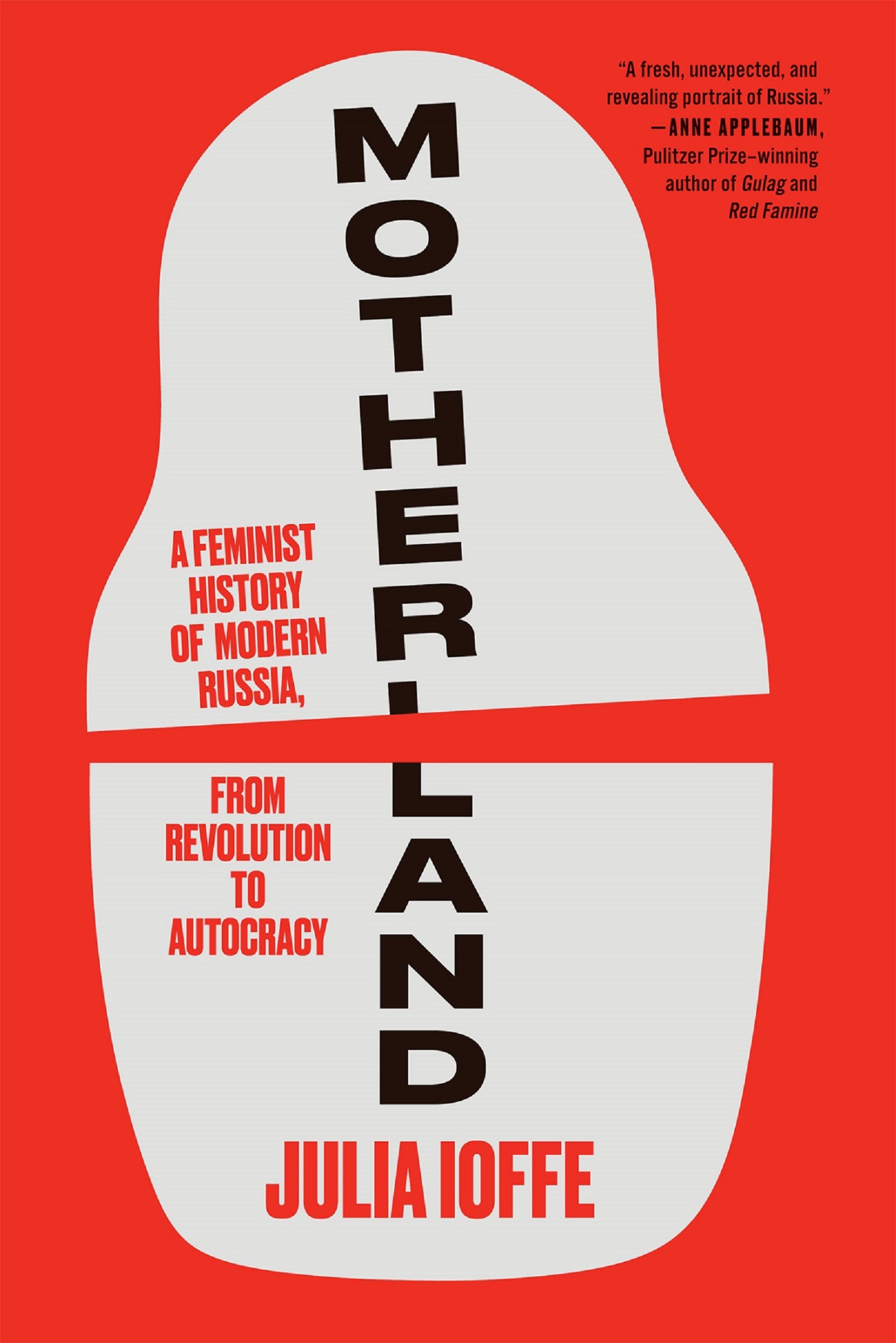
Motherland: A Feminist History of Modern Russia, from Revolution to Autocracy
About this book
Julia Ioffe left the Soviet Union as a child and later returned as a journalist. Her own family history provides one path through a larger question: how a revolution that proclaimed women's emancipation became an autocracy allied with conservative gender ideals.
The narrative moves from revolutionaries and workers to doctors, soldiers, mothers, dissidents, oligarchs' wives, activists, and political operators. Public policy repeatedly reorganizes domestic life while calling the result natural or traditional.
Ioffe uses biography, reporting, and family memory rather than treating women as a separate social chapter. Their experience becomes the main route through revolution, war, stagnation, collapse, capitalism, and Putin's rule.
Motherland is a feminist history of modern Russia for general readers. It combines a national chronology with individual lives that complicate the official account of each period.
Read a sample
5,030 words
Plain text
From the opening
Introduction
HOW DO YOU TELL THE STORY OF ORDINARY PEOPLE LIVING IN extraordinary times?
My little sister, an oncologist, is the fourth generation of women in our family to practice medicine. She follows our mother (a pathologist), our mother’s mother (a cardiologist), and our mother’s mother’s mother (a pediatrician). In fact, two of our great-grandmothers were doctors. Another was a PhD in chemistry who, in the 1930s, ran her own lab and published scientific papers at a time when her peers in the West still needed their husbands’ permission to do much of anything. (Our other grandmother, for what it’s worth, was a chemical engineer who oversaw the lab at a water filtration plant that supplied the Kremlin’s drinking water.) Any American who hears this lineage assumes one thing: that the women in my family were extraordinary. That is because they measure them against American history and their own American families: even in educated families, most of my peers’ grandmothers didn’t attend college.
But, measured against the history of their own country, the Soviet Union, the women from whom I descend were perfectly average people. They were ordinary women who happened to be the subjects—and products—of one of the most radical social experiments in history: the attempt to emancipate women and build a new Soviet person. This book is, in part, an effort to explain the extraordinary circumstances that transformed the lives of my rather ordinary foremothers.
When the Bolsheviks seized power in October 1917, they embarked on a campaign to erase gender and dismantle the bourgeois family, which, in their view, imprisoned women in marriages based on economics rather than love and mutual respect. In just a couple of years, Soviet women were granted freedoms and rights that their Western counterparts would have to fight for, in most cases, for another several decades. By 1917, Soviet women had the (increasingly irrelevant) right to vote, years before their Western peers. They had the right to no-fault divorce and child support, paid maternity leave, and free higher education, including in the sciences, by 1918. By 1920, they had the right to abortion, provided by the state for free.
These changes were introduced in part by Alexandra Kollontai, a revolutionary who would become the world’s first female cabinet minister and first credentialed female ambassador for a country that would put the first woman in space, two decades before Sally Ride. The experiment in erasing the legal, educational, and social differences between men and women was so successful that the first post-Revolutionary generation of Soviet women took up arms to fight the Nazis en masse. When Hitler’s army invaded the USSR in the summer of 1941, tens of thousands of young women, most of them teenage girls, swarmed recruitment posts all over the country. Eventually, nearly a million of them would serve in the Red Army, as machine gunners and medics, as sappers and artillery officers, as snipers and fighter pilots in all-female squadrons. This was without parallel among any of the countries fighting in World War II. As one of the female Soviet veterans told historian Anna Krylova, “We are a generation not from this universe.”1 By the time my mother entered medical school in 1977, 70 percent of doctors in the Soviet Union were women.
A century after that experiment began, I found myself living in Russia for the first time since we emigrated when I was a child. This country was the successor state to the Soviet Union, but its women seemed different from my mother and grandmothers. Women there were obsessed with men—as husbands, as sugar daddies, as inseminators. The Russian women around me—educated, intelligent, cosmopolitan women—oriented their entire lives around attracting men and tricking them into staying put. The pinnacle of their fantasies was to become a stay-at-home wife. And when Vladimir Putin returned to power in 2012 for his third term as president, things only got worse. He revamped his entire governing ideology from the fiction of “managed democracy” to one of cultural and religious revanche. He weaponized traditional values as a means of political control and incorporated the Russian Orthodox Church into the Kremlin’s political hierarchy. What, I began to wonder, had happened? How had the country of Kollontai and women fighter pilots become a country of women who wanted nothing more than to become housewives?
In trying to answer these questions, I also conducted an experiment of my own: How do you tell the story of a country through its women? I drew on my personal fatigue with the West’s fixation on Putin, on historians’ fixations on Lenin, Stalin, Khrushchev, and the rest. The focus is merited: they are the dictators who set the course for a country of tens of millions. But the women in that history had been overlooked and underappreciated by historians who were, of course, mostly male. This book takes a different approach. It interweaves the unfurling of big history (as embodied here by the wives of leaders such as Lenin, Stalin, and Gorbachev, all of them influential in their own right) with what it felt like to live through that history (as told through my foremothers and other regular women).
In the end, though, it is a story of my family, of the women I descend from, and the country that shaped them and failed them, lured them in and cast them out. It is an extraordinary country, in the good sense and the bad, this land of my mothers, my Motherland.
Continue reading the sampleClose the sample
A Note on Transliteration
Place-names are spelled the way they would have been spelled at the time that is being described, so the capital of Ukraine is rendered as Kiev when the story takes place in Soviet times, and as Kyiv when we go to independent Ukraine.
Part I
Who knows four?
I know four!
Four are the mothers
—PASSOVER HAGGADAH
Valkyrie of the Revolution
IT WAS THE WOMEN WHO STARTED THE RUSSIAN REVOLUTION.1
The events that toppled the three-hundred-year-old Romanov dynasty began on International Women’s Day—February 23, 1917, or March 8 in the Western calendar. That year, the day came in unusually warm, a bright winter sun scattering the leaden clouds over Petrograd, a welcome respite in what had been a brutal winter.2 The Great War was now in its third year, and there was no one to clear the snowdrifts that had piled up on the railroad tracks, blocking trains from supplying food and fuel to the capital. Women in the city stood in line for hours, waiting for bread. Without fuel, the factories where they worked began to idle, one after another. There were more and more women with nothing to do but wait in line for bread that never came.3
On the morning of February 23, against the advice of all the capital’s revolutionary organizations, the women working in several Petrograd textile factories went on strike.4 As news of the strike traveled, more women walked out of their jobs. Within hours, over a hundred thousand people, men and women, were protesting in the streets. Hungry women workers marched down to the parliament. Women workers and housewives, fed up with bread lines, spontaneously joined a rally that the socialists had planned for International Women’s Day. Coursing down Nevsky Prospect, the city’s main artery, they carried banners that said, “If a woman is a slave, there will be no freedom! Long live equal rights for women!”5
As more workers joined the strikes in the following days, soldiers were ordered to put down the protests by force. Instead, they mutinied. Within a week, Tsar Nicholas II had abdicated the throne and a provisional government was installed. “If future historians look for the group that began the Russian Revolution, let them not create any involved theory,” wrote one male revolutionary in his diary of what he saw in Petrograd during those turbulent days. “The Russian Revolution was begun by hungry women and children demanding bread and herring.”6 Leon Trotsky, who in a few months would mobilize the troops that helped the Bolsheviks seize power, wrote that Petrograd’s women had “marched on the cordons of soldiers more bravely than the men, grabbed the [soldiers’] rifles and asked, almost commanded, ‘Drop your guns and join us.’”
It wasn’t exactly a surprise that women were so instrumental in the success of the February Revolution. In Russia’s increasingly radicalized industrial labor force, women made up 40 percent of the workers. Russia also had the highest number of female radicals of any country in Europe: some 18,000 anarchist, socialist, and Communist revolutionaries, ready to fight.7 By the turn of the twentieth century, there were so many female political prisoners in the Russian capital alone that the government had to build a new prison just to hold them.8 “While the suffragettes or militants [in the West] smashed windows, caned politicians, and provoked arrest,” wrote historian Richard Stites, “Russian revolutionary women fired at generals, plotted uprisings, and dangled from gallows.”
***
As soon as Alexandra Kollontai got word that the Provisional Government had amnestied all political exiles, she rushed home from Norway to Petrograd, arriving on April 9, 1917. The monarchy had fallen and suddenly history was here, and she longed to mold it, to bring about the socialist revolution she had dreamt of for twenty years. Soon, Kollontai, once an opponent of the Bolsheviks, had an unexpected ally: a week after she set foot in the capital, an armored train pulled into Petrograd’s Finland Station. Onboard was the famous Bolshevik Vladimir Lenin.9
Almost immediately, Lenin began demanding that Bolsheviks seize power and refuse to work with any of the other anti-tsarist parties. The Bolsheviks had always wanted to “telescope” the revolution described by their prophet Karl Marx. The idea was to rush Russia from its current feudal stage of development right to the socialist phase, essentially skipping over the bourgeois industrial period that Marx saw as necessary for revolution. It set them apart from the Mensheviks, the socialist gradualists. But when Lenin sought to actually make that leap, the Bolsheviks balked. They feared that if they moved too fast, their movement would be crushed. No one supported Lenin’s proposals—except Kollontai. So ferocious was her proselytization of Lenin’s so-called April Theses that foreign newspapers dubbed the striking forty-five-year-old the “Valkyrie of the Revolution.”10
It was a strange molting that had transformed Kollontai from a child of privilege into a Marxist revolutionary. Born Alexandra Domontovich in St. Petersburg in 1872 into a wealthy, aristocratic family, she rebelled early, mostly against a mother that wouldn’t let her take university classes or marry the man she wanted, a poor distant cousin named Vladimir Kollontai. Alexandra did both anyway. Marriage had initially seemed like a way to free herself from her mother’s control and pursue her true desire, which was to study Marxist and populist philosophy. The plan worked at first. Her parents sent her and Vladimir enough money to hire a maid, but Alexandra’s home life became more complicated when, at the age of twenty-two, she gave birth to her son. Being a wife and a mother, she soon realized, was extremely time-consuming. “I longed to be free,” she wrote, complaining to her friends, “I hate marriage. It is an idiotic, meaningless life.”11
Kollontai began to read widely about political theory and philosophy, searching, like many educated young people of her generation, for a meaningful way to solve Russia’s myriad problems. She quickly discarded the liberalism she had grown up with, calling it “too shallow, too passive, powerless in some way.” She was drawn first to Russian populism, which focused on liberating the peasants who made up the overwhelming majority of the population. She was especially captivated with the young female revolutionaries from the People’s Will, the radical populist movement that killed Tsar Alexander II in 1881. One of the assassins, Sofia Perovskaya, was much like Kollontai: they were both daughters of decorated generals but had grown up to rebel against the cause their fathers served. But, unlike Kollontai, Perovskaya had turned her beliefs into action. She had led the plot to kill the emperor and was hanged for it.
These nigilistki, the nihilist women of the 1860s, were deadly serious about living their convictions. They wore their hair short and their dresses dark and plain because they didn’t want to be decorative objects. They studied and developed their minds and personalities and demanded respect from their male peers—often successfully. Preaching total freedom in love and sex, they wed their radical brethren in sham marriages to escape their parents’ control.12
Eventually, though, Perovskaya and the People’s Will began to seem outdated to Kollontai. She felt the populists were too preoccupied with rural peasants, whose reality was so far removed from her modern, urban life. Marxism was new and European and scientific, and it seemed to perfectly explain the grimy reality of the industrialization that she was witnessing in the capital.
At first, Kollontai tried to incorporate her newfound beliefs into her existing life. She began teaching literacy to workers, sneaking some socialist doctrine into her lessons. She had an affair with her husband’s friend, a man she dubbed “the Martian.” But this, too, was not enough. She was still not free.
In 1898, she handed off her four-year-old son to her parents, boarded a train for Zurich, where she aimed to join the Russian Marxist intelligentsia in exile, and sent her husband a letter saying that she was leaving him. “If she must choose between ‘love and work,’ [a woman] should never hesitate,” she would write many years later. “It is work, her own creative work, which gives her the real satisfaction and makes life worth living.”13
***
Kollontai’s work made her the Russian socialists’ preeminent theorist on what her contemporaries called the “woman question.” Few socialist thinkers, not even Marx himself, had bothered to address the issue. (Marx did allow that women couldn’t be completely ignored, since “major social transformations were impossible without ferment among women.”)14 A German socialist named August Bebel was the first to address the matter in his popular 1879 book, Woman Under Socialism. “She suffers both as a social and a sex entity, and it is hard to say in which of the two respects she suffers more,” he wrote.15 For Bebel, the bourgeois marriage was a clear illustration of the problem. In the capitalist system, money and property, rather than love and respect, were the cornerstones of marriage. The vast majority of women, Bebel wrote, married to find financial support, a contract “which they must enter into at any price.”16 Such an arrangement was, to him, worse than prostitution. “The prostitute has, to a certain degree, the freedom to withdraw from her disgraceful pursuit,” he wrote, “but a sold married woman must submit to the embraces of her husband, even though she have a hundred reasons to hate and despise him.”17
Most socialists agreed with Bebel but had few specific ideas about fixing the gender imbalance within the larger class struggle. Even Bebel was rather vague when it came to solutions: like most male Marxist theologians, he believed that the elimination of private property would magically resolve everything.
Friedrich Engels, Marx’s collaborator, was slightly more rigorous, positing that collective labor would obviate women’s traditional work inside the home. “The individual family ceases to be the economic unit of society,” he wrote. “Private housekeeping is transformed into a social industry. The care and education of children becomes a public matter.” Even that argument, though, was less about the woman’s freedom than the man’s pleasure. “Society takes care of all children equally, irrespective of whether they are born in wedlock or not,” Engels explained. “Thus the anxiety about the ‘consequences,’ which is today the most important social factor—both moral and economic—that hinders a girl from giving herself freely to the man she loves, disappears.”18
Just as Marx, Engels, and Bebel were traditional bourgeois married men in their private lives, they ended up being quite conventional when envisioning what a socialist society would look like for women. They agreed that marriage was paramount and that sex was for bearing children. (Bebel added that women should not opt out of having children out of convenience or to keep their figures.) Prostitution, they concurred, had to go. In a break with prevailing norms, however, they believed that married couples had to be able to separate and divorce. An adamant Lenin wrote that “one cannot be a democrat and a socialist without demanding full freedom of divorce.”19 On everything else relating to women, the great Marxist theorists were either extremely nebulous or entirely mute.
***
Kollontai would have bristled at being called a feminist. Like any orthodox Marxist, she saw feminists as “bourgeois equal-righters” who wanted “to drink the blood” of the revolution. She attended their meetings just to argue with them, and one prominent Russian feminist took to crossing herself whenever Kollontai entered the room.20 Kollontai and other socialists were focused on what they saw as far bigger issues, like capitalist exploitation of the working class and the repressions of the tsarist police state. The paramount distinction for socialists was not gender or nationality or religion; it was class. Everything else was secondary.
There was arguably some truth in this analysis. Upper-class women may have suffocated in their gilded cages, but so, too, did upper-class Russian men, who lived off their estates and also had little in the way of meaningful activity to occupy their time. The peasants toiling on their land were men and women both, as were those working in the squalor of city factories. In belle époque Russia, class differences were more stark than those of gender, notes historian Elizabeth Wood, and Russian men and women of all classes “shared an ‘equal rightlessness’ under the rigid hand of the autocracy.”21
But women in tsarist Russia suffered an additional and specific kind of rightlessness, one that began inside the family. It was embedded in the empire’s legal code, which stated that “a wife must obey her husband as the head of the family, live with him in love and treat him with esteem, utmost respect, obedience and humility due to him as master of the house.” A wife could not be issued a passport, travel, change her place of residence, or work without her husband’s permission.22 Marriage was a religious institution and the Russian Orthodox Church allowed divorce only in cases of adultery, impotence, criminality, or desertion. The procedure involved nine long and intensely bureaucratic stages and usually included a humiliating investigation of the wife’s intimate life. To prove a husband’s impotence, for instance, a wife first had to prove that she was a virgin. Proceedings quickly devolved into absurdity: upper-class spouses who wanted out of their marriages often resorted to making their servants play their fictional lovers in court.23 What a woman said in front of a judge mattered little anyway. According to Russian law, “When two witnesses do not agree, the testimony of an adult outweighs that of a child, and the testimony of a man that of a woman.”24
In peasant households, where girls were married off in their early teens, if not earlier, marriage was even more restrictive. It was replete with physical violence as well as the Russian tradition of snokhachestvo, in which the bride was forced to have sex with her father-in-law.25 Her mother-in-law was often scarcely better, meting out physical and verbal abuse. Since there was no birth control, peasant women spent much of their lives pregnant or nursing. A 1908 study found that 25 percent of forty-five-year-old Russian peasant women had had ten or more pregnancies, one-fourth of which had ended in miscarriages. “A not atypical example,” writes Stites, “is that of a fifty-five-year-old woman who had been married for thirty-five years and had been pregnant twenty-four times. Two children had lived.”26
For women in the poor quarters of the cities, life was a blur of long hours in dangerous factories and overcrowding at home, as well as disease, abuse, alcoholism, infanticide, malnutrition, and neglect.27 Pregnant workers were not given time off, even after the birth of a child. New mothers often had to leave babies locked alone in their tenement flats or entrust them to old women or to children scarcely older than the infants. Underground abortions and infanticide were ubiquitous, and some unwanted children were sold at birth. At work, there was sexual exploitation, both by factory owners and by pimps who recruited right on the factory floor.28 Women were paid a fraction of what men earned, leading some to pose as men to get full wages. Factory owners explained the discrepancy by saying that men should be paid more because, unlike women, they had to provide for the whole family. In reality, the reverse was frequently the case. Historian Barbara Evans Clements writes that “many women were the sole support of their families” and “often went undernourished in order to feed their children on starvation wages.”29
It was impossible to ignore that working women suffered in ways that set them apart from working men. A prolific writer, Kollontai gave shape to the hazy orthodoxy set down by the male theorists. On one hand, she agreed that the true source of women’s oppression wasn’t men but capitalism. On the other hand, as a keen observer of all the ways society failed women, she had far more developed ideas for how to fix them. Kollontai pushed for socialists to recognize that childbearing was a public good that should be supported by the state, with healthcare, maternity leave, and nurseries, regardless of whether the mother was married.30
Kollontai also expanded Engels’s idea of a collectivized home. In the socialist future, she wrote, dozens of families would live in houses heated and lit collectively, with “common kitchens and dining rooms.” (Lenin would come to espouse this idea, saying it would “relieve millions of ‘domestic slaves’ of the need to spend three-fourths of their lives in smelly kitchens.”)31 Child-rearing would become collectivized, too, performed by professional instructors. This, Kollontai posited, would introduce some woefully needed scientific expertise into the vital task of raising future citizens.
Like many of her contemporaries, Kollontai did not believe that marriage should disappear. Bourgeois marriage was, in her view, a man’s economic and sexual enslavement of a woman. But socialist marriage would be a “comradely and warm union of two free and independent, laboring, equal members of communist society.”32 Nor did socialist marriage have to be a lifelong prison: simplified divorce procedures would restore freedom and dignity to both partners.
Kollontai also wrote frankly about women’s sexuality. In the atomized society of the industrialized age, she observed, men and women both craved intimacy “with sick greed,” trying desperately to feel less alone. Yet the only two avenues allowed to them were marriage and prostitution, which were both built on money and ownership and only deepened people’s loneliness. “The normal woman seeks in sexual intercourse completeness and harmony,” Kollontai wrote in 1913. “The man, reared on prostitution, overlooking the complex vibrations of love’s sensations, follows on his pallid, monotone, physical inclinations, leaving sensations of incompleteness and spiritual hunger on both sides.”33
The new socialist woman, Kollontai wrote, would actively engage her sexuality, rather than suppressing it in the ill-fitting box of monogamous marriage. “When the wave of passion sweeps over her,” Kollontai wrote of this new woman, “she holds out her hand to her chosen one and goes away for several weeks to drink from the cup of love’s joy, however deep it is, and to satisfy herself. When the cup is empty, she throws it away without regret or bitterness. And again to work.”34 For a liberated woman, sex and love were “only the episodes of life,” Kollontai wrote. “Its real content is that ‘holy cause’ which the new woman serves: the social idea, science, calling, creativity . . . And this cause, this goal, is often more important, more worthy, and holier for the new woman than all the joys of the heart, than all the pleasures of passion.”35
This was a truly revolutionary view of the woman under socialism. The new woman Kollontai envisioned was the free woman that she had spent her life striving to be. This woman would be free because she worked and made her own money. Liberated from the subjugation of bourgeois marriage, she would be free to love whom and how she chose. If she decided to marry and bear children, she would be supported by the state, which would enable her to work and parent in the way a man did. For Marx, Engels, Lenin, and even Bebel, the goal was the creation of a new socialist man. The new socialist woman was a mere afterthought. For Kollontai, she was as real as her own flesh.
***
During the underground years, Kollontai noticed that the Russian Marxists were almost entirely overlooking working-class women. Instead, this constituency was being picked up by the loathed feminists, who were overwhelmingly from the upper classes and had little interest in overturning the existing economic order. Kollontai tried to convince the mostly male party leaders that they needed to create a special branch to target working women. At first, party officials denied her request along the usual ideological grounds: it smacked of bourgeois feminism. When they finally granted her permission to hold a meeting to discuss her idea, she and her supporters arrived at the assigned location only to find a locked door. On it was a sign. “The meeting for women only has been called off,” it said. “Tomorrow: a meeting for men only.”36
The Bolsheviks may have aimed to transform Russian society, but they were also products of that society, one that was still deeply patriarchal—and patronizing. Russian lore viewed the Russian woman as a backward and conservative workhorse, the superstitious and illogical baba.37 “A chicken is not a bird,” the popular saying went, “and a baba is not a person.” The socialists simply dressed up these old canards in pseudoscientific Marxist language. Even though literacy among working women was rising rapidly, as was their participation in labor strikes, the Bolsheviks, notes Wood, saw women as “empty vessels” who needed to be “‘brought up to’ the level of the male workers.”38 Even Lenin, the most progressive male party leader on the subject, viewed women outside the intelligentsia with suspicion. Women were “the most backward and immobile element” of the working class, he said, an element that had served as “a brake in all previous revolutions.”39
And it wasn’t just the men who felt this way. Socialist women, too, were wary of their working-class and peasant sisters. Lenin’s wife and comrade in arms, Nadezhda Krupskaya, worried that it was dangerous for a revolutionary to have a wife: uneducated in the world-historical processes unfolding around her, she would try to keep her husband at home out of fear. Even Kollontai herself was not free of this internalized bias. She referred to women as the “little sisters” of the proletariat and berated herself for crying when ordering her first arrests. It would not be the hardest thing she would have to do in forging a new socialist woman.
Inessa
ACCOMPANYING LENIN IN HIS SEALED TRAIN CAR TRAVELING FROM Zurich to Petrograd was his wife, Nadezhda Krupskaya, as well as their friend and fellow revolutionary Inessa Armand. On and off for a decade, Inessa had lived near the couple during their long exile in Paris and Krakow and was a frequent guest in their house. Inessa came over and played piano, which Lenin loved but Krupskaya had never mastered. She shared stories of her five children, who had remained with their father in Russia, and smoked and chatted with Krupskaya’s elderly mother. And she went for long walks with Krupskaya and Lenin, talking revolution all the while.
There had always been rumors. In 1911, the tsarist secret police tracking Russian revolutionaries in Paris began identifying Inessa as Lenin’s mistress. There was talk that Krupskaya had offered to leave Lenin that year but that Lenin refused. Forced to choose between the two women, he broke things off with Inessa—at least physically.1 Eventually, their love seemed to mellow into friendship, and Inessa became Lenin’s trusted political associate and executor. She even became close friends with Krupskaya, who kept a photo of her in her Kremlin apartment long after Inessa’s death.
“Beautiful people get most of the attention, even from historians,” Sheila Fitzpatrick, the great scholar of Russia, wrote of the two women. Inessa, to whom most people referred by her elegant first name, was a Bolshevik celebrity because she was “uncommonly good-looking” and Lenin’s mistress, Fitzpatrick observes. Krupskaya, who was known by her last name, like a male colleague, was overlooked as “Vladimir Lenin’s diligent but unglamorous wife.” In truth, both have been treated unfairly by historians, most of them male, who saw their importance only insofar as their lives were intimately tied to Lenin’s. Yet these women were veteran revolutionaries in their own right whose key roles in the Revolution have long gone unrecognized.
***
No one was particularly surprised that Lenin had fallen for the beautiful, sophisticated Inessa. She was born in a working-class neighborhood of Paris in 1874 to a French father who sang opera and a French-English mother who acted and gave voice lessons. By the time Inessa was six, both of her parents were dead, so her aunt took her to Russia to live with the large Armand family, who had hired Inessa’s aunt as a governess.2 The Armands raised Inessa as one of their own, and when she was nineteen, she married the eldest Armand son, Alexander.
Well educated and energetic, Inessa wilted in the hothouse of the Armand estate. She was a young mother with lots of help, a busy husband, and not much to occupy her. She “felt very lonely,” she would recall many years later.3 This was not an unusual predicament for a woman of her socioeconomic status: an overeducated, elaborately feathered bird, preening and chirping in a gilded cage.