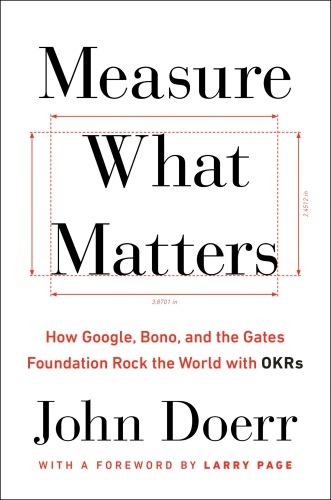
Measure What Matters: How Google, Bono, and the Gates Foundation Rock the World with OKRs
About this book
Doerr learned the system from Intel chief Andy Grove and introduced it to Google in 1999. An objective states a significant direction, while a small set of key results defines observable outcomes that indicate whether the objective has been achieved.
The book groups the benefits into focus, alignment, tracking, and stretch. Public or visible goals can connect teams and expose conflict early, while regular scoring provides information for revision rather than merely a final judgment.
Extended cases show how different organisations adapted the method, and a later section links OKRs to conversations, feedback, recognition, and workplace culture. The examples also make clear that writing a metric does not remove the need to choose the right one.
Measure What Matters: How Google, Bono, and the Gates Foundation Rock the World with OKRs is an advocacy and implementation book. It is most useful when objectives remain few and key results describe outcomes rather than repackaging an existing task list.
Read a sample
5,007 words
Plain text
From the opening
PART ONE
OKRs in Action
1
Google, Meet OKRs
If you don’t know where you’re going, you might not get there.
—Yogi Berra
On a fall day in 1999, in the heart of Silicon Valley, I arrived at a two-story, L-shaped structure off the 101 freeway. It was young Google’s headquarters, and I’d come with a gift.
The company had leased the building two months earlier, outgrowing a space above an ice-cream parlor in downtown Palo Alto. Two months before that, I’d placed my biggest bet in nineteen years as a venture capitalist, an $11.8 million wager for 12 percent of a start-up founded by a pair of Stanford grad school dropouts. I joined Google’s board. I was committed, financially and emotionally, to do all I could to help it succeed.
Barely a year after incorporating, Google had planted its flag: to “organize the world’s information and make it universally accessible and useful.” That might have sounded grandiose, but I had confidence in Larry Page and Sergey Brin. They were self-assured, even brash, but also curious and thoughtful. They listened—and they delivered.
Sergey was exuberant, mercurial, strongly opinionated, and able to leap intellectual chasms in a single bound. A Soviet-born immigrant, he was a canny, creative negotiator and a principled leader. Sergey was restless, always pushing for more; he might drop to the floor in the middle of a meeting for a set of push-ups.
Larry was an engineer’s engineer, the son of a computer science pioneer. He was a soft-spoken nonconformist, a rebel with a 10x cause: to make the internet exponentially more relevant. While Sergey crafted the commerce of technology, Larry toiled on the product and imagined the impossible. He was a blue-sky thinker with his feet on the ground.
Earlier that year, when the two of them came to my office to pitch me, their PowerPoint deck had just seventeen slides—and only two with numbers. (They added three cartoons just to flesh out the deck.) Though they’d made a small deal with the Washington Post, Google had yet to unlock the value of keyword-targeted ads. As the eighteenth search engine to arrive on the web, the company was way late to the party. Ceding the competition such a long head start was normally fatal, especially in technology.*
But none of that stopped Larry from lecturing me on the poor quality of search in the market, and how much it could be improved, and how much bigger it would be tomorrow. He and Sergey had no doubt they would break through, never mind their lack of a business plan. Their PageRank algorithm was that much better than the competition, even in beta.
I asked them, “How big do you think this could be?” I’d already made my private calculation: If everything broke right, Google might reach a market cap of $1 billion. But I wanted to gauge their dreams.
Larry Page and Sergey Brin at Google’s birthplace, the garage at 232 Santa Margarita, Menlo Park, 1999.
And Larry responded, “Ten billion dollars.”
Just to be sure, I said, “You mean market cap, right?”
And Larry shot back, “No, I don’t mean market cap. I mean revenue.”
I was floored. Assuming a normal growth rate for a profitable tech firm, $10 billion in revenue would imply a $100 billion market capitalization. That was the province of Microsoft and IBM and Intel. That was a creature rarer than a unicorn. There was no braggadocio to Larry, only calm, considered judgment. I didn’t debate him; I was genuinely impressed. He and Sergey were determined to change the world, and I believed they had a shot.
Long before Gmail or Android or Chrome, Google brimmed with big ideas. The founders were quintessential visionaries, with extreme entrepreneurial energy. What they lacked was management experience.* For Google to have real impact, or even to reach liftoff, they would have to learn to make tough choices and keep their team on track. Given their healthy appetite for risk, they’d need to pull the plug on losers—to fail fast.*
Not least, they would need timely, relevant data. To track their progress. To measure what mattered.
And so: On that balmy day in Mountain View, I came with my present for Google, a sharp-edged tool for world-class execution. I’d first used it in the 1970s as an engineer at Intel, where Andy Grove, the greatest manager of his or any era, ran the best-run company I had ever seen. Since joining Kleiner Perkins, the Menlo Park VC firm, I had proselytized Grove’s gospel far and wide, to fifty companies or more.
To be clear, I have the utmost reverence for entrepreneurs. I’m an inveterate techie who worships at the altar of innovation. But I’d also watched too many start-ups struggle with growth and scale and getting the right things done. So I’d come to a philosophy, my mantra:
Ideas are easy. Execution is everything.
In the early 1980s, I took a fourteen-month sabbatical from Kleiner to lead the desktop division at Sun Microsystems. Suddenly I found myself in charge of hundreds of people. I was terrified. But Andy Grove’s system was my bastion in a storm, a source of clarity in every meeting I led. It empowered my executive team and rallied the whole operation. Yes, we made our share of mistakes. But we also achieved amazing things, including a new RISC microprocessor architecture, which secured Sun’s lead in the workstation market. That was my personal proof point for what I was bringing, all these years later, to Google.
Continue reading the sampleClose the sample
The practice that molded me at Intel and saved me at Sun—that still inspires me today—is called OKRs. Short for Objectives and Key Results. It is a collaborative goal-setting protocol for companies, teams, and individuals. Now, OKRs are not a silver bullet. They cannot substitute for sound judgment, strong leadership, or a creative workplace culture. But if those fundamentals are in place, OKRs can guide you to the mountaintop.
Larry and Sergey—with Marissa Mayer, Susan Wojcicki, Salar Kamangar, and thirty or so others, pretty much the whole company at the time—gathered to hear me out. They stood around the ping-pong table (which doubled as their boardroom table), or sprawled in beanbag chairs, dormitory style. My first PowerPoint slide defined OKRs: “A management methodology that helps to ensure that the company focuses efforts on the same important issues throughout the organization.”
An OBJECTIVE, I explained, is simply WHAT is to be achieved, no more and no less. By definition, objectives are significant, concrete, action oriented, and (ideally) inspirational. When properly designed and deployed, they’re a vaccine against fuzzy thinking—and fuzzy execution.
KEY RESULTS benchmark and monitor HOW we get to the objective. Effective KRs are specific and time-bound, aggressive yet realistic. Most of all, they are measurable and verifiable. (As prize pupil Marissa Mayer would say, “It’s not a key result unless it has a number.”) You either meet a key result’s requirements or you don’t; there is no gray area, no room for doubt. At the end of the designated period, typically a quarter, we declare the key result fulfilled or not. Where an objective can be long-lived, rolled over for a year or longer, key results evolve as the work progresses. Once they are all completed, the objective is necessarily achieved. (And if it isn’t, the OKR was poorly designed in the first place.)
My objective that day, I told the band of young Googlers, was to build a planning model for their company, as measured by three key results:
KR #1: I would finish my presentation on time.
KR #2: We’d create a sample set of quarterly Google OKRs.
KR #3: I’d gain management agreement for a three-month OKR trial.
By way of illustration, I sketched two OKR scenarios. The first involved a fictional football team whose general manager cascades a top-level objective down through the franchise org chart. The second was a real-life drama to which I’d had a ringside seat: Operation Crush, the campaign to restore Intel’s dominance in the microprocessor market. (We’ll delve into both in detail later on.)
I closed by recapping a value proposition that is no less compelling today. OKRs surface your primary goals. They channel efforts and coordination. They link diverse operations, lending purpose and unity to the entire organization.
I stopped talking at the ninety-minute mark, right on time. Now it was up to Google.
In 2009, the Harvard Business School published a paper titled “Goals Gone Wild.” It led with a catalog of examples of “destructive goal pursuit”: exploding Ford Pinto fuel tanks, wholesale gouging by Sears auto repair centers, Enron’s recklessly inflated sales targets, the 1996 Mount Everest disaster that left eight climbers dead. Goals, the authors cautioned, were “a prescription-strength medication that requires careful dosing . . . and close supervision.” They even posted a warning label: “Goals may cause systematic problems in organizations due to narrowed focus, unethical behavior, increased risk taking, decreased cooperation, and decreased motivation.” The dark side of goal setting could swamp any benefits, or so their argument went.
WARNING!
Goals may cause systematic problems in organizations due to narrowed focus, unethical behavior, increased risk taking, decreased cooperation, and decreased motivation.
Use care when applying goals in your organization.
The paper struck a chord and is still widely cited. Its caveat is not without merit. Like any management system, OKRs may be executed well or badly; the aim of this book is to help you use them well. But make no mistake. For anyone striving for high performance in the workplace, goals are very necessary things.
In 1968, the year Intel opened shop, a psychology professor at the University of Maryland cast a theory that surely influenced Andy Grove. First, said Edwin Locke, “hard goals” drive performance more effectively than easy goals. Second, specific hard goals “produce a higher level of output” than vaguely worded ones.
In the intervening half century, more than a thousand studies have confirmed Locke’s discovery as “one of the most tested, and proven, ideas in the whole of management theory.” Among experiments in the field, 90 percent confirm that productivity is enhanced by well-defined, challenging goals.
Year after year, Gallup surveys attest to a “worldwide employee engagement crisis.” Less than a third of U.S. workers are “involved in, enthusiastic about and committed to their work and workplace.” Of those disengaged millions, more than half would leave their company for a raise of 20 percent or less. In the technology sector, two out of three employees think they could find a better job inside of two months.
In business, alienation isn’t an abstract, philosophical problem; it saps the bottom line. More highly engaged work groups generate more profit and less attrition. According to Deloitte, the management and leadership consulting firm, issues of “retention and engagement have risen to No. 2 in the minds of business leaders, second only to the challenge of building global leadership.”
But exactly how do you build engagement? A two-year Deloitte study found that no single factor has more impact than “clearly defined goals that are written down and shared freely. . . . Goals create alignment, clarity, and job satisfaction.”
Goal setting isn’t bulletproof: “When people have conflicting priorities or unclear, meaningless, or arbitrarily shifting goals, they become frustrated, cynical, and demotivated.” An effective goal management system—an OKR system—links goals to a team’s broader mission. It respects targets and deadlines while adapting to circumstances. It promotes feedback and celebrates wins, large and small. Most important, it expands our limits. It moves us to strive for what might seem beyond our reach.
As even the “Goals Gone Wild” crowd conceded, goals “can inspire employees and improve performance.” That, in a nutshell, was my message for Larry and Sergey and company.
As I opened the floor for questions, my audience seemed intrigued. I guessed they might give OKRs a try, though I couldn’t have foreseen the depth of their resolve. Sergey said, “Well, we need to have some organizing principle. We don’t have one, and this might as well be it.” But the marriage of Google and OKRs was anything but random. It was a great impedance match, a seamless gene transcription into Google’s messenger RNA. OKRs were an elastic, data-driven apparatus for a freewheeling, data-worshipping enterprise.* They promised transparency for a team that defaulted to open—open source, open systems, open web. They rewarded “good fails” and daring for two of the boldest thinkers of their time.
Google, meet OKRs: a perfect fit.
While Larry and Sergey had few preconceptions about running a business, they knew that writing goals down would make them real.* They loved the notion of laying out what mattered most to them—on one or two succinct pages—and making it public to everyone at Google. They intuitively grasped how OKRs could keep an organization on course through the gales of competition or the tumult of a hockey-stick growth curve.
Along with Eric Schmidt, who two years later became Google’s CEO, Larry and Sergey would be tenacious, insistent, even confrontational in their use of OKRs. As Eric told author Steven Levy, “Google’s objective is to be the systematic innovator of scale. Innovator means new stuff. And scale means big, systematic ways of looking at things done in a way that’s reproducible.” Together, the triumvirate brought a decisive ingredient for OKR success: conviction and buy-in at the top.
As an investor, I am long on OKRs. As Google and Intel alumni continue to migrate and spread the good word, hundreds of companies of all types and sizes are committing to structured goal setting. OKRs are Swiss Army knives, suited to any environment. We’ve seen their broadest adoption in tech, where agility and teamwork are absolute imperatives. (In addition to the firms you will hear from in this book, OKR adherents include AOL, Dropbox, LinkedIn, Oracle, Slack, Spotify, and Twitter.) But the system has also been adopted by household names far beyond Silicon Valley: Anheuser-Busch, BMW, Disney, Exxon, Samsung. In today’s economy, change is a fact of life. We cannot cling to what’s worked and hope for the best. We need a trusty scythe to carve a path ahead of the curve.
At smaller start-ups, where people absolutely need to be pulling in the same direction, OKRs are a survival tool. In the tech sector, in particular, young companies must grow quickly to get funding before their capital runs dry. Structured goals give backers a yardstick for success: We’re going to build this product, and we’ve proven the market by talking to twenty-five customers, and here’s how much they’re willing to pay. At medium-size, rapidly scaling organizations, OKRs are a shared language for execution. They clarify expectations: What do we need to get done (and fast), and who’s working on it? They keep employees aligned, vertically and horizontally.
In larger enterprises, OKRs are neon-lit road signs. They demolish silos and cultivate connections among far-flung contributors. By enabling frontline autonomy, they give rise to fresh solutions. And they keep even the most successful organizations stretching for more.
Similar benefits accrue in the not-for-profit world. At the Bill & Melinda Gates Foundation, a $20 billion start-up, OKRs deliver the real-time data that Bill Gates needs to wage war against malaria, polio, and HIV. Sylvia Mathews Burwell, a Gates alumna, ported the process to the federal Office of Management and Budget and later to the Department of Health and Human Services, where it helped the U.S. government fight Ebola.
But perhaps no organization, not even Intel, has scaled OKRs more effectively than Google. While conceptually simple, Andy Grove’s regimen demands rigor, commitment, clear thinking, and intentional communication. We’re not just making some list and checking it twice. We’re building our capacity, our goal muscle, and there is always some pain for meaningful gain. Yet Google’s leaders have never faltered. Their hunger for learning and improving remains insatiable.
As Eric Schmidt and Jonathan Rosenberg observed in their book How Google Works, OKRs became the “simple tool that institutionalized the founders’ ‘think big’ ethos.” In Google’s early years, Larry Page set aside two days per quarter to personally scrutinize the OKRs for each and every software engineer. (I’d sit in on some of those reviews, and Larry’s analytical legerdemain—his preternatural ability to find coherence in so many moving parts—was unforgettable.) As the company expanded, Larry continued to kick off each quarter with a marathon debate on his leadership team’s objectives.
Today, nearly two decades after my slide show at the ping-pong table, OKRs remain a part of Google’s daily life. With growth and its attendant complexity, the company’s leaders might have settled into more bureaucratic methods or scrapped OKRs for the latest management fad. Instead, they have stayed the course. The system is alive and well. OKRs are the scaffolding for Google’s signature home runs, including seven products with a billion or more users apiece: Search, Chrome, Android, Maps, YouTube, Google Play, and Gmail. In 2008, a company-wide OKR rallied all hands around the Code Yellow battle against latency—Google’s bête noire, the lag in retrieving data from the cloud. Bottom-up OKRs work hand in glove with “20 percent time,” which frees grassroots engineers to dive into promising side projects.
Many companies have a “rule of seven,” limiting managers to a maximum of seven direct reports. In some cases, Google has flipped the rule to a minimum of seven. (When Jonathan Rosenberg headed Google’s product team, he had as many as twenty.) The higher the ratio of reports, the flatter the org chart—which means less top-down oversight, greater frontline autonomy, and more fertile soil for the next breakthrough. OKRs help make all of these good things possible.
In October 2018, for the seventy-fifth consecutive quarter, Google’s CEO will lead the entire company to evaluate its progress against top-level objectives and key results. In November and December, each team and product area will develop its own plans for the coming year and distill them into OKRs. The following January, as CEO Sundar Pichai told me, “We’ll go back in front of the company and articulate, ‘This is our high-level strategy, and here are the OKRs we have written for the year.’”* (In accordance with company tradition, the executive team will also grade Google’s OKRs from the prior year, with failures unblinkingly dissected.)
Over the following weeks and months, thousands of Googlers will formulate, discuss, revise, and grade their team and individual OKRs. As always, they’ll have carte blanche to browse their intranet and see how other teams are measuring success. They’ll be able to trace how their work connects up, down, and sideways—how it fits into Google’s big picture.
Not quite twenty years later, Larry’s jaw-dropping projection now looks conservative. As we go to press, parent company Alphabet’s market cap exceeds $700 billion, making it the second-most valuable company in the world. In 2017, for the sixth year in a row, Google ranked number one on Fortune magazine’s list of “Best Companies to Work For.” This runaway success is rooted in strong and stable leadership, a wealth of technical resources, and a values-based culture of transparency, teamwork, and relentless innovation. But OKRs have also played a vital role. I cannot imagine the Googleplex running without them, and neither can Larry or Sergey.
As you will see in the pages to come, objectives and key results drive clarity, accountability, and the uninhibited pursuit of greatness. Take it from Eric Schmidt, who credits OKRs with “changing the course of the company forever.”
For decades I’ve been the Johnny Appleseed of OKRs, doing my best to disseminate Andy Grove’s genius with my twenty slides and earnest proposition. But I always felt I was skating on the surface, not really getting the job done. A few years ago, I decided it would be worth trying again—in print this time, and in enough depth to do the subject justice. This book—with its companion website, whatmatters.com—is my chance to bring a long-held passion to you, my reader. I hope you find it useful. I can tell you it has changed my life.
I’ve introduced the OKR system to the world’s most ambitious nonprofit and to an iconic Irish rock star. (And you’ll hear from them directly.) I’ve witnessed countless individuals use objectives and key results to grow more disciplined in their thinking, clearer in communication, more purposeful in action. If this book were an OKR, I’d call its objective aspirational: to make people’s lives, your life, more fulfilling.
Grove was ahead of his time. Acute focus, open sharing, exacting measurement, a license to shoot for the moon—these are the hallmarks of modern goal science. Where OKRs take root, merit trumps seniority. Managers become coaches, mentors, and architects. Actions—and data—speak louder than words.
In sum, objectives and key results are a potent, proven force for operating excellence—for Google, so why not for you?
Like OKRs themselves, this book comes in two complementary sections. Part One considers the system’s cardinal features and how it turns good ideas into superior execution and workplace satisfaction. We begin with OKRs’ origin story at Andy Grove’s Intel, where I became a zealous convert. Then come the four OKR “superpowers”: focus, align, track, and stretch.
Superpower #1—Focus and Commit to Priorities (chapters 4, 5, and 6):
High-performance organizations home in on work that’s important, and are equally clear on what doesn’t matter. OKRs impel leaders to make hard choices. They’re a precision communication tool for departments, teams, and individual contributors. By dispelling confusion, OKRs give us the focus needed to win.
Superpower #2—Align and Connect for Teamwork (chapters 7, 8, and 9):
With OKR transparency, everyone’s goals—from the CEO down—are openly shared. Individuals link their objectives to the company’s game plan, identify cross-dependencies, and coordinate with other teams. By connecting each contributor to the organization’s success, top-down alignment brings meaning to work. By deepening people’s sense of ownership, bottom-up OKRs foster engagement and innovation.
Superpower #3—Track for Accountability (chapters 10 and 11):
OKRs are driven by data. They are animated by periodic check-ins, objective grading, and continuous reassessment—all in a spirit of no-judgment accountability. An endangered key result triggers action to get it back on track, or to revise or replace it if warranted.
Superpower #4—Stretch for Amazing (chapters 12, 13, and 14):
OKRs motivate us to excel by doing more than we’d thought possible. By testing our limits and affording the freedom to fail, they release our most creative, ambitious selves.
Part Two covers OKRs’ applications and implications for the new world of work:
CFRs (chapters 15 and 16): The failings of annual performance reviews have sparked a robust alternative—continuous performance management. I will introduce OKRs’ younger sibling, CFRs (Conversation, Feedback, Recognition), and show how OKRs and CFRs can team up to lift leaders, contributors, and organizations to a whole new level.
Continuous Improvement (chapter 17): As a case study for structured goal setting and continuous performance management, we see a robotics-powered pizza company deploys OKRs in every aspect of its operations, from the kitchen to marketing and sales.
The Importance of Culture (chapters 18, 19, and 20): Here we’ll explore the impact of OKRs on the workplace, and how they ease and expedite culture change.
Along our journey, we’ll rove behind the scenes to observe OKRs and CFRs in a dozen very different organizations, from Bono’s ONE Campaign in Africa to YouTube and its quest for 10x growth. Collectively these stories demonstrate the range and potential of structured goal setting and continuous performance management, and how they are transforming the way we work.
2
The Father of OKRs
There are so many people working so hard and achieving so little.
—Andy Grove
This all began with an ex-girlfriend I was trying to win back. Ann had dumped me and was working in Silicon Valley, but I didn’t know where. It was the summer of 1975, between terms at Harvard Business School. I drove through Yosemite and arrived in the Valley with no job and no place to live. Though my future was unsettled, I could program computers.* While earning my master’s in electrical engineering at Rice University, I’d cofounded a company to write graphics software for Burroughs, one of the “Seven Dwarfs” battling IBM for market share. I loved every minute of it.
I’d hoped to land an internship at one of the Valley’s venture capital firms, but they all turned me down. One suggested I try a chip company they’d funded in Santa Clara, a place called Intel. I cold-called the highest-ranking Intel person I could get on the phone, Bill Davidow, who headed the microcomputer division. When Bill heard I could write benchmarks, he invited me to come down and meet him.
The Santa Clara headquarters was an open expanse of low-walled cubicles, not yet a design cliché. After a brief chat, Bill referred me to his marketing manager, Jim Lally, who referred me on down the line. By five o’clock I’d scored a summer internship at the rising paragon of tech firms. As luck would have it, I found my ex-girlfriend there, too, working just down the corridor. She was not amused when I showed up. (But by Labor Day, Ann and I would be back together.)
Midway through orientation, Bill took me aside and said, “John, let’s be clear about something. There’s one guy running operations here, and that’s Andy Grove.” Grove’s title was executive vice president; he would wait twelve more years to succeed Gordon Moore as CEO. But Andy was Intel’s communicator, its operator par excellence, its taskmaster-in-chief. Everybody knew he was in charge.
By pedigree, Grove was the least likely member of the Intel Trinity that ran the company for three decades. Gordon Moore was the shy and revered deep thinker, author of the eponymous law that underpins the exponential scaling of technology: Computer processing power doubles every two years. Robert Noyce, co-inventor of the integrated circuit (aka the microchip), was the charismatic Mr. Outside, the industry’s ambassador, equally at home at a congressional hearing or buying a round of drinks at the Wagon Wheel. (The semiconductor crowd was a hard-partying crowd.)
And then there was András István Gróf, a Hungarian refugee who’d narrowly escaped the Nazis and reached the U.S. at age twenty with no money, little English, and severe hearing loss. He was a coiled and compact man with curly hair and a maniacal drive. By dint of sheer will and brainpower, he rose to the top of the most admired organization in Silicon Valley and led it to phenomenal success. During Grove’s eleven-year tenure as CEO, Intel would return more than 40 percent per annum to its shareholders, on a par with the arc of Moore’s law.
Andy Grove, 1983.
Intel was Grove’s laboratory for management innovation. He loved to teach, and the company reaped the benefits.* A few days after getting hired, I received a coveted invitation to Intel’s Organization, Philosophy, and Economics course, known as iOPEC, a seminar on Intel strategy and operations. Resident professor: Dr. Andy Grove.
In the space of an hour, Grove traced the company’s history, year by year. He summarized Intel’s core pursuits: a profit margin twice the industry norm, market leadership in any product line it entered, the creation of “challenging jobs” and “growth opportunities” for employees.* Fair enough, I thought, though I’d heard similar things at business school.
Then he said something that left a lasting impression on me. He referenced his previous company, Fairchild, where he’d first met Noyce and Moore and went on to blaze a trail in silicon wafer research. Fairchild was the industry’s gold standard, but it had one great flaw: a lack of “achievement orientation.”
“Expertise was very much valued there,” Andy explained. “That is why people got hired. That’s why people got promoted. Their effectiveness at translating that knowledge into actual results was kind of shrugged off.” At Intel, he went on, “we tend to be exactly the opposite. It almost doesn’t matter what you know. It’s what you can do with whatever you know or can acquire and actually accomplish [that] tends to be valued here.” Hence the company’s slogan: “Intel delivers.”
It almost doesn’t matter what you know. . . . To claim that knowledge was secondary and execution all-important—well, I wouldn’t learn that at Harvard. I found the proposition thrilling, a real-world affirmation of accomplishment over credentials. But Grove wasn’t finished, and he had saved the best for last. Over a few closing minutes, he outlined a system he’d begun to install in 1971, when Intel was three years old. It was my first exposure to the art of formal goal setting. I was mesmerized.
A few unvarnished excerpts, straight from the father of OKRs:*
Now, the two key phrases . . . are objectives and the key result. And they match the two purposes. The objective is the direction: “We want to dominate the mid-range microcomputer component business.” That’s an objective. That’s where we’re going to go. Key results for this quarter: “Win ten new designs for the 8085” is one key result. It’s a milestone. The two are not the same. . . .
The key result has to be measurable. But at the end you can look, and without any arguments: Did I do that or did I not do it? Yes? No? Simple. No judgments in it.
Now, did we dominate the mid-range microcomputer business? That’s for us to argue in the years to come, but over the next quarter we’ll know whether we’ve won ten new designs or not.
It was a “very, very simple system,” Grove said, knowing simplicity was catnip to an audience of engineers. On its face, the conception seemed logical, commonsensical—and inspiring. Against the stale management orthodoxy of the period, Grove had created something fresh and original. Strictly speaking, however, his “objectives and key results” did not spring from the void. The process had a precursor. In finding his way, Grove had followed the trail of a legendary, Vienna-born gadfly, the first great “modern” business management thinker: Peter Drucker.