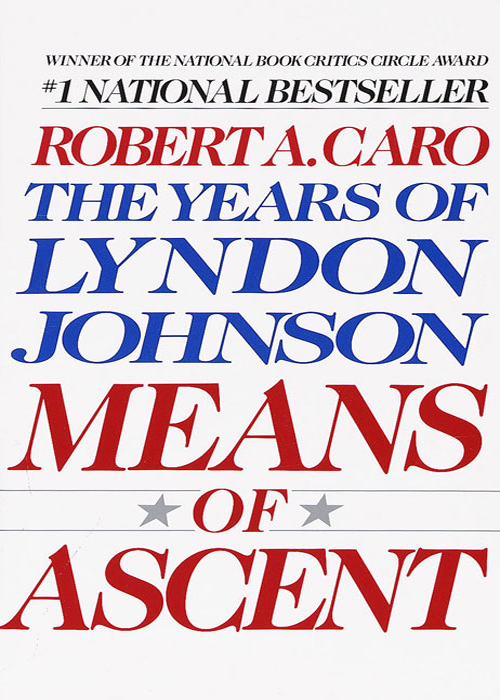
Means of Ascent: The Years of Lyndon Johnson II
About this book
After military service and years in the House, Johnson needs a Senate victory to escape political stagnation. His opponent Coke Stevenson represents a different Texas tradition and begins the campaign with the reputation and support to win.
Caro reconstructs money, media, helicopter campaigning, county machines, court challenges, and the late appearance of ballots from Box 13. The narrow result becomes a study in how procedure, influence, and endurance can turn defeat into office.
Means of Ascent is the second volume of The Years of Lyndon Johnson. It is shorter and more concentrated than the others, pairing Johnson's methods with a detailed portrait of the man he defeated.
Read a sample
5,166 words
Plain text
From the opening
INTRODUCTION Ends and Means
AS THE LONG LINE of limousines began to pull away from the White House in the darkness, the protesters were there, outside the gates, as they had been for weeks. Over their radios they had been listening to the latest bulletins from Selma, and they were singing “We Shall Overcome.”
It was a song of defiance—even as a hymn sung in black churches a century earlier it had contained the line “I do not yield”—and of demand: it had emerged from the churches into a broader sphere in October, 1945, during a strike in South Carolina by black women tobacco workers against a company that seemed too strong to be beaten; one day, after months of futile picketing, some of the women, surrendering, dropped off the picket line during a storm and went back to work; the others, to keep their courage up, began to sing in the rain, and suddenly one of them started singing the church song, adding two new lines—“We will win our rights” and “We will overcome.” After the strike ended—in victory—the hymn was kept alive (with “will” changed to “shall”) because two of the pickets attended a “folk school” in the mountains of Tennessee that had been founded to train labor and civil rights organizers, and taught the students its theme: “We shall overcome / We shall overcome / We shall overcome some day. / Oh, deep in my heart / I do believe / WE SHALL OVERCOME some day.” (It was in that school that a new verse was added—during a raid in which local deputy sheriffs forced the students to sit on the floor in the dark for hours while they smashed furniture and windows in a search for “subversive” materials. Sitting in the dark, one of the students, a terrified black high school girl, began to sing: “We are not afraid / We are not afraid / We are not afraid today.…”) In 1959, a white folk singer from the school taught it to the founding conference of the black Student Nonviolent Coordinating Committee, and led audiences in singing it at other civil rights rallies. Over the years, its tempo had been speeded up, but now the folk singer could feel the black audiences instinctively “tugging at the rhythm,” and “I thought I’d better stop playing my banjo and just let them sing”—and as they sang it, they slowed it back down to its original stately, solemn, powerful meter, appropriate to its mighty words.
Nineteen sixty was the year of the first sit-ins to desegregate department store lunch counters in Southern cities. The young, neatly dressed blacks, sworn to nonviolence, sitting on the counter stools were taunted in attempts to make them relinquish their seats. When the taunts failed, mustard and ketchup were poured on them, to mingle with the spit. Then they were pulled off the stools, and knocked to the floor, and kicked and beaten as they lay there. Police arrived, arrested them and flung them into paddy wagons. But they got their breath back, and as the wagons drove off, from their barred windows could be heard: “Deep in my heart / I do believe / We shall overcome some day.”
During the next years the hymn was sung at a thousand sit-ins, during a thousand “freedom rides.” A new verse, “We’ll walk hand in hand,” had been added, and that verse inspired a ritual: civil rights workers would cross their arms, and with each hand clasp the hand of the person standing next to them, and sway rhythmically as they sang. As the movement caught the conscience of Northerners, black hands were, more and more, clasping white, and there was another verse: “Black and white together.” The hymn was sung in triumph: on August 28, 1963, during the March on Washington which organizers had been afraid would be poorly attended, when the quarter of a million persons who had come to demand justice sent it thundering across the nation’s capital—that was the moment when it became the anthem of the civil rights crusade of the 1960s. And it was sung in sorrow: when, eighteen days later, the four little black girls were killed in the bombing of their church in Birmingham, Alabama. As the pallbearers came slowly down the steps of the church, carrying the four small coffins, at first the only sounds from the throng—not only local residents but an astonishingly large number of people who had come from other cities—were sobs. There was no signal, but suddenly, all at once, several people began singing, and over the sobs of mothers rose up the words: “We shall overcome some day.”
During the next summer—“Freedom Summer”—it was sung when the college students and the clergymen and the thousands of white men and women volunteers from the North were leaving to go down to Mississippi to try to win for black men and women the right to vote. (“The buses pulled up, and all belongings were piled aboard. But the kids refused to get aboard until we all stood in a large circle alongside one bus and sang ‘We Shall Overcome’ … with arms crossed, holding hands.… Then the departing kids got aboard.”) After their arrival in Mississippi, the volunteers heard it in unexpected places. “We were sitting on the steps at dusk, watching the sun folding into the flat country.… Cotton harvesters went by—and then the sheriff—and then a six-year-old Negro girl with a stick and a dog, kicking up as much dust as she could with her bare feet. As she went by, we could hear her humming to herself, ‘We Shall Overcome.’ ” It was sung that summer on the hot, sweaty nights in Mississippi’s black churches, thirty-seven of which were bombed or burned that year. (“Tonight, at our mass meeting, as we were singing ‘We Shall Overcome,’ a girl was shot in the side and in the chest. We fell to the floor in deadly fear …”) It was sung by the volunteers when they were being beaten, and Viola Liuzzo was singing it in the moment she was killed. And it sustained them. “I know the drudgery, the dangers and the disappointments,” a college student wrote her worried parents. “I know what it’s like to be so exhausted you feel as though you will drop.… Yet I also know what it’s like to sing ‘We Shall Overcome’ with two hundred others till you think the roof will explode off the church.” Wrote another volunteer: “Finally we stood, everyone, crossed arms, clasped hands and sang ‘We Shall Overcome.’ Ending every meeting of more than a half dozen with it, we sang out all fatigue and fear, each connected by this bond of hands to each other.… Together we were an army.” Wrote another: “And then [we were] singing our freedom song, ‘We shall overcome, we shall overcome …’ We all joined hands and sang.… We sang with all our hearts—’Justice shall be done … we shall vote together … we shall live in freedom.…’ ”
Continue reading the sampleClose the sample
And now, in March, 1965, the church song that had become the mighty battle hymn of the civil rights crusade had swelled to a new crescendo, for March, 1965, was the month of Selma, Alabama—of the Edmund Pettus Bridge and the long line of black men and women and children pledged to nonviolence marching toward the phalanx of troopers in gas masks and helmets, carrying guns and clubs, and, thanks to television, an entire nation had seen the swirling clouds of the tear gas, and, through the tear gas, the billy clubs swinging, and thudding as they struck, and then the mounted deputies spurring their horses forward and uncoiling their bullwhips. An entire nation had heard the screaming begin—and, as loud as the screaming, the cheers from white onlookers. That had been on Sunday, March 7. Two days later, when a club had smashed in his skull, the Reverend James J. Reeb of Boston became the second man killed—Jimmie Lee Jackson had been shot on February 18 in a nearby town—as a result of the Selma demonstrations. “Rarely in history,” Time magazine reported, “has public opinion reacted so spontaneously and with such fury.” That week, when a Jewish synagogue in Boston held a memorial service for Reeb, the congregation softly hummed “We Shall Overcome” as the rabbi recited the Mourner’s Kaddish for the dead. The hymn was sung in Detroit, where the Governor joined the Mayor and ten thousand marchers, and in parades in scores of other Northern cities, and it was sung in Selma, by hundreds of white clergymen (“Black and white together / Black and white together / Black and white together some day …”) who had come from all across America in answer to Martin Luther King’s call for help. And, of course, it was sung—over and over, all during that week—in Washington, in front of the White House, for if it was a hymn of demand and defiance, the demands the civil rights movement was making could, its leaders felt, ultimately be met only through the power and the leadership of the President, Lyndon Baines Johnson, who, at the same time, was a target of their defiance.
During the sixteen months since he had taken the oath of office as thirty-sixth President of the United States, Lyndon Johnson had done much for civil rights—including pushing through to passage a civil rights bill in 1964—but, in the view of most of the movement, he hadn’t done nearly as much as he should have.
What were they asking for, after all, protesters felt, but the most basic right of citizenship under a constitutional government—the right to vote? It was ninety-five years since the Fifteenth Amendment to the Constitution had supposedly guaranteed that right, and they still didn’t have it. Of the five million blacks in the South old enough to vote, the overwhelming majority were still not registered. The figures in Selma were typical for a small Southern town: out of 14,000 whites, 9,300 were registered; out of 15,000 blacks, 325. Despite the President’s promises of progress, little progress was being made. His Justice Department had filed lawsuits, as had the Justice Department of his predecessor, John F. Kennedy, but the suits had been drifting along at a painfully slow pace. That very week, as it happened, the protesters outside the White House, leafing through the Washington Post, read that thus far in 1965 three out of every four blacks who had applied for voter registration in Selma had been turned down. For months after the passage of the 1964 law, even after its inadequacies had been demonstrated, President Johnson had let civil rights leaders know that he didn’t think it wise to press for another bill so soon. Now, with the violence raging in Alabama, Johnson had let them know he would address a special joint session of Congress on Monday, March 15, and had promised them that in the address he would submit a voting-rights bill, a bill that would be stronger, but while some—a growing number, in fact—of the leaders who had met with the President personally were telling their colleagues that they believed in Lyndon Johnson’s commitment to their cause, this belief was not widespread.
Worst of all, in the view of most civil rights protesters—most damaging proof of the President’s lack of sincerity—he wasn’t even protecting the marchers in Alabama. When Jimmie Lee Jackson had been murdered, Martin Luther King had said, “He was murdered by the timidity of the federal government that … cannot protect the rights of its own citizens seeking the right to vote.” Now almost a month had passed since Jackson’s death, a month of beatings and savagery—and the federal government, Lyndon Johnson’s government, was still not protecting the marchers. Six days had passed now since Reverend Reeb had been killed, and there was still no one to protect the clergymen who had come to take Reeb’s place. For almost four months, since the first marches in Selma had begun, black leaders had been pleading with the President to federalize the Alabama National Guard, or to send in regular Army troops—to do something to protect the demonstrators from the bullwhips and the clubs. Most of them had felt all along that Johnson wouldn’t help; that was why King had called for the clergy. As his assistant Andrew Young had put it: “We didn’t think they would send in the National Guard to protect black people. So we sent out a call to people of good will.” And indeed Johnson hadn’t helped. On Saturday, Alabama’s Governor, George C. Wallace, had come to the White House to confer with him, and newspapers were reporting that the President had been very tough with Wallace—but the fact remained: the Alabama Guard was not federalized.
Not only did the protesters distrust his policies, many of them distrusted him. Although some civil rights leaders were now convinced of Lyndon Johnson’s good faith, others were not, for they remembered his record—not the short record but the long one. He had been a Congressman, beginning in 1937, for eleven years, and for eleven years he had voted against every civil rights bill—against not only legislation aimed at ending the poll tax and segregation in the armed services but even against legislation aimed at ending lynching: a one hundred percent record. Running for the Senate in 1948, he had assailed President Truman’s entire civil rights program (“an effort to set up a police state”). In the Senate, his maiden speech had been the lead-off address in a Southern filibuster against an attempt to impose cloture on debate and thus make passage of civil rights legislation possible. “We of the South,” Lyndon Johnson had said, know that “cloture is the deadliest weapon” against the rights of a minority such as the South, and he, he had made clear, was part of that minority. At the conclusion of his eloquent, closely reasoned, ninety-minute-long defense of the filibuster, the Southern Senators, many aging now, had lined up at Lyndon Johnson’s desk to congratulate this new recruit to their cause. The first person in line had been the Southerners’ patriarch and leader, Richard Brevard Russell of Georgia, who later told reporters that Johnson’s speech had been “one of the ablest I ever heard on the subject.” Subsequently, the young Senator from Texas had been raised to the leadership of his party in that Senate by the Southern bloc, as the young hope of those aging men in their grim, last-ditch fight to preserve segregation. Until 1957, in the Senate, as in the House, his record —by that time a twenty-year record—against civil rights had been consistent. And although in that year he oversaw the passage of a civil rights bill, many liberals had felt the compromises Johnson had engineered to get the bill through had gutted it of its effectiveness—a feeling that proved correct. And constantly reminding them of Johnson’s record, of course, was Johnson’s accent, which was the slow drawl of the South; when Lyndon Johnson said “Negroes,” for example, it came out, despite all that speech coaches could do, as “Nigroes,” close to “niggers.” And if, nonetheless, some of the leaders who had recently met with Lyndon Johnson were convinced he had changed, this feeling had not spread to the ranks: no matter how strong his words, most of the marchers outside the White House didn’t believe he meant them; in the view of many, his actions—or lack of action—during this past terrible month had proven he didn’t mean them. If, after years of opposition, he was in alliance with them now, they believed the alliance was reluctant, grudging. Very few of the tens of thousands—hundreds of thousands—of men and women, black and white, in the American civil rights movement believed Lyndon Johnson was wholeheartedly on their side. So now, on Monday, March 15, 1965, pickets had been marching in front of the White House for the eight days since the Edmund Pettus Bridge, walking in a long oval formation along the sidewalk outside the tall black wrought-iron fence that guarded the broad lawn that led to the Executive Mansion, carrying signs demanding that Lyndon Johnson take action, and singing. And the previous day, a Sunday on which churches across the country held services in memory of Reverend Reeb, fifteen thousand protesters had held a rally in Lafayette Park, across Pennsylvania Avenue from the White House, to protest “federal inaction”—Johnson’s inaction, ultimately—“in the Alabama racial crisis.” The rally ended with the singing of “We Shall Overcome.” On the White House lawn, 350 Washington policemen formed a human wall reinforcing the wrought-iron wall, with White House guards and Secret Service men deployed behind them, but the mighty hymn could be heard clearly inside the White House, as could the words of a chant the protesters had adopted: “LBJ, just you wait / See what happens in ’68.” Speakers at the rally assailed his promises—“President Johnson’s words are good, but they remain just that: words,” one said—and his performance. His Administration, another speaker said, “has told the same old story in the Selma crisis. The minute there’s violence, the Administration announces it’s powerless to deal with it.” There was little feeling in that crowd that Lyndon Johnson had any deeper commitment to its cause than he had shown in the past, so that the words “We shall overcome,” sung outside the White House, were saying, in effect, that the cause would manage to win even without him. And now, on the evening the limousines were pulling away from the White House, the pickets were singing “We Shall Overcome.”
Inside the fourth in the line of long, black vehicles that headed for the South gates, away from the pickets, a long double line of motorcycle outriders moving out ahead, Lyndon Johnson sat in the back seat, facing three of his assistants, his huge ears, outsized nose and jutting jaw accentuated by the light from the reading lamp behind him as he bent over a black looseleaf notebook containing the speech he was about to give to Congress. His massive bulk—he was more than six feet three inches tall, and weighed about 230 pounds—and the fierceness of the concentration with which he bent over the notebook and of the way his big hands snatched for the next page while he was still reading the one before it seemed to fill the car. He had entered the limousine without a word of greeting, and had immediately opened the notebook for a last-minute study of the speech. He said not a word during the ride to the Capitol. His eyes didn’t look up from the notebook as the limousine passed the White House gates—with the pickets singing “We Shall Overcome” as if to tell him to his face, If you won’t help us, we’ll win without you. But one of the assistants riding with him had worked for him for almost twenty years, and saw his expression, and knew what it meant. “He heard,” Horace Busby recalls.
WITH ALMOST the first words of his speech, the audience—the congressmen and Senators with whom he had served, the Cabinet members he had appointed, the black-robed Justices of the Supreme Court, the Ambassadors of other nations, a few in robes of far-off countries as if to dramatize that the world as well as America was listening, the packed galleries rimming him above—knew that Lyndon Johnson intended to take the cause of civil rights further than it had ever gone before. “At times history and fate meet at a single time in a single place to shape a turning point in man’s unending search for freedom,” the President said. “So it was at Lexington and Concord. So it was a century ago at Appomattox. So it was last week in Selma, Alabama.”
He would submit a new civil rights bill, Johnson said—the Congress would have it before them that week—and it would be far stronger than the bills of the past. The strength of those bills had been diluted by compromise, he said, by compromise and delay; in the case of the last bill, just a year before, by a Southern filibuster which it took liberal forces eight months to overcome. In the minds of many in his audience as he spoke was the fact that he himself, on the previous bills, had often led the forces of compromise. “This time, on this issue,” he said now, “there must be no delay, no hesitation and no compromise.” But still no one among those Senators, congressmen, Justices, Ambassadors, not even the most perceptive, knew how far he was really going to go—for none of them could have predicted the words to come.
By submitting the bill, Johnson said, he was fulfilling the formal purpose of his appearance before them, but it was not merely a bill that he wanted to talk about. “Even if we pass this bill,” the President said, “the battle will not be over. What happened in Selma is part of a far larger movement which reaches into every section and state of America. It is the effort of American Negroes to secure for themselves the full blessings of American life.”
There was the briefest pause, as if he were gathering himself, and over his face came a look that the public, thus far in his presidency, had seldom seen, so careful had he been to wear a mask he considered statesmanlike and dignified. The eyes narrowed a little, and the jaw jutted, and the mouth, barely keeping itself from a snarl, hinted at it, and the tens of millions of people watching on television were looking into a face that many of those in the audience in the Capitol knew already—the face of a Lyndon Johnson determined to win.
“Their cause must be our cause, too,” Lyndon Johnson said. “Because it is not just Negroes, but really it is all of us, who must overcome the crippling legacy of bigotry and injustice.”
Briefly, he paused again. He always had so much trouble in his speeches with the emphasis on the words, but he got it right this time. The next four words fell like sledgehammers.
“And we shall overcome.”
There was a moment of silence, as if, one observer was to say, it took a moment for the audience to realize that the President had adopted the rallying cry of black protest as his own, had joined his voice to the voices of the men and women who had sung that mighty hymn. And then the applause rolled across the Chamber.
And there were testimonies to the power of that speech even more eloquent than that applause. One took place in the living room of a local family in Selma, Alabama, where Martin Luther King and several of his aides were watching the speech on television. During all the years of struggle, none of his aides had ever seen Dr. King cry. When Johnson said “We shall overcome,” they looked over to their leader to see his reaction. So they were looking when Martin Luther King began to cry.
Another testimony took place on the motorcade’s return to the White House. As the limousines slowed to turn into the White House gates, the turn was made in silence.
The pickets were gone.
AFTER HE HAD STEPPED DOWN from the dais and was making his way out through the crowded center aisle of the House, accepting congratulations on his speech from Senators and congressmen who pressed forward to shake his hand, Lyndon Johnson had a few more words to say, to an audience of one: Emanuel Celler, the seventy-six-year-old chairman of the House Judiciary Committee.
While he was shaking Celler’s hand, Johnson told him, with a friendly, boyish grin which he had found effective with the older man, that the formal draft of the voting-rights legislation would be ready in no more than two days, but that it would not be necessary for Celler’s committee to wait even that long to begin its work on the measure. “Manny,” he said, “I want you to start hearings tonight.”
“Mr. President,” Celler protested, “I can’t push that committee or it might get out of hand. I’m scheduling hearings for next week.”
In the midst of the crowd, Johnson’s eyes narrowed, and his face turned harder. His right hand was still shaking Celler’s, but the left hand was up, and a finger was out, pointing, jabbing. “Start them this week, Manny,” he said. “And hold night sessions, too.”
Celler did. In the Senate, the South staged an angry filibuster, but with Johnson using pressure and persuasion (civil rights leader James Farmer, seated in the Oval Office, heard the President “cajoling, threatening, everything else, whatever was necessary”), the bill was passed—its key provisions intact—with remarkable speed. And even before it was passed, the march from Selma to Montgomery had taken place. Segregationists lined the route again, but this time no one dared rush forward to strike a marcher. Standing between the hostile onlookers and the long line of black men and women and children were the FBI agents, and the federal marshals, and the National Guard troops and the regular-Army troops that Lyndon Johnson had sent, to make sure that no one would.
ABRAHAM LINCOLN struck off the chains of black Americans, but it was Lyndon Johnson who led them into voting booths, closed democracy’s sacred curtain behind them, placed their hands upon the lever that gave them a hold on their own destiny, made them, at last and forever, a true part of American political life. He was to call the passage of the Voting Rights Act of 1965 his “greatest accomplishment,” and the speech in which he presented that Act to Congress with the ringing words that touched a nation’s conscience was indeed the high-water mark of the tides of social justice in his Administration. And there remain other legislative monuments to the accomplishments of the President who figuratively linked his arms with the arms of civil rights crusaders and clasped their hands in his; during the five years of the Johnson Presidency, great strides were made toward ending discrimination in public accommodations, and strides, if not great at least the first, toward ending discrimination in education, employment, even in private housing. Thurgood Marshall, a black face at last above the black robes of the High Court, through appointment by Lyndon Johnson, was speaking not of his own advancement but of that of his people when he said: “Thank you, Mr. President. You didn’t wait for the times. You made them.” In other areas of domestic social welfare as well, Johnson rammed to passage laws of which liberals had dreamed for decades: sixty separate education laws for the young and the poor; legislation that provided medical care for the aged and the poor. His “War on Poverty” was not crowned with triumph like his war on prejudice. Many of the laws he rushed through Congress in such unprecedented numbers—in a frenzy of legislation—as if, it sometimes seemed, he equated speed and quantity with accomplishment, were inadequately thought through, flawed, contradictory, not infrequently exacerbating, at immense cost, the evils they were intended to correct. But his very declaration of that war was a reminder—as was his overall concept of a “Great Society”—of government’s responsibility to do more than stand idly by without at least attempting to strike blows against ignorance and disease and want. The presidency of Lyndon Johnson marked the legislative realization of many of the liberal aspirations of the twentieth century: in storming, on behalf of those laws, long-held bastions of congressional hostility to social-welfare programs, he used the power of the presidency for purposes as noble as any in American history.
But the fight for social justice was only one aspect of the presidency of Lyndon Johnson. In April, 1965, not a month after his Voting Rights speech, protesters were back outside the White House again. And this time, when they sang “We Shall Overcome,” there was a new verse: “We shall live in peace.”
Protesters outside the White House—every day, it seemed, month after month, year after year, for all the remaining forty-five months of his Administration. Flags outside the White House, and across Pennsylvania Avenue in Lafayette Park—not American flags but the flags of the enemy. Chants outside the White House: “Ho ho ho, Ho Chi Minh—the NLF is gonna win.” Clenched fists against the Washington sky. Little flickers of flame as darkness fell—not the candles of earlier “vigils” for civil rights and peace, but burning draft cards. When civil rights protesters had sung “We Shall Overcome” outside the White House in 1965, they had sung it in defiance and demand, but when the hymn was sung now by protesters against the Vietnam War—sometimes the protesters were the same, so closely intertwined were the civil rights and anti-war movements—there was a new overtone to it, and the overtone was hatred. Before Lyndon Johnson’s civil rights speech of March, 1965, the singers had in effect been saying to the President, we’ll win even without your help; by 1966 and 1967 and 1968, they were saying, we’ll win even though you oppose us. In 1965 Lyndon Johnson had been, in their eyes, a reluctant ally; by the end of his presidency he was the enemy to be overcome—a difference shown more clearly by other songs the protesters sang (“Waist deep in the Big Muddy / And the big fool says to push on. / Waist deep! Neck deep! / And the big fool says to push on”) and by the signs they carried (“Hitler Is Alive—in the White House”) and by the chants they chanted: “War criminal! War criminal! War criminal!”—and by one chant in particular, a chant that had become the battle cry of the anti-war movement: “Hey! Hey! LBJ! How many kids did you kill today?” New police regulations had recently limited the number of pickets allowed to parade on Pennsylvania Avenue, but there were still enough so that their chant could be heard inside the White House, and Lyndon Johnson heard it—and, of course, since it was being chanted constantly in anti-war rallies and parades across the country, he also heard it as he watched the television newscasts, night after night: “Hey! Hey! LBJ! How many kids did you kill today?” He would never forget it. In his retirement, at his ranch, during the silence of the nights in the lonely Hill Country of Texas, it still rang in his mind. He would sit and talk at the ranch of “young people by the thousands … chanting … about how many kids I had killed that day.” He would talk of them chanting “that horrible song.”