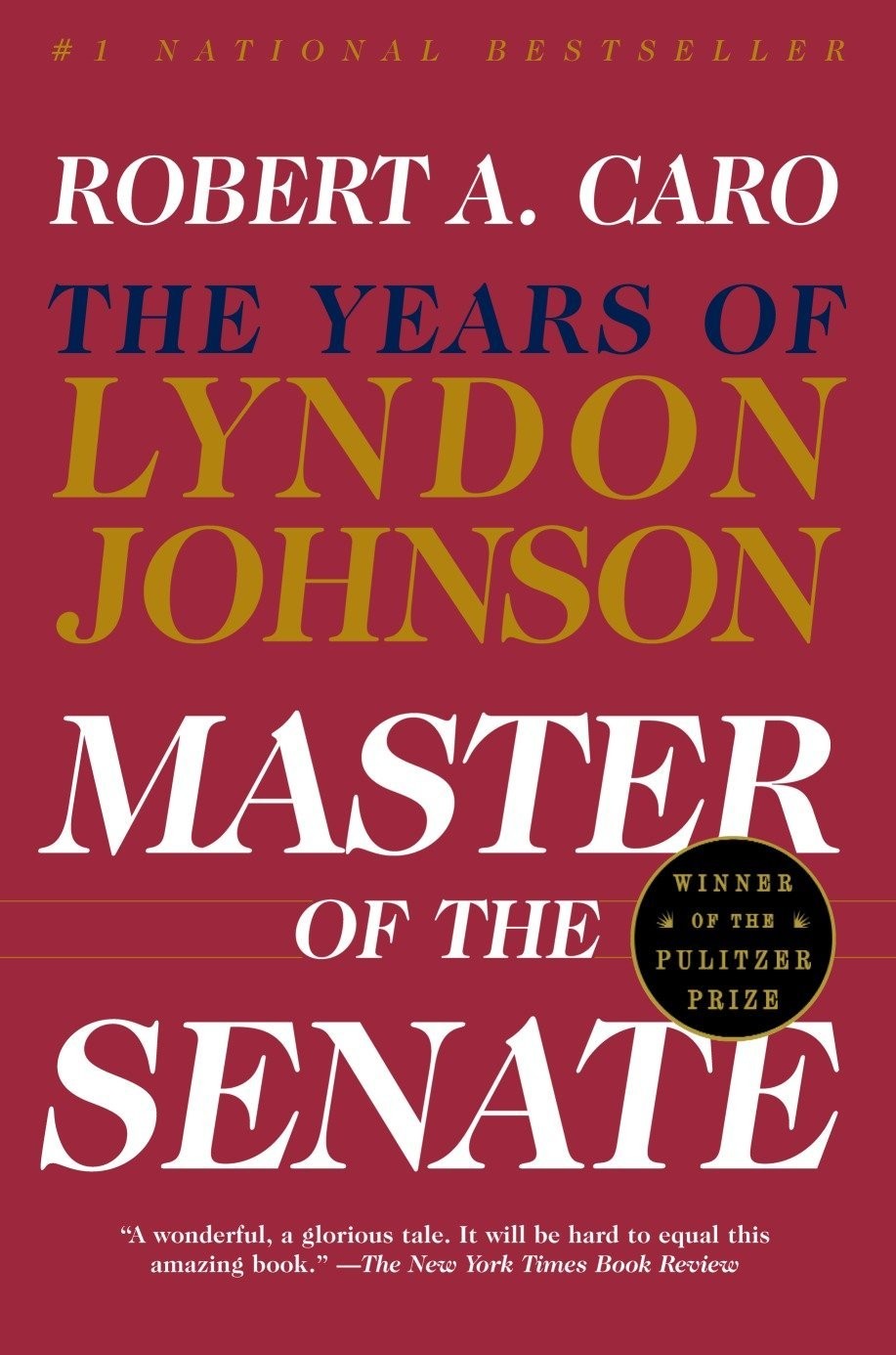
Master of the Senate: The Years of Lyndon Johnson
About this book
The book first explains the Senate Johnson entered: an institution of seniority, committees, courtesy, and southern control. Its customs could protect deliberation, but they could also keep civil-rights bills from ever receiving a vote.
Johnson studies every lever—assignments, schedules, favors, information, humiliation, and personal need. As majority leader he turns procedural mastery into power unmatched by his predecessors, then directs it toward the Civil Rights Act of 1957.
Master of the Senate is the third volume of The Years of Lyndon Johnson. Caro's scale allows political tactics, institutional history, and the lives affected by federal inaction to occupy the same account.
Read a sample
5,036 words
Plain text
From the opening
INTRODUCTION The Presence of Fire
When you come into the presence of a leader of men, you know you have come into the presence of fire; that it is best not incautiously to touch that man; that there is something that makes it dangerous to cross him.
—WOODROW WILSON
THE ROOM on the first floor of the Barbour County Courthouse in the little town of Eufaula, Alabama, was normally the County Clerk’s Office, but after it had closed for the day on August 2, 1957, it was being used by the county’s Board of Registrars, the body that registered citizens so they could vote in elections—not that the Board was going to register any of the three persons who were applying that day, for the skin of these applicants was black.
It was not a large room, and it was furnished very plainly. Its walls, white and in need of a fresh coat of paint, were adorned only by black-and-white photographs of former county officials. Against the rear wall stood a row of battered old filing cabinets that contained records of deeds and mortgages and applications for driver’s licenses, and in front of the cabinets were six small, utilitarian gray metal office desks, each with a small, worn chair. Then there was a waist-high wooden counter at which people doing business with the County Clerk’s Office usually stood. Today, the three registrars were standing behind the counter, and the applicants were standing in the bare space in front of it. No one offered them a chair, and the registrars didn’t bother to pull up chairs for themselves, because the hearing wasn’t going to take very long.
Trying to register to vote took courage for black people in Alabama in 1957, even when physical intimidation or violence wasn’t employed to discourage them—as it often was. Everyone knew about black men who had registered and who shortly thereafter had been told by their employers that they no longer had a job, or about black farmers who, the following spring, went to the bank as usual for their annual “crop loan”—the advance they needed to buy the seed for the crop they were planning to plant that year—only to be informed that this year there would be no loan, and who had therefore lost their farms, and had had to load their wives and children into their rundown cars and drive away, sometimes with no place to go. Indeed, David Frost, the husband of Margaret Frost, one of the three applicants that August day, would never forget how, after he himself had registered some years before, a white man had told him that “the white folks are the nigger’s friend as long as the nigger stays in his place,” but that “I had got out of my place if I was going to vote along with the white man,” and how, for months thereafter, instead of calling him “David” or “Boy” as they usually did, white people called him by the word he “just hated, hated”: “Nigger”—pronounced in Alabama dialect, “Nigra”—and how, when they learned he was planning to actually vote, a car filled with men had stopped in front of his house one night and shot out the porch lights, and how, cowering inside, he had thought of calling the police, until, as the car drove away, he saw it was a police car.
And of course there was the humiliation of the registration hearings themselves. Many county Boards of Registrars required black applicants to pass an oral test before they would be given the certificate of registration that would make them eligible to vote, and the questions were often on the hard side—name all of Alabama’s sixty-seven county judges; what was the date Oklahoma was admitted to the Union?—and sometimes very hard indeed: How many bubbles in a bar of soap?
The Barbour County registrars used a less sophisticated technique. They asked more reasonable questions—the names of local, state, and national officials—but if an applicant missed even one question, he would not be given the application that had to be filled out before he could receive a certificate, and somehow, even if a black applicant felt sure he had answered every question correctly, often the registrars would say there was one he had missed, although they would refuse to tell him which it was. Margaret Frost had already experienced this technique, for she had tried to register before—in January of 1957—and forty years later, when she was an elderly woman, she could still remember how, after she had answered several questions, the Board’s chairman, William (Beel) Stokes, had told her she had missed one, adding, “You all go home and study a little more,” and she could still remember how carefully blank the faces of Stokes and his two colleagues had been, the amusement showing only in their eyes.
Nonetheless, despite the humiliation of her earlier hearing in the County Clerk’s Office, Mrs. Frost—a soft-spoken woman of thirty-eight—had returned to that dingy room to stand in front of that counter again. “I was scared I would do something wrong,” she recalls. “I was nervous. Shaky. Scared that the white people would do something to me.” But, she says, “I wanted to be a citizen,” truly a part of her country, and she felt that voting was part of being a citizen. “I figure all citizens, you know, should be able to vote.” In the months since January, she had, with her husband asking her questions, studied, over and over, all the questions she felt the Board might ask, until she thought she would be able to answer every one. And on August 2, she put on her best clothes and went down to the courthouse again.
Continue reading the sampleClose the sample
As it turned out, however, the diligence with which Margaret Frost had studied turned out to be irrelevant, because the Board examined her and the two other applicants as a group, and one of them wasn’t as well prepared as she.
When she asked Stokes for an application, he said, “There’s twelve questions you have to answer before we give you an application.” He asked just two. Mrs. Frost answered them both correctly, as did one of the other applicants. But the third applicant answered the second question incorrectly, and Stokes told them that therefore they had all failed. “You all go home and study a little more,” he said.
MARGARET FROST left the room quietly, and she never sued or took any other legal action to try to force the Board to register her. Doing so, however, would almost certainly not have helped. In August, 1957, black Americans in the South who were denied the right to vote, and who asked a lawyer (if they could find a lawyer who would take their case) what law would assist them to do so, were informed that there was no such law—and that information was accurate. Summarizing the situation, a study made that same year by the United States Department of Justice concluded that “There is no adequate legal remedy” for a person who had been denied a registration certificate by a county Board of Registrars.
The scene that had occurred in the Eufaula courthouse was not an unusual one in the American South in 1957. After the Civil War almost a century before, there had been an attempt to make black Americans more a part of their country, to give them the basic rights of citizens—which included, of course, a citizen’s right to vote—and in 1870, the Fifteenth Amendment to the Constitution had supposedly guaranteed that right, forbidding any state to “deny or abridge” the “right of citizens … to vote” because of their race or color. But the amendment proved to be an insufficient guarantee in the eleven southern states that had seceded from the Union and formed the rebel Confederacy; specific laws to give the amendment force and make it meaningful—federal laws, since there was no realistic possibility that any southern state would pass an effective statute—were going to be necessary. During the eighty-seven years since the Fifteenth Amendment had been ratified, scores, indeed hundreds, of proposed federal laws had been introduced in the Congress of the United States to ensure that black Americans would have in fact as well as theory the right to vote. Not one of these bills had passed. And in Barbour County, in which there were approximately equal numbers of black Americans and white Americans, out of 7,158 blacks of voting age in 1957, exactly 200—one out of thirty-five—had the right to vote, while 6,521 whites had that right. In Alabama as a whole, out of 516,336 blacks who were eligible to vote, only 52,336—little more than one out of ten—had managed to register. For the eleven southern states as a whole, out of more than six million blacks eligible to vote, only 1,200,000—one out of five—had registered. And of course, even those blacks who had registered to vote often didn’t dare go to the polls to cast ballots, because of fear of violence or economic retaliation. In 1957, there were scores of counties in the South which had tens of thousands of black residents, but in which, in some elections, not a single vote had been cast by a black.
THE ROOM in another city eight hundred miles to the northeast—in Washington, D.C.—was hardly more impressive than the Eufaula County Clerk’s Office. It was L-shaped, and the short leg of the L was lined with telephone booths only slightly larger than conventional booths and distinguished from them only by a small light bulb above each one that was lit when the booth was in use. The other leg—the main part of the room—was narrow and drab, its two long walls a pale tan in color and undecorated except for a few black-and-white lithographs and dull green draperies. Aside from a rickety little desk and a small fireplace on the right wall and a pair of swinging doors on the left, both walls were lined with couches and armchairs covered in cracked brown leather, and they were set so close together that their arms almost touched. On the room’s far wall, however, was a feature that didn’t fit in with the rest of the furnishings: a huge mirror. Twice as tall as a man and wide enough to fill almost the entire wall, bordered in a broad frame of heavy gold leaf, it was a mirror out of another age, a mirror large enough for a man to watch as he swirled a cloak around himself and to check the way it sat on his shoulders—or, having removed the cloak and handed it to a waiting pageboy, to check every detail of his appearance before he pushed open those swinging doors. And when those doors swung open, suddenly, framed between them in the instant before they swung shut again, were long arcs of darkly glowing mahogany, semi-circles of desks whose deep reddish-brown surfaces had been burnished so highly that they gleamed richly with the reflection of lights in the ceiling high above them. There were ninety-six desks. The narrow room, drab though it was, was one of the cloakrooms, the Democratic cloakroom, of the United States Senate.
The cloakroom was generally rather empty, a comfortable, comradely place whose manners as well as furniture resembled those of a men’s club (the only woman among the ninety-six senators was a Republican), a place of handshaking and backslapping and bluff camaraderie; a sleepy place—literally sleepy, since among the dozen or so senators present on a typical afternoon, several elderly men might be taking naps in the armchairs. In that August of 1957, however, the cloakroom was often crowded, with senators talking earnestly on sofas and standing in animated little groups, and sometimes the glances between various groups were not comradely at all—sometimes, in fact, they glinted with a barely concealed hostility, and the narrow room simmered with tension, for the main issue before the Senate that summer was civil rights, a proposed law intended to make voting easier for millions of black Americans like Margaret Frost, and the liberals among the Democratic senators were grimly determined to pass that law, and the southerners among the Democrats were grimly determined that it should not be passed.
The liberals in the Democratic cloakroom—the majority cloakroom; there were forty-nine Democratic senators in 1957 and forty-seven Republicans—included some of the great figures of the fight for social justice in America in the middle of the twentieth century. Among them was Hubert Horatio Humphrey of Minnesota, who as a crusading young mayor had courageously fought not only underworld gambling interests but the racial and religious bias that had made Minneapolis “the anti-Semitism capital of America”—one of the mightiest orators of his generation, he had, in the face of warnings that he was fatally damaging his career, delivered one of the most memorable convention addresses in the nation’s history, a speech that roused the 1948 Democratic National Convention to defy the wishes of its leaders and adopt a tough civil rights plank. Among the other liberals in the cloakroom were white-maned Paul Douglas of Illinois, war hero and renowned professor of economics, who had battled for rights for black Americans on a dozen fronts with the same unwavering independence with which he had taken on Chicago’s rapacious public utilities and corrupt political machine, and Estes Kefauver, who had won his Senate seat by defeating Tennessee’s notorious, venal—and racist—Crump Machine. Among them, too, was a younger senator who would become a great figure: John Fitzgerald Kennedy of Massachusetts.
With the exception of Kennedy, the names of these senators, and of others, too—Wayne Morse of Oregon, Stuart Symington of Missouri, Frank Church of Idaho, Henry (Scoop) Jackson of Washington—would be all but forgotten forty years later, when this book was being written, so exclusively had the history of America come to be thought of in terms of America’s Presidents, but in 1957, these men were icons of the liberal cause. In their ranks were eloquent orators, profound believers in social justice, senators of principles and ideals. Their ranks included senators who had long stood staunchly for the rights of man. And now, in 1957, these heroes of liberalism were united behind the latest civil rights bill, all of them determined that this year, at last, a civil rights bill would be passed.
Yet, eloquent though they were, courageous and determined though they were, honorable as their motives may have been, these men had been eloquent, courageous, determined and honorable in many previous fights for civil rights legislation, and each time they had lost. If, for eighty-seven years, every attempt to enact federal voting rights legislation had been blocked in Congress, most of the more significant of these bills had been blocked in the Senate, for it was in the Senate that the power of what had come to be called the “Southern Bloc”—the congressional delegations from the eleven former Confederate states—was strongest. And the situation was virtually the same with the Fourteenth Amendment, which had been passed two years before the Fifteenth—in 1868—supposedly to guarantee black Americans “the equal protection of the law” in areas of life outside the voting booth. During the intervening decades, generations of senators committed to the rights of black Americans—Progressives, reformers, liberals; from Charles Sumner of the mid-nineteenth century to Herbert Lehman of the mid-twentieth—had attempted to pass laws that would make that amendment effective. Hundreds of pieces of legislation had been proposed—bills to give black Americans equality in education, in employment, in housing, in transportation, in public accommodations, as well as to protect them against being beaten, and burned, and mutilated—against the mob violence called “lynching.” Exactly one of those bills had passed—in 1875—and that lone statute had later been declared unconstitutional. It was not, therefore, only in the area of voting rights that black Americans had been denied the help of the law. No civil rights legislation of any type had been written permanently into the statute books of the United States since the ratification of the Fifteenth Amendment. And, despite the determination that this latest generation of liberal senators had displayed in the civil rights battles they had waged in recent years, not only had they been unable to reach their goal, they were not getting closer to it; rather, it was receding from them. In the last battle—in the previous year, 1956—not only had a civil rights bill been crushed in the Senate, it had been crushed by a margin greater than ever before.
In this summer of 1957, it seemed all but certain that the liberals—and the black Americans like Margaret Frost for whom they were fighting—were going to lose again. Among Democratic senators, it was not the liberals who held the power in the Senate; it was the senators who stood in their own, separate groups: the southerners. Of the eight most powerful Senate committees, the southerners held the chairmanships of five; another was held by a dependable ally of the South. And the southerners were led by a senator, Richard Brevard Russell of Georgia, who during a quarter of a century in the Senate had never lost a civil rights fight, a legislative strategist so masterful that he had, in long years of uninterrupted victory, been called the South’s greatest general since Robert E. Lee. Russell was a senator whose name is also all but lost to history, so that most Americans touring Washington today hardly know for whom the “Russell Senate Office Building” is named, but during his years in the Senate he was a figure so towering that an admiring journalist would recall years later, “Back then, when the U.S. got into trouble and Truman or Ike or Kennedy asked for help, Russell would gather up his six-foot frame, stick a forefinger into his somber vest and amble down those dim corridors to see if he could help his country. Everybody watching felt better when he arrived.”
• • •
IN THE CLOAKROOM AS WELL, however, standing near its center, the focus of activity in it, was another senator, the Democratic Leader and hence the Senate’s Majority Leader, Lyndon Baines Johnson.
He was not a member of the liberal faction, far from it. His state, Texas, had been one of the eleven Confederate states, and his accent was often (not always, for his accent changed depending on whom he was talking to) the same syrupy southern drawl as that of the Barbour County registrar, and he used many of the same words and phrases—including the word that David Frost hated; Lyndon Johnson was, in fact, using that word a lot in the Democratic cloakroom that Summer. “Be ready to take up the goddamned nigra bill again,” he told one of the southern senators, Sam Ervin of North Carolina. Walking over to a group of southerners, he told them there was no choice but to take it up, and to pass at least part of it. “I’m on your side, not theirs,” he told them. “But be practical. We’ve got to give the goddamned niggers something.” “Listen,” he told James Eastland of Mississippi, who was anxious to adjourn for the year, “we might as well face it. We’re not gonna be able to get out of here until we’ve got some kind of nigger bill.”
Johnson’s voting record—a record twenty years long, dating back to his arrival in the House of Representatives in 1937 and continuing up to that very day—was consistent with the accent and the word. During those twenty years, he had never supported civil rights legislation—any civil rights legislation. In Senate and House alike, his record was an unbroken one of votes against every civil rights bill that had ever come to a vote: against voting rights bills; against bills that would have struck at job discrimination and at segregation in other areas of American life; even against bills that would have protected blacks from lynching. His first speech in the Senate—a ringing defense of the filibuster that was a key southern tactic—had opened with the words “We of the South,” and thereafter, as this book will demonstrate, he had been not merely a member of the Senate’s southern anti-civil rights bloc, but an active member; not merely one of the senatorial “sentries” whom Richard Russell deployed on the floor to make sure that the liberals could not sneak a bill through (although he was a vigilant sentry), but one of the South’s strategists. He had been raised to power by the Southern Bloc, had been elected Democratic Leader through its support. He was, in fact, the protégé, the anointed successor, of the bloc’s great general, the senator Richard Russell had chosen to carry its banner when he himself should one day be forced to lay it down.
Johnson’s methods, moreover, were different from the methods of the liberals, not a few of whom disliked and deeply distrusted him. They spoke of principles and ideals—the traumas of his youth had made him despise men who spoke in such abstractions; calling them “crazies” and “bomb-throwers,” he cut off their attempts to move conversations to high ground by saying, “It’s not the job of a politician to go around saying principled things.” While they spoke of kindness, compassion, decency, he had already displayed a pragmatism and ruthlessness striking even to Washington insiders who had thought themselves calloused to the pragmatism of politics. While the Douglases and Humphreys spoke of truth and honor, he was deceitful, and proud of it: at that moment, in the Democratic cloakroom, as he talked first to a liberal, then to a conservative, walked over first to a southern group and then to a northern, he was telling liberals one thing, conservatives the opposite, and asserting both positions with equal, and seemingly total, conviction. Tough politicians though some of the liberals were, they felt themselves bound, to one degree or another, by at least some fundamental rules of conduct; he seemed to feel himself bound by nothing; he had to win every fight in which he became involved, said men and women who had known him for a long time—“had to win, had to!”—and to win he sometimes committed acts of great cruelty.
But he was about to become—beginning in that summer of 1957—the greatest champion that the liberal senators, and Margaret Frost and the millions of other black Americans, had had since, almost a century before, there had been a President named Lincoln.
THIS BOOK is in part the story of that man, Lyndon Baines Johnson. He is not yet the thirty-sixth President of the United States, but a senator—at the beginning of the book, in 1949, the newly elected junior senator from Texas; then the Democratic Party’s Assistant Leader, then its Leader, and finally, in 1955, when the Democrats became the majority party in the Senate, the Senate’s Majority Leader. And the Lyndon Johnson of this book is very different from the man Americans would later come to know as President.
His physical appearance was strikingly different. He was a tall man—a shade under six feet four inches tall—with long arms, and heavily mottled hands so huge that they seemed to swallow the hands of other men, and a massive, powerful head; the back of his skull rose almost straight out of his neck with only a slight softening curve. His features were boldly dramatic: his face, framed by large ears with very long lobes, was a portrait in aggressiveness with its downward-hooking nose that jutted far out of it, its big, sharply pointed jaw that jutted out almost as far, and, under heavy black eyebrows, piercing eyes. But during his Senate years, he was much thinner than he would be as President. Because of his gargantuan appetite, and his repeated attempts at dieting, his weight was constantly rising and falling, but as a senator, he usually weighed scores of pounds less than he would as President. Although his presidential weight was, as one aide puts it, “as closely guarded as a state secret” and he tried to conceal his girth with a heavy girdle, it was sometimes more than 240 pounds; in the Senate, it was generally far less—at the time of the 1957 civil rights fight, for example, he weighed about 180. And during his Senate years, not only did his body seem, in contrast with his presidential years, lean, hard, powerful, vibrant beneath his richly tailored suits, but, with nothing to blur their edges and soften them, the nose and jaw and eyes were even more prominent than they would be later. During the Senate years, furthermore, the furrows that care and time would later gouge cruelly deep into his cheeks and, in layer above layer, into his forehead were only beginning to appear. By the end of his presidency, the face of Lyndon Johnson, sixty years old when he left office, would be the face of a man harried, grim, beleaguered, and sometimes looking considerably older than his age; the face of Senate Leader Lyndon Johnson, in his forties for most of his senatorial years, was the face of a man confident, cocky, tough, the face of a man in the full flush of power.
It was, however, not in his appearance but in his manner that the contrast between President Johnson and Senator Johnson was most dramatic.
As President, conscious always of television, he tried to be what he conceived of as “presidential,” composed his face into a “dignified” (expressionless, immobile, carefully still) mask, spoke in deliberate cadences that he believed were “statesmanlike,” so that on television, which is where most Americans got to know him, he was stiff, stilted, colorless, unconvincing.
As Senator, he was the opposite.
Still was the last thing his face was then. The bold visage was as mobile as the face of a great actor; expressions—whimsical, quizzical, beseeching, demanding, pleading, threatening, cajoling—chased themselves across it as rapidly and vividly as if some master painter were painting new expressions on it; a “canvas face,” one journalist called it. It was a face that could be, one moment, suffused with a rage that made it a “thundercloud,” his mouth twisted into a snarl, his eyes narrowed into icy slits, and the next moment it could be covered with a sunny grin, the eyes crinkled up in companionable warmth. (Although there was, even in these moments, a wariness in those eyes.) He grinned a lot more often then, and he laughed a lot more often, and when he laughed, he roared, his mouth wide in a roar of laughter, the whole face a mask of mirth. And he was, when he needed to be, irresistibly charming, a storyteller with an extraordinary narrative gift, who could bring to dramatic life the drunks and hellfire preachers and lonely elderly farm wives of his native Texas Hill Country, and, because he was a remarkable mimic, the legendary figures of Washington as well: when he imitated Franklin Roosevelt, a fellow senator says, “you saw Roosevelt”; when he imitated Huey Long filibustering on the Senate floor, there was Huey in the flesh. He was a teller of tales that not only amused his listeners but convinced them, for when a point needed to be made, he often made it with a story—he had what a journalist calls “a genius for analogy”—made the point unforgettably, in dialect, in the rhythmic cadences of a great storyteller.
Still was the last thing his hands were. When, as President, he addressed the nation, they were often clasped and folded on the desk before him as if to emphasize the calmness and dignity he considered appropriately “presidential.” During his years as a senator, they were moving—always moving—in gestures as expressive as the face: extended, open and palms up, in entreaty, or closed in fists of rage, or—a long forefinger extended—jabbing out to make a point. Or they were making some gesture that brought a story vividly to life; Hubert Humphrey, recalling years later Lyndon Johnson explaining that “If you’re going to kill a snake with a hoe, you have to get it with one blow at the head,” said he would never forget “those hands that were just like a couple of great big shovels coming down.”
And, not on television but in person, he was, in the force of his personality, overwhelming. In the Senate’s cloakroom or its corridors or on the Senate floor, one thick arm would be around a fellow senator’s shoulders, pulling him close, and the other hand would be grabbing his colleague’s lapel, or straightening his tie, and then the forefinger of that hand would be poking his points forcefully into the senator’s chest. His face would be very close to the senator’s face, looming above it and forcing the other man’s head back, or, in a peculiar cocking gesture, turning sideways, and coming up under his colleague’s face. And all the time he would be talking, arguing, persuading, with emotion, belief, conviction that seemed to well up inside him and pour out of him—even if it poured out with equal conviction on opposite sides of the same issue; if Lyndon Johnson seemed even bigger than he was—“larger than life,” in the phrase so often used about him—it was not only because of the size of his huge body or his huge hands but because of his passions: burning, monumental. His magnetism drew men toward him, drew them along with him, made them follow where he led.
AND WHEN, on the floor, Lyndon Johnson was running the Senate, he put on a show so riveting that Capitol Hill had never seen anything like it during the previous century and a half of the Republic’s existence—as it has never seen anything like it since.