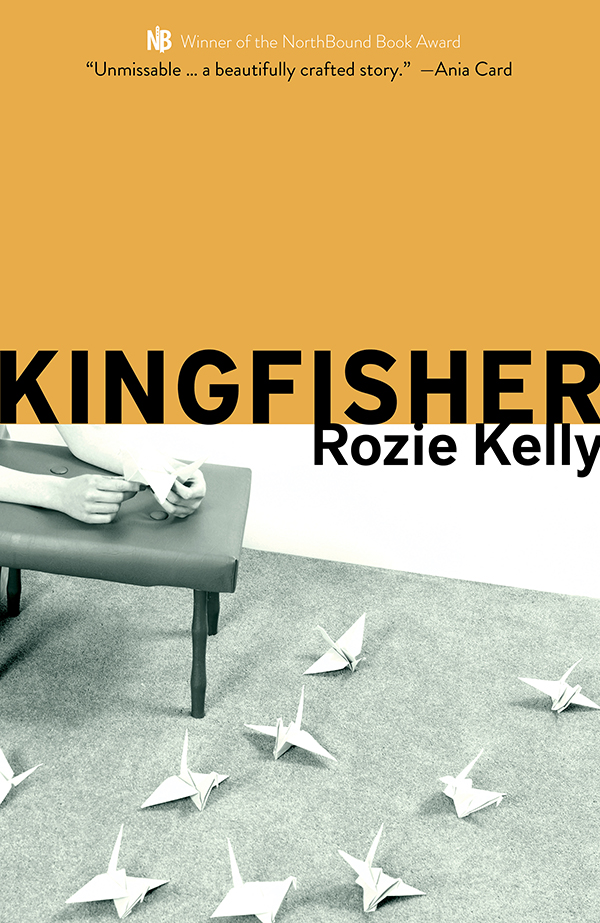
Kingfisher
About this book
The narrator works in academia and has built a steady home with Michael. A colleague—a poet who appears restless, confident, and creatively alive—offers an image of the freedom and ambition he feels he has surrendered.
Admiration becomes desire and then fixation. He names the poet his Kingfisher, turning a person into both inspiration and private symbol while the limits between artistic attention, intimacy, and possession begin to blur.
Michael's safety is not presented as emptiness, nor is the poet's brilliance a simple invitation. When illness enters their lives, the emotional arrangements that allowed ambiguity become harder to maintain.
Kingfisher is a standalone debut novel about queer love, grief, creativity, and power. Rozie Kelly stays close to a difficult narrator while allowing the people around him to exceed the roles his longing assigns them.
Read a sample
5,014 words
Plain text
From the opening
1.
I can pinpoint, almost to the second, when I realised I wanted to fuck her. It wasn’t the first time I saw her in the hallways of the university, nor was it when I first saw her read, and watched her face move from awkwardness to elation. It was a more happenstance occasion than that.
We’d tripped over one another while trying to buy coffee, me drifting, as usual, her clearly on the way to somewhere. But she stopped, as I did, awkwardly holding her coat and bag and some food shopping. It seemed rude not to invite her to sit with me, especially with the sun shining, as it was that moment. We perched on a recently vacated bench by the river. The ducks were fighting over crusts thrown by a small child and his mother. It was spring, so they were filled with its verve and aggression, trying to drown one another, mallards chasing females absentmindedly, flapping and splashing. An elderly cocker spaniel waded nearby, paying them no mind.
Ducks are evil, I said, as I rolled a cigarette.
The world must be very black and white, for you, she said.
It struck me as an odd thing to say, especially in England, where everything is grey. But it was then that I realised I wanted to be inside her. To push her down, to render her imperious intelligence stupid with the weight of my body, with my younger, harder form. I could tell, of course, that she wouldn’t accept being dominated, but it was a pleasant thought. She smelled like toast and marmalade. Like wet leather. Yes, I wanted to fuck her. And I don’t want to fuck women very often.
I was new to the area, then, although I feel old to it now, despite it being not much more than a year ago that this happened. My memory of that day is potent, but it’s blurred, like the feeling of emerging into a bright afternoon after unexpectedly quick pints. Vivid, but indistinct.
I can see the path underfoot as I walked away from her, having finished our coffees, with two Lotus biscuits in my pocket. She’d given me hers. I don’t like them, but I took it anyway, and allowed them to crumble in my pocket over the coming days as some kind of reminder. There was toadflax growing in the cracks of the walls, which I gazed at more than where I was going, as I am wont to do, when I am distracted.
I went home to Michael, perhaps earlier than he was expecting me. Or rather, not perhaps, but definitely, because as I stepped into the bedroom (the first room off the hallway of our new flat) he slowly and sheepishly moved some lubricant and a box of condoms from the bedside table and into the drawer. So. There was that. He was having his own fun. More classically consummated than my coffee and imaginings, clearly. But that was the arrangement.
Michael is a beautiful man. There is no denying that fact. He has black hair and blue eyes, a combination I’d believed only fictional until we met. But there he was, clear as day. Sat on the bed in his boxers with a thin gleam of sweat on his smooth chest.
I didn’t expect you back yet, he said.
Clearly, I said, with more venom than I’d intended.
We did say —
Ignore me. I have a headache.
You need to drink more water.
I know, don’t start with that.
Michael has a very smooth face. He has never been able to grow a full moustache and beard, although he keeps hoping it will arrive. At thirty-six years old I would imagine he’s missed his chance. He has some soft black hairs in the centre of each cheek, islands that the tides just won’t cover.
The smell of glue was emanating from the living room. His other passion. Michael builds model aeroplanes. A hobby he is entirely too beautiful for. His father was in the RAF (one thing we had in common) and instead of finding porn, should I ever open his laptop, I am likely to find strange forums from an earlier, more crudely built version of the internet. Elderly men trying to find one another. Has anyone heard from Billy-Bob ’56? Jimmy? Fairy Fred? Snowdrop ’62? I’m tempted to write about them but it feels too sad.
We’d decided to sleep with other people a few months previously. He seemed to be making the most of this arrangement, which galled me, but the arrangement itself was a mutual one. I wanted Michael to be in my life long-term. I believe he felt the same about me. We both knew we couldn’t be everything to each other. So, we’d made the decision. My frustration stemmed from how much the little fucker got laid. Or rather, how much I didn’t. And now I was mysteriously interested in a woman seventeen years my senior. A woman! What was the world coming to?
2.
Michael and I have very little in common. So little, in fact, that it has become something of a running joke between us. One of those jokes you get in relationships a couple of years deep, a joke that’s had all the hard edges scuffed off it, that you can settle into like an old sofa.
We bond over music. Have bonded, from the beginning. Our first date was a gig, which I was unsure of at first. It seemed to me an unsociable thing to do – it involved looking at something other than each other, experiencing something other than each other. But then I have always demanded a lot of attention. It’s likely that I found some masochistic joy in this beautiful man essentially ignoring me and staring at a stage all night, but also, I found a purer joy in watching him. His whole body moved fluidly to the sounds that filled the air. He bought us cheap beers without looking at the bar staff, he danced broadly and unashamedly for the supporting band, despite initially being the first to move into that wide, cavernous space. He is not a wallflower. He is not a flower at all. He is fire, an explosion, a spark hitting a stream of spilt petrol, the fissure in a sheet of ice before it breaks, the creak before an avalanche – a natural force that’s impossible to resist. He was the very first person to teach me that I could forget, however temporarily, what others might think of me, and just exist. I think perhaps Michael enjoyed the opportunity to introduce me to another version of myself. With him I became looser, my corners softened and blurred. I could see the joy he took in watching this happen, watching himself dissolve some of the starch ironed into my very core.
Continue reading the sampleClose the sample
The woman I wanted to fuck is a poet. I met her at the university, whilst in my short position as writing fellow for the MA students – just the spring term. I’d been excited by the position, prompted by the publication of my first pamphlet, not because I cared much about the students, but because I wanted to meet the staff. To rub shoulders with some real writers and thinkers in a non-subordinate scenario. Of course, we weren’t equal, but I wasn’t having to submit my own poems to their sharp eyes, which felt better. A step closer. She was the big-name writer on the course. The one they put in all the brochures. I’d only heard of one of her books, but then, judging by the distinctly female studentship, I probably wasn’t her target demographic. She ran a not-for-credit class each week, which she’d allowed me to sit in on, rather ruining the illusion that I wasn’t being taught, but there we are.
Most of us are poets, she said. It’s just a question of how it comes out.
She has green eyes and a soft Southern-Irish accent. Smile lines crease her cheeks, and her eyebrows are slightly wild. She looked right at me as she said it, and it felt like an accusation. Like I hadn’t yet figured out where my poetry came from.
After our meeting by the river, I began to pay more attention to her. I observed her routine. Most of the other academics passed me like ghosts, if I saw them at all. I understood that they spent their lunches, if they took them, tucked away in their tiny offices. But she was different. She took a break at 1pm every day, on the same bench on campus, underneath a large tree and facing the greenest space the university had to offer. I began to copy her. Eventually, I began to join her.
She would always buy grainy salads from Marks & Spencer. Small bottles of mango smoothie or iced coffees. Such a waste of money. I took curries and chicken and rice from home. Heated them in the dirty microwave. Of all the writers at the university, hers is the work I’d been least interested in. She was always writing about nature, making obscure references to long-dead tomes. Always banging on about birds. Having spent some time with her, it became clear that this wasn’t an affectation – she stared at the birds wherever she went. She taught me how to tell when a pigeon is happy. Not something I’d ever imagined caring about, but these days I watch for them dipping and swirling, catching currents in the air for short, joyful moments. A modern-day ornithomantist, then. I write about smells and steel and semen. It took me longer than it should to realise that we write about the same thing.
That night, after our first coffee, after returning home to Michael, I cooked steaks. For once I’d braved the butcher – normally I can’t handle the smell. I didn’t make a sauce. I wanted to taste blood. Although it’s not actually blood, is it? It’s myoglobin. The protein that delivers oxygen to the muscles. I think my muscles needed oxygen. A release of some kind. A deep breath out.
You keep fucking everyone else, I said, over dinner with my mouth full.
He smiled wryly but didn’t say anything. When will it be my turn?
Still quiet, he reached over and took my cock in one hand, through the thin fabric of my jogging bottoms.
When you stop wearing these old things, perhaps? Never, I said.
He blew me later that night. Nobody wants apology fellatio, do they? I mean, it’s still better than no blow job at all, but it’s hardly exciting. I could see myself in the mirror in the wardrobe door. I looked terribly sad, although I didn’t feel it. I wasn’t feeling very much of anything. Most of us are poets? What does that say about everyone else?
3.
The following day I was at the university. I’d been given a strange, draughty office in one of the older buildings. The room itself was shaped almost like a corridor, with a desk at either end, one for me, one for the fiction fellow, who never seemed to be there. It was almost impossible to find, as it involved going up and then down some stairs, so I was constantly fielding emails from late-comers, and opening the door to breathless red faces and gasped apologies. Despite my initial reticence, I found I liked most of the students. I wasn’t teaching classes, and it was voluntary for them whether they came to see me or not, which meant that the ones I did see were the earnest ones. The ones who put the hours in. This didn’t necessarily mean they were talented – although some were – but it did mean they were serious about being there. They sent me their little poems like paper ships onto a rough sea, and I did my best to try and help them dry out.
There was one girl in particular, though, who irritated me beyond belief. Short, bespectacled, loud-voiced, and obstinate. I suppose I shouldn’t call her a girl really; she could only be a few years younger than me, but something about how she sat upright in her chair with her arms wrapped around her folder of empty words didn’t allow me to ascribe to her the title of woman. Which I’m sure makes me a cunt.
Her work was all sounds, there wasn’t a shred of beauty to be found anywhere. As much as she made me itch, sat there all self-important, she did teach me something. Poetry should be beautiful, I decided. What an extraordinarily mundane thing to realise. I think my favourite poems are the ones that force you to see the beauty in something filthy and used up.
After a long and tiring meeting with The Girl, I went outside into the sunshine and sat on the glossy metal bench where the poet liked to eat her lunch. She came and joined me soon enough. She was wearing an ankle-length dress with a silver belt around her tiny waist. She looked like she worked in an expensive boutique. She looked like a hummingbird. Today she was eating something with green beans and goat cheese. It smelled of lemons.
How are you finding it? she asked.
Finding what?
Well, the job of course.
What do you do when you don’t like your students? I teach them anyway.
I was circling her. I don’t believe she noticed. She was always so deep in her work; she seemed surprised when I appeared on the bench every day. Perhaps she is not used to the kind of attention I was giving her. Perhaps she has experienced too much of it. She was in high demand. I was a beggar. I knew she had a purse full of gold, if only I could get close enough to cut the strings.
I think Michael noticed the difference. I was lighter, and this made him happier. He wanted me to be happy but he didn’t want it to be any work. At the beginning I tried not to be work. In fact, I worked incredibly hard at it. I was so easy going I felt like I might slip through the floorboards at any moment and disappear. He liked me better like that. But time goes on and it gets harder to pretend, doesn’t it? Perhaps love is still being willing to try.
You’re quite dangerous, really, aren’t you, said the poet.
She was eating spaghetti carbonara, and she sucked a piece of pasta up between her lips, fast, how I’d imagine a cat would do it, if a cat were to eat pasta.
What do you mean? I said, picking at my plate. My fingertips smelled of meat.
Charisma is deadly.
It is?
Yes. And you’re an expert at making people feel good about themselves.
Why is that a bad thing?
It’s not, exactly. But it’s potent. If you can make someone feel good about themselves, you can make them do what you want. They say psychopaths are very charismatic.
Who does?
People do.
She took a swig of her Sauvignon. I mulled it over. This was our first meeting past sundown. She’d agreed to meet me to discuss my new (imaginary) collection. I hadn’t been able to come up with a better excuse to see her. Now she was here with me she was softening like butter. It was raining outside, and the windows of the small Italian restaurant were steamed up. I felt tightly wound, like there was a coil of metal in my stomach. It felt like being there was a betrayal, although of what I couldn’t say. Our plates were cleared, and the poet ordered a tiramisu before the waitress could go back to the kitchen. When they brought it, she gave a little wiggle of delight. I felt myself harden. On a whim I ordered an Irish coffee, and then watched as the manager came down from the office to show the waitress how to make it. It took her two goes and by the time she brought it over, the poet had eaten her dessert. I realised we hadn’t spoken that whole time.
Are you married?
No, she said. I was. But he was profoundly disappointing. Are you?
No, I replied, and didn’t elaborate.
When we said goodbye, it was so ridiculously cinematic and beautiful that it made me embarrassed. Not the interaction, you understand, but the environment. Stepping from the steamy restaurant and into the rain, sheltering her under my large blue golf umbrella. Her hair curled behind her ears in the damp. She leaned in and gave me a one-armed hug goodbye. At the last second, she turned her head and kissed me on the cheek. I had forgotten what it felt like to kiss someone who was smaller than me. Although I didn’t kiss her, I suppose, I was the recipient.
She smelled like jasmine. No, not exactly. She smelled like the earth beneath a jasmine plant on a hot day. We hadn’t talked about my poems.
She didn’t join me for lunch for the rest of that week. I sat in the sun eating my overcooked curries and trying not to look around me too much. Students gathered on the grass, laughing, performing youth for one another. I smoked more than I usually do, and I’d been doing so well at cutting down. Not seeing her felt like having too much caffeine.
I was short with Michael that week, in the evenings. He was short back, punching me on the arm and asking me what my fucking problem was. I told him I didn’t know, and he accepted it. His fist left a small bruise and I rubbed it with my thumb as I thought about her. He made spaghetti carbonara one night, and ate his like a dog, not a cat, which made me very angry, although naturally I couldn’t explain why. But he let me fuck him afterwards, for a change. I kept catching sight of myself in the mirror again. At this rate I should just find a pond and drown myself in it.
4.
That weekend we went to see my mother. Even as an adult man being close to my mother sends adrenaline coursing through me. I so quickly become a small boy again it’s as if nothing has changed. My knees and palms begin to ache as if the old wounds are trying to open themselves for her.
My mother lives in sheltered accommodation in a converted manor house. The whole building is covered so thickly with ivy that you can only see the windows. She doesn’t like me to see her in her room, she says it makes her feel like she’s hospitalised, so Michael and I wait in the communal living room. There are two grandfather clocks and a mantle clock, all running at slightly different times. They tick loudly and out of speed, making it feel like we are part of a Lewis Carroll storyline. I keep expecting to see rabbits. Every hour the cacophony of mismatched tolling bells sets off all the resident’s hearing aids, screeching into their deadened ears. The living room is so thickly carpeted that the carers strain to push their missives’ wheelchairs through the deep pile.
My mother is a homophobe. Despite this, she and Michael get on wonderfully well. She always did relish having someone to criticise me with. I am frightened of my mother. Michael doesn’t know this. I’m not sure whether Michael realises anyone is frightened of anything. He is so completely secure. On this visit, she was wearing a lemon-yellow suit, altered so that she could pour her misshapen body into it. She smelled like TCP and Angostura bitters. She never smells of anything else. The nurse pushed her to us silently through the thick carpet.
I’ll take a tea dear, my mother said to the nurse.
That’s not my job Hetty, you know that. Your lovely son can get you one.
Yes, a tea dear, and nice and strong this time. I don’t know what it is with you lot here and making weak tea. I should complain.
The nurse rolled her eyes at me and abandoned my mother’s chair by our table. It made me want to laugh loudly, so instead I stared at my feet like a little boy.
Hello Hetty, said Michael.
Hello, Michael dear. How is the business?
Booming, actually. Most of our January flakers have stayed on this year. Or are paying us still at least. I’m thinking of opening a new location too.
You’ll rid us of those nasty fatties, won’t you?
I’m trying my best.
Michael owns two gymnasiums. The sort of gyms that have never had someone with more than 2 per cent body fat step through their doors. But he’s placating her. I’m not sure when she last looked in a mirror, as her fast-extending waistline is threatening to overflow her wheelchair these days.
Homophobe. Hypocrite.
Hello Mum.
You look sallow, son. Michael, he hasn’t been drinking enough water, has he?
He hasn’t Hetty. I do try and tell him, but he won’t listen to me.
And you’re still living in sin, are you?
Yes Mother, I said.
She can hardly even be bothered these days. Not like the leathering she gave me when she found my magazines. Although she wasn’t in a wheelchair then, admittedly.
It was an enormous relief when the poet joined me on the bench the following Monday. I breathed a heavy sigh as she sat down, and she looked askance.
What?
Nothing. I’m working on my breathing.
Of course you are.
I was surprised to see her take out a Tupperware. In it was a jacket potato with tuna, some coleslaw and salad.
No M&S today?
I’m working on being organised.
She said it as if it were a made-up word. As if she was trying it out for size.
We still need to talk about your collection, she said.
I’d like that.
You should come for dinner.
She wrote down her address for me on a piece of paper, which was the one time I’d really considered the fact of our age difference as a potential issue.
I have a flat in the city, where I stay when I’m working during the week. I’ll cook. Are you free on Friday evening?
I am.
Eight okay?
Absolutely. Good.
She began to eat her jacket potato. That day she smelled like linen and hope.
On Sundays Michael cooks all our lunches for the week. He makes a huge pot of curry, grills endless chicken breasts, steams brown rice. He lays out all our Tupperware in symmetry on the counter. He weighs everything and tries to tell me about macronutrients or some such nonsense.
When I get back from playing squash, he asks me – have you taken your electrolytes?
Salt, Michael, I say. It’s just a fancy word for salt. I’m not a fucking hamster.
You’re my hamster, he says, and gives me two tablets.
One day I’m going to crush them up in front of him and sprinkle them on my dinner.
This week he tells me he misses me.
You see me every day, I tell him.
That’s not what I mean, he says.
Michael makes me feel peaceful. We have a routine. He’s up early to train (he works out at a different gym, rather than his own, which always struck me as odd). He makes the tea and brings me a cup in bed. I often wake to its cold presence on the bedside table, knowing that he left hours ago. After he has been to the gym, he comes home, showers, and sits in his office doing paperwork. By this time I’ve surfaced, and I make our coffee – freshly ground, a new blend each week, purchased at the farmer’s market. He smells of the minty shower gel he uses, and always kisses my hand when I put down his mug. We both drink our coffee black. Another of the few things we have in common. When I try to imagine us growing old together, I cannot picture his face, but I can smell mint and feel him kiss the back of my hand.
After our coffee and my shower (I don’t think I’ve showered once in that flat without the glass being steamed up from Michael), I leave for the university. I am technically not required in the office for more than three days, but I go in for five. The corridor-office isn’t used by anyone else, and, although cold, is quiet and conducive to my work. Or so I tell myself, to avoid the fact that really, I want to eat my lunches on that metal bench. I have started buying mango smoothies and iced coffees from M&S. I can see what the fuss is about. I let them rim my mouth with their sweetness.
I am trying to write a poem about birds. I know, I know. Don’t. They’re not real birds, at least. I want to write about a water fountain in Stratford-upon-Avon, where I grew up. The fountain is shaped like two metal swans, wings open, facing each other. Perhaps in conflict, perhaps edging on a human embrace, who knows. I like how sharp the swans are. They look dangerous. Hetty thought the statue was a monstrosity when it was first put up, which may have contributed to how much I like it. Every line I write feels trite, predictable. Maybe I should write about a hamster instead.
So. Dinner with the poet. You must be wondering. I’d spent my day in that draughty office, writing terrible lines about stiletto blade swans and such. What rubbish. I was angry and horny and most of all I was hungry, although it was the kind of hunger where you don’t realise until it makes you feel ill.
The poet’s flat was in a suburb of the city and comprised of the basement and ground floor of a pretty (large) Victorian house. It irritated me but I’m not sure why. People with money are irritating but then I’m one of them so who am I to talk? I rang the doorbell and took a few deep breaths. Why was I letting myself get so worked up? To my surprise, when she answered the door, she was wearing black jeans and a cream silk blouse. Jeans? It threw me. She looked wonderful – sparkling clean and fresh. An advert for fabric conditioner.
Wine? she said, before she even said hello.
I laughed like a big gust of wind. Yes, oh yes, I said.
The flat was beautifully decorated. It had retained its original fireplaces, complete with cobalt tiles. The carpets were hessian and they caught on my socks (it was a shoes-off house). Everything was immaculately clean and quite minimal. With her wild hair and eyebrows and obsession with birds, I think I’d imagined some dark and sumptuous space filled with taxidermy. But I was wrong. There was a watercolour of a swallow on one wall. Or was it a martin? I get them confused.
Here, she said, handing me a large glass of red. She hadn’t asked what colour I wanted, and I saw she was drinking white. So, she thought she knew me, then. I suppose she was right too. I took a sip, then another. It was good. Something Italian and hearty, my best guess. Montepulciano d’Abruzzo, perhaps. There was a large Le Creuset on the stovetop, the contents bubbling. It smelled like preserved lemon.
Sit down, she said, gesturing to the breakfast bar. It had a white marble top.
I didn’t picture you liking white marble, I said.
I didn’t decorate. She smiled ruefully. I bought it like this and have made very little imprint at all. Which is the point, I suppose. I brought books, blankets, and birds. Everything I need to write. And to sleep.
I sat down on one of the tall wooden chairs. It squeaked, which embarrassed me. I realised I didn’t know how to talk to her now that we were in her space.
How long have you had it? I asked.
As long as I’ve been at the university, nearly. So, six years perhaps.
I like it.
So do I.
There was a selection of birdfeeders hanging outside the kitchen window. A blue tit was swinging gently as it extracted seeds from one of them. The poet was stirring whatever she’d cooked, but I could see that she had one eye on the feeder the entire time.
5.
She fed me at a large, bleached pine table at one end of the huge living room. There were blue linen placemats and the cutlery looked brand new. We ate moussaka, with some kind of spicy bean stew, and couscous.
Why don’t you bring food like this to work? I asked.
I don’t cook like this normally. If you weren’t here, I’d be eating cereal.
Are you trying to impress me?
I think I might be. Is it working?
Yes.
I thought about her motivations. Was she flattered by me, or did she really want to help me with my writing? It couldn’t be that, she must be approached for advice relentlessly. When I put my hand on her forearm she didn’t move away. Her motivations were simpler, then.
We drank a bottle of wine each. She made espresso after dinner, and I was grateful. We still hadn’t looked at my poems. We drank our coffee by the fire, which she lit, despite it being spring. I was grateful for that, too. It was cold in her minimal house.
Tell me about your partner, she said.
How do you know I have one?
Because I’m not stupid, she said.
Michael is strong, confident. He knows who he is and what he wants in a way I’ve always been envious of. I think it must be simple, to be him.