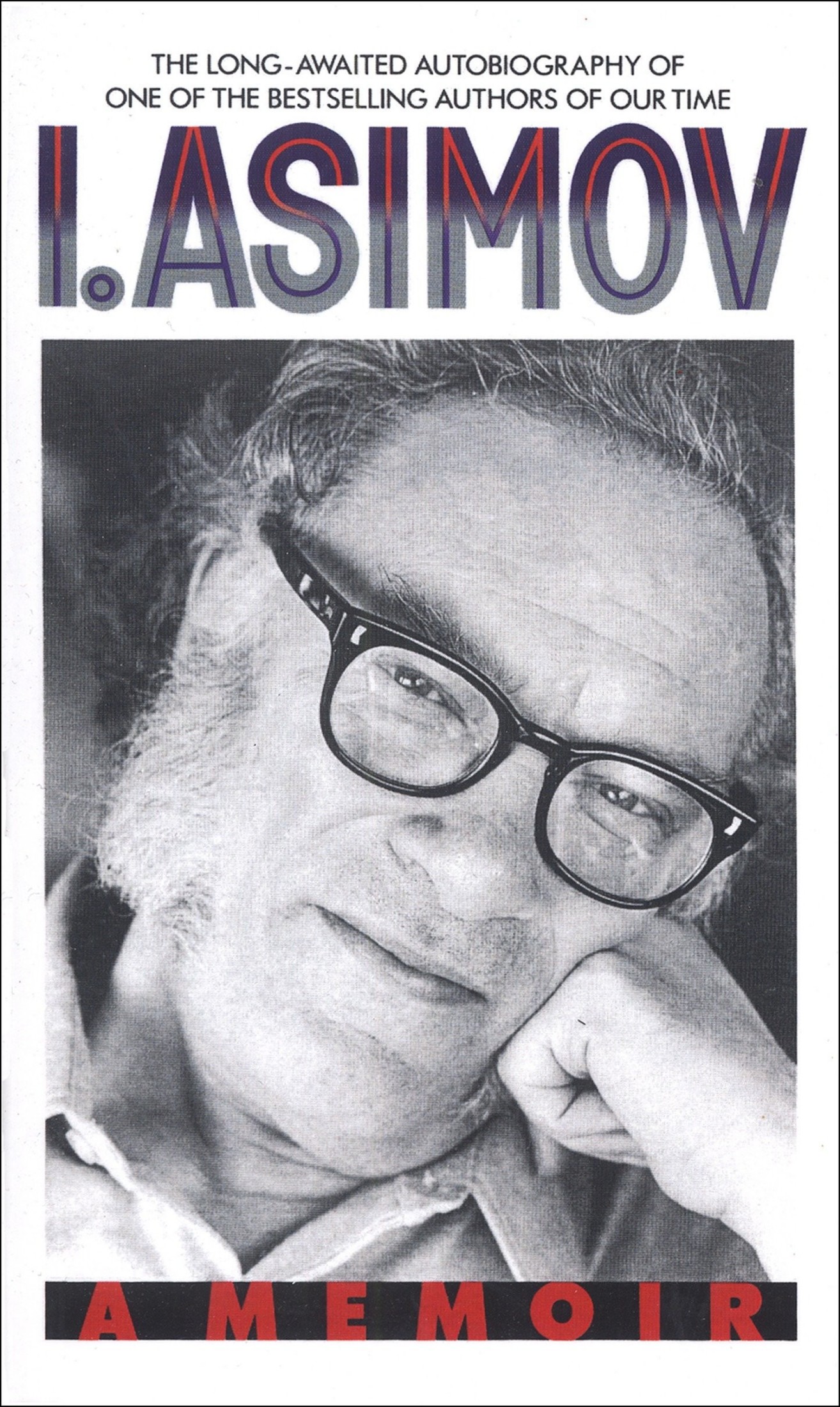
I. Asimov: A Memoir
About this book
Asimov had already written two volumes of chronological autobiography when he returned to his life in a different form. Short chapters move among family, education, science fiction, publishing, friendship, fame, and the routines that produced hundreds of books.
The voice is recognizably his: direct, amused, proud, argumentative, and willing to record both loyalty and grievance. The arrangement lets recurring people and ideas matter more than a calendar.
I. Asimov was published after the author's death and serves as his final memoir. It is especially useful to readers interested in the working life behind the Foundation and Robot books.
Read a sample
5,045 words
Plain text
From the opening
Introduction
In 1977, I wrote my autobiography. Since I was dealing with my favorite subject, I wrote at length and I ended with 640,000 words. Since Doubleday is always overwhelmingly kind to me, they published it all—but in two volumes. The first was In Memory Yet Green (1979), the second In Joy Still Felt (1980). Together, they described the first fifty-seven years of my life in considerable detail.
It had been a quiet life and there was no great excitement in it, so even though I made up for that by what I considered a charming literary style (I never bother with false modesty, as you will quickly discover), the publication was not a world-shaking event. However, some thousands of people found pleasure in reading it, and I am periodically asked if I will continue the tale.
My answer always is: “I have to live it first.”
It was my notion that I ought to wait till the symbolic year of 2000 (always so important to science fiction writers and futurists) and write it then. However, I will be eighty years old in 2000 and it may just be possible that I may not make it till then.
When, just before my seventieth birthday, I was stricken with a rather serious illness, my dear wife, Janet, said to me severely, “Start that third volume now.”
I protested feebly and said that the last twelve years had seen my life turn quieter than ever. What could I possibly have to say? She pointed out that the first two volumes of my autobiography were strictly chronological. I recounted events in precise order according to the calendar (thanks to a diary I’ve kept since I turned eighteen, to say nothing of an excellent memory) and I had said almost nothing about my inner being. She said she wanted something else for the third volume. She wanted a retrospective in which the events were secondary to my thoughts, my reactions, my philosophy of life, and so on.
I said, even more feebly, “Who would be interested?”
And she said firmly, for she is even less falsely modest on my behalf than I am on my own, “Everybody!”
I don’t think she’s right, but she might be, so I intend to try. I don’t intend to start where the second volume left off. In fact, it would be dangerous to do so. The first two volumes are out of print and many people who might pick up this volume and find it interesting (stranger things have happened) would be unable to find the first two volumes in either the hard- or soft-cover incarnation and grow seriously annoyed with me.
So what I intend to do is describe my whole life as a way of presenting my thoughts and make it an independent autobiography standing on its own feet. I won’t go into the kind of detail I went into in the first two volumes. What I intend to do is to break the book into numerous sections, each dealing with some different phase of my life or some different person who affected me, and follow it as far as necessary—to the very present, if need be.
I trust and hope that, in this way, you will get to know me really well, and, who knows, you may even get to like me. I would like that.
1
Infant Prodigy?
I was born in Russia on January 2, 1920, but my parents emigrated to the United States, arriving on February 23, 1923. That means I have been an American by surroundings (and, five years later, in September 1928, by citizenship) since I was three years old.
I remember virtually nothing of my early years in Russia; I cannot speak Russian; I am not familiar (beyond what any intelligent American would be) with Russian culture. I am completely and entirely American by upbringing and feeling.
But if I now try to discuss myself at the age of three and the years immediately beyond, which I do remember, I am going to have to make statements of the type that have always led some people to accuse me of being “egotistical,” or “vain,” or “conceited.” Or, if they are more dramatic, they say I have “an ego the size of the Empire State Building.”
What can I do? The statements I make certainly seem to make it clear that I think highly of myself, but only for qualities that, in my opinion, deserve admiration. I also have many shortcomings and faults and I admit them freely, but no one seems to notice that.
In any case, when I say something that sounds “vain,” I assure you it is true and I refuse to accept the accusation of vanity until somebody can prove that something I say that sounds vain is not true.
So I will take a deep breath and say that I was an infant prodigy.
I don’t know that there is a good definition of an infant prodigy. The Oxford English Dictionary describes it as “a child of precocious genius.” But how precocious? How much genius?
You hear of children who can read at two, who learn Latin at four, who enter Harvard at the age of twelve. I suppose those are undoubted infant prodigies, and, in that case, I was not one.
I suppose that if I had had a father who was an American intellectual, well off and lost in his study of the classics or of science, and if that father had discovered in me a likely candidate for prodigiousness, he might have driven me onward and gotten something like that out of me. I can only thank whatever chance has guided my life that this was not so.
Continue reading the sampleClose the sample
A force-fed child, driven relentlessly to the very top of his bent, might break under the strain. My father, however, was a small storekeeper, with no knowledge of American culture, with no time to guide me in any way, and no ability to do so even if he had the time. All he could do was to urge me to get good marks in school, and that was something I had every intention of doing anyhow.
In other words, circumstances conspired to allow me to find my own happy level, which turned out to be sufficiently prodigious for all purposes and yet kept the pressure at a sufficiently reasonable value to allow me to chug along rapidly with no feeling of strain whatever. It meant that I kept my “prodigiousness” for all my life, in one way or another.
In fact, when asked if I was an infant prodigy (and I am asked this with disconcerting frequency), I have taken to answering, “Yes, indeed, and I still am.”
I learned to read before I went to school. Spurred on by my realization that my parents could not yet read English, I took to asking the older children on the block to teach me the alphabet and how each letter sounded. I then began to sound out all the words I could find on signs and elsewhere and in that way I learned to read with a minimum of outside help.
When my father discovered that his preschool youngster could read and, moreover, when he found on questioning that the learning was on my own initiative, he was astounded. That may have been the first time he began to suspect that I was unusual. (He kept that feeling all his life, though he never hesitated to criticize me for my many failings.) The fact that he thought I was unusual, and made it clear that he did, gave me the first inkling that I was unusual.
I imagine there must be many children who learned to read before going to school. I taught my younger sister to read before she went to school, for instance, but I taught her. No one taught me.
When I finally entered the first grade in September of 1925, I was astonished at the trouble the other children were having with their reading. I was even more astonished at the fact that after something had been explained to them, they would forget and would have to have it explained again and again.
That, I think, was what I noticed very early in the game; that in my case it was only necessary that I be told once. I did not realize that my memory was remarkable until I noticed that my classmates didn’t have memories like it. I must instantly deny that I have a “photographic memory.” I have been accused of that by those who admire me beyond my deserts but I always say, “I only have a near-photographic memory.”
Actually, my memory for things that are of no particular interest to me is not much better than normal, if that, and I can be guilty of appalling lapses, when my self-absorption gets the better of me. (I can be remarkably self-absorbed.) I once stared at my beautiful daughter, Robyn, without recognizing her, because I did not expect to see her at the time and was only aware of a vaguely familiar face. Nor was Robyn in the least hurt, or even surprised. She turned to the friend at her side and said, “See, I told you that if I just stood here and didn’t say anything, he wouldn’t know me.”
For things that do interest me, and they are many, I have virtually instant recall. Once when I was out of town, my first wife, Gertrude, and her brother, John, were having some small argument, and little Robyn, about ten at the time, was sent up to my office to get down the appropriate volume of the Encyclopaedia Britannica to settle the matter.
Robyn went rebelliously, saying, “I wish Daddy were home. Then you could just ask him.”
There are, however, difficulties and disadvantages to everything. I may have been gifted with a delightful memory and a quick understanding at a very early stage, but I was not gifted with great experience and a deep understanding of human nature. I did not realize that other children would not appreciate the fact that I knew more than they did and could learn more quickly than they did.
(Why is it, I wonder, that anyone who displays superior athletic ability is an object of admiration to his classmates, while one who displays superior mental ability is an object of hatred? Is there some hidden understanding that it is brains, not muscles, that define the human being and that children who are not good at athletics are simply not good, while those that are not smart feel themselves to be subhuman? I don’t know.)
The problem was that I did not try to hide my superior mentality. I demonstrated it every day in the classroom, and I never, never, never thought of being “modest” about the matter. I cheerfully made it clear, at all times, that I was very bright, and you can guess the result.
The results were all the more inevitable in that I was small for my age, weak for my age, and younger than anyone else in the class (eventually two and a half years younger due to my being shoved ahead periodically, yet still the “smart kid”).
I was scapegoated. Of course I was.
Eventually, it became plain to me why I was scapegoated, but I spent many years accepting this because I could not bear to hide my brilliance from the eyes of others. In fact, I was scapegoated, with diminishing intensity, right into my early twenties. (Let me, however, not make it seem worse than it was. I was never physically assaulted. I was merely sneered at, derided, and excluded from the society of my peers—all of which I could bear with reasonable equanimity.)
In the end, though, I did learn. There is still no way of hiding the fact that I am unusual, considering the vast number of books I have written and published, and the vast number of subjects I have covered in those books, but I have learned, in ordinary life, to refrain from being on display. I have learned how to “turn it off” and meet people on their own terms.
The result is that I have many friends who treat me with the greatest of affection and for whom I feel the greatest of affection in return.
If only an infant prodigy could be prodigious in grasping human nature and not in memory and quickness of intellect alone. But then, not everything is inborn. The truly important parts of life develop slowly with experience, and that person is lucky who can learn them more quickly and with greater ease than I did.
2
My Father
My father, Judah Asimov, was born in Petrovichi, Russia, on December 21, 1896. He was a bright young man who received a complete education within the limits of Orthodox Judaism. He studied the “holy books” assiduously and was fluent in Hebrew as pronounced in his particular Litvak (Lithuanian) dialect. In later life, in our conversations he would delight in quoting from the Bible or the Talmud, in Hebrew, then translating it into Yiddish or English for my benefit and expounding on the matter.
He also gained secular knowledge and could speak, read, and write Russian with great fluency and was well read in Russian literature. He knew Sholem Aleichem’s Yiddish stories virtually by heart. I remember him once reciting one to me, in Yiddish, a language I understand.
He knew enough mathematics to serve his father as bookkeeper in the family business. He survived the dark days of World War I without, for some reason, serving in the Russian army. This last was a good thing, for, had he served, the chances were excellent that he would have been killed and I would never have been born. He also survived the disorders that followed the war, marrying my mother sometime in 1918.
Until 1922, despite the dislocations of war, revolution, and civil turmoil, he was doing fairly well in Russia, though, of course, if he had remained there who knows what would have happened to him and to me in the even darker days of Stalin’s tyranny, World War II, and the Nazi occupation of our native region?
Fortunately, we need not speculate on that, because in 1922 my mother’s half brother, Joseph Berman, who had gone to the United States some years before, invited us to come to that land and join him, and my parents, after some agonizing introspection, decided to do so. It was not an easy decision. It meant leaving a small town in which they had lived all their lives, in which all their friends and relatives were to be found, and heading out into an unknown land.
But my parents decided to risk it, and they got in just under the wire, for in 1924 stricter immigration quotas were imposed and we would not have been allowed to enter.
My father came to the United States in the hope of a better life for his children, and this he certainly achieved. He lived to see one son a successful writer, another son a successful journalist, and a daughter happily married. However, this was all at a great cost to himself.
In Russia, he was part of a reasonably prosperous merchant family. In the United States, he found himself penniless. In Russia, he had been an educated man, looked up to by those about him for his learning. In the United States, he found himself virtually illiterate, for he could not read or even speak English. What’s more, he had no education that would be counted as such by secular Americans. He found himself looked down upon as an ignorant immigrant.
All this he suffered without complaint, for he concentrated entirely on me. I was to make up for everything, and I did. I have always been very grateful to my father for this sacrifice of his, once I was old enough to understand what it was he had had to do.
Once in the United States, he turned his hand to any job he could get, selling sponges door to door, demonstrating vacuum cleaners, working for a wallpaper concern and later in a sweater factory. After three years, he had saved enough money for a down payment on a small mom-and-pop candy store and our future was assured—and shaped.
My father never pushed me toward prodigiousness, as I have already explained. He also never punished me physically; he left that to my mother, who was very good at it. He contented himself with long, improving lectures whenever I misbehaved. I think I preferred my mother’s blows, but I always knew my father loved me, even if it was difficult for him to put it into words.
3
My Mother
My mother was born Anna Rachel Berman. Her father was Isaac Berman. He died when she was young, and it was for him that I was named.
My mother, who looked like a typical Russian peasant woman and was only about four feet ten inches tall, was literate and could read and write both Russian and Yiddish.—And here I have a complaint against both my parents. They spoke Russian to each other when they wanted to discuss something privately that my big ears were not to hear. Had they sacrificed this trivial urge for privacy and spoken to me in Russian, I would have picked it up like a sponge and had a second world language.
This, however, was not to be. I presume my father’s defense was that he wanted me to learn English and make it my first language, untroubled by the complexities of another, so that I could become a complete American. Well, I did that, and since I consider English the most glorious language in the world, perhaps all is for the best.
Aside from literacy and the knowledge of enough arithmetic so that she was able to serve as cashier in her mother’s store, my mother was not educated. In orthodox Judaism women simply weren’t educated. She knew no Hebrew and had no secular knowledge.
Nevertheless, I have heard her sneer at my learned father’s Russian handwriting, and I think she was probably justified. It is my experience that women’s handwriting is, for some reason, more attractive and more legible than men’s handwriting. My sister’s writing, for instance, makes mine look crabbed and semi-literate. It would not be surprising to me, then, if my mother’s Russian was more elegantly written than my father’s.
My mother’s role in life could be explained in one word—“work.” In Russia, she had been the oldest of numerous siblings and had to take care of them in addition to working in her mother’s store. In the United States, she had to raise three children and work endless hours in the candy store.
She was all too aware of the limitations of her life, of the lack of the kind of freedom others had. She was often lost in self-pity, and while I cannot blame her for that, I was the most frequent recipient of her self-pitying tirades. And since she made it clear that I was part of the cross she had to bear, and not the lightest part either, I was filled with guilt.
Her hard life made her short-tempered as well, and her rage found its outlet chiefly on me. I won’t deny I gave her cause, but she hit me frequently, and with no light hand either. This didn’t mean she didn’t love me to distraction, because she did. I wish she had had some other way of showing it, though.
My mother never had a fair chance as a cook. She had to prepare meals quickly and on the run because of the candy store, so that all during my youth (till I got married, in fact) I ate fried foods of all kinds with occasional boiled beef or boiled chicken with boiled potatoes. We were not strong on vegetables, but we were very strong on bread.—I’m not complaining, though. I loved it all.
However, I think that my mother’s cooking started me on a way of life that led to troubles with my coronary arteries in late middle age. On the more positive side, her cooking inured my alimentary canal to difficult tasks, so that I developed an iron digestion.
My mother did have some specialties, though—grated radish with onions and hard-boiled eggs that were heaven going down but repeated on you for a week and forced people to grant you privacy.
She also prepared jellied calf’s feet with onions and hard-boiled eggs, and who knows what else. It was called pchah, and I would rather have had that than Elysium. Even after I was married, I would occasionally be given a vast container of pchah to take home. It is an acquired taste, of course, and it was a sad day for me when my wife, Gertrude, acquired the taste. It instantly cut the supply in half. I remember sadly the last bit of pchah my mother made for me.
My present wife, Janet, the dearest woman in the world, has carefully looked up recipes and occasionally makes pchah for me even now. A pleasure, but not quite like mother’s, I’m afraid.
4
Marcia
My younger days were spent in the company of my younger sister, Marcia, who was born on June 17, 1922, in Russia and came to the United States with us when she was eight months old. She has frequently complained that I rarely speak of her in my writings, and that is true. In 1974, however, I published a book in which I did mention her and said she was born in Russia.
I phoned her to read the passage to her as proof that I did speak of her sometimes and she immediately broke into loud, hysterical wails. I said, in consternation, “What’s the matter?”
She said, between sobs, “Now everyone will know how old I am.” (She was fifty-two at the time.)
“So what?” I said. “Is this going to disqualify you for the Miss America contest?”
It didn’t help. I could not placate her, and now you know the sort of relationship my sister and I have had too often.
Marcia is not her original name. She had a very nice Russian name which I am not allowed to use. She chose Marcia for herself in later life and that’s what I must call her.
We did not get along well when we were children. That’s not surprising. Why should we have? Our personalities were completely different and had we been independent individuals we would never have chosen each other for friends. Yet here we were, bound together and in constant irritation with each other.
Almost anything one of us did aroused umbrage in the other. There would be an argument that quickly escalated to a shouting match and then to a ferocious howling. Things might have been better if we had had parents who could pull us apart, listen patiently to each one of us as we detailed the high crimes and misdemeanors of the other, and then adjudicate the matter fairly. Unfortunately, our parents had no time for that.
My mother would come running upstairs from the store and hurl her ukase at us: “Stop fighting.” She would then launch into an angry oration, the burden of which was that we were the only children in the neighborhood, nay, in the whole world, who fought in this disgraceful manner, and that all other children were nothing but sweetness and light. She would also say that customers and neighbors at a distance of two blocks would hear us and come running to the store to find out what was happening and that, as a result, she was embarrassed beyond description by all this. If we hadn’t heard that speech a hundred times, we hadn’t heard it once. Nor did it have any effect on us, especially since I knew that other siblings did not get along any better than we did.
Now here’s a funny thing. Marcia remembers that I taught her to like Gilbert and Sullivan and that I had friends in the science fiction world who were interesting and witty, but she doesn’t remember that we ever fought. She pictures an idyllic existence between us and I have found this to be true of other people who have shared memories with me. They wipe out whole continents of fact and construct some fairy tale that never existed and insist that that’s the way it was. Maybe it is more comfortable to create your own past, but I can’t do it. I remember things too well—although I don’t say that my own past is entirely immune to reconstruction. When I wrote my autobiography and consulted my diary, I was astonished at the things I had forgotten, as well as the things I remembered that weren’t so. They were all matters of trivial detail, however.
Marcia was a bright child. I taught her to read (somewhat against her will) before she went to school, and she raced ahead, just as I did, graduating from high school, again as I did, at the age of fifteen. Then the male chauvinism of Judaism raised its head to Marcia’s great disadvantage. My father was poor, but he managed, somehow, to send both his sons to college. There was no thought, however, of sending poor Marcia to college. Girls, after all, were simply meant for marriage.
Marcia, therefore, at fifteen had to find work. She was too young for marriage and, as a matter of fact, she was also too young to work, at least too young to work legally. I think she must have lied about her age. In any case, she got a secretarial position and did quite well at it.
She did not marry until she was thirty-three. With a brother’s inability to see the virtues of a sister, I was not surprised. I remember that when I was getting ready for marriage thirteen years earlier, some woman (obviously of the old school) expressed surprise.
“Brothers,” she said, “shouldn’t marry till after the sister is married.”
That may have been a viable custom in Eastern Europe in the days when marriages were arranged and any girl could be (and usually was) married off as a teenager as long as the dowry was right. But here? In America?
I said, “If I wait for my sister to marry, I’ll die a bachelor.”
I was wrong, though. A man of thirty-seven, Nicholas Repanes, who was passive, quiet, and gentle, was smitten by her. They married, had two handsome sons, and were happy together for thirty-four years till Nicholas died on February 16, 1989, at the age of seventy-one. Janet and I drove out to the wilds of Queens to see him lying in state (wearing his glasses). I owed him that much for making Marcia so good a husband.
Marcia, by the way, is just five feet tall, has a ready smile, and is a really generous person. I’m sorry we couldn’t get along better.
5
Religion
My father, for all his education as an Orthodox Jew, was not Orthodox in his heart. For some reason, we never discussed this—perhaps because I felt it to be a very private thing with him and I did not wish to intrude upon it. I think that while he was in Russia he went through the motions only in order to please his father.—This sort of thing is, I believe, very common.
It may be that since my father was brought up under the Tsarist tyranny, under which Jews were frequently brutalized, he turned revolutionary in his heart. He did not, to my knowledge, engage in any actual revolutionary activity; he was far too cautious a man for that.
One of the ways a Jew could be a revolutionary, could work for a new world of social equality, of civil liberty, and of democracy, would be to shake off the dead hand of Orthodoxy. Orthodox Judaism dictates one’s every action at every moment of the day and it enforces differences between Jew and Gentile that virtually make certain the persecution of the weaker group.
It followed, then, that my father, when he came to the United States and was freed of the overwhelming presence of his father, could turn to a secular life. Not entirely, of course. Dietary laws are hard to break, when you’ve been taught that the flesh of swine is the broth of hell. You can’t entirely ignore the local synagogue; you are still interested in biblical lore.
However, he didn’t recite the myriad prayers prescribed for every action, and he never made any attempt to teach them to me. He didn’t even bother to have me bar mitzvahed at the age of thirteen—the rite whereby a young boy becomes a Jew with all the responsibilities of obeying the Jewish law. I remained without religion simply because no one made any effort to teach me religion—any religion.
To be sure, at one period in 1928, my father, feeling the need for a little extra money, undertook to serve as secretary for the local synagogue. To do so, he had to show up at the synagogue services and, on occasion, took me with him. (I didn’t like it.) He also, as a gesture, entered me in Hebrew school, where I began to learn a little Hebrew. Since that meant learning the Hebrew alphabet and its pronunciation, and since Yiddish makes use of the Hebrew alphabet, I found I could read Yiddish.
I showed my father I could, in rather halting fashion, and I was astonished when I found that he was thunderstruck and asked how I did it. By this time, I thought, he should be past being surprised at anything I did.
My father didn’t stay secretary long; he couldn’t swing both it and the candy store. After some months, therefore, I was taken out of Hebrew school, to my great relief, for I didn’t like it either. I didn’t like the rote learning, and I didn’t see the value of learning Hebrew.