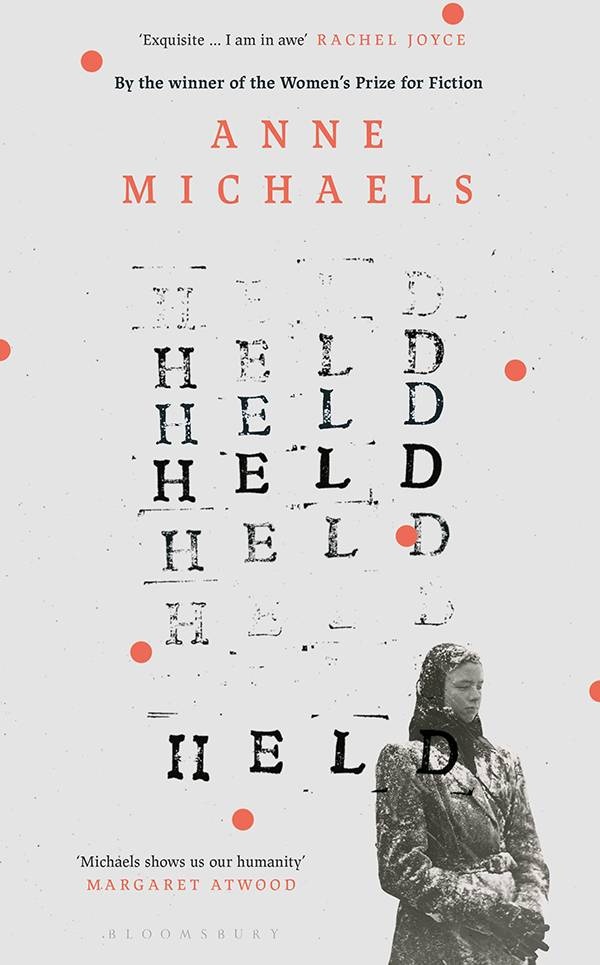
Held
About this book
In 1917, John lies injured on a battlefield and survives with memories that return as images. After the war he works as a photographer, trying to understand whether a camera preserves presence or merely gives absence a sharper edge.
The narrative moves through John and Helena, their descendants, and lives touched by later wars and disasters. People appear briefly and reappear through another person’s memory, so chronology gives way to the way grief actually travels through a family.
Science, spiritualism, medicine, and art provide different languages for experiences that none can finally prove. The novel does not ask the reader to choose whether the dead are literally present; it asks what changes when the living behave as though connection persists.
Held is a short, formally layered novel by Anne Michaels. Its compressed scenes reward slow reading, joining the physical history of the twentieth century to an intimate study of how love outlasts the evidence on which certainty depends.
Read a sample
5,029 words
Plain text
From the opening
We know life is finite. Why should we believe death lasts forever?
The shadow of a bird moved across the hill; he could not see the bird.
Certain thoughts comforted him:
Desire permeates everything; nothing human can be cleansed of it.
We can only think about the unknown in terms of the known.
The speed of light cannot reference time.
The past exists as a present moment.
Perhaps the most important things we know cannot be proven.
He did not believe that the mystery at the heart of things was amorphous or vague or a discrepancy, but a place in us for something absolutely precise. He did not believe in filling that space with religion or science, but in leaving it intact; like silence, or speechlessness, or duration.
Perhaps death was Lagrangian, perhaps it could be defined by the principle of stationary action.
Asymptotic.
Mist smouldered like cremation fires in the rain.
It was possible that the blast had taken his hearing. There were no trees to identify the wind, no wind, he thought, at all. Was it raining? John could see the air glistening, but he couldn’t feel it on his face.
The mist erased all it touched.
Through the curtain of his breath he saw a flash, a shout of light.
It was very cold.
Somewhere out there were his precious boots, his feet. He should get up and look for them.
When had he eaten last?
He was not hungry.
Memory seeping.
The snow fell, night and day, into the night again. Silent streets; impossible to drive. They decided they would walk to each other across the city and meet in the middle.
The sky, even at ten o’clock at night, was porcelain, a pale solid from which the snow detached and fell. The cold was cleansing, a benediction. They would each leave at the same time and keep to their route, they would keep walking until they found each other.
In the distance, in the heavy snowfall, John saw fragments of her–elliptic, stroboscopic–Helena’s dark hat, her gloves. It was hard yet to tell how far away she was. He shook the snow from his hat so she might see him too. Yes, she lifted her arms above her head to wave. Only her hat and gloves and the powdery yellow blur of the streetlamps were visible against the whiteness of sky and earth. He could barely feel his feet or his fingers, but the rest of him was warm, almost hot, from walking. He pulsed with the sight of her, the vestige of her. She was everything that mattered to him. He felt inviolable trust. They were close now but could not make their way any faster. Somewhere between the library and the bank, they gripped each other as if they were the only two humans left in the world.
Her small ways known only to him. That Helena matched her socks to her scarf even when no one could see them in her boots. That she kept beside the bed, superstitiously unfinished, the novel she had been reading in the park the day they understood they would always be together. The paper-thin leather gloves she found in the pocket of the men’s tweed coat she bought from the jumble sale. Her mother’s ring that she wore only when she wore a certain blouse. That she left her handbag at home and slipped a five-shilling note in her book when she went to the park to read. The boiled sweets tin she kept her foreign change in.
Helena carried the handbag he had bought for her on the Hill Road, soft brown leather, with a clasp in the shape of a flower. She wore the silk scarf she had found in the market, made hers now by her scent, autumn colours with a dark green border, and her tweed coat with velvet under the collar. How many times had he felt that velvet when he held open her coat for her. A finite number. Every pleasure in a day or a life, numbered. But pleasure was also countless, beyond itself–because it remained, even only in memory; and in your body, even when forgotten. Even the stain of pleasure and its taunting: loss. The finite as unmanageable as the infinite.
They walked to his flat and left their wet clothes at the door. No need to turn on the lights. The blinds were up, the room snow-lit. White dusk, impossible light. John was always surprised, he never stopped being astonished, at how little there was of her, she was tiny it seemed to him, and so gentle and fierce he couldn’t breathe. He had bought the scented powder she liked and he filled the tub. He added too much and the foam spilled over the steaming edge. ‘A snowbank,’ she said.
The young soldier was lying only a few metres away. How long had the boy been staring? John wanted to call out to him, make a joke of it, but couldn’t find his voice.
Pinned to the ground, no weight upon him.
Who would believe light could fell a man.
John’s child-hand in his mother’s hand. The paper bag of chestnuts from the vendor with the brazier in front of the shops, too hot to hold without mittens. Leaning against his mother’s heavy wool coat. Her smooth handbag against his cheek. Peeling the brown paper skins of the chestnuts to the steaming meat. The tram squealing on the track. The edge of his mother’s apron escaping from the edge of her coat, the apron she forgot to take off, the apron she always wore. Trams, queues, the smells of fish and petrol. Her softness against his hard childhood. Her scent before he succumbed to sleep, the burnished warmth of her necklace as she leaned over to him. The lamp left on.
Continue reading the sampleClose the sample
The inn had been built beside the rail tracks, next to the rural station, in a river valley. Long ago, the inn and the valley had been a tourist destination, promoted by the train company for its view of the mountains, the wildflower meadows, the aromatic pines and betony. The rail tracks were shadowed by the slow river, like a mother struggling to keep up with her child, silver lines running the length of the vale.
Helena had been heading for the larger town beyond, but had fallen asleep. She could not stop herself from drifting off, succumbing as if drugged by the motion of the train. And when the train stopped at the last station before the town, she had, half asleep, misunderstood the conductor booming out the next stop and had grabbed her satchel and disembarked a station too early.
Beyond the dim lamp by the exit, it was dark–profound country darkness. She felt foolish and slightly afraid; the deserted platform, the locked waiting room. She was about to sit on the single cold bench and wait for daylight, when she heard laughter in the distance. Later, she would tell him she heard singing, though John remembered no music at all. She stood at the exit, not wanting to leave the pitiful protection of that single dusty bulb in the station. But, leaning into the darkness, she saw, some distance away, the inviting pool of light of the inn.
Later, she would imbue the short walk in the darkness towards that corona of light–the endless fields of invisible grasses rustling around her–with the qualities of a dream; the inevitability of it, the foreknowledge.
Looking into the front window, Helena saw a room enclosed in a time of its own. An inn of legend, of folklore–warmth and woodsmoke. Faded upholstered armchairs, scarred wooden tables and benches, stone floors, massive fireplace, with a store of logs to last the coldest winter, stacked from floor to ceiling, the self-perpetuating supply of a fairy tale, each log, she imagined, magically replacing itself over the centuries. John watched as she sat down nearby. It was, to him, an encounter of sudden intimacy in this public place; the angle of her head, her posture, her hands. He watched as a man–soused and staggering, every careful step an acknowledgement of the spinning earth and its axial tilt–fell into the vacant chair opposite her, giving Helena a slow, marinated gaze until his head fell, weighty as a curling stone, and slid across the table. John and another onlooker jumped up to help at the same time and, between them, dragged the man to the back of the pub to sleep it off. When John returned, he found his own table taken by a couple who did not look up, already lost to the room around them.
‘I’m so sorry,’ Helena said, quickly gathering her coat and satchel, ‘please, take this table.’
He insisted she stay. With a great effort past shyness, she asked if he would care to sit with her. Later she would tell him of the feeling that passed through her, inexplicable, momentary, not even a thought: that if he sat down she would be sharing a table with him for the rest of her life.
In the little window in the hallway, from the heat of the bath, they could see the snow falling.
The black lines of the trees reminded him of a winter field he’d once seen from the window of a train. And the black sea of evening, and the deep black bonnet and apron of his grandmother climbing up from the harbour, knitting all the while, leading their ancient donkey burdened with heavy baskets of crab. All the women in the village wore their tippie and carried their knitting easy to hand, under their arm or in their apron pocket, sleeves and sweater-fronts, filigree work, growing steadily over the course of the day. Each village with its own stitch; you could name a sailor’s home port by the pattern of his gansey, which contained a further signature–a deliberate error by which each knitter could identify her work. Was an error deliberately made still an error? Coastal knitters cast their stitches like a protective spell to keep their men safe and warm and dry, the oil in the wool repelling the rain and sea spray, armour passed down, father to son. They knitted shorter sleeves that did not need to be pushed out of the way of work. Dense worsted, faded by the salt wind. The ridge and furrow stitch, like the fields in March when they put in the potatoes. The moss stitch, the rope stitch, the honeycomb, the triple sea wave, the anchor; the hailstone stitch, the lightning, diamonds, ladders, chains, cables, squares, fishnets, arrows, flags, rigging. The Noordwijk bramble stitch. The black and white socks of Terschelling (two white threads, a single black). The Goedereede zigzag. The tree of life. The eye of God over the wearer’s heart.
If a sailor lost his life at sea, before his body was committed to the deep, his gansey was removed and returned to his widow. If a fisherman washed ashore, he was carried home to his village, the stitch of his sweater as good as a map. And once he was restored to home port, his widow could claim his beloved body by a distinctive talisman–the deliberate error in a sleeve, a waistband, a cuff, a shoulder, the broken pattern as definitive as a signature on a document. The error was a message sent into darkness, the stitch of calamity and terror, a signal to the future, from wife to widow. The prayer that, wherever found, a man might be returned to his family and laid to rest. That the dead would not lie alone. The error of love that proved its perfection.
There were rules of the sea that also applied to life on land and any sailor, knowing the changing face of the deep, was a fool to ignore a warning. If, in the early morning, on the way to the docks, a fisherman encountered a hare or a priest or looked into the face of a woman–even wife, daughter, sister, mother–he would not dare sail that day. Along the dawn streets to the North Sea harbours, women dutifully turned their backs to the men. And after death too, there were strict rules of passage. In the villages, the coffins were carried thus: fishermen bearing fishermen, women bearing women, land folk bearing land folk.
His father had given up the sea for the fields. Sailor or farmer, what kind of freedom had his father known, or his grandfather? The freedom of a man breaking his back to plant his own harvest.
When John remembered his father, he seemed only able to recall fragments–deep feeling, but only pieces–moments together, not even days. Years, an entire life–now only this handful, this heartful.
Stories told on a battlefield, on a life raft, in a hospital ward at night. In a café that will disappear before morning. Someone overhears. Someone listens, attentive with all his heart. No one listens. The story told to one who is slipping into sleep, or into unconsciousness, never to wake. The story told to one who survives who will tell that story to a child, who will write it down in a book, to be read by a woman in a country or a time not her own. The story told to oneself. The fervent confession. The meandering, repetitive search for meaning in a gesture, in a moment that has eluded the speaker’s understanding for a lifetime. Stories incomprehensible to the listener yet received nonetheless–by darkness, by the wind, by a place, by an unperceiving or unperceived pity, even by indifference.
What we give cannot be taken from us.
It was late now. Outside the inn, there was only the dim light of the station and the stars beyond.
John could not explain what he felt–it seemed that he and Helena had been there before, that they were enacting something, that everything they spoke had been somehow fated. He felt that if he returned to the inn the next day, it would not exist, she would not exist.
He said he would wait with her until her train came. He wondered why she was not afraid of him, a stranger in this isolated place. He was a little afraid of her.
Inside the warm inn, they had talked about second chances. Outside, in the cool night, it seemed they had known each other always. He almost reached for her hand.
He would understand, later, that there is a moment when your life must become your own; you must claim it from all the other stories you’ve been given, that have been handed down or thrust upon you, or that you’ve been left holding while someone else claimed theirs. He already knew that the life unchosen, left behind because of cowardice or shame, does not wither. But instead, without exception, grows rampant, choking the path ahead.
It would be like stepping out of one’s clothes, he thought. Like entering the sea, where you can no longer tell where your skin begins.
He had never considered before that drowning could be a gentle death. But perhaps the sea might be the best place to die after all. The sea, where, like memory–he had once written down–the elusiveness of the form is the form. Before this moment he would have said there was discipline in such mental detachment. Now he thought, when something is detached, it is broken.
Impossible to name the exact moment night falls, elusive as the moment sleep overtakes us.
The water he washed with stank in his helmet, a pool too filthy to hold a reflection. As if the dimmet itself were whispering, he could hear Gillies’ voice. At first, he didn’t know if Gillies was talking to himself or someone else, but soon John understood that Gillies’ words were meant for him. Somewhere along the way, they had thrown in their lot together. John had learned the three kinds of twilight–astronomical, nautical, civil–from his father, but in that place it was as hard to tell the age of the dawn as to tell the age in a man’s face. Gillies was twelve years older than John and had already been stitched up more than once. ‘In the hospital at Sarnesfield,’ Gillies said, ‘there was a nurse, the Miss Ella Leather. She sang to us when the ward was dark, with only a little lamp by each bed…’
The dawn was a kind of scum over everything.
Oh no for another I will not seek, not as long as I do live…
For I never never had but one true love, and he lies fast asleep…
‘I won’t say no one cried,’ said Gillies.
Her breasts fit perfectly in his hands.
He felt a presence, a thermal current, a tremor across the entire surface of things, like a heat mirage. A deepening, not a darkening. He knew he’d felt it because immediately he felt something even more certain and powerful: its dousing. Drowned by his clumsy incomprehension, his limitation, his twitch of doubt.
The snow in the dusk made him wonder if light was rising from the ground.
Would he know the moment of his death or would it be like night falling.
John’s grandfather had been washed ashore and carried home to his village, restored by the pattern across his chest and the deliberate error in his sleeve.
All the sailors that summer who had washed ashore–Adrianus, Martinus, William, Jens, Arie, Thomas, Dirk, Joos, Hendrik, James, Luc, Dorus, Edward–and all the women of the North Sea ports who had earned a new title ahead of the family name: Widow Maris, Widow Fischer, Widow Langlands, Widow Martin, Widow Hansen, Widow Meijer, Widow Williamson, Widow Fairnie, Widow Troost…
Some maintain this is hearsay, that there is no evidence of sailors ever being returned home by way of a knitted cable crossing the wrong way. But, like everything we find hard to believe, it need only have happened once to be true.
Cold blows the wind o’er my true love, cold blows the drops of rain…
‘I won’t say no one died listening to her,’ said Gillies.
Perhaps consciousness only occurred when there were enough humans alive to generate the spark, to seal the circuit, the critical mass for the grain of sand to become the dune, the synapse to allow a flock to change direction in an instant. There would be other metaphors later–the chiasmata, the interchange, the crossing over. The cable crossing the wrong way.
Is the soul in death, consciousness without matter?
There was that church near Siena with its gargoyle, a head with two bodies. Would it be more of a torment to have two heads with one body?
Everything, he thought, is dualistic, nothing is alone: the snow growing brighter only as dusk deepens.
It was snowing hard now, why did he not feel cold?
He remembered feeling pain. Why did he not feel it now?
The pub was almost empty; the drunken man who had brought them together, asleep still. John would wait with Helena at the station, hours yet before morning. Her chestnut hair gleaming, her tweed coat with its prim collar. She was graceful, earnest, searching, gentle, he did not know how to belong to anyone, how would he let her go.
‘Pity doesn’t give us any right over another human being,’ she said, ‘or give any human being a right over us.’
‘It’s a form of judgement,’ he said.
‘Pity isn’t love,’ she said.
Who had ever spoken to him this way?
‘And mercy?’ he asked. Mercy is another form of judgement, he thought. Bestowed…but still, a judgement. What is agape then? A surrender to the good.
‘I can understand falling asleep and missing your stop, but who falls asleep only to get off the train too soon?’ Helena laughed. And then suddenly she looked as astonished as he felt, as if an enchantment had brought her to this inexplicable place, sitting across a table from each other. How could events of such fragile chance feel exactly like inevitability? How many countless switch points had been necessary to bring them together at this table, this country night at the end of summer, under the ancient map of the stars, a map that had already passed out of existence, yet luminous and clear.
Faith uses the mechanism of doubt to prove itself. It is absence that proves what was once present. We can understand without proof, he thought, we can prove without understanding.
In the mudhole, no one had spoken, it seemed, for hours.
Can you hear a man thinking in the dark? Yes.
‘I can cover the moon with my hand,’ said Gillies.
Snow fell on this field in the Iron Age, in the Bronze Age, on those buried beneath him, the distant trees like a runic Snellen chart. Soon, he thought, he would no longer be able to read the smallest line.
Where John and Helena waited near the train station, the road marker had been effaced by rain, each letter only the softest indentation, as if a finger were capable of erasing stone.
The night grew around them by degree, by slow permeation. Like sea fret, like love, that gradually soaks us through.
He would have to remember to write it in his diary, when he could reach his pocket, still a bit of pencil left: if you take the wrong road, you will never reach the meeting place.
What does a mother say to her child when he wakes in the night, his soul sick with fear? That he is safe in her arms, loved by her forever, nothing can end this love she holds him in, love without end. And he looks into her face, the face of unalloyed love, and slowly he lets this love suffuse him, and they fall asleep in each other’s arms, old mother and grown son, separated by hundreds of miles.
Perhaps in death, he thought, we lose the details and keep only the feeling associated with those details. Is that what the soul knows in death–the separation of feelings from memory?
The tweed of her coat, the silk of her dress.
He came home from school to find his mother lying on the bed–never in all his life had he seen her lie down during the day. She was on her side; he saw her ribs and hip bone. She hadn’t even taken off her shoes, the worn, black, lace-up shoes she always wore. He would never forget his tenderness and fear. She held out her hand and he lay down beside her.
How old had he been? Not more than twelve or thirteen. His father newly dead. Not much younger really than the young soldier watching him now, who he could almost touch, if he could only reach out his arm.
No escape from the pain of faith even in this darkness, even when belief is completely disassembled; if the parts could be fitted back together, would it be a lantern or a gun? Any word the heart speaks, even the bitterest renunciation or scorn, hangs in the air waiting for a response.
His mother fell asleep and, lying next to her, he listened to the rain. The warm summer rain, his mother often said, that made her want to run outside to feel it on her arms, to raise her face to it.
And if he died here? In this filth instead of the clean brine, without a gansey the colour of the night sea, soaked and clinging to his skin, cold and heavy as chain-mail, no one to recognise the error?
Meals in the small garden, rushing inside to undress, the next day finding their teacups in the grass, filled with rain.
The thin pale cotton of Helena’s nightgown, worn sheer with sleep; the faint shadow of her bare legs.
The young soldier, not more than two arm lengths away, continued to watch him without speaking.
The shadow of the bird’s folding and unfolding, like a silk scarf in the wind, wings against the sky like the turning of a page inside out, a message passing between them.
How alert the dead soldier looked, how absolutely, utterly awake.
II
RIVER ESK, NORTH YORKSHIRE, 1920
Sunday morning, the bells tolling eternity. John forced himself to be still. Helena beside him, swimming in the river of sleep, her cotton nightgown riding up under her arms, her hair floating around her. The church at Hull, stained glass melted to liquid. The French in Reims wearing their Prussian-avenging red trousers. Frenchmen, trenchmen. The 450-mile-long grave.
John stood in their small kitchen as if lost. Helena had to ask him to sit down. His lame leg extended. He reached his hand to the light falling across the table. As if he could pick it up, she thought, as if he could not believe it.
The train hurtling home, eating into the future; its wake of smoke the burning away of possibilities, chances already extinguished. In each direction, torpor lurking behind every action, a draining of momentum in every decision. Fear so tirelessly attached to hope, it was hard to tell the difference between them.
Helena scrubbed clean the potatoes and carrots, chopped them, slid them into a pan. The innocent earth they’d come from.
She filled the teapot and sat down next to him. She took his hand.
‘Does Mrs Harvey still live next door?’ John asked.
‘Yes,’ she said.
‘Is that her Jip barking?’ he asked.
‘Yes.’
She watched him take in this information, as if it were an instruction, as if he had asked for directions.
From the edge of the North Sea, twenty miles distant, a faint hum reached the stone ear, the acoustic mirror that faced the sea. The measured drone of an aircraft engine twenty miles away. Fifteen precious minutes’ warning.
He had once possessed another faculty, a resilience he was only aware of now that it was gone, undetectable as a tide in a river; his father had told him of a boat that looked perfectly whole as it sank, weeping water from every seam. Invisible as the radio waves and cosmic rays that pass through us, the seiches and forces of history that restrict us, shape our assumptions, compassions, freedoms, judgements; the regrets of one generation passed down as hopes for the next, the germs and spores of limitation and expectation we absorb from the social atmosphere. How a bird struggling against the wind can appear motionless.
On his first Sunday home, they drove to Molk Hole. In the early mist, the chalk cliffs looked like icebergs. They watched the blizzard of birds, kittiwakes devouring their own questions, cries echoing against the cliffs. John held Helena’s hand and felt the signet ring that had been her mother’s, a hair’s width of gold, like a pencil line around her finger. M for Mara; on her hand now, M for mother.
‘We could run away,’ Helena had whispered, before he’d joined up, next to him in the dark.
‘Where would we go?’
Long silence. ‘St Kilda.’
He’d laughed. ‘We’d stick out like scarecrows.’
Even she had to laugh at herself, until indignant.
Now John knew he’d been wrong to laugh. He couldn’t live without her fierceness for their sake, together. She had woken him in the middle of the night: what had conscription to do with them? Now, as she drew her hand to her hair to keep it back in the wind, he saw her nape bare above her sweater. All the secret softnesses he was allowed to touch. ‘We could find a cave somewhere,’ she’d plotted in the dark, ‘we could hide the smoke from our cooking fire, we could live on nettles and forage the sea…’
Now they stood on the cliffs again. He could not understand how he had been so lucky–to be left for dead, gutted, thrown back.
While supper cooked, we built a house on the kitchen table with stones from the beach. Sometimes, down from the mountain, so tired from the climb, supper was soup from a tin, biscuits torn from a package, a square of chocolate by the fire. The house had once been a mill on a thread of water. We read to each other in the continuous sound of brook and sea, slept under blankets heavy as the night enclosing. What happened to the switchman’s lantern, the stones on the table? Who reads my father’s book of Tolstoy’s stories under the blanket? There was another house, a plank hut by a tarn, a bed, a table, a scrap of rug, a sink, a woodstove, the painted shutters, the childhood story told in the dark. Your blue shirt. The sea was as large as death, you said, its crashing so loud, even at the supper table we had to whisper. Mouths and ears. Stars like daylight through a weave of curtain. We’ve never lived far from the sound or sight of water. There was the worker’s cottage in the town that aluminium built, and the pub in the middle of the field where we woke to frost on every filament and fibre, stalk, stave and stone, silver filigrees of microscopic precision. We found the road to the ruins at dusk. Biscuits, a flask of tea in the car. Our sleeves wet out the car window, washing our cups in the rain.
I’m writing this, John, not because I think you’ve forgotten, but because I know you remember.
Above the sea smoke, in the echo chamber of the cliffs, the persistent calls of the kittiwakes, as if hoping for a different answer. All along the coast, the stone mirrors, listening.
The photography studio, which they lived above, had been closed since the day he enlisted. Now he raised the blinds in the storefront and took stock of what was needed. John saw that Helena had painted and chalked new backdrops for the studio–a summer garden, a distant view of meadow and mountains, an Italianate terrace, a piano.