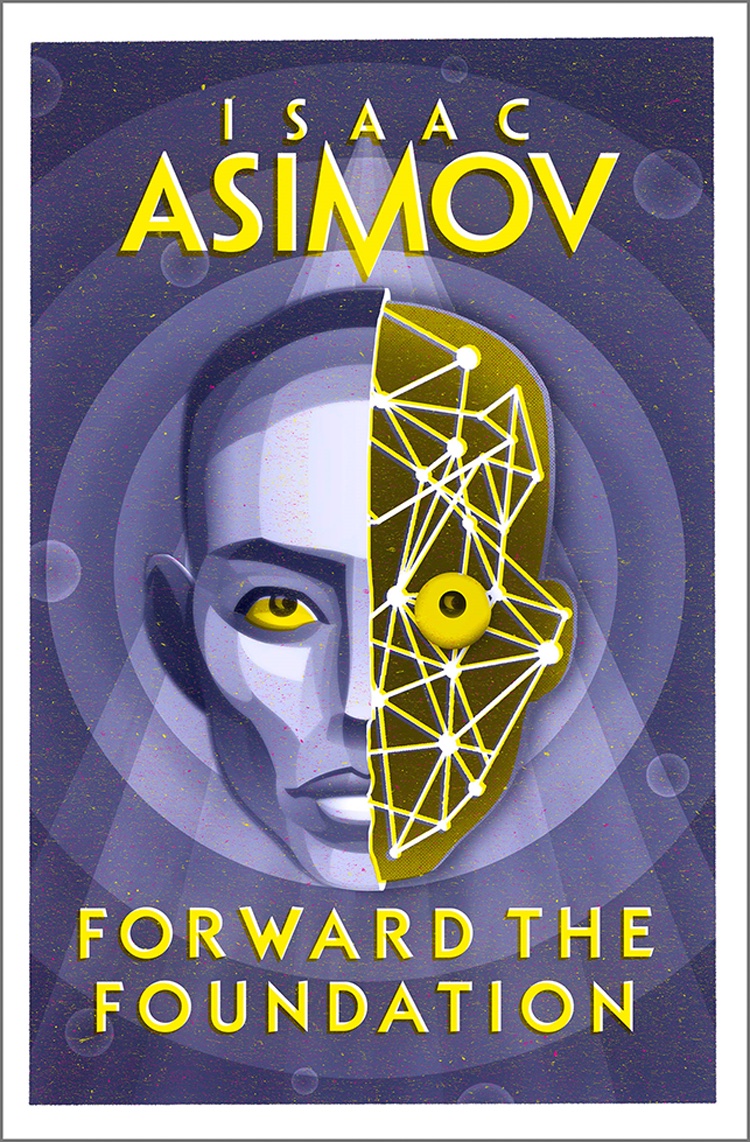
Forward the Foundation
About this book
Forward the Foundation follows Hari Seldon across the later decades of his life. Psychohistory has moved from a disputed possibility to a working discipline, but the equations remain fragile and the Empire supplying their data is deteriorating around them. Seldon must preserve the project long enough to create the two Foundations on which his shortened future will depend.
The novel is arranged in four large movements centered on Eto Demerzel, Emperor Cleon I, Dors Venabili, and Wanda Seldon. Political crises enter the work at Streeling University; changes in government alter what research is possible; friends and colleagues who once seemed permanent gradually disappear. The fall of the Empire is measured as much through absence as through public catastrophe.
This structure makes the book feel closer to a biography than a single continuous adventure. Seldon grows older, the people around him acquire histories of their own, and psychohistory becomes an institution that must survive its founder. Its greatest obstacles are not only mathematical. Time, money, secrecy, and grief all enter the calculation.
Asimov's final Foundation novel closes the space between Prelude to Foundation and the opening of Foundation. The ending is already known, which gives the story its quiet pressure: every apparent success brings Seldon closer to the future he predicted and to the personal losses that prediction could not prevent.
Read a sample
5,009 words
Plain text
From the opening
PART 1
ETO DEMERZEL
DEMERZEL, ETO— … While there is no question that Eto Demerzel was the real power in the government during much of the reign of Emperor Cleon I, historians are divided as to the nature of his rule. The classic interpretation is that he was another in the long line of strong and ruthless oppressors in the last century of the undivided Galactic Empire, but there are revisionist views that have surfaced and that insist his was, if a despotism, a benevolent one. Much is made, in this view, of his relationship with Hari Seldon, though that remains forever uncertain, particularly during the unusual episode of Laskin Joranum, whose meteoric rise—
ENCYCLOPEDIA GALACTICA[1]
1 “I tell you again, Hari,” said Yugo Amaryl, “that your friend Demerzel is in deep trouble.” He emphasized the word “friend” very lightly and with an unmistakable air of distaste.
Hari Seldon detected the sour note and ignored it. He looked up from his tricomputer and said, “I tell you again, Yugo, that that’s nonsense.” And then—with a trace of annoyance, just a trace—he added, “Why are you taking up my time by insisting?”
“Because I think it’s important.” Amaryl sat down defiantly. It was a gesture that indicated he was not going to be moved easily. Here he was and here he would stay.
Eight years before, he had been a heatsinker in the Dahl Sector—as low on the social scale as it was possible to be. He had been lifted out of that position by Seldon, made into a mathematician and an intellectual—more than that, into a psychohistorian.
Never for one minute did he forget what he had been and who he was now and to whom he owed the change. That meant that if he had to speak harshly to Hari Seldon—for Seldon’s own good—no consideration of respect and love for the older man and no regard for his own career would stop him. He owed such harshness—and much more—to Seldon.
“Look, Hari,” he said, chopping at the air with his left hand, “for some reason that is beyond my understanding, you think highly of this Demerzel, but I don’t. No one whose opinion I respect—except you—thinks well of him. I don’t care what happens to him personally, Hari, but as long as I think you do, I have no choice but to bring this to your attention.”
Seldon smiled, as much at the other’s earnestness as at what he considered to be the uselessness of his concern. He was fond of Yugo Amaryl—more than fond. Yugo was one of the four people he had encountered during that short period of his life when he was in flight across the face of the planet Trantor—Eto Demerzel, Dors Venabili, Yugo Amaryl, and Raych—four, the likes of which he had not found since.
In a particular and, in each case, different way, these four were indispensable to him—Yugo Amaryl, because of his quick understanding of the principles of psychohistory and of his imaginative probings into new areas. It was comforting to know that if anything happened to Seldon himself before the mathematics of the field could be completely worked out—and how slowly it proceeded, and how mountainous the obstacles—there would at least remain one good mind that would continue the research.
He said, “I’m sorry, Yugo. I don’t mean to be impatient with you or to reject out of hand whatever it is you are so anxious to make me understand. It’s just this job of mine; it’s this business of being a department head—”
Amaryl found it his turn to smile and he repressed a slight chuckle. “I’m sorry, Hari, and I shouldn’t laugh, but you have no natural aptitude for the position.”
“As well I know, but I’ll have to learn. I have to seem to be doing something harmless and there is nothing—nothing—more harmless than being the head of the Mathematics Department at Streeling University. I can fill my day with unimportant tasks, so that no one need know or ask about the course of our psychohistorical research, but the trouble is, I do fill my day with unimportant tasks and I have insufficient time to—” His eyes glanced around his office at the material stored in computers to which only he and Amaryl had the key and which, even if anyone else stumbled upon them, had been carefully phrased in an invented symbology that no one else would understand.
Amaryl said, “Once you work your way further into your duties, you’ll begin to delegate and then you’ll have more time.”
“I hope so,” said Seldon dubiously. “But tell me, what is it about Eto Demerzel that is so important?”
“Simply that Eto Demerzel, our great Emperor’s First Minister, is busily creating an insurrection.”
Seldon frowned. “Why would he want to do that?”
“I didn’t say he wants to. He’s simply doing it—whether he knows it or not—and with considerable help from some of his political enemies. That’s all right with me, you understand. I think that, under ideal conditions, it would be a good thing to have him out of the Palace, off Trantor … beyond the Empire, for that matter. But you think highly of him, as I’ve said, and so I’m warning you, because I suspect that you are not following the recent political course of events as closely as you should.”
Continue reading the sampleClose the sample
“There are more important things to do,” said Seldon mildly.
“Like psychohistory. I agree. But how are we going to develop psychohistory with any hope of success if we remain ignorant of politics? I mean, present-day politics. Now—now—is the time when the present is turning into the future. We can’t just study the past. We know what happened in the past. It’s against the present and the near future that we can check our results.”
“It seems to me,” said Seldon, “that I have heard this argument before.”
“And you’ll hear it again. It doesn’t seem to do me any good to explain this to you.”
Seldon sighed, sat back in his chair, and regarded Amaryl with a smile. The younger man could be abrasive, but he took psychohistory seriously—and that repaid all.
Amaryl still had the mark of his early years as a heatsinker. He had the broad shoulders and the muscular build of one who had been used to hard physical labor. He had not allowed his body to turn flabby and that was a good thing, for it inspired Seldon to resist the impulse to spend all of his time at the desk as well. He did not have Amaryl’s sheer physical strength, but he still had his own talents as a Twister—for all that he had just turned forty and could not keep it up forever. But for now, he would continue. Thanks to his daily workouts, his waist was still trim, his legs and arms firm.
He said, “This concern for Demerzel cannot be purely a matter of his being a friend of mine. You must have some other motive.”
“There’s no puzzle to that. As long as you’re a friend of Demerzel, your position here at the University is secure and you can continue to work on psychohistorical research.”
“There you are. So I do have a reason to be friends with him. It isn’t beyond your understanding at all.”
“You have an interest in cultivating him. That, I understand. But as for friendship—that, I don’t understand. However—if Demerzel lost power, quite apart from the effect it might have on your position, then Cleon himself would be running the Empire and the rate of its decline would increase. Anarchy might then be upon us before we have worked out all the implications of psychohistory and made it possible for the science to save all humanity.”
“I see. —But, you know, I honestly don’t think that we’re going to work out psychohistory in time to prevent the Fall of the Empire.”
“Even if we could not prevent the Fall, we could cushion the effects, couldn’t we?”
“Perhaps.”
“There you are, then. The longer we have to work in peace, the greater the chance we will have to prevent the Fall or, at least, ameliorate the effects. Since that is the case, working backward, it may be necessary to save Demerzel, whether we—or, at least, I—like it or not.”
“Yet you just said that you would like to see him out of the Palace and away from Trantor and beyond the Empire.”
“Yes, under ideal conditions, I said. But we are not living under ideal conditions and we need our First Minister, even if he is an instrument of repression and despotism.”
“I see. But why do you think the Empire is so close to dissolution that the loss of a First Minister will bring it about?”
“Psychohistory.”
“Are you using it for predictions? We haven’t even gotten the framework in place. What predictions can you make?”
“There’s intuition, Hari.”
“There’s always been intuition. We want something more, don’t we? We want a mathematical treatment that will give us probabilities of specific future developments under this condition or that. If intuition suffices to guide us, we don’t need psychohistory at all.”
“It’s not necessarily a matter of one or the other, Hari. I’m talking about both: the combination, which may be better than either—at least until psychohistory is perfected.”
“If ever,” said Seldon. “But tell me, where does this danger to Demerzel arise? What is it that is likely to harm him or overthrow him? Are we talking about Demerzel’s overthrow?”
“Yes,” said Amaryl and a grim look settled on his face.
“Then tell me. Have pity on my ignorance.”
Amaryl flushed. “You’re being condescending, Hari. Surely you’ve heard of Jo-Jo Joranum.”
“Certainly. He’s a demagogue—Wait, where’s he from? Nishaya, right? A very unimportant world. Goat herding, I think. High-quality cheeses.”
“That’s it. Not just a demagogue, however. He commands a strong following and it’s getting stronger. He aims, he says, for social justice and greater political involvement by the people.”
“Yes,” said Seldon. “I’ve heard that much. His slogan is: ‘Government belongs to the people.’”
“Not quite, Hari. He says: ‘Government is the people.’”
Seldon nodded. “Well, you know, I rather sympathize with the thought.”
“So do I. I’m all for it—if Joranum meant it. But he doesn’t, except as a stepping-stone. It’s a path, not a goal. He wants to get rid of Demerzel. After that it will be easy to manipulate Cleon. Then Joranum will take the throne himself and he will be the people. You’ve told me yourself that there have been a number of episodes of this sort in Imperial history—and these days the Empire is weaker and less stable than it used to be. A blow which, in earlier centuries, merely staggered it might now shatter it. The Empire will welter in civil war and never recover and we won’t have psychohistory in place to teach us what must be done.”
“Yes, I see your point, but surely it’s not going to be that easy to get rid of Demerzel.”
“You don’t know how strong Joranum is growing.”
“It doesn’t matter how strong he’s growing.” A shadow of thought seemed to pass over Seldon’s brow. “I wonder that his parents came to name him Jo-Jo. There’s something juvenile about that name.”
“His parents had nothing to do with it. His real name is Laskin, a very common name on Nishaya. He chose Jo-Jo himself, presumably from the first syllable of his last name.”
“The more fool he, wouldn’t you say?”
“No, I wouldn’t. His followers shout it—‘Jo … Jo … Jo … Jo’—over and over. It’s hypnotic.”
“Well,” said Seldon, making a move to return to his tricomputer and adjust the multidimensional simulation it had created, “we’ll see what happens.”
“Can you be that casual about it? I’m telling you the danger is imminent.”
“No, it isn’t,” said Seldon, eyes steely, his voice suddenly hardening. “You don’t have all the facts.”
“What facts don’t I have?”
“We’ll discuss that another time, Yugo. For now, continue with your work and let me worry about Demerzel and the state of the Empire.”
Amaryl’s lips tightened, but the habit of obedience to Seldon was strong. “Yes, Hari.”
But not overwhelmingly strong. He turned at the door and said, “You’re making a mistake, Hari.”
Seldon smiled slightly. “I don’t think so, but I have heard your warning and I will not forget. Still, all will be well.”
And as Amaryl left, Seldon’s smile faded. —Would, indeed, all be well?
2
But Seldon, while he did not forget Amaryl’s warning, did not think of it with any great degree of concentration. His fortieth birthday came and went—with the usual psychological blow.
Forty! He was not young any longer. Life no longer stretched before him as a vast uncharted field, its horizon lost in the distance. He had been on Trantor for eight years and the time had passed quickly. Another eight years and he would be nearly fifty. Old age would be looming.
And he had not even made a decent beginning in psychohistory! Yugo Amaryl spoke brightly of laws and worked out his equations by making daring assumptions based on intuition. But how could one possibly test those assumptions? Psychohistory was not yet an experimental science. The complete study of psychohistory would require experiments that would involve worlds of people, centuries of time—and a total lack of ethical responsibility.
It posed an impossible problem and he resented having to spend any time whatever on departmental tasks, so he walked home at the end of the day in a morose mood.
Ordinarily he could always count on a walk through the campus to rouse his spirits. Streeling University was high-domed and the campus gave the feeling of being out in the open without the necessity of enduring the kind of weather he had experienced on his one (and only) visit to the Imperial Palace. There were trees, lawns, walks, almost as though he were on the campus of his old college on his home world of Helicon.
The illusion of cloudiness had been arranged for the day with the sunlight (no sun, of course, just sunlight) appearing and disappearing at odd intervals. And it was a little cool, just a little.
It seemed to Seldon that the cool days came a little more frequently than they used to. Was Trantor saving energy? Was it increasing inefficiency? Or (and he scowled inwardly as he thought it) was he getting old and was his blood getting thin? He placed his hands in his jacket pockets and hunched up his shoulders.
Usually he did not bother guiding himself consciously. His body knew the way perfectly from his offices to his computer room and from there to his apartment and back. Generally he negotiated the path with his thoughts elsewhere, but today a sound penetrated his consciousness. A sound without meaning.
“Jo … Jo … Jo … Jo …”
It was rather soft and distant, but it brought back a memory. Yes, Amaryl’s warning. The demagogue. Was he here on campus?
His legs swerved without Seldon’s making a conscious decision and brought him over the low rise to the University Field, which was used for calisthenics, sports, and student oratory.
In the middle of the Field was a moderate-sized crowd of students who were chanting enthusiastically. On a platform was someone he didn’t recognize, someone with a loud voice and a swaying rhythm.
It wasn’t this man, Joranum, however. He had seen Joranum on holovision a number of times. Since Amaryl’s warning, Seldon had paid close attention. Joranum was large and smiled with a kind of vicious camaraderie. He had thick sandy hair and light blue eyes.
This speaker was small, if anything—thin, wide-mouthed, dark-haired, and loud. Seldon wasn’t listening to the words, though he did hear the phrase “power from the one to the many” and the many-voiced shout in response.
Fine, thought Seldon, but just how does he intend to bring this about—and is he serious?
He was at the outskirts of the crowd now and looked around for someone he knew. He spotted Finangelos, a pret-math undergraduate. Not a bad young man, dark and woolly-haired.
“Finangelos,” he called out.
“Professor Seldon,” said Finangelos after a moment of staring as though unable to recognize Seldon without a keyboard at his fingertips. He trotted over. “Did you come to listen to this guy?”
“I didn’t come for any purpose but to find out what the noise was. Who is he?”
“His name is Namarti, Professor. He’s speaking for Jo-Jo.”
“I hear that,” said Seldon as he listened to the chant again. It began each time the speaker made a telling point, apparently. “But who is this Namarti? I don’t recognize the name. What department is he in?”
“He’s not a member of the University, Professor. He’s one of Jo-Jo’s men.”
“If he’s not a member of the University, he has no right to speak here without a permit. Does he have one, do you suppose?”
“I wouldn’t know, Professor.”
“Well then, let’s find out.”
Seldon started into the crowd, but Finangelos caught his sleeve. “Don’t start anything, Professor. He’s got goons with him.”
There were six young men behind the speaker, spaced rather widely, legs apart, arms folded, scowling.
“Goons?”
“For rough stuff, in case anyone tries anything funny.”
“Then he’s certainly not a member of the University and even a permit wouldn’t cover what you call his ‘goons.’—Finangelos, signal through to the University security officers. They should have been here by now without a signal.”
“I guess they don’t want trouble,” muttered Finangelos. “Please, Professor, don’t try anything. If you want me to get the security officers, I will, but you just wait till they come.”
“Maybe I can break this up before they come.”
He began pushing his way through. It wasn’t difficult. Some of those present recognized him and all could see the professorial shoulder patch. He reached the platform, placed his hands on it, and vaulted up the three feet with a small grunt. He thought, with chagrin, that he could have done it with one hand ten years before and without the grunt.
He straightened up. The speaker had stopped talking and was looking at him with wary and ice-hard eyes.
Seldon said calmly, “Your permit to address the students, sir.”
“Who are you?” said the speaker. He said it loudly, his voice carrying.
“I’m a member of the faculty of this University,” said Seldon, equally loudly. “Your permit, sir?”
“I deny your right to question me on the matter.” The young men behind the speaker had gathered closer.
“If you have none, I would advise you to leave the University grounds immediately.”
“And if I don’t?”
“Well, for one thing, the University security officers are on their way.” He turned to the crowd. “Students,” he called out, “we have the right of free speech and freedom of assembly on this campus, but it can be taken away from us if we allow outsiders, without permits, to make unauthorized—”
A heavy hand fell on his shoulder and he winced. He turned around and found it was one of the men Finangelos had referred to as “goons.”
The man said, with a heavy accent whose provenance Seldon could not immediately identify, “Get out of here—fast.”
“What good will that do?” said Seldon. “The security officers will be here any minute.”
“In that case,” said Namarti with a feral grin, “there’ll be a riot. That doesn’t scare us.”
“Of course it wouldn’t,” said Seldon. “You’d like it, but there won’t be a riot. You’ll all go quietly.” He turned again to the students and shrugged off the hand on his shoulder. “We’ll see to that, won’t we?”
Someone in the crowd shouted, “That’s Professor Seldon! He’s all right! Don’t pound him!”
Seldon sensed ambivalence in the crowd. There would be some, he knew, who would welcome a dustup with the University security officers, just on general principles. On the other hand, there had to be some who liked him personally and still others who did not know him but who would not want to see violence against a member of the faculty.
A woman’s voice rang out. “Watch out, Professor!”
Seldon sighed and regarded the large young men he faced. He didn’t know if he could do it, if his reflexes were quick enough, his muscles sturdy enough, even given his prowess at Twisting.
One goon was approaching him, overconfidently of course. Not quickly, which gave Seldon a little of the time his aging body would need. The goon held out his arm confrontationally, which made it easier.
Seldon seized the arm, whirled, and bent, arm up, and then down (with a grunt—why did he have to grunt?), and the goon went flying through the air, propelled partly by his own momentum. He landed with a thump on the outer edge of the platform, his right shoulder dislocated.
There was a wild cry from the audience at this totally unexpected development. Instantly an institutional pride erupted.
“Take them, Prof!” a lone voice shouted. Others took up the cry.
Seldon smoothed back his hair, trying not to puff. With his foot he shoved the groaning fallen goon off the platform.
“Anyone else?” he asked pleasantly. “Or will you leave quietly?”
He faced Namarti and his five henchmen and as they paused irresolutely, Seldon said, “I warn you. The crowd is on my side now. If you try to rush me, they’ll take you apart. —Okay, who’s next? Let’s go. One at a time.”
He had raised his voice with the last sentence and made small come-hither motions with his fingers. The crowd yelled its pleasure.
Namarti stood there stolidly. Seldon leaped past him and caught his neck in the crook of his arm. Students were climbing onto the platform now, shouting “One at a time! One at a time!” and getting between the bodyguards and Seldon.
Seldon increased the pressure on the other’s windpipe and whispered in his ear, “There’s a way to do this, Namarti, and I know how. I’ve practiced it for years. If you make a move and try to break away, I’ll ruin your larynx so that you’ll never talk above a whisper again. If you value your voice, do as I say. When I let up, you tell your bunch of bullies to leave. If you say anything else, they’ll be the last words you’ll say normally. And if you ever come back to this campus again, no more Mr. Nice Guy. I’ll finish the job.”
He released the pressure momentarily. Namarti said huskily, “All of you. Get out.” They retreated rapidly, helping their stricken comrade.
When the University security officers arrived a few moments later, Seldon said, “Sorry, gentlemen. False alarm.”
He left the Field and resumed his walk home with more than a little chagrin. He had revealed a side of himself he did not want to reveal. He was Hari Seldon, mathematician, not Hari Seldon, sadistic Twister.
Besides, he thought gloomily, Dors would hear of this. In fact, he’d better tell her himself, lest she hear a version that made the incident seem worse than it really was.
She would not be pleased.
3
She wasn’t.
Dors was waiting for him at the door of their apartment in an easy stance, hand on one hip, looking very much as she had when he had first met her at this very University eight years before: slim, shapely, with curly reddish-gold hair—very beautiful in his eyes but not very beautiful in any objective sense, though he had never been able to assess her objectively after the first few days of their friendship.
Dors Venabili! That’s what he thought when he saw her calm face. There were many worlds, even many sectors on Trantor where it would have been common to call her Dors Seldon, but that, he always thought, would put the mark of ownership on her and he did not wish it, even though the custom was sanctioned by existence back into the vague mists of the pre-Imperial past.
Dors said, softly and with a sad shake of her head that barely disturbed her loose curls, “I’ve heard, Hari. Just what am I going to do with you?”
“A kiss would not be amiss.”
“Well, perhaps, but only after we probe this a little. Come in.” The door closed behind them. “You know, dear, I have my course and my research. I’m still doing that dreadful history of the Kingdom of Trantor, which you tell me is essential to your own work. Shall I drop it all and take to wandering around with you, protecting you? It’s still my job, you know. It’s more than ever my job, now that you’re making progress with psychohistory.”
“Making progress? I wish I were. But you needn’t protect me.”
“Needn’t I? I sent Raych out looking for you. After all, you were late and I was concerned. You usually tell me when you’re going to be late. I’m sorry if that makes me sound as though I’m your keeper, Hari, but I am your keeper.”
“Does it occur to you, Keeper Dors, that every once in a while I like to slip my leash?”
“And if something happens to you, what do I tell Demerzel?”
“Am I too late for dinner? Have we clicked for kitchen service?”
“No. I was waiting for you. And as long as you’re here, you click it. You’re a great deal pickier than I am when it comes to food. And don’t change the subject.”
“Didn’t Raych tell you that I was all right? So what’s there to talk about?”
“When he found you, you were in control of the situation and he got back here first, but not by much. I didn’t hear any details. Tell me—What—were—you—doing?”
Seldon shrugged. “There was an illegal gathering, Dors, and I broke it up. The University could have gotten a good deal of trouble it didn’t need if I hadn’t.”
“And it was up to you to prevent it? Hari, you’re not a Twister anymore. You’re an—”
He put in hastily, “An old man?”
“For a Twister, yes. You’re forty. How do you feel?”
“Well—A little stiff.”
“I can well imagine. And one of these days, when you try to pretend you’re a young Heliconian athlete, you’ll break a rib. —Now tell me about it.”
“Well, I told you how Amaryl warned me that Demerzel was in trouble because of the demagoguery of Jo-Jo Joranum.”
“Jo-Jo. Yes, I know that much. What don’t I know? What happened today?”
“There was a rally at the Field. A Jo-Jo partisan named Namarti was addressing the crowd—”
“Namarti is Gambol Deen Namarti, Joranum’s right-hand man.”
“Well, you know more about it than I do. In any case, he was addressing a large crowd and he had no permit and I think he was hoping there would be some sort of riot. They feed on these disorders and if he could close down the University even temporarily, he would charge Demerzel with the destruction of academic freedom. I gather they blame him for everything. So I stopped them. —Sent them off without a riot.”
“You sound proud.”
“Why not? Not bad for a man of forty.”
“Is that why you did it? To test your status at forty?”
Seldon thoughtfully clicked the dinner menu. Then he said, “No. I really was concerned that the University would get into needless trouble. And I was concerned about Demerzel. I’m afraid that Yugo’s tales of danger had impressed me more than I realized. That was stupid, Dors, because I know that Demerzel can take care of himself. I couldn’t explain that to Yugo or to anyone but you.”
He drew in a deep breath. “It’s amazing what a pleasure it is that I can at least talk to you about it. You know and I know and Demerzel knows and no one else knows—at least, that I know of—that Demerzel is untouchable.”
Dors touched a contact on a recessed wall panel and the dining section of their living quarters lit up with a soft peach-colored glow. Together, she and Hari walked to the table, which was already set with linen, crystal, and utensils. As they sat, the dinner began to arrive—there was never any long delay at this time of evening—and Seldon accepted it quite casually. He had long since grown accustomed to the social position that made it unnecessary for them to patronize the faculty dinners.
Seldon savored the seasonings they had learned to enjoy during their stay at Mycogen—the only thing about that strange, male-dominated, religion-permeated, living-in-the-past sector they had not detested.
Dors said softly, “How do you mean, ‘untouchable’?”
“Come, dear, he can alter emotions. You haven’t forgotten that. If Joranum really became dangerous, he could be”—he made a vague gesture with his hands—“altered; made to change his mind.”
Dors looked uncomfortable and the meal proceeded in an unusual silence. It wasn’t until it was over and the remains—dishes, cutlery, and all—swirled down the disposal chute in the center of the table (which then smoothly covered itself over) that she said, “I’m not sure I want to talk about this, Hari, but I can’t let you be fooled by your own innocence.”
“Innocence?” He frowned.
“Yes. We’ve never talked about this. I never thought it would come up, but Demerzel has shortcomings. He is not untouchable, he may be harmed, and Joranum is indeed a danger to him.”
“Are you serious?”
“Of course I am. You don’t understand robots—certainly not one as complex as Demerzel. And I do.”
4
There was a short silence again, but only because thoughts are silent. Seldon’s were tumultuous enough.