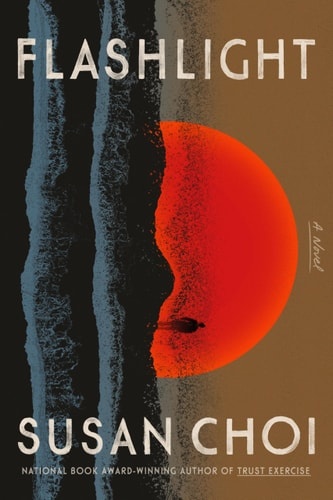
Flashlight
About this book
Ten-year-old Louisa is found on a beach while her father Serk remains missing. The event becomes an unstable centre in family history: accident, abandonment, violence, and political past can all explain parts of what the surviving child remembers.
The novel moves backward and forward through Serk’s childhood in Korea and Japan, Anne’s American life, and Louisa’s adulthood. Migration and the legacy of Japanese rule shape the family before any of them possesses language for the larger history.
Each viewpoint changes the apparent meaning of the disappearance without turning it into a conventional clue trail. Memory is partial because families protect themselves, children misunderstand adults, and nations omit what would disturb a useful identity.
Flashlight is a multigenerational novel by Susan Choi about belonging, inherited silence, and the long reach of a missing person. Its scale allows private uncertainty and twentieth-century history to illuminate one another without collapsing into the same explanation.
Read a sample
5,120 words
Plain text
From the opening
Seok
At last he goes to school.
He’s been waiting. He can’t remember a time he wasn’t waiting, the same way he can’t remember a time he couldn’t read. The ones that make simple sounds and the ones that are entire pictures, ideas. The first time he ever saw a book was when he entered the schoolroom, a place he views as his but heretofore unreasonably withheld from him. The orderliness, the discipline, the ever-changing chalked strings of words instead of just the same street signs that never say anything new. The glorious singing and shouting, the fierce battling in the dusty schoolyard against dummies of scrap wood or sacking and husks, the inordinate amount of time spent tending vegetables in the garden, learning to use different tools including the almost-as-tall-as-you shovel, helping out the old men at the docks to coil their ropes by running the rope dizzyingly in a tiny circle because your arms are too short to do it any other way, in other words every kind of activity besides schoolwork (but there is a bit of this, too, and that feels like a lot, to one who’s never held a pencil or brush or a bottle of ink of his own). He loves all of it; he assumes his ordained place. In the pecking orders, those of the other children no less than those their woman teacher recognizes (no men in classrooms anymore, a disappointment he soon forgets), he’s at the top.
All of this he associates with his new name, another transformative improvement. He loves the way it sounds in the mouths of his new friends, his school friends, only some of whom are friends from before, from the dirty passageway ever narrowed by handcarts and scrap heaps and laundry cascading from every possible anchorage that he will not understand for some years is not even a street, just as he will not understand for some years that the crooked concavity decorated by his own family’s laundry is not even a house so much as a clever improvisation of his father’s. Everything within the concavity is an improvisation of his mother’s, including the stiff, colorless cloth of his trousers; they’re too poor even for dye. But with school this had to change, as did so many other things; he does not know or think to wonder what his mother did to get the dyed cloth for his school pants. The things he does see her do, her eternal kneeling to a little handful of vegetables or a little water in a pot or a lapful of fabric, are so permanent a part of his experience he does not recognize his mother as productive, he does not recognize that everything that comes in contact with his body, or that makes its way inside, has been somehow created from just short of nothing by her.
His friends from before also have new names and he does not think to wonder if they wonder about them, because he does not wonder about his own new name, only appreciates how well it fits him, especially when hallooed after him with admiration and ill-disguised longing by the other children, all of whom want him for coconspirator: Hiroshiiiiiiiii, they holler as he knifes past. The name his mother and father still call him does not unfurl this way, it is unexpandable, truncated, blunt, and though it was once so intimate to him he did not notice it or anything about it—it was included in his body, part of the way things always were—that name has been lopped off and seems like an always-lopped thing, this muffled stub of a sound like someone gulping down a sob or indigestion.
“Hiroshiiiii!” comes the holler and he never turns, never seems to slow down, but imperceptibly he allows a creaking handcart to interfere with his path, he rotates like a top to eye the meager market stands, he knocks away a small rock that has bedded itself in his foot sole. By these slight concessions which his peers never grasp he makes it possible for himself to be reached. Other children strike him as a little slow, unaware of his ways of accommodating them. His ability to hide this difference between himself and other children is pure instinct. As his self-consciousness develops this knack will recede, but for now he can still camouflage and his nascent distinction takes only desirable forms: he’s the number-one boy, his qualities bedazzle generally and especially the old and slow-moving who never suspect that this boy is the thief who accounts for the shortfall at the end of an already bad market day.
The other boys catch up and off they go on their rounds, roughhousing between the vendors, who sit like solemn stones beside their little piles of mountain ferns or frail carrots drawn slightly too soon from the dirt because the leisure to wait for a vegetable doesn’t exist anymore. Despite the decline of rations, these boys are still round-cheeked from their parents’ sacrifices, some of them even show dimples. Their reckless play cracks smiles across a few vendors’ faces; a few sets of hunched shoulders hitch with amusement. “Be careful, you boys,” a few warn, as sure enough the puppylike tangle of limbs sends a couple of boys sprawling and wailing. Now the old vendors rouse themselves from their spots, circle the fallen to check for split skin or snapped bones, nod with eventual satisfaction as the hurt boys, tear- and dust- and snot-streaked, slowly regain their footing and reassemble their pride. “Go on now, you’re all right,” the old people confirm before resuming their vigilance over heaps of foodstuffs that are not quite perceptibly smaller. The uninjured boys have long since melted away down the cluttered streetscape.
Continue reading the sampleClose the sample
Around a corner the boys, those who did the pushing and those who were pushed, divide the spoils with practiced efficiency. Hiroshi by unspoken agreement adjudicates. When he later deposits the edible contents of his pockets in front of his mother, she regards them without comment. They are the only fresh vegetables she’ll cook with all week. His father, who comes home every day in clothing so stiffened with dirt that his mother uses the hand broom to beat him all over like a rug before he undresses and joins them inside, is unaware of this system by which the evening soup bowl is enhanced. Hiroshi has a little sister, Soonja, just learning to walk, and a little brother, Seung, who doesn’t yet crawl. Obviously neither of them has a school name yet.
These silent transactions between himself and his mother are perhaps a reason his mother is restrained when he brings home the school note that he and his classmates have spent the morning transcribing. His note is particularly excellent, his teacher had praised it, gazing on him as she often does with a mixture of frank affection and distracted contemplation. The note is part of the continuous, exciting life of school that in just a few short months has displaced the world of home—school is where he lives, home is where he briefly eats and sleeps, his school friends and his teachers are his people, his parents and toddler sister and squalling blanket-bundle brother often seem to him like strangers, so total is their separation from, their ignorance of, the world in which he vibrantly exists. At school, a sense of purpose and progress infuses every moment. That same week they had harvested the peas from their garden—Sensei with her pale slender fingers had shown them how to press down on the seams of the pods so the seam zippered open, disclosing the fat peas so snug in their line. She had shown them how to gently spring them free, and then each pod’s peas were spilled on a cloth around which they knelt, struggling to free yet control their bouncing, exuberant peas. When all the peas had been spilled on the cloth like green stars, their sensei showed them how to group the peas in tens, then how to count the groups of ten, then how to know, from the number of themselves and the number of peas, how many peas each of them should receive in their palm. Then they had each taken up their allotment of peas and—been allowed to eat them! And the peas had been sharp with the brightness of life, Hiroshi had thoroughly chewed up and spread out the taste of each pea on his tongue, and no food had ever been so delicious. They made their eating of their handfuls of peas—he could have tossed his down all at once, they all could have, they were all always hungry, yet they weren’t even tempted to do this—take as long as it possibly could, which was helped by all the laughing and talking they did. They had grown these peas entirely themselves; it was the first thing they had ever done together as a class, remember? Remember sprouting the dried peas so that each grew a tail? Remember carefully bedding each sprout in the ground? Remember giving the frilly pea plants bamboo poles to climb so that each plant could reach for the sun? These were the same bamboo poles they had used in their bayonet training, when they stood in the dust of the schoolyard in only their shorts, and, gripping their poles very tight with two hands, stabbed, and stabbed again at the battered dummies they’d inherited from the upper-grades students, who had made them of gunnysacks stuffed with husks, while their teacher shouted through her cupped hands, “You must be fast but also take aim! Do not stab your classmates! Do not stab your foot!” Now that the peas had been harvested, they would reclaim the poles and have bayonet practice again.
“So, read it,” his mother finally said of the note he held open before her. She made no comment at all about the beauty of his characters or the near-total absence of ink spots, and he felt sharpen into a point the sadness and disappointment that always stole into him once he was home, as if he’d stabbed the bamboo pole into himself. But once he was reading the note, the excitement of its contents renewed in his mind and the pain in his gut was forgotten.
The children continued to glorify their Emperor and their nation, explained the note, by glorifying their classroom, the shared site of their learning, which efforts made the room ever more safe, comfortable, and instructive to themselves and anyone who might visit. The children had accomplished great things on their own!—among other decorative activities, painting banners bearing patriotic slogans as well as images of uniforms and armaments—but some help was needed from the mothers. Each child would be making a padded cushion for his or her desk chair, each cushion to consist of two quilted layers. The two layers would be joined on two sides that met at a corner, and left open at the other two sides. This way, the comfortable seat cushion also doubled as a head cover—Sensei had made hers already, and had shown her students how it opened to fit on her head like a hood. In the beam of his mother’s expressionless stare Hiroshi mimed the same actions: snatching up the invisible cushion, pulling apart the two sides and ducking his head in, then hunkering swiftly for safety, the hood anchored by his palms flattened over his ears. Hiroshi ran swiftly in place, there being no space in their home for him to actually run.
“Why?” his mother finally said. “Why wear the cushion on your head?”
Already he had the sense, though he could not have named it, that the glory and the urgency of war were somehow absent from his home. That the manner in which things mattered everywhere else—even that they mattered at all—left off at their threshold. He only vaguely knew—because its ingloriousness did not hold his interest—that his father variously dug holes and trenches, moved rocks and dirt, and otherwise contributed his steadily diminishing force to the inexhaustible demands of new roads. This, in ways both direct and indirect, also was part of the glory and the urgency of war. But even if he had connected his father’s lengthy absences and brief, hollow-eyed presences with the war, he would not have further connected the war with that sifting of dirt from which his father stepped, leaving footprints behind, when his mother and the hand broom were done. The war stayed outside. The war failed to include his home, or his home failed to be worthy of the war. But this was what school was for.
As this complex understanding moved through him, his exasperation with his mother gave way to an entirely different feeling of kindliness for her. For the first time he felt consciously how helpless she was without him.
“For the bombing raids,” he patiently explained. And then he left her for his after-school life of the streets, at the same time giving no thought to the impossible injunction he had placed on her. Somehow, the squares of quilting appeared on the morning he needed to bring them to school. He was six years old in the spring of 1945. Though worldly for a child of his age, there still were things he didn’t know.
He’d had less practice with a needle than with a brush, and the stitches assembling his cushion were correspondingly rudimentary. His effort, however, was as exceptional as always, and Sensei had praised his cushion and shown it around to his classmates: see how she could yank the two sides open, see how she could pull the cover tight around her head, and Hiroshi’s stitches held strong without threatening to tear. He would have the use of this cushion/head cover for a good long time, Sensei told them all, inviting his appropriate pride, and indeed his cushion long outlasted the war. It long outlasted his adored, gentle sensei, who after the war’s end got married and left the classroom, to be replaced by a male sensei who, though he’d spent the war doing the sort of important brain work that did not involve combat, refused to speak of it because, as he angrily informed them, they were far behind their grade level and would never make their contributions to society if they did not hurl themselves into the effort. But this new effort was not tangible, comprehensible, or enthralling, as the war effort had been. One afternoon a fresh disturbance rearranged the afternoon street, which recently had happened so often that Hiroshi was less aware of the difference between uneventful and agitated than he was aware of varieties of agitation. There had been that summer day of the war’s abrupt end, when running shouts had streaked past like comets until one threw open the door to the classroom and their principal, shocking in his loss of composure, cried out that the Emperor was on the radio and they all must run home to their parents immediately. There had been a different tone of clamor the day American troops first arrived in their small seaside town. Today’s disturbance was somehow furtive. It zigzagged like a mouse rather than sweeping all persons with it like a tide. It found Hiroshi in the form of a friend of his mother’s, one of their slum’s sisterhood who treated all the children with equal rough authority. She yanked him close and barked, “Get your mom out here fast,” in his ear.
In the distance he heard shrill whistles, lively cracks like artillery fire, and beneath them at slow intervals a more menacing, thunder-like boom. Such phenomena would generally empty the crowded street in the direction of the sound, and yet he sensed a hesitancy around him, and observing eyes followed him as he ran. “Auntie Kim says come fast,” he conveyed, and somehow his mother, with his sister by the hand and his brother on her hip, unquestioningly followed him.
“I told you!” Auntie Kim said to his mother. “I told you!” Whatever it was she had said to his mother couldn’t be guessed by Hiroshi as he darted his glance back and forth between his mother and the source of warlike noise that had come into view: a ragtag parade, perhaps three-times-ten women and men, messily anticipated and flanked by running children and a few wobbly cyclists. The formation of persons was loose but their repeated shouts were loud, and several poles bobbed from their midst, from which snapped a standard-size United States flag such as he had already seen flying from the back of military vehicles on the coast road; a white flag so many times larger than the US one, of so much seething, undulating fabric that three men were struggling to control it on its pole; and a skinny white banner. The symbols on both the enormous white flag and the skinny white banner were illegible to him. He could see a colored medallion at the center of the flag, red and blue swirled together like the crests of two waves; and at the corners of the flag, short and longer black dashes making different designs. On the banner were markings that, unlike those on the flag, he knew for certain were words, but unnervingly, they were not words he recognized.
“What does it say?” he asked his mother urgently. “What are they yelling?”
Auntie Kim snarled in disgust. “The smartest boy in his school, and he can’t even read his own language.”
“I can read!” he said furiously. “If they write it correctly!”
But the women were ignoring him now.
“Aren’t they afraid?” his mother implored, sounding frightened herself.
“I told you,” Auntie Kim repeated.
“But what if they’re arrested?”
“They won’t be. The Americans say we’re liberated now.”
“The Americans were our enemy,” Hiroshi scolded the mothers. Was it possible this was the first time he’d ever seen his mother outside their home? She certainly acted as though she had never been outside before. “They inflicted unthinkable cruelty on us. Our job now is to take them in hand and show them how to make peace.”
“Korea is free,” Auntie Kim concluded, and then, to him: “Are you paying attention? That’s what the banner says! That’s what they are shouting! That’s our own Taegukgi!”
The fishmonger on the main shopping street owned a radio and sometimes Hiroshi loitered nearby and watched him tune it, the man’s calloused fingers touching the dial so slightly Hiroshi could not even see the dial change position, but something would shift, out of spraying static would resolve spoken language, like a melting in reverse, the puddle lifting into a lace of snowflakes. Something like that happened after Auntie Kim spoke. Hiroshi understood that the incoherent noise that had meant nothing to him was in fact two languages, overlapping and dismantling each other until his realization helped him tease them apart: the language he spoke and wrote at school every day and spoke at play and in the streets of his town; and the language his parents used with each other, mostly late at night when they thought he was asleep. He knew this language also, he understood it when he heard it directed at him, but it rarely left his mouth and he had never learned to write it down. The parade had moved past and the crowd closed in its wake as if trying to decide whether to join. The enormous flag heaved and snapped in the distance like a sail pulling free from its mast. Korea is free! and Long live Korea! and Out of darkness, into light! were all three being uttered in his school language and in his parents’ late-night language, both at the same time, so that as his intense concentration on the cacophony flagged, and as it drew farther away, the filigree of clarity collapsed, and all he heard again was meaningless noise.
“But what’s Korea?” he asked as they turned to walk home.
“Let me die,” Auntie Kim said.
“Korea is the homeland of Koreans,” his mother told him.
“But what are Koreans?”
“We are,” said his mother. “You are. That’s why your name isn’t really Hiroshi, it’s 석.”
“What do you mean my name isn’t Hiroshi?” he cried.
“I told you,” Auntie Kim said to his mother again.
His mother replied, “But what choice did we have?”
His parents’ homeland was an island called Jeju, where mer-women raised glittering heaps of succulent bivalves from the deep, where oranges the size of melons and sweeter than candy so weighed down the boughs of the trees that a person didn’t even have to stretch to pick the fruit, and where the soil was so rich, being the gift of an ancient volcano, that it was almost good enough to eat on its own. Why his parents would ever leave such a paradise was a question it would not occur to him to ask until he was older, by which time he would know that it’s possible to be poor anywhere. He no longer remembered that his knowledge of his parents’ island’s wonders came from the ancient bedtime stories told him by his mother, which, like the island they concerned, belonged to a bygone halcyon period, his toddlerhood, before his younger sister had arrived.
Even if he had remembered his process of learning, he would not have known that Jeju Island was not one of Japan’s many thousands of islands, because this had never been mentioned. For his mother it went without saying, just as for Hiroshi it went without saying that this island, like all the other islands that made up his known world, was Japanese. To learn it was not Japanese but Korean was so profoundly disorienting that the greater discovery, that he himself was Korean, was for the moment secondary. He pined for some tangible proof, but the map of the Japanese Empire had disappeared from his classroom along with all his and his classmates’ decorative efforts, all their colorful drawings, all their painstakingly calligraphed slogans and songs, everything except their seat-covers/bomb-raid-head-protectors, spared perhaps by their deceptively domestic appearance. Even the Imperial Rescript, basic as the blackboard, had been replaced by a pale rectangular ghost on the wall. Almost every textbook but those pertaining to math had also vanished, to undergo some process called revision, which made their intemperate sensei angrier than ever, and more disinclined than ever to notice Hiroshi’s particular gifts, which hadn’t gone away just because the war and the empire had. Yet the day Hiroshi arrived at the door to the school building so early even the custodian wasn’t yet there, and once his sensei finally arrived made a deep bow and scuttled, eyes on his own toes, in that man’s wake all the way to the administrative offices in which no student was allowed, his sensei did finally turn to him, to ask with bitten-back impatience what he was doing there.
“I’d like a map to study, Teacher,” he told his teacher, still studying his toes.
“Straighten up. For what reason do you want to study a map?”
“To learn where different things are, Teacher.”
“What things? There are many things and many maps.”
“To learn what are the islands that are Japan and—what aren’t.”
His sensei’s lips compressed with what could have equally been distaste or contemplation. “You’ve chosen an unpropitious time for such an interest,” he said, and sent Hiroshi to their stripped-bare classroom, even more discouraging a place when entered all by oneself. But at the end of the next day his sensei, while dismissing his classmates, called him forward to his desk. Once they were alone he removed a bright-colored pamphlet from his briefcase. “One Nation, One System! The People’s Transport Network: Comfortable, Modern, Far-Reaching.” Stylized pagodas peeked out from behind stylized hills; a pen-and-ink locomotive and steamship stood shoulder to shoulder, ready to span land and sea. Dwarfing them was the familiar blood-red sunburst logo for Sunrise Toothpaste.
“This is my personal property,” Hiroshi’s sensei said, unfolding the map so it covered the desk. The map was breathtaking, so beautiful Hiroshi felt a strange pain in his chest. He’d never seen anything so bright, clean, and beguiling. The land was yellow, with green mountain peaks surging across it like arrows, the sea was bright blue, and the rail lines—for that was what this was, Hiroshi understood, a map of all the trains and where they went—were dark red ribbons twisting over the landscape, with the countless circles of their stations strung densely along them like beads.
The map could not accommodate the size of the rail network without breaking it into pieces. While the greatest part of the map was a skinny rectangle almost as long as Hiroshi’s wingspan that pressed the four big islands into its borders, obliging them to lie flatter than they did naturally, there were three more panels of yellow land, green mountain, red rail line, and blue sea that Hiroshi struggled to connect to the map of the empire that had once been so familiar a part of his classroom. But his sensei touched a fingertip to each of those panels in turn. “Formosa, Chōsen, and Manchukuo you must now disregard. And I’m afraid this map does not show all the thousands of our smaller islands, because they are not reached by train. I think that was your main interest? But this is the only map that I own.”
“I don’t need to see all of the islands. I’m just looking for the one called Jeju.”
“Jeju?” His sensei paused a moment. “Ah. Kang-san, I believe you mean the island that we call Saishū. It’s a big island. It may appear here.” His sensei leaned toward the map and adjusted his glasses to sit a little closer to the tip of his nose, and Hiroshi imagined him during the war, doing the sort of brain work that is even more important than combat, and riding the modern and far-reaching trains with the aid of this map. “Here it is,” his sensei then said, laying his finger near the base of Chōsen’s dangling paw, where it disintegrated, just where the paw’s claws would be, into many tiny islets that might not even be fully detached, and one larger and farther-off oblong like a fallen-off toenail. So it was true. The island was a part of Chōsen. It held no green arrow-shape mountain, no red ribbon of track. It was itself held, by wispy black threads, to the paw, as if in danger of floating away. “Our ferry system linked Saishū to the peninsula,” his sensei said, explaining the threads, “though I can’t say whether any ferries still operate. That would be up to the Americans in their infinite wisdom.” Hiroshi’s riveted gaze no longer took the map in, his desire to take it home with him had become so overwhelming. He only wanted to be alone with it, to pore over it as long as he liked, to trace the routes of the tracks with his fingers. He was still so stunned that Jeju had an outline and location and alternate name it hadn’t even occurred to him to find the town in which he himself lived, the bright white bead indicating the station with its single set of tracks and peaked-roof station house, the front façade of which held his town’s most reliable clock. He was still struggling to choose the right words to ask his sensei, whose show of favor to him today was so unprecedented, how he might stay with the map just a little bit longer, when, like a reverse magic trick, in a few quick folds his sensei made the map disappear behind the Sunrise Toothpaste logo—and then that too was gone, into the briefcase. Hiroshi was so stunned by the dispossession it took him a moment to realize his sensei was still speaking to him.
“Then your parents are from Saishū, Kang-san? Though with your surname I suppose you could be a Formosan.” Hiroshi could not follow the thread of this at all; his gaze kept straying to the briefcase, as if enough silent imploring might cause the map to creep out again on its own power.
“My parents are from Jeju, from Saishū,” he managed to confirm.
“And will they return there, as so many Koreans are doing?”
Return there? Why would his parents return to a place they had left? But this wasn’t Hiroshi’s own wise comment, it was the argument he heard day and night, whether between his parents, or between his mother and Auntie Kim or another such woman friend, or between his parents and some other agitated pair with whom his parents both agreed and disagreed often at the same time. “Will you go back?” “Why go back to a place that we left?” “Because it’s different now—” “Yes! Worse!” There had been the story of Auntie Kim’s brother, who had been cheated ten different ways just getting as far as the port of Senzaki, a long expensive journey as it was; who had then been made by the American military authorities to give up all the money and goods he had brought with him, so that he boarded the “liberty ship” with barely enough yen in his pocket to eat for a week; who had found on his arrival in Busan late at night that he couldn’t even change his yen into won, so that he had to beg a meal and sleep on the street; and whose prospects had steadily diminished from there, because southern Korea was a place of sheer chaos, presided over by Americans who could not even coordinate the two ends of a single boat journey, but greeted with dismissive bewilderment the very same people who’d been herded to Korea by the Americans running Japan! Auntie Kim’s brother had finally stowed away on a boat coming back to Japan, minus his life savings, minus working papers. He now smuggled Koreans like himself as well as contraband into Japan. This was what happened! And in the next breath the very same Auntie Kim was imploring, often with tears splashing off her chin onto the floor, “How can we not go to Korea, our own country? That is finally free?” While someone else demanded, “One thousand yen per family? Or for each person? Could the baby be counted?” And another cried, “How can you ask this? What does it matter if you’ll starve there in three weeks, or six?”