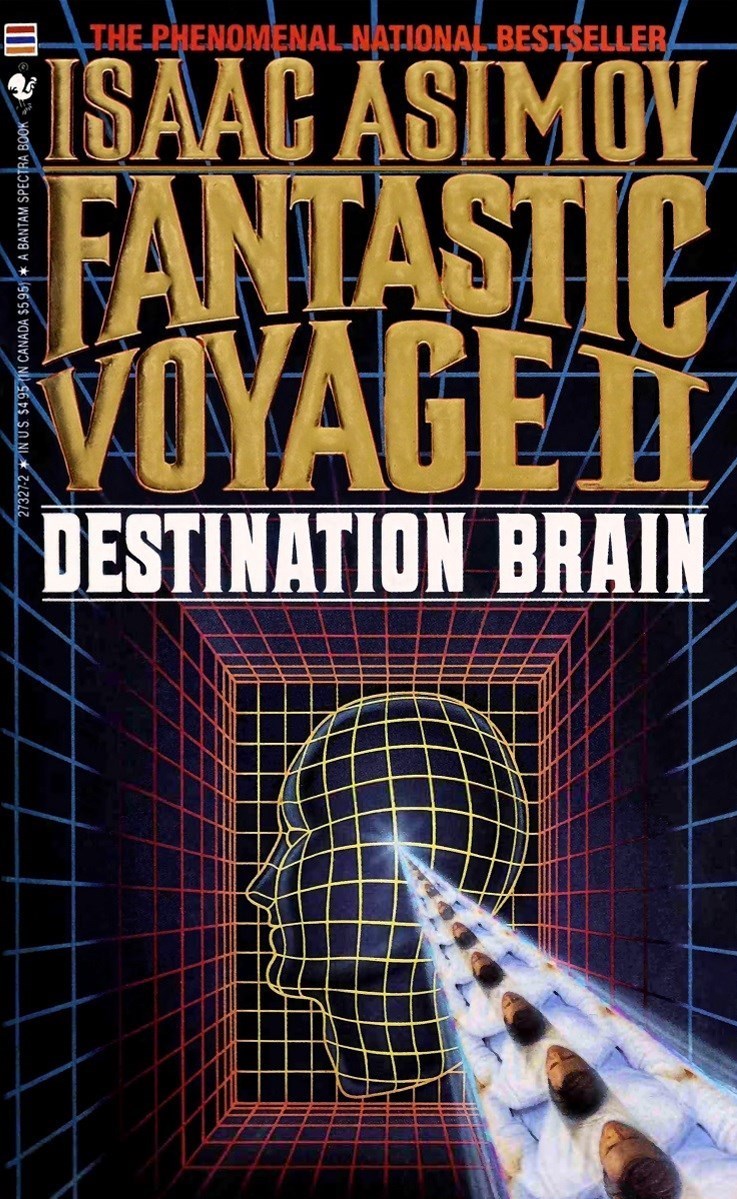
Fantastic Voyage II: Destination Brain
About this book
Albert Morrison studies how minds interact at a distance, work the Soviet Union considers useful enough to justify an involuntary invitation. Their leading scientist, Pyotr Shapirov, lies unconscious with crucial knowledge inaccessible by ordinary means.
Morrison joins a miniature expedition through Shapirov's body, where the crew must reach the brain, interpret unfamiliar signals, and manage rival ambitions inside the vessel. The mission soon reveals that its scientific premise is not what every participant was told.
Unlike the first Fantastic Voyage, this novel is not a retelling of the film. Asimov rebuilds the idea around his own account of miniaturization, neurobiology, and the possibility of collective mental phenomena.
Fantastic Voyage II: Destination Brain is an independent sequel. Familiarity with the earlier premise helps, but the characters, mission, and scientific problem are new.
Read a sample
5,079 words
Plain text
From the opening
Chapter 1
NEEDED
He who is needed must learn to endure flattery.
—Dezhnev Senior
1.
“PARDON me. Do you speak Russian?” said the low voice, definitely contralto, in his ear.
Albert Jonas Morrison stiffened in his seat. The room was darkened and the computer screen on the platform was displaying its graphics with an insistence that had been lost on him.
He must have been more than half-asleep. There had definitely been a man on his right when he sat down. When had that man changed into a woman? Or risen and been replaced?
Morrison cleared his throat and said, “Did you say something, ma’am?” He couldn’t make her out clearly in the dim room and the flashing light from the computer screen obscured rather than revealed. He made out dark hair, straight, hugging the skull, covering the ears—no artifice.
She said, “I asked if you spoke Russian.”
“Yes, I do. Why do you want to know?”
“Because that would make it easier. My English sometimes fails me. Are you Dr. Morrison? A. J. Morrison? I’m not certain in this darkness. Forgive me if I have made a mistake.”
“I am A. J. Morrison. Do I know you?”
“No, but I know you.” Her hand reached out, touching the sleeve of his jacket lightly. “I need you badly. Are you listening to this talk? You did not seem to be.”
They were both whispering, of course.
Morrison looked about involuntarily. The room was sparsely filled and no one was sitting very close. His whisper grew lower just the same. “And if I’m not? What then?” (He was curious—if only out of boredom. The talk had put him to sleep.)
She said, “Will you come with me now? I am Natalya Boranova.”
“Come with you where, Ms. Boranova?”
“To the coffee shop—so that we may talk. It is terribly important.”
That was the way it began. It didn’t matter, Morrison decided afterward, that he had been in that particular room—that he had not been alert—that he had been intrigued enough, flattered enough to be willing to go with a woman who said she needed him.
She would, after all, have found him wherever he had been and would have seized upon him and would have made him listen. It might not have been quite so easy under other circumstances, but it would all have gone as it did. He was certain.
There would have been no escape.
2.
HE was looking at her in normal light now, and she was less young than he had thought. Thirty-six? Forty, perhaps?
Dark hair. No gray. Pronounced features. Heavy eyebrows. Strong jaws. Pleasant nose. Sturdy body, but not fat. Almost as tall as he was, even though she was wearing flat heels. On the whole, a woman who was attractive without being beautiful. The kind of woman, he decided, one could get used to.
He sighed, for he was facing the mirror and he saw himself there. Sandy hair, thinning. Blue eyes, faded. Thin face, thin body, stringy. Beaky nose, nice smile. He hoped it was a nice smile. But no, not a face you would want to get used to. Brenda had gotten entirely unused to it in a little over ten years, and his fortieth birthday would be five days past the fifth anniversary of the day his divorce had been made final and official.
The waitress brought the coffee. They had been sitting there, not talking but appraising each other. Morrison finally felt he had to say something.
“No vodka?” he said in an attempt at lightness.
She smiled and looked somehow even more Russian when she did so. “No Coca-Cola?”
“If that’s an American habit, Coca-Cola is at least cheaper.”
“For good reason.”
Morrison laughed. “Are you this quick in Russian?”
“Let us see if I am. Let’s talk Russian.”
“We’ll sound like a couple of spies.”
Her last sentence had been in Russian. So had Morrison’s reply. The change of language made no difference to him. He could speak and understand it as easily as English. That had to be so. If an American wished to be a scientist and keep up with the literature, he had to be able to handle Russian, almost as much as a Russian scientist had to be able to handle English.
This woman, Natalya Boranova, for instance, despite her pretence that she was not at home in English, spoke it readily and with only a faint accent, Morrison noticed.
She said, “Why will we sound like spies? There are hundreds of thousands of Americans speaking English in the Soviet Union and hundreds of thousands of Soviet citizens speaking Russian in the United States. These are not the bad old days.”
“That’s true. I was joking. But in that case, why do you want to speak Russian?”
“This is your country and that gives you a psychological advantage, does it not, Dr. Morrison? If we speak my language, it will balance the scales a bit.”
Morrison sipped at his coffee. “As you wish.”
“Tell me, Dr. Morrison. Do you know me?”
“No. I have never met you before.”
“And my name? Natalya Boranova? Have you heard of me?”
“Forgive me. If you were in my field, I would have heard of you. Since I have not, I assume you are not in my field. —Should I know you?”
“It might have helped, but we’ll let it go. I know you, however. In fact, I know a great deal about you. When and where you were born. Your schooling. The fact that you are divorced and that you have two daughters that live with your ex-wife. I know about your university position and the research you do.”
Continue reading the sampleClose the sample
Morrison shrugged. “None of that would be hard to find out in our computer-ridden society. Should I be flattered or annoyed?”
“Why either?”
“It depends on whether you tell me that I am famous in the Soviet Union, which would be flattering, or that I have been the target of an investigation, which might be annoying.”
“I have no intention of being anything but honest with you. I have investigated you—for reasons that are important to me.”
Morrison said coldly, “What reasons?”
“To begin with, you are a neurophysicist.”
Morrison had finished his coffee and had absently signaled for a refill. Boranova’s cup was half-empty, but she had apparently lost interest in it.
“There are other neurophysicists,” Morrison said.
“None like you.”
“Clearly you are trying to flatter me. That can only be because you don’t know anything about me after all. Not the crucial things.”
“That you are not successful? That your methods of brain wave analysis are not generally accepted in the field?”
“But if you know that, then why are you after me?”
“Because we have a neurophysicist in our country who knows your work, and he thinks it is brilliant. You have rather jumped into the unknown, he says, and you may be wrong—but if you are, you are brilliantly wrong.”
“Brilliantly wrong? How is that different from wrong?”
“It is his view that it is impossible to be brilliantly wrong without being not altogether wrong. Even if you are in some ways wrong, much of what you maintain will prove useful—and you may be entirely right.”
“What is the name of this paragon who has this view of me? I’ll mention him with favor in my next paper.”
“He is Pyotor Leonovich Shapirov. Do you know him?”
Morrison sat back in his chair. He had not expected this. “Know him?” he said. “I’ve met him. Pete Shapiro I called him. Our people here in the United States think he’s as crazy as I am. If it turns out that he’s backing me, that’s just one more nail in my coffin. —Listen, tell Pete I appreciate his faith in me, but if he really wants to help me, please ask him not to tell anyone he’s on my side.”
Boranova looked at him disapprovingly. “You are not a very serious man. Is everything a joke to you?”
“No. Just me. I’m the joke. I’ve got something really great and I can’t convince anyone of it. Except Pete—I’ve now found out—and he doesn’t count. I can’t even get my papers published these days.”
“Then come to the Soviet Union. We can use you—and your ideas.”
“No no. I’m not emigrating.”
“Who said emigrate? If you wish to be an American, be an American. But you have visited the Soviet Union in the past and you can visit it once again and stay a while. Then return to your own country.”
“Why?”
“You have crazy ideas and we have crazy ideas. Perhaps yours can help ours.”
“What crazy ideas? I mean, yours. I know what mine are.”
“It’s not something to discuss until I know if you are perhaps willing to help us.”
Morrison, still sitting back in his chair, was vaguely aware of the buzz about him, of people drinking, eating, talking—most of them from the conference, he was sure. He stared at this intense Russian woman who admitted to crazy ideas and wondered what kind of—
He stiffened and cried out, “Boranova! I have heard of you. Of course. Pete Shapiro mentioned you. You’re—”
In his excitement he was speaking English and her hand came down on his, her nails pressing hard against his skin.
He choked it off and she removed her hand, saying, “Sorry. I did not mean to hurt you.”
He stared at the marks on his hand, one of which, he decided, was going to be slightly bruised. He said quietly in Russian, “You’re the Miniaturizer.”
3.
BORANOVA looked at him with an easy calm. “Perhaps a little walk and a bench by the river. The weather is beautiful.”
Morrison held his lightly damaged hand in the other. There had been a few, he thought, who had looked in his direction when he had cried out in English, but none seemed to show any interest now. He shook his head. “I think not. I should be attending the conference.”
Boranova smiled as though he had agreed that the weather was beautiful. “I don’t think so. I think you’ll find a seat by the river more interesting.”
For one flashing moment, Morrison thought her smile might be intended to be seductive. Surely she wasn’t implying—
He abandoned the thought almost before he had put it clearly to himself. That sort of thing was passé‚ even on holovision: “Beautiful Russian Spy Uses Sinuous Body to Dazzle Naïve American.”
To begin with, she wasn’t beautiful and her body wasn’t sinuous. Nor did she look as though anything of that nature could possibly be on her mind and he himself, after all, wasn’t that naïve—or even interested.
Yet he found himself accompanying her across the campus and toward the river.
They walked slowly—sauntered—and she talked cheerfully about her husband Nikolai and her son Aleksandr, who was going to school and was, for some strange reason, interested in biology, even though his mother was a thermodynamicist. What’s more, Aleksandr was a dreadful chess player, much to his father’s disappointment, but he showed signs of promise on the violin.
Morrison did not listen. He occupied himself, instead, in trying to recall what he had heard about the Soviet interest in miniaturization and what possible connection there might be between that and his own work.
She pointed to a bench. “This one looks reasonably clean.”
They sat down. Morrison stared over the river, watching, with eyes that did not really absorb it, the line of cars filing along the highway on their side and the parallel line on the highway on the other side—while sculls, looking like centipedes, plied the river itself.
He remained silent and Boranova, staring at him thoughtfully, finally said, “You do not find this interesting?”
“Find what interesting?”
“My suggestion that you come to the Soviet Union.”
“No!” He said it curtly.
“But why not? Since your American colleagues do not accept your ideas, and since you are depressed over this and are seeking a way out of the dead end at which you have arrived, why not come to us?”
“Given your investigations into my life, I am sure you know that my ideas are not accepted, but how can you possibly be sure that I am all that depressed over it?”
“Any sane man would be depressed. And one has only to talk to you to be certain.”
“Do you accept my ideas?”
“I? I am not in your field. I know nothing—or very little—about the nervous system.”
“I suppose you simply accept Shapirov’s estimate of my ideas.”
“Yes. And even if I did not—desperate problems may require desperate remedies. What harm, then, if we try your ideas as a remedy? It will certainly leave us no worse off.”
“So you have my ideas. They have been published.”
She gazed at him steadily. “Somehow we don’t think all your ideas have been published. That is why we want you.”
Morrison laughed without humor. “What good can I possibly do you in connection with miniaturization? I know less about miniaturization than you do about the brain. Far less.”
“Do you know anything at all about miniaturization?”
“Only two things. That the Soviets are known to be investigating it—and that it is impossible.”
Boranova stared thoughtfully at the river. “Impossible? What if I told you we had accomplished the task?”
“I would as soon believe you if you told me polar bears fly.”
“Why should I lie to you?”
“I point out the fact. I’m not concerned about the motivation.”
“Why are you so certain miniaturization is impossible?”
“If you reduce a man to the dimensions of a fly, then all the mass of a man would be crowded into the volume of a fly. You’d end up with a density of something like—” he paused to think—“a hundred and fifty thousand times that of platinum.”
“But what if the mass were reduced in proportion?”
“Then you end up with one atom in the miniaturized man for every three million in the original. The miniaturized man would not only have the size of a fly but the brainpower of a fly as well.”
“And if the atoms are reduced, too?”
“If it is miniaturized atoms you are speaking of, then Planck’s constant, which is an absolutely fundamental quantity in our Universe, forbids it. Miniaturized atoms would be too small to fit into the graininess of the Universe.”
“And if I told you that Planck’s constant was reduced as well, so that a miniaturized man would be encased in a field in which the graininess of the Universe was incredibly finer than it is under normal conditions?”
“Then I wouldn’t believe you.”
“Without examining the matter? You would refuse to believe it as a result of preconceived convictions, as your colleagues refuse to believe you?”
And at this, Morrison was, for a moment, silent.
“Not the same,” he mumbled at last.
“Not the same?” Again she stared thoughtfully out over the river. “In what way not the same?”
“My colleagues think I’m wrong. My ideas are not theoretically impossible in their opinion—only wrong.”
“While miniaturization is impossible?”
“Yes.”
“Then come and see. If it turns out that miniaturization is impossible, just as you say, then you’ll at least have a month in the Soviet Union as a guest of the Soviet Government. All expenses will be paid. If there’s a friend you would like to bring with you, bring her, too. Or him.”
Morrison shook his head. “No thanks. I’d rather not. Even if miniaturization were possible, it is not my field. It would not help me or be of interest to me.”
“How do you know? What if miniaturization gave you the opportunity to study neurophysics as you have never studied it before—as no one has ever studied it before? And what if, in doing so, you might be able to help us? That would be our stake in it.”
“How can you offer me a new way of studying neurophysics?”
“But, Dr. Morrison, I thought that was what we were talking about. You cannot really prove your theories because you cannot study single nerve cells in sufficient detail without damaging them. But what if we make a neuron as large as the Kremlin for you—or even larger—so that you can study it a molecule at a time?”
“You mean you can reverse miniaturization and make a neuron as large as you wish.”
“No, we can’t do that, as yet, but we can make you as small as we wish and that would amount to the same thing, wouldn’t it?”
Morrison rose, staring at her.
“No,” he said in half a whisper. “Are you insane? Do you think I am insane? Good-bye! Good-bye!”
He turned and strode away rapidly.
She called after him. “Dr. Morrison. Listen to me.”
He made a sweeping gesture of rejection with his right arm and broke into a run across the drive, narrowly dodging the cars.
Then he was back into the hotel, puffing, almost dancing with impatience as he waited for the elevator.
Madwoman! he thought. She wanted to miniaturize him, attempt this impossibility on him. —Or attempt the possibility of it on him, which would be infinitely worse.
4.
MORRISON was still shaking when he stood at the door of his hotel room, holding the plastic rectangle of his key, breathing hard, and wondering if she knew his room number. She could find out, of course, if she were sufficiently determined. He looked down the length of the corridor each way, half-afraid he might see her running toward him, face contorted, hair flying, hands outstretched.
He shook his head. This was madness. What could she do to him? She could not carry him off bodily. She could not force him to do anything he didn’t want to do. What childish terror was overcoming him?
Morrison took a deep breath and thrust his key into the door slit. He felt the small click as the key seated itself, then he withdrew it and the door swung open.
The man sitting in the wicker armchair at the window smiled at him and said, “Come in.”
Morrison stared at him in astonishment, then twisted his head to look at the room number.
“No no. It’s your room, all right. Do come in and close the door behind you.”
Morrison followed orders, staring at the man in silent astonishment.
He was a comfortably plump man, not quite fat, filling the chair from arm to arm. He wore a thin seersucker jacket and under it was a shirt so white that it seemed to glisten. He was not yet what one might call bald, but he was clearly on the way and what remained of his brown hair was crisply curly. He did not wear glasses, but his eyes were small and had a nearsighted look about them, which might be misleading—or which perhaps meant he wore contacts.
He said, “You came back running, didn’t you? I watched you”—he pointed out the window—“sitting on the bench, then get up and come toward the hotel at the double. I was hoping you would come up to your hotel room. I didn’t want to sit up here all day waiting for you.”
“You were here in order to watch me from the window?”
“No, not at all. That was just an accident. You just happened to walk out with the lady to that bench. Convenient, but not really foreseen. It’s all right, though. If I hadn’t had the view from the window, there were others watching.”
By that time Morrison had caught his breath and his mind had steadied itself to the point where he asked the question that should have had pride of place in the conversation. “Who are you, anyway?”
In response the man, smiling, took a small wallet from his inner jacket pocket and let it flip open. He said, “Signature, hologram, fingerprint, voiceprint.”
Morrison looked from the hologram to the smiling face. The hologram was smiling, too. He said, “All right, so you’re security. It still doesn’t give you the right to break into my private quarters. I’m available. You could have called me from the lobby or knocked at my door.”
“Strictly speaking, you’re right, of course. But I thought it best to meet you as discreetly as possible. Besides, I presumed on old acquaintance.”
“What old acquaintance?”
“Two years ago. Don’t you remember? An international conference in Miami? You were presenting a paper and had a hard time of it—”
“I remember the occasion. I remember the paper. It’s you I don’t remember.”
“That’s not surprising, perhaps. I met you afterward. I asked you questions, and we actually had a few drinks together.”
“I don’t consider that old acquaintance. —Francis Rodano?”
“That’s my name, yes. You even pronounced it correctly. Accent on the second syllable. Broad a. Subliminal memory, obviously.”
“No, I don’t remember you. The name was on your identification. —I’d rather you left.”
“I would like to talk to you in my official capacity.”
“Apparently everyone wants to talk to me. What about?”
“Your work.”
“Are you a neurophysicist?”
“You must know I’m not. Slavic languages was my major. I minored in economics.”
“Then what can we talk about? I’m good at Russian, but you’re probably better. And I know nothing about economics.”
“We can talk about your work. As we did two years ago. —Look, why don’t you sit down? It’s your room and I won’t really take long. If you want the chair I’m sitting on, I’ll be glad to give it to you.”
Morrison sat down at the side of the bed. “Let’s get this over with. What do you want to know about my work?”
“The same thing I wanted to know two years ago. Is there anything to your notion that there’s a specific structure in your brain that’s specifically responsible for creative thought?”
“Not quite a structure. It’s not something you can cut out in the ordinary way. It’s a neuronic network. Yes, I think there’s something to that. Obviously. The catch is that no one else thinks so because they can’t locate it and have no evidence for it.”
“Have you located it?”
“No. I reason backward from results and from my analysis of brain waves and I don’t seem to be convincing. My analyses are not—orthodox.” He added bitterly, “Orthodoxy in this field has gotten them nowhere, but they won’t let me be unorthodox.”
“I am told that you use mathematical techniques in your electroencephalographic analyses that are not only unorthodox, but are flat wrong. To be unorthodox is one thing; to be wrong is quite another.”
“The only reason they say I am wrong is that I cannot prove that I am right. The only reason I cannot prove that I am right is that I can’t study an isolated brain neuron in sufficient detail.”
“Have you tried to study them? If you work with a living human brain, don’t you leave yourself open to severe lawsuits or to criminal trial?”
“Of course. I’m not mad. I’ve worked with animals. I have to.”
“You told me all this two years ago. I take it, then, you have made no startling discoveries in the last two years.”
“None. But I’m convinced I’m right just the same.”
“Your being convinced doesn’t matter if you can’t convince anyone else. But now I have to ask you another question. Have you done something in the last two years that has managed to convince the Soviets?”
“The Soviets?”
“Yes. What is this attitude of surprise, Dr. Morrison? Haven’t you spent an hour or two in conversation with Dr. Boranova? Isn’t she the one whom you just left in a great hurry?”
“Dr. Boranova?” Morrison, in his confusion, could think of nothing better to do than play the parrot.
Rodano’s face lost none of its pleasantness. “Exactly. We know her well. We keep half an eye on her whenever she is in the United States.”
“You make it sound like the bad old days,” mumbled Morrison.
Rodano shrugged. “No, not at all. There is no danger of nuclear war now. We are polite to each other, the Soviet Union and we. We cooperate in space. We have a cooperative mining station on the moon and freedom of entry into each other’s space settlements. That makes these the good new days. But, Doctor, some things don’t change entirely. We keep an eye on our polite companions, the Soviets, just to make sure they stay virtuous. Why not? They keep an eye on us.”
Morrison said, “You keep an eye on me, too, it would seem.”
“But you were with Dr. Boranova. We couldn’t help seeing you.”
“That won’t happen again, I assure you. I have no intention of ever being in her vicinity again if I can help it. She’s a madwoman.”
“Do you mean that literally?”
“Take my word for it. —Look, nothing of what she and I talked about is secret as far as I’m concerned. What she said I feel free to repeat. She’s involved in some miniaturization project.”
“We’ve heard of it,” said Rodano easily. “They have a special town in the Urals devoted to miniaturization experiments.”
“Are they getting anywhere as far as you know?”
“We wonder.”
“She’s tried to tell me they are, that they’ve succeeded in producing actual miniaturization.”
Rodano said nothing.
Morrison, who had waited a moment to let him speak, then said, “But that’s impossible, I tell you. Scientifically impossible. You must realize that. Or, since your field of expertise is Slavic languages and economics, take my word for it.”
“I don’t have to, my friend. There are many others who say it is impossible and yet, nevertheless, we wonder. The Soviets are free to play with miniaturization if they please, but we don’t actually want them to have it unless we do also. After all, we don’t know to what uses it might be put.”
“To none! To none!” said Morrison fiercely. “There’s no point in worrying about it. If our government really doesn’t want the Soviet Union to get too far ahead in technology, it should encourage this miniaturization madness. Let the Soviets spend money on it—and time and material—and concentrate every atom of their scientific expertise on it. Everything will be wasted.”
“And yet,” said Rodano. “I don’t think Dr. Boranova is mad or a fool, any more than I think that you are mad or a fool. —Do you know what I was thinking as I watched the two of you in so intent a conversation on the park bench? It seemed to me that she wanted your help. Perhaps she thought that with your theories on neurophysics you could somehow help the Soviet push for miniaturization. Their peculiar theories and your peculiar theories might add up to something that is not at all peculiar. Or so I think.”
Morrison’s lips tightened. “I told you I have no secrets to keep, so I’m telling you that you’re right. Just as you say, she wants me to go to the Soviet Union and help out in their miniaturization project. I won’t ask how you know that, but I don’t think it’s just an idle guess and don’t try to persuade me it is.”
Rodano smiled and Morrison went on. “In any case, I said no. I refused absolutely. I stood up and left at once—and in a hurry. You saw me hurry. That’s the truth. I would have reported it if you had given me time to do so. And I’m reporting it now, as a matter of fact, to you. Nor is there any reason for you not to believe me because why, under any circumstances, would I take any part in a project that has absolutely no sense to it. Even if I wanted to work against my country, which I don’t, I’m enough of a physicist not to try to do so by involving myself in anything as insane as working on a project without hope. They might as well be working on a perpetual motion machine, or antigravity, or faster-than-light travel, or—” He was perspiring freely.
And Rodano said gently, “Please, Dr. Morrison, no one doubts your loyalty. Certainly I don’t. I’m not here because I am perturbed at your having had a discussion with the Russian woman. I am here because we had reason to think she might approach you and we feared you would not listen to her.”
“What?”
“Now understand me, Dr. Morrison. Please understand. We would suggest—in fact, we would very much want—to have you go with Dr. Boranova to the Soviet Union.”
5.
MORRISON stared at Rodano, face pale, lower lip quivering slightly. He brushed at his hair with his right hand and said, “Why do you want me to go to the Soviet Union?”
“Not I, personally. The United States Government wants it.”
“Why?”
“For the obvious reason. If the Soviet Union is engaged in miniaturization experiments, we would like to know as much about them as possible.”
“You’ve got Madame Boranova. She must know a great deal. Grab her and beat it out of her.”
Rodano sighed and said, “I know you’re joking. We can’t do that these days. You know that. The Soviet Union would retaliate at once in the most unpleasant ways and world opinion would be with them. So let’s not waste time with jokes like that.”
“All right. Granted, we can’t do anything crude. I presume we have agents attempting to dig out the details.”
“The operative word, Doctor, is attempting. We have our agents in the Soviet Union, to say nothing of sophisticated espionage equipment both Earthside and in space, just as they have agents here. But if they and we are very good at poking around quietly, we’re also very good at keeping things secret. If anything, the Soviet Union is better at it than we are. Even though these are not what you call the bad old days, the Soviet Union is still not quite an open society in our sense and they’ve had more than a century of practice in keeping things under the rug.”