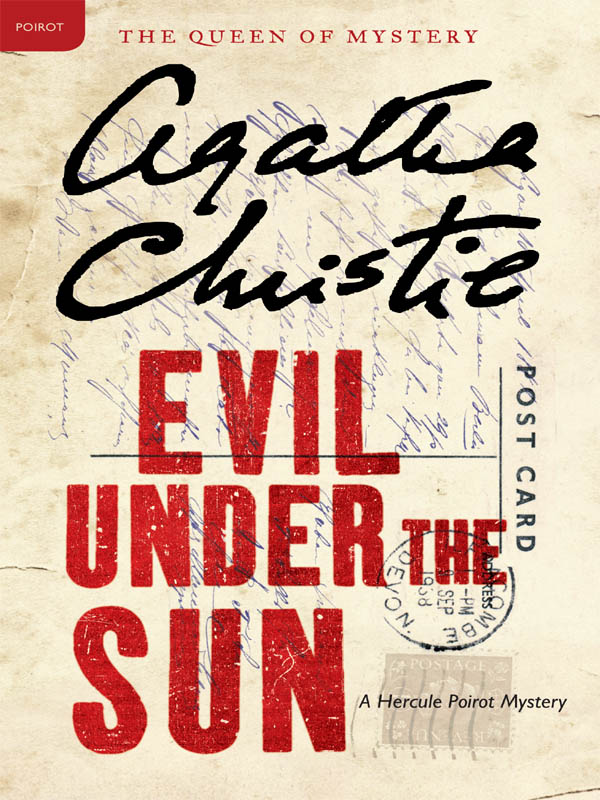
Evil Under the Sun
About this book
Hercule Poirot travels to the Jolly Roger Hotel on a secluded island off the Devon coast. Among the guests is actress Arlena Marshall, whose beauty, affairs, and open disregard for other people make her the center of attention.
Arlena is found strangled in an isolated cove. The island limits the possible killer, but carefully observed movements seem to account for everyone during the relevant period, including her husband, his daughter, and the man with whom she has been flirting.
Sun, bathing schedules, boats, and the geography of the coves become parts of the timetable. Poirot treats the resort's theatrical social life as evidence, asking who is performing a role and who benefits from observers seeing exactly what they expect.
Evil Under the Sun is a self-contained Hercule Poirot mystery. Its holiday setting gives the murder a bright, public surface while the solution depends on choreography and mistaken recognition.
Read a sample
5,020 words
Plain text
From the opening
One
When Captain Roger Angmering built himself a house in the year 1782 on the island off Leathercombe Bay, it was thought the height of eccentricity on his part. A man of good family such as he was should have had a decorous mansion set in wide meadows with, perhaps, a running stream and good pasture.
But Captain Roger Angmering had only one great love, the sea. So he built his house—a sturdy house too, as it needed to be, on the little windswept gull-haunted promontory—cut off from land at each high tide.
He did not marry, the sea was his first and last spouse, and at his death the house and island went to a distant cousin. That cousin and his descendants thought little of the bequest. Their own acres dwindled, and their heirs grew steadily poorer.
In 1922 when the great cult of the Seaside for Holidays was finally established and the coast of Devon and Cornwall was no longer thought too hot in the summer, Arthur Angmering found his vast inconvenient late Georgian house unsaleable, but he got a good price for the odd bit of property acquired by the seafaring Captain Roger.
The sturdy house was added to and embellished. A concrete causeway was laid down from the mainland to the island. “Walks” and “Nooks” were cut and devised all round the island. There were two tennis courts, sun terraces leading down to a little bay embellished with rafts and diving boards. The Jolly Roger Hotel, Smugglers’ Island, Leathercombe Bay, came triumphantly into being. And from June till September (with a short season at Easter) the Jolly Roger Hotel was usually packed to the attics. It was enlarged and improved in 1934 by the addition of a cocktail bar, a bigger dining room and some extra bathrooms. The prices went up.
People said:
“Ever been to Leathercombe Bay? Awfully jolly hotel there, on a sort of island. Very comfortable and no trippers or charabancs. Good cooking and all that. You ought to go.”
And people did go.
II
There was one very important person (in his own estimation at least) staying at the Jolly Roger. Hercule Poirot, resplendent in a white duck suit, with a panama hat tilted over his eyes, his moustaches magnificently befurled, lay back in an improved type of deck chair and surveyed the bathing beach. A series of terraces led down to it from the hotel. On the beach itself were floats, lilos, rubber and canvas boats, balls and rubber toys. There was a long springboard and three rafts at varying distances from the shore.
Of the bathers, some were in the sea, some were lying stretched out in the sun, and some were anointing themselves carefully with oil.
On the terrace immediately above, the nonbathers sat and commented on the weather, the scene in front of them, the news in the morning papers and any other subject that appealed to them.
On Poirot’s left a ceaseless flow of conversation poured in a gentle monotone from the lips of Mrs. Gardener while at the same time her needles clacked as she knitted vigorously. Beyond her, her husband, Odell C. Gardener, lay in a hammock chair, his hat tilted forward over his nose, and occasionally uttered a brief statement when called upon to do so.
On Poirot’s right, Miss Brewster, a tough athletic woman with grizzled hair and a pleasant weather-beaten face, made gruff comments. The result sounded rather like a sheepdog whose short stentorian barks interrupted the ceaseless yapping of a Pomeranian.
Mrs. Gardener was saying:
“And so I said to Mr. Gardener, why, I said, sightseeing is all very well, and I do like to do a place thoroughly. But, after all, I said, we’ve done England pretty well and all I want now is to get to some quiet spot by the seaside and just relax. That’s what I said, wasn’t it, Odell? Just relax. I feel I must relax, I said. That’s so, isn’t it, Odell?”
Mr. Gardener, from behind his hat, murmured:
“Yes, darling.”
Mrs. Gardener pursued the theme.
“And so, when I mentioned it to Mr. Kelso, at Cook’s—He’s arranged all our itinerary for us and been most helpful in every way. I don’t really know what we’d have done without him!—well, as I say, when I mentioned it to him, Mr. Kelso said that we couldn’t do better than come here. A most picturesque spot, he said, quite out of the world, and at the same time very comfortable and most exclusive in every way. And, of course, Mr. Gardener, he chipped in there and said what about the sanitary arrangements? Because, if you’ll believe me, M. Poirot, a sister of Mr. Gardener’s went to stay at a guesthouse once, very exclusive they said it was, and in the heart of the moors, but would you believe me, nothing but an earth closet! So naturally that made Mr. Gardener suspicious of these out-of-the-world places, didn’t it, Odell?”
“Why, yes, darling,” said Gardener.
“But Mr. Kelso reassured us at once. The sanitation, he said, was absolutely the latest word, and the cooking was excellent. And I’m sure that’s so. And what I like about it is, it’s intime, if you know what I mean. Being a small place we all talk to each other and everybody knows everybody. If there is a fault about the British it is that they’re inclined to be a bit standoffish until they’ve known you a couple of years. After that nobody could be nicer. Mr. Kelso said that interesting people came here, and I see he was right. There’s you, M. Poirot and Miss Darnley. Oh! I was just tickled to death when I found out who you were, wasn’t I, Odell?”
Continue reading the sampleClose the sample
“You were, darling.”
“Ha!” said Miss Brewster, breaking in explosively. “What a thrill, eh, M. Poirot?”
Hercule Poirot raised his hands in deprecation. But it was no more than a polite gesture. Mrs. Gardener flowed smoothly on.
“You see, M. Poirot, I’d heard a lot about you from Cornelia Robson who was at Badenhof. Mr. Gardener and I were at Badenhof in May. And of course Cornelia told us all about that business in Egypt when Linnet Ridgeway was killed. She said you were wonderful and I’ve always been simply crazy to meet you, haven’t I, Odell?”
“Yes, darling.”
“And then Miss Darnley, too. I get a lot of my things at Rose Mond’s and of course she is Rose Mond, isn’t she? I think her clothes are ever so clever. Such a marvellous line. That dress I had on last night was one of hers. She’s just a lovely woman in every way, I think.”
From beyond Miss Brewster, Major Barry, who had been sitting with protuberant eyes glued to the bathers, grunted out:
“Distinguished lookin’ gal!”
Mrs. Gardener clacked her needles.
“I’ve just got to confess one thing, M. Poirot. It gave me a kind of a turn meeting you here—not that I wasn’t just thrilled to meet you, because I was. Mr. Gardener knows that. But it just came to me that you might be here—well, professionally. You know what I mean? Well, I’m just terribly sensitive, as Mr. Gardener will tell you, and I just couldn’t bear it if I was to be mixed up in crime of any kind. You see—”
Mr. Gardener cleared his throat. He said:
“You see, M. Poirot, Mrs. Gardener is very sensitive.”
The hands of Hercule Poirot shot into the air.
“But let me assure you, Madame, that I am here simply in the same way that you are here yourselves—to enjoy myself—to spend the holiday. I do not think of crime even.”
Miss Brewster said again, giving her short gruff bark:
“No bodies on Smugglers’ Island.”
Hercule Poirot said:
“Ah! but that, it is not strictly true.” He pointed downward. “Regard them there, lying out in rows. What are they? They are not men and women. There is nothing personal about them. They are just—bodies!”
Major Barry said appreciatively:
“Good-looking fillies, some of ’em. Bit on the thin side, perhaps.”
Poirot cried:
“Yes, but what appeal is there? What mystery? I, I am old, of the old school, When I was young, one saw barely the ankle. The glimpse of a foamy petticoat, how alluring! The gentle swelling of the calf—a knee—a beribboned garter—”
“Naughty, naughty!” said Major Barry hoarsely.
“Much more sensible—the things we wear nowadays,” said Miss Brewster.
“Why, yes, M. Poirot,” said Mrs. Gardener. “I do think, you know, that our girls and boys nowadays lead a much more natural healthy life. They just romp about together and they—well, they—” Mrs. Gardener blushed slightly for she had a nice mind—“they think nothing of it, if you know what I mean?”
“I do know,” said Hercule Poirot. “It is deplorable!”
“Deplorable?” squeaked Mrs. Gardener.
“To remove all the romance—all the mystery! Today everything is standardized!” He waved a hand towards the recumbent figures. “That reminds me very much of the Morgue in Paris.”
“M. Poirot!” Mrs. Gardener was scandalized.
“Bodies—arranged on slabs—like butcher’s meat!”
“But M. Poirot, isn’t that too far-fetched for words?”
Hercule Poirot admitted:
“It may be, yes.”
“All the same,” Mrs. Gardener knitted with energy, “I’m inclined to agree with you on one point. These girls that lie out like that in the sun will grow hair on their legs and arms. I’ve said so to Irene—that’s my daughter, M. Poirot. Irene, I said to her, if you lie out like that in the sun, you’ll have hair all over you, hair on your arms and hair on your legs and hair on your bosom, and what will you look like then? I said to her. Didn’t I, Odell?”
“Yes, darling,” said Mr. Gardener.
Everyone was silent, perhaps making a mental picture of Irene when the worst had happened.
Mrs. Gardener rolled up her knitting and said:
“I wonder now—”
Mr. Gardener said:
“Yes, darling?”
He struggled out of the hammock chair and took Mrs. Gardener’s knitting and her book. He asked:
“What about joining us for a drink, Miss Brewster?”
“Not just now, thanks.”
The Gardeners went up to the hotel.
Miss Brewster said:
“American husbands are wonderful!”
III
Mrs. Gardener’s place was taken by the Reverend Stephen Lane.
Mr. Lane was a tall vigorous clergyman of fifty odd. His face was tanned and his dark grey flannel trousers were holidayfied and disreputable.
He said with enthusiasm:
“Marvellous country! I’ve been from Leathercombe Bay to Harford and back over the cliffs.”
“Warm work walking today,” said Major Barry who never walked.
“Good exercise,” said Miss Brewster. “I haven’t been for my row yet. Nothing like rowing for your stomach muscles.”
The eyes of Hercule Poirot dropped somewhat ruefully to a certain protuberance in his middle.
Miss Brewster, noting the glance, said kindly:
“You’d soon get that off, M. Poirot, if you took a rowing boat out every day.”
“Merci, Mademoiselle. I detest boats!”
“You mean small boats?”
“Boats of all sizes!” He closed his eyes and shuddered. “The movement of the sea, it is not pleasant.”
“Bless the man, the sea is as calm as a mill pond today.”
Poirot replied with conviction:
“There is no such thing as a really calm sea. Always, always, there is motion.”
“If you ask me,” said Major Barry, “seasickness is nine-tenths nerves.”
“There,” said the clergyman, smiling a little, “speaks the good sailor—eh, Major?”
“Only been ill once—and that was crossing the Channel! Don’t think about it, that’s my motto.”
“Seasickness is really a very odd thing,” mused Miss Brewster. “Why should some people be subject to it and not others? It seems so unfair. And nothing to do with one’s ordinary health. Quite sickly people are good sailors. Someone told me once it was something to do with one’s spine. Then there’s the way some people can’t stand heights. I’m not very good myself, but Mrs. Redfern is far worse. The other day, on the cliff path to Harford, she turned quite giddy and simply clung to me. She told me she once got stuck halfway down that outside staircase on Milan Cathedral. She’d gone up without thinking but coming down did for her.”
“She’d better not go down the ladder to Pixy Cove, then,” observed Lane.
Miss Brewster made a face.
“I funk that myself. It’s all right for the young. The Cowan boys and the young Mastermans, they run up and down and enjoy it.”
Lane said.
“Here comes Mrs. Redfern now, coming up from her bathe.”
Miss Brewster remarked:
“M. Poirot ought to approve of her. She’s no sunbather.”
Young Mrs. Redfern had taken off her rubber cap and was shaking out her hair. She was an ash blonde and her skin was of that dead fairness that goes with that colouring. Her legs and arms were very white.
With a hoarse chuckle, Major Barry said:
“Looks a bit uncooked among the others, doesn’t she?”
Wrapping herself in a long bathrobe Christine Redfern came up the beach and mounted the steps towards them.
She had a fair serious face, pretty in a negative way and small dainty hands and feet.
She smiled at them and dropped down beside them, tucking her bath wrap round her.
Miss Brewster said:
“You have earned M. Poirot’s good opinion. He doesn’t like the suntanning crowd. Says they’re like joints of butcher’s meat, or words to that effect.”
Christine Redfern smiled ruefully. She said:
“I wish I could sunbathe! But I don’t go brown. I only blister and get the most frightful freckles all over my arms.”
“Better than getting hair all over them like Mrs. Gardener’s Irene,” said Miss Brewster. In answer to Christine’s inquiring glance she went on: “Mrs. Gardener’s been in grand form this morning. Absolutely nonstop. ‘Isn’t that so, Odell?’ ‘Yes, darling.’” She paused and then said: “I wish, though, M. Poirot, that you’d played up to her a bit. Why didn’t you? Why didn’t you tell her that you were down here investigating a particularly gruesome murder, and that the murderer, a homicidal maniac, was certainly to be found among the guests of the hotel?”
Hercule Poirot sighed. He said:
“I very much fear she would have believed me.”
Major Barry gave a wheezy chuckle. He said:
“She certainly would.”
Emily Brewster said:
“No, I don’t believe even Mrs. Gardener would have believed in a crime staged here. This isn’t the sort of place you’d get a body!”
Hercule Poirot stirred a little in his chair. He protested. He said:
“But why not, Mademoiselle? Why should there not be what you call a ‘body’ here on Smugglers’ Island?”
Emily Brewster said:
“I don’t know. I suppose some places are more unlikely than others. This isn’t the kind of spot—” She broke off, finding it difficult to explain her meaning.
“It is romantic, yes,” agreed Hercule Poirot. “It is peaceful. The sun shines. The sea is blue. But you forget, Miss Brewster, there is evil everywhere under the sun.”
The clergyman stirred in his chair. He leaned forward. His intensely blue eyes lighted up.
Miss Brewster shrugged her shoulders.
“Oh! of course I realize that, but all the same—”
“But all the same this still seems to you an unlikely setting for crime? You forget one thing, Mademoiselle.”
“Human nature, I suppose?”
“That, yes. That, always. But that was not what I was going to say. I was going to point out to you that here everyone is on holiday.”
Emily Brewster turned a puzzled face to him.
“I don’t understand.”
Hercule Poirot beamed kindly at her. He made dabs in the air with an emphatic forefinger.
“Let us say, you have an enemy. If you seek him out in his flat, in his office, in the street—eh bien, you must have a reason—you must account for yourself. But here at the seaside it is necessary for no one to account for himself. You are at Leathercombe Bay, why? Parbleu! it is August—one goes to the seaside in August—one is on one’s holiday. It is quite natural, you see, for you to be here and for Mr. Lane to be here and for Major Barry to be here and for Mrs. Redfern and her husband to be here. Because it is the custom in England to go to the seaside in August.”
“Well,” admitted Miss Brewster, “that’s certainly a very ingenious idea. But what about the Gardeners? They’re American.”
Poirot smiled.
“Even Mrs. Gardener, as she told us, feels the need to relax. Also, since she is ‘doing’ England, she must certainly spend a fortnight at the seaside—as a good tourist, if nothing else. She enjoys watching people.”
Mrs. Redfern murmured:
“You like watching the people too, I think?”
“Madame, I will confess it. I do.”
She said thoughtfully: “You see—a good deal.”
IV
There was a pause. Stephen Lane cleared his throat and said with a trace of self-consciousness.
“I was interested, M. Poirot, in something you said just now. You said that there was evil done everywhere under the sun. It was almost a quotation from Ecclesiastes.” He paused and then quoted himself: “Yea, also the heart of the sons of men is full of evil, and madness is in their heart while they live.” His face lit up with an almost fanatical light. “I was glad to hear you say that. Nowadays, no one believes in evil. It is considered, at most, a mere negation of good. Evil, people say, is done by those who know no better—who are undeveloped—who are to be pitied rather than blamed. But M. Poirot, evil is real! It is a fact! I believe in Evil like I believe in Good. It exists! It is powerful! It walks the earth!”
He stopped. His breath was coming fast. He wiped his forehead with his handkerchief and looked suddenly apologetic.
“I’m sorry. I got carried away.”
Poirot said calmly:
“I understand your meaning. Up to a point I agree with you. Evil does walk the earth and can be recognized as such.”
Major Barry cleared his throat.
“Talking of that sort of thing, some of these fakir fellers in India—”
Major Barry had been long enough at the Jolly Roger for everyone to be on their guard against his fatal tendency to embark on long Indian stories. Both Miss Brewster and Mrs. Redfern burst into speech.
“That’s your husband swimming in now, isn’t it, Mrs. Redfern? How magnificent his crawl stroke is. He’s an awfully good swimmer.”
At the same moment Mrs. Redfern said:
“Oh look! What a lovely little boat that is out there with the red sails. It’s Mr. Blatt’s, isn’t it?”
The sailing boat with the red sails was just crossing the end of the bay.
Major Barry grunted:
“Fanciful idea, red sails,” but the menace of the story about the fakir was avoided.
Hercule Poirot looked with appreciation at the young man who had just swum to shore. Patrick Redfern was a good specimen of humanity. Lean, bronzed with broad shoulders and narrow thighs, there was about him a kind of infectious enjoyment and gaiety—a native simplicity that endeared him to all women and most men.
He stood there shaking the water from him and raising a hand in gay salutation to his wife.
She waved back calling out:
“Come up here, Pat.”
“I’m coming.”
He went a little way along the beach to retrieve the towel he had left there.
It was then that a woman came down past them from the hotel to the beach.
Her arrival had all the importance of a stage entrance.
Moreover, she walked as though she knew it. There was no self-consciousness apparent. It would seem that she was too used to the invariable effect her presence produced.
She was tall and slender. She wore a simple backless white bathing dress and every inch of her exposed body was tanned a beautiful even shade of bronze. She was as perfect as a statue. Her hair was a rich flaming auburn curling richly and intimately into her neck. Her face had that slight hardness which is seen when thirty years have come and gone, but the whole effect of her was one of youth—of superb and triumphant vitality. There was a Chinese immobility about her face, and an upward slant of the dark blue eyes. On her head she wore a fantastic Chinese hat of jade green cardboard.
There was that about her which made every other woman on the beach seem faded and insignificant. And with equal inevitability, the eye of every male present was drawn and riveted on her.
The eyes of Hercule Poirot opened, his moustache quivered appreciatively, Major Barry sat up and his protuberant eyes bulged even farther with excitement; on Poirot’s left the Reverend Stephen Lane drew in his breath with a little hiss and his figure stiffened.
Major Barry said in a hoarse whisper:
“Arlena Stuart (that’s who she was before she married Marshall)—I saw her in Come and Go before she left the stage. Something worth looking at, eh?”
Christine Redfern said slowly and her voice was cold: “She’s handsome—yes. I think—she looks rather a beast!”
Emily Brewster said abruptly:
“You talked about evil just now, M. Poirot. Now to my mind that woman’s a personification of evil! She’s a bad lot through and through. I happen to know a good deal about her.”
Major Barry said reminiscently:
“I remember a gal out in Simla. She had red hair too. Wife of a subaltern. Did she set the place by the ears? I’ll say she did! Men went mad about her! All the women, of course, would have liked to gouge her eyes out! She upset the apple cart in more homes than one.”
He chuckled reminiscently.
“Husband was a nice quiet fellow. Worshipped the ground she walked on. Never saw a thing—or made out he didn’t.”
Stephen Lane said in a low voice full of intense feeling:
“Such women are a menace—a menace to—”
He stopped.
Arlena Stuart had come to the water’s edge. Two young men, little more than boys, had sprung up and come eagerly towards her. She stood smiling at them.
Her eyes slid past them to where Patrick Redfern was coming along the beach.
It was, Hercule Poirot thought, like watching the needle of a compass. Patrick Redfern was deflected, his feet changed their direction. The needle, do what it will, must obey the law of magnetism and turn to the north. Patrick Redfern’s feet brought him to Arlena Stuart.
She stood smiling at him. Then she moved slowly along the beach by the side of the waves. Patrick Redfern went with her. She stretched herself out by a rock. Redfern dropped to the shingle beside her.
Abruptly, Christine Redfern got up and went into the hotel.
V
There was an uncomfortable little silence after she had left.
Then Emily Brewster said:
“It’s rather too bad. She’s a nice little thing. They’ve only been married a year or two.”
“Gal I was speaking of,” said Major Barry, “the one in Simla. She upset a couple of really happy marriages. Seemed a pity, what?”
“There’s a type of woman,” said Miss Brewster, “who likes smashing up homes.” She added after a minute or two, “Patrick Redfern’s a fool!”
Hercule Poirot said nothing. He was gazing down the beach, but he was not looking at Patrick Redfern and Arlena Stuart.
Miss Brewster said:
“Well, I’d better go and get hold of my boat.”
She left them.
Major Barry turned his boiled gooseberry eyes with mild curiosity on Poirot.
“Well, Poirot,” he said. “What are you thinking about? You’ve not opened your mouth. What do you think of the siren? Pretty hot?”
Poirot said:
“C’est possible.”
“Now then, you old dog. I know you Frenchmen!”
Poirot said coldly:
“I am not a Frenchman!”
“Well, don’t tell me you haven’t got an eye for a pretty girl! What do you think of her, eh?”
Hercule Poirot said:
“She is not young.”
“What does that matter? A woman’s as old as she looks! Her looks are all right.”
Hercule Poirot nodded. He said:
“Yes, she is beautiful. But it is not beauty that counts in the end. It is not beauty that makes every head (except one) turn on the beach to look at her.”
“It’s IT, my boy,” said the Major. “That’s what it is—IT.”
Then he said with sudden curiosity.
“What are you looking at so steadily?”
Hercule Poirot replied: “I am looking at the exception. At the one man who did not look up when she passed.”
Major Barry followed his gaze to where it rested on a man of about forty, fair-haired and suntanned. He had a quiet pleasant face and was sitting on the beach smoking a pipe and reading The Times.
“Oh, that!” said Major Barry. “That’s the husband, my boy. That’s Marshall.”
Hercule Poirot said:
“Yes, I know.”
Major Barry chuckled. He himself was a bachelor. He was accustomed to think of The Husband in three lights only—as “the Obstacle,” “the Inconvenience” or “the Safeguard.”
He said:
“Seems a nice fellow. Quiet. Wonder if my Times has come?”
He got up and went up towards the hotel.
Poirot’s glance shifted slowly to the face of Stephen Lane.
Stephen Lane was watching Arlena Marshall and Patrick Redfern. He turned suddenly to Poirot. There was a stern fanatical light in his eyes.
He said:
“That woman is evil through and through. Do you doubt it?”
Poirot said slowly:
“It is difficult to be sure.”
Stephen Lane said:
“But, man alive, don’t you feel it in the air? All round you? The presence of Evil.”
Slowly, Hercule Poirot nodded his head.
Two
When Rosamund Darnley came and sat down by him, Hercule Poirot made no attempt to disguise his pleasure.
As he has since admitted, he admired Rosamund Darnley as much as any woman he had ever met. He liked her distinction, the graceful lines of her figure, the alert proud carriage of her head. He liked the neat sleek waves of her dark hair and the ironic quality of her smile.
She was wearing a dress of some navy blue material with touches of white. It looked very simple owing to the expensive severity of its line. Rosamund Darnley as Rose Mond Ltd was one of London’s best-known dressmakers.
She said:
“I don’t think I like this place. I’m wondering why I came here!”
“You have been here before, have you not?”
“Yes, two years ago, at Easter. There weren’t so many people then.”
Hercule Poirot looked at her. He said gently:
“Something has occurred to worry you. That is right, is it not?”
She nodded. Her foot swung to and fro. She stared down at it. She said:
“I’ve met a ghost. That’s what it is.”
“A ghost, Mademoiselle?”
“Yes.”
“The ghost of what? Or of whom?”
“Oh, the ghost of myself.”
Poirot asked gently:
“Was it a painful ghost?”
“Unexpectedly painful. It took me back, you know….”
She paused, musing. Then she said.
“Imagine my childhood. No, you can’t! You’re not English!”
Poirot asked:
“Was it a very English childhood?”
“Oh, incredibly so! The country—a big shabby house—horses, dogs—walks in the rain—wood fires—apples in the orchard—lack of money—old tweeds—evening dresses that went on from year to year—a neglected garden—with Michaelmas daisies coming out like great banners in the autumn….”
Poirot asked gently:
“And you want to go back?”
Rosamund Darnley shook her head. She said:
“One can’t go back, can one? That—never. But I’d like to have gone on—a different way.”
Poirot said:
“I wonder.”
Rosamund Darnley laughed.
“So do I, really!”
Poirot said:
“When I was young (and that, Mademoiselle, is indeed a long time ago) there was a game entitled, ‘If not yourself, who would you be?’ One wrote the answer in young ladies’ albums. They had gold edges and were bound in blue leather. The answer? Mademoiselle, is not really very easy to find.”
Rosamund said:
“No—I suppose not. It would be a big risk. One wouldn’t like to take on being Mussolini or Princess Elizabeth. As for one’s friends, one knows too much about them. I remember once meeting a charming husband and wife. They were so courteous and delightful to one another and seemed on such good terms after years of marriage that I envied the woman. I’d have changed places with her willingly. Somebody told me afterwards that in private they’d never spoken to each other for eleven years!”
She laughed.
“That shows, doesn’t it, that you never know?”
After a moment or two Poirot said:
“Many people, Mademoiselle, must envy you.”
Rosamund Darnley said coolly:
“Oh, yes. Naturally.”
She thought about it, her lips curved upward in their ironic smile.
“Yes, I’m really the perfect type of the successful woman! I enjoy the artistic satisfaction of the successful creative artist (I really do like designing clothes) and the financial satisfaction of the successful business woman. I’m very well off, I’ve a good figure, a passable face, and a not too malicious tongue.”
She paused. Her smiled widened.
“Of course—I haven’t got a husband! I’ve failed there, haven’t I, M. Poirot?”
Poirot said gallantly:
“Mademoiselle, if you are not married, it is because none of my sex have been sufficiently eloquent. It is from choice, not necessity, that you remain single.”
Rosamund Darnley said:
“And yet, like all men, I’m sure you believe in your heart that no woman is content unless she is married and has children.”
Poirot shrugged his shoulders.
“To marry and have children, that is the common lot of women. Only one woman in a hundred—more, in a thousand, can make for herself a name and a position as you have done.”