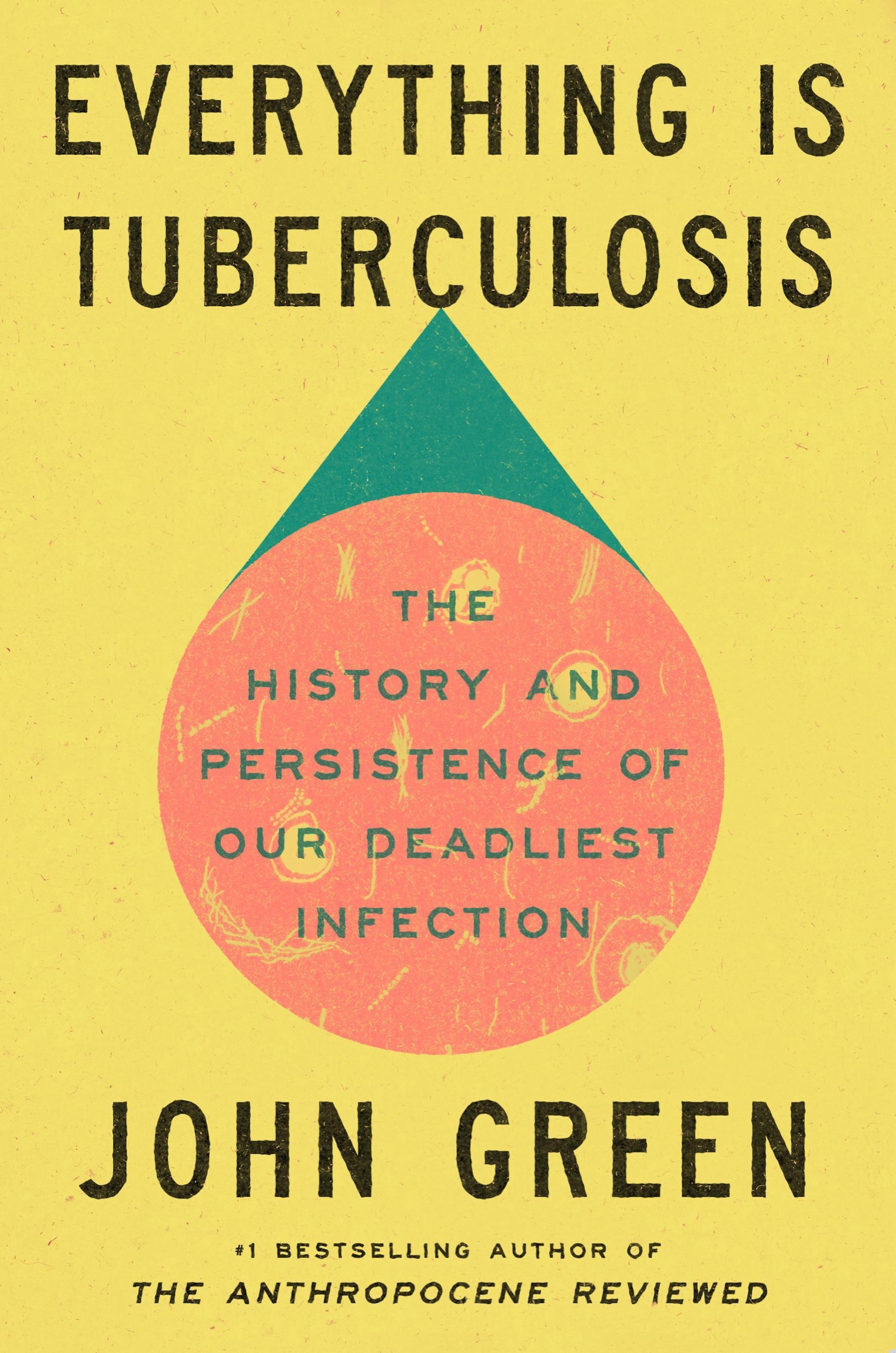
Everything Is Tuberculosis: The History and Persistence of Our Deadliest Infection
About this book
Tuberculosis has travelled with human beings for millennia. It has been romanticized as the illness of artists, feared as consumption, identified as a bacterial infection, and made curable—yet it remains one of the world's deadliest infectious diseases.
John Green organizes that history around Henry Reider, a young patient he met at Lakka Government Hospital in Sierra Leone in 2019. Henry's treatment turns global statistics into a specific chain of drugs, transport, nutrition, money, family care, and time.
The book follows scientific discoveries and medical failures, but it does not treat today's deaths as an unsolved biological mystery. Effective tools exist; their uneven price and availability reveal the policy choices that decide whose infection becomes fatal.
Everything Is Tuberculosis combines medical history, cultural analysis, memoir, and reporting. Green's argument is that disease is never only a pathogen: tuberculosis follows the routes laid out for it by poverty, stigma, infrastructure, and the value institutions place on different lives.
Read a sample
5,154 words
Plain text
From the opening
Introduction
Gregory and Stokes
Around the turn of the nineteenth century, the Scottish tinkerer and chemist James Watt began working on a new project.
He had already achieved fame and success for making steam engines more efficient, helping to fuel the industrial revolution that would radically reshape human history. The steam engine would lead to everything from air-conditioning to air travel to AirPods, while also unleashing over a trillion tons of carbon dioxide into the atmosphere, reshaping the planet’s climate. Watt’s innovation carried within it so much power that we named a measurement of power after him. Watt also made other important contributions to the human collection of tools and knowledge, inventing a machine that could copy sculptures and developing new strategies for manufacturing chlorine to bleach textiles.
But Watt hoped this new project would be his most important yet. He became obsessed with finding some kind of chemical solution to treat the lung disease known to physicians as phthisis.
Watt’s daughter Jessy had died of phthisis at the age of fifteen in 1794. And now his son, Gregory, was ill with the disease, suffering from the classic symptoms of a persistent cough, night sweats, fever, and the physical wasting of the body that gave the disease its colloquial name: consumption. Gregory was in his early twenties, a skilled orator known for being phenomenally attractive—one friend described him as “literally the most beautiful youth I ever saw.”
In a furious attempt to save Gregory, Watt helped invent a device that delivered nitrous oxide to the lungs, believing that shifting the amount of oxygen available to the body might help it heal. But the treatment proved unsuccessful. After many years of suffering, Gregory died of consumption in 1804 at the age of twenty-seven.
By 1900, phthisis had come to be known by a new name: tuberculosis. My great-uncle Stokes Goodrich was born that year in rural Tennessee. He was raised in a wood-frame house built by my great-grandfather Charles, a country doctor who rode his horse night and day around Franklin County delivering babies and dispensing medicine.
Stokes was a sickly child. In those days—and in these ones, too, I suppose—it was common to connect illness to some kind of deficiency, failure, or past mistake. A physician might conclude, as one German doctor did in the early eighteenth century, that a woman’s life-threatening illness was brought on “by a dog which barked loudly at her.” For baby Stokes, being given coffee and sweets by a family friend was thought to be the inciting incident. Thereafter, Stokes “developed the worst case of typhoid fever I ever saw recover,” my great-grandfather later reported in a short memoir he wrote for our family.
In 1918, when Stokes was eighteen, he again nearly died during the Great Influenza pandemic when he became ill while working at a munitions factory. He survived, and in 1920 went to work for Alabama Power and Light, laboring as a lineman. As the 1920s progressed, Stokes experienced frequent bouts of what he hoped might be bronchitis. But the stubborn cough would not go away, and eventually, after coughing up blood, he sought medical attention.
Here is how my great-grandfather reported what happened next: “Stokes went to see a fine doctor in Gadsden, Alabama, who X-rayed him and discovered tuberculosis in the apex of his right lung. The X-ray technician who made the film told me, ‘Dr. Goodrich, your son has miliary tuberculosis, and I have never seen a case that lived over two months.’ ”
Stokes was placed in a sanatorium in Asheville, North Carolina, one of many American cities that functioned as a tuberculosis colony of sorts. “Stokes had the best of care in the sanatorium but steadily grew worse, and on May 18, 1930, passed over the river to his Lord.”
My great-uncle was twenty-nine years old. I often wonder what it must have been like for my great-grandfather, having trained as a doctor, to be unable to save his own son from disease.
We are powerful enough to light the world at night, to artificially refrigerate food, to leave Earth’s atmosphere and orbit it from outer space. But we cannot save those we love from suffering. This is the story of human history as I understand it—the story of an organism that can do so much, but cannot do what it most wants.
Now we are two centuries removed from the deaths of Jessy and Gregory Watts, and nearly a century removed from the death of my great-uncle Stokes. Still, over a million people died of tuberculosis in 2023. That year, in fact, more people died of TB than died of malaria, typhoid, and war combined.
Just in the last two centuries, tuberculosis caused over a billion human deaths. One estimate, from Frank Ryan’s Tuberculosis: The Greatest Story Never Told, maintains that TB has killed around one in seven people who’ve ever lived. Covid-19 displaced tuberculosis as the world’s deadliest infectious disease from 2020 through 2022, but in 2023, TB regained the status it has held for most of what we know of human history. Killing 1,250,000 people, TB once again became our deadliest infection. What’s different now from 1804 or 1904 is that tuberculosis is curable, and has been since the mid-1950s. We know how to live in a world without tuberculosis. But we choose not to live in that world.
Continue reading the sampleClose the sample
In 2000, the Ugandan physician Dr. Peter Mugyenyi gave a speech about the rich world’s refusal to expand access to drugs treating HIV/AIDS. Millions of people were dying each year of AIDS, even though safe and effective antiretroviral therapy could have saved most of their lives. “Where are the drugs? The drugs are where the disease is not,” Dr. Mugyenyi said. “And where is the disease? The disease is where the drugs are not.”
And so it is with TB. This year, thousands of doctors will attend to millions of TB patients, and just as my great-grandfather could not save his son, these physicians will be unable to save their patients, because the cure is where the disease is not, and the disease is where the cure is not.
This is a book about that cure—why we didn’t find it until the 1950s, and why in the decades since discovering the cure, we’ve allowed over 150,000,000 humans to die of tuberculosis. I started writing about TB because I wanted to understand how an illness could quietly shape so much of human history. But along the way, I learned that TB is both a form and expression of injustice. And I learned that how we imagine illness shapes our societies and our priorities. James Watt understood consumption as a mechanical failure by the lungs to ingest the proper ratio of gases. My great-grandfather understood his son’s sickliness to have been driven by ingesting coffee and sweets in childhood. Others would understand TB as an inherited disease that affected certain types of personalities. Still others would argue that the illness was caused by demon possession, or poisoned air, or God’s judgment, or whiskey. And each of these ways of understanding tuberculosis shaped not just how people lived and died of TB, but also who lived and died of it.
Today, we understand tuberculosis as an infection caused by bacteria. TB is airborne—it spreads from person to person through small particles contained in coughs, sneezes, or exhalations. Anyone can get tuberculosis—in fact, between one-quarter and one-third of all living humans have been infected with it. In most people, the infection will lie dormant for a lifetime. But up to 10 percent of the infected will eventually become sick, a phenomenon we call “active TB.” People are especially likely to develop active TB if they have a weakened immune system due to other health problems like diabetes, HIV infection, or malnutrition. In fact, of the ten million people who became sick with TB in 2023, over five million also experienced malnutrition. And because the disease spreads especially well in crowded living and working conditions like slums and poorly ventilated factories, tuberculosis has come to be seen as a disease of poverty, an illness that walks the trails of injustice and inequity that we blazed for it.
The world we share is a product of all the worlds we used to share. For me at least, the history and present of tuberculosis reveal the folly and brilliance and cruelty and compassion of humans.
My wife, Sarah, often jokes that in my mind everything is about tuberculosis, and tuberculosis is about everything. She’s right.
Chapter 1
Lakka
When I first visited Lakka Government Hospital a few years back, I did not really want to be there.
Sarah and I were in Sierra Leone, a nation of nearly nine million people in West Africa, to learn about the country’s maternal and neonatal healthcare systems. At the time, Sierra Leone had the highest maternal mortality rate in the world, with around one in every seventeen women dying in pregnancy or childbirth, and we’d traveled there to learn about and share stories of people affected by the crisis.[*]
So our trip was supposed to be oriented around the global maternal mortality crisis, not tuberculosis, and by our last day in Sierra Leone, I was exhausted and ill. (I possess a somewhat fragile constitution when it comes to health, and also when it comes to most other things.) But a doctor we were traveling with asked us to visit Lakka with him. He assured us that Lakka, a facility supported by the global health nonprofit Partners In Health, was basically on the way to the airport, and he needed to consult with the staff about a few cases.
At the time, I knew almost nothing about TB. To me, it was a disease of history—something that killed depressive nineteenth-century poets, not present-tense humans. But as a friend once told me, “Nothing is so privileged as thinking history belongs to the past.”
When we arrived at Lakka, we were immediately greeted by a child who introduced himself as Henry. “That’s my son’s name,” I told him, and he smiled. Most Sierra Leoneans are multilingual, but Henry spoke particularly good English, especially for a kid his age, which made it possible for us to have a conversation that could go beyond my few halting phrases of Krio. I asked him how he was doing, and he said, “I am happy, sir. I am encouraged.” He loved that word. Who wouldn’t? Encouraged, like courage is something we rouse ourselves and others into.
My son Henry was nine then, and this Henry looked about the same age—a small boy with spindly legs and a big, goofy smile. He wore shorts and an oversized rugby shirt that reached nearly to his knees. Henry took hold of my T-shirt and began walking me around the hospital. He showed me the lab where a technician was looking through a microscope. Henry looked into the microscope and then asked me to, as the lab tech, a young woman from Freetown, explained that this sample contained tuberculosis even though the patient had been treated for several months with standard therapy. The lab tech began to tell me about this “standard therapy,” but Henry was pulling on my shirt again. He walked me through the wards, a complex of poorly ventilated buildings that contained hospital rooms with barred windows, thin mattresses, and no toilets. There was no electricity in the wards, and no consistent running water. To me, the rooms resembled prison cells. Before it was a TB hospital, Lakka was a leprosy isolation facility—and it felt like one.
Inside each room, one or two patients lay on cots, generally on their side or back. A few sat on the edges of their beds, leaning forward. All these men (the women were in a separate ward) were thin. Some were so emaciated that their skin seemed wrapped tightly around bone. As we walked down a hallway between buildings, Henry and I watched a young man drink water from a plastic bottle, and then promptly vomit a mix of bile and blood. I instinctively turned away, but Henry continued to stare at the man.
I figured Henry was someone’s kid—a doctor, maybe, or a nurse, or one of the cooking or cleaning staff. Everyone seemed to know him, and everyone stopped their work to say hello and rub his head or squeeze his hand. I was immediately charmed by Henry—he had some of the mannerisms of my son, the same paradoxical mixture of shyness and enthusiastic desire for connection.
Henry eventually brought me back to the group of doctors and nurses who were meeting in a small room near the entrance of the hospital, and then one of the nurses lovingly and laughingly shooed him away.
“Who is that kid?” I asked.
“Henry?” answered a nurse. “The sweetest boy.”
“He’s one of the patients we’re worried about,” said a physician who went by Dr. Micheal.
“He’s a patient?” I asked.
“Yes.”
“He’s such a cute little kid,” I said. “I hope he’s going to be okay.”
Dr. Micheal told me that Henry wasn’t a little boy. He was seventeen. He was only so small because he’d grown up malnourished, and then the TB had further emaciated his body.
“He seems to be doing okay,” I said. “Lots of energy. He walked me all around the hospital.”
“This is because the antibiotics are working,” Dr. Micheal explained. “But we know they are not working well enough. We are almost certain they will fail, and that is a big problem.” He shrugged, tight-lipped.
There was a lot I didn’t understand.
I saw Henry again as we were getting ready to leave. He was standing near the entrance to the hospital, and I asked him if I could take his picture. He said yes, and I photographed him a few times.
We scrolled through the pictures together. I tried to communicate that I was smiling from behind my mask. Henry wore no mask—his bacterial load was low enough that he posed no infection risk to others. As we chatted, I realized I was looking at him differently than I had when I believed him to be the son of a staff member. He no longer reminded me of my nine-year-old son; now he was an emaciated young man. When he looked up at me, I saw yellow clouds in the whites of his eyes—a byproduct of the liver toxicity that frequently accompanies the treatment he was on. I noticed swelling on one side of his neck—which I would later learn is a telltale sign that TB has infected the lymph nodes. I asked him if he took medicine every day.
“Yes,” he said. “I swallow them. Also they inject shot.”
“Is that scary?”
His big eyes got bigger as he nodded.
Henry told me that the injections burned like a fire under his skin, and that the medications had many side effects, but the worst one was hunger. Active tuberculosis severely suppresses appetite, causing stomachaches and generally inhibiting the ability to eat, and once treatment commences and the infection begins to lessen, hunger roars back, which is a good sign—but only if one has enough to eat.
Years later, a young TB survivor told me about the hunger. I was at Lakka again, sitting in the immense shade of a mature mango tree, one of the only pleasant spots on the hospital grounds, which otherwise comprised patches of red clay and overgrown shrubbery. Three long, rough-hewn wooden benches were moved throughout the day to keep in the mango’s shade. On the bench opposite me sat a young woman—we’ll call her Marie—hunched forward, knees on elbows. Marie was so thin when she arrived at the hospital that she’d been unable to walk, and her chest X-ray revealed hardly any healthy lung tissue at all. She was five feet, three inches tall, and when she’d arrived at Lakka, she weighed less than seventy pounds.
Marie told me she dreamed night and day of eating as she recovered her health, that she thought of making mud soup and eating sticks. She thought about how crunchy they would be, imagining them as overstuffed with rich, soft nutrients inside. She could not think of anything but food, all the time.
Almost apologetically, a nurse sitting beside us said, “We feed everyone three times a day. Big meals. But it is not enough.” Not nearly enough, in fact, but the nurse explained that even three meals a day strained resources, because food was not considered to be an essential aspect of tuberculosis treatment, and so there was no funding for food. Some people became so hungry, she told me, that they left the hospital and stopped taking their medication, which increased the likelihood that the TB bacteria within them would continue multiplying, eventually developing resistance to first-line treatments. But they simply could not live with the hunger.
In Henry’s short, beautifully written memoir, he referenced hunger many times. He called Lakka “a place where hope and despair intertwined…. I found myself in a world where food was scarce, water was rationed, and clothing was inadequate for the chilly nights.”
After I first met Henry, I asked one of the nurses if he would be okay. “Oh, we love our Henry!” she said. She told me he had already gone through so much in his young life. Thank God, she said, that Henry was so loved by his mother, Isatu, who visited him regularly and brought him extra food whenever she could. Most of the patients at Lakka had no visitors. Many had been abandoned by their families; a tuberculosis case in the family was a tremendous mark of shame. But Henry had Isatu.
I realized none of this was an answer to whether he would be okay.
He is such a happy child, she told me. He cheers everyone up. When he’d been able to go to school, the other kids called him pastor, because he was always offering them prayers and assistance.
Still, this was not an answer.
“We will fight for him,” she told me at last.
Skip Notes
* Thanks to investments from Sierra Leone’s Ministry of Health in deep partnership with other organizations, maternal mortality in Sierra Leone declined by more than 50 percent in the five years following our trip, a reminder that there is nothing permanent or unalterable about health inequities.
Chapter 2
Cowboys and Assassins
After I returned from Lakka to my home in Indianapolis, I began reading about the history of tuberculosis, which seemed to pop up everywhere from fashion to warfare to human geography, and I found that I simply could not shut up about the disease. Someone would mention New Mexico, and I’d jump in: “Did you know that New Mexico became a state partly because of tuberculosis?” Or, if a conversation turned to World War I, I’d respond, “Did you know that tuberculosis sorta kinda but not really caused World War I?” Or perhaps at a neighborhood Halloween party, I’d confront a ten-year-old dressed as a cowboy: “Did you know tuberculosis helped give us the cowboy hat?”
Which it really did, by the way: In the 1850s, a young man named John was living in New Jersey, working as a hatmaker, when he started coughing up blood. John visited the doctor and learned that, indeed, he had consumption. According to the prevailing wisdom of the time, his only real chance of survival was to head West.
The American West has long been associated with escape and freedom and last hopes. “West is where we all plan to go some day,” Robert Penn Warren wrote in All the King’s Men. “It is where you go when the land gives out and the old-field pines encroach. It is where you go when you get the letter saying: Flee, all is discovered.” And it is where consumptives went to extend their lives.
In the nineteenth and early twentieth centuries, it was commonly accepted that consumption could be effectively treated by dry air, which made a kind of sense—consumptive lungs seemed wet, and so did the humid, stagnant air in big American cities like New York and Baltimore, where consumption flourished. People fled to Arizona or New Mexico or California, which came to be known as the “land of new lungs.” As one brochure boldly promised: “Come West and live.”
Several cities, including Pasadena and Colorado Springs, were essentially created for consumptives and their families. But it wasn’t only desert air that was mythologized. Doctors also recommended island air, or mountain air, or forest air, or Italian air. The justification for the so-called “travel cure” varied, except for one constant: Consumption thrived in cities, and so the solution must be rural. (This worldview was not unique to Europe and the U.S., although it was centered there. The Japanese poet Masaoka Shiki also traveled with consumption in the hopes of improvement.)
Now, our hatmaker John did not travel all the way to the West Coast, but instead headed from his home in New Jersey to the rough frontier town of St. Joseph, Missouri. It’s hard to see how St. Joe’s humid, stultifying air could be viewed as TB-friendly, but John ended up settling there for a while, and—wonder of wonders—began to feel better. For reasons we still don’t fully understand, between 20 and 25 percent of people recover from active TB illness without treatment, and John was among that lucky minority.
Regaining his health over the next few years, John noticed something about the West: The hats sucked. Fur traders of European descent often wore bug-infested, brimless coonskin caps. Folks who made their way to Missouri from Texas and Mexico, meanwhile, tended to wear wide-brimmed straw hats that protected from the sun but leaked in the rain. So, after returning to the northeast with his consumption under control, John B. Stetson created a new sort of hat, which in time came to be known as the cowboy hat. (And even, sometimes, the Stetson.)[*]
I wasn’t kidding about New Mexico, either. Even after New Mexico became a U.S. territory in 1848, it was regarded with suspicion by many white Americans. After all, the majority of people living in the territory were Indigenous people or people who spoke Spanish as their first language. And so despite New Mexico having the institutions needed for statehood, a large enough population, and a strong majority of its voters seeking statehood, the U.S. Congress repeatedly turned down New Mexico’s attempts to fully enter the Union.
In order to please Congress, New Mexican officials realized they needed to recruit a larger white and English-speaking population, and thus began New Mexico’s quest to woo consumptives from the American Northeast and South with the promise of desert air, open skies, and world-class consumption care. That plan worked—by 1910, around 10 percent of all New Mexicans were tuberculosis patients, and with these new white residents, the U.S. Congress finally acquiesced, and New Mexico became the forty-seventh U.S. State in 1912.
Did TB cause World War I? Not really, but I would argue that it should be listed as a minor cause alongside the major ones—the alliance system of early twentieth-century Europe, the growing militarization and expansion of empires, etc.
As you may recall from history class, the Great War began after the assassination of the Austro-Hungarian Archduke Franz Ferdinand, which was—as assassinations go—somewhat farcical. On one side, we had the archduke’s wildly incompetent support staff, and on the other, a group of wildly incompetent assassins, half of whom were teenage consumptives.
In early 1914, the archduke and his wife made plans to visit Sarajevo, which was part of their Austro-Hungarian Empire—but a rather reluctant part. Many people living in the Balkan region wished to see their long-marginalized communities emerge as independent states, and among them were three teenagers from Belgrade—Nedjelko Cabrinovic, Trifko Grabez, and Gavrilo Princip. All three were nineteen and connected with the Black Hand, a revolutionary group led by Serbian Army officers who wanted to liberate Serbia from the Austro-Hungarian Empire.
Cabrinovic, Grabez, and Princip were all seriously ill with tuberculosis. They knew they would die soon. As John Simkin put it, “They were therefore willing to give their life for what they believed was a great cause.” So when news spread that Franz Ferdinand would be touring Sarajevo (in an open-top car, no less), the three young men traveled there with the intention of assassinating the archduke. In Sarajevo, they joined up with three coconspirators, and each of the six was given a gun, bombs, and a cyanide pill, along with instructions to commit suicide once the archduke was dead.
The mission was an unmitigated catastrophe. Three of the men (the three without tuberculosis!) ended up unable or unwilling to act, but the boys from Belgrade were different. Cabrinovic was the first to see the archduke on the parade route; he threw a bomb toward Franz Ferdinand’s car but he missed, instead injuring several people in another car. Cabrinovic proceeded to take his cyanide pill, which contained too little cyanide to actually kill him, and then jump into a river where he hoped to drown, except the river ended up only being four inches deep, so he was quickly captured.
The archduke’s car took off after that, and the remaining conspirators gave up. At this point the archduke probably should’ve returned to his hotel after almost dying, but one of his companions convinced him to continue driving around Sarajevo, saying, “Do you think Sarajevo is full of assassins?”
Minutes later, their driver—who did not know the streets of Sarajevo well—took a wrong turn and stopped the car to shift into reverse. And where should that car stop except right in front of Gavrilo Princip. Princip shot both the archduke and Duchess Sophie to death, and then took his cyanide pill, which of course failed to kill him. Instead, he and all of his coconspirators were imprisoned. In the Austro-Hungarian Empire, it was illegal at the time to put teenagers to death, but the government didn’t need a firing squad to kill them. All three would be dead before the end of the war, and all from tuberculosis.
It’s fascinating to see the places where TB intersects with history, but there’s risk in claiming that, for instance, Princip’s consumption caused World War I, or that TB made New Mexico a state, and so on. Looking at history through any single lens creates distortions, because history is too complex for any one way of looking to suffice.
And anyway, while I’m fascinated by how TB shaped culture and history, what’s most important to me is how culture has shaped TB. The infection has long exploited human biases and blind spots, wriggling its way through the paths injustice creates. Of course, tuberculosis doesn’t know what it’s doing, but for centuries, the disease has used social forces and prejudice to thrive wherever power systems devalue human lives—an experience that, back in Sierra Leone, Henry and his mother, Isatu, knew all too well.
Skip Notes
* Stetson would go on to live a long life and make a vast fortune, almost all of which he donated to endow schools, homeless shelters, and food banks.
Chapter 3
Look at Our Railroads
It is common to say that Sierra Leone is a poor country, but this is not the case. It is an exceptionally rich country with vast wealth in metal ores and especially in diamonds, which during centuries of colonialism encrusted many a British crown. After achieving independence in 1961, the new government struggled to transition away from this extraction-based economy. This was in part because systems to mine and export diamonds and minerals were more mature and robust than any other economic sector, and in part because independence didn’t change the fact that many of the most valuable assets in Sierra Leone were (and still are) foreign-owned. Although the economy grew and life expectancy increased after independence, the country remained deeply impoverished.
The Sierra Leonean physician Dr. Bailor Barrie once told me, “If you want to understand why Sierra Leone is poor, you must look at a map of our railroads.” And so I did. The map looks like this:
The railroads, built during colonial rule, did not connect people to each other. They connected the mineral-rich areas of Sierra Leone to the coast of Sierra Leone, where those minerals could be exported. The British Empire was in the business of resource extraction, and the systems built to support that business were resource-extraction systems. Were there schools? A few, to train servants of the empire. Were there clinics? A few, to heal servants of the empire. But the empire’s role in Sierra Leone was primarily to take Sierra Leone’s wealth, as quickly and efficiently as possible, out of Sierra Leone.
In the Global North, we still sometimes hear about the benefits of colonialism, how it brought roads and hospitals and schools to colonized regions, but this perspective is not supported by strong evidence. In 1950, life expectancy in Britain was sixty-nine. In Sierra Leone, after 150 years of colonial rule, life expectancy was under thirty, relatively similar to the life expectancy of premodern humans who lived five thousand or fifty thousand years ago. In general, colonial infrastructure was not built to strengthen communities; it was built to deplete them.
Sierra Leone was a British protectorate for centuries, but even before it was formally controlled by the British, it was terrorized by them. The historian Stephen Greenblatt introduced me to one account, written by a merchant named John Sarracoll, of a 1586–1587 voyage to Sierra Leone:
The fourth of November we went on shore to a town of the Negroes…. It was of about two hundred houses, and walled about with mighty great trees, and stakes so thick that a rat could hardly get in or out. But as it chanced, we came directly upon a port which was not shut up, where we entered with such fierceness, that the people fled all out of the town, which we found to be finely built after their fashion, and the streets of it so intricate that it was difficult for us to find the way out that we came in at. We found their houses and streets so…cleanly kept that it was an admiration to us all, for that neither in the houses nor streets was so much dust to be found as would fill an egg shell. We found little in their houses, except some mats, gourds, and some earthen pots. Our men at their departure set the town on fire, and it was burnt (for the most part of it) in a quarter of an hour, their houses being covered with reed and straw.