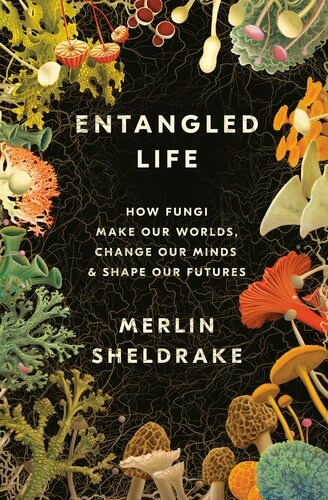
Entangled Life: How Fungi Make Our Worlds, Change Our Minds & Shape Our Futures
About this book
A mushroom is only one temporary structure in a fungal life. Much of the kingdom exists as branching mycelium, growing through soil, bodies, roots, buildings, food, and habitats where familiar categories of individual and environment become difficult to maintain.
The book moves through lichens, mycorrhizal relationships, yeast, truffles, parasitic fungi, psychedelics, fermentation, and experiments in materials and remediation. Scientific uncertainty remains visible, especially where popular metaphors of communication run ahead of demonstrated mechanism.
Sheldrake combines fieldwork, laboratory research, history, and personal experiments to change the scale at which readers look. Fungi make dependence unavoidable: plants, carbon cycles, human culture, and decay all rely on processes occurring mostly out of sight.
Entangled Life: How Fungi Make Our Worlds, Change Our Minds & Shape Our Futures is an accessible introduction to mycology's conceptual reach. Its most useful effect is not a list of wonders but a challenge to think in relationships rather than isolated organisms.
Read a sample
5,077 words
Plain text
From the opening
PROLOGUE
I LOOKED UP TOWARD the top of the tree. Ferns and orchids sprouted from its trunk, which vanished into a tangle of lianas in the canopy. High above me, a toucan flapped off its perch with a croak, and a troupe of howler monkeys worked themselves into a slow roar. The rain had only just stopped, and the leaves above me shed heavy drops of water in sudden showers. A low mist hung over the ground.
The tree’s roots wound outward from the base of its trunk, soon vanishing into the thick drifts of fallen leaves that covered the floor of the jungle. I used a stick to tap the ground for snakes. A tarantula scuttled off, and I knelt, feeling my way down the tree’s trunk and along one of its roots into a mass of spongy debris where the finer roots matted into a thick red and brown tangle. A rich smell drifted upward. Termites clambered through the labyrinth, and a millipede coiled up, playing dead. My root vanished into the ground, and with a trowel I cleared the area around the spot. I used my hands and a spoon to loosen the top layer of earth and dug as gently as I could, slowly uncovering it as it ranged out from the tree and twisted along just below the surface of the soil.
After an hour, I had traveled about a meter. My root was now thinner than string and had started to proliferate wildly. It was hard to keep track of as it knotted with its neighbors, so I lay down on my stomach and lowered my face into the shallow trench I had made. Some roots smell sharp and nutty and others woody and bitter, but the roots of my tree had a spicy resinous kick when I scratched them with a fingernail. For several hours I inched along the ground, scratching and sniffing every few centimeters to make sure I hadn’t lost the thread.
As the day went on, more filaments sprang out from the root I’d uncovered and I chose a few of them to follow all the way to the tips, where they burrowed into fragments of rotting leaf or twig. I dipped the ends in a vial of water to wash off the mud and looked at them through a loupe. The rootlets branched like a small tree and their surface was covered with a filmy layer that appeared fresh and sticky. It was these delicate structures I wanted to examine. From these roots, a fungal network laced out into the soil and around the roots of nearby trees. Without this fungal web my tree would not exist. Without similar fungal webs no plant would exist anywhere. All life on land, including my own, depended on these networks. I tugged lightly on my root and felt the ground move.
INTRODUCTION
WHAT IS IT LIKE TO BE A FUNGUS?
There are moments in moist love when heaven is jealous of what we on earth can do.
—HAFIZ
FUNGI ARE EVERYWHERE but they are easy to miss. They are inside you and around you. They sustain you and all that you depend on. As you read these words, fungi are changing the way that life happens, as they have done for more than a billion years. They are eating rock, making soil, digesting pollutants, nourishing and killing plants, surviving in space, inducing visions, producing food, making medicines, manipulating animal behavior, and influencing the composition of the Earth’s atmosphere. Fungi provide a key to understanding the planet on which we live, and the ways that we think, feel, and behave. Yet they live their lives largely hidden from view, and over ninety percent of their species remain undocumented. The more we learn about fungi, the less makes sense without them.
Fungi make up one of life’s kingdoms—as broad and busy a category as “animals” or “plants.” Microscopic yeasts are fungi, as are the sprawling networks of honey fungi, or Armillaria, which are among the largest organisms in the world. The current record holder, in Oregon, weighs hundreds of tons, spills across ten square kilometers, and is somewhere between two thousand and eight thousand years old. There are probably many larger, older specimens that remain undiscovered.
Many of the most dramatic events on Earth have been—and continue to be—a result of fungal activity. Plants only made it out of the water around five hundred million years ago because of their collaboration with fungi, which served as their root systems for tens of million years until plants could evolve their own. Today, more than ninety percent of plants depend on mycorrhizal fungi—from the Greek words for fungus (mykes) and root (rhiza)—which can link trees in shared networks sometimes referred to as the “wood wide web.” This ancient association gave rise to all recognizable life on land, the future of which depends on the continued ability of plants and fungi to form healthy relationships.
Plants may have greened the planet, but if we could cast our eyes back to the Devonian period, four hundred million years ago, we’d be struck by another life-form: Prototaxites. These living spires were scattered across the landscape. Many were taller than a two-story building. Nothing else got anywhere close to this size: Plants existed but were no more than a meter tall, and no animal with a backbone had yet moved out of the water. Small insects made their homes in the giant trunks, chewing out rooms and corridors. This enigmatic group of organisms—thought to have been enormous fungi—were the largest living structures on dry land for at least forty million years, twenty times longer than the genus Homo has existed.
Continue reading the sampleClose the sample
To this day, new ecosystems on land are founded by fungi. When volcanic islands are made or glaciers retreat to reveal bare rock, lichens (pronounced LY ken)—a union of fungi and algae or bacteria—are the first organisms to establish themselves and to make the soil in which plants subsequently take root. In well-developed ecosystems soil would be rapidly sluiced off by rain were it not for the dense mesh of fungal tissue that holds it together. There are few pockets of the globe where fungi can’t be found; from deep sediments on the seafloor, to the surface of deserts, to frozen valleys in Antarctica, to our guts and orifices. Tens to hundreds of species can exist in the leaves and stems of a single plant. These fungi weave themselves through the gaps between plant cells in an intimate brocade and help to defend plants against disease. No plant grown under natural conditions has been found without these fungi; they are as much a part of planthood as leaves or roots.
The ability of fungi to prosper in such a variety of habitats depends on their diverse metabolic abilities. Metabolism is the art of chemical transformation. Fungi are metabolic wizards and can explore, scavenge, and salvage ingeniously, their abilities rivaled only by bacteria. Using cocktails of potent enzymes and acids, fungi can break down some of the most stubborn substances on the planet, from lignin, wood’s toughest component, to rock; crude oil; polyurethane plastics; and the explosive TNT. Few environments are too extreme. A species isolated from mining waste is one of the most radiation-resistant organisms ever discovered and may help to clean up nuclear waste sites. The blasted nuclear reactor at Chernobyl is home to a large population of such fungi. A number of these radio-tolerant species even grow toward radioactive “hot” particles, and appear to be able to harness radiation as a source of energy, as plants use the energy in sunlight.
MUSHROOMS DOMINATE THE popular fungal imagination, but just as the fruits of plants are one part of a much larger structure that includes branches and roots, so mushrooms are only the fruiting bodies of fungi, the place where spores are produced. Fungi use spores like plants use seeds: to disperse themselves. Mushrooms are a fungus’s way to entreat the more-than-fungal world, from wind to squirrel, to assist with the dispersal of spores, or to prevent it from interfering with this process. They are the parts of fungi made visible, pungent, covetable, delicious, poisonous. However, mushrooms are only one approach among many: The overwhelming majority of fungal species release spores without producing mushrooms at all.
We all live and breathe fungi, thanks to the prolific abilities of fungal fruiting bodies to disperse spores. Some species discharge spores explosively, which accelerate ten thousand times faster than a space shuttle directly after launch, reaching speeds of up to a hundred kilometers per hour—some of the quickest movements achieved by any living organism. Other species of fungi create their own microclimates: Spores are carried upward by a current of wind generated by mushrooms as water evaporates from their gills. Fungi produce around fifty megatons of spores each year—equivalent to the weight of five hundred thousand blue whales—making them the largest source of living particles in the air. Spores are found in clouds and influence the weather by triggering the formation of the water droplets that form rain and the ice crystals that form snow, sleet, and hail.
Spores
Some fungi, like the yeasts that ferment sugar into alcohol and cause bread to rise, consist of single cells that multiply by budding into two. However, most fungi form networks of many cells known as hyphae (pronounced HY fee): fine tubular structures that branch, fuse, and tangle into the anarchic filigree of mycelium. Mycelium describes the most common of fungal habits, better thought of not as a thing but as a process: an exploratory, irregular tendency. Water and nutrients flow through ecosystems within mycelial networks. The mycelium of some fungal species is electrically excitable and conducts waves of electrical activity along hyphae, analogous to the electrical impulses in animal nerve cells.
Mycelium
Hyphae make mycelium, but they also make more specialized structures. Fruiting bodies, such as mushrooms, arise from the felting together of hyphal strands. These organs can perform many feats besides expelling spores. Some, like truffles, produce aromas that have made them among the most expensive foods in the world. Others, like shaggy ink cap mushrooms (Coprinus comatus), can push their way through asphalt and lift heavy paving stones, although they are not themselves a tough material. Pick an ink cap and you can fry it up and eat it. Leave it in a jar, and its bright white flesh will deliquesce into a pitch-black ink over the course of a few days (the illustrations in this book were drawn with Coprinus ink).
Shaggy ink cap mushrooms, Coprinus comatus, drawn with ink made from shaggy ink cap mushrooms
Their metabolic ingenuity allows fungi to forge a wide variety of relationships. Whether in their roots or shoots, plants have relied on fungi for nutrition and defense for as long as there have been plants. Animals, too, depend on fungi. After humans, the animals that form some of the largest and most complex societies on Earth are leaf-cutter ants. Colonies can reach sizes of more than eight million individuals, with underground nests that grow larger than thirty meters across. The lives of leaf-cutter ants revolve around a fungus that they cultivate in cavernous chambers and feed with fragments of leaf.
Human societies are no less entwined with fungi. Diseases caused by fungi cause billions of dollars of losses—the rice blast fungus ruins a quantity of rice large enough to feed more than sixty million people every year. Fungal diseases of trees, from Dutch elm disease to chestnut blight, transform forests and landscapes. Romans prayed to the god of mildew, Robigus, to avert fungal diseases but weren’t able to stop the famines that contributed to the decline of the Roman Empire. The impact of fungal diseases is increasing across the world: Unsustainable agricultural practices reduce the ability of plants to form relationships with the beneficial fungi on which they depend. The widespread use of antifungal chemicals has led to an unprecedented rise in new fungal superbugs that threaten both human and plant health. As humans disperse disease-causing fungi, we create new opportunities for their evolution. Over the last fifty years, the most deadly disease ever recorded—a fungus that infects amphibians—has been spread around the world by human trade. It has driven ninety species of amphibian to extinction and threatens to wipe out over a hundred more. The variety of banana that accounts for ninety-nine percent of global banana shipments, the Cavendish, is being decimated by a fungal disease and faces extinction in the coming decades.
Like leaf-cutter ants, however, humans have worked out how to use fungi to solve a range of pressing problems. In fact, we have probably deployed fungal solutions for longer than we have been Homo sapiens. In 2017, researchers reconstructed the diets of Neanderthals, cousins of modern humans who went extinct approximately fifty thousand years ago. They found that an individual with a dental abscess had been eating a type of fungus—a penicillin-producing mold—implying knowledge of its antibiotic properties. There are other less ancient examples, including the Iceman, an exquisitely well-preserved Neolithic corpse found in glacial ice, dating from around five thousand years ago. On the day he died, the Iceman was carrying a pouch stuffed with wads of the tinder fungus (Fomes fomentarius) that he almost certainly used to make fire, and carefully prepared fragments of the birch polypore mushroom (Fomitopsis betulina) most probably used as a medicine.
The indigenous peoples of Australia treated wounds with molds harvested from the shaded side of eucalyptus trees. The Jewish Talmud features a mold cure, known as “chamka,” consisting of moldy corn soaked in date wine. Ancient Egyptian papyruses from 1500 BCE refer to the curative properties of mold, and in 1640, the king’s herbalist in London, John Parkinson, described the use of molds to treat wounds. But it was only in 1928 that Alexander Fleming discovered that a mold produced a bacteria-killing chemical called penicillin. Penicillin became the first modern antibiotic and has since saved countless lives. Fleming’s discovery is widely credited as one of the defining moments of modern medicine and arguably helped to shift the balance of power in the Second World War.
Penicillin, a compound that could defend fungi from bacterial infection, turned out to defend humans as well. This is not unusual: Although fungi have long been lumped together with plants, they are actually more closely related to animals—an example of the kind of category mistake that researchers regularly make in their struggle to understand fungal lives. At a molecular level, fungi and humans are similar enough to benefit from many of the same biochemical innovations. When we use drugs produced by fungi, we are often borrowing a fungal solution and rehousing it within our own bodies. Fungi are pharmaceutically prolific, and today we depend on them for many other chemicals besides penicillin: cyclosporine (an immunosuppressant drug that makes organ transplants possible), cholesterol-lowering statins, a host of powerful antiviral and anticancer compounds (including the multibillion-dollar drug Taxol, originally extracted from the fungi that live within yew trees), not to mention alcohol (fermented by a yeast) and psilocybin (the active component in psychedelic mushrooms recently shown in clinical trials to be capable of lifting severe depression and anxiety). Sixty percent of the enzymes used in industry are generated by fungi, and fifteen percent of all vaccines are produced by engineered strains of yeast. Citric acid, produced by fungi, is used in all fizzy drinks. The global market for edible fungi is booming and is projected to increase from $42 billion in 2018 to $69 billion by 2024. Sales of medicinal mushrooms are increasing yearly.
Fungal solutions don’t stop at human health. Radical fungal technologies can help us respond to some of the many problems that arise from ongoing environmental devastation. Antiviral compounds produced by fungal mycelium reduce colony collapse disorder in honeybees. Voracious fungal appetites can be deployed to break down pollutants, such as crude oil from oil spills, in a process known as mycoremediation. In mycofiltration, contaminated water is passed through mats of mycelium, which filter out heavy metals and break down toxins. In mycofabrication, building materials and textiles are grown out of mycelium and replace plastics and leather in many applications. Fungal melanins, the pigments produced by radio-tolerant fungi, are a promising new source of radiation-resistant biomaterials.
Human societies have always pivoted around prodigious fungal metabolisms. A full litany of the chemical accomplishments of fungi would take months to recite. Yet despite their promise, and central role in many ancient human fascinations, fungi have received a tiny fraction of the attention given to animals and plants. The best estimate suggests that there are between 2.2 and 3.8 million species of fungi in the world—six to ten times the estimated number of plant species—meaning that a mere six percent of all fungal species have been described. We are only just beginning to understand the intricacies and sophistications of fungal lives.
FOR AS LONG as I can remember I’ve been fascinated by fungi and the transformations they provoke. A solid log becomes soil, a lump of dough rises into bread, a mushroom erupts overnight—but how? As a teenager I dealt with my bafflement by finding ways to involve myself with fungi. I picked mushrooms and grew mushrooms in my bedroom. Later, I brewed alcohol in the hope that I might learn more about yeast and its influence on me. I marveled at the transformation of honey into mead and fruit juice into wine—and at how the product of these transformations could transform my own senses and those of my friends.
By the time my formal study of fungi began, when I became an undergraduate at Cambridge in the Department of Plant Sciences—there is no Department of Fungal Sciences—I had become fascinated by symbiosis—the close relationships that form between unrelated organisms. The history of life turned out to be full of intimate collaborations. Most plants, I learned, depend on fungi to provide them with nutrients from the soil, such as phosphorus or nitrogen, in exchange for energy-giving sugars and lipids produced in photosynthesis—the process by which plants eat light and carbon dioxide from the air. The relationship between plants and fungi gave rise to the biosphere as we know it and supports life on land to this day, but we seemed to understand so little. How did these relationships arise? How do plants and fungi communicate with one another? How could I learn more about the lives of these organisms?
I accepted the offer of a PhD to study mycorrhizal relationships in tropical forests in Panama. Soon afterward, I moved to a field station on an island run by the Smithsonian Tropical Research Institute. The island and surrounding peninsulas were part of a nature reserve entirely covered by forest, apart from a clearing for dormitories, a canteen, and lab buildings. There were greenhouses for growing plants, drying cupboards filled with bags of leaf litter, a room lined with microscopes, and a walk-in freezer packed with samples: bottles of tree sap, dead bats, tubes containing ticks pulled from the backs of spiny rats and boa constrictors. Posters on the notice board offered cash rewards to anyone who could source fresh ocelot droppings from the forest.
The jungle bristled with life. There were sloths, pumas, snakes, crocodiles; there were basilisk lizards that could run across the surface of water without sinking. In just a few hectares there lived as many woody plant species as in the whole of Europe. The diversity of the forest was reflected in the rich variety of field biologists who came there to study it. Some climbed trees and observed ants. Some set out at dawn every day to follow the monkeys. Some tracked the lightning that struck trees during tropical storms. Some spent their days suspended from a crane measuring ozone concentrations in the forest canopy. Some warmed up the soil using electrical elements to see how bacteria might respond to global heating. Some studied the way beetles navigate using the stars. Bumblebees, orchids, butterflies—there seemed to be no aspect of life in the forest that someone wasn’t observing.
I was struck by the creativity and humor of this community of researchers. Lab biologists spend most of their time in charge of the pieces of life they study. Their own human lives are lived outside the flasks that contain their subject matter. Field biologists rarely have so much control. The world is the flask and they’re inside it. The balance of power is different. Storms wash away the flags that mark their experiments. Trees fall on their plots. Sloths die where they planned to measure the nutrients in the soil. Bullet ants sting them as they crash past. The forest and its inhabitants dispel any illusions that scientists are in charge. Humility quickly sets in.
The relationships between plants and mycorrhizal fungi are key to understanding how ecosystems work. I wanted to learn more about the way nutrients passed through fungal networks, but I became dizzy when I thought about what was going on underground. Plants and mycorrhizal fungi are promiscuous: many fungi can live within the roots of a single plant, and many plants can connect with a single fungal network. In this way a variety of substances, from nutrients to signaling compounds, can pass between plants via fungal connections. In simple terms, plants are socially networked by fungi. This is what is meant by the “wood wide web.” The tropical forests I worked in contained hundreds of plant and fungal species. These networks are inconceivably complicated, their implications huge and still poorly understood. Imagine the puzzlement of an extraterrestrial anthropologist who discovered, after decades of studying modern humanity, that we had something called the Internet. It’s a bit like that for contemporary ecologists.
In my efforts to investigate the networks of mycorrhizal fungi that strung their way through the soil, I collected thousands of soil samples and tree-root trimmings and mashed them into pastes to extract their fats, or DNA. I grew hundreds of plants in pots with different communities of mycorrhizal fungus and measured how big their leaves grew. I sprinkled thick rings of black pepper around the greenhouses to deter cats from creeping in and bringing with them rogue fungal communities from outside. I dosed plants with chemical labels and traced these chemicals through roots and into the soil so that I might measure how much must have passed to their fungal associates—more mashing and more pastes. I spluttered around the forested peninsulas in a small motorboat that often broke down, climbed up waterfalls looking for rare plants, trudged for miles down muddy paths carrying a backpack full of waterlogged soil, and drove trucks into drifts of thick red jungle mud.
Of the many organisms that lived in the rainforest, I was most enthralled by a species of small flower that sprouted from the ground. These plants were the height of a coffee cup, their stalks spindly and pale white with a single bright blue flower balanced on top. They were a species of jungle gentian called Voyria, and had long ago lost the ability to photosynthesize. In doing so, they had lost their chlorophyll, the pigment that makes photosynthesis possible and gives plants their green color. I was perplexed by Voyria. Photosynthesis is one of the things that makes plants plants. How could these plants survive without it?
I suspected Voyria’s relationships with their fungal partners were unusual, and I wondered whether these flowers might tell me something about what was going on below the surface of the soil. I spent many weeks searching for Voyria in the jungle. Some flowers grew in open stretches of the forest and were easy to spot. Others hid, tucked behind buttressed tree roots. Within plots a quarter the size of a football field there could be hundreds of flowers, and I had to count them all. The forest was rarely open or flat, so this meant scrambling and stooping. In fact, it meant almost anything but walking. Each evening I returned to the field station filthy and exhausted. Over supper my Dutch ecologist friends cracked jokes about my cute blossoms with their frail stems. They studied the ways that tropical forests stored carbon. While I scuffed along squinting at the ground in search of tiny flowers, they measured the girth of trees. In a carbon budget of the forest, Voyria were inconsequential. My Dutch friends teased me about my small ecology and my dainty fascinations. I teased them about their brute ecology and their machismo. At dawn the next day, I would set off once again, peering at the floor in the hope that these curious plants could help me find my way underground, into this hidden, teeming world.
WHETHER IN FORESTS, labs, or kitchens, fungi have changed my understanding of how life happens. These organisms make questions of our categories, and thinking about them makes the world look different. It was my growing delight in their power to do so that led me to write this book. I have tried to find ways to enjoy the ambiguities that fungi present, but it’s not always easy to be comfortable in the space created by open questions. Agoraphobia can set in. It’s tempting to hide in small rooms built from quick answers. I have done my best to hold back.
A friend of mine, the philosopher and magician David Abram, used to be the house magician at Alice’s Restaurant in Massachusetts (made famous by the Arlo Guthrie song). Every night he passed around the tables; coins walked through his fingers, reappeared exactly where they shouldn’t, disappeared again, divided in two, vanished into nothing. One evening, two customers returned to the restaurant shortly after leaving and pulled David aside, looking troubled. When they left the restaurant, they said, the sky had appeared shockingly blue and the clouds large and vivid. Had he put something in their drinks? As the weeks went by, it continued to happen—customers returned to say the traffic had seemed louder than it was before, the streetlights brighter, the patterns on the sidewalk more fascinating, the rain more refreshing. The magic tricks were changing the way people experienced the world.
David explained to me why he thought this happened. Our perceptions work in large part by expectation. It takes less cognitive effort to make sense of the world using preconceived images updated with a small amount of new sensory information than to constantly form entirely new perceptions from scratch. It is our preconceptions that create the blind spots in which magicians do their work. By attrition, coin tricks loosen the grip of our expectations about the way hands and coins work. Eventually, they loosen the grip of our expectations on our perceptions more generally. On leaving the restaurant, the sky looked different because the diners saw the sky as it was there and then, rather than as they expected it to be. Tricked out of our expectations, we fall back on our senses. What’s astonishing is the gulf between what we expect to find and what we find when we actually look.
Fungi, too, trick us out of our preconceptions. Their lives and behaviors are startling. The more I’ve studied fungi, the more my expectations have loosened and the more familiar concepts have started to appear unfamiliar. Two fast-growing fields of biological inquiry have helped me both navigate these states of surprise and provide frameworks that have guided my exploration of the fungal world.
The first is a growing awareness of the many sophisticated, problem-solving behaviors that have evolved in brainless organisms outside the animal kingdom. The best-known examples are slime molds, such as Physarum polycephalum (though they are amoeba, not fungi, as true molds are). As we’ll see, slime molds have no monopoly on brainless problem-solving, but they are easy to study and have become poster organisms that have opened up new avenues of research. Physarum form exploratory networks made of tentacle-like veins and have no central nervous system—nor anything that resembles one. Yet they can “make decisions” by comparing a range of possible courses of action and can find the shortest path between two points in a labyrinth. Japanese researchers released slime molds into petri dishes modeled on the Greater Tokyo area. Oat flakes marked major urban hubs and bright lights represented obstacles such as mountains—slime molds don’t like light. After a day, the slime mold had found the most efficient route between the oats, emanating into a network almost identical to Tokyo’s existing rail network. In similar experiments, slime molds have re-created the motorway network of the United States and the network of Roman roads in central Europe. A slime-mold enthusiast told me about a test he had performed. He frequently got lost in IKEA stores and would spend many minutes trying to find the exit. He decided to challenge his slime molds with the same problem and built a maze based on the floor plan of his local IKEA. Sure enough, without any signs or staff to direct them, the slime molds soon found the shortest path to the exit. “You see,” he said with a laugh, “they’re cleverer than me.”
Whether one calls slime molds, fungi, and plants “intelligent” depends on one’s point of view. Classical scientific definitions of intelligence use humans as a yardstick by which all other species are measured. According to these anthropocentric definitions, humans are always at the top of the intelligence rankings, followed by animals that look like us (chimpanzees, bonobos, etc.), followed again by other “higher” animals, and onward and downward in a league table—a great chain of intelligence drawn up by the ancient Greeks, which persists one way or another to this day. Because these organisms don’t look like us or outwardly behave like us—or have brains—they have traditionally been allocated a position somewhere at the bottom of the scale. Too often, they are thought of as the inert backdrop to animal life. Yet many are capable of sophisticated behaviors that prompt us to think in new ways about what it means for organisms to “solve problems,” “communicate,” “make decisions,” “learn,” and “remember.” As we do so, some of the vexed hierarchies that underpin modern thought start to soften. As they soften, our ruinous attitudes toward the more-than-human world may start to change.