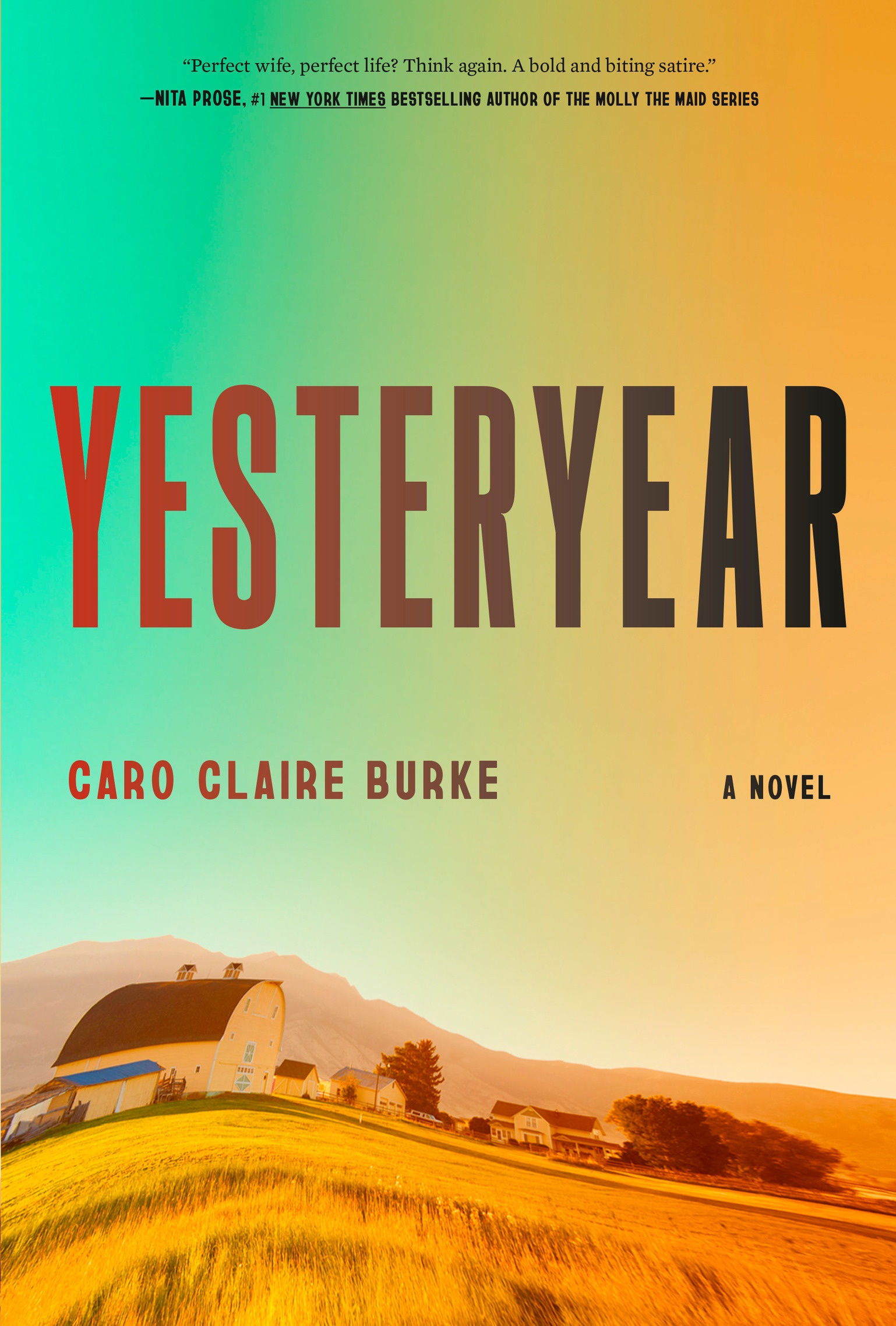
Yesteryear
About this book
Natalie lives by schedules, sobriety, and the polished domestic brand she presents online. Then she wakes in a picture-perfect house in 1955, married to a man she does not know and responsible for two children who call her mother.
The apparent fantasy of simpler living quickly reveals its terms. Money, medicine, marriage, work, and a woman’s public credibility all operate under rules Natalie cannot dismiss with a post, while the people around her possess memories that make her the unreliable person in the room.
Her search for a way home becomes inseparable from the question of what has happened to the woman whose place she occupies. The novel uses the contrast between curated nostalgia and daily dependence to expose what each period hides behind a desirable image.
Yesteryear is a time-slip thriller with a satirical edge. Caro Claire Burke treats mid-century aesthetics and online homemaking as related performances, then asks who pays when a performance is mistaken for a whole life.
Read a sample
5,161 words
Plain text
From the opening
This is the last day of the life I imagined for myself.
I woke up two minutes before my alarm went off, like usual. Five fifty-eight and bing: eyes wide open, ready to greet the day. I’ve never had a hard time waking up in the morning. Never used the snooze button, either, not once in my life. Sobriety helps. I don’t drink. Discipline helps, too. I was born with spades of discipline, I’m practically overflowing with it—which is why, I think, I’ve never had that much trouble with anything in my life. Not motherhood, nor marriage, nor building a business, nor serving Him. All of it appeared to me as a series of tasks to be accomplished each day, at the right time, in the correct chronological order. I know it’s not that easy for other people, but it really is for me.
That’s why all those strangers liked me so much.
That, and the money. The money definitely helped too.
It was wintertime. January. A cold front had just blown through the pass. By my bedroom window, the radiator was puffing hot air. The sky outside was deep-as-death black, and would be for another few hours. Our farm was nestled in the rolling divots between two mountain ranges in Idaho, which meant we didn’t see the sun until nine or so in the winter months. We were located five miles down a long, winding gravel country road. Not even airplanes flew overhead.
In the darkness, I listened to the distant mooing of Sassafras, our beloved dairy cow. I could tell by the pitch and register of her moans that my husband, Caleb, was milking her. Right on time. The man was good.
My husband was not disciplined before he met me. He was the youngest of five boys, the runt of the litter in an American dynasty. His father was the latest senator in a long line of U.S. senators, currently barreling through a presidential bid (third time’s the charm!); his mother was a homemaker who had spent most of her life drowning in Chardonnay. Together, through a near-fatal combination of paternal neglect and maternal sympathy, they had raised Caleb to be soft and spoiled and sweet. But the only thing more valuable than a person with God-given traits is a person who’s willing to learn, and my husband, that man, had been willing to learn.
And who was I?
A flawless Christian woman. The manic pixie American dream girl of this nation’s deepest, darkest fantasies. The mother every woman wanted to be, and the wife every man wanted to come home to. Like a nun in a porno, it didn’t make sense, but also, by God: it worked.
My name is Natalie Heller Mills, and I was perfect at being alive.
In the silences between Sassafras’s near-human groans of pleasure (sometimes I joked online that my husband had a bovine mistress, ha ha!), I could just hear the distant chicken coop chatter, that meditative bockbockbockbockbock that served as the white noise machine of our farm. I loved our chickens. They were as domesticated as dogs, as harmless as toddlers. Sometimes I went out to the coop just to sit with them. I liked to stroke their silky necks, let them peck softly at the feed in my cupped palms.
We’d be killing them soon. In the darkness, my mouth watered. I’d been yearning, lately, for fresh bone broth. Once you’ve made it from scratch, the store-bought kind tastes rancid.
Through the open crack of my bedroom door, there was a spilling of little-boy laughter. The children were down the hall, having breakfast. I closed my eyes, felt the rhythms of my house like a heartbeat. Nanny Louise—a godsend for our family—was at the stove, making pancakes. Producer Shannon—my right arm—was by the kitchen sink, getting the video equipment prepared for a long day of work. Stetson and Samuel—my darling young men—were sitting at the table, shoving and pulling one another in equally groggy measure. Clementine—my eldest, the girl who made me a mother—was at the head of the table, ignoring her brothers, reading a book. Nanny Aimee—our second in command—was moving through the far corners of the house, waking up each of the littles, kissing sleepy eyelids, tugging my two toddlers gently forward into the day. She would bring one to the kitchen, hand her over to Nanny Louise, and go back to get the other.
I closed my eyes and whispered my daily thanks to the Lord for everything he had provided me.
Thank you, Father, for Caleb. Thank you for the Inheritance. Thank you for Clementine, Samuel, Stetson, Jessa, Junebug, and the little angel we haven’t named yet.
My hand moved instinctively to my stomach, resting at the height of the curve. I was thirty-two years old. Six months pregnant with our sixth child. It had been the easiest pregnancy to date—though all my pregnancies, relatively speaking, had been smooth. I was born to be a mother. I never felt more connected with Him than when I was tasked with carrying one of His creations.
(Do you see what I’m saying? Perfect.)
Beneath my palm, my baby girl rolled slowly to her side. My little sea creature. I loved her so much.
Thank you for watching over the farm animals, Lord, and thank you for helping us pass five million on Instagram this week. We’re only a few souls away from one million on YouTube, Lord. It’s through Your will, and Your will alone, that I have reached so many hearts and minds. It’s in Your name that I work to spread Your truth.
Continue reading the sampleClose the sample
A wave of nausea passed over me, and I suffered beneath the shadow. Sometimes it actually made me sick, how perfect my life was, and how good I was at living it.
On the bedside table, my phone sputtered awake. I reached over and silenced it, then threw off the sheets and got up.
We hadn’t always had this much help. For the first few years, it had been us and the kids and the farm. When I became pregnant with my fourth, we hired Nanny Louise. When I was pregnant with my fifth, I hired Nanny Aimee, and shortly after that, we hired Producer Shannon. What we had now, in terms of help, was more than enough for the time being. It allowed me to be present with both my children and my followers in all the ways I wanted to be at all the different points throughout the day. That’s the thing about being a mother and a wife and an influencer, all at the same time: it’s basically like breastfeeding three babies simultaneously. Like seducing three lovers at once.
Why don’t you ever show all the help you have behind the scenes?
“We love our employees like they’re family, so we go to great means to protect their privacy as they’ve requested. I wouldn’t be able to forgive myself if my social media account ended up compromising them in any way.”
When I stepped into the kitchen, Producer Shannon was in the corner, fiddling with a tripod, and my four oldest children were eating breakfast at the table, each wearing a thick wool sweater. Nanny Louise was helping Jessa, our three-and-a-half-year-old, as she poured orange juice into her glass.
“I can do it myself,” Jessa whined.
Nanny Louise, who also served as our homeschooling teacher, nodded and said, “Of course you can. Look. You’re doing it right now. All by yourself. Big girl.”
Jessa grinned, the verbal pronouncement of her autonomy enough to make her forget how Nanny Louise’s hands never left the cup. “Big girl,” she echoed. Nanny Louise tipped the glass, and my little girl drank greedily. I watched with approval as the pulp dripped down her chin. The orange juice was homemade. The tutorial would go online later this week.
“Good morning!” I said to the room. Five heads swiveled toward me. A chirpy chorus of Morning, Mama came in reply.
I made my way around the table, kissing each perfect cheek, ruffling each perfect head. All my children, even the boys, wore their hair long. The girls looked just like me: freckled, narrow faces, soil-dark hair, expressions prone to penetrating seriousness. Catch one of us in a pouting moment, and you’d be forgiven for summoning images of some sixteenth-century martyr on a hunger strike. As for the boys, they looked like Caleb: ruddy cheeks, big toothy smiles. When they were all walking in a group (and they often were; the boys worshiped Caleb) they made me think of a trio of politicians in lockstep, scouring the land in search of babies to kiss.
I rarely paid attention to the differences in the children. Both the girls and the boys spoke similarly, laughed similarly. Their clothing was a rainbow of neutrals. The same pile of olive and tan and ocher had been tumbling down our growing family tree for over a decade.
It’s amazing how long good cotton can last.
I walked over to my two boys, Stetson and Samuel. Stetson was eight years old, a full year younger than Samuel, but as of last summer the boys were the same height, same weight. With their shoulder-length hair and the way they seemed to do everything—run, play, do chores, shovel food into their mouths—in jerky, awkward-limbed unison, they reminded me of a pair of dressage ponies.
I rested a hand on either head as they ate their cereal with little-boy gusto, felt their skulls move around beneath my palms like possessed bulldozer levers. “What’s on the docket for today, boys?”
“Needa builda new enclosure for Sassafras,” Stetson said, mouth full.
“Mmm,” I said. “Very important. Papa will love the help.”
“Papa said I could use the nail gun.”
Samuel shoved Stetson, knocking the spoonful of cereal out of Stetson’s hand and sending it clattering to the floor. “It’s my turn to use the nail gun.”
“You’ll both use the nail gun,” I said. “Nanny Louise…?”
She nodded, wiped the pulpy juice from Jessa’s cheeks and chin, then got up to clean up the mess.
People refused to believe my babies were as amenable as they appeared online. There’s no way this is their actual life!!!!, the Angry Women would write. (That’s what Caleb and I called them. The Angry Women.) To which I would reply: absolutely nothing, of course. A mother’s main task is to protect her children from the world. There was no need for some hateful witch in Manhattan to see how physical Samuel got with his brother (and even his sisters, sometimes), no need for them to witness Stetson’s daily tantrum over arithmetic (I loved that boy, but he had not been gifted with a standard helping of brains). If the Angry Women found out about any of my children’s failings, they’d go crazy with bloodthirst. They’d also be devastated. None of them realized it, of course, but they needed me as much as I needed them. It was a symbiotic relationship. I was a shark, and they were five million tiny fish, nipping at the nutrients along my belly.
Little idiots. They were desperate to eat me. They had no idea I was the one who was keeping them alive.
How does it feel to know that millions of people around the world know intimate details about your children?
“I show only very selective moments of my children’s lives. And besides, none of them have any access to screens—have you seen the studies, by the way? Of what screen time does to children’s brains? If you ask me, my children are much better off in this household, where they occasionally show up in videos for my account, than in some other household where they’d be staring at an iPad all night. I mean, really.” Sympathetic cluck. “It’s an epidemic. So sad. You should look into that.”
“You’re up early,” I remarked to Producer Shannon as I poured my coffee.
“Couldn’t sleep,” she said. She was frowning at one of the knobs on the camera, twisting it one way, then the other, a grumpy expression on her face. When Shannon first showed up at the ranch, she was nineteen years old, a Barnard dropout with pink hair and a nose ring who was willing to do professional work at a student rate. Now she was twenty-one. The nose ring remained; the pink hair had been abandoned in the name of her natural brown. I wasn’t sure if that was an indication of any personal identity shift so much as a practical acceptance of the realities of living an hour away from the closest city. Not exactly many options when it came to qualified hair colorists near a five-hundred-acre farm.
I paused, then said delicately, “Are you having those dreams again?”
She looked at me. “Who told you about that?”
In the dreams, Shannon stood on the nearby hillside, watching the farm burn to the ground. The house, the chicken coop, the gardens: all aflame. Car-size balls of fire raining down from the violet heavens. As the fire spread across the fields, she would run—or try to run—while the barn collapsed, the animals screaming in the rubble. Sometimes she could see us in the distance, waving to her. Saying something. And sometimes—when the dream lasted this long—she could see beams of light shooting down from the heavens, shining grace onto my children and Caleb and me. Saving everyone but her.
“Nanny Louise is worried about you,” I said—which was more diplomatic, I thought, than Nanny Louise is sick of being startled awake in the middle of the night by screaming. All our farm employees lived in a set of rooms above the stables, next to the homeschooling classroom.
“I’m fine,” Shannon said. “It’s no big deal.” She leaned past me to plug in a battery charger. For a moment, we were silent, standing side by side in the small corner of the house where we spent nearly all our waking hours together.
You might just have the most beloved kitchen in America, these days. Can you tell us a little bit about it?
“Oh, gosh—where do I even start?”
Through the camera’s discerning eye, the cooking space was perfectly cluttered: a half-filled mason jar of water here, a flour spill there, a few forgotten flower stems strewn across a worn-looking cutting board. It looked like a space where a mother worked; like a kitchen in the real world, only obviously better than anything the real world had to offer. People think they want minimalism, they think they want a house absent of stuff, when in fact a perfectly uncluttered home makes them want to kill themselves. A space must always look lived-in for someone to want to live in it. This is a completely obvious notion, when you take a moment to really think about it, but most people don’t take a moment to really think about anything. Most people are morons.
Another bonus of this area of the kitchen was that it was right next to a long row of windows, so the light, once the sun rose, was a perfect soft-bright at any hour of the day. Just standing near that kitchen corner made me look and feel a good six years younger. God-given plastic surgery, I called it privately, though I wouldn’t dream of saying something like that online. The Angry Women would eat me alive.
Have you ever had any work done?
Laugh, laugh, laugh.
“God, no. I’m sorry, no offense to others who have, but me? Personally? I would never.”
Shannon was looking blankly at the windows now, which seemed on these early winter mornings to offer a portal into a world shrouded in black. I knew she was thinking about the dreams. It was clear she didn’t even have an inkling of an idea of what they meant. How could she be so dense? God was clearly trying to reach her, in about as direct a way as He could, He was sending smoke signals and carrier pigeons and writing messages to her in the sky, and she was ignoring all of it. She’d probably schedule a call with some scam-artist dream interpreter before she even considered that her brain might be offering her a nonmetaphorical insight. It was a shame to watch her totally bypass revelation, but not exactly surprising. Shannon’s partially Barnard-educated brain was a blunt instrument, secular and smooth; it was about as suited a tool for speaking directly with God as a pair of rubber spatulas were for open-heart surgery.
And why might the Lord want to reach Shannon so badly?
Well. Shannon had misbehaved.
Shannon looked up at me, and our eyes locked. My cheeks flushed for having been caught staring at her with such an openly judgmental look on my face. “By the way,” she said, “my new phone arrived today. Thanks, again, for letting me do the rush shipping option.”
“Of course.” One of the children had dropped Shannon’s phone into a puddle, apparently, a week earlier. And because I was such a good boss, I’d remedied it immediately, handing her the company card to order a new one along with a little lighthearted joke: Wouldn’t want you to be stuck out here without access to the real world!
“Weren’t you going to wear the purple apron today?”
“Ah!” I said, and laughed. “Whoops! Pregnancy brain.” I hated that phrase, pregnancy brain, but it was an excellent way to sound relatable. The apron I was wearing was a dark navy. We were using these videos to announce a new shade option for the aprons on our online store ($35.99, 100 percent cotton, buttons made of recycled plastic, made in Spain). “I’ll go get it now.”
As I left the kitchen, Nanny Aimee walked in with my toddler, Junebug. Jessa got up from the table, her glass empty now, and trailed whimsically after me like a dandelion puff. She grabbed Junebug’s hand as she passed, and soon both nannies were calling plaintively after the little girls as they followed me up the stairs.
“It’s fine,” I called over my shoulder. “They can come with me.”
It was a particularly special gift from our Creator that we had been blessed with three girls in a row. All children were gifts from God, of course, but groups of girls, little jewelry sets of two and three? That was something else altogether. A girl was lovely, a boy was nice, but girls, plural, were rainbows and fluff, personified. Radiant balls of delight. Such community-oriented creatures; with the addition of each new little lady to their little-lady tribe, they all seemed to grow a little taller, glow a little brighter. They carried each other like dolls. They braided each other’s hair. They picked and preened and poked at one another with motherly obsession.
The boys would keep us fed when we were old and feeble, I liked to say, but the girls? They would dance around our wheelchairs, toss rose petals over our graves. Plus, I’ll admit it: they were easier to train. The boys occasionally resisted or got frustrated or bored, but not the girls. They could perform on film for hours without complaint, just like their mama.
“Mom.”
I winced instinctually, then rearranged my expression into softness. “Yes, honey?” I was standing in front of my bedroom mirror, fixing the new apron, and my eldest daughter, Clementine, was standing in the doorway. She had turned twelve over the summer and promptly stopped calling me Mama a few days after. It made my eye twitch each time I heard her say Mom; I hated the word. It was such an ugly sound, so short and masculine, far much less musical than my preferred alternative. I didn’t fight it, though. Clementine was a preteen, which meant she was testing me. The worst thing I could do would be to push back.
I watched through the mirror as Clementine crossed the room and sat next to the girls on my bed. “What does tradwife mean?”
Record scratch. “Who said that word to you?”
“What? Is it bad?”
“Tradwife,” Jessa said, and giggled. She threw her head back and said it again. “Traaaaadwife!”
It almost seemed possible Clementine might hear the mechanical clicks of my brain as it whirred into warp speed, sorting through five hundred possible answers to that question. My eldest daughter was like me, not just in likeness but in disposition, too: she held her intelligence like a knife behind her back. Now that she was creeping toward womanhood, I found our similarities a bit unnerving. Like watching a clone of myself walk slowly toward me from a faraway point in the distance: What would happen when she arrived?
I’m aware this isn’t the kind of thing you’re meant to feel about your own daughter. But motherhood is its own kind of curation. Which is to say: every woman I know lied to me about what it would be like, before I became one myself.
If your children became influencers someday, would you be proud of them?
“I just want my kids to be happy.”
Big gummy smile.
I opted for casual ambivalence. The worst thing you can ever do is let a child know you care. “I know that trad is short for traditional. Some people call women like me a traditional wife. For obvious reasons.”
By some people, I meant the Angry Women. The Angry Women were the ones who called me a tradwife, who said trad like it was short for something evil, like traditional wasn’t a fine word in any sane person’s universe. But these women were not sane, nor were they happy, nor were they big believers in personal accountability. Instead of asking themselves why they spent so much of their precious time on Earth scrolling through other people’s lives when they could be making their own home-cooked meals, or even offering eye contact to their own children—instead of asking themselves why they spent so much time bathing in their own rancid jealousy when they could be building their own lives into something they were proud of—they were apparently far more interested in drinking a bottle of wine each night and typing their little hearts out in online chat rooms about me. I suppose I’m assuming that these women were winos, but judging by the number of typos riddled throughout each of their messages, I’d call it an evidence-based assumption. Tradwives were ruuning the country by staying married 2there husbands, apparently. Tradwives were destoryin America because they actually liked spending time with their cildrn.
To which I would comment, in one of the six rotating anonymous burner accounts I used online: Oh my goodness, heaven forbid!
Before these women called me a tradwife, they had called me a religious zealot, a cult leader, a breeder. Compared to those names, tradwife seemed mild.
“I don’t personally think celebrating traditions is bad,” I said. “Do you?”
The two littles shook their heads. No, Mama. We love you, Mama. But Clementine just stared at me. “So you’re saying you are one?”
I felt, suddenly, like I was being deposed for a lawsuit. “Clementine, why don’t you just tell me who told you I was a tradwife?”
“No one,” Clementine said. In a flash, she was bored. “I was just asking a question. Jeez.”
As she stood up, I faced my reflection again, busying myself with the apron bow. I wasn’t smiling anymore. “Tell Nanny Louise to look at the weather forecast,” I said to Clementine. “It might rain today. The children should wear boots.”
Clementine didn’t respond, and by the time I turned back around, she was gone.
Nannies. It had to be the nannies. They were constantly leaving their phones on countertops and couch cushions, no matter how many times I told them not to. It was an overwhelming task, protecting your child from the world. Jessa and Junebug were still so young, so impressionable—but Clementine? Practically a woman now. She couldn’t be trusted.
Do your children enjoy being filmed?
“Oh! They love it.”
The plan for this Content Day was to make a boule with my famous sourdough starter and to depict a Nativity scene on the dough with herbs I’d personally picked from our garden. This was, excuse the pun, my literal bread and butter. Plus, the holiday season always led to a major boom for our online store (Yesteryear Ranch Cherry Cutting Board, $120, made in Brazil; Yesteryear Ranch French Salt Blend, $45, made in France; Yesteryear Ranch patented indoor paint gallons in shades of Homestead, Pioneer, and Cowgirl, $80 per gallon, all made in America). The boule wasn’t the main attraction so much as the gateway drug: Baby Lavender Jesus in a Rosemary manger, three wise Thyme sprig men, fa la la and the followers would click, click, click, until their hearts—and their online shopping carts—were full. They would beg—they were always begging—for more.
The herb boule took four hours. A standard amount of time, which would be clipped and snipped by Shannon into a thirty-second time lapse, my fingers spinning dizzily around the screen, packing and kneading and caressing a lump of pale dough. The second half of the day was Natural Dinner. I was going to make a traditional Sunday roast (or should I say a trad Sunday roast? I planned to write in the caption, with a winky face; that would really drive the Angry Women up a wall). All the ingredients would be sourced from our very own farm, except for the beef itself, which technically came from the supermarket on the other side of the mountain pass.
At some point in the early afternoon, we realized we were out of fresh eggs, so we decided to make a trip to the chicken coop. The sky and the mountains performed beautifully for us. I walked blissfully over to the coop, Jessa and Junebug clinging to my skirt as we mucked along in the mud and said hello to our ladies, which is what I called the chickens whenever I was being filmed. The ladies.
“Hello, ladies,” I sang out. “How are y’all doing today?”
Behind me, Shannon tripped on her video cord and swore loudly. “Sorry,” she said, “can you do that part again?”
Of course I could. I could do any of it on command, a million times over, in a million variations of singsong. “Hello, ladies! How are y’all doing today?”
“Perfect. Let’s move on to a shot of the egg pickup.”
“I say,” someone said from behind. “Is that Marilyn Monroe by the chicken coop?”
It might as well have been! I rolled my eyes and laughed, had a single moment to smooth my skirt and pray that Shannon was still filming before Caleb strode into the coop, grabbed me by the waist, and dipped me low. He kissed me while our daughters cheered. Then he lifted me back up, grinning as I slapped him playfully on the shoulder. “You got my boots all dirty!”
“Little dirt never killed anybody.” He tipped his cowboy hat to me and winked.
I laughed and rolled my eyes again. “We’re filming, Caleb.”
As if he didn’t know.
“Actually,” Shannon said, “we’re not. I paused right before Caleb spoke. So you guys are good. If you want to take a quick break, I can go have some coffee.”
“Oh,” I said, crestfallen. “Okay. Well, we don’t actually have to—”
But Shannon was already trudging away with the camera, walking quickly toward the house.
Caleb patted my behind twice, gently. As we watched Shannon throw open the front door with an unnecessary amount of force, he said, “She still upset?”
A surge of emotion rolled through me.
“Yes, Caleb. She’s still upset.”
“Well. She’ll feel better soon. When we—”
I looked at him, and he fell silent. “You don’t understand women at all.”
He was about to reply, and I was about to cut him off with an even sharper statement, and then both of us seemed to realize at the exact same time that we were being watched.
Jessa, Junebug. Little girls, sweet things, peering up at us. Watching, always. Where the hell was Nanny Aimee?
No matter. It was good practice, anyway. That was what I told myself when I found myself under surveillance by a child who should’ve been under surveillance by someone else: It’s good practice! A flawless performance, after all, does not arrive overnight. It takes years—and years, and years—of practice.
I leaned forward on tiptoes and kissed Caleb twice in quick succession. “Get back to work, cowboy.” The girls laughed and clapped, and I flushed from the reward. Caleb tipped his hat to the three of us and strode back toward the barn, where he would probably spend an hour or two messing around with the organization of some hay bales. Caleb was very good at keeping himself busy. He was also very good at only ever doing the farm chores that he actually enjoyed: milking Sassafras, driving the big John Deere tractor around in tight donuts in the pastures, staying up all night with a laboring sow. As for the chores he didn’t enjoy—cleaning, planting, picking, mucking out the stalls—he left all that to the ranch hands.
Hold on. You have ranch hands, too?
Pause.
“Did I not mention those before?”
Shit. Consider mentioning pregnancy brain.
“We have two or three, usually. Just seasonal work. Depending on what’s going on at the farm. We need as much help as we can get!”
But why didn’t you—
“Pregnancy brain!”
The filming for Natural Dinner ran late. All throughout the house, moods went sour. Shannon and I started bickering over how to do the overhead filming, and then our bickering wasted ten precious minutes of afternoon light, causing us to rush, which then led to further bickering, then the older kids’ homeschooling lesson ended fifteen minutes earlier than usual because Nanny Louise apparently didn’t feel like providing a comprehensive education for the day, and all of a sudden the kitchen was filled with incessant whining, the boys arguing with Clementine about what to play before dinner, and the nannies—who were, the agency had assured us, the absolute cream of the crop, but sometimes made me feel like I was paying full-time prices for part-time work—were just sitting there on the couch scrolling on their phones while a world war was waged over the tiny Scottie dog game piece in the Monopoly set. (The only board game allowed in our house, by explicit demand of my father-in-law. It was important, Doug said, for children to learn the value of a free market as soon as possible.)