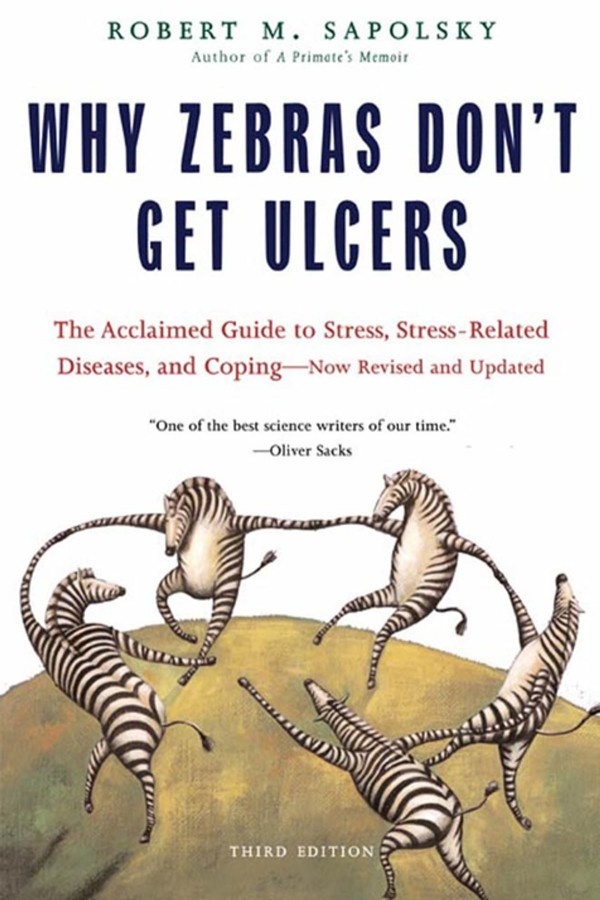
Why Zebras Don't Get Ulcers
About this book
The core distinction is between an acute stressor and chronic activation of the same physiological systems. Glucocorticoids, adrenaline, metabolism, circulation, immunity, digestion, growth, reproduction, pain, sleep, and memory are examined as parts of an adaptive response with costs over time.
Sapolsky moves between laboratory findings, animal behaviour, human studies, and comic examples. He also shows that control, predictability, social rank, and support change how a stressor is experienced, so the same external event need not produce an identical response.
Later chapters consider ageing, depression, personality, inequality, and coping. The book is careful at its best to distinguish stress as a contributing mechanism from the simplistic claim that attitude alone causes or cures serious disease.
This catalogue file is the complete 1993 edition, not the later revised third edition. It remains an accessible introduction to stress physiology, but specific evidence and medical recommendations should be checked against current sources.
Read a sample
5,016 words
Plain text
From the opening
Preface
Perhaps you’re reading this while browsing in a bookstore. If so, glance over at the guy down the aisle when he’s not looking, the one pretending to be engrossed in the Stephen Hawking book. Take a good look at him. He’s probably not missing fingers from leprosy, or covered with smallpox scars, or shivering with malaria. Instead, he probably appears perfectly healthy, which is to say he has the same diseases that most of us have—cholesterol levels that are high for an ape, hearing that has become far less acute than in a hunter-gatherer of his age, a tendency to dampen his tension with Valium. We in our Western society now tend to get different diseases than we used to. But what’s more important, we tend to get different kinds of diseases now, with very different causes and consequences. A millennium ago, a young hunter-gatherer inadvertently would eat a reedbuck riddled with anthrax and the consequences are clear—she’s dead a few days later. Now, a young lawyer unthinkingly decides that red meat, fried foods, and a couple of beers per dinner constitute a desirable diet, and the consequences are anything but clear—a half-century later, maybe he’s crippled with cardiovascular disease, or maybe he’s taking bike trips with his grandkids. Which outcome occurs depends on some obvious nuts-and-bolts factors, like what his liver does with cholesterol, what levels of certain enzymes are in his fat cells, whether he has any congenital weaknesses in the walls of his blood vessels. But the outcome will also depend heavily on such surprising factors as his personality, the amount of emotional stress he experiences over the years, whether he has someone’s shoulder to cry on when those stressors occur.
There has been a revolution in medicine concerning how we think about the diseases that now afflict us. It involves recognizing the interactions between the body and the mind, the ways in which emotions and personality can have a tremendous impact on the functioning and health of virtually every cell in the body. It is about the role of stress in making some of us more vulnerable to disease, the ways in which some of us cope with stressors, and the critical notion that you cannot really understand a disease in vacuo, but rather only in the context of the person suffering from that disease.
This is the subject of my book. I begin by trying to clarify the meaning of the nebulous concept of stress and to teach, with a minimum of pain, how various hormones and parts of the brain are mobilized in response to stress. I then focus on the links between stress and increased risk for certain types of disease, going, chapter by chapter, through the effects of stress on the circulatory system, on energy storage, on growth, reproduction, the immune system, and so on. Next I describe how the aging process may be influenced by the amount of stress experienced over a lifetime. I then examine the link between stress and the most common and arguably most crippling of psychiatric disorders, major depression. As part of updating the material for this third edition, I have added two new chapters: one on the interactions between stress and sleep, and one on what stress has to do with addiction. In addition, of the chapters that appeared in the previous edition, I rewrote about a third to half of the material.
Some of the news in this book is grim—sustained or repeated stress can disrupt our bodies in seemingly endless ways. Yet most of us are not incapacitated by stress-related disease. Instead, we cope, both physiologically and psychologically, and some of us are spectacularly successful at it. For the reader who has held on until the end, the final chapter reviews what is known about stress management and how some of its principles can be applied to our everyday lives. There is much to be optimistic about.
I believe that everyone can benefit from some of these ideas and can be excited by the science on which they are based. Science provides us with some of the most elegant, stimulating puzzles that life has to offer. It throws some of the most provocative ideas into our arenas of moral debate. Occasionally, it improves our lives. I love science, and it pains me to think that so many are terrified of the subject or feel that choosing science means that you cannot also choose compassion, or the arts, or be awed by nature. Science is not meant to cure us of mystery, but to reinvent and reinvigorate it.
Thus I think that any science book for nonscientists should attempt to convey that excitement, to make the subject interesting and accessible even to those who would normally not be caught dead near the subject. That has been a particular goal of mine in this book. Often, it has meant simplifying complex ideas, and as a counterbalance to this, I include copious references at the end of the book, often with annotations concerning controversies and subtleties about material presented in the main text. These references are an excellent entrée for those readers who want something more detailed on the subject.
Many sections of this book contain material about which I am far from expert, and over the course of the writing, a large number of savants have been called for advice, clarification, and verification of facts. I thank them all for their generosity with their time and expertise: Nancy Adler, John Angier, Robert Axelrod, Alan Baldrich, Marcia Barinaga, Alan Basbaum, Andrew Baum, Justo Bautisto, Tom Belva, Anat Biegon, Vic Boff (whose brand of vitamins graces the cupboards of my parents’ home), Carlos Camargo, Matt Cartmill, M. Linette Casey, Richard Chapman, Cynthia Clinkingbeard, Felix Conte, George Daniels, Regio DeSilva, Irven DeVore, Klaus Dinkel, James Doherty, John Dolph, Leroi DuBeck, Richard Estes, Michael Fanselow, David Feldman, Caleb Tuck Finch, Paul Fitzgerald, Gerry Friedland, Meyer Friedman, Rose Frisch, Roger Gosden, Bob Grossfield, Kenneth Hawley, Ray Hintz, Allan Hobson, Robert Kessler, Bruce Knauft, Mary Jeanne Kreek, Stephen Laberge, Emmit Lam, Jim Latcher, Richard Lazarus, Helen Leroy, Jon Levine, Seymour Levine, John Liebeskind, Ted Macolvena, Jodi Maxmin, Michael Miller, Peter Milner, Gary Moberg, Anne Moyer, Terry Muilenburg, Ronald Myers, Carol Otis, Daniel Pearl, Ciran Phibbs, Jenny Pierce, Ted Pincus, Virginia Price, Gerald Reaven, Sam Ridgeway, Carolyn Ristau, Jeffrey Ritterman, Paul Rosch, Ron Rosenfeld, Aryeh Routtenberg, Paul Saenger, Saul Schanburg, Kurt Schmidt-Nielson, Carol Shively, J. David Singer, Bart Sparagon, David Speigel, Ed Spielman, Dennis Styne, Steve Suomi, Jerry Tally, Carl Thoresen, Peter Tyak, David Wake, Michelle Warren, Jay Weiss, Owen Wolkowitz, Carol Worthman, and Richard Wurtman.
Continue reading the sampleClose the sample
I am particularly grateful to the handful of people—friends, collaborators, colleagues, and ex-teachers—who took time out of their immensely busy schedules to read chapters. I shudder to think of the errors and distortions that would have remained had they not tactfully told me I didn’t know what I was writing about. I thank them all sincerely: Robert Ader of the University of Rochester; Stephen Bezruchka of the University of Washington; Marvin Brown of the University of California, San Diego; Laurence Frank at the University of California, Berkeley; Craig Heller of Stanford University; Jay Kaplan of Bowman Gray Medical School; Ichiro Kawachi of Harvard University; George Koob of the Scripps Clinic; Charles Nemeroff of Emory University; Seymour Reichlin of Tufts/New England Medical Center; Robert Rose of the MacArthur Foundation; Tim Meier of Stanford University; Wylie Vale of the Salk Institute; Jay Weiss of Emory University; and Redford Williams of Duke University.
A number of people were instrumental in getting this book off the ground and into its final shape. Much of the material in these pages was developed in continuing medical education lectures. These were presented under the auspices of the Institute for Cortext Research and Development, and its director, Will Gordon, who gave me much freedom and support in exploring this material. Bruce Goldman of the Portable Stanford series first planted the idea for this book in my head, and Kirk Jensen recruited me for W. H. Freeman and Company; both helped in the initial shaping of the book. Finally, my secretaries, Patsy Gardner and Lisa Pereira, have been of tremendous help in all the logistical aspects of pulling this book together. I thank you all, and look forward to working with you in the future.
I received tremendous help with organizing and editing the first edition of the book, and for that I thank Audrey Herbst, Tina Hastings, Amy Johnson, Meredyth Rawlins, and, above all, my editor, Jonathan Cobb, who was a wonderful teacher and friend in this process. Help in the second edition came from John Michel, Amy Trask, Georgia Lee Hadler, Victoria Tomaselli, Bill O’Neal, Kathy Bendo, Paul Rohloff, Jennifer MacMillan, and Sheridan Sellers. Liz Meryman, who selects the art for Natural History magazine, helping to merge the cultures of art and science in that beautiful publication, graciously consented to read the manuscript and gave splendid advice on appropriate artwork. In addition, I thank Alice Fernandes-Brown, who was responsible for making my idea for the cover such a pleasing reality. In this new edition help came from Rita Quintas, Denise Cronin, Janice O’Quinn, Jessica Firger, and Richard Rhorer at Henry Holt.
This book has been, for the most part, a pleasure to write and I think it reflects one of the things in my life for which I am most grateful—that I take so much joy in the science that is both my vocation and avocation. I thank the mentors who taught me to do science and, even more so, taught me to enjoy science: the late Howard Klar, Howard Eichenbaum, Mel Konner, Lewis Krey, Bruce McEwen, Paul Plotsky, and Wylie Vale.
A band of research assistants have been indispensable to the writing of this book. Steve Balt, Roger Chan, Mick Markham, Kelley Parker, Michelle Pearl, Serena Spudich, and Paul Stasi have wandered the basements of archival libraries, called strangers all over the world with questions, distilled arcane articles into coherency. In the line of duty, they have sought out drawings of opera castrati, the daily menu at Japanese-American internment camps, the causes of voodoo death, and the history of firing squads. All of their research was done with spectacular competence, speed, and humor. I am fairly certain this book could not have been completed without their help and am absolutely certain its writing would have been much less enjoyable. And finally, I thank my agent, Katinka Matson, and my editor, Robin Dennis, who have been just terrific to work with. I look forward to many more years of collaborations ahead.
Parts of the book describe work carried out in my own laboratory, and these studies have been made possible by funding from the National Institutes of Health, the National Institute of Mental Health, the National Science Foundation, the Sloan Foundation, the Klingenstein Fund, the Alzheimer’s Association, and the Adler Foundation. The African fieldwork described herein has been made possible by the long-standing generosity of the Harry Frank Guggenheim Foundation. Finally, I heartily thank the MacArthur Foundation for supporting all aspects of my work.
Finally, as will be obvious, this book cites the work of a tremendous number of scientists. Contemporary lab science is typically carried out by large teams of people. Throughout the book, I refer to the work of “Jane Doe” or “John Smith” for the sake of brevity—it is almost always the case that such work was carried out by Doe or Smith along with a band of junior colleagues.
There is a tradition among stress physiologists who dedicate their books to their spouses or significant others, an unwritten rule that you are supposed to incorporate something cutesy about stress in the dedication. So, to Madge, who attenuates my stressors; for Arturo, the source of my eustress; for my wife who, over the course of the last umpteen years, has put up with my stress-induced hypertension, ulcerative colitis, loss of libido, and displaced aggression. I will forgo that style in the actual dedication of this book to my wife, as I have something simpler to say.
Why Don’t Zebras Get Ulcers?
It’s two o’clock in the morning and you’re lying in bed. You have something immensely important and challenging to do that next day—a critical meeting, a presentation, an exam. You have to get a decent night’s rest, but you’re still wide awake. You try different strategies for relaxing—take deep, slow breaths, try to imagine restful mountain scenery—but instead you keep thinking that unless you fall asleep in the next minute, your career is finished. Thus you lie there, more tense by the second.
If you do this on a regular basis, somewhere around two-thirty, when you’re really getting clammy, an entirely new, disruptive chain of thought will no doubt intrude. Suddenly, amid all your other worries, you begin to contemplate that nonspecific pain you’ve been having in your side, that sense of exhaustion lately, that frequent headache. The realization hits you—I’m sick, fatally sick! Oh, why didn’t I recognize the symptoms, why did I have to deny it, why didn’t I go to the doctor?
When it’s two-thirty on those mornings, I always have a brain tumor. These are very useful for that sort of terror, because you can attribute every conceivable nonspecific symptom to a brain tumor and justify your panic. Perhaps you do, too; or maybe you lie there thinking that you have cancer, or an ulcer, or that you’ve just had a stroke.
Even though I don’t know you, I feel confident in predicting that you don’t lie there thinking, “I just know it; I have leprosy.” True? You are exceedingly unlikely to obsess about getting a serious case of dysentery if it starts pouring. And few of us lie there feeling convinced that our bodies are teeming with intestinal parasites or liver flukes.
Influenza pandemic, 1918.
Of course not. Our nights are not filled with worries about scarlet fever, malaria, or bubonic plague. Cholera doesn’t run rampant through our communities; river blindness, black water fever, and elephantiasis are third world exotica. Few female readers will die in childbirth, and even fewer of those reading this page are likely to be malnourished.
Thanks to revolutionary advances in medicine and public health, our patterns of disease have changed, and we are no longer kept awake at night worrying about infectious diseases (except, of course, AIDS or tuberculosis) or the diseases of poor nutrition or hygiene. As a measure of this, consider the leading causes of death in the United States in 1900: pneumonia, tuberculosis, and influenza (and, if you were young, female, and inclined toward risk taking, childbirth). When is the last time you heard of scads of people dying of the flu? Yet the flu, in 1918 alone, killed many times more people than throughout the course of that most barbaric of conflicts, World War I.
Our current patterns of disease would be unrecognizable to our great-grandparents or, for that matter, to most mammals. Put succinctly, we get different diseases and are likely to die in different ways from most of our ancestors (or from most humans currently living in the less privileged areas of this planet). Our nights are filled with worries about a different class of diseases; we are now living well enough and long enough to slowly fall apart.
The diseases that plague us now are ones of slow accumulation of damage—heart disease, cancer, cerebrovascular disorders. While none of these diseases is particularly pleasant, they certainly mark a big improvement over succumbing at age twenty after a week of sepsis or dengue fever. Along with this relatively recent shift in the patterns of disease have come changes in the way we perceive the disease process. We have come to recognize the vastly complex intertwining of our biology and our emotions, the endless ways in which our personalities, feelings, and thoughts both reflect and influence the events in our bodies. One of the most interesting manifestations of this recognition is understanding that extreme emotional disturbances can adversely affect us. Put in the parlance with which we have grown familiar, stress can make us sick, and a critical shift in medicine has been the recognition that many of the damaging diseases of slow accumulation can be either caused or made far worse by stress.
In some respects this is nothing new. Centuries ago, sensitive clinicians intuitively recognized the role of individual differences in vulnerability to disease. Two individuals could get the same disease, yet the courses of their illness could be quite different and in vague, subjective ways might reflect the personal characteristics of the individuals. Or a clinician might have sensed that certain types of people were more likely to contract certain types of disease. But since the twentieth century, the addition of rigorous science to these vague clinical perceptions has made stress physiology—the study of how the body responds to stressful events—a real discipline. As a result, there is now an extraordinary amount of physiological, biochemical, and molecular information available as to how all sorts of intangibles in our lives can affect very real bodily events. These intangibles can include emotional turmoil, psychological characteristics, our position in society, and how our society treats people of that position. And they can influence medical issues such as whether cholesterol gums up our blood vessels or is safely cleared from the circulation, whether our fat cells stop listening to insulin and plunge us into diabetes, whether neurons in our brain will survive five minutes without oxygen during a cardiac arrest.
This book is a primer about stress, stress-related disease, and the mechanisms of coping with stress. How is it that our bodies can adapt to some stressful emergencies, while other ones make us sick? Why are some of us especially vulnerable to stress-related diseases, and what does that have to do with our personalities? How can purely psychological turmoil make us sick? What might stress have to do with our vulnerability to depression, the speed at which we age, or how well our memories work? What do our patterns of stress-related diseases have to do with where we stand on the rungs of society’s ladder? Finally, how can we increase the effectiveness with which we cope with the stressful world that surrounds us?
Perhaps the best way to begin is by making a mental list of the sorts of things we find stressful. No doubt you would immediately come up with some obvious examples—traffic, deadlines, family relationships, money worries. But what if I said, “You’re thinking like a speciocentric human. Think like a zebra for a second.” Suddenly, new items might appear at the top of your list—serious physical injury, predators, starvation. The need for that prompting illustrates something critical—you and I are more likely to get an ulcer than a zebra is. For animals like zebras, the most upsetting things in life are acute physical crises. You are that zebra, a lion has just leapt out and ripped your stomach open, you’ve managed to get away, and now you have to spend the next hour evading the lion as it continues to stalk you. Or, perhaps just as stressfully, you are that lion, half-starved, and you had better be able to sprint across the savanna at top speed and grab something to eat or you won’t survive. These are extremely stressful events, and they demand immediate physiological adaptations if you are going to live. Your body’s responses are brilliantly adapted for handling this sort of emergency.
An organism can also be plagued by chronic physical challenges. The locusts have eaten your crops, and for the next six months, you have to wander a dozen miles a day to get enough food. Drought, famine, parasites, that sort of unpleasantness—not the sort of experience we have often, but central events in the lives of non-westernized humans and most other mammals. The body’s stress-responses are reasonably good at handling these sustained disasters.
Robert Longo, Untitled Work on Paper, 1981. (Two yuppies contesting the last double latte at a restaurant?)
Critical to this book is a third category of ways to get upset—psychological and social disruptions. Regardless of how poorly we are getting along with a family member or how incensed we are about losing a parking spot, we rarely settle that sort of thing with a fistfight. Likewise, it is a rare event when we have to stalk and personally wrestle down our dinner. Essentially, we humans live well enough and long enough, and are smart enough, to generate all sorts of stressful events purely in our heads. How many hippos worry about whether Social Security is going to last as long as they will, or what they are going to say on a first date? Viewed from the perspective of the evolution of the animal kingdom, sustained psychological stress is a recent invention, mostly limited to humans and other social primates. We can experience wildly strong emotions (provoking our bodies into an accompanying uproar) linked to mere thoughts.* Two people can sit facing each other, doing nothing more physically strenuous than moving little pieces of wood now and then, yet this can be an emotionally taxing event: chess grand masters, during their tournaments, can place metabolic demands on their bodies that begin to approach those of athletes during the peak of a competitive event.* Or a person can do nothing more exciting than sign a piece of paper: if she has just signed the order to fire a hated rival after months of plotting and maneuvering, her physiological responses might be shockingly similar to those of a savanna baboon who has just lunged and slashed the face of a competitor. And if someone spends months on end twisting his innards in anxiety, anger, and tension over some emotional problem, this might very well lead to illness.
This is the critical point of this book: if you are that zebra running for your life, or that lion sprinting for your meal, your body’s physiological response mechanisms are superbly adapted for dealing with such short-term physical emergencies. For the vast majority of beasts on this planet, stress is about a short-term crisis, after which it’s either over with or you’re over with. When we sit around and worry about stressful things, we turn on the same physiological responses—but they are potentially a disaster when provoked chronically. A large body of evidence suggests that stress-related disease emerges, predominantly, out of the fact that we so often activate a physiological system that has evolved for responding to acute physical emergencies, but we turn it on for months on end, worrying about mortgages, relationships, and promotions.
This difference between the ways that we get stressed and the ways a zebra does lets us begin to wrestle with some definitions. To start, I must call forth a concept that you were tortured with in ninth-grade biology and hopefully have not had to think about since—homeostasis. Ah, that dimly remembered concept, the idea that the body has an ideal level of oxygen that it needs, an ideal degree of acidity, an ideal temperature, and so on. All these different variables are maintained in homeostatic balance, the state in which all sorts of physiological measures are being kept at the optimal level. The brain, it has been noted, has evolved to seek homeostasis.
This allows us to generate some simple initial working definitions that would suffice for a zebra or a lion. A stressor is anything in the outside world that knocks you out of homeostatic balance, and the stress-response is what your body does to reestablish homeostasis.
But when we consider ourselves and our human propensity to worry ourselves sick, we have to expand on the notion of stressors merely being things that knock you out of homeostatic balance. A stressor can also be the anticipation of that happening. Sometimes we are smart enough to see things coming and, based only on anticipation, can turn on a stress-response as robust as if the event had actually occurred. Some aspects of anticipatory stress are not unique to humans—whether you are a human surrounded by a bunch of thugs in a deserted subway station or a zebra face to face with a lion, your heart is probably racing, even though nothing physically damaging has occurred (yet). But unlike less cognitively sophisticated species, we can turn on the stress-response by thinking about potential stressors that may throw us out of homeostatic balance far in the future. For example, think of the African farmer watching a swarm of locusts descend on his crops. He has eaten an adequate breakfast and is not suffering the homeostatic imbalance of starving, but that farmer will still be undergoing a stress-response. Zebras and lions may see trouble coming in the next minute and mobilize a stress-response in anticipation, but they can’t get stressed about events far in the future.
And sometimes we humans can be stressed by things that simply make no sense to zebras or lions. It is not a general mammalian trait to become anxious about mortgages or the Internal Revenue Service, about public speaking or fears of what you will say in a job interview, about the inevitability of death. Our human experience is replete with psychological stressors, a far cry from the physical world of hunger, injury, blood loss, or temperature extremes. When we activate the stress-response out of fear of something that turns out to be real, we congratulate ourselves that this cognitive skill allows us to mobilize our defenses early. And these anticipatory defenses can be quite protective, in that a lot of what the stress-response is about is preparative. But when we get into a physiological uproar and activate the stress-response for no reason at all, or over something we cannot do anything about, we call it things like “anxiety,” “neurosis,” “paranoia,” or “needless hostility.”
Thus, the stress-response can be mobilized not only in response to physical or psychological insults, but also in expectation of them. It is this generality of the stress-response that is the most surprising—a physiological system activated not only by all sorts of physical disasters but by just thinking about them as well. This generality was first appreciated about sixty-five years ago by one of the godfathers of stress physiology, Hans Selye. To be only a bit facetious, stress physiology exists as a discipline because this man was both a very insightful scientist and lame at handling lab rats.
In the 1930s, Selye was just beginning his work in endocrinology, the study of hormonal communication in the body. Naturally, as a young, unheard-of assistant professor, he was fishing around for something with which to start his research career. A biochemist down the hall had just isolated some sort of extract from the ovary, and colleagues were wondering what this ovarian extract did to the body. So Selye obtained some of the stuff from the biochemist and set about studying its effects. He attempted to inject his rats daily, but apparently not with a great display of dexterity. Selye would try to inject the rats, miss them, drop them, spend half the morning chasing the rats around the room or vice versa, flailing with a broom to get them out from behind the sink, and so on. At the end of a number of months of this, Selye examined the rats and discovered something extraordinary: the rats had peptic ulcers, greatly enlarged adrenal glands (the source of two important stress hormones), and shrunken immune tissues. He was delighted; he had discovered the effects of the mysterious ovarian extract.
Being a good scientist, he ran a control group: rats injected daily with saline alone, instead of the ovarian extract. And, thus, every day they too were injected, dropped, chased, and chased back. At the end, lo and behold, the control rats had the same peptic ulcers, enlarged adrenal glands, and atrophy of tissues of the immune system.
Now, your average budding scientist at this point might throw up his or her hands and furtively apply to business school. But Selye, instead, reasoned through what he had observed. The physiological changes couldn’t be due to the ovarian extract after all, since the same changes occurred in both the control and the experimental groups. What did the two groups of rats have in common? Selye reasoned that it was his less-than-trauma-free injections. Perhaps, he thought, these changes in the rats’ bodies were some sort of nonspecific responses of the body to generic unpleasantness. To test this idea, he put some rats on the roof of the research building in the winter, others down in the boiler room. Still others were exposed to forced exercise, or to surgical procedures. In all cases, he found increased incidences of peptic ulcers, adrenal enlargement, and atrophy of immune tissues.
We know now exactly what Selye was observing. He had just discovered the tip of the iceberg of stress-related disease. Legend (mostly promulgated by Selye himself) has it that Selye was the person who, searching for a way to describe the nonspecificity of the unpleasantness to which the rats were responding, borrowed a term from physics and proclaimed that the rats were undergoing “stress.” In fact, by the 1920s the term had already been introduced to medicine in roughly the sense that we understand it today by a physiologist named Walter Cannon. What Selye did was to formalize the concept with two ideas:
The homeostasis concept has been modified in recent years in work originated by Peter Sterling and Joseph Eyer of the University of Pennsylvania and extended by Bruce McEwen of Rockefeller University.* They have produced a new framework that I steadfastly tried to ignore at first and have now succumbed to, because it brilliantly modernizes the homeostasis concept in a way that works even better in making sense of stress (although not all folks in my business have embraced it, using “old wine in a new bottle” imagery).