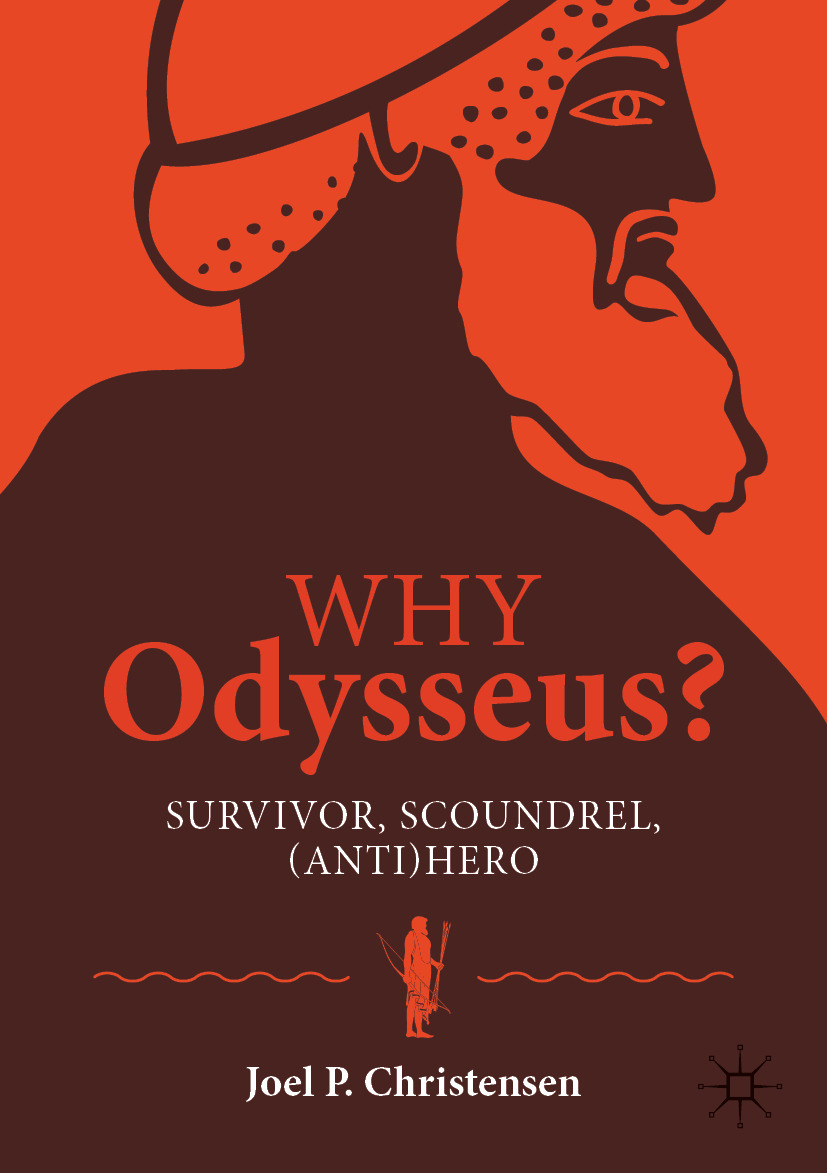
Why Odysseus?
About this book
Why Odysseus? begins from the hero's unusual persistence. The Odyssey remains central, but Odysseus also exceeds that poem: other ancient authors make him strategist, deceiver, criminal, philosopher, or symbol of endurance, and each version selects different possibilities from the same unstable figure.
Joel P. Christensen follows those transformations through ancient literature, translation, and post-classical reception. Novels, movies, music, and contemporary retellings reveal how a man of many ways can serve imperial adventure in one context and the damaged veteran or compromised antihero in another.
The book joins literary history to questions about storytelling, identity, and survival. Rather than settle whether Odysseus deserves admiration, it explains why his capacity to make and unmake himself through speech has allowed later cultures to keep arguing through him.
Read a sample
5,069 words
Plain text
From the opening
Preface
The year of the publication of this book also welcomes the release of a highly anticipated and hotly debated feature film based on the Odyssey. Christopher Nolan’s film, however, comes at the tail end of a quarter-century of cultural receptions of Odysseus and Homer’s Odyssey. Starting somewhat arbitrarily in 2000 with the release of O Brother Where Art Thou? and followed by retellings from Margaret Atwood (2005), Madeline Miller (2018), translations from scholars and major presses by Emily Wilson (2017) and Daniel Mendelsohn (2025), a social-media-based musical (Epic: The Musical), and another film released in 2024 (The Return), this period has also seen the most academic monographs released on Odysseus in a generation. This summary necessarily overlooks other examples and focuses entirely on work in the English language.
The question of the book’s title, then, why Odysseus? responds to a cultural moment that seems unmatched by any other ancient myth or figure. The title also performs something of a trick: there are at least two phenomena to discuss. On the one hand, we have Homer’s epic poem, the Odyssey. On the other hand, we have the mythic figure himself who is certainly essential to the epic but has a range of narrative traditions and interpretations that exceed the boundaries of the Homeric tradition. This book explores that larger cultural figure, both inside and outside Homer’s poems.
Two widely read books already address Odysseus outside of the Odyssey: W. B. Stanford’s The Ulysses Theme (1954), and Sylvia Montiglio’s From Villain to Hero: Odysseus in Ancient Thought (2011). Stanford wrote his book to try to make some sense of the differences between modern “variations on the Ulysses Theme” and ancient models. Stanford breaks his discussion down into chapters that isolate various aspects of Odysseus’s character, moving somewhat forward in time but generally sticking to the notion of Odysseus’s Homer as the model upon which later literary traditions depend and from which they depart. His end point is, in part, James Joyce’s Ulysses. His “theme,” as it were, describes and anticipates a narrower character tradition than I will explore in this book. Furthermore, his literary emphasis leads him to discount the oral tradition, to an extent, and to frame his research and discussions in such a way as to overlook certain kinds of receptions. Nevertheless, The Ulysses Theme is an influential and deeply impressive exploration of Odysseus’s character across various literary traditions. It is an essential companion for thinking about the hero’s diachronic journey. Montiglio’s book is a more constrained but equally accomplished exploration of Odysseus’s adaptation in philosophy, an area Stanford focuses on less. The influence of Montiglio’s analysis on the following will be impossible to ignore. In addition, some recent books expand on these treatments. Jonathan Burgess’ The Travels of Odysseus (2025) explores material and symbolic meanings of the hero’s wanderings inside and outside Homeric epic. Erica Stevenson’s The Odyssey Effect (2026) traces the reception and impact of Homer’s Odyssey on literature, art, and popular culture over time. Finally, Christina-Panagiota Manolea’s and François Renaud’s Brill’s Companion to the Reception of Homer from Byzantium to the Enlightenment is a great resource for an often-neglected period. Burgess and Stevenson each guide their readers through territory similar to some of the chapters in this book, but their paths intersect and diverge from this work in complementary and sometimes surprising ways. Manolea’s and Renaud’s book is an exceptional resource, although not exclusively about Odysseus. Like any book, this one builds on the foundations and structures of the giants who came before it and contemporary voices debating them. Where I depart from or differ from Stanford and Montiglio, it is at times a function of different theoretical approaches I take toward storytelling (outlined in my earlier work on the Odyssey and narrative) and in my entertainment of modern reception. Where I fail to engage sufficiently with Burgess and Stevenson, the recentness of their publications is to blame rather than any issue with their work. As with all of my colleagues who try to tell the full story of this figure, I will make many omissions in this book. I have elected not to discuss Odysseus in the visual arts after antiquity because the subject is so large and outside my expertise. I also regret that Peter Meineck's Tony Stark, Odysseus, and the Myths Behind Marvel: Ancient Heroes in the Modern World (2026) was released too late for me to engage with it in my later chapters. My focus is also almost entirely on Odysseus’s reception in the English-speaking world. The figure’s travels with other imperial languages (Spanish and Portuguese, for example) would be a study all of its own. Odysseus’s contributions and reception throughout the rest of the world are also dynamic and bewildering and I hope the limits of my study will inspire others to explore them. Some of your favorite Odyssean appearances and allusions may not have made it to this book. I have tried to pair the familiar with the surprising, following a few key threads from antiquity to today.
Similarly, this book will at times converge with and then suddenly depart from the discussions offered by my peers. And this should not be too surprising: Odysseus takes so many shapes and forms over time that no single book could give a full treatment of all his manifestations. Because I see narrative as a living and adapting thing that persists outside of texts, expressing itself at time in things we sometimes canonize as “literature,” the way I talk about Odysseus and some of the modern examples I use may be surprising to some.
Continue reading the sampleClose the sample
1. Introduction: A Man of Many Ways
In the now iconic scene from the Coen Brothers’s 2000 film O Brother, Where Art Thou? Ulysses Everett McGill joins a hastily assembled ensemble dubbed the Soggy Bottom Boys in recording the song “Man of Constant Sorrow.” George Clooney’s Ulysses stands centered in the frame, wide-eyed and ingenuous. While the Coen Brothers played coy with how much they based Brother on the Odyssey, they certainly used enough of the epic’s well-known motifs to invite Homeric affiliation: Ulysses, separated from his wife for years, encounters Sirens and a Cyclops impeding his way home. Like the Odysseus of epic, he sings and tells lies to facilitate his homecoming.1 For many audiences of the early twenty-first century, Clooney’s portrayal of Odysseus was as memorable as the music that the film brought to mainstream audiences. His Ulysses remains clever, charming, self-effacing, and at times inept, but firmly framed by a desire to reunite with his wife, the need to get home, and the inscrutability native to conmen through the ages.
Many could well quibble, however, that this Ulysses is as distant from Homer’s Odysseus as the song “Man of Constant Sorrow” is from its folk origins in Kentucky. Contemporary social media can make it hard to recall how influential movie albums used to be.2 But the O Brother, Where Art Thou? soundtrack had a tremendous cultural impact, inspiring new popular interest in bluegrass and folk music and earning a Grammy for Best Country Collaboration in 2002. But the hit single’s history predates the film: “Man of Constant Sorrow” has origins as a traditional American folk song, first appearing in a collection prior to World War 1. Over time, it has been rewritten and adapted by artists like Bob Dylan and Joan Baez, to name a few, and performed by many others.
The song’s lyrics echo what we might recognize as Odyssean notes: the singer laments his “sorrow” and “trouble” and separation from the place where he was born. His suffering is connected to his wandering, his loss of friends, and his loneliness as a stranger in a foreign land. Anyone familiar with an epic Odysseus hears the echoes: Homer’s hero went to war for ten years, struggled to get home for another decade, lost all his friends along the way, and became proverbially known for his suffering. In the Odyssey, moreover, he uses his storytelling—glossed as singing in epic—first, to convince an audience to give him passage home and then to test and manipulate people on his home island of Ithaca as he slips back into his palace and exacts a heavy penalty on those who wooed his wife in his absence.
“Man of Constant Sorrow” is thus apt for a Depression-era Ulysses. But its own story of unclear origins, arising from a folk tradition and moving through bluegrass, blues, and other genres before landing on the soundtrack of a major motion picture, presents neat formal echoes for Odysseus and Homer as well. Both the character and the song go through different shapes over time, shifting and morphing to suit the needs of performer and audience alike. The song being claimed by multiple songwriters and connections to different places over time also nicely corresponds to the unclear origins of oral traditions, different dialects and regions of Greece, as well as the turning pathways from the roads of song to the final impressions of the written word.
Like “Man of Constant Sorrow” in the twentieth century, Odysseus has taken many forms over time. Yet, despite these changes, we still recognize some essential, shared qualities that render each instance as identifiably Odysseus. There are ancient and modern frameworks for making sense of this. For example, in The Literary Mind, the cognitive scientist Mark Turner defines “character” from a cognitive perspective as “a pattern of connections we expect to operate across stories about a particular individual” (133). Characters, Turner continues, play “similar roles” in different narratives. For Turner, the combination of role and character—in conjunction with perspective and what he calls “focus”—provide audiences with tools to “constr[uct] our own meaning, which is to say, ways of understanding who we are, what it means to be us, to have a particular life” (134).
Of the characters who persist from ancient myth, Odysseus is among the most dynamic and adaptive “tools” for audiences’s construction of meaning. The figure has persisted in a dizzying variety of roles. He is a veteran and a rogue who tries to avoid going to war; he is mercurial on the battlefield, yet instrumental in ending the Trojan War; he, more than nearly any other figure, preserves the lives of his fellow Achaeans, yet he loses all of his own men and returns home as an executioner; he is a cold-eyed killer, but he is also a philosopher king; he is a stoic sage, praised for his indifference to the physical world, but he remains forever known as a husband, a father, and a son. Above all else, he is a survivor. No other figure from ancient myth occupies the same range or continues to attract the same interest Odysseus does today. In their books, both W. B. Stanford (The Ulysses Theme, 1954) and Sylvia Montiglio (From Villain to Hero, 2011) explore the complexity of the character in myth and literature in antiquity. But even since the publication of Montiglio’s book, the story has continued to change; he appears as a romantic wanderer, longing for Penelope in Epic: The Musical (2019–2024) and a traumatized avenger, sneaking into his home in Pasolini’s The Return (2024), to name but a few recent entries.
There are many recent Odysseis (the Greek plural). From Margaret Atwood’s retelling of the Odyssey from the perspective of Penelope and the enslaved women (2005) to Madeline Miller’s reimagining of Circe’s experiences (2018), Emily Wilson’s (2017) and Daniel Mendelsohn’s (2025) recent translations, and feature films starring major actors (2024 and 2026), audiences keep returning to Odysseus’s stories from different angles. While this interest has been growing for a far longer time from a historical perspective, such fascination does not appear inevitable. Antiquity has bequeathed to us many more manuscripts of the Iliad than the Odyssey and in much higher quality, for example. In the early days of Google n-grams, I had students in an advanced seminar do a search for mentions of the Iliad and the Odyssey: the Iliad is the more cited text straight into the twentieth century, which is when the Odyssey starts to gain in popularity until it clearly eclipses the story of Achilles’ rage. What is it about the poem and its hero that remain so appealing to the modern world?
Complicating the Hero
To begin to understand Odysseus’s appeal, we need to appreciate the fullness of his story over time. The hero and Homer’s poem overlap but also represent very different ranges of development. What makes this possible? Mark Turner’s description of “character” cited above is aimed at both literary and living figures—Turner sees the use of, and vulnerability to, narrative as a fundamental aspect of the working of the human mind. The qualities he outlines are also accurate for figures from myth as well who have set biographies (in terms of home, genealogy, and death) and characteristics that exhibit themselves in roles that characters play in various narratives. Among the most prominent characters from Greek myth, however, Odysseus may have a special status as a figure of multiplicity, or, to riff on Emily Wilson’s translation, complexity.3
This multiplicity is reflected in part by the epithets associated with him. Greek heroes and gods have traditional adjectives (epithets, or descriptors that are “set next or addition to” a regular name) that often signal qualities specific to that hero (such as a patronym) or which might activate certain aspects of the hero (e.g., “swift-footed” Achilles or Diomedes “good-at-the-war-cry”). Because characters from myth often also had sacred or ritual functions in and outside of their stories, these adjectives can also be functional. For example, characters prayed to different manifestations of gods like Zeus or Aphrodite based on the quality the speaker is seeking to appeal to and the locality important to the deity. Calling upon a god or demigod by the wrong epithet would undermine the efficacy of the prayer. In the beginning of the Iliad, for example, the priest Chryses calls on the Apollo who has a temple on his island and appeals to him as the “Sminthean God” for his association with diseases. Modern scholars presume that a less specific appeal would not have been as effective.
I tread on some uneven ground by calling epithets “functional” here. There is some controversy about how exactly they functioned in composition and performance. The work of Milman Parry and Albert Lord, which demonstrated that epithets were functional instead of ornamental—that is, they supported composition in performance—led to the misunderstanding that epithets could not also have significant or context-appropriate meaning.4 Current scholarship countermands the simplistic notion that any element of language should be only one thing or another. As a rule, however, early epithets do demonstrate a tendency toward “economy,” which means, for the most part, that there are a limited number of name-epithet combinations for different technical contexts. The number of Odysseus’s epithets bucks the trend. In the Odyssey, he is “many-wiled” (polymētis). “many-minded” (polyhphrōn), “of many-devices” (polymēkhanos), “much-enduring” (polytlas), “much-prayed for” (polyarētos), “of many pains” (polypenthes), of “many sorrows” (polystonos) and, most famously, a man “of many ways” (polytropos), the epithet Wilson adapts for her now famous opening invocation of the “complicated man.”
This final epithet, polytropos, defies simple definition. The prefix for “many,” poly, is clear enough. It shows up in modern English compounds like polytheist, polyamory, or polynomial. Tropos is also easy to explain on its own: it is a noun related to the verbal notion of turning. Our “tropic” is related to the geographical regions where the sun hits its zenith and nadir during seasonal cycles, thus marking where the years “turn.” But it also has additional metaphorical meaning in the modern trope, hailing from rhetorical forms: devices, repeated figures, or clichés.
To be a man of many tropes, is to be a man of many forms, but also a man of many turns. A conventional translation of the epithet is thus “man of many ways,” imagining that the adjective alludes to the hero’s long and surprising journeys. But it is clear from the Odyssey’s toying with the term that it also indicates the turning of the hero’s character, the roles he plays in myth, and the variety of traits essential to a figure who fills so many functions. An anonymous ancient scholar, commenting on the oratory of the Athenian Demosthenes (who lived in the fourth century BCE), suggests that “a man of many ways [polytropos] changes himself in accordance with the nature of the matters at hand,” while the orator Antisthenes allegedly claimed that Homer meant to criticize Odysseus by calling him polytropos.5 Unsavory associations persist: Plato has Socrates ask whether “people who are many-wayed are deceptive because of their foolishness and thoughtlessness, or because of wickedness and some thought?” (Hippias Minor 366a). The third-century philosopher Porphyry suggests that to be of “many ways” was to know how to use language to fit the right circumstance and people. (See Schol. HM 1.1 ex 62–74.) “Many-wayedness” is a sign of adapting to audiences, rather than committing to a single way of speaking or being.
At its core, then, the epithet indicates a tendency to change and an ability to adapt to different contexts: here, most likely, different contexts. Such flexibility, however, seems to run afoul of the very continuity that is a mark of a traditional character. In fact, Odysseus’s status as a mythical figure may defy the very nature of the word character, which in Greek originally indicates something imprinted or cut out: a recognizable, pre-set shape. In the work of the philosopher Theophrastus (who lived in the third century BCE), characters are stock and predictable figures like the boor, the cheat, or the complainer. A unifying feature of Odysseus is that he is many things and more. In a way, his character may anticipate modern notions of the self, predating Walt Whitman’s poetic line “Very well then I contradict myself, (I am large, I contain multitudes)” by a mere few thousand years.6
By any Other Name…
One simple answer for why Odysseus persists and thrives today is his narrative multiplicity. Confusion about his name may support this. Archaic Greek poetry is fond of using etymology to explain names, even when the semantic claims may be suspect. For instance, in Hesiod’s Theogony, the narrative claims that Ouranos gives the race of gods known as the Titans their name because they “overreached,” offering the verb titainō (Hesiod, Theogony, 208–9) as the explanation.
Multiple times throughout the Odyssey, characters play with Odysseus’s name, relating it, perhps falsely, to the Greek verb odussomai, which can mean “to hate or be hateful.” This meaning does not necessarily make sense for the character’s function in this epic, however. The primary origin of Odysseus’s name is offered in Book 19 as the narrative provides a flashback to the hero’s youth, when he went on a hunting expedition with his grandfather (Autolycus, a figure worth discussing later). According to the narrative, Odysseus was wounded during what some have depicted as an initiation ritual. The scar he received during the boar hunt is the very sign that lets his nurse, Eurycleia, identify him later. In this tale, after his wounding, Odysseus’s grandfather decided to rename him. He concluded “I have come to this point hated [odussamenos] by many—/ Both men and women over the man-nourishing earth. / So let his name be Ody[s]seus…” (Od.19.407–409).7
Perhaps we could make less of this if his initiatory naming were not anticipated early in the epic. When Athena first presses Zeus to clarify the hero’s fate, she asks pointedly, “…Didn’t Odysseus please you/By making sacrifices along the ships of the Argives/In broad Troy? Why are you so hateful [ōdusao] to him, Zeus?” (Od.1.60–2). Later authors continue leaning into supporting such interpretations. A fragment from Sophocles (965) has Odysseus declaring, “I am called Odysseus for evil deeds correctly: / For many who have been my enemy hate [ōdusanto] me.” But even this seemingly clear usage has an intrinsic ambiguity. Ancient commentary preserves multiple explanations for the meaning of his name. To be odussamenos could mean “[someone] who is hated. Or who has rage. Or has harmed [someone].” Each of these interpretations is appropriate to our Odysseus. The recourse to etymology in early poetry and myth is both about play—for who does not love a pun—but it also reflects a metaphysical belief that the qualities of things may be found in obscure origins.
Of course, there is more. The wildest interpretation of the meaning of Odysseus I know of comes from a Byzantine-era etymological dictionary which suggests: “The name Odysseus has been explained through the following story. For they claim that when Anticleia, Odysseus’s mother, was pregnant she was travelling [hodeuousan] on Mt. Neritos in Ithaka, and it began to rain [husantos] terribly. Because of her labor and fear she collapsed and gave birth to Odysseus there. So, he obtained his name in this way, since Zeus, on the road [hodon] rained [hūsen].”8 Such an adventurous a wild etymology certainly seems ill-at-home with the hero we find in the Odyssey, but it is illustrative of the lack of precise agreement about the significance of his name. Adding to this complexity is the fact that there were multiple versions of the name. Early evidence provides Olusseus or Oulikseus or Olutteus as Greek alternatives, either from different dialects (Corinthian and Boeotian, the latter of which is the dialect around Thebes) or from different traditions. Such variations are fascinating because they likely explain the origins of the Latin “Ulysses” and because they reflect different emphases on his character.9 Even if these variations are production by sound changes over time, allowing the letters delta and lambda to replace each other, audiences could still assume multiple origins for the name.
There are different ways to understand what the variations in the name might mean, and each one reflects a possible version of Odysseus’s narrative. The prefix oulo-could reflect “woolly” (oulos), “scar” (oulê), or “destructive, ruinous” (oulos) in his name. Each option echoes part of Odysseus’s traditional story: he is mentioned in the Iliad as having woolly hair, and he is well-known from the Cyclops episode for sneaking out of the cave under a woolly ram. The Odyssey consciously makes a connection between his name and his scar, perhaps acknowledging the tradition of his “scar” (oulē) as the defining feature of his physical identity. Finally, the opening oul-could also sound like the adjective “destructive, ruinous” (oulos). Odysseus’s actions and character are frequently ruinous in Homer, especially in the Odyssey. There is a fourth possibility, too: the rare verb oulein, meaning “to be healthy,” shows up in early Greek as well. Perhaps some audiences sensed a tension in the name between the famous scarring and a promise of becoming whole.
The point of this survey is not to push for one interpretation over another, but rather to show that even the Homeric Odyssey accommodates multiple interpretations for the hero’s name. This is effective in part because of epic’s aural performance environment. Different audiences from different Greek-speaking communities could have heard and understood divergent meanings for the names. And many may have enjoyed the ambiguity as well.
The sound environment of the performance of Greek epic—which I will discuss more in the next chapter—provides additional power for puns and verbal echoes. Performers of epics are called aoidoi, singers, in Homer. The elocution of an ambiguous name in a dynamic performance context would invite multiple interpretations at once. Indeed, a reflex of such ambiguity, such trickiness pervades Odysseus’s characterization and may help explain his narrative success. But this very success can be a problem as well. The slippage between the ambiguity of Odysseus’s name and his character is best represented in his most famous trick, the “nobody” exchange from the Cyclops episode. This scene functions as an index of so much of Odysseus’s adaptability and challenge as a character, but it takes a little exploration of the Greek to explain in full.
When Odysseus is getting Polyphemus drunk and the Cyclops asks his name, Odysseus says, “You are asking for my famous name?… my name is Nobody. My mother and father/and all the rest of my companions call me nobody” (Odyssey 9. 364–7). Polyphemus responds that “I will eat Nobody last after his companions/and the rest of them first. That will be your gift of hospitality!” (367–369). The dramatic irony here is amusing, but the wordplay that follows plays with introduces double meanings, amplifying Odysseus’s wit.
Once Polyphemus has been blinded, he shouts to the other Cyclopes on the island from inside his cave, shut in behind the boulder with which he sealed it. They inquire whether “someone has stolen” his flocks or “someone is killing you with trick or force” (9.403–6). But the Greek they use is in the form of a negative question that toys with the scene at large. When Odysseus introduces himself as “Nobody,” he uses the regular negative particle ou (“not”) and the indefinite pronoun tis (“someone, anyone”) to say outis, “no one” or “nobody.” When the Cyclopes ask “surely, no one is doing X and Y” to you, they have to use the negative particle that is reserved for unreal or uncertain statements in Greek, mē, yielding the combination mē tis, which sounds very much like the word mētis, “wit, cunning” that appears in Odysseus’s epithet polymētis. Ancient audiences would not have missed the ironic absurdity of the other Cyclopes asking whether cunning is stealing from or murdering Polyphemus.
When Polyphemus responds, despondently, that “Nobody is killing me…” (Od. 9.408), it increases the absurdity because he is both technically correct and incapable of clarifying his meaning. Through this simple stratagem, Odysseus has escaped the trappings of identity altogether. If he cannot be named, he cannot be blamed. When the other Cyclopes conclude, “If nobody [mētis] is harming you, then only the gods can help you,” they are both speaking the truth and fundamentally misunderstanding the situation.
The wordplay in this scene—erasing Odysseus’s identity but replacing it with a quality of the hero—speaks in part to the mythical character’s adaptability and the impossible challenge that a coherent character inhabiting that adaptability faces. Odysseus very much is his intelligence, but when he is reduced to it, he is deprived of any markers that connect him to a larger story. He has no name, no family, no origin, and no destination. He is a function, not a person. Odysseus’s polytropic nature makes him capable of being anybody. But to be anybody is to be a symbol without meaning, a sign that points to nothing. This very emptiness, however, helps to explain Odysseus’s adaptability. As I will discuss in the next chapter, this is one of the core challenges faced by Homer’s Odysseus: how to transcend a fundamental characteristic that makes Odysseus successful in myth—his mutable nature—but remains rooted in his most important attribute, which is his intelligence.
Making Myth, Made by Myth
What do we mean when we talk about Odysseus? Most of us probably assume that we mean Homer’s Odysseus. I had to struggle in writing this book not to lead with Homer. Given what we know about the performance tradition, there were many Odysseys before our Odyssey and ancient audience members had all likely encountered many an Odysseus before the one we recognize. I will spend a good deal of time in the next chapter talking about the Homeric Odysseus, but it is important not to treat Homer as the standard and authoritative tale. Instead, Homer’s epic is an incredibly influential step in responding to a larger mythopoetic tradition. Simply put, there is Odysseus as that broader character. Then there is Homer’s man.
When I use that word—mythopoetic—it can be somewhat off-putting, sounding too much like specialist terminology or theoretical jargon. But the compound is useful, insofar as it reflects the traditions of storytelling we call myth, the inclusion of such stories in forms we now recognize as poetry, and the new meaning created by the compound mythopoesis. In early Greek myth generally means an utterance, something that is said; poetic comes from the verb poeio, “to make, do, or create.” Mythopoesis can thus be taken as the creation of stories or, more to my liking, the creation of things by means of story. Mythopoetics can then be said to refer to the world(s) made through myth and, perhaps, the world remade through myth.
Odysseus’s general place in Greek myth as a trickster figure helps to explain some of his thematic associations in epic and beyond. Trickster figures, defined by Lewis Hyde as primarily characters who cross boundaries, tend to challenge the dominant divine power structure on behalf of those lower in the hierarchy (such as mortals). As such, they also tend to occupy marginal positions between the realms of gods and men, often acting as a go-between or inhabiting spaces others cannot. Famous trickster figures include Loki from Norse myth, Anansi from West Africa, or Satan from the Christian tradition. In a pantheon like Greek myth—where evil and good are not well-defined—trickster figures can be more ambiguous in their loyalties. Prometheus, an early god, is punished for his assistance to human beings; Hermes comes later in the pantheon, exercising authority over cattle-rustling, lying, and theft; and Odysseus—along with some in his family—has similar characteristics. The trickster’s ability to cross boundaries facilitates all these roles. This capacity is translational, moving from one domain to another. Such movement can also be seen as interpretive: Greek gives us the synonym hermeneutic from the root “Hermes.”
I digress on this because Odysseus makes and unmakes himself in the Odyssey through speech, and outside of Homer, he is repeatedly remade through myth. The range of meanings given to his character through his name draws on the flexibility and re-generative nature of myth, as well as how his character traits interact with different narrative contexts. One of the challenges of asking why the figure of Odysseus is especially adaptable in narrative over time is that many other mythical figures exhibit some of the same characteristics. But, before exploring Odysseus’s place in early myth outside of epic at greater length, it is worth considering for just a moment how ancient myth worked and the meaning of the Greek word hero.