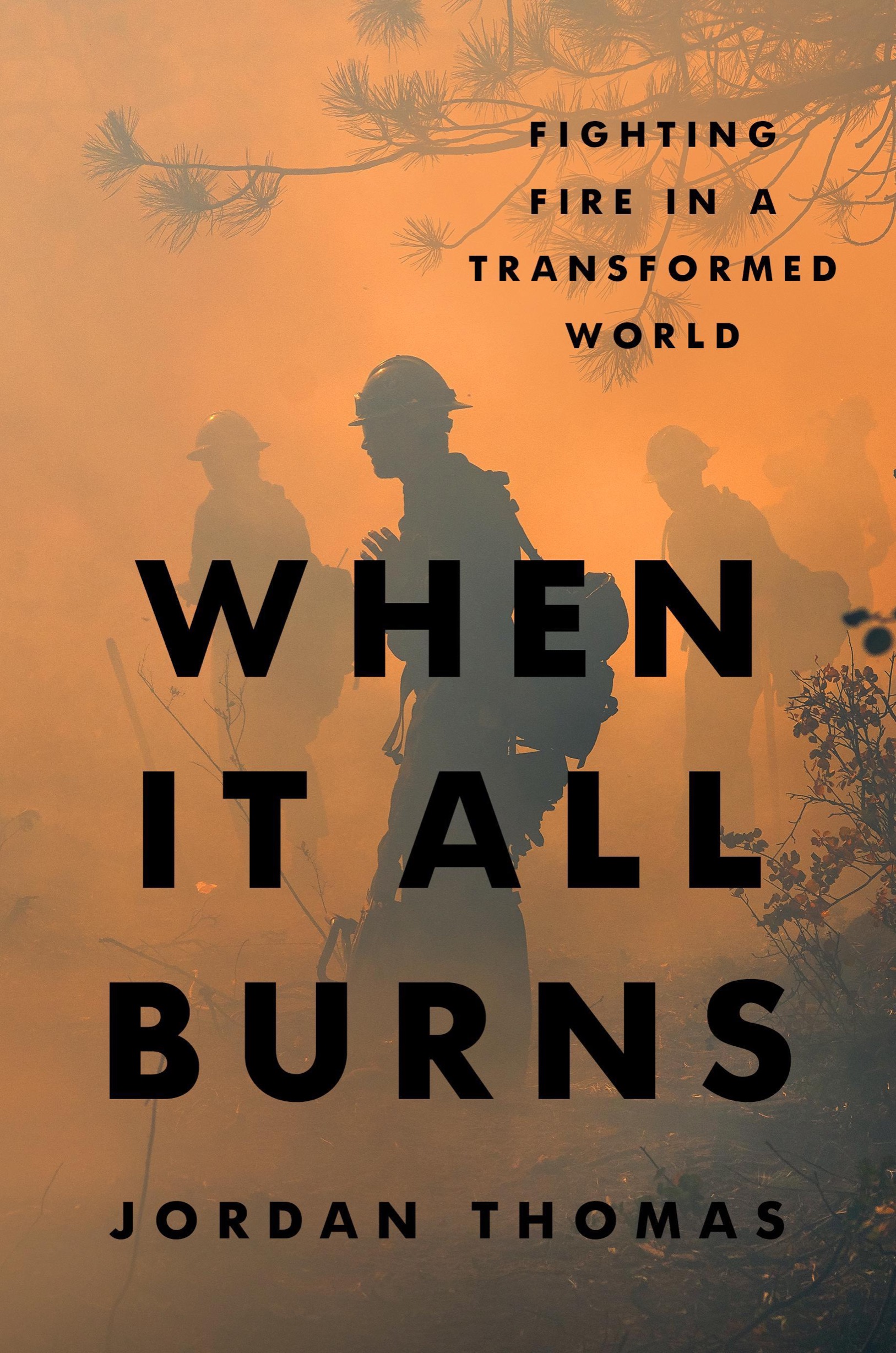
When It All Burns: Fighting Fire in a Transformed World
About this book
Jordan Thomas joins a specialized wildland crew during a year of extreme heat, dry fuels, and fires that grow through nights and seasons once expected to slow them. Daily labor remains physical, repetitive, and dangerous.
The account follows cutting line, carrying gear, reading terrain, waiting, sleeping, and sudden movement when weather changes. Crew culture provides competence and solidarity while also carrying its own assumptions about endurance.
Thomas writes as both firefighter and anthropologist, linking firsthand experience to land management, climate change, labor, and the history of suppressing fire in ecosystems that evolved with it.
When It All Burns is memoir and environmental reporting, not a tactical manual. It shows a profession adapting in real time as the category of an exceptional fire becomes less exceptional.
Read a sample
5,057 words
Plain text
From the opening
Author’s Note
When I began writing this book, I wanted to write about climate change and wildfires. I quickly realized, however, that it wouldn’t be accurate to write about this topic without chronicling the historical factors that shaped the landscapes climate change now disrupts. This history includes the ways Indigenous people in California used—as many continue to use—fire to shape the land. It also includes the violent processes by and through which governments have attempted to take the use of fire away from Indigenous people through time.
As a white anthropologist and writer, this presented me with a dilemma. Any account of the megafires of today that does not centrally acknowledge Indigenous burning perpetuates an erasure of Indigenous people—including their histories and contemporary movements for cultural sovereignty. If a story of fire is to be told, it must not only include but also elevate the lived realities of Indigenous people and, ideally, be a voice from these diverse communities. This, however, is not me. And outsiders—often external anthropologists such as myself—have a disquieting history of narrating Indigenous stories on their behalf. This has often led to a failure to reflect people’s lived realities and, at times, has perpetuated dominant systems that undermine Indigenous cultural sovereignty.
It is a fraught space in which to write. Honestly, I don’t believe there is a clear resolution to this dilemma of erasure versus narration. Nor do I think there could or should be. Like many dilemmas, this one begs a constant revisiting, reflection, and attention.
In this book, I’ve done my best to draw from Indigenous sources when detailing their histories and current perspectives on fires. This includes using primary sources in the historical literature, interviewing Indigenous fire practitioners and activists working to revive cultural burning, and attempting to forefront the work of Indigenous scholars who provide critical perspectives on wildfire management.
The end result is far from perfect, I am sure, and I humbly request patience from my readers as I do my best to craft a story that is both accurate and ethical.
Wildfires Fought by Los Padres Hotshot Crew in California in 2021
Introduction
One afternoon in September 2021, as a megafire burned through Sequoia National Forest, my hotshot crew marched into a grove of its ancient trees. In the crisp air of high country, the sounds of creaking wood and swishing pine muted our footsteps. Sequoias towered through the smoke. Their canopy closed hundreds of feet above. We moved between trunks the size of cabins, the bark grooved and red. Small squads dropped off from our crew of twenty, spreading along the ridge to prepare for the megafire hurtling toward us.
My own group peeled off near the top of the ridge to await orders. After fighting this fire for the past week, my knees ached, my blisters stung, and my head hurt. I was tired. I knew the other hotshots felt the same. They were chewing tobacco and sharpening their tools—hybridized shovels, axes, and hoes with macho names: the Rogue, Pig, Chingadera. I set my chainsaw on the forest floor, removed my gloves, and, for the fifth time that day, pricked my thumb on the chain’s teeth to make sure they were sharp. The grove made me restless.
In the past two decades, wildfires have been doing things not even computer models can predict, environmental events that have scientists racking their brains for appropriately dystopian terminology: firenadoes, firestorms, gigafires, megafires. Scientists recently invented the term “megafire” to describe wildfires that behave in ways that would have been impossible just a generation ago, burning through winter, exploding in the night, and devastating landscapes historically impervious to incendiary destruction—like the sequoia groves of California. Sequoias are among the oldest organisms in existence, with fire-resistant bark several feet thick and crowns that can recover when 90 percent is scorched. They even rely on fire to reproduce, as flames crack their cones so seedlings can germinate. Now, the same ecological force they once depended upon is pushing them toward extinction.
Sequoias’ lives are monuments of deep time. Their death would signify something else. If we could not hold this ridge against the megafire, the sequoias would become the largest torches on earth, carrying flames higher than the Statue of Liberty. After three thousand years of life, they would become charred monuments to a passing era, symbols of a violent future. By holding the ridge, I felt we were holding back a new, altered world. As I waited on the fireline with ash in my lungs, I still hoped this was possible.
A figure appeared through the smoke, huffing toward us. I stood, worried our superintendent, Aoki, the leader of the Los Padres Hotshots, would catch us sitting. I relaxed when I recognized Jackson.
“Jack!” someone called.
“What’s the word?” another asked.
“Fellas,” Jack greeted us, loosening his pack to catch his breath. His face and beard were caked in dirt. “Cancel your plans, boys. We’re gonna be up all night.” Word had traveled down the chain of command that we were going to burn our line that evening.
We had spent six days building that line, working from sunrise to sunset, cutting a path through brush and hills, up a mountain ridge into high timber and finally to an old logging road. Wildfires cannot burn without fuel—grass, bushes, and trees—and our line formed a fuel break, a continuous barrier of dirt that snaked around the megafire. When the conditions were right, we would set fire to its edges. The flames we lit would move toward the megafire and consume the fuel in its path. This is the fireline—a dirt band that holds fire back from the world.
Continue reading the sampleClose the sample
Now, we only had a few hours before the megafire would hit us—a few hours to finish the line and set fire to the ridge.
“It’s gonna be a shitty burn,” Jack relayed. “We’ll be chasing spot fires all night.”
I asked if we had any safety zones, defensible spaces like meadows where we could survive if the fire got out of control.
Jack hedged, chewing the corner of his mustache. “There’re some bulldozers trying to plow one near the peak,” he said. “The thing is, we’ll be going downhill. So, if this thing gets away from us, we’ll need to run to our vehicles and get out of here.”
“It’s a forty-five-minute drive out of the forest,” I noted.
“Yeah, hopefully we’ll get out.”
A radio crackled. Through the static came a gruff voice. Márlon was reporting from his lookout position. “The fire seems a little more extreme,” he said. “Three-hundred-foot flames coming at us.”
Aoki’s laughter cut into the radio traffic. “Hoookay! Let’s get the rest of the line pushed through and get that burn goin’.”
My group huddled in the trees in smoke and radio silence. We didn’t know where Aoki was or who he was telling to push the line. We often joked that he was a mountain spirit. Tall and willow thin, with black hair that fell to the small of his back, he moved with the smoke, drifting and reappearing through the trees. Aoki had turned fifty that season and was widely considered the most experienced hotshot in California—a state that claims the most skilled firefighters globally.
Now, the megafire was throwing embers ahead of its advance, starting smaller fires, spot fires, like raiding parties for an approaching army. Axel, a squad boss, called us toward one that was smoking in the valley below. If we let it grow, it would rush up and cross our line, igniting the forest behind us and trapping us in the path of the megafire. “If the fire gets behind us,” Axel said, “we’re fucked.”
Scrambling down loose rocks into the valley, we followed Axel’s shout and found the spot fire. It had grown to the size of a football field. We cut around it, choked with smoke. In the ringing silence that follows a chainsaw’s scream, I realized that the silence was becoming a roar, and the roar came from the megafire. It was close.
The dark understory of the forest began to glow, a vibration emanating from its depths, rising to the sound of a jet engine. The treetops groaned with wind created by the force of the megafire.
On the fireline, I rarely felt adrenaline. I experienced danger more as a pressure, a weight that never fully disappeared. As the danger grew, so did the weight. With the megafire roaring through the trees, I’d dropped my chainsaw and begun filing the saw’s teeth to new points. Now, the chainsaw shook in my hands.
“Listen.” Axel cocked his head with wild eyes and a feral grin. “You hear it? Let’s get out of here.”
Axel led our escape, men sweating as the moon rose like a counterweight to the setting sun. A radio crackled, Aoki warning that the fireline was no longer safe and we should hurry down the ridge to our vehicles. I shouted to Axel, several headlamps ahead, that we were throwing away the past week of work. “It’s part of the job,” Axel replied. “You’ll get used to it.” His reply evoked a hotshot adage: You learn to let go of hope, or you get crushed.
As we walked, our headlamps cast beams through clouds of smoke and dust, illuminating the trees around us like pillars supporting another world. Forced to retreat, I felt like we were abandoning that world. Just before reaching our vehicles, I stopped to look back at the megafire. It was a billowing column of shadow and light. Briefly, I doubted what I’d seen: through a gap in the trees, a lone flame rose and flickered above the rest.
Only a sequoia—a tree that had coexisted with fire for millennia—could carry flames so high.
Part I
Chapter 1
One Year Earlier
In August 2020, soon after I first signed up to suppress wildfires for the United States Forest Service, a puff of white smoke was reported in Big Sur, California. The blacktop strip of Highway 1 cut along coastal cliffs, speckled with vehicles that seemed to dangle over the ocean. Helicopters approached the ocean in an insect procession, scooping water in big balloons, which they then dumped into a flaming gorge. Within that gorge, clusters of homes, with their carefully tended orange trees and gardens, were evacuated. Redwood trees creaked and groaned in cloaks of moss, hidden in the shadows of late afternoon. Heat distorted the air until the whole land seemed to flutter like windblown curtains.
I stood on a ridge with a young man who really wanted to look like a wildland firefighter. He had grown a mustache, bought a belt buckle, and smeared some soot on his cheeks, perhaps to hide the fact that, a week before, he had been selling kombucha in a beach town to the south. I had no more claim to the job than he did, having taken emergency leave from an anthropology graduate program at the University of California to fight this fire. We were both on a beginner crew, a patchwork of Trader Joe’s cashiers, yogis, Zumba instructors, pet rescuers, painters, and fishermen, misfits of all stripes, all hoping to make a name for ourselves so we could rise in the ranks of the wildfire world. And we all stood in the thrall of the largest flames any of us had ever seen, watching them swallow a mountain across the valley.
“Incredible,” said the young man beside me. His name was Finnegan. “All because one guy lit a match.”
I looked at Finnegan sideways, annoyed, not because he spoke like he was on television, or because he was my rival—as a fellow “saw dog,” he was gunning for my position as lead sawyer—but because I envied his simple cause-and-effect explanation for the unfolding destruction. On one hand, Finnegan’s observation made sense: light a spark in the mountains, the mountains burn. On the other hand, the flames were, for me, much more puzzling.
I sought solidarity with another would-be firefighter. He was my age, late twenties, no mustache, a duck hunter who could name just about every plant in California. I pulled him aside. “Hey, man, have you, like, ever wondered what fire is?” Before the words left my mouth, I realized how stupid they sounded.
“I know what fire is.”
“You do?”
“Yeah. It’s the exothermic chemical process of rapid oxidation.”
“Mmm.”
I told myself I wasn’t the only one struggling to understand wildfires. We were in the middle of the most catastrophic fire season in California’s recorded history. The redwoods in the gorge below us were torching. The sequoias, their inland cousins, were burning almost to extinction. Four million acres of land would go up in smoke. The entire state was veiled in the red haze of perpetual dusk, and there didn’t seem to be enough explanations to go around. The president at the time, Donald Trump, said we needed to rake our forests like the Scandinavians. Ryan Zinke, a fossil fuel pundit who had formerly been the top official charged with managing America’s federal lands—which comprise around 47 percent of California’s total acreage—passed the blame to environmentalists, claiming they weren’t letting corporations log enough trees. Fox News said, “The fuel for California’s wildfires is the government, not climate change.” Meanwhile, as flames spread within three miles of Governor Gavin Newsom’s commercial vineyards, the governor spoke against what he saw as attempts to shield the fossil fuel industry from complicity. “This is a climate damn emergency!” Newsom declared.
Did the fires come from climate change or land-use practices, governmental ineptitude or corporate malfeasance? Or maybe, just some guy who lit a match? The swirl of competing explanations reminded me of a common Buddhist parable in which a group of blind friends encounter an unfamiliar creature, an elephant, and begin touching it to discover what it is. One, with his hands on the trunk, believes it is a snake. The other, feeling the ear, calls it a fan. Another, leaning against a leg, believes it is a pillar. While none perceive the whole of the elephant, each believes that their subjective experience is absolute truth, and, suspecting that the others are deceiving them, the friends eventually come to blows. To stretch the metaphor, I felt like the wildfire was the elephant in the forest, and it was on a rampage.
The other firefighter’s textbook recitation of oxidation and exothermic what-have-you went over my head, but he seemed to have a finger on the creature’s pulse. Fire is unique to our planet because life is unique to our planet, and life, through a strange series of events, creates fire. Some five hundred million years ago, when plants first populated the land, they used the sun’s energy to transform carbon and water into stems, leaves, and roots. Their waste product was oxygen, a highly reactive gas, which they exhaled into the atmosphere. When these same plants are heated by, say, lightning, their molecules break into vapor. That vapor reacts with oxygen to form fire. The flames that catch our eyes are simply particles of soot heated to incandescence.
Ever since the origins of terrestrial life, as forests have spread and shrunk and grown again, fires have moved in their midst, rising and falling and roaring and scurrying with the ebbs and flows of atmospheric oxygen and floral life until every surface has been touched by flames. Over these millennia, flora and flames developed an elegant choreography, a symbiosis of sorts, as some ecosystems grew to tolerate fire, others came to need fire, and some even contrived to produce the kinds of fires they need. Fire is as woven into the fabric of life on our planet as the rains that wash its hills and the rivers that flow through its valleys.
Yet humans have completely altered the forms fires take by changing the contexts in which they burn: the patterns of vegetation, frequency of ignitions, and, recently, carbon in the atmosphere. Each human society carries a unique environmental footprint. By extension, every society creates a unique fire regime. On that ridge in Big Sur, watching flames chew through redwoods and belch them into the sky in whirls of black smoke, I didn’t have an easy answer to the question of what these flames were.
Unlike my new colleagues, many of whom grew up watching their fathers rush into the red, glowing night, I had only recently become interested in wildfires. Raised in the Midwest, far from America’s explosive West Coast, I had always considered wildfires as a distant, separate problem. I found their portrayal in film and media boring—like a war story, but with less action and worse outfits. When I was young, wildfires rarely covered whole hemispheres with smoke.
It is easy to think of wildfires as a problem unique to the American West. Every year, news cycles follow the cycles of our planetary orbit. In the United States, flames appear in headlines as soon as the northern hemisphere tilts toward the sun. The air warms, the forests dry, and flames inevitably emerge. In recent years, these headlines have been embedded with warnings that our society is out of balance with nature, hurtling toward climate apocalypse. And these warnings are not entirely wrong. Eighteen of California’s twenty largest wildfires on record have burned in the past two decades.
But I was approaching wildfires from a different angle. In my early twenties, I had spent seven months traveling from Kansas to South America, mostly on a bicycle. I wrote an essay about the experience, which landed me funding to research anthropology at the University of Cambridge, in England. I was skeptical of the idea that humans are inherently destructive to our environments, so for my research project, I returned to a Maya community in southern Mexico that had previously welcomed me. Indigenous people in this region have been sustainably managing forests for millennia. When I arrived in that village, I was surprised to see plumes of smoke rising over the jungle.
The Maya farmers, I learned, used fire to tend to the forest much as those in the region had for the past five thousand years. When the conditions were right—the wind was low, the humidity was high, and the temperature was cool—they lit fires that nourished the soil, encouraged useful plants, and enhanced the diversity of the forest. People in southern Mexico have been managing these forests ever since today’s warm tropical conditions emerged from the last Ice Age, and their techniques have evolved with the trees. Without carefully tended flames, the Maya farmers told me, the health of their food systems, and of the forests, would be jeopardized.
While I was finishing my graduate degree amid the pointy buildings and dusty libraries of England, I read every book I could find on fire, trying to make sense of the fact that flaming landscapes aren’t simply the stuff of breathless media commentaries and militaristic suppression campaigns, but can be integral ecological processes in landscapes as diverse as tropical jungles, African savannahs, arctic peatlands, and the California coast. Nearly every terrestrial area, I learned, has evolved with different kinds of fire—flames catered to each ecological niche and shaped by the people who inhabit the land. What did it mean, I wondered, that so much of the planet was now experiencing continental conflagrations?
This question was on my mind when the English summer skies became pale with smoke. Unprecedented wildfires were burning not just in California, but in Europe, North Africa, South Africa, Australia, Indonesia, the Arctic, and the Amazon. Historically, fire had a natural place in each of these ecosystems, but something had changed. The smoke wrapping itself around the earth was the effluence of infernos that erased forests, incinerated towns, killed hundreds of people, and drove species to the brink of extinction.
I wanted to make sense of the cultural currents that stoked this new era of fire, but my degree was nearing completion. My girlfriend at the time, Kenzie, had recently quit her job at an English bakery and moved to California, where she was raised. I decided to follow her, but like most graduate students, I was broke. In a rustic attempt to preserve funds for the overpriced garage Kenzie had secured for our housing in Santa Barbara, California, I finished the edits to my thesis in a tent under a bridge beside the River Cam, listening to the patter of rain and drinking wine by the light of a headlamp. I was cold, damp, and far removed from the fires that captivated me. Still, it was romantic, I told myself, to spend my final weeks in Cambridge camped along the riverbank where Charles Darwin formulated his theory of evolution. “The discovery of fire,” Darwin speculated, perhaps strolling along this very river, was “probably the greatest ever made by man, excepting language.”
In 1871, the year Darwin published The Descent of Man, the notion that fire was man’s greatest discovery was not original; it reflected the mythological structure of nearly every world culture. In Namibia, the Bergdama people tell of a man who stole fire from a pride of supernatural lions. For the Awikenoq of British Columbia, a deer spirit delivered fire as a gift to primal humans. In one Pueblo myth, the envoy was a coyote. The Greeks say that Prometheus filched fire from Mount Olympus and shared it with early humans. In each case, in each culture, in each story, fire is the bridge between our primal past and modern present, and its discovery illuminated the path toward civilization.
Myths are useful narrative tools, but they aren’t known for their scientific accuracy. Like Christian creationism, the notion that fire was “discovered” condenses several million years, and a lot of complexity, into a single momentous event. In spite of this, over the years, the old myth of man and fire became woven into scientific language. Intellectuals who were instrumental in founding the academic disciplines of anthropology, psychology, evolutionary biology, and French philosophy all opined, at some point, about the pivotal role the discovery of fire played in the history of our species. Today, the idea of discovery enters popular consciousness most commonly in the form of cartoons, where a primitive man—always a man—invents fire; usually, the rhetorical implication is that men drive human progress through innovation.
Perhaps such cartoonish projections are enabled by the fact that the origin of humanity’s relationship with fire remains quite mysterious. No one really knows exactly who used fire first, or where, when, or why they did so. This is because traces of fire are quickly washed away by rain. Of the evidence that does survive the wear of time, it is often impossible to distinguish between fires that burned naturally and those that were controlled by humans. Both lightning fires and firepits char animal bones. Smoldering roots harden clay just like hearths do. And many scientists, their vision constricted by their search for the man who brought light to humanity—the Elon Musk of cavemen—failed to imagine that our relationship with fire was perhaps not a discovery, invention, or conquest, but a gradual process that unfolded among the forebears of our species over several million years. However, this idea did occur to primatologist Jill Pruetz when flames began to crackle near the troop of chimpanzees that had adopted her in Senegal.
Pruetz heard the fire before she saw it, a rustling in the grass and a pop of saplings. Her anxiety began to mount when smoke blocked out the sun. But the chimpanzees around her in a small patch of forested ravine seemed undisturbed. As the flames jumped over the lip of the slope and crept downhill, an adult male woke from a nap and began grooming himself. When the fire reached the trees and leapt ten feet high, the chimpanzees calmly shuffled toward a termite mound for a snack. As the fire approached them, the chimpanzees didn’t retreat—they stood and filed toward the flame front. Pruetz fled.
Pruetz had joined this group of chimpanzees because, unlike their kin in nearby forests, they live in savannah grasslands. These grasslands were similar to those that early humans would have adapted to when, about three million years ago, climatic changes shrank the forests they inhabited. Among these chimpanzees, Pruetz was looking for clues to our evolutionary past. And she found one when, after the fire, she reunited with her chimpanzee troop and discovered them unharmed, foraging through the charred aftermath.
Many animals that evolved alongside humans were attracted to wildfires. Some birds of prey have even been observed intentionally spreading fires by lifting flaming brands in their talons, dropping them in unburned fields, then eating the rodents that flee. Before the smoke settles, bird activity increases tenfold. On the ground, zebras and warthogs are often the first to appear, digging into the ashes to uncover exposed tubers. Soon after, elephants traverse the blackened earth, dispersing fruit seeds with their dung and creating corridors of orchards along their migratory pathways. Eventually, the burned area fills with herds of antelope and wildebeests. They graze new grass shoots, which are made more nutritious by the ash.
But Pruetz and her colleagues believe humans, our ancestors, and our evolutionary relatives stand alone in our ability to navigate active fire events. Not only can chimpanzees control their fear responses, calmly monitoring wildfires, but they can also predict how fires will spread. This is a complex process, requiring the chimpanzees to understand how flames respond to different plants, the steepness of slopes, and weather patterns. They do this so effectively, Pruetz told me, that she now tells her student researchers never to leave the troop in the event of a wildfire.
This cognitive capacity to navigate wildfires would likely have been present in the earliest hominins, providing advantages that were essential for the emergence of our species. Natural flames made predators visible, opened landscapes for walking, and even began cooking for us. Wildfires made seeds and nuts easier to digest, while softening meat and eliminating pathogens. New foods became available, bulbs and rhizomes that were inedible raw but, when roasted, provided abundant nutrients. Nature, however, is rarely a good chef, so hominins would have eventually learned to intervene, dragging carcasses from flames before the meat was charred or tossing roots into smoldering stump pits for tenderizing. In other words, long before anyone built organized hearths, our ancestors were likely already becoming a uniquely fire-adapted species by following wildfires.
By one million years ago, the physical effects of our coexistence with fire had transformed our bodies. Flames acted like an external stomach, digesting food before it entered our mouths. This allowed our teeth to shrink and guts to compress. Our bodies directed the energy saved from digestion toward our brains, which doubled in size, allowing us to develop more complex social structures, tools, and language. By half a million years ago, we had developed a genetic mutation, present in no other primate, that allowed us to safely metabolize carcinogenic toxins present in smoke and charred food. It’s not so much that humans domesticated wildfires, but that wildfires domesticated us.
Eventually, though, humans didn’t just follow wildfires. We nurtured them, kept them burning, and spread them wherever we traveled. We used fire to shape the land. The land adapted, growing plants that thrived with flames around our settlements. By sixty thousand years ago, when humans dispersed across the earth, our journeys could be traced by plumes of smoke.
Then, just a few centuries ago, a small group of humans began putting these fires out.
The fires that had been suppressed when I first arrived in California were different from those that occurred at any other time in human history. Driving up the coast from Los Angeles, I entered the burn scar of a megafire. For weeks, the road had been blocked by flames and debris, isolating Santa Barbara, our new home, in red sunlight and ash. This fire had taken the state by surprise, igniting in December and consuming fifty square miles in a matter of hours. At some points, the fire had spread at a rate of an acre per second, killing one firefighter, destroying over a thousand buildings, and forcing an exodus of one hundred thousand residents.
Cultural histories, economies, and ideologies converge to shape a region’s ecological character, from which flames emerge. Driving toward Santa Barbara, I wondered what this perspective could reveal about California’s fires. But I also wanted to get close to the flames, to understand how people navigate new scales of destruction—emotionally, physically, and tactically. Shortly after I began a PhD in the Anthropology Department of UC Santa Barbara, I became a wildland firefighter to see what I could learn on the front lines.
I also saw wildfire as a way to pay the rent. Within the first week of a multi-month hiatus between academic jobs, I became aware that I was an overeducated, unemployed millennial living in an overpriced garage. So I called the Forest Service hotshots. I had heard locals describe the hotshots as the Navy SEALs of wildland firefighters. The hotshots laughed at my gumption, but they gave me the phone number of a beginner crew.
I called the number. The man who answered was on his way to a wildfire ripping through the suburbs of Los Angeles. “This job is painful,” the man warned. “You have to be able to push yourself harder than you ever thought possible.”
I enjoyed pushing myself and traversing rough terrain. A few years before, I had hiked the length of the Hashemite Kingdom of Jordan. A few months before, I had crossed Bosnia from Montenegro on foot. I was pretty confident I could fight wildfires. The man hired me.
I was less confident that firefighters would take a book nerd seriously, so I trained hard, cycling through the Sonoran Desert, hiking along the Continental Divide, and running dozens of miles through Santa Barbara’s coastal mountains. I trained so hard that when the crew’s forty new hires raced up a mountain, I found myself in the lead. Hiking speed, I learned, is an informal metric that firefighters use to estimate how long they can work before collapsing.