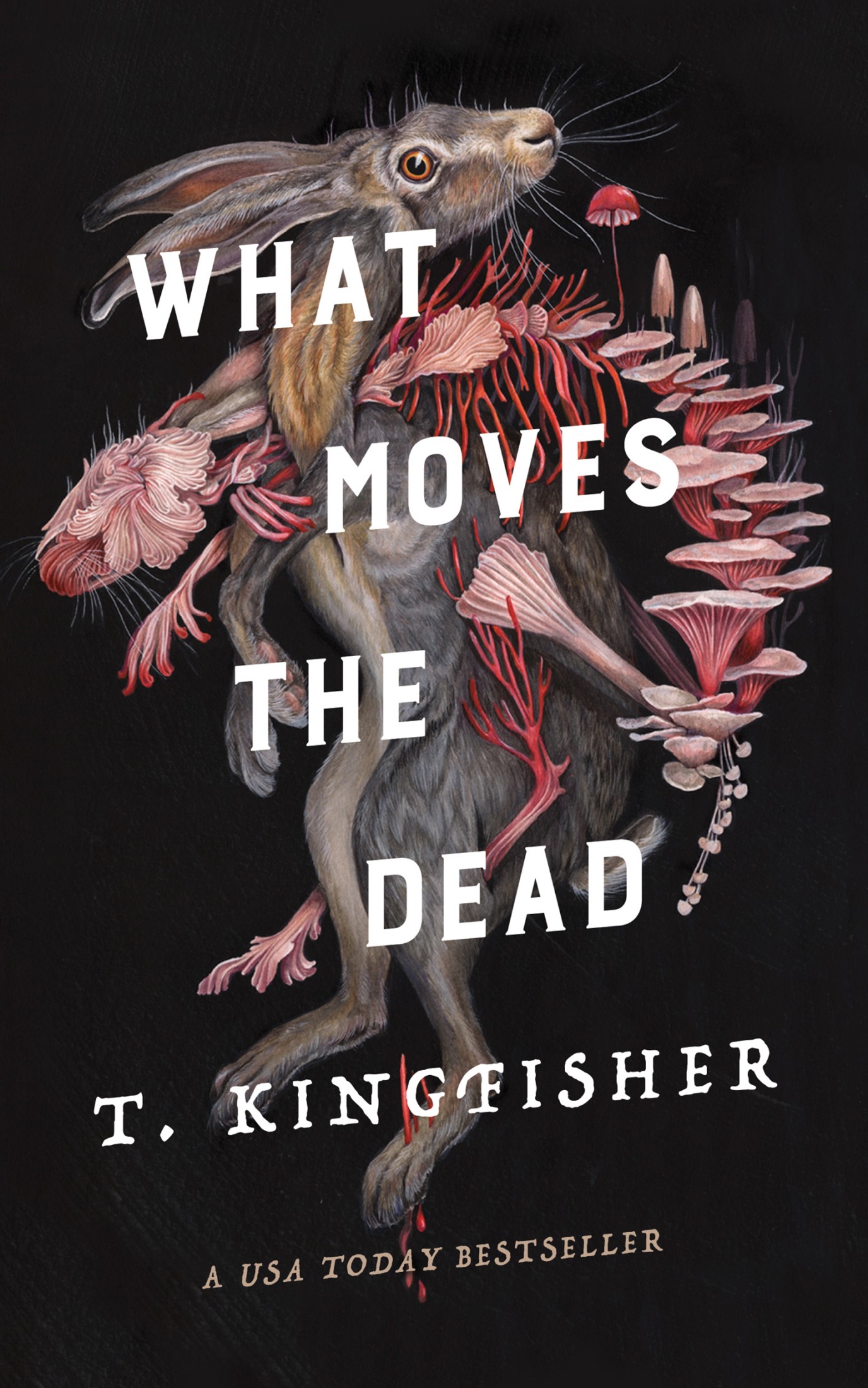
What Moves the Dead
About this book
Alex Easton travels to remote Ruritania after receiving word that childhood friend Madeline Usher is gravely ill. The Usher house is collapsing, Madeline walks and speaks strangely, and her brother Roderick appears nearly as unwell.
Outside, hares move with disturbing coordination and an English mycologist studies growth around the dark lake. Easton and American doctor James Denton try to connect the symptoms before the household becomes impossible to leave.
The novella reimagines Edgar Allan Poe's The Fall of the House of Usher through fungal biology and a narrator shaped by Gallacian military service. The horror comes from life that can imitate familiar behavior without sharing a familiar mind.
What Moves the Dead begins the Sworn Soldier series. It tells a complete Usher story and introduces Easton, Angus, Miss Potter, and Dr Denton for later investigations.
Read a sample
5,008 words
Plain text
From the opening
CHAPTER 1
The mushroom’s gills were the deep-red color of severed muscle, the almost-violet shade that contrasts so dreadfully with the pale pink of viscera. I had seen it any number of times in dead deer and dying soldiers, but it startled me to see it here.
Perhaps it would not have been so unsettling if the mushrooms had not looked so much like flesh. The caps were clammy, swollen beige, puffed up against the dark-red gills. They grew out of the gaps in the stones of the tarn like tumors growing from diseased skin. I had a strong urge to step back from them, and an even stronger urge to poke them with a stick.
I felt vaguely guilty about pausing in my trip to dismount and look at mushrooms, but I was tired. More importantly, my horse was tired. Madeline’s letter had taken over a week to reach me, and no matter how urgently worded it had been, five minutes more or less would not matter.
Hob, my horse, was grateful for the rest, but seemed annoyed by the surroundings. He looked at the grass and then up at me, indicating that this was not the quality to which he was accustomed.
“You could have a drink,” I said. “A small one, perhaps.”
We both looked into the water of the tarn. It lay dark and very still, reflecting the grotesque mushrooms and the limp gray sedges along the edge of the shore. It could have been five feet deep or fifty-five.
“Perhaps not,” I said. I found that I didn’t have much urge to drink the water either.
Hob sighed in the manner of horses who find the world not to their liking and gazed off into the distance.
I looked across the tarn to the house and sighed myself.
It was not a promising sight. It was an old gloomy manor house in the old gloomy style, a stone monstrosity that the richest man in Europe would be hard-pressed to keep up. One wing had collapsed into a pile of stone and jutting rafters. Madeline lived there with her twin brother, Roderick Usher, who was nothing like the richest man in Europe. Even by Ruravia’s small, rather backward standards, the Ushers were genteelly impoverished. By the standards of the rest of Europe’s nobility, they were as poor as church mice, and the house showed it.
There were no gardens that I could see. I could smell a faint sweetness in the air, probably from something flowering in the grass, but it wasn’t enough to dispel the sense of gloom.
“I shouldn’t touch that if I were you,” called a voice behind me.
I turned. Hob lifted his head, found the visitor as disappointing as the grass and the tarn, and dropped it again.
She was, as my mother would say, “a woman of a certain age.” In this case, that age was about sixty. She was wearing men’s boots and a tweed riding habit that may have predated the manor.
She was tall and broad and had a gigantic hat that made her even taller and broader. She was carrying a notebook and a large leather knapsack.
“Pardon?” I said.
“The mushroom,” she said, stopping in front of me. Her accent was British but not London—somewhere off in the countryside, perhaps. “The mushroom, young…” Her gaze swept down, touched the military pins on my jacket collar, and I saw a flash of recognition across her face: Aha!
No, recognition is the wrong term. Classification, rather. I waited to see if she would cut the conversation short or carry on.
“I shouldn’t touch it if I were you, officer,” she said again, pointing to the mushroom.
I looked down at the stick in my hand, as if it belonged to someone else. “Ah—no? Are they poisonous?”
She had a rubbery, mobile face. Her lips pursed together dramatically. “They’re stinking redgills. A. foetida, not to be confused with A. foetidissima—but that’s not likely in this part of the world, is it?”
“No?” I guessed.
“No. The foetidissima are found in Africa. This one is endemic to this part of Europe. They aren’t poisonous, exactly, but—well—”
She put out her hand. I set my stick in it, bemused. Clearly a naturalist. The feeling of being classified made more sense now. I had been categorized, placed into the correct clade, and the proper courtesies could now be deployed, while we went on to more critical matters like mushroom taxonomy.
“I suggest you hold your horse,” she said. “And perhaps your nose.” Reaching into her knapsack, she fished out a handkerchief, held it to her nose, and then flicked the stinking redgill mushroom with the very end of the stick.
It was a very light tap indeed, but the mushroom’s cap immediately bruised the same visceral red-violet as the gills. A moment later, we were struck by an indescribable smell—rotting flesh with a tongue-coating glaze of spoiled milk and, rather horribly, an undertone of fresh-baked bread. It wiped out any sweetness to the air and made my stomach lurch.
Hob snorted and yanked at his reins. I didn’t blame him. “Gahh!”
“That was a little one,” said the woman of a certain age. “And not fully ripe yet, thank heavens. The big ones will knock your socks off and curl your hair.” She set the stick down, keeping the handkerchief over her mouth with her free hand. “Hence the ‘stinking’ part of the common name. The ‘redgill,’ I trust, is self-explanatory.”
Continue reading the sampleClose the sample
“Vile!” I said, holding my arm over my face. “Are you a mycologist, then?”
I could not see her mouth through the handkerchief, but her eyebrows were wry. “An amateur only, I fear, as supposedly befits my sex.”
She bit off each word, and we shared a look of wary understanding. England has no sworn soldiers, I am told, and even if it had, she might have chosen a different way. It was none of my business, as I was none of hers. We all make our own way in the world, or don’t. Still, I could guess at the shape of some of the obstacles she had faced.
“Professionally, I am an illustrator,” she said crisply. “But the study of fungi has intrigued me all my life.”
“And it brought you here?”
“Ah!” She gestured with the handkerchief. “I do not know what you know of fungi, but this place is extraordinary! So many unusual forms! I have found boletes that previously were unknown outside of Italy, and one Amanita that appears to be entirely new. When I have finished my drawings, amateur or no, the Mycology Society will have no choice but to recognize it.”
“And what will you call it?” I asked. I am delighted by obscure passions, no matter how unusual. During the war, I was once holed up in a shepherd’s cottage, listening for the enemy to come up the hillside, when the shepherd launched into an impassioned diatribe on the finer points of sheep breeding that rivaled any sermon I have ever heard in my life. By the end, I was nodding along and willing to launch a crusade against all weak, overbred flocks, prone to scours and fly-strike, crowding out the honest sheep of the world.
“Maggots!” he’d said, shaking his finger at me. “Maggots ’n piss in t’ flaps o’ they hides!”
I think of him often.
“I shall call it A. potteri,” said my new acquaintance, who fortunately did not know where my thoughts were trending. “I am Eugenia Potter, and I shall have my name writ in the books of the Mycology Society one way or another.”
“I believe that you shall,” I said gravely. “I am Alex Easton.” I bowed.
She nodded. A lesser spirit might have been embarrassed to have blurted her passions aloud in such a fashion, but clearly Miss Potter was beyond such weaknesses—or perhaps she simply assumed that anyone would recognize the importance of leaving one’s mark in the annals of mycology.
“These stinking redgills,” I said, “they are not new to science?”
She shook her head. “Described years ago,” she said. “From this very stretch of countryside, I believe, or one near to it. The Ushers were great supporters of the arts long ago, and one commissioned a botanical work. Mostly of flowers”—her contempt was a glorious thing to hear—“but a few mushrooms as well. And even a botanist could not overlook A. foetida. I fear that I cannot tell you its common name in Gallacian, though.”
“It may not have one.” If you have never met a Gallacian, the first thing you must know is that Gallacia is home to a stubborn, proud, fierce people who are also absolutely piss-poor warriors. My ancestors roamed Europe, picking fights and having the tar beaten out of them by virtually every other people they ran across. They finally settled in Gallacia, which is near Moldavia and even smaller. Presumably they settled there because nobody else wanted it. The Ottoman Empire didn’t even bother to make us a vassal state, if that tells you anything. It’s cold and poor and if you don’t die from falling in a hole or starving to death, a wolf eats you. The one thing going for it is that we aren’t invaded often, or at least we weren’t, until the previous war.
In the course of all that wandering around losing fights, we developed our own language, Gallacian. I am told it is worse than Finnish, which is impressive. Every time we lost a fight, we made off with a few more loan words from our enemies. The upshot of all of this is that the Gallacian language is intensely idiosyncratic. (We have seven sets of pronouns, for example, one of which is for inanimate objects and one of which is used only for God. It’s probably a miracle that we don’t have one just for mushrooms.)
Miss Potter nodded. “That is the Usher house on the other side of the tarn, if you were curious.”
“Indeed,” I said, “it is where I am headed. Madeline Usher was a friend of my youth.”
“Oh,” said Miss Potter, sounding hesitant for the first time. She looked away. “I have heard she is very ill. I am sorry.”
“It has been a number of years,” I said, instinctively touching the pocket with Madeline’s letter tucked into it.
“Perhaps it is not so bad as they say,” she said, in what was undoubtedly meant to be a jollying tone. “You know how bad news grows in villages. Sneeze at noon and by sundown the gravedigger will be taking your measurements.”
“We can but hope.” I looked down again into the tarn. A faint wind stirred up ripples, which lapped at the edges. As we watched, a stone dropped from somewhere on the house and plummeted into the water. Even the splash seemed muted.
Eugenia Potter shook herself. “Well, I have sketching to do. Good luck to you, Officer Easton.”
“And to you, Miss Potter. I shall look forward to word of your Amanitas.”
Her lips twitched. “If not the Amanitas, I have great hopes for some of these boletes.” She waved to me and strode out across the field, leaving silver boot prints in the damp grass.
I led Hob back to the road, which skirted the edge of the lake. It was a joyless scene, even with the end of the journey in sight. There were more of the pale sedges and a few dead trees, too gray and decayed for me to identify. (Miss Potter presumably knew what they were, although I would never ask her to lower herself to identifying mere vegetation.) Mosses coated the edges of the stones and more of the stinking redgills pushed up in obscene little lumps. The house squatted over it like the largest mushroom of them all.
My tinnitus chose that moment to strike, a high-pitched whine ringing through my ears and drowning out even the soft lapping of the tarn. I stopped and waited for it to pass. It’s not dangerous, but sometimes my balance becomes a trifle questionable, and I had no desire to stumble into the lake. Hob is used to this and waited with the stoic air of a martyr undergoing torture.
Sadly, while my ears sorted themselves out, I had nothing to look at but the building. God, but it was a depressing scene.
It is a cliché to say that a building’s windows look like eyes because humans will find faces in anything and of course the windows would be the eyes. The house of Usher had dozens of eyes, so either it was a great many faces lined up together or it was the face of some creature belonging to a different order of life—a spider, perhaps, with rows of eyes along its head.
I’m not, for the most part, an imaginative soul. Put me in the most haunted house in Europe for a night, and I shall sleep soundly and wake in the morning with a good appetite. I lack any psychic sensitivities whatsoever. Animals like me, but I occasionally think they must find me frustrating, as they stare and twitch at unknown spirits and I say inane things like “Who’s a good fellow, then?” and “Does kitty want a treat?” (Look, if you don’t make a fool of yourself over animals, at least in private, you aren’t to be trusted. That was one of my father’s maxims, and it’s never failed me yet.)
Given that lack of imagination, perhaps you will forgive me when I say that the whole place felt like a hangover.
What was it about the house and the tarn that was so depressing? Battlefields are grim, of course, but no one questions why. This was just another gloomy lake, with a gloomy house and some gloomy plants. It shouldn’t have affected my spirits so strongly.
Granted, the plants all looked dead or dying. Granted, the windows of the house stared down like eye sockets in a row of skulls, yes, but so what? Actual rows of skulls wouldn’t affect me so strongly. I knew a collector in Paris … well, never mind the details. He was the gentlest of souls, though he did collect rather odd things. But he used to put festive hats on his skulls depending on the season, and they all looked rather jolly.
Usher’s house was going to require more than festive hats. I mounted Hob and urged him into a trot, the sooner to get to the house and put the scene behind me.
CHAPTER 2
It took longer than I expected to reach the house. The landscape was one of those deceptive ones, where you seem to be only a few hundred yards distant, but once you have picked your way through the hollows and wrinkles in the ground, you find that it’s taken a quarter of an hour to get where you are going. Ground like that saved my life multiple times in the war, but I am still not fond of it. It always seems to be hiding things.
In this case, it was hiding no more than a hare, which stared at Hob and me with huge orange eyes as we rode past. Hob ignored it. Hares are beneath his dignity.
Reaching the house required crossing a short causeway over the lake, which Hob didn’t enjoy any more than I did. I dismounted to lead him. The bridge looked sturdy enough, but the whole landscape was so generally decrepit that I found myself trying not to put my full weight down as I crossed, absurd as that sounds. Hob gave me the look he gives me when I am asking him to do something that he considers excessive, but he followed. The clop of his hooves sounded curiously flat, as if muffled by wool.
No one awaited me. The causeway led onto a shallow courtyard, set back from the rest of the building. On either side, the walls dropped directly into the lake, with only the occasional balcony to break up the lines. The front door was positively Gothic, probably literally as well as figuratively, a great monstrosity set into a pointed archway that would have been at home on any cathedral in Prague.
I took the great iron door knocker in hand and rapped on the door. The noise was so loud that I flinched back, half expecting the entire house to crumble at the vibration.
There was no answer for many minutes. I began to feel uneasy … surely Madeline could not have died in the time since her letter arrived? Was the household attending a funeral? (Which only goes to show you how the damned place acted on my nerves. I would not normally jump to funeral as my first guess.)
Eventually, long after I had given up hope and was eyeing the door knocker and wondering whether to make a second go of it, the door creaked open. An elderly servant peered around the door and stared at me. It was not an insolent stare so much as a puzzled one, as if I were not only unexpected but completely outside his experience.
“Hello?” I said.
“May I help you?” said the servant, at the same time.
We both paused, then I tried again. “I’m a friend of the Ushers.”
The servant nodded gravely at this information. I waited, half expecting him to close the door again. But after a long, long moment, he finally said, “Would you like to come inside?”
“Yes,” I said, aware that I was lying. I did not want to go into that tired house dripping with fungi and architectural eyes. But Madeline had summoned me and here I was. “Is someone available to tend to my horse?”
“If you will step inside, I will send the boy to attend to it.” He opened the door, still not very wide. A shaft of gray daylight penetrated the darkness inside without illuminating much of anything. I walked down the shaft with my shadow taking point, and then the servant closed the door and I stood in darkness.
As leaden as the landscape outside had been, it was lit up like a burning city compared to the interior of the house. My eyes took a moment to adjust, and then there was a rasp of matches and the servant lit a set of candles on the side table by the door. He handed me one, as if it were completely normal for the house to be this dark at midday.
“Easton?” The voice was familiar, though the owner stood in the shadows of the hallway. “Easton, what are you doing here?”
I turned to face the owner of the voice just as he stepped forward. In the flickering light of the candle, I beheld my old friend Roderick Usher. He had been a friend of my youth and under my command in the war through an accident of fate. I knew his face as well as I knew my own.
And I swear to you, if I had not heard his voice, I would not have recognized him.
Roderick Usher’s skin was the color of bone, white with a sallow undertone, a nasty color, like a man going into shock. His eyes had sunk into deep hollows tinged with blue and if there was a spare grain of flesh left on his cheeks, I couldn’t see it.
The worst of it, though, was his hair. It floated in the air like spider silk, and I told myself that it was a trick of the candlelight that made it look white rather than blond. Either way, it was now all flyaway wisps, like strands of fog, drifting in a halo around his head. The very young and the very old have hair like that. It was unsettling to see it in a man a year my junior.
Both Roderick and Madeline had always been rather pale, even when we were children. Later, in the war, Roderick could be relied upon to burn rather than tan. They both had large, liquid eyes, the sort that are called doe-like by poets, although those poets have mostly never hunted deer, because neither of the Ushers had giant elliptical pupils and they both had perfectly serviceable whites. I could see rather too much of the whites of Roderick’s eyes right now, in fact. His eyes gleamed feverishly in that unnaturally pale face.
“Usher,” I said, “you look like you’ve been dragged arse-first through hell.”
He gave a choked laugh and clutched at his head. “Easton,” he said again, and when he lifted his head, there was a little more of the Roderick I knew in his expression. “Oh God, Easton. You have no idea.”
“You’ll have to tell me,” I said. I put an arm around his shoulders and thumped him, and there was no flesh on his bones at all. He’d always been rawboned, but this was something else again. I could feel individual ribs. If Hob had ever looked like that, I’d challenge the stable master to pistols at dawn. “My God, Roderick, I don’t think much of your cook if they let you go around looking like this.”
He sagged against me for a moment, then straightened and stepped back. “Why did you come?”
“Maddy sent me a letter saying that she was ill.…” I trailed off. I did not want to say that Maddy had written that Roderick thought she was dying. It was too bald a statement and he looked like a shattered man.
“She did?” His eyes showed even more white around the edges. “What did she say?”
“Just that you were afraid for her health.” When Roderick merely stared at me, I tried to make light of it. “Also her lifelong unrequited passion for me, of course. So naturally I came to sweep her off her feet and take her to live in my enormous castle in Gallacia.”
“No,” said Roderick, apparently ignoring my poor attempt at humor, “no, she cannot leave here.”
“That was a joke, Roderick.” I gestured with the candle. “I was worried, that was all. Do you want to keep standing in the hall? I’ve been on horseback all day.”
“Oh … yes. Yes, of course.” He passed a hand across his forehead. “I’m sorry, Easton. It’s been so long since I’ve had visitors that I’ve forgotten all my manners. Mother would be ashamed.” He turned, gesturing to me to follow him.
None of the halls were lit and all were cold. The lack of light did not seem to bother Roderick. I hastened to keep up, even with the candle. The floors looked black in the gloom, and I caught glimpses of ragged tapestries on the walls and carvings on the ceiling that belonged to the same Gothic sensibility as the door.
We turned into a newer wing of the building and I relaxed a little. Instead of tapestries, there were paneled walls, and some even had wallpaper. It was in poor condition, bubbled and swollen with damp, but at least it felt a little less like walking through an ancient crypt. Very few ancient crypts have plump shepherdesses and gamboling sheep on the walls. I consider this an oversight.
At last we reached a door that actually had light streaming under it. Roderick pushed open the door to a parlor with an actual fireplace, and though the windows were covered in moth-eaten curtains, a little light leaked around their edges as well.
There were several sofas drawn up close to the fire, and I got my second shock of the day, for reclining against one lay Madeline.
She was swathed in gowns and blankets, so I could not see if she was as emaciated as Roderick, but her face had become so thin that I could nearly see the bones under the skin. Her lips were tinged with violet, like a drowning woman’s. I told myself it was some poorly chosen cosmetic, and then she stretched out a hand like a bird’s claw to me, and I saw that her fingernails were the same deep cyanotic violet.
“Maddy,” I said, taking her hand. Thank God for the time they spend hammering manners into officers, because it was only reflex that let me bow over her wrist and say, in a reasonably normal tone of voice, “It has been so very long.”
“You haven’t aged a day,” she said. Her voice was weak, but still very much the Maddy I remembered.
“You have grown more beautiful,” I said.
“And you have grown into an outrageous liar,” she said, but she smiled as she said it, and a tiny bit of color came into her cheeks.
I released her hand and Roderick pointed me to the other person in the room, whom I had barely noticed in my alarm over Maddy. “May I present my friend James Denton?”
Denton was a tall, lanky man with silvering hair, probably approaching fifty if not quite over the edge. He wore his clothes as if they were clothes rather than symbols of rank, and his mustache was too long for fashion.
“How do you do?” Denton said.
Ah. American. That explained the clothes and the way he stood with his legs wide and his elbows out, as if he had a great deal more space than was actually available. (I am never sure what to think of Americans. Their brashness can be charming, but just when I decide that I rather like them, I meet one that I wish would go back to America, and then perhaps keep going off the far edge, into the sea.)
“Denton, this is my sister’s friend Lieutenant Easton, most recently of the Third Hussars.”
“A pleasure, sir,” I said.
I offered Denton my hand, because Americans will shake hands with the table if you don’t stop them. He took it automatically, then stared at me, still holding my fingers, until I let them drop.
I knew the look, of course. Another classification, though not so graceful as Miss Potter’s.
Americans, so far as I know, have no sworn, but I am given to understand that they have very lurid periodicals. Denton likely thought that a sworn soldier would be a seven-foot-tall Amazon with one breast cut off and a harem of cowed men under kan heel.
He was likely not expecting a short, stout person in a dusty greatcoat and a military haircut. I no longer bother to bind my breasts, but I never had a great deal to worry about in that direction, and my batman sees that my clothing is cut in proper military style.
Denton was not a swift social thinker, I gather, or perhaps he was thinking of the periodicals. I could see Roderick over his shoulder, tensing in case his guest should commit some serious faux pas. It took Denton a moment to clear his throat and say, “Lieutenant Easton, a pleasure. I beg your pardon, my country was not in the recent war, so I fear I have not had the privilege of serving alongside your countrymen.”
“Fortunate America,” I said dryly. “The Gallacian army … well, there are just about enough of us left to fill out a regiment, if you don’t look too closely. I cashed out when it became obvious that they were more interested in filling overfed noblemen’s private coffers than in rebuilding the ranks—and now I shall have to beg your pardon, Sir Roderick, Maddy, for speaking ill of your peers!”
Roderick laughed, with a little too much relief, and I took the glass of spirits that his servant was handing me. “I would forgive you gladly,” he said, “if there was anything to forgive. What happened there was a great crime, and I’m grateful you will still have anything to do with those of us above the salt.”
“How could I not?” I said, saluting Madeline with two fingers on the rim of my glass. “But what is the trouble of which you wrote?”
Maddy’s flush had begun to fade, and this drove the last of it from her cheeks until she, too, was white as bone. “Perhaps we might speak of it later,” she murmured, looking down at her hands.
“Yes, of course,” I said. “Whenever you like.”
Denton glanced from her to me and back again. I could see the wheels working in his head, trying to determine my relationship to his friend’s sister. It was vaguely amusing and vaguely offensive all at once.
On the whole, I much preferred Eugenia Potter’s swift classification. In some ways, it is rather refreshing to be treated in the same way as a fungus, though I might have felt differently if she insisted on taking spore prints or seeing what color I bruised.
“I am tired,” said Madeline abruptly. Roderick leapt up and helped her to the door, and seeing them together, it struck me again just how badly they had both fared. Madeline had been a slender, pale-haired wisp of a girl, and she seemed to have aged forty years, though I knew it had been less than twenty. Roderick had aged better, except for his hair. It was his manner that had not fared so well. Madeline moved slowly, like an invalid, but Roderick was full of shuddering, nervous energy. He could not keep his fingers still, moving them restlessly on the arm of her dressing gown as if playing a musical instrument. He turned his head repeatedly to the side, as if listening for something, but there was no sound that I could hear.
I could not have said, as they both moved toward the door, which of them was leading the other.
They were but a moment gone when Denton said, quietly, “Shocking, isn’t it?”
I looked at him sharply. “It’s all right,” he said, leaning forward. “Her rooms are a long way. We have a little time.”