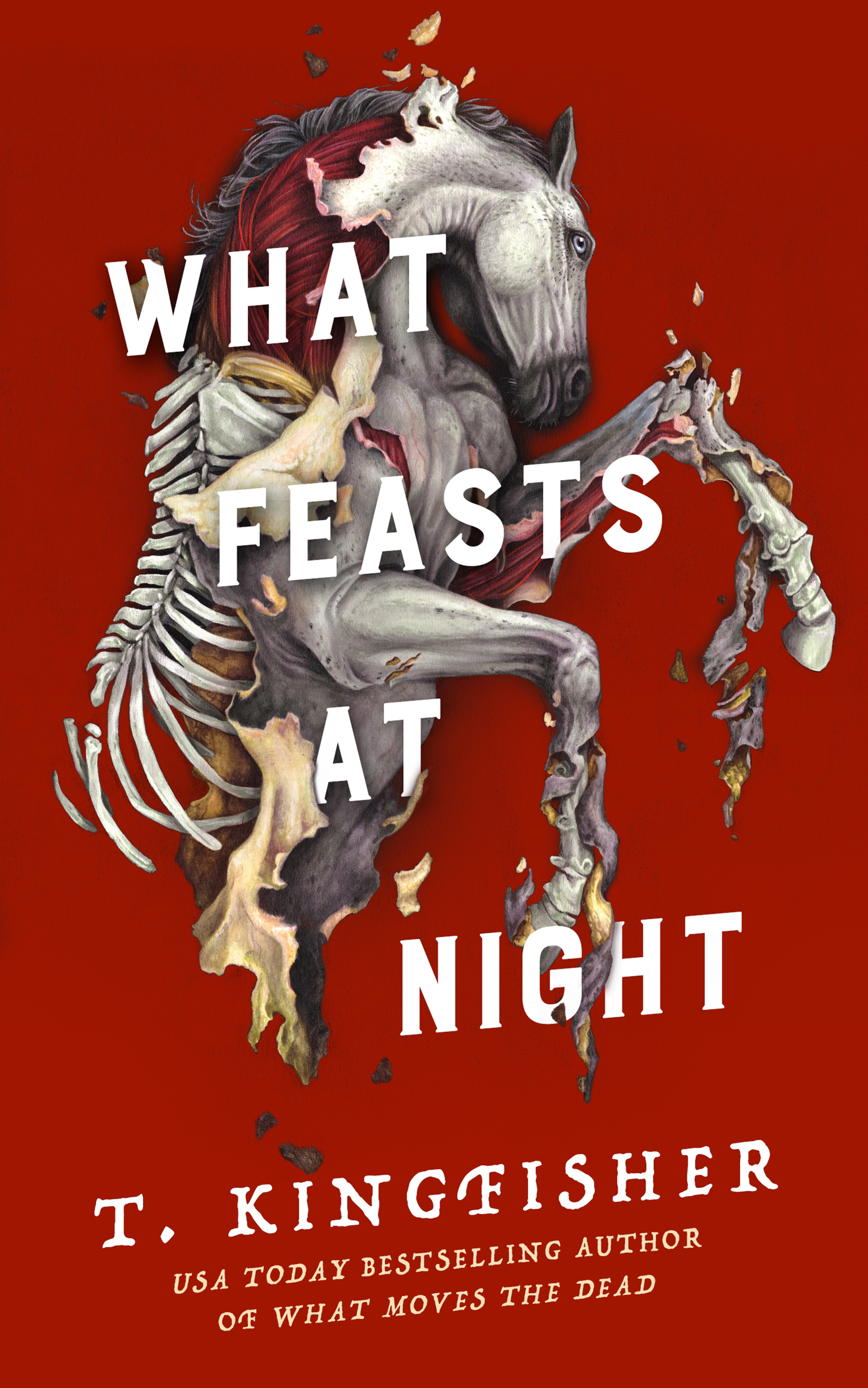
What Feasts at Night
About this book
After surviving the Usher manor, Alex Easton seeks rest in the damp Gallacian countryside with Angus and the mycologist Miss Potter. The lodge they expect to open has been neglected, and its caretaker has died under circumstances no one wants to discuss plainly.
Villagers speak of a creature that steals breath at night. Easton initially recognizes folklore rather than evidence, but nightmares, illness, and the silence around the property make ordinary explanations increasingly difficult to sustain.
The investigation connects supernatural fear to the aftereffects of war and to a culture in which outsiders can miss the meaning of local warnings. Easton's competence does not prevent the body from carrying memories the mind would prefer to dismiss.
What Feasts at Night is the second Sworn Soldier novella and follows What Moves the Dead. Its haunting is self-contained, while the returning characters and Easton's condition continue from the first book.
Read a sample
5,026 words
Plain text
From the opening
CHAPTER 1
A poet once wrote that the woods of Gallacia are as deep and dark as God’s sorrow, and while I am usually skeptical of poets, I feel this one may have been onto something. Certainly the stretch of my homeland that I found myself riding through was as deep and dark as something out of a fairy tale.
Autumn was nearly spent, which meant that many of the trees had lost their leaves. You might think that would mean that the woods had opened up, but if you think that, you have likely never been to Gallacia. Serrated ranks of pine lined the road, with the bare branches of oaks thrusting out between them like arthritic fingers. The sky was the color of a lead slug and seemed barely higher than the trees themselves. Combined with the wagon ruts that left a ridge down the center of the road, I had the unpleasant feeling that I was riding straight down a giant throat.
Everything was damp. Water dripped from the trees, and the fallen leaves had formed a slick brown mush that coated the ground like cheap gravy. Only the evergreens retained their elegance. If this was a fairy tale, it was the kind where everyone gets eaten as a cautionary tale about straying into the woods, not the sentimental kind that ends with a wedding and the words, “And if they have not since died, they are living there still.”
The road sloped upward and the trees on the right-hand side thinned out, to be replaced by a high stone cliff. This is normal. Gallacia is, above all, compact. Our cliffs are very high and usually directly on the road, the trees crowd close on all sides, and while we do have more than our fair share of small waterfalls breaking quaintly over mossy boulders, if you try to step back to admire one from a distance, you’re likely to fall off a different cliff and break your neck.
Also there are bears.
“You know,” I said to Angus, “we could still be in Paris right now.”
Angus grunted. He was my batman in the war, and now served as a combination valet, groom, and voice of reason. I inherited him from my father, along with my chin, my hair color, and my cast-iron liver.
“I didn’t force you to come,” he said.
“You blackmailed me.”
“I most certainly did not.”
“There was guilt. I distinctly remember guilt being involved.”
He grunted again. Angus’s mustache is sometimes capable of its own independent expressions, and was currently expressing its disdain for my complaints. “I, at least, remember what we owe Miss Potter.”
“Believe me, I haven’t forgotten.” Miss Potter, that redoubtable British mycologist, had more or less saved the world from the monstrosity lurking in the Ushers’ lake. An American doctor and I had done a lot of the heavy lifting, but without Eugenia, we would probably still be sitting in the house and wondering why we had started growing strange white filaments out of our ears.
(It had been long enough now that I could joke about it, but only just.)
“I could hardly let her stay in your hunting lodge without a translator,” Angus added. “She doesn’t speak Gallacian.”
No one speaks Gallacian if they can avoid it. Our language is as complicated and miserable as everything else in this country. I couldn’t fault Angus’s logic. And there was no reason not to use the hunting lodge. I had inherited it years ago, and certainly no one else was using it. Still …
“Tell me the truth, Angus. Is this a romantic getaway I sense?”
Angus’s mustache gave me a quelling glare. “I have nothing but the highest respect for Miss Potter,” said the rest of Angus stiffly.
“As do we all. The one doesn’t preclude the other, you know.”
My oldest and dearest friend muttered something that I didn’t quite catch, and let his horse drop back so that I couldn’t needle him any longer.
Honestly, it was hard to imagine a less romantic setting than Gallacia in autumn. I edged Hob away from the side of the road, where a tangle of vines draped over a bare tree like spilled entrails. The road swallowed another hill and we started down it. I stared between my horse’s ears and felt generally ill-used.
Paris, when we left, had been in full glory. Much is made of springtime there, but for my money, a warm autumn is just as spectacular and you don’t trip over nearly as many poets. The window boxes of red geraniums glow like embers, and if it rains, it only makes the sunlight glitter more beautifully off the windowpanes.
Not a week earlier, I had been leaning on the windowsill, the smell of fresh bread wafting up from the bakery below my apartment, listening to the sound of two coachmen fighting over a fare. They had called each other the most extraordinary names, but because they were screaming in French, it sounded like a declaration of love delivered in the heat of a grand passion. Truly, Paris was the city of my heart.
And now I was here, back in Gallacia. The country of my birth, such as it was. Riding down a road that made me feel as if I was being swallowed whole.
We started up another rise. Hob, my horse, sighed as only a disaffected horse can sigh. I patted his neck. Hob was an old trooper, but technically so was I and I didn’t enjoy it either. “Don’t worry, boy. There’ll be a nice hot mash at the end for you.” I hoped there would be, anyway. I’d written to Codrin, the man who kept up the hunting lodge, to tell him that we were coming. He hadn’t written back. I was hoping that it was just because Codrin had never been terribly easy with his letters, but between the grim gray road and the grim gray trees and the grim gray sky—not to mention the profound lack of Paris—I was starting to feel distinctly worried.
Continue reading the sampleClose the sample
“Don’t sulk,” said Angus.
“I’m not sulking.” I didn’t want to admit to baseless anxiety, so I added, “It’s my tinnitus.” This was true, so far as it went. Changes in altitude always set it off, and the train from Paris to the capital had been nothing but altitude changes. I lost most of the trip to a high-pitched whine somewhere inside my head.
Still, it could have been much worse. According to the doctor who told me the name of that ringing in my ears, a few hundred years ago they thought that it was caused by wind getting trapped in your ears. They used to treat it by drilling a hole in your skull to suck the trapped wind out. Now they just said, “Can’t help you, sorry,” and prescribed laudanum to help you sleep.
Laudanum sounded lovely about now. Maybe that would make the growing knot in the pit of my stomach go away.
There’s nothing wrong, I told myself. You’re just tired and cross. Codrin’s letter is probably sitting somewhere in Paris, having just missed us. You know what the mail’s like here, once you get out of the capital.
This was all true and it still didn’t make me feel any better. Hob clearly sensed my anxiety, but was either too well-mannered or too tired from the trip to make anything out of it.
We’d left the capital behind about five hours ago—me with a splitting headache, Angus with his usual unflappable calm, the horses with the deep suspicion that most horses feel about train rides. Angus had collected the horses, arranged for our luggage to be delivered separately, and we set out immediately. (The greatest city in Gallacia is fine, I suppose, but I didn’t feel the need to linger. Imagine if an architect wanted to re-create Budapest, but on a shoestring budget and without any of the convenient flat bits. While fighting wolves.)
The devouring road began not long after we left the city. We traveled from smell to smell, the road rising up into the scent of pines and down into woodsmoke and damp, then back up to the pines again. The smell of woodsmoke usually preceded a small village built in the Gallacian style, the houses clay-plastered wattle, all sporting weathered wooden shingles. Since our local clays are mostly gray, this means that our villages are mostly gray as well. (For a short period after the war, we had lost so many young men that our male population was also gray, which led to the popular tragic song “Silver, Clay, and Frost” that every musician played for about a decade, until we were all heartily sick of it.)
When we finally reached the road leading to the lodge, I nearly missed it. The edges had become overgrown and the potholes were deep enough to lose a sheep in. I turned Hob’s head toward it and his ears flicked skeptically. Was I sure about this? Really?
In truth, I wasn’t sure. The anxiety in my gut was starting to acquire the metallic taste of fear. Which is ridiculous. It’s an overgrown road, not enemy soldiers coming over the ridge. Get hold of yourself.
“I could swear that I was paying Codrin to keep this place up,” I muttered as Hob began to pick his way along the narrow road. Frost-killed weeds choked the edges. “I send money back twice a year.”
“Codrin’s older than I am,” said Angus, which told me very little since I still don’t know how old Angus is. (My guess is late fifties, early sixties, but that was also my guess a decade ago, so I can’t be certain. His hair used to be red and is now silver, but that’s the only concession he has made to age.)
“Still. He should have been able to hire a few village lads to come hack this stuff down.” I paused for a moment, trying to do math in my head. “Err … we do have village lads now, right? All the ones that were being born back when I signed up? Nobody conscripted them?”
Angus shrugged as if to indicate that the life trajectories of the local village lads was no business of his. Hob sighed again.
“All right,” I said, nudging him forward. “Let’s go see how bad it is.”
It could have been worse. That’s about the best I can say for it. The lodge was old and had been built to last, so the roof hadn’t fallen in and the timbers were still sound. But the door stuck, and I had to jam my shoulder into it to get it to open. The smell of dust and old mouse nests hit me like a living thing, and it was very cold.
It was dark inside. The thickness of the lodge walls meant the narrow windows were already in deep shadow, and all the shutters were drawn. I doubt the windows would have let much light in anyway, given the grime. I lit a match and waved it around, unpleasantly reminded of the Usher mansion and the unlit halls.
Nothing horrible jumped out at me, so that was good. “Codrin?” I called. “Codrin, you here?”
No answer.
“This is a bit much,” I muttered. Maybe having a hot meal waiting was too much to ask, fine, but not even a fire?
I immediately felt guilty. Codrin had always been relentlessly conscientious. If he hadn’t prepared for our arrival, he must have had a damn good reason.
There was wood stacked by the fireplace. Angus knelt on the hearth and built the kind of cautious, tiny fire that you make when you aren’t sure if the chimney is full of bird nests. I blundered around, relying more on my memory of the floorplan than the feeble light of the match. Unfortunately, my memory proved to be extremely fallible, and I banged my shins, my shoulder, and my knuckles before finally locating the kitchen and a set of candles.
Light didn’t help all that much. It was a hunting lodge, as I said, which meant that there were dozens of racks of antlers hung on the walls. Cobwebs hung between them like garlands. A stuffed boar’s head was mounted over the fireplace, and the less said about that, the better.
Armed with a candle, my first target was the little room where Codrin normally slept. I didn’t smell death, but that didn’t mean something hadn’t happened to him. If he was injured or had suffered a fall, he might be in desperate straits.
The door was open. His window was unshuttered, but a thin film of grime obscured the glass. I stood in the doorway, taking in the scene—unmade bed with sheets spilling off, stand and basin, whitewashed walls with a crucifix hanging over the head of the bed. Shadows leapt as the candle flame moved, and I had a brief, intense sensation that someone was lying curled up under the crumpled sheets. I stepped forward and yanked them away from the bed, half angry at myself, then felt foolish when they slid onto the floor, leaving only the bare mattress behind.
No Codrin.
I felt, I confess, a pang of relief at that. I would much rather that he had left than that he had died in the house. Death no longer shocks me, but I still prefer that it not visit my friends and acquaintances in my presence.
The basin was empty, as was the ewer. No trace of water. The razor on the stand was starting to rust. The candle on the stand had burned most of the way down. A dead moth, wings half burned away, lay entombed in the pool of wax. I got down on my hands and knees and pulled the chamber pot from under the bed. Dry, though with a coating of foulness on the bottom.
“Codrin’s been gone for a while,” I told Angus, returning. “A couple of weeks at least, I think.”
Angus grunted and got to his feet. “I’ll go into the village and get us some provisions,” he said. “And ask around.”
I nodded. “I’ll see to the horses.” Angus would do a better job of getting information out of the locals. My headache was improving, but I wasn’t feeling up to prolonged conversation or, God forbid, haggling.
The stables were in decent shape. No leaks, no rot, and the hay had gone dry and musty rather than damp and moldy. I vaguely recalled that Codrin had kept a donkey and a little dogcart for going into the village, but neither were in evidence. Presumably he’d taken them with him whenever he’d left. On the other side of the stable wall, firewood had been split and stacked up to the roof.
I unsaddled Hob and Angus’s gray, led them both into stalls, and picked up the water bucket. A stream ran about a hundred yards from the lodge, but the springhouse was much closer, so I trudged up the hillside toward the entrance.
Gallacia has natural springs the way that dogs have fleas, and they are frequently similarly inconvenient. There are plenty of roads that have odd little sideways curves and jogs to avoid a seep, which would otherwise turn it into a mud pit. Still, they’re useful for keeping things cold in summer. You find a good spring, slap a springhouse over it, and then the water runs into deep stone tanks in the floor, which stay cold enough to keep your milk fresh and your butter unmelted.
Our particular spring emerged partway up a hill, which meant that the springhouse was built into the side of it. The low doorway was framed with heavy stones, which made the whole affair look rather like one of those old barrows where the Irish buried their dead kings.
The water channel appeared to be working, but mud squelched under my feet as I approached. I stifled a groan. The overflow from the spring is supposed to run down the channel and into the stream, but of course this, too, was in disrepair. Peering inside, I saw that rocks had fallen down from the ceiling and dead leaves had piled up in the corners. The whole building stank of mildew and wet. The spring water was still trickling from the back wall and splitting into the two stone troughs that ran down either side of the springhouse, but one trough was dry, and the other half was clogged with leaves and had overflowed. Mushrooms grew from the central floor, their thin flesh-colored stems clotted with wet earth. I shuddered. Fleshy stems, thin white threads growing through the staring eye of a hare …
I forced the memory down. It was just a clump of mushrooms. Hell, it was probably a good thing. Miss Potter will have something to paint while she’s here.
It looked like a stone had fallen in from the ceiling and blocked off the right side. That was a bit more of a task than I felt like tackling right now, so I settled for crouching down and scraping mud and wet leaves out of the channel, which was even less appealing than it sounds.
I was bent over, hands full of muck, when my tinnitus came roaring in, a buzzing that rose to the familiar whine, and suddenly I knew that the enemy was coming up behind me, my back so exposed that I might as well have been wearing a sign that said INSERT BULLET HERE and I was supposed to be scouting but I’d missed them somehow and I was going to get shot by a Bulgarian soldier and I couldn’t even blame them because we shouldn’t have been fighting the goddamn Bulgarians to begin with, they were our allies, for Christ’s sake, we shouldn’t even be here, and I snatched up the bucket and spun around, striking out at …
Nothing.
I stood for a moment, unable to even hear my own breathing through the whine, and then I sagged against the doorframe of the springhouse, the bucket handle dropping from my fingers.
Soldier’s heart, my American friend Denton called it. He had been a combat medic during his country’s civil war, and he had plenty of experience with it. Mine is pretty mild, all things considered. I know soldiers who can’t share a bed with another person for fear they’ll strike out in their sleep. (Me, I just don’t like having someone else steal the covers.) Usually it’s not so bad. Every now and then, there’ll be a sound or a smell, or I’ll see something out of the corner of my eye, and for a few seconds I’ll slip into the war again.
Slowly my tinnitus passed. I took a deep breath and then another, then straightened up, embarrassed, even though there hadn’t been anyone around to see me. It was probably the damn mushrooms that set me off. Soldier’s heart doesn’t know the difference between terrible things. Fungus or cannon fire, it’s all just the war.
The water in the channel was a tea-colored trickle. I took my bucket and slogged down to the stream to get clean water for Hob.
God, it was so quiet. Somehow I hadn’t noticed that before.
Not that there was anything odd about that. I’d come directly from Paris. Of course the countryside was going to seem quiet afterward. “Famous for it,” I said out loud, just to hear myself talk. “Peace and quiet. People pay good money for it.”
The silence didn’t feel peaceful. It felt thick. Like the layer of fuzz on your tongue after a hard night of drinking, which you can’t see or touch but you can damn well taste. There weren’t even any birds singing. (Not that I could blame them, since it was the sort of gray day when even sunlight looks dingy.)
“I’m being ridiculous,” I said, still out loud. I dipped the bucket into the stream, and kicked a rock with my boot just to hear the click-click-plop of it rattling past the other rocks and into the water.
The image of the unmade bed kept nagging at me as I walked back to the stable. Codrin was exactly the sort of meticulous, responsible person that you wanted as a caretaker. He would never cut a corner, never leave a job half-done. And while I had no personal knowledge of the matter, I would have sworn by the Blessed Mother that he made his bed every morning, too.
“If he got too old and retired, he’d still have made his bed,” I told Hob, delivering his water. “Not to mention that he would have sent me a letter telling me that he was retiring, and probably recommending someone for the job.”
Hob nosed my shoulder, which I chose to take as agreement.
“Even if he was out in the woods and keeled over suddenly, he’d have made his bed that morning.”
I moved firewood into the house. The interior was just as quiet as the woods, if not more so. Which, again, was perfectly normal, and there was absolutely no reason that it should feel as though my thoughts were echoing in the silence. Angus would have told me that it was the emptiness in my skull making them echo. I wished Angus was here.
Christ’s blood, he’d been gone for less than two hours. What was wrong with me? It was just an empty house. Shadows lay thick in the corners, but surely no thicker than they lay anywhere else.
I built up the fire, recklessly using up my newly hauled firewood. The shadows retreated, but not far enough. Cobwebs hung thick as rags, and the shadows hid behind them. Orange light licked the eyes of the hunting trophies on the walls—those that had eyes at all. Most of them were simply mounted skulls. The others hailed from the days when the art of taxidermy was not quite so advanced as it is now. Perhaps it was the trophies that were so upsetting. I have seen that expression in particularly debauched absinthe drinkers, but you hate to see it on a deer.
One of the skulls rolled its eyes at me.
I was against the opposite wall, heart pounding and spine digging into the plaster, before I quite realized what had happened. I stared up at the skull, the empty eye sockets dark as grief. Had I imagined it? Would it be better or worse if I had?
A white moth climbed out of the eye socket. I sagged against the wall and made a noise that could have passed for a laugh if you didn’t examine it closely. The moth fluttered away from the skull, settled for a moment on an antler, then launched itself at one of the windows and began to batter itself against the glass.
“Right,” I said out loud. My voice tasted strange in my throat. I caught the moth in my cupped hands and went back outside. It fluttered against my palms in a delicate panic, and I released it into the cold gray air.
If anything, the silence outside had thickened. I started to whistle, just to keep from going out of my head. When I glanced down at my hands, they were streaked with silvery dust where the moth’s wings had touched.
I could have gone back inside, but instead I pulled out Hob’s brushes and gave him a quick brush-down. He leaned into the brush, whuffling, and then gave me a betrayed look when I stopped too soon.
“I have other work to do, buddy.”
Hob expressed skepticism that this work could be as important as brushing a very good horse who had been traveling for ages.
“I know. I’ll be back. I just have to make sure that we have somewhere to sleep and that the mattresses haven’t been eaten by mice.”
The silence of the woods was disquieting, but the silence of a horse that feels that he has been deprived of his due tribute is eloquent. I retreated to the lodge, feeling distinctly told off, and shut the door against both of them.
CHAPTER 2
The upper floor of the lodge was taken up by three bedrooms. I had slept in the largest one the last time I was here, but with Miss Potter coming, it seemed polite to leave it for her, and take one of the smaller ones.
Although unless we clean this place up, I can hardly imagine hosting Miss Potter at all. Granted, she probably wouldn’t say anything critical. Miss Potter belonged to a fine old school of courtesy, and if she thought you were doing your best, you could offer her skinned mice and boiled newt-water for tea, and she would by God drink the newt-water with her pinky finger extended and praise the plating of the mice.
Still, it was the principle of the thing.
The mattresses were blessedly free of rodents. I was going to have to lug everything outside for airing, but it was getting on toward evening and a damp Gallacian night was hardly ideal for such a task. I settled for unshuttering the windows and shaking the blankets a few times, rousing a cloud of dust.
I could hardly believe how much the place had deteriorated. It hadn’t been like this last time, surely? Granted, that had been … err …
“Goddammit,” I muttered to myself, wrestling a quilt as if it were an enemy. “It hasn’t been that long. I’m sure of it.”
The problem was that while I had always had an image in my head of the hunting lodge, I was starting to suspect that it had been fixed in childhood and perhaps not updated regularly since. My father bought the place years back and while nearly everything got sold after he died, I’d wound up inheriting the lodge. (Technically, as a sworn soldier, the entire estate was left to me, as my father’d had no sons. This includes the house I grew up in, but my mother actually owns that, no matter whose name is on the paperwork. The lodge, though, is mine.)
I just hadn’t spent much time here as an adult. I’d been busy. There had been a war. Several wars. And then a few other things that weren’t technically wars but involved a lot of soldiers cleaning up messes.
The last time I had been out here was after that godawful mess with the Serbs and the Bulgarians. We’d come in expecting to be helping the Bulgarians fight off the Turks—again—and then it turned out we were shooting at them instead. That would have been bad enough, but my people had been attached to a Serbian unit as scouts. Unfortunately, the commander—may he shit pinecones in hell—heard light cavalry scouts and fixated on the word cavalry, which meant that he expected my people to reenact the Charge of the goddamn Light Brigade while his men provided cover fire. And their goddamn fancy modern rifles didn’t work worth a damn, with the end result that some good people didn’t live to see our ignominious defeat. (That commander took a bullet himself near the end, which is the reason I’m out here telling you this and not in a stockade somewhere for assaulting a superior officer.)
I spent most of the following January in the hunting lodge, staring out at the snow. Angus put me in front of a window, otherwise I might have just stared at the wall. It had been pretty bad.
It had also apparently been a decade ago. Christ’s blood.
The front door slammed. I came down the stairs to find Angus taking off his riding gloves. “Codrin’s dead,” he said bluntly.
I’d been half expecting it ever since I saw the unmade bed, but it still felt like a punch in the gut anyway. I couldn’t pretend that I knew Codrin well or that we were bosom companions, but I’d known him for twenty years. He had kept bringing me tea while I was staring at the snow. Days’ and weeks’ worth of tea. The fighting had only lasted two weeks, and I spent nearly twice that staring at the snow, drinking tea. Had I ever thanked him for that?
“Shit,” I said, leaning against the wall. “How long ago?”
“About two months.” I’d already built up the fire, but Angus poked it a few times until it was arranged to his satisfaction. “He didn’t die here.” He glanced at me under his bushy eyebrows, and I nodded. It wouldn’t have bothered me if he had, but it’s still a good thing to know. “His daughter came and fetched him home.”
I swallowed a few times. “What got him?” It didn’t matter, really, but at the same time, it mattered very very much, if you understand what I mean.
Angus shook his head. “Nobody knew, or most likely, nobody would tell me. If they didn’t actually know, I’d have gotten ten different stories.”
I looked up sharply at that. “Won’t tell you? Why not?”
“That’s the question, isn’t it?” Angus sat back on his heels and began unloading his pack, setting out bread and cheese and a bottle of wine that was, fortunately, not from Gallacia. (You really don’t want to drink our wine. We export it because we don’t want to drink it either.)
“It can’t have been something scandalous. Not with Codrin.”
“Mmm.” Angus found a toasting fork and impaled a helpless slice of bread.
I recognized that as his “thinking” grunt. I grabbed the bucket and fetched water from the stream for us to wash up.
The path from the house to the stream was well-worn under the scattering of soggy leaves. If it snowed while we were here, I was going to have to shovel it if I didn’t get the springhouse in decent shape again. Maybe tomorrow I’d clear the rest of the muck out and make sure there were no fragments of mushroom in the troughs.