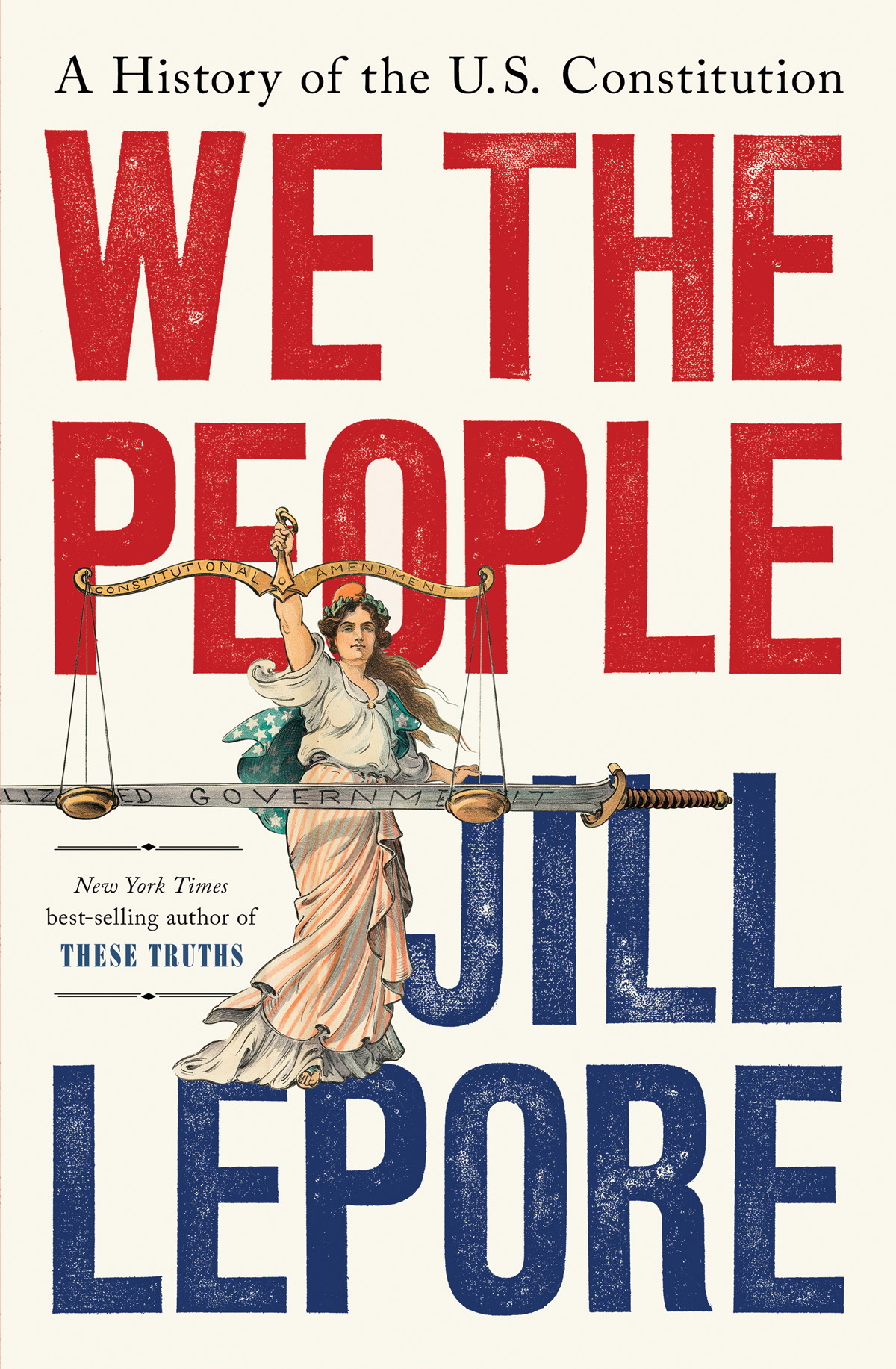
We the People: A History of the U.S. Constitution
About this book
The history begins with state constitutions and the federal convention, then follows arguments over who counts as the people authorized to govern. Petitions, amendments, conventions, courts, and political movements become rival methods of constitutional change.
Lepore gives particular attention to proposals that failed as well as the twenty-seven amendments that succeeded. Abolition, suffrage, labor, civil rights, and equal-rights campaigns show how much constitutional history happens outside judicial opinions.
The book treats durability as an unresolved design problem rather than a simple virtue. A constitution must prevent violent instability without making peaceful reform so difficult that exclusion becomes permanent.
We the People is a broad narrative history of the U.S. Constitution, supported by an extensive database of amendment efforts. It is a companion to Lepore's national history These Truths, but it stands independently.
Read a sample
5,005 words
Plain text
From the opening
Introduction The Philosophy of Amendment
The people have an indubitable, unalienable, and indefeasible right to reform or change their government, whenever it be found adverse or inadequate to the purposes of its institution.
—James Madison, failed First Amendment to the U.S. Constitution introduced into Congress, 1789
We the People. The Constitution of the United States is made of things that are born, live, thrive, decay, and die: insects, animals, plants, ideas. In order to form a more perfect Union. Each of its elements began, long ago, in the loamy earth, hatching and creeping or slipping, slick and squealing, from the womb of the mind. Establish justice, insure domestic tranquility. The text is written on parchment made from sheep, fleeced, their hides soaked in lime, stretched and dried. Provide for the common defense. The ink came from the buds of oak leaves, swollen to the size of musket balls by the eggs of wasps. Promote the general welfare. Its words were shaped by quills fashioned from the feathers of molting geese. Secure the blessings of liberty. Its lofty, momentous ideas came from the minds of men, long since dead, and from the books they read. To ourselves and our posterity. Of the nearly two hundred written constitutions, the Constitution of the United States—the most influential constitution in the world—is also among the oldest, a relic, as brittle as bone, as hard as stone. Do ordain and establish.
But the U.S. Constitution is neither bone nor stone. It is an explosion of ideas. Parchment decays and ink fades, but ideas endure; they also change. The Constitution attempted to solve ancient problems having to do not only with the people and their rulers, the structure of government, and the nature of rights, but also with the knowability and endurance of law. Ingeniously, it accounted for the passage of time.
The U.S. Constitution was intended to be amended. “The whole purpose of the Constitution,” Supreme Court justice Antonin Scalia once said, “is to prevent a future society from doing whatsoever it wants to do.” 1 This is not true. One of the Constitution’s founding purposes was to prevent change. Another was to allow for change without violence. Amendment is so essential to the American constitutional tradition, so methodical and so entire a conception of endurance through adaptation, that it can best be described as a philosophy.
This book, a history of the Constitution, argues that the philosophy of amendment is foundational to modern constitutionalism. Amendment is also a constitution’s mechanism for the prevention of insurrection. This book aims to chronicle the origins of amendment, to identify the conditions under which amendment is possible, to examine why the practice of amendment has been abandoned, and to reckon with the question of whether the Constitution can endure without it.
A government of laws and not of men
Every ordered society is governed by a set of core rules, customs, and principles. This is true for every species that lives in a structured community: a pack of wolves or a pod of whales, a hive of honeybees or a colony of ants, a herd of deer or a flock of geese, a clan of elephants or a tribe of apes and even a forest of trees.2 Only humans devise constitutions. Devising constitutions, or fundamental laws, is so elemental to human society that the collective noun might be a constitution of humans.
Since long before the keeping of records, humans erected governments, codified laws, anointed rulers, imposed or banned religious practices, federated or severed states, claimed territory, and established sovereignty. Once writing was invented, rulers of ancient human societies began recording laws, etching them into clay and stone in the hope that they would last, binding one generation to the next. The Sumerian Code of Ur-Nammu, the oldest surviving written law, was carved into sunbaked clay tablets four thousand years ago. It declared that the king had “banished malediction, violence and strife” from the land. Three hundred years later the Code of the Babylonian king Hammurabi was etched into an eight-foot-tall slab of black stone, weighing four tons, declaring Hammurabi anointed by God “to bring about the rule of righteousness in the land, to destroy the wicked and the evil-doers; so that the strong should not harm the weak.” Sometime around 1300 BCE, Yahweh, the Hebrew god, issued ten commandments to the prophet Moses, according to the Book of Deuteronomy, “and he wrote them in two tables of stone.” Ancient Chinese written law dates to the Zhou Dynasty in the sixth century BCE, inked onto jiǎndú, strips of bamboo.3
The eight-foot-tall Code of Hammurabi, 1755–1750 BCE
Laws govern people; constitutions govern governments. Nearly all constitutions are assemblages, as an eighteenth-century English political philosopher once explained, gatherings together “of institutions and customs, derived from certain fixed principles of reason, directed to certain fixed objects of publick good.” The idea that the object of a constitution is the common good dates to antiquity. When Aristotle wrote Politics around 350 BCE, forming its letters by pressing a pen made of reed upon papyrus made from the soaked and woven pith of the stalks of a sedge that grew on the bank of a river, he divided constitutions into those “which aim at the common advantage” and “are correct and just” and “those which aim only at the advantage of the rulers” and “are deviant and unjust.” 4 Most were unjust.
Continue reading the sampleClose the sample
Many legal instruments combine the constituting of governments with the assigning of territory and the proclaiming of laws. Whether to call these records constitutions is debatable; some are more like treaties; others are more like criminal codes. The prophet Muhammad drew up the now-lost Ṣaḥīfa in 622 CE, establishing a pact between certain Muslims and the Jews of Medina. Sometimes scholars translate the Arabic word ṣaḥīfa as “scripture,” sometimes as “constitution.” In 1215 CE, outside London, King John of England signed a parchment made of sheepskin known as the Magna Carta, the great charter, guaranteeing his noblemen “all the liberties written out below, to have and to keep for them and their heirs.” Meant to last, it was almost immediately annulled, even though later generations of English politicians liked to call it England’s “ancient constitution.” Other ancient constitutions have lasted longer. About 1450 CE, Dekanawidah, the Great Peacemaker, and delegates from the Five Nations of the Iroquois, or Haudenosaunee—Seneca, Cayuga, Oneida, Onondaga, and Mohawk—adopted an agreement known as the Gayanashagowa or Great Law of Peace and often referred to as a constitution, which they recorded on wampum, a light and dark pattern of shells strung together. It begins, “I plant the Tree of Great Peace.” 5 It was meant to grow, root and branch.
Wampum belt recording the Great Law of Peace, c. 1450 CE
The revolutionary idea that the ruled rather than the rulers decide the rules emerged only haltingly. In 1765 Catherine the Great, the Empress of Russia, began drafting the Nakaz, or constitution, to proclaim her sovereignty and guarantee her subjects liberty and equality. To consider it, she called for an assembly of 564 elected representatives—elected by everyone, including women and peasants, with fifty-four seats allotted for Muslims—to meet in Moscow in 1767. The course of human events turned upside down in 1776—the ruled became their own rulers—when the United States declared independence and stated what Thomas Jefferson described as self-evident truths: “that all men are created equal, that they are endowed by their Creator with certain unalienable Rights, that among these are Life, Liberty and the pursuit of Happiness.—That to secure these rights, Governments are instituted among Men, deriving their just powers from the consent of the governed,—That whenever any Form of Government becomes destructive of these ends, it is the Right of the People to alter or to abolish it.” Four years later the people of the Commonwealth of Massachusetts ratified a new constitution, written by John Adams, whose aim, as Adams wrote, was to establish “a government of laws and not of men.” 6 They wrote that constitution down, ink on parchment. It is still in force: it is the law. It also still exists, in a museum in Boston, sealed in a double-paned bulletproof glass case filled with a mix of argon and helium gas to preserve it from the forces of decay: water and oxygen and sunlight.
All written constitutions contain unwritten elements, as invisible as those glass-boxed gases.7 “The sacred rights of mankind are not to be rummaged for, among old parchments, or musty records,” Alexander Hamilton advised seekers in 1775. “They are written, as with a sunbeam, in the whole volume of human nature.” A written constitution’s power comes not from the words themselves but from the life breathed into it, or what Montesquieu called “the spirit of laws,” ethereal and even enchanted. James Madison warned that early state constitutions—the first was written in 1776—offered little more than “parchment barriers” to those who would seek to defy them. “The Constitution of a country is not the paper or parchment upon which the compact is written,” John Quincy Adams agreed. “It is the system of fundamental laws, by which the people have consented to be governed, which is always supposed to be impressed upon the mind of every individual, and of which the written and printed copies are nothing more than the evidence.” 8
All the same, a written constitution is a different creature from an unwritten one. Committing a constitution to writing offers stability, a form of endurance akin to inheritance, but it also presents a problem: how is a government established by a written constitution to be altered except by its destruction?
Amend your ways
The U.S. Constitution drew from ancient ideas, but it was also something new and truly revolutionary, an eighteenth-century invention: a body of fundamental law drafted and ratified by representatives of an invented polity—a constituency—known as the People, binding them to their government by an act of consent. It was meant to transcend ordinary law by establishing fundamental principles, structures, powers, and rights. Printed, copied, and circulated among an extraordinarily literate population, the Constitution executed a covenant and allowed, too, for the exertion of power over vast distances.9 The U.S. Constitution is not a list of commandments, like the Code of Hammurabi or the laws Moses found etched on tablets, engraved in stone, a monument. Nor is it a form of scripture. Unlike all of these, but very much like the Massachusetts Constitution of 1780, which has been amended more than a hundred times, it was meant to be revised, updated, and improved. The eighteenth century was an age not only of revolution and empire but also of enlightenment animated by the idea of progress—political, scientific, economic, technological, and moral. By far the most radical innovation of the U.S. Constitution, and of state constitutions, was the provision they made for their own repair and improvement by the people themselves, to the end it may be a government of laws and not of men.
This mechanism for improvement is called amendment. In English, the verb amend goes back to about the twelfth century, when it meant to correct a fault; to repair an omission; to fix what’s broken; or to improve in a moral sense: to make something better. The word shares a root, four of its five letters, and almost the entirety of its meaning, with the verb mend. (Both words came to Middle English by way of the Old French verb amender.)10 To amend something is to mend it, although you amend a text but you mend a textile. Like amend and mend, text and textile share a root and most of their letters and almost the entirety of their meanings. A text is made of woven letters; a textile is made of woven threads. Weaving and mending were not, at the time the Constitution was written, mysterious arts; they were the everyday work of women. More than half of eighteenth-century American households had spinning wheels, and in some parts of the country as many as a third of households had looms.11 Men amended and women mended. Men wrote and revised texts—bills, laws; women wove and repaired textiles—clothing, bedding. Men wielded pens and operated binderies, stitching books together; women wielded needles and operated spinning wheels and looms. We began this quilt, one woman stitched, with her needle and silken thread. Not We the people do ordain.
To amend also means to rectify something that has become corrupted and, in that sense, not only to repair but to restore, to fix not only something broken but also something that’s gone wrong. Amend and mend have moral meanings: you can make amends, and you can mend your ways. “Amend this fault,” an earl instructs his nephew in Shakespeare’s Henry IV in 1598. “Amend your ways and your doings,” reads a passage from the King James Bible in 1611. By the eighteenth century, the meanings of mend and amend had hardly changed. “Tell me my Faults, and mend your own,” Benjamin Franklin advised in 1745. Ten years later the English lexicographer Samuel Johnson caught each of these meanings in his Dictionary of the English Language:
A sampler of mending stitches, 1797
To AME’ND. v.a.
[amender, Fr. emendo, Lat.]
These meanings became American. The lexicographer Noah Webster, in an early dictionary, defined amend as “to correct, grow better, reform, mend” and the noun amendment as “a change for the better, a correction.” In his monumental American Dictionary of the English Language, Webster elaborated that to amend is “to correct; to reform; to improve or make better, by adding what is wanted, as well as expunging what is wrong.” All this was—and is—contained within the philosophy of amendment.13
Amendment is necessary because everything decays, even laws. As the English jurist Matthew Hale put it in 1697, “As all sublunary things are subject to corruption and putrefaction, to diseases and rust, so even laws themselves, by long tract of time gather certain diseases and excrescences, certain abuses and corruptions grow into the law, as close as the ivy unto the tree, or the rust to the iron, and in a little tract of time gain the reputation of being part of the law.” Or as Montesquieu explained, “Sometimes it is proper the Law should amend itself.” In the eighteenth century, people hoped written constitutions would endure, to bind one generation to the next. They cherished stability. The Scottish philosopher David Hume argued that “as human society is in perpetual flux, one man every hour going out of the world, another coming into it, it is necessary in order to preserve stability in government that the new brood should conform themselves to the established constitution, and nearly follow the path which their fathers, treading in the footsteps of theirs, had marked out for them.” But alongside that idea they held in their heads the equally important idea that constitutions need to be revised or even entirely rewritten, either as occasion demands or at regular intervals.14 Even the mere passage of time would necessitate alterations.
Through experiment and experience, Americans came to agree that if such a strange, fragile thing as a written constitution were to endure, it would, as time passed, the ticking of a clock, need to be both revised and repaired, improved and updated.15 Mostly, the demand for amendments came from ordinary Americans who insisted that their constitutions be revisable, “to rectify the errors that will creep in through lapse of time, or alteration of situation,” as one Massachusetts town meeting put it in 1778, demanding an amendment mechanism in the state’s constitution. The U.S. Constitution was itself an act of amendment.16 It was written because the existing frame of government, the Articles of Confederation, were technically amendable but, for all practical purposes, not.17 Eight times members of Congress had tried to amend the Articles, but as any change required the unanimous consent of all thirteen states, eight times they failed. The Articles of Confederation, as Hamilton wrote, suffered not “from minute or partial imperfections, but from fundamental errors in the structure of the building, which cannot be amended otherwise than by an alteration in the first principles and main pillars of the fabric.” At the Constitutional Convention in Philadelphia in 1787, Virginia delegate George Mason, pointing out that everyone knew the Constitution was imperfect, argued that “amendments therefore will be necessary, and it will be better to provide for them, in an easy, regular and Constitutional way than to trust to chance and violence.” 18
Amendability is the essential contribution of American constitutionalism.19 “Permit me to mention one great principle, the vital principle I may well call it,” Pennsylvania delegate to the Constitutional Convention James Wilson declared in 1791. “The principle I mean is this, that the supreme or sovereign power of the society resides in the citizens at large; and that, therefore, they always retain the right of abolishing, altering, or amending their constitution, at whatever time, and in whatever manner, they shall deem it expedient.” This vital principle, Wilson argued, was not an incitement to violence but an alternative to it, “not a principle of discord, rancor, or war” but “a principle of melioration, contentment, and peace.” 20 A constitution too easily amended leads to chaos. But a constitution too difficult to amend leads to chaos, too. Without amendment, Wilson argued, there would be nothing but revolution: everlasting insurrection.
The Fifth Article
The trick was finding that sweet spot: devising a method of amendment that, as Madison hoped, would leave open a “constitutional road to the decision of the people” but would guard against both “that extreme facility, which would render the Constitution too mutable; and that extreme difficulty, which might perpetuate its discovered faults.” 21 Not too easy, not too hard. In this, the framers did not succeed.
The amendment power is defined in Article V of the Constitution. It reserves to the people the power of amendment and sets out two paths to propose amendments (Congress can propose amendments, and the state legislatures can call for a convention to propose them) and two paths for ratifying amendments (either by the state legislatures or by special conventions held in the states). Article V requires a double supermajority: to pass, an amendment must be approved by a two-thirds majority in both houses of Congress, and to be ratified, it has to be approved by the legislatures or special conventions in three-quarters of the states.22
The Fifth Article was the triumph of the Constitutional Convention; without it, the Constitution would never have been ratified.23 Everyone expected the Constitution would need amending. There are features of the Constitution that sizable numbers of Americans have complained about for centuries, including its strange method of electing the president, and the absence of any acknowledgement of God. Some problems emerged due to an alteration of circumstances, like the growth and changing distribution and composition of the population; the shifting balance of power between the three branches of government; the rise of capitalism and the attendant widening of inequalities of wealth, income, and political power; and the tremendous growth of the federal government. Many proposed changes were animated by the spirit of moral reform. (“The paramount duty of man upon earth is to amend himself,” as John Stuart Mill once wrote, but all bear the duty, too, of “amending the world.”)24 Then, too, in its failures to abolish slavery, extend rights to women, and fully recognize the sovereignty of Native nations, the Constitution defied its own principles of liberty, equality, and republicanism, even though for decades the people most affected by those defects were least able to participate in public debate, and to propose amendments.25
Article V is the mechanism the framers devised to revise, reform, correct, update, and improve the Constitution.26 But due to factors that they could not possibly have foreseen—the emergence of political parties, the astounding geographical and demographic growth of the country, and the political paralysis of polarization—amending the Constitution turned out to be infinitely more difficult than they intended. Almost all efforts to amend the Constitution fail. Success often takes decades. And for long stretches of American history, amending the Constitution has been effectively impossible.
Article V is a sleeping giant.27 It sleeps until it wakes. War is, generally, what wakes it up. And then it roars. In 1789, in the aftermath of the Revolutionary War, Congress passed twelve amendments, ten of which, later known as the Bill of Rights, were ratified by the states by 1791. No amendments were ratified in the sixty-one years between 1804 and 1865, and then, at the end of the Civil War, three in five years. What became the Thirteenth Amendment in 1865, abolishing slavery, had first been proposed fifty-seven years earlier. No amendments were ratified in the forty-three years between 1870 and 1913, and then, during the First World War, four in seven years. The Nineteenth, granting women the right to vote and first called for in 1848, was ratified in 1920 only after a seventy-two-year moral crusade.
Again, the giant slept. In the 1930s, Franklin Delano Roosevelt abandoned constitutional amendment in favor of applying pressure on the Supreme Court, even as the civil rights movement, too, adopted a legal strategy that involved seeking constitutional change through the Court. The Second World War did not awaken Article V because midcentury liberals disfavored amendment in favor of the exercise of executive and judicial power. Between 1961 and 1971, as the United States became engulfed in the war in Vietnam, Americans ratified four amendments and seemed very likely to ratify two more. Those that succeeded included the Twenty-Fourth Amendment, which in 1964 abolished poll taxes, and the Twenty-Sixth Amendment, which in 1971 lowered the voting age to eighteen. Both relied on a broad liberal consensus. Other efforts, like an amendment abolishing the Electoral College, which passed the House in 1969, failed. The Equal Rights Amendment, introduced into Congress in 1923, was sent to the states in 1972, nearly a half century later. It was never ratified.28 Liberals stopped proposing amendments, and amendments proposed by conservatives—providing for school prayer, banning flag-burning, defending marriage, protecting fetal life, and requiring a balanced budget—all failed. Given those failures, conservatives, like earlier liberals, then instead sought constitutional change through the federal judiciary. The amending stopped (Figure 1). (The Twenty-Seventh Amendment, which concerns congressional salary and was ratified in 1992, was one of the twelve amendments sent by Congress to the states in 1789, then was more or less forgotten; it can hardly be said to have introduced a new idea into the Constitution.) The Constitution has not been meaningfully amended since 1971. The military draft ended in 1973. The giant has not awoken since.
figure 1
Proposed and Ratified Amendments by Decade, 1789–2018
Follow for extended description
The people will have ceased to be their own rulers
“Nothing new can be put into the Constitution except through the amendatory process,” Justice Felix Frankfurter declared in 1956, and “nothing old can be taken out without the same process.” 29 This is an exceedingly narrow view of the facts of the matter. In truth, the Constitution is changing all the time: by judicial decisions, by the enactment of new state and federal laws, by the application of new meanings to old laws, and by popular protest.30 Scholars sometimes call these methods of constitutional change the “informal amendment process” or “common-law constitutionalism.” 31 Ordinary Americans from abolitionists and suffragists to Tea Partiers and advocates of same-sex marriage have sought constitutional change by petitioning, protesting, organizing, and voting, in a process of informal amendment known as popular constitutionalism.32 Informal amendment has advantages: the Supreme Court, which is specifically designed to be unaccountable to public opinion, can protect the interests of minorities against a tyrannical majority.33 But none of these exercises of power is as mighty or as enduring as formal amendment, since any changes that informal amendment imposes, including changes made by the Supreme Court, can be reversed.34
Article III of the U.S. Constitution created the Supreme Court and granted it judicial power—the power to pronounce judgments—over all cases and controversies “arising under this Constitution.” It did not specify how many justices were to serve on the Court or explain what method they were to use to decide constitutional cases.35 It also did not expressly grant the Court the power of judicial review, the authority to determine the constitutionality of government action. Instead, after much contestation, the Court assumed this power. If judicial review has been disputed both frequently and vehemently, it is a well-established and regular feature of American constitutional practice.36 But Americans have never been wholly resigned to the Court’s assertion that its word is the first, last, and only word on the meaning of the Constitution. This is known as judicial supremacy, and it emerged only in the nineteenth century.37 Much use of Article V has involved defying the judiciary. Of the fifteen amendments ratified after the Bill of Rights (discounting the Eighteenth and the Twenty-First, because the one repealed the other), seven—the Eleventh, Thirteenth, Fourteenth, Sixteenth, Nineteenth, Twenty-Fourth, and Twenty-Sixth—overturned opinions issued by the Supreme Court.
Informal amendment happens all the time, but formal amendment happens hardly ever. The relationship between these two methods of constitutional revision has aptly been described as hydraulic: the more willing the Court is to offer new interpretations, the less likely is revision by amendment. And the more difficult it becomes to amend the Constitution, the more necessary is recourse to the Court for Americans seeking to alter fundamental law.38 The nature of the situation has encouraged political actors to take alternating positions about both the feasibility and the desirability of formal amendment and the legitimacy of judicial review. When the Supreme Court is conservative, liberals defend the formal amendment process as the only democratic method of constitutional change and denounce judicial interpretation as antidemocratic; when the Court is liberal, the reverse is true. In 1857 the Supreme Court ruled in Dred Scott v. Sandford that no people of African descent can ever become American citizens. Frederick Douglass rejected the Court’s authority to make any such declaration: “No Court in America, no Congress, no President, can add a single word thereto, or take a single word therefrom. It is a great national enactment, done by the people, and can only be altered, amended, or added to by the people.” 39 Abraham Lincoln, too, refused to concede the Court’s authority to revise the Constitution. “If the policy of the Government upon vital questions affecting the whole people is to be irrevocably fixed by decisions of the Supreme Court,” Lincoln said in his First Inaugural Address, then “the people will have ceased to be their own rulers, having to that extent practically resigned their Government into the hands of that eminent tribunal.” 40
Nearly a century later, after the Court declared school segregation unconstitutional in Brown v. Board of Education in 1954, North Carolina senator Sam Ervin accused liberals who celebrated the decision of believing that Article V “is too cumbersome and slow” and that “the Supreme Court must do the amending.” 41 Beginning on the very day the Court issued its opinion in Brown, segregationists called for amending the Constitution to overturn the decision. More recently, after the Court issued its opinion in Roe v. Wade in 1973, the right-to-life movement began proposing formal amendments to overturn that decision, accusing the Court of having unlawfully amended the Constitution by finding a right (to privacy) where none existed. Those same advocates expressed no concern about judicial overreach in the Supreme Court’s decision to overturn Roe in 2022, in Dobbs v. Jackson Women’s Health Organization, when the Court denied the existence of a right that, whatever its earlier history, had existed since 1973. One’s commitment to Article V, it seems, depends on whether one agrees or disagrees with the Court’s decisions. This arrangement is not sustainable.
The philosophy of amendment has structured American constitutional and political development for two and a half centuries. It has done so in a distinctive, halting pattern of progression and regression in which constitutional change by way of judicial interpretation, in the form of opinions issued by the U.S. Supreme Court, alternates with formal amendment as a means of constitutional revision. This pattern has many times provided political stability, with formal amendment and judicial interpretation as the warp and weft of a sturdily woven if by now fraying and faded constitutional fabric. But this pattern, which features, at regular intervals, the perception by half the country that the Court has usurped the power of amendment, has also undermined the idea of representative government, increased the polarization of American politics, contributed to political violence, and led to the underdevelopment of the U.S. Constitution.
With only twenty-seven amendments, the U.S. Constitution has one of the lowest amendment rates in the world.42 But since 1789, Americans have submitted nearly ten thousand petitions and countless letters, postcards, and phone and email messages to Congress calling for or opposing constitutional amendments, and they have introduced and agitated for thousands more amendments in the pages of newspapers and pamphlets, from pulpits, at political rallies, on websites, and over social media. Some twelve thousand amendments have been formally introduced on the floor of Congress.43 During the era of rising polarization that began around 1968, members of Congress all but stopped bothering even to propose amendments (Figure 2). The more conservative the Court, the smaller the number of amendments proposed by members of Congress.44 Instead of arguing for amendments, legislators, lobbyists, and other advocates pursued different means of either securing or thwarting constitutional change: influencing the nomination and confirmation of Supreme Court justices and altering the method those justices use to interpret the Constitution.
figure 2
Proposed Amendments per Legislator and DW−NOMINATE Polarization Score by Congress, 1789–2019