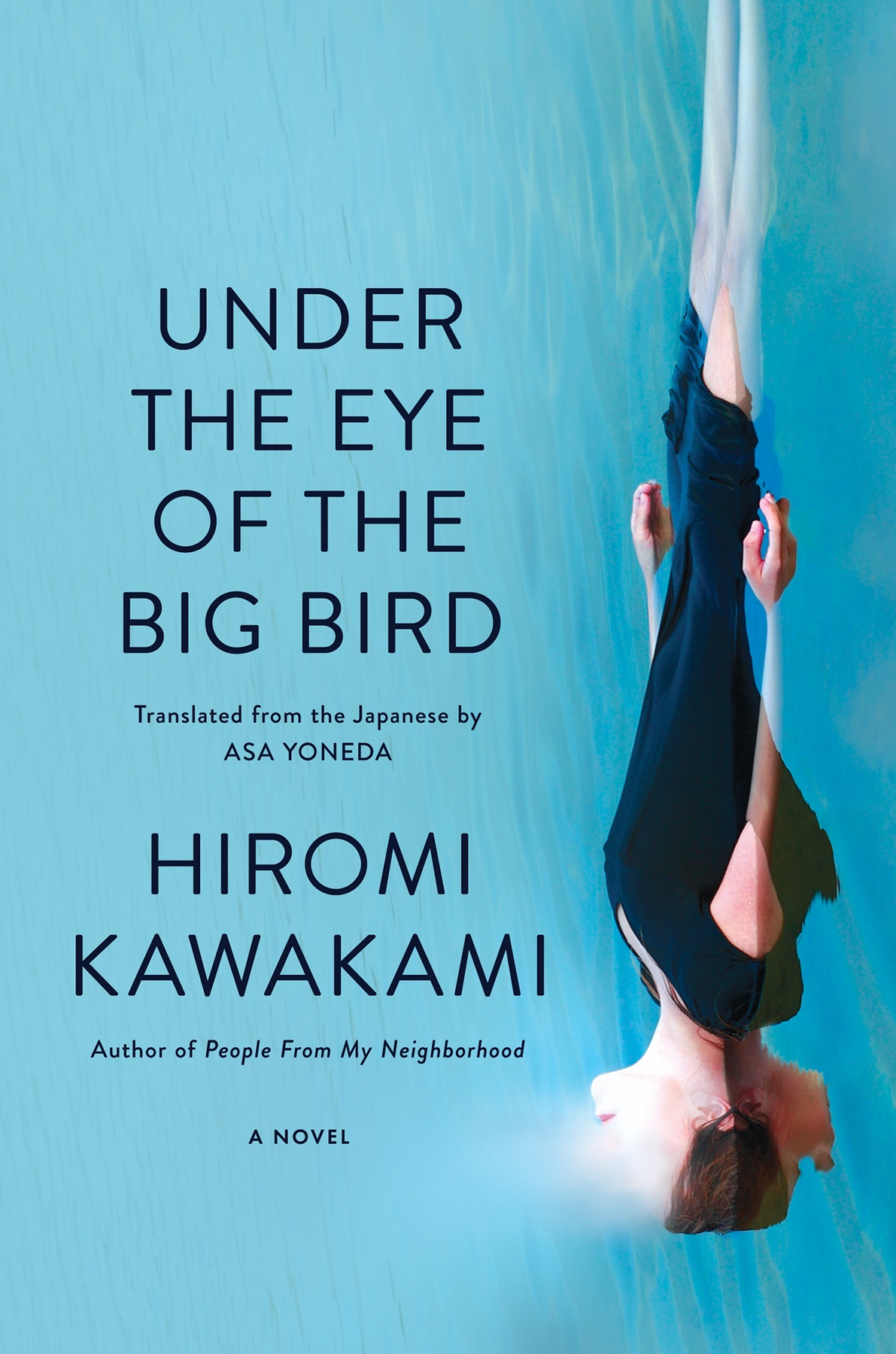
Under the Eye of the Big Bird
About this book
The book moves across generations and forms of life rather than following one hero. Children are raised by manufactured mothers, bodies and memories are altered, and isolated settlements preserve different answers to the species’ decline.
Recurring names, objects, and relationships gradually reveal connections among the episodes. The technologies remain intimate—care, birth, hunger, ageing, sex—so the future is understood through households before it becomes a history.
Kawakami’s quiet tone makes radical changes feel ordinary to the people living with them. The result is neither a simple extinction warning nor a celebration of engineered survival, but an inquiry into which continuities matter when biology no longer supplies the definition.
Under the Eye of the Big Bird is Hiromi Kawakami’s speculative novel in Asa Yoneda’s English translation. Its mosaic structure rewards readers willing to assemble a civilisation from the lives it regards as temporary.
Read a sample
5,001 words
Plain text
From the opening
/ Keepsakes /
Let’s go to the baths today, Miss Ikuko said, so we all got ready.
In our robes of white gauze, we took the children by their hands, formed a line, and walked the five minutes or so to the river, down the flagstone path. Some of the stones were missing where they had come loose. Up ahead, Miss Chiaki stopped every so often at these empty spots, crouching to scoop up the fragments scattered on the ground into her palm.
“It could be much worse,” Miss Ikuko said soothingly.
Miss Chiaki nodded. “You’re right. We’re fortunate here.”
Miss Chiaki gathered her robe around her and continued walking, a little faster now. We could hear the river and see the steam rising through the trees. This was a natural bathing spot.
We sank ourselves into the water and warmed our bodies. Our breasts and pale bellies were visible through our robes. One of us soaked her feet, while another submersed herself all the way up to her neck. We flushed faintly and soon started to perspire.
The children kept together, splashing in a shallow some distance from us. Their voices carried over the surface of the water as they played.
Farther down, an animal was swimming toward the other bank. Miss Chiaki gave a small cough. One of us said, Is it time we were going? Still in our robes, we rose out of the pool and made our way back, spilling drops of water. After our homeward procession had passed, the cobblestones shone wetly for some time, as in the wake of a giant snake.
I got married five years ago.
My husband is tall and generously built. I am tall for a woman, but when he hugs me, I feel as though I’ve been neatly rolled in heavy cloth, which is very pleasant.
My husband commutes to a factory at the edge of the city. Each region has a similar factory, but I have heard a rumor that even among those, this one is of an especially high standard.
Miss Ikuko laughs and says no. “They’re all the same. The technology is identical, after all.”
But even if the technology and the workings are the same, might not the quality of what is produced differ according to the skill of those working at the factory? I said so to my husband once, and he nodded, seeming pleased.
Several times a week, I think about how much I love my husband. When I notice these feelings I have for him, it makes me feel relieved, and also a little uneasy.
While my husband is at work, I raise children.
The children are full of energy. Miss Ikuko has been mentioning more often recently how it runs her out of breath to keep up. Before, she would be the first one to join in their games.
We take them to play in the big park in the middle of the city.
This park has a fountain and a trickling stream, a climbing frame, a sandbox, and a small carousel. The children are allowed on the carousel once they have entered kindergarten. So in spring, when they first start at kindergarten, they rush to climb astride the wooden horses and show off how they ride around and around. Soon, though, they tire of it, and go back to playing house and tag and kick-the-can.
The carousel attendant is an elderly man. He once told me that he resided somewhere in the north of the city.
By autumn, hardly any children ride the carousel. The attendant sits quietly next to the silent platform. Every once in a while, a child decides to jump onto a wooden horse, and then the attendant pulls a kind of large lever installed next to the platform. Slowly, the platform starts to turn. Tinny music plays. After exactly eight rotations, the platform stops. Underwhelmed, the child gets off the horse, and without a backward glance runs off toward the sandbox.
Miss Chiaki has been married three times. Her first husband died two years after they got married, and the next was with her for seven years but then also fell ill and died. She registered her marriage with her current husband last year.
“Why bother making it official?” Miss Ikuko says to me behind Miss Chiaki’s back, but I think I understand.
Of course, registering the marriage doesn’t change anything. Either way, the two of you live together, and quietly grow older.
“Perhaps she wants to have something to mark the time they spend together,” I suggest.
Miss Ikuko laughs and looks askance. “I guess so.”
My husband and I have registered our partnership, although he wasn’t keen to at first.
“It looks like I might be around for a while,” he said.
“And me? You don’t think I’ll live very long?” I said.
He shrugged. “We don’t know, do we? No one can know that.”
This is my husband’s fourth marriage, and my second. His other wives and my previous husband are all dead. Unlike me, my husband has his wives’ keepsakes. He keeps each one in its own small box neatly lined with cotton.
Sometimes I try to remember all the children I’ve raised so far.
Pito, puta, mita, yota . . . Even counting up just the children whose names I can recall, there are fifteen of them. If I include the ones I’ve forgotten, the number must easily be over fifty.
Continue reading the sampleClose the sample
The children grow quickly. It’s rare that a child takes as long as two or three years to become ready for kindergarten, and the fast ones can be ready at three months.
Once they enter kindergarten, my work is nearly done. If I were to meet any of those fifteen children now, whose names I remember but who all grew up and left, I don’t know that I’d recognize them straightaway.
Recently, I had a visit from someone who must have once been one of those children.
“Hello, Mother?” The child held out a sprig of flowers. They were small white flowers that grow on a hillock near the factory. “I picked these for you,” he said shyly.
I hesitated, trying to recall his name.
“It’s Taku.”
“Yes.” He had been . . . not in the first ten, but certainly one of the first twenty or so of the children. “How tall you are!” Out of instinct I reached out and took his hands, and the child gently squeezed back.
“I’m going to be getting married.”
“Well!”
“When was I your child?”
“You know I can’t tell you that. Just like you’re not supposed to come here.”
I looked around discreetly, but there was no one there to admonish us. I hadn’t seen Miss Ikuko today. I put my arms around his torso and held him tightly. This child I had raised—I could feel the firm warm muscle of him breathing.
“Congratulations,” I whispered.
Taku smiled sweetly and lowered his head. Hugging me back, he said, “I’m so glad I came.”
Then he left, looking back over his shoulder, seeming sorry to be leaving.
Are things going well at the factory? I ask my husband.
He shrugs his shoulders in a way that can be taken as either uh-huh or nuh-uh.
They say the factory in this region was built around a hundred years ago. The other regions’ factories are around the same age. The very first one was built several hundred years ago, but that one no longer exists. Also, at that time, there was a unit that contained multiple regions, called a country, and that country was named Japan. And as well as Japan, there were countless other countries, each of which had a name. I learned all this from my husband, who enjoys reading old documents.
What was life like back then? I ask him.
He shakes his head. We don’t know. It’s not recorded anywhere. I expect that’s something we’re not supposed to know.
There are many things in this world that we aren’t supposed to know.
Miss Ikuko once took me aside and said, You’re a little inquisitive. That’s fine, of course. People ought to have a thirst for knowledge. Life is short, after all.
The factory makes food, and also children.
The origins of the children are randomized. Some are derived from cows; others from whales or rabbits.
“Why don’t they make human-derived children?”
“I think there must be a small number made,” my husband says. “But the human-derived stem cells are fragile.”
“Really?”
“For some reason, cells harvested from people who are human-derived are much more likely to mutate. We don’t have a lot of luck using them to produce children.”
“Really.”
None of us is allowed to know what our animal of origin is. Did the people back then also live in a world with so many things they couldn’t know? I wonder.
“Will you show me your keepsakes of your wives?” I ask.
Sure, my husband says, and brings out the boxes.
My husband told me that his first wife had been of mouse origin. The next one was of horse origin, and the third, of kangaroo.
Each box contains a bone, which is the keepsake. For some reason, the small bone called the analogous bone, which is located near the cervical spine, takes on the shape of the skull of the animal a person is derived from—only in miniature, of course. After someone dies, before the body is incinerated and pulverized at the factory, you can put in a request to be given the analogous bone. It’s only once someone’s dead that we can know what their heritage was.
My favorite is the analogous bone belonging to the horse-based wife. Its snout sweeps so prettily away from the eye sockets, and it looks as though it might start talking to me at any moment.
“Which wife did you like best?”
“The one I have now.”
If I die before my husband, I wonder, will he keep my analogous bone in a fourth box? I’d be happier if he didn’t, I think.
“I don’t want to end up like your other wives,” I say, to see how he’ll respond.
He smiles and says, “I agree. Let me think about it.”
But then, just like that, my husband was dead.
I put in my request at the factory counter and was given his analogous bone. I went to the library and looked it up in a reference book, which showed me that it closely resembled the skull of a dolphin.
The caption placed next to the photograph of swimming dolphins said: Dolphin: a generic name for the smaller varieties within Odontoceti, suborder Cetacea, order Cetartiodactyla, class Mammalia.
For quite some time, I felt like doing nothing at all.
“You mustn’t be down for too long, for the children’s sakes, too. I’m sure your dead husband would want the same,” Miss Ikuko said, trying to be encouraging.
But even the thought of the children didn’t appeal to me. “All they make is mess and trouble.”
“Don’t be silly!” Miss Ikuko raised her voice. “If we lose the children, that’s the end of the world. We have to make the children and raise them, because that’s how we maintain the biological diversity of the genetic information we need to preserve. That’s the only way the world keeps going.”
I have trouble understanding what she’s saying. Of course, they’re words I’ve had repeated to me daily, ever since I too was a child. But I don’t know what it all means.
“Where did people come from, Miss Chiaki?” I asked.
Would you like to go to the baths, just the two of us? I’d suggested. I was trying to avoid Miss Ikuko.
Miss Chiaki immediately said yes, and the two of us put on our light robes and walked to the river. Miss Chiaki didn’t say much. She didn’t mention my dead husband or the children, for which I was grateful.
Bubbles formed on the surface of the river. Vapor rose and drifted away. The two of us sat in the water without talking for a long time. Sweat ran down our foreheads and temples and the sides of our necks, but we stayed like that for a while.
It started to get dark. Miss Chiaki quietly got out of the water. Her breasts and her belly were flushed pink.
“Your husband who died the other day,” Miss Chiaki said simply. “You loved him.”
I nodded. I felt tears trickle down my face. From my eyes and my nose.
“May I show you something?” Miss Chiaki took a flat square tin from the small bag she had left on the bank. She opened the lid and showed me what was inside.
“What is it?”
“The soul of the throat. Some people call it an Adam’s apple.”
The small bone that lay on the cotton was nothing like an analogous bone: not like a skull at all, but like a butterfly that had failed to open its wings.
“Human-derived people don’t have an analogous bone. So they give you the Adam’s apple instead, because it’s unique to human-derived people.
“When the factory sent me this bone, I was taken aback. I never dreamed my second husband might have been of human heritage. He was pretty old, so I knew it had to be a long-lived mammal, but still.” Miss Chiaki smiled gently. “Do you know, they say only three people have ever been derived from humans?”
“What about from other mammals?”
“There must be at least a thousand per species, even the rarest ones. That’s what my first husband said.”
Miss Chiaki’s first husband had been deputy chief at the factory, so it stood to reason that he would have known information like this, which was kept from the rest of us.
“Why are factories always making so many people?”
“Oh, but they make food, too.”
Food, meaning things other than people. Animals, plants—they were all made in factories.
“Don’t you think there’s something strange about the way that we live just to be made and raised, and to marry, and raise children, and then die again?”
“But that’s simply how it goes.”
Miss Chiaki reached toward a worn flagstone on the path and stroked it with her fingers. Our skin under our gauzy robes was no longer flushed, but pale and tender.
“This path has been here for a thousand years,” Miss Chiaki said.
“Is that really true?”
“My first husband used to say so.”
“Who made it?”
“Humans.”
“Why?”
“That, I don’t know.”
I thought about the sand on the bed of the river where we had just bathed. After the bones of the dead are pulverized, they’re put in the river. My husband’s bones, and eventually my bones, too, will mix with the countless grains of sand and continue to be trodden underfoot by women for years to come.
“She likes the story about the man and the woman who go down the river in a small boat,” Miss Ikuko says.
“I would never have guessed.”
“I know. I’m not entirely sure why myself.”
The man and the woman leave the city and set out in a boat. They’re the first ones ever to think of doing this. The boat is swept out to sea, and the man and the woman wash ashore on an unknown continent, where they raise children and build a new city.
“That story’s a myth,” Miss Chiaki says quietly.
What’s a myth?
A story about gods.
What are gods?
I’m not sure, but they must be something like a factory.
The women’s talk shifts like ripples on the water.
They had children, so I guess there must have been factories on that continent, too.
I bet they’re nothing like ours.
Wouldn’t you like to see them?
But I’d be too afraid to go down the river.
There are shouts from the children. One of the bigger ones is playing at drowning. You mustn’t, Miss Ikuko scolds. What if you really do drown?
A long-eared animal is swimming near the other bank. It’s a kind of animal normally used for food, but the ones that break free and get across the river are able to escape being eaten.
Do you think that animal might wash up on another continent, too?
I guess it’ll make it into the myth if it does.
The water is hot today. The long-eared animal bobs up and down in the water and moves its legs determinedly. The other day, I ground my husband’s analogous bone into fine pieces and scattered them in the river. The sparkling grains floated on the water for a while before slipping under the surface.
That’s a myth.
What’s that? A myth?
I’ve never heard of anything like it. Have you?
The women giggle and continue murmuring to each other.
\ Narcissi \
I turned up today.
I opened the front door, and there stood a much younger me, with long hair.
“Well. I thought it had to be about time. It’s good to see you,” I said.
The me outside the door took a small step back.
“I remember that hairstyle,” I said.
I seemed to be at a loss for what to say.
“So this is what I used to look like.”
“It is. I know your face well. There’s another you, about as old as you are, still alive back there,” the me on the doorstep said quietly.
The two of us lived together from then on.
First of all, we decided how to split the housework. I liked cleaning, and had little interest in cooking. The other me felt the same, so rather than divide up the tasks, we decided to alternate according to the days of the week.
My cooking was plain fare.
“You’re still young. Are you hungry for more meat, or fried foods?” I asked me, but I shook my head.
“I don’t eat a lot of meat, or even fish . . . I like vegetables best.”
“Is that right? It would seem that we’re different in many small ways,” I said.
My cleaning was a little more slapdash than mine. I took some time to show me how to use the broom and wring out a cloth.
“I only figured out how to do all this after I started living here, I guess,” I said to myself.
I nodded. “That must be it. I enjoy cleaning, but I never had much opportunity for it back there.”
My words suddenly reminded me of many things.
The place where I’d been raised was even farther to the north.
By the time I knew it, there were three of me. I was told that when we were born there had been ten, but seven had stunted.
“What does that mean, they stunted?” I asked the mothers, but they would only shake their heads.
“Things that live are things that die. In time.”
Die. I didn’t understand the meaning of the word until the cat I kept brought in a mouse. The mouse, which had always moved, stopped moving at all, and grew cold before my eyes.
There were many animals at that house. Cats. Dogs. Mice. Rabbits. Cows. Horses. Chickens. Bantams. Ducks. Geese. Peafowl. Dozens of waterbirds bobbed on the big lake in the garden. The one who liked to sit very still and watch the grebes dive was me, the shortest of us three.
“You like that? Just watching those birds go into the water?” I asked, and the shortest me nodded.
“Sometimes they dive for a long time, and sometimes they don’t.”
The mothers always told us how important it was to notice things. When the shortest me gave an account of the grebes over dinner, they were full of praise.
“Observe carefully. Never rush to conclusions. But commit everything to memory, without neglecting the smallest detail,” they said.
We turned fifteen, and the shortest me quickly grew taller. Soon the three of us were all the same height, and not even the mothers were able to tell us apart.
We often fooled around and tried to trick the mothers. There were several of them, and although each looked slightly different, overall they more or less resembled one another. Once, one of them left, and another came to take her place.
“I miss her,” one of me said, but I didn’t really understand what I meant.
The mothers were kind. But that was all. Like fishing floats spinning on the water, the mothers were always there, brightly hovering. They taught us how to cook and clean and launder, but when we tried to apply what we’d learned, they laughed and stopped us.
“You’ll have more housework than you can shake a stick at soon enough,” they said.
I’d never loved the mothers. Not until the great mother arrived.
The three of us slept in the same bed. We’d lie in a row, in no specific order.
The rhythms of our sleep were similar. When I woke, more often than not the other two would open their eyes, too.
We slept with the curtains open. The midnight moon shone through the window and cast its frame in shadow onto the floor.
I’d say, “Look, there,” and the others would echo—Look, there.
The great mother arrived the day we turned seventeen.
“Happy birthday,” the great mother said, and gave us a gift in a large cardboard box: a computer.
The great mother taught us how to use it. The three of us were enchanted. We played games on it, and wrote, and designed pictures, and made music.
The great mother arrived and taught me the meaning of love.
“But you don’t love one another?” the great mother asked.
I thought about it. There was a lot of time for thinking, so I thought about it for a very long time.
I loved me. But I also didn’t love me.
Both these things were true, as far as I could tell.
The great mother I only loved.
I lived with the other two of me until we turned twenty-five. A few things happened in that time, but the most important for me was the great mother leaving.
“Well, this is goodbye,” the great mother said on the day we turned twenty. That night she made our favorite dish: chicken pot pie.
She used butter churned from our cows’ milk, eggs from our hens, a slaughtered cockerel, and wheat the mothers had harvested from the field.
“It tastes good.”
The other two happily had the chicken pot pie, but my chest was full and I could eat only a little.
“Don’t cry,” the great mother said, as she wiped my tears with the palm of her hand. I hadn’t realized I was crying.
That night I followed the great mother out of the house. I found her waiting for me beside the lake in the garden. Its shores were adorned by a tumult of white narcissi.
“Don’t come after me.”
“Why do you have to leave?”
“I realized I want to be somewhere else. Somewhere far away.”
“Please don’t.”
“I’m going.”
The great mother and I embraced. Her breasts were soft. I felt as if a lump of something was growing and filling me up somewhere under my navel. I sucked at her lips. She smelled good.
“Well,” the great mother said, and looked distracted. “Your lips are like a spring snow.”
I can no longer clearly recall the look that was on the great mother’s face as she said this. It’s far in the past now.
I didn’t let her go for a long, long time. Even once the rooster had signaled dawn, we were still sitting on the grass, holding hands.
I was unable to get to my feet until the other two came and found me. I only vaguely remember how she looked when she left, but I remember her smell vividly. It was a beguiling scent, like narcissus.
I started my journey the autumn of the year I turned twenty-five.
Leaving the other two of me behind, I simply headed south.
It took a long voyage to get to this place. After setting out, I traveled through green fields for some time, but once I had crested the first mountains, there were hardly any plants to be seen.
I’d been given a compact hovercraft. It was powered by sunlight and wind, and inefficient. I dug for insects to eat when I could to make the food I’d brought with me go further.
Water, on the other hand, was abundant. Streams flowed everywhere through the barrens, and the sandbanks and shores harbored what few plants there were. When I was able to use the hovercraft to travel upstream, the going was easy. But the streams were too narrow and shallow more often than not.
I had no computer communication during my journey. Out in the wastelands there was no way to connect to what remained of the satellite network. I had to rely on a compass and the stars to track where I was. The mothers had taught me how to read the stars.
It took about three months to reach this place.
How relieved I was when the city came into view! I’d known for some time that I was getting close. There had been signs—small things indicating the presence of life. Hints that were neither sounds, nor smells, nor vibrations, and for which there were yet no words.
I’d imagined the city would have a castle wall, or a gate, but this one didn’t.
“Sometimes you have a little trouble finding your way in,” the mothers had said. But gradually the wastelands budded, shrubs and trees appeared, water became abundant, and the city glided serenely into view.
I hid the hovercraft in a ravine some distance away and made for my home, which I’d been told was in the north of the city.
How had I reacted then—the me that met me at the door?
I think I greeted me very calmly. I must have had a similar cast of mind, most likely, to how I was feeling now.
So many times I’d tried to picture the day when I would turn up. At first, of course, I’d resisted the idea. Once I turned forty the reluctance started to yield, bit by bit, and by the time I was fifty, it started to give my uneventful days a sense of purpose to turn my thoughts to how I might eventually appear before me.
“It’s good to see you,” I’d said to me that day, and welcomed me in.
For the next two months, we lived together.
The day I left, the skies foretold snow. Goodbye, I waved, and started walking toward the ravine where I had hidden the hovercraft.
As I watched me walk away, I recalled the day the great mother had left. It had been a balmy spring day. The warmth of the great mother’s body as we sat next to each other on the grass. Once night fell, though, the air had cooled. We had pressed our shoulders close, and clasped our hands in each other’s. When tears rolled down my cheeks, the great mother had dried them with her handkerchief.
The great mother had kept turning around to look behind her. When dawn broke and she slowly started walking, prompted by the two who found me and the other mothers, she looked back toward us repeatedly, as though searching for something in my expression. But unlike her, the me who left that day when the clouds were heavy with snow walked away without turning back at all. Resolutely, toward the ravine.
What had I been thinking of as I walked away? And how much had I, left alone in this house until the next me arrived, thought of it since?
“I never knew there would be so many people here,” said the me with the long hair. I sounded happy. I reminded me of myself when I had first arrived.
It was true that unlike back there where we were raised, this city contained many men and many women, with faces unlike ours, different bodies. And children.
“It’s strange to think there are humans who aren’t me.”
“The mothers weren’t us,” I said.
The me with the long hair looked doubtful. “But the mothers are creations.”
“So are we.”
“No—unlike them, we’re alive.”
“The mothers also live.”
“Depending on how you define life, perhaps.”
I had no time left. Now that the new me was here, I would have to leave in two months, like the me before me had done.
“Do you think you’ve gotten the hang of operating the carousel?”
“It’s simple enough.”
My ostensible position here was as the carousel attendant at the park.
“The park is a good place for keeping watch,” said the me with the long hair, and smiled.
“Observe carefully. Never rush to conclusions. But commit everything to memory, without neglecting the smallest detail.” I repeated the words the mothers had taught me long ago.
The me with the long hair nodded gravely. “I will: Observe carefully. Never rush to conclusions. But commit everything to memory, without neglecting the smallest detail. The mothers used to tell me that, too.”
The word mothers felt like a thorn to my heart. Although I had lived in this city for a long time now, I had thought about the great mother often. Though her face had long since been worn down to a pale dim blur of a memory, I had continued to think of her, again and again.
“In the spring, the garden comes up in white narcissus,” I said to the long-haired me.
“Did you say narcissus?”
“Narcissus, as well as viola, crocus, tulips, anemones, wild strawberries.”
“You’ve planted so many different kinds.”
“Each of us did, over the years.”
“I love flowers, too. Spring flowers especially.”
“The narcissus was mine.”
Soon I would be leaving behind the me with the long hair to be the new carousel attendant.