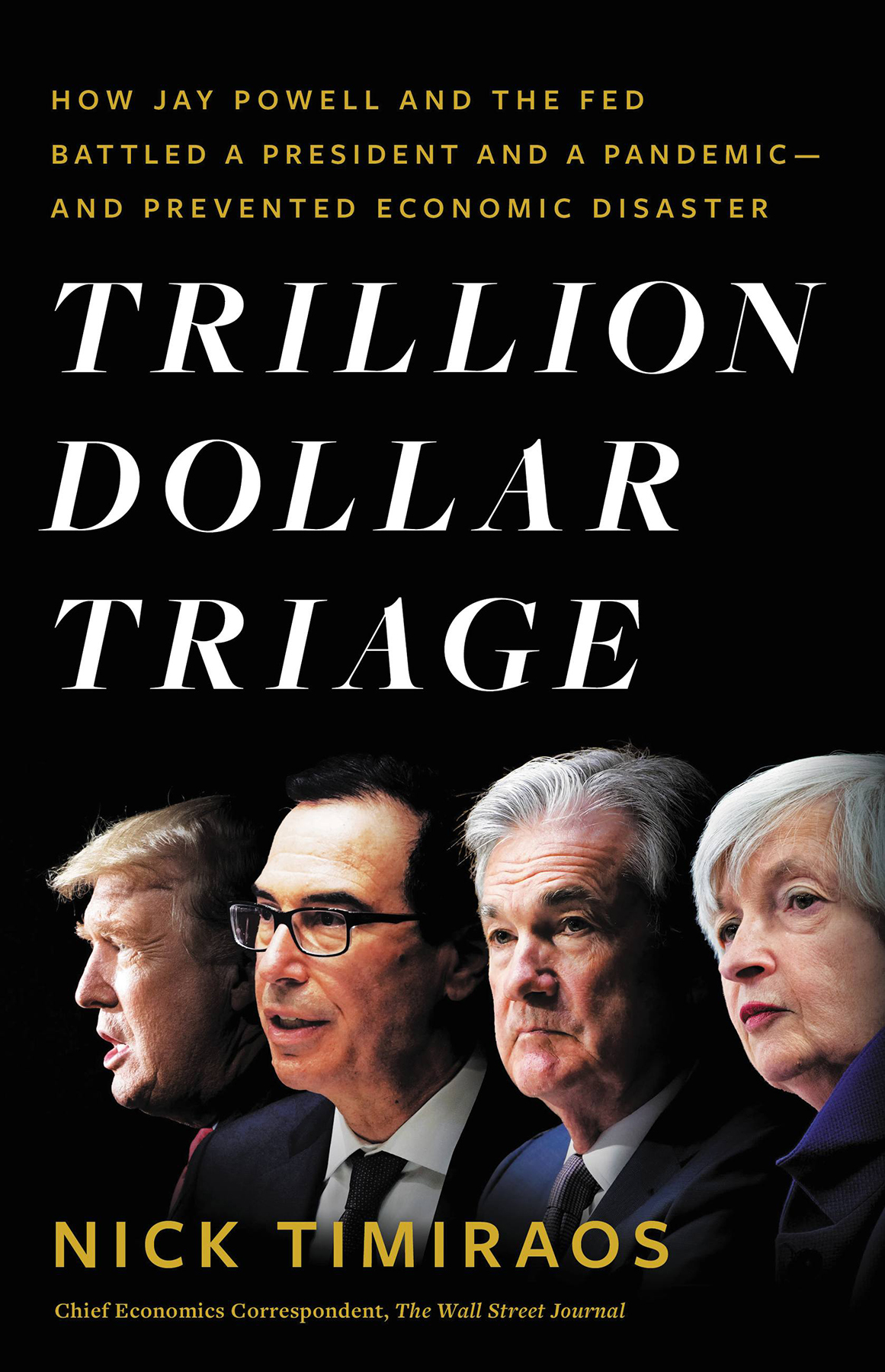
Trillion Dollar Triage: How Jay Powell and the Fed Battled a President and a Pandemic—and Prevented Economic Disaster
About this book
The American economy entered 2020 with low unemployment and rising markets. Within weeks, the pandemic froze ordinary commerce and strained the markets that finance companies, municipalities, and the federal government itself.
Nick Timiraos follows Federal Reserve chair Jay Powell and the officials who built emergency programs at extraordinary speed. Their decisions stabilized credit and supported recovery, but also expanded the central bank's reach and reopened arguments about inequality, inflation, and moral hazard.
Trillion Dollar Triage is a contemporary history of economic crisis management. It places conference calls and policy design beside the political conflict surrounding an institution expected to act decisively while remaining formally independent.
Read a sample
5,043 words
Plain text
From the opening
INTRODUCTION
Over the weekend of February 22, 2020, Saudi Crown Prince Mohammed bin Salman hosted the finance ministers and central-bank governors from the Group of Twenty nations, a forum for the leaders of the world’s largest economies. The prince was eager to use the event in Riyadh to showcase his country’s modernization, although the progress was relative; one of his most radical steps was allowing women to drive.
The summit featured icons of Saudi culture—which explains how Federal Reserve Chair Jerome Powell and Treasury Secretary Steven Mnuchin each ended up donning a leather glove and posing with a gray feathered falcon, Saudi Arabia’s national bird. The most powerful players in the global economy also held up their iPhones to video a white camel parading through a palace courtyard. The animal, named Most Beautiful Camel at the annual King Abdulaziz Camel Festival, had won hundreds of thousands of dollars based on criteria such as hair color and lip plumpness. Powell’s colleague at the Fed, governor Randal Quarles, and François Villeroy de Galhau, governor of the Banque de France, snapped a photo together in front of the mammal.
The trim, silver-haired Powell, who had spent his career at top-flight law firms, investment companies, and as a White House appointee, moved comfortably in these rarefied settings. He had survived a tumultuous first two years at the top of the Fed, earning the respect of Democrats and Republicans for his levelheaded leadership in the face of constant attacks from President Donald Trump. By most metrics, the US economy he was responsible for monitoring was in very good shape after the central bank had shifted from raising rates in 2018 to cutting them in 2019, a humbling U-turn. But the conference’s luxuries and cultural trappings offered just a temporary distraction from unsettling news about a virus that had recently emerged in the Hubei province of China.
That weekend, the novel coronavirus had gone viral, with outbreaks now multiplying in Iran, South Korea, and Italy. In Riyadh, there was little opportunity for Powell or other global economic leaders to officially discuss global responses to the virus—the summit had been planned down to the minute many weeks earlier. Talk on the sidelines of the conference, however, quickly turned to how northern Italy was sealing off eleven towns inside a quarantined zona rossa, or red zone, enforced by military police. Major events such as the Venice Carnival were being canceled. Guests didn’t know what to think—it all sounded like something out of The Andromeda Strain, the 1969 Michael Crichton techno-thriller about a deadly rogue pathogen from outer space. Would it be a worse repeat of the 2003 SARS outbreak, which killed hundreds, primarily in East Asia? Or something more serious? Over 2,300 people had already died, almost all of them in China.
Powell—who was not trained as an economist—had spent hours poring over economic papers and textbooks when he first joined the central bank in 2012 so he could take part in monetary debates. In recent weeks, he had added the latest epidemiological research to his evening reading diet. There were still more questions than answers—the virus appeared to be less lethal than Ebola or SARS, but it was extremely contagious.
In Riyadh that weekend, Powell walked away from a private meeting with Lee Ju-yeol, the head of South Korea’s central bank, struck by Lee’s firsthand report over the stringent public-health measures already being deployed in South Korea to prevent outbreaks. Not good, thought Powell. Until then, Powell shared the consensus view that the virus might sap Chinese demand and roil supply chains for a couple of quarters, denting growth in Asia, but it would not be memorable for the United States. The previous week, for example, Apple had announced it would miss its quarterly sales goal because of chaos caused by the coronavirus in China. Unfazed investors sent the tech-heavy Nasdaq stock index to a record high the following day.
When it was his turn to address the international delegations, Powell slapped a huge disclaimer on his cautiously positive outlook. “I hold these views with very, very low confidence,” he said, “and I’m really wondering whether they’re right at this point.” His private remarks would have been especially notable if they became public because the Fed leader’s words can cause huge, nearly instantaneous drops in investor confidence and stock markets.
Officials from Hong Kong and Singapore—areas that had been heavily affected by similar earlier viruses—skipped straight past standard monetary-policy measures and discussed extensive, much more radical, fiscal measures, such as income-replacement programs, that were being rolled out to defend against the virus’s disruptions. It was a wake-up call for Western financial officials.
On his last day in Riyadh, Powell began to think it was only a matter of time before virus clusters would multiply through US cities. He called his colleagues at the Fed. “What capabilities are available to the Treasury to do anything specific about this?” he asked. “And by the way, what authorities do we actually have?”
During the previous year’s trade war, Trump had come up with a farmer-bailout program that ultimately directed nearly $25 billion to offset losses in exports. Was there a similar way for the Treasury Department to quickly make government payments available if American cities had to start shutting down commerce to stop the spread of the virus?
During a television interview from Riyadh on Sunday, February 23, Mnuchin, a former partner at Goldman Sachs with jet-black hair and black-framed eyeglasses, said there was “no question” that the US government had a backup plan to deal with a contagious virus, but he also said it was too soon to say what that would entail. “In another three or four weeks, we’ll have much better data,” he said. “I don’t think people should be at the point where they’re panicked. On the other hand, it is concerning.”1
Continue reading the sampleClose the sample
On Monday, February 24, Powell climbed on a jet for the flight back to Washington, DC. In 2018, he’d been asked at a forum if he slept well at night. “No one wants a central banker who sleeps well,” he joked. “What good is that?” But there wasn’t much he could do for the moment. He switched off his phone and settled in for the fourteen-hour flight.
When the plane touched down at Dulles International Airport outside Washington, Powell switched on his phone. The news was all bad. Italy and South Korea had announced more deaths. Additional countries were imposing travel restrictions. The Dow Jones Industrial Average had tanked, falling 1,000 points. The Centers for Disease Control wasn’t calling it a pandemic yet, but the markets were treating it like one.
There are two sides to Powell’s job. One could fairly be described as boring—regulating banks and the supply of credit to keep the economy growing steadily. These decisions on dry monetary policy, however, can have tremendous influence over people’s lives. Setting the price of money influences the prices Americans pay on their credit-card balances, their car loans, their mortgages. Changes in the prices of stocks and bonds can influence how much large and small companies are willing to hire, invest, and save.
The other side of his job is harder to quantify: maintaining confidence in the financial system. In a few hours on that Monday, investors had erased the Dow’s gains for the year to date. The Fed’s job, of course, isn’t to respond to normal ups and downs in markets. But when investors and corporate finance chiefs are forced to make very sudden changes in their investment plans, the risk of a market crack-up or panic soars. In late February, those risks accelerated. The Federal Reserve had been created 107 years earlier to prevent a rerun of debilitating banking panics by serving as a lender of last resort—a role that it had embraced during the Great Recession of 2008.
Even with interest rates at historically low levels, that episode illustrated how Powell had plenty of tools at his disposal. He led an institution with almost magical powers—lending money that it creates out of thin air. American presidents can order troops to war and a midnight air strike, but they can’t spend $1 trillion unilaterally. The Fed can.
At the same time, politics, monetary theory, and decades of Fed history meant that Powell’s job wasn’t as simple as pointing a money hose at a problem. The central bank can help boost demand when the economy slumps; there was no precedent for what policymakers would soon face—the equivalent of an economy placed into a medically induced coma. And rash action risked panicking the markets further. As he disembarked from the plane, Powell already knew one thing: doing nothing was not an option.
The next day, Dr. Nancy Messonnier, director of the CDC’s National Center for Immunization and Respiratory Diseases, offered an austere assessment of the public-health situation. “It’s not so much of a question of if this will happen anymore, but rather more of a question of exactly when this will happen and how many people in this country will have severe illness,” she said at a press briefing.2
Messonnier described how she had told her children that morning about the potential for severe disruptions to everyday life, including school closures and telework, and she calmly advised Americans to begin preparing for similar “significant disruption of our lives.” Unnerved by the candor, the Dow dropped another 879 points on Tuesday.
The White House continued to deny that the virus would have much impact. That same Tuesday, February 25, after two straight days of a plunging Dow average, Larry Kudlow, Trump’s director of the National Economic Council, appeared on CNBC. Fed governor Lael Brainard, at a conference in Amsterdam, caught part of the interview. Kudlow had just walked out of a meeting with senior health advisers and thought he was simply reiterating the points they had covered. “We have contained this,” Kudlow said from the briefing room. “We have contained this—I won’t say airtight, but pretty close to airtight… I don’t think it’s going to be an economic tragedy at all.”3
Brainard couldn’t believe what she was hearing. Oh my God, she thought. These guys think this is all about the stock market. They just don’t get it.
The next morning, President Trump fired off a tweet blaming cable news for overhyping the “Caronavirus” and panicking markets. Then he called Powell to tell him how big a loser he was. The dollar had strengthened over the prior week—as it usually does when investors get nervous about financial volatility. The strong dollar was killing the United States, Trump said.
The president envied negative interest rates in Germany and incorrectly believed that if the US had negative rates, he could call due existing Treasury debt, like the mortgage on a hotel, and replace it with new, negative-yield debt. After decades in real estate and three years as president, Trump still didn’t understand the difference between public and private debt. Trump told Powell the Germans were laughing their heads off at the Fed chief. “They think it’s so funny that you don’t understand any of this, how they’re picking our pockets because of you, and they tell me this personally,” Trump said to the man he had put in charge of the central bank two years earlier.
On this and other occasional calls, Trump would also refer to the CEO of Caterpillar, the giant maker of construction equipment and engines, who, the president alleged, had said the Fed was the reason the economy was not growing faster. After Trump first brought up the company, Powell read Caterpillar’s earnings reports and found no such mention of the Fed or a strong dollar. But with Trump, reality didn’t matter.
Powell summoned the discipline that had served him well over the past year of similar outbursts. The only promise I can make you, Powell would offer politely, is to do my absolute best for the people that we both serve. He pledged that the Fed was devoting lots of thought and analysis to what was happening, and that it would use whatever tools would be needed. Trump’s public threats and needling would soon be the least of Powell’s worries.
At 10 a.m. Wednesday morning, Powell and a dozen Fed officials convened their first Covid-19 crisis-planning meeting in a wood-paneled conference room on the fourth floor of the Marriner S. Eccles Federal Reserve Board Building overlooking the National Mall. The Fed had already put in place certain safeguards, such as quarantining paper money returning from Asia just in case it might spread the virus. The discussion turned to what might happen to the US economy if and when the virus arrived.
At the time, the Fed was preparing for a one-quarter slowdown. Officials could see anecdotal reports that foot traffic at shopping malls was declining. It seemed likely that air travel and hotel bookings would soon follow. But they believed the economy—then in the middle of the longest continuous expansion since the Civil War—could still avoid a recession. It was a classic case of the human tendency to absorb big news slowly. What’s more, none of the experts around the table had any historical context for what happens when a $20 trillion economy shuts down, either voluntarily or by government decree.
Powell, who sat at the head of the conference room, had encouraged his board members to ignore received wisdom and economic orthodoxies. He turned to Vice Chair Richard Clarida and pressed him for his worst-case scenario. “Don’t tell me what’s plausible,” said Powell. “What’s the real worst case?”
“Well, Jay, if we become Italy, and we shut down the entire economy, then this will be a bigger hit than the Great Depression,” Clarida said.
The names of Fed chairs are often well known—Paul Volcker, Alan Greenspan, Ben Bernanke, Janet Yellen—but the central bank’s leaders operate mostly in the background, giving bland speeches in drab hotel ballrooms to chambers of commerce and economics clubs, away from the harsh political glare bathing other institutions such as Congress and the Supreme Court.
There are certain moments, however, when the Fed sheds those reservations and becomes what is tantamount to a fourth branch of government. In crisis, the Fed chair’s words are more closely watched by global money managers and CEOs than anyone else’s in the world, including those of the US president. On the precipice of catastrophic financial meltdowns, the normally staid and predictable Fed can move faster and more powerfully than any other arm of the government.
The Pandemic Crisis would be one of those moments.
3
Chapter One
HAWKS, DOVES, AND JAYBIRD
Jerome “Jay” Powell grew up the second of six children in Chevy Chase, Maryland, a Washington DC suburb with picturesque Cape Cod–style homes that sits about seven miles from the Fed headquarters.
His upper-middle-class family were among the first Catholics to join the prestigious Chevy Chase Club, where his father, also named Jerome, would serve as president. The elder Powell saw combat as an Army infantryman in Europe during World War II before a career as an accomplished lawyer who represented companies in labor disputes. Powell learned from his father how to measure his words carefully. Patricia Hayden, Powell’s mother, graduated valedictorian from Trinity College in Washington before going to work as a statistician for the Army Map Service. After marrying the elder Powell, she volunteered widely and worked part-time for the Republican National Committee.
Powell, whose family called him “Jaybird,” followed his father to Georgetown Prep, a strict all-male Jesuit high school in nearby Bethesda. Students wore jackets and ties, attended Mass every day, and were assigned to detention called JUG, short for Justice Under God, for minor violations—such as arriving late to class. Georgetown Prep graduated future diplomats, congressmen, senators—and the first two justices Donald Trump would seat on the Supreme Court, Neil Gorsuch and Brett Kavanaugh. Powell was popular, played center for Prep’s “Little Hoyas” football team, and was a good student. His classmate Francis Rooney, later a two-term Republican congressman from Florida, recalls Powell as “killer smart.”
Despite a first-rate education—he graduated from Princeton University, where he majored in government, in 1975—Powell considered himself a bit of a late bloomer. That summer, he traveled through Europe with his guitar, entertaining a crowd at a Paris café with “I’m So Lonesome I Could Cry” and other Hank Williams ballads. Back in Washington, he took a job working for a friend’s father at an office-supply company, then became an assistant to a senator on Capitol Hill. After watching former classmates take high-paying and prestigious jobs, he rediscovered his drive at Georgetown University’s law school.
After graduating from Georgetown, Powell went on to a clerkship and a few years at prestigious Manhattan law firms before switching to investment banking in 1983, joining Dillon, Read & Company, led by a low-key but well-connected New England blueblood named Nicholas Brady.
Two years later, in 1985, Powell married Elissa Leonard, a Harvard-educated producer and writer of science television shows who was friends with Powell’s younger sister. Leonard kept her last name and would eventually put her career on hold after their first two of three children were born.
At Dillon Read, Powell snagged a meeting with Brady and introduced himself as a Washington native who was interested in public service and ready to make himself helpful however he could. His colleagues at Dillon Read rolled their eyes: Time spent in Washington was time wasted; it didn’t generate new banking business. Powell didn’t care, and his connection to Brady paid off.
A few months later, Dillon Read found itself defending the petroleum exporter Unocal Corporation in a takeover bid from T. Boone Pickens, the corporate raider. Brady called Powell down to Washington to accompany him on meetings with top officials at the Treasury, White House, and Congress.
President Ronald Reagan tapped Brady to chair a task force that reviewed the Black Monday stock market crash of 1987, then named him Treasury secretary a few months before Brady’s friend, George H. W. Bush, became president. It seemed like a plum opportunity for Powell, but to his disappointment, Brady had agreed not to bring anyone from his firm down to DC.
Two years later, a partner at Dillon Read leaned into Powell’s office to tell him Brady was looking for a new assistant secretary:
“Nick wants someone who’s like a carbon copy of Jay Powell.”
Powell offered a few names before adding, “But why settle for a cheap imitation?”
He got the job. A few months later, Powell called up his old Wall Street law firm, Davis Polk & Wardwell, and said he needed a hardworking assistant. They recommended a thirty-three-year-old, Ivy League–educated lawyer, Randal Quarles. Powell hired him, launching the public-policy career of another future Fed colleague.
Financial crisis 101
1990 wasn’t the easiest year to start work at the Treasury. Over the previous few years, the country had been rocked by financial collapses and corruption. A rolling savings-and-loans crisis had resulted in the collapse of over 1,000 banks and depositories and still wasn’t fully contained. The bank-deposit insurance fund—which guarantees that bank customers will be able to withdraw their money even in a crisis—was depleted. The economy entered a recession.
It was, however, the perfect time to learn firsthand how to deal with unpredictable crises. In early 1991, Powell found himself at the center of a disaster involving the Bank of New England, a large regional bank on the brink of failure as a result of the recent collapse of the commercial and residential real-estate markets. Powell and other regulators wrestled with the potential consequences of a bailout. The immediate stakes were not catastrophic—the Bank of New England was only the 33rd largest bank in the country—but the basic questions were the same as when a Citigroup or Lehman Brothers was courting insolvency. A fraction of the $19 billion in deposits at the bank and two of its sisters were in accounts that exceeded the amounts guaranteed by the Federal Deposit Insurance Corporation. Should the government let market forces wash away poorly managed institutions? Or did it have a responsibility to prevent shocks to the bigger economy?
Robert Glauber, a Harvard academic whom Powell reported to, came down firmly on one side: he hated bailouts. Powell huddled with Fed governor John LaWare at a Treasury Department conference room where Glauber pounded the table and insisted the depositors take a haircut and pay for the sins of the bank. If we always run to the rescue, he said, it creates a “moral hazard”—a term the insurance industry uses to refer to people who take risks knowing they’re protected against larger losses.
After Glauber got off his soapbox, LaWare calmly laid out the Fed’s line: “You’re the government, and you can do whatever you want, but here’s what we think will happen if we haircut uninsured depositors. There will be a run on every American bank when they open Monday, and all these money-center banks will be at our door. Do you really want to run that test, Bob?”
The fear of a bigger crisis trumped the concern about bailouts.
“We chose the first option, without dissent,” Powell said.1
Upping the ante
A few months later, Powell again wrestled with the problem of what to do with a financial institution on the verge of insolvency—this time, with greater stakes. Salomon Brothers had dominated 1980s Wall Street, both financially—the investment bank was consistently one of the most profitable firms—and culturally. It was the fictional backdrop for The Bonfire of the Vanities, Tom Wolfe’s 1987 satire of an ambitious bond salesman, as well as the actual setting for Michael Lewis’s 1989 Liar’s Poker, a searing critique of testosterone-driven trading culture. But by 1991, as the Wall Street party was quickly turning into a hangover, the all-powerful Salomon Brothers had hit a wall.
The trouble for the bond-trading giant began in late May, when federal regulators started investigating how Salomon and a few of its customers had ended up controlling 94 percent of the market for two-year Treasury notes. By cornering the market, Salomon could force dealers who had been shut out of the auction—together with arbitrageurs who had bet prices would fall and had sold such securities “short”—to buy the notes back from Salomon at higher prices.
Salomon was one of an elite group of thirty-nine “primary dealers” authorized to trade directly with the New York Fed, which transacts in markets on behalf of the US Treasury. Primary dealers buy Treasury securities directly from the government and resell them to other investors. The total purchases of any one buyer are limited, but Salomon had gotten around that rule by buying securities in its clients’ names—without their knowledge—and then using the combined purchases from multiple clients to corner the market.
As the regulators kept digging around, Salomon executives hoped to put the scandal behind them when they disclosed how a senior trader had flouted government rules and rigged the bidding. The revelations sent ripples through the $2.2 trillion market for Treasury securities. Had other dealers joined Salomon in manipulating pricing? Why had Salomon executives not come clean earlier? Was the US government paying more to finance the federal debt as a result of the rigging? And why hadn’t regulators noticed sooner?
In the messy aftermath, the New York Fed forced out Salomon’s legendary CEO and chairman, John Gutfreund.2 The government was also contemplating a harsher penalty: suspending the firm’s privileged status as a primary dealer in Treasury securities. Even though government bond trading didn’t account for much of the firm’s total revenues, the move could still be tantamount to a death sentence for the firm in the eyes of its creditors. Salomon depended heavily on short-term borrowing to finance its trading operations. If the Fed cut off Salomon, its lenders could refuse to extend new loans, forcing a fire sale of its assets that would almost surely dissolve the storied firm into bankruptcy.
Revered investor Warren Buffett, the firm’s biggest shareholder, had agreed to help clean up the mess and soothe markets by stepping in to serve as chairman. But he threatened to back out if the Treasury decided not to allow Salomon to keep its privileged relationship with the Fed. A game of high-stakes brinksmanship ensued.
On Sunday, August 18, 1991, Powell found himself in the middle of a series of urgent calls among some of the most powerful people in finance—Brady, Greenspan, New York Fed president Gerald Corrigan, and Buffett—about the fate of one of the most powerful firms on Wall Street.
The clock was ticking. Salomon’s board was set to meet that afternoon to elect Buffett—known as the “Oracle of Omaha”—as chairman. The board had already called a 2:30 p.m. press conference to make the announcement. But Buffett balked when, that same morning, Treasury announced that it would follow through with the sanctions that would revoke Salomon’s status as a primary dealer.
Buffett wanted to shore up confidence in the existing firm, not mop up a total mess. “I am not going to spend the rest of my life shepherding the greatest financial disaster in history,” he said.3
Corrigan thought Buffett was bluffing. He figured there was no way Salomon’s biggest shareholder would flush his stock down the drain. He also thought Buffett was exaggerating the consequences of revoking Salomon’s status.
Buffett countered with an ugly picture of handing off a bankrupt Salomon: “We were going to find a judge someplace in Manhattan, walk in on him while he’s watching baseball probably and eating popcorn at two in the afternoon, and tell him, we’re handing you the keys, you’re running the place now. By the way, what do you know about Japanese law, because we owe ten or twelve billion dollars in Japan?”4
Powell himself had doubts about taking a hard line on Salomon. He knew Treasury had no plan for handling the failure of a firm that big. And what if Buffett was right? If Salomon’s board met and then didn’t announce a new chairman, would traders in Tokyo set off a chain reaction when trading opened that evening by refusing to roll over the bank’s loans?
Buffett made a final emotional appeal to Brady that Sunday.
“Well, I don’t think you’re right, but I believe that you believe that you are right,” Brady said. Buffett would later call it “among the most important sentences I’ve ever heard.”5
Brady, Powell, and the other regulators agreed among themselves to a compromise: if Buffett would stay, they would partially reverse the penalties. Salomon could bid in Treasury auctions for its own accounts, but not for other customers.
Powell was nominated to deal directly with Buffett, but Corrigan wanted him to update the rest of the team before agreeing to any final deal. Brady shot Corrigan down. He was the type of boss who, once he trusted someone, would throw them into the deepest part of the ocean.
“I trust him. Just go do it, Jay,” Brady said.
So Powell called Buffett and explained the new offer. “Will that do?” Powell asked.
“I think it will,” Buffett said.6
Powell was finally able to exhale. “The firm’s failure,” he said years later, “would almost certainly have caused massive disruption in the markets.”7
After persuading Buffett to stay on, Powell had another, more-public role in the Salomon mess: a Senate hearing. Lawmakers want to appear firm when dealing publicly with the bosses of big financial institutions—it showcases their independence from moneyed elites.
Wednesday, September 4, 1991 was Salomon Brothers’ turn in the hot seat. In this case, though, it was a chair behind a large wooden table in a cavernous hearing room on Capitol Hill. Dark red curtains covered the floor-to-ceiling windows. And the first person to occupy the seat had been an executive at Salomon for less than a month.
Cameramen crowded around Buffett in the standing-room-only hearing chamber. He used his homespun Nebraska charm to placate angry lawmakers, beginning with this apology that vowed changes in the bank’s culture: “Lose money for the firm, and I will be understanding; lose a shred of reputation for the firm, and I will be ruthless.”
Later, lawmakers hauled up the Treasury regulators to find out what had gone wrong on their end. Had the government been asleep at the wheel?
The thirty-eight-year-old Powell, with a shock of silver in the middle of his dark hair, had been at Treasury for only about a year, but he wielded a notable ability to dial down the pressure in a room. He assured lawmakers the government would treat the scandal that was roiling the market for US debt with the utmost seriousness.
The Treasury market “is the bedrock of the world financial system,” said Powell.
When a skeptical congressman from Kansas asked him why Treasury hadn’t detected Salomon’s false bids earlier, Powell raised his eyebrows and lifted his hand.
“The fact is, we did catch it, and that’s why we’re sitting here,” said Powell.
Another representative from Ohio piled on: Hadn’t the Treasury simply gotten lucky because Salomon’s behavior grew so sloppy?
“They fumbled the ball,” the congressman said. “You recovered the fumble.”
Powell held his ground. “But why did they fumble? They were hit. They didn’t just fumble in open field.”
His retort drew laughs from the chamber, and even Powell’s interlocutor cocked his head and grinned.8
Brady had given Powell a chance to cut his teeth in public service, and Powell seized it. When Glauber returned to Harvard in 1992, Brady promoted Powell to be the undersecretary for domestic finance.
Finding fortune
After Bush left office in 1993, Powell returned to the private sector, primarily in mergers and acquisitions. Over the next decade and a half he made a ton of money, although he didn’t always jibe with the culture on Wall Street. Not long after he joined Bankers Trust, traders of novel securities called derivatives were caught on tape bragging about how they had screwed over the bank’s unsophisticated customers. Lawsuits followed. Powell wanted no part of it and left.