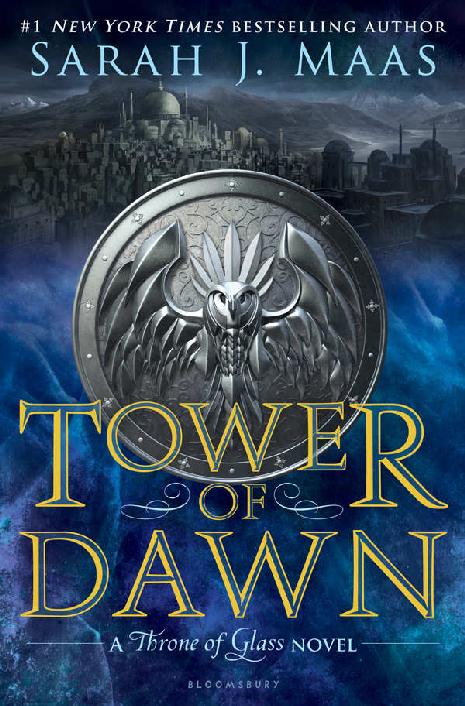
Tower of Dawn
About this book
Chaol Westfall reaches Antica in a chair, carrying injuries from the fall of the glass castle and guilt that no political mission can conceal. He and Nesryn need the khagan's armies for the war in the north, but the royal family has little reason to enter a distant conflict.
Yrene Towers, a gifted healer at the Torre Cesme, is asked to treat him. Healing requires more than repairing bone and nerve, and neither Yrene nor Chaol can keep their histories outside the room. Their difficult work becomes the novel's emotional center.
Meanwhile, Nesryn and Prince Sartaq follow reports of missing people into the mountains and the territory of the great ruks. What they discover links the Southern Continent to the same ancient enemy threatening Erilea.
Tower of Dawn takes place during the events of Empire of Storms and is the sixth Throne of Glass novel. Its new setting is not a detour: diplomacy, medicine, family politics, and a crucial discovery all feed directly into the final war.
Read a sample
5,019 words
Plain text
From the opening
CHAPTER
1
Chaol Westfall, former Captain of the Royal Guard and now Hand to the newly crowned King of Adarlan, had discovered that he hated one sound above all others.
Wheels.
Specifically, their clattering along the planks of the ship on which he’d spent the past three weeks sailing through storm-tossed waters. And now their rattle and thunk over the shining green marble floors and intricate mosaics throughout the Khagan of the Southern Continent’s shining palace in Antica.
With nothing to do beyond sit in the wheeled chair that he’d deemed had become both his prison and his only path to seeing the world, Chaol took in the details of the sprawling palace perched atop one of the capital city’s countless hills. Every bit of material had been taken from and built in honor of some portion of the khagan’s mighty empire:
Those polished green floors his chair now clattered over were hewn from quarries in the southwest of the continent. The red pillars fashioned like mighty trees, their uppermost branches stretching across the domed ceilings high above—all part of one endless receiving hall—had been hauled in from the northeastern, sand-blasted deserts.
The mosaics that interrupted the green marble had been assembled by craftsmen from Tigana, another of the khagan’s prized cities at the mountainous southern end of the continent. Each portrayed a scene from the khaganate’s rich, brutal, glorious past: the centuries spent as a nomadic horse-people in the grassy steppes of the continent’s eastern lands; the emergence of the first khagan, a warlord who unified the scattered tribes into a conquering force that took the continent piece by piece, wielding cunning and strategic brilliance to forge a sweeping empire; and then depictions of the three centuries since—the various khagans who had expanded the empire, distributing the wealth from a hundred territories across the lands, building countless bridges and roads to connect them all, ruling over the vast continent with precision and clarity.
Perhaps the mosaics provided a vision of what Adarlan might have been, Chaol mused as the murmurings of the gathered court flitted between the carved pillars and gilded domes ahead. That is, if Adarlan hadn’t been ruled by a man controlled by a demon king hell-bent on turning this world into a feast for his hordes.
Chaol twisted his head to peer up at Nesryn, stone-faced behind him as she pushed his chair. Only her dark eyes, darting over every passing face and window and column, revealed any sort of interest in the khagan’s sprawling home.
They’d saved their finest set of clothes for today, and the newly appointed Captain of the Guard was indeed resplendent in her crimson-and-gold uniform. Where Dorian had dug up one of the uniforms Chaol had once worn with such pride, he had no idea.
He’d initially wanted to wear black, simply because color … He’d never felt comfortable with colors, save the red and gold of his kingdom. But black had become the color of Erawan’s Valg-infested guards. They had worn those black-on-black uniforms as they’d terrorized Rifthold. As they’d rounded up, tortured, and then butchered his men.
Then strung them along the palace gates to swing in the wind.
He’d barely been able to look at the Antican guards they’d passed on their way here, both in the streets and in this very palace—standing proud and alert, swords at their backs and knives at their sides. Even now, he resisted the urge to glance to where he knew they’d be stationed in the hall, exactly where he would have positioned his own men. Where he himself would undoubtedly have been standing, monitoring all, while emissaries from a foreign kingdom arrived.
Nesryn met his stare, those ebony eyes cool and unblinking, her shoulder-length black hair swaying with each step. Not a trace of nerves flickered across her lovely, solemn face. No inkling that they were about to meet one of the most powerful men in the world—a man who could alter the fate of their own continent in the war surely now breaking out across Adarlan and Terrasen.
Chaol faced forward without saying a word. The walls and pillars and arched doorways had ears and eyes and mouths, she’d warned him.
It was that thought alone that kept Chaol from fiddling with the clothes he’d finally decided upon: light brown pants, knee-high chestnut-colored boots, a white shirt of finest silk, mostly concealed by a dark teal jacket. The jacket was simple enough, the cost of it only revealed by the fine brass buckles down the front and the glimmer of delicate golden thread skimming the high collar and edges. No sword hung from his leather belt—the absence of that comforting weight like some phantom limb.
Or legs.
Two tasks. He had two tasks while here, and he still was not certain which one would prove the more impossible:
Convincing the khagan and his six would-be heirs to lend their considerable armies to the war against Erawan …
Or finding a healer in the Torre Cesme who could discover some way to get him walking again.
To—he thought with no small ripple of disgust—fix him.
He hated that word. Almost as much as the clattering of the wheels. Fix. Even if that’s what he was beseeching the legendary healers to do for him, the word still grated, made his gut churn.
He shoved the word and the thought from his mind as Nesryn followed the near-silent flock of servants who had led them from the docks, through the winding and dusty cobblestoned streets of Antica, all the way up the sloped avenue to the domes and thirty-six minarets of the palace itself.
Continue reading the sampleClose the sample
Strips of white cloth—from silk to felt to linen—had been hanging from countless windows and lanterns and doorways. Likely because of some official or distant royal relation dying recently, Nesryn had murmured. Death rituals were varied and often a blend from the countless kingdoms and territories now governed by the khaganate, but the white cloth was an ancient holdover from the centuries when the khagan’s people had roamed the steppes and laid their dead to rest under the watchful, open sky.
The city had been hardly gloomy, though, as they traveled through it. People still hurried about in clothes of various makes, vendors still called out their wares, acolytes in temples of wood or stone—every god had a home in Antica, Nesryn supplied—still beckoned to those on the street. All of it, even the palace, watched over by the shining, pale-stoned tower atop one of its southern hills.
The Torre. The tower that housed the finest mortal healers in the world. Chaol had tried not to look too long at it through the carriage windows, even if the massive tower could be seen from nearly every street and angle of Antica. None of the servants had mentioned it, or pointed out the dominant presence that seemed to rival even the khagan’s palace.
No, the servants hadn’t said much at all on the trek here, even regarding the mourning-banners flapping in the dry wind. Each of them remained silent, men and women alike, their dark hair shining and straight, and each wore loose pants and flowing jackets of cobalt and bloodred edged with pale gold. Paid servants—but descendants of the slaves who had once been owned by the khagan’s bloodline. Until the previous khagan, a visionary and firebrand, had outlawed slavery a generation ago as one of her countless improvements to the empire. The khagan had freed her slaves but kept them on as paid servants—along with their children. And now their children’s children.
Not a single one of them appeared underfed or undercompensated, and none had shown even a flicker of fear as they’d escorted Chaol and Nesryn from the ship to the palace. The current khagan, it seemed, treated his servants well. Hopefully his yet-undecided Heir would as well.
Unlike Adarlan or Terrasen, inheritance of the empire was decided by the khagan—not by birth order or gender. Having as many children as possible to provide him or her with a wide pool to choose from made that choice only somewhat easier. And rivalry amongst the royal children … It was practically a blood sport. All designed to prove to their parent who was the strongest, the wisest, the most suited to rule.
The khagan was required by law to have a sealed document locked away in an unmarked, hidden trove—a document that listed his or her Heir, should death sweep upon them before it could be formally announced. It could be altered at any time, but it was designed to avoid the one thing the khaganate had lived in fear of since that first khagan had patched together the kingdoms and territories of this continent: collapse. Not from outside forces, but from war within.
That long-ago first khagan had been wise. Not once during the three hundred years of the khaganate had a civil war occurred.
And as Nesryn pushed him past the graceful bowing of the servants now paused between two enormous pillars, as the lush, ornate throne room spread before them with its dozens of people gathered around the golden dais glittering in the midday sun, Chaol wondered which of the five figures standing before the enthroned man would one day be chosen to rule this empire.
The only sounds came from the rustling clothing of the four dozen people—he counted in the span of a few casual blinks—gathered along either side of that glinting dais, forming a wall of silk and flesh and jewels, a veritable avenue through which Nesryn wheeled him.
Rustling clothing—and the clatter and squeak of the wheels. She’d oiled them this morning, but weeks at sea had worn on the metal. Every scrape and shriek was like nails on stone.
But he kept his head high. Shoulders back.
Nesryn paused a healthy distance from the dais—from the wall of five royal children, all in their prime, male and female, standing between them and their father.
Defense of their emperor: a prince or princess’s first duty. The easiest way to prove their loyalty, to angle for being tapped Heir. And the five before them …
Chaol schooled his face into neutrality as he counted again. Only five. Not the six Nesryn had described.
But he didn’t scan the hall for the missing royal sibling as he bowed at the waist. He’d practiced the movement over and over this final week at sea, as the weather had turned hotter, the air becoming dry and sunbaked. Doing it in the chair still felt unnatural, but Chaol bowed low—until he was staring at his unresponsive legs, at his spotless brown boots and the feet he could not feel, could not move.
From the whisper of clothing to his left, he knew Nesryn had come to his side and was bowing deeply as well.
They held it for the three breaths Nesryn claimed were required.
Chaol used those three breaths to settle himself, to shut out the weight of what was upon them both.
He had once been skilled at maintaining an unfaltering composure. He’d served Dorian’s father for years, had taken orders without so much as blinking. And before that, he’d endured his own father, whose words had been as cutting as his fists. The true and current Lord of Anielle.
The Lord now in front of Chaol’s name was a mockery. A mockery and a lie that Dorian had refused to abandon despite Chaol’s protests.
Lord Chaol Westfall, Hand of the King.
He hated it. More than the sound of wheels. More than the body he now could not feel beneath his hips, the body whose stillness still surprised him, even all these weeks later.
He was Lord of Nothing. Lord of Oath-Breakers. Lord of Liars.
And as Chaol lifted his torso and met the upswept eyes of the white-haired man on that throne, as the khagan’s weathered brown skin crinkled in a small, cunning smile … Chaol wondered if the khagan knew it as well.
CHAPTER
2
There were two parts of her, Nesryn supposed.
The part that was now Captain of Adarlan’s Royal Guard, who had made a vow to her king to see that the man in the wheeled chair beside her was healed—and to muster an army from the man enthroned before her. That part of Nesryn kept her head high, her shoulders back, her hands within a nonthreatening distance of the ornate sword at her hip.
Then there was the other part.
The part that had glimpsed the spires and minarets and domes of the god-city breaking over the horizon as they’d sailed in, the shining pillar of the Torre standing proud over it all, and had to swallow back tears. The part that had scented the smoky paprika and crisp tang of ginger and beckoning sweetness of cumin as soon as she had cleared the docks and knew, deep in her bones, that she was home. That, yes, she lived and served and would die for Adarlan, for the family still there, but this place, where her father had once lived and where even her Adarlan-born mother had felt more at ease … These were her people.
The skin in varying shades of brown and tan. The abundance of that shining black hair—her hair. The eyes that ranged from uptilted to wide and round to slender, in hues of ebony and chestnut and even the rare hazel and green. Her people. A blend of kingdoms and territories, yes, but … Here there were no slurs hissed in the streets. Here there would be no rocks thrown by children. Here her sister’s children would not feel different. Unwanted.
And that part of her … Despite her thrown-back shoulders and raised chin, her knees indeed quaked at who—at what—stood before her.
Nesryn had not dared tell her father where and what she was leaving to do. Only that she was off on an errand of the King of Adarlan and would not be back for some time.
Her father wouldn’t have believed it. Nesryn didn’t quite believe it herself.
The khagan had been a story whispered before their hearth on winter nights, his offspring legends told while kneading endless loaves of bread for their bakery. Their ancestors’ bedside tales to either lull her into sweet sleep or keep her up all night in bone-deep terror.
The khagan was a living myth. As much of a deity as the thirty-six gods who ruled over this city and empire.
There were as many temples to those gods in Antica as there were tributes to the various khagans. More.
They called it the god-city for them—and for the living god seated on the ivory throne atop that golden dais.
It was indeed pure gold, just as her father’s whispered legends claimed.
And the khagan’s six children … Nesryn could name them all without introduction.
After the meticulous research Chaol had done while on their ship, she had no doubt he could as well.
But that was not how this meeting was to go.
For as much as she had taught the former captain about her homeland these weeks, he’d instructed her on court protocol. He had rarely been so directly involved, yes, but he had witnessed enough of it while serving the king.
An observer of the game who was now to be a prime player. With the stakes unbearably high.
They waited in silence for the khagan to speak.
She’d tried not to gawk while walking through the palace. She had never set foot inside it during her few visits to Antica over the years. Neither had her father, or his father, or any of her ancestors. In a city of gods, this was the holiest of temples. And deadliest of labyrinths.
The khagan did not move from his ivory throne.
A newer, wider throne, dating from a hundred years ago—when the seventh khagan had chucked out the old one because his large frame didn’t fit in it. He’d eaten and drunk himself to death, history claimed, but at least had the good sense to name his Heir before he clutched his chest one day and slumped dead … right in that throne.
Urus, the current khagan, was no more than sixty, and seemed in far better condition. Though his dark hair had long since gone as white as his carved throne, though scars peppered his wrinkled skin as a reminder to all that he had fought for this throne in the final days of his mother’s life … His onyx eyes, slender and uptilted, were bright as stars. Aware and all-seeing.
Atop his snowy head sat no crown. For gods among mortals did not need markers of their divine rule.
Behind him, strips of white silk tied to the open windows fluttered in the hot breeze. Sending the thoughts of the khagan and his family to where the soul of the deceased—whoever they might be, someone important, no doubt—had now rejoined the Eternal Blue Sky and Slumbering Earth that the khagan and all his ancestors still honored in lieu of the pantheon of thirty-six gods their citizens remained free to worship.
Or any other gods outside of it, should their territories be new enough to not yet have had their gods incorporated into the fold. There had to be several of those, since during his three decades of rule, the man seated before them had added a handful of overseas kingdoms to their borders.
A kingdom for every ring adorning his scar-flecked fingers, precious stones glinting among them.
A warrior bedecked in finery. Those hands slid from the arms of his ivory throne—assembled from the hewn tusks of the mighty beasts that roamed the central grasslands—and settled in his lap, hidden beneath swaths of gold-trimmed blue silk. Indigo dye from the steamy, lush lands in the west. From Balruhn, where Nesryn’s own people had originally hailed, before curiosity and ambition drove her great-grandfather to drag his family over mountains and grasslands and deserts to the god-city in the arid north.
The Faliqs had long been tradesmen, and not of anything particularly fine. Just simple, good cloth and household spices. Her uncle still traded such things and, through various lucrative investments, had become a moderately wealthy man, his family now dwelling in a beautiful home within this very city. A definitive step up from a baker—the path her father had chosen upon leaving these shores.
“It is not every day that a new king sends someone so important to our shores,” the khagan said at last, using their own tongue and not Halha, the language of the southern continent. “I suppose we should deem it an honor.”
His accent was so like her father’s—but the tone lacked the warmth, the humor. A man who had been obeyed his entire life, and fought to earn his crown. And executed two of the siblings who proved to be sore losers. The surviving three … one had gone into exile, and the other two had sworn fealty to their brother. By having the healers of the Torre render them infertile.
Chaol inclined his head. “The honor is mine, Great Khagan.”
Not Majesty—that was for kings or queens. There was no term high or grand enough for this man before them. Only the title that the first of his ancestors had borne: Great Khagan.
“Yours,” the khagan mused, those dark eyes now sliding to Nesryn. “And what of your companion?”
Nesryn fought the urge to bow again. Dorian Havilliard was the opposite of this man, she realized. Aelin Galathynius, however … Nesryn wondered if the young queen might have more in common with the khagan than she did with the Havilliard king. Or would, if Aelin survived long enough. If she reached her throne.
Nesryn shoved those thoughts down as Chaol peered at her, his shoulders tightening. Not at the words, not at the company, but simply because she knew that the mere act of having to look up, facing this mighty warrior-king in that chair … Today would be a hard one for him.
Nesryn inclined her head slightly. “I am Nesryn Faliq, Captain of the Royal Guard of Adarlan. As Lord Westfall once was before King Dorian appointed him as his Hand earlier this summer.” She was grateful that years spent living in Rifthold had taught her not to smile, not to cringe or show fear—grateful that she’d learned to keep her voice cool and steady even while her knees quaked.
Nesryn continued, “My family hails from here, Great Khagan. Antica still owns a piece of my soul.” She placed a hand over her heart, the fine threads of her gold-and-crimson uniform, the colors of the empire that had made her family often feel hunted and unwanted, scraping against her calluses. “The honor of being in your palace is the greatest of my life.”
It was, perhaps, true.
If she found time to visit her family in the quiet, garden-filled Runni Quarter—home mostly to merchants and tradesmen like her uncle—they would certainly consider it so.
The khagan only smiled a bit. “Then allow me to welcome you to your true home, Captain.”
Nesryn felt, more than saw, Chaol’s flicker of annoyance. She wasn’t entirely certain what had triggered it: the claim on her homeland, or the official title that had now passed to her.
But Nesryn bowed her head again in thanks.
The khagan said to Chaol, “I will assume you are here to woo me into joining this war of yours.”
Chaol countered a shade tersely, “We’re here at the behest of my king.” A note of pride at that word. “To begin what we hope will be a new era of prosperous trade and peace.”
One of the khagan’s offspring—a young woman with hair like flowing night and eyes like dark fire—exchanged a wry look with the sibling to her left, a man perhaps three years her elder.
Hasar and Sartaq, then. Third and secondborn, respectively. Each wore similar loose pants and embroidered tunics, with fine leather boots rising to their knees. Hasar was no beauty, but those eyes … The flame dancing in them as she glanced to her elder brother made up for it.
And Sartaq—commander of his father’s ruk riders. The rukhin.
The northern aerial cavalry of his people had long dwelled in the towering Tavan Mountains with their ruks: enormous birds, eagle-like in shape, large enough to carry off cattle and horses. Without the sheer bulk and destructive weight of the Ironteeth witches’ wyverns, but swift and nimble and clever as foxes. The perfect mounts for the legendary archers who flew them into battle.
Sartaq’s face was solemn, his broad shoulders thrown back. A man perhaps as ill at ease in his fine clothes as Chaol. She wondered if his ruk, Kadara, was perched on one of the palace’s thirty-six minarets, eyeing the cowering servants and guards, waiting impatiently for her master’s return.
That Sartaq was here … They had to have known, then. Well in advance. That she and Chaol were coming.
The knowing glance that passed between Sartaq and Hasar told Nesryn enough: they, at least, had discussed the possibilities of this visit.
Sartaq’s gaze slid from his sister to Nesryn.
She yielded a blink. His brown skin was darker than the others’—perhaps from all that time in the skies and sunlight—his eyes a solid ebony. Depthless and unreadable. His black hair remained unbound save for a small braid that curved over the arch of his ear. The rest of his hair fell to just past his muscled chest, and swayed slightly as he gave what Nesryn could have sworn was a mocking incline of his head.
A ragtag, humbled pair, Adarlan had sent. The injured former captain, and the common-bred current one. Perhaps the khagan’s initial words about honor had been a veiled mention of what he perceived as an insult.
Nesryn dragged her attention away from the prince, even as she felt Sartaq’s keen stare lingering like some phantom touch.
“We arrive bearing gifts from His Majesty, the King of Adarlan,” Chaol was saying, and twisted in his chair to motion the servants behind them to come forward.
Queen Georgina and her court had practically raided the royal coffers before they’d fled to their mountain estates this spring. And the former king had smuggled out much of what was left during those final few months. But before they’d sailed here, Dorian had ventured into the many vaults beneath the castle. Nesryn still could hear his echoed curse, filthier than she’d ever heard him speak, as he found little more than gold marks within.
Aelin, as usual, had a plan.
Nesryn had been standing beside her new king when Aelin had flipped open two trunks in her chambers. Jewelry fit for a queen—for a Queen of Assassins—had sparkled within.
I’ve enough funds for now, Aelin had only said to Dorian when he began to object. Give the khagan some of Adarlan’s finest.
In the weeks since, Nesryn had wondered if Aelin had been glad to be rid of what she’d purchased with her blood money. The jewels of Adarlan, it seemed, would not travel to Terrasen.
And now, as the servants laid out the four smaller trunks—divided from the original two to make it seem like more, Aelin had suggested—as they flipped open the lids, the still-silent court pressed in to see.
A murmur went through them at the glistening gems and gold and silver.
“A gift,” Chaol declared as even the khagan himself leaned forward to examine the trove. “From King Dorian Havilliard of Adarlan, and Aelin Galathynius, Queen of Terrasen.”
Princess Hasar’s eyes snapped to Chaol at the second name.
Prince Sartaq only glanced back at his father. The eldest son, Arghun, frowned at the jewels.
Arghun—the politician amongst them, beloved by the merchants and power brokers of the continent. Slender and tall, he was a scholar who traded not in coin and finery but in knowledge.
Prince of Spies, they called Arghun. While his two brothers had become the finest of warriors, Arghun had honed his mind, and now oversaw his father’s thirty-six viziers. So that frown at the treasure …
Necklaces of diamond and ruby. Bracelets of gold and emerald. Earrings—veritable small chandeliers—of sapphire and amethyst. Exquisitely wrought rings, some crowned with jewels as large as a swallow’s egg. Combs and pins and brooches. Blood-gained, blood-bought.
The youngest of the assembled royal children, a fine-boned, comely woman, leaned the closest. Duva. A thick silver ring with a sapphire of near-obscene size adorned her slender hand, pressed delicately against the considerable swell of her belly.
Perhaps six months along, though the flowing clothes—she favored purple and rose—and her slight build could distort that. Certainly her first child, the result of her arranged marriage to a prince hailing from an overseas territory to the far east, a southern neighbor of Doranelle that had noted the rumblings of its Fae Queen and wanted to secure the protection of the southern empire across the ocean. Perhaps the first attempt, Nesryn and others had wondered, of the khaganate greatly expanding its own considerable continent.
Nesryn didn’t let herself look too long at the life growing beneath that bejeweled hand.
For if one of Duva’s siblings were crowned khagan, the first task of the new ruler—after his or her sufficient offspring were produced—would be to eliminate any other challenges to the throne. Starting with the offspring of his or her siblings, if they challenged their right to rule.
She wondered how Duva was able to endure it. If she had come to love the babe growing in her womb, or if she was wise enough to not allow such a feeling. If the father of that babe would do everything he could to get that child to safety should it come to that.
The khagan at last leaned back in his throne. His children had straightened again, Duva’s hand falling back at her side.
“Jewels,” Chaol explained, “set by the finest of Adarlanian craftsmen.”
The khagan toyed with a citrine ring on his own hand. “If they came from Aelin Galathynius’s trove, I have no doubt that they are.”
A beat of silence between Nesryn and Chaol. They had known—anticipated—that the khagan had spies in every land, on every sea. That Aelin’s past might be just a tad difficult to work around.
“For you are not only Adarlan’s Hand,” the khagan went on, “but also the Ambassador of Terrasen, are you not?”
“Indeed I am,” Chaol said simply.
The khagan rose with only the slightest stiffness, his children immediately stepping aside to clear a path for him to step off the golden dais.
The tallest of them—strapping and perhaps more unchecked than Sartaq’s quiet intensity—eyed up the crowd as if assessing any threats within. Kashin. Fourthborn.
If Sartaq commanded the ruks in the northern and central skies, then Kashin controlled the armies on land. Foot soldiers and the horse-lords, mostly. Arghun held sway over the viziers, and Hasar, rumor claimed, had the armadas bowing to her. Yet there remained something less polished about Kashin, his dark hair braided back from his broad-planed face. Handsome, yes—but it was as if life amongst his troops had rubbed off on him, and not necessarily in a bad way.
The khagan descended the dais, his cobalt robes whispering along the floor. And with every step over the green marble, Nesryn realized that this man had indeed once commanded not just the ruks in the skies, but also the horse-lords, and swayed the armadas to join him. And then Urus and his elder brother had gone hand-to-hand in combat at the behest of their mother while she lay dying from a wasting sickness that even the Torre could not heal. The son who walked off the sand would be khagan.