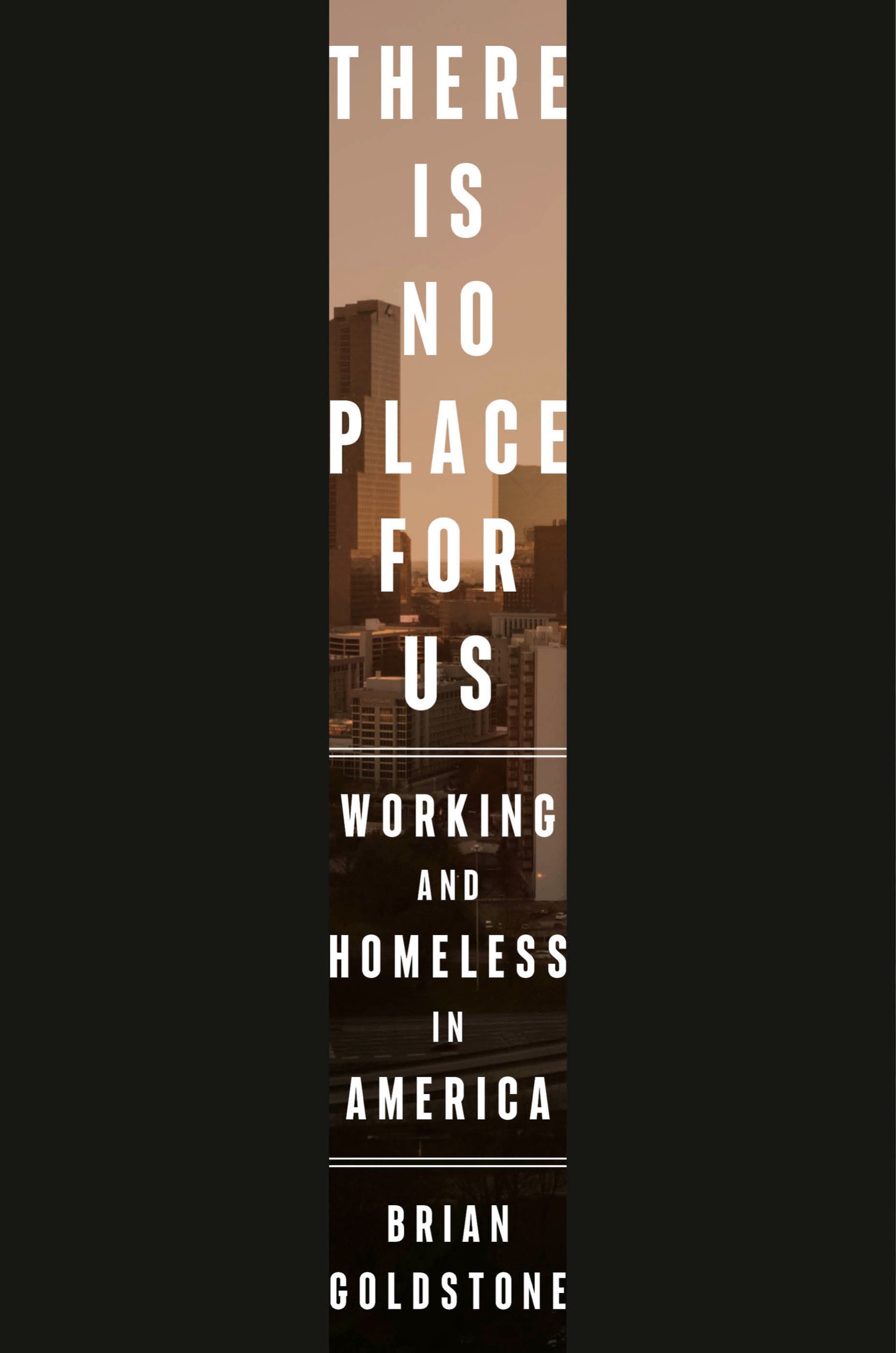
There Is No Place for Us: Working and Homeless in America
About this book
Brian Goldstone follows parents and children moving through motels, cars, shelters, temporary rooms, and unstable leases. Jobs continue, school continues, and the daily labor of hiding homelessness consumes time and money.
Their experiences expose gaps between common categories. Families may earn too much for one form of aid, lack the documentation for another, or remain officially invisible because they are not sleeping on the street.
The reporting connects intimate decisions to rent, wages, eviction practices, tenant law, zoning, and Atlanta's development. A thriving local economy does not protect workers when housing costs rise faster than the income their work provides.
There Is No Place for Us is narrative journalism about the working homeless. It combines several years of family reporting with a structural account of how a housing crisis is measured and administered.
Read a sample
5,065 words
Plain text
From the opening
Introduction
By the time I met Cokethia Goodman and her children, they had been homeless for three months. Their ordeal began on an afternoon in August 2018, when Cokethia discovered a terse letter from her landlord in the mailbox. The home she had been renting over the past year was in a quiet Atlanta neighborhood, within walking distance of a playground and her kids’ schools. But the area was gentrifying, and their landlord had decided it was time to cash out on her investment. The property would be sold; the family’s lease would not be renewed. Unable to find another affordable apartment nearby, they relocated to a dilapidated rental in Forest Park, on the city’s outer periphery. The rent was $50 more per month. After just two weeks in the house, Cokethia heard a scream from the kitchen: her twelve-year-old son had been washing dishes when, reaching his hand into the soapy water, he got a painful electric shock. Code enforcement arrived and, discovering exposed wiring in the basement, immediately condemned the home. The family moved into a squalid extended-stay hotel, until the weekly rent proved too expensive. There was nowhere left to go.
When Cokethia shared her story with me, she was still in a state of disbelief. It wasn’t just the circumstances that had deprived her family of housing. It was the fact that they had become homeless despite her full-time job as a home health aide—a point Cokethia returned to again and again, as if unable to wrap her mind around it. Like many of us, she had been taught to believe that homelessness and a job were mutually exclusive: that if she worked hard enough and stayed on top of her responsibilities, if she clocked enough hours, she could avoid such a fate. And yet here she was, dressed in bright blue medical scrubs and checking her phone to see if any shelter beds had opened up. “I grew up in this city,” she told me. “I graduated from high school in this city. Through my job, I’ve been taking care of men and women in this city. And now my kids and I are homeless? How does that even happen?”
I recounted the family’s plight in an article for The New Republic in 2019. But their story wouldn’t let me go. Was their predicament a bizarre anomaly, an exception to the rule? Or was their experience representative of a larger trend? If that was the case, then why did it seem so out of sync with our prevailing assumptions about homelessness? As I continued to research and write about housing insecurity, I realized that the problem was much bigger than this particular family or even this particular city. I started seeing it everywhere. In Northern California, I visited “safe parking lots” full of working families living in their cars and minivans. I talked to a shelter director who explained that more than half of the people his organization served were employed in low-wage jobs.
One freezing January morning, at an encampment in midtown Atlanta, I met a woman in her late forties. Wearing slacks and a dark blazer, she was often mistaken for a case manager. But in fact she lived in one of the tents. Over breakfast at a Chick-fil-A around the corner, she pointed to a garbage dumpster behind the restaurant, where a garden hose was peeking out. Each day at dawn, she told me, she left her tent and used the hose to shower, praying no men were nearby. Then she went to work at a call center.
There were others: people who had worked their entire lives and, now disabled, were on the street because of paltry government support (or none at all); the man outside the food pantry who had just landed a second job in the meat department at Kroger, living with his wife and kids at a Super 8; the young Uber driver who did airport runs during the day and slept in the same car at night. And soon there were the families whose journeys I have sought to document in this book.
The Working Homeless: the term seems counterintuitive, an oxymoron. In a country where hard work and determination are supposed to lead to success—or at least stability—there is something scandalous about the very concept. Popular media and scholarly accounts alike often depict unhoused people as lacking, almost by definition, not only homes but jobs; the view that these men and women are “unconnected to the world of work,” as sociologist Peter Rossi argued in his seminal 1989 book Down and Out in America, has persisted into the present day. Yet a growing number of Americans confront a starkly different reality. Besieged by a combination of skyrocketing rents, low wages, and inadequate tenant protections, they are becoming the new face of homelessness in the United States: people whose paychecks are not enough to keep a roof over their heads.
Today there isn’t a single state, metropolitan area, or county in the United States where a full-time worker earning the local minimum wage can afford a two-bedroom apartment. Currently, 11.4 million low-income households are classified as “severely cost burdened,” spending, on average, an astounding 78 percent of their earnings on rent alone. But strikingly, it’s in the nation’s richest, most rapidly developing cities—the ones “doing well”—that the threat of homelessness has become particularly acute. New York, whose economy soared over the last three decades, has watched its shelter population more than triple. Washington, D.C., boasts some of the country’s highest median incomes; it also has one of the greatest per capita homeless rates. Seattle is close behind. In Austin and Phoenix, Denver and Nashville, the pattern is similar. Unemployment is at a record low; corporate profits have surged; the signs of growth are everywhere. Yet the delivery drivers, daycare workers, supermarket cashiers, and home health aides who help sustain our cities are being relentlessly priced out of them—and often out of housing altogether. Unlike earlier periods of widespread immiseration, such as the recession of 2008, what we’re seeing today is an emergency born less of poverty than prosperity. Families are not “falling” into homelessness. They’re being pushed.
Continue reading the sampleClose the sample
Atlanta, the third-fastest-growing metropolitan area in the country, is a case in point. For much of the past century, the city has been shaped by a strategic partnership between its Black political leadership and white business elites that prioritizes stability and growth above all else. Resurgens, the city motto, has been seen to refer not only to Atlanta’s rise from the ashes after the Civil War but to a perpetual process of commerce-driven renewal. Fashioning Atlanta into an economic powerhouse has always been an aspiration for city leaders, and in recent decades they have achieved this goal. Home Depot, Coca-Cola, Delta Airlines, and UPS are some of the many Fortune 500 companies now headquartered there. Often referred to as the “Silicon Valley of the South,” the city has become a leading technology hub—Google, Microsoft, and Amazon all have outposts—and it has also emerged as a key center for healthcare and life sciences, transportation and logistics. Then there’s the entertainment industry: these days, more movies and TV series are being shot in Atlanta, or “Y’allywood,” than in California. The area’s population surge has been equally dramatic, nearly doubling since 1990—and showing no sign of slowing down.
But by far the most startling transformation has been the remaking of the city’s physical landscape. For decades, Atlanta typified the “poor in the core” phenomenon seen in many postindustrial urban areas, the result of deliberate disinvestment and the flight of white residents to surrounding suburbs. This began to change with Atlanta’s hosting of the 1996 Olympic Games, which coincided with a concerted campaign to draw a more affluent demographic to the city proper. Tax incentives and other public subsidies were mobilized to entice developers and real estate capital to build and invest within city limits. Twenty years later, whole swaths of Atlanta had been changed beyond recognition. The place was shinier, trendier—and much wealthier. For anyone who had associated the city solely with traffic-clogged highways or fortress-like convention hotels in an otherwise desolate downtown, the makeover was shocking. The ultimate signifier of this “new Atlanta” was the BeltLine, a twenty-two-mile mixed-use trail built on a former railway. The multibillion-dollar megaproject was hailed as one of the most ambitious urban redevelopment projects in the nation.
As in other cities where such engineered renewal was underway, Atlanta’s development boom was presented as advantageous for everyone. Under the guise of “smart growth” and “New Urbanism,” the promise of a more beautiful, environmentally sustainable city—with abundant jobs, improved schools, and upgraded infrastructure—was sold to new and old residents alike. In mayoral speeches and community engagement meetings, the message was consistent: Atlantans of all stripes would benefit from their revitalized city.
Today, all the amenities are there, but the city’s renaissance has exacted a heavy toll on its low-income residents. Between 2010 and 2023, median rents soared by 76 percent, and the metro area lost a staggering sixty thousand apartments renting for $1,250 or less. The problem is not so much a lack of new housing as the kind of housing that is being built. Over the past decade, 94 percent of the tens of thousands of apartments added to the city’s rental market have been luxury units, featuring resort-style swimming pools, coworking spaces, pickleball courts, and onsite dog parks. Atlanta is no longer “poor in the core.”
But attend a yoga class or visit a new craft brewery, and chances are somebody’s affordable housing complex was torn down to make way for it. A city that was 67 percent Black in the early 1990s is now 47 percent Black. Many families have been pushed to Atlanta’s outer edges, far from their jobs and public transit and other services—but where rents are still absurdly high. According to the most recent studies, there are now more than 159,000 low-income households in Atlanta spending more than half of their earnings on rent, living in grossly substandard conditions, or both. Indeed, what has emerged in recent years is a kind of dystopian rejoinder to the claim—famously put forward by the urbanist Richard Florida in his book The Rise of the Creative Class—that the future of America’s cities would stand or fall on their capacity to attract a wealthier, more educated and “vibrant” demographic. Well, cities like Atlanta have, and scores of families are suffering the consequences.
A similar interplay of growth and displacement, development and deprivation can be found in many American cities. In these places, a low-wage job is homelessness waiting to happen. The slightest setback or unanticipated expense—minor car trouble, disrupted childcare, a brief illness—can be disastrous. Outrageous housing costs would be less painful if incomes were rising at a comparable rate. But since 1985, rent prices nationwide have exceeded income gains by 325 percent. Some fifty-three million Americans, or almost half of the country’s workers between the ages of eighteen and sixty-four, hold jobs that pay a median hourly wage of $10.22, which amounts to a mere $21,000 a year—below the poverty line for a family of three. If you’re disabled and receive Supplemental Security Income (SSI), which is capped at $943 a month, it’s even worse: the national average rent now amounts to 142 percent of this form of fixed income. In Atlanta, the “housing wage” needed to afford a modest two-bedroom apartment is $29.87 an hour. (Georgia’s minimum wage is $7.25 an hour.) In Boston, a tenant earning the local minimum wage would have to log 141 hours a week to afford the same apartment; in San Francisco, it’s 160 hours. Confronted with the bleak arithmetic of stagnant incomes and out-of-control housing expenses, people cut back wherever possible. Eventually they’ve cut all they can.
These families find themselves trapped in a sort of shadow realm, languishing in their cars, the overcrowded apartments of friends and relatives, and hyperexploitative extended-stay hotels and rooming houses. How many people are caught in this nightmare? It’s a hard question to answer. Counting the homeless has always been politically charged: government officials have a clear stake in keeping the numbers as low as possible. One way they’ve done this is to define homelessness ever more narrowly. Each January, when a battalion of volunteers, service providers, and public employees fan out across the country to conduct the federal homeless census, only those defined as “literally homeless”—people staying in shelters and on the street—are tallied. Everyone else is rendered doubly invisible: at once hidden from sight and omitted from the reported statistics.
Not only are those who fall outside this narrow definition denied vital assistance, but as the census figures make their way into the media, the true scale and nature of the phenomenon are obscured. It’s an alarming thought: as bad as the official numbers are—in 2023, the limited annual count showed the largest nationwide increase on record—the reality is far worse. Recent research reveals that the actual number of those experiencing homelessness in the United States, factoring in those living in cars or hotel rooms or doubled up with other people, is at least six times larger than the official figure. Driving around the nation’s richest cities, we see the sprawling tent encampments, we see the makeshift dwellings on sidewalks and under overpasses. But those are just the most visible manifestations of a far more pervasive crisis.
This is a book about what we’re not seeing. It follows five families in Atlanta desperate to secure a home. Maurice and Natalia make a fresh start in the city after being priced out of D.C. but now find themselves at the mercy of a cutthroat rental market, living paycheck to paycheck. Kara dreams of starting her own cleaning business while mopping floors at a public hospital. Michelle is in school to become a social worker, even as she struggles to raise her own three kids. Britt’s roots in Atlanta go back five generations; she believes a long-awaited housing voucher will give her a foothold in her increasingly unrecognizable city. Celeste is a person of a thousand talents, savvy and unflappable, but a cancer diagnosis and a predatory housing system prove overwhelming even for her. Some of these families are isolated and on their own; others rely on an extensive network of friends and relatives. All are part of the country’s low-wage labor force. All are renters. And all are Black—as are 93 percent of homeless families in Atlanta, the cradle of the civil rights movement.
It used to be that owning a home was held up as the ultimate goal, a reward for diligent effort and perseverance. Now simply having a home has become elusive for many. The myth that hard work will lead to stability has been shattered, revealing a stark disconnect between the story America tells about itself and the reality of deepening precarity. We need a new narrative, a new perspective on a nation whose citizens toil in vain for one of the most basic human necessities. The reach of homelessness is expanding. As it pulls more and more people into its grip, we might wonder: Who gets to feel secure in this country? And who are the casualties of our prosperity?
Part One Equilibrium
1
Britt scrutinized her face in the bathroom mirror, hoping she looked less tired than she felt. Sleep had been hard to come by since she began working the closing shift at Low Country, a “new Southern cuisine” restaurant at Hartsfield-Jackson International Airport. Some nights, after a grinding hour-plus commute from the airport back to her great-grandmother’s apartment in Atlanta’s East Lake neighborhood, she managed to crawl into bed beside her two-year-old son, Kyrie, and four-year-old daughter, Desiree, without waking them. Last night she was not so lucky: Kyrie stirred and Britt was up with him until well past midnight. No sooner had they finally drifted off than Britt’s phone alarm sounded, and it was all she could do to get the kids dressed and fed by six o’clock, when their daycare van arrived. Now, seven hours later, she massaged cocoa butter moisturizer onto her cheeks and forehead. Good enough, she thought with a sigh.
“Britt!” her great-grandmother bellowed over a television commercial. “Don’t forget to tidy up my living room before you leave!” Britt examined herself one last time. She hadn’t been able to wash her line-cook uniform between the previous night’s shift and the one she would be starting shortly, but the stains weren’t too noticeable.
For five months, Britt and her kids had been living out of several oversized tote bags in a corner of the apartment’s compact living room, next to the pullout sofa bed they shared. An ironclad rule at Granny’s apartment was that you pick up after yourself, and as Britt rushed to fold their clothes and blankets, she tried to arrange everything as neatly as possible. She had never asked Granny for a closet or dresser drawer in which to keep these items, in part because it seemed like there wasn’t any room to spare—the older woman had a propensity to squirrel away whatever toy or child’s sweater or pajama set she thought could be handed down to the family’s newest members—but mostly because she needed to believe that their stay at her apartment was only temporary. For her part, Granny made it clear in her own loving but not particularly subtle way that she was in no need of roommates. Britt described it to a friend as a “don’t get too comfortable” situation.
After reassembling the sofa bed and arranging its cushions, Britt hurried into the kitchen to finish preparing the kids’ dinner for later: chicken tenders, rice, green peas, and Pillsbury Crescent Rolls. She glanced at Granny, perched in her rocking chair a few feet away from the TV. Britt often marveled at the disconnect between this kindly arthritic woman, who passed the hours glued to Judge Mathis or Tyler Perry’s Madea movies while clutching her large-print Bible, and the stories she’d grown up hearing about her. Britt’s favorite photo of Granny from her younger years showed a scowling, self-professed hustler outside Butler’s Shoes in downtown Atlanta, sporting an all-white Levi’s denim suit with a smart red bow tie. These days the sole vestige of Granny’s former self was her fierce independence, which a recent diagnosis of Alzheimer’s had done little to diminish.
“Girl, it’s almost one-thirty. Shouldn’t you be on your way?” Britt hadn’t noticed her mom, Cass—short for Cassandra—enter the apartment. As always, the forty-three-year-old had a brusque, tightly coiled energy. She greeted Granny with a quick kiss on the top of her head.
“I’m making food for Des and Kyrie,” Britt replied. “If you could just throw it in the microwave when they get back—”
Cass cut her off. “What? You think I can’t put together some nuggets for my grandchildren?” She said this playfully, if a bit defensively. For a brief moment Britt stared at her, as if there was a lot she could say in response. “You get going and let me handle this,” Cass said.
At the front door, beside Granny’s “wall of fame,” where dozens of pictures taken at graduations and proms and athletic events had been assembled, Britt put on a thin, stylish camouflage-print jacket. “Where’s your coat at?” Cass yelled from the kitchen. “You know how cold it is? Why don’t you step out on that patio and find out.”
“Oh, she thinks she too cute for a puffy jacket,” Granny teased.
“Well, her ass is gonna freeze,” Cass said. The two women laughed. Britt, grinning, said, “Yeah, yeah,” and shut the door behind her.
Outside, Britt headed toward the bus stop on Glenwood Avenue. She had been walking this route since she was a toddler. Granny’s apartment building was a stone’s throw from the public housing project where Britt had spent the first few years of her life. Five generations of the family had lived together at East Lake Meadows. That had not been the plan. When Granny’s mother—“Big Mama,” as everyone called her—landed a job at an Atlanta printing factory in 1961, her hope was to eventually purchase her own house. But this was before the Fair Housing Act was signed into law. A century of housing discrimination ensured that the path to homeownership remained closed to the majority of Black Americans. Unlike some of her white co-workers, who were approved for low-interest mortgages and able to move to the nearby suburbs, Big Mama and her progeny were confined to Atlanta’s renter class—spending ten years at an apartment at 949 Washington Street, located in the predominantly Black Peoplestown neighborhood, before relocating to East Lake Meadows in the early seventies.
In the public imagination, the 650-unit complex known as “Little Vietnam” was rampant with crime and violence, but Britt’s family spoke about it differently, as a place where people managed to forge a community despite living in terrible conditions. And the conditions were abysmal. Government neglect had plagued the project from the very beginning. Then, in the early nineties, Atlanta real estate titan Tom Cousins purchased the historic but derelict East Lake Golf Club, which bordered the housing project. Instead of advocating for the city to renovate the complex, he began calling for its demolition: his goal was to “rehabilitate” the neighborhood surrounding the golf course. Soon the complex was razed.
By 2001, when Britt was eight, the area had its first grocery store, a charter school, and The Villages of East Lake, a privately owned apartment complex built on the former site of East Lake Meadows. Cousins’s revived golf club became the annual host of the prestigious PGA TOUR Championship. The neighborhood’s rapid change was celebrated in media reports across the country, but not everyone benefited from it: because of strict eligibility requirements and the limited number of apartments set aside for low-income households, a mere 15 percent of the families residing at East Lake Meadows before its demolition were able to move into the new development. Granny and Big Mama, who died shortly after settling into her unit at the Villages, were among this select group. Cass and her kids were forced to go elsewhere.
A cold February wind cut through Britt’s outfit as she raced to catch the bus on Glenwood that would take her to MARTA’s Edgewood-Candler Park station and, from there, after transferring at Five Points, to the domestic terminal at Hartsfield-Jackson. As Britt rounded the corner, she saw that her bus was already approaching. She had to sprint to catch it.
It was only when she boarded the Gold line train at Five Points that Britt allowed herself to relax. She put in her earbuds and closed her eyes. The gentle opening notes of “Be Blessed” by Yolanda Adams—first an unadorned piano, then the deep, resonant tones of a gospel organ—began to settle her nerves. Prone to minor panic attacks, Britt had come up with strategies to stave off such episodes. Although she didn’t consider herself religious, listening to this song had a way of grounding her. It was as if Adams were an older, wiser friend, perfectly aware of Britt’s traumas and regrets but steadfast in the conviction that she need not be defined by them.
I want you to be blessed, don’t live life in distress
Just let go, let God, He’ll work it out for you
I pray that your soul will be blessed
Forever in His hands, for you deserve His best, no less.
Britt played the song twice and, when it ended, realized there was only one stop left before she arrived at the airport. As she had already done a number of times that day, she checked her email. She wasn’t expecting to see the message she’d been waiting for, but she still felt a pang of disappointment when it wasn’t there.
Securing a home for her children, Britt believed, hinged on a long-anticipated email from the Atlanta Housing Authority (AHA). Two years earlier, in January of 2015, she’d been excited to hear that AHA was about to open its Housing Choice Voucher Program to new applicants. These “Section 8” vouchers, as they were popularly known, had an almost mythical status among her relatives and friends: voucher holders paid no more than 30 percent of their income on rent to a private landlord, with federal funds covering the rest. Yet acquiring a voucher was no easy task. Although the program had become the nation’s primary means of offering housing support to low-income families, the money allocated by Congress was woefully inadequate. Some social safety net programs, such as Medicaid and food stamps, provided benefits to everyone who met the eligibility criteria. Not so with housing aid. Roughly fourteen million poor renter households who qualified for housing assistance would never receive it. But everyone in Britt’s world knew at least one co-worker or cousin’s friend who had gotten a voucher. For these lucky few, the support could be life-changing—lifting the strain of constant financial instability, of having to choose between paying the rent or the electric bill.
In the weeks before AHA opened its application portal, voucher fever seemed to grip the city. The excitement was understandable: it had been fourteen years since low-income Atlantans could apply for a voucher. On the radio and local news shows, officials from AHA explained the process. Over the course of seven days, from January sixth to the thirteenth, those wishing to apply would need to do so online, after which a computerized system would select a given number of names at random. Those who were chosen would feel like they’d won the lottery.
The odds were far worse in other places. In 2010, a crowd of thirty thousand gathered outside the housing authority office in East Point, a city southwest of Atlanta, when it was announced that voucher applications would be handed out; the small municipality had a total of 455 housing vouchers. A year later, in Dallas, several people were trampled as thousands of residents rushed the doors at Jesse Owens Memorial Complex, where applications were going to be distributed on a first-come, first-served basis. Prior to this stampede, the line of applicants, many of whom had camped out the night before, stretched over a mile long.
Britt had filled out the application on her phone. It was the morning the AHA portal went live, and she had to decide whether to include the kids’ father, Javon, on the lease. Their relationship had been up and down since Desiree’s birth, but for the last year they’d been staying together at his mother’s house on the West Side and things were going well: they were both working—he was a mechanic; she had two part-time jobs, one at Chick-fil-A and the other with SecurAmerica—and they hoped to get their own place before their second child arrived. Even Javon’s mother wasn’t sure that he should be a “co-head of household.”
“You crazy?” she said to Britt one day. “These men ain’t shit.” Britt said nothing in response. She was proud of belonging to a long line of strong, industrious women who could get by without a man. “The females in this family will do anything to put food on the table,” her mom liked to joke, “except sell our bodies.” But it annoyed Britt that Javon’s mother would project her own experiences with men, her own heartaches and resentments, onto her son. Still, the comment nagged at her, and she decided at the last minute to leave his name off the application. It turned out to be the right call. That summer, a few months after Kyrie was born, a trivial disagreement escalated to shouting and cursing, and then, for the first time, Javon hit her. In tears, she threatened to call the police; he pulled out a handgun. She’d had no idea he owned a gun. Britt resolved never to live with him again.
When the application window closed on January 13, 113,000 people had applied for a housing voucher. Britt was one of 10,000 to win a spot on the waiting list. In Atlanta, as in other cities across the country, it was not uncommon for families to spend years waiting to actually receive their voucher. In larger cities, the wait could be a decade or more. Still, Britt considered it a miracle. She told herself that “delay is not denial,” that the wait could turn out to be a blessing. And besides, as with getting onto the waiting list, names were selected off the list at random—which meant there was a possibility she wouldn’t be waiting long at all.
She began incessantly checking and rechecking her email, fantasizing about her future apartment. She imagined birthday parties for the kids and family gatherings at Thanksgiving. She decorated each room in her mind; it would be modern but cozy, she decided, extremely chill. She browsed the aisles of furniture stores, determining which coffee table went best with her favorite couch, which nightstand with her favorite bed frame. She wondered what life would be like: maybe she’d coach cheerleading or gymnastics—Desiree was already following in Britt’s footsteps—or get more involved at the children’s school, as her own mom had been. Or perhaps she’d go back to school herself. She could start to date again; she’d have a my place to go back to at the end of the night, no longer ashamed to be staying in Granny’s living room.
Desiree and Kyrie had their own hopes for the new place. But gradually they stopped asking Britt how much longer the wait would be.
Britt was embarrassed to admit it, but walking through the airport en route to work always gave her a little thrill. Something about the frenetic atmosphere, the important-looking people coming from every corner of the planet and speaking languages she’d never heard, made her aware that she was living in a big, exciting city. It didn’t matter that she was headed to a dead-end job in the Concourse A food court. The ambient bustle of this massive airport, the busiest in the world, was strangely energizing.