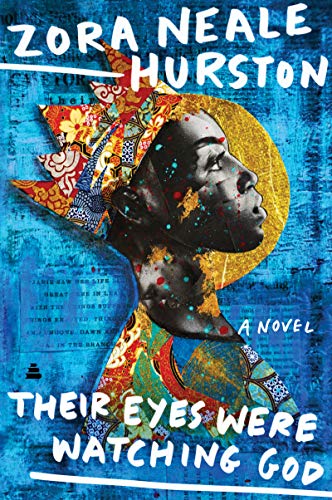
Their Eyes Were Watching God
About this book
Janie Crawford comes home to Eatonville, Florida, muddy and alone, and tells her story to her friend Pheoby. Raised by her grandmother, a former slave determined to see her safe, Janie is married off young to an old man with land. She leaves him for Joe Starks, who carries her to a town he means to run — and who keeps her under his thumb for twenty years, her hair tied up and her opinions swallowed.
Then comes Tea Cake, a gambler and drifter twelve years her junior, who plays checkers with her and laughs with her and treats her like a person. With him she goes to the Everglades, to work the bean fields among the migrant workers, and for the first time her life is her own. The hurricane that follows tests everything they have built.
Hurston writes the frame in a rich literary English and the speech in vivid Black dialect, and the two registers together make the book's music. Janie's real journey is toward speech — the right to tell her own story in her own words, which is exactly how the novel ends.
Published in 1937 and savaged by male contemporaries who wanted protest instead of love stories, the novel was rescued from obscurity in the 1970s and now stands as a cornerstone of American literature.
Read a sample
5,092 words
Plain text
From the opening
Their Eyes Were Watching God
Foreword
BY EDWIDGE DANTICAT
I
“S hips at a distance have every man’s wish on board.” S o begins Zora Neale Hurston’s brilliant novel about a woman’s search for her authentic self and for real love. At first it might seem contradictory that a work whose central character is the remarkably resolute and resilient Janie Crawford should start with a dictum about “the life of men.” However, that is one of the many shrewd manifestations of Zora Neale Hurston’s enormous talents: her ability to render a world complete with its codes and disciplines within a few sentences, and then placing in that world her vision of how her people—the women and men of her own creation, her characters—function, triumph, and survive. So off that metaphorically distant ship comes our heroine Janie Crawford, and suddenly we realize that she had been on her own singular journey all along, her dreams “mocked to death by Time,” but never totally defeated. And since women “remember everything they don’t want to forget,” Janie Crawford recalls all the crucial moments of her life, from the time she first discovers that she is a “colored” little girl by searching for her face in a group photograph, to the moment she returns to Eatonville, Florida, from the Everglades, not swindled and deceived, as had been expected, but heartbroken, yet boldly defiant, after having toiled in the bean fields, survived a hurricane, and lost the man she loved.
Janie Crawford is able to retrace her steps, disembark from her own ship, come home, and remember, because she has been close to death but has lived a very full life. So in spite of the judgmental voices that greet her upon her return, in spite of the “mass cruelty” invoked by her prodigal status, Janie has earned the right to be the griot of her own tale, the heroine of her own quest, the “member” of her own remembering.
In the loose call-and-response structure that frames the novel—Janie’s friend Pheoby asks her to tell her where she has been, and Janie responds with the story that constitutes the book—Janie’s is an intimate audience of one. She entrusts her adventures to Pheoby to retell to others only if Pheoby chooses. (“You can tell ’em what Ah say if you wants to. Dat’s just de same as me ’cause mah tongue is in mah friend’s mouf.”) Janie is recounting her story as much to Pheoby as to herself. Her response to Pheoby’s call is at the same time an echo, much like the nymph Echo who retains only her voice after having literally been torn apart. Hurston herself also becomes Janie’s echo by picking up the narrative thread in intervals, places where in real life, or in real time, Janie might have simply grown tired of talking. Much like the porch sitters at the beginning of the book who are the first to see Janie arrive, Janie, Pheoby, and Zora Neale Hurston form their own storytelling chain, and it is through their linking of voices that we are taken on this intimate yet communal journey that is Their Eyes Were Watching God.
II
I have always been extremely proud to remind all who would listen that Zora Neale Hurston’s masterpiece, Their Eyes Were Watching God, was written, by her own account, in seven weeks, in my homeland, Haiti. I once made a complete fool of myself in front of a group of young women writers who had just created a book club and had gracefully invited me to their first meeting. Soon after the book club’s newly elected president announced that the first book they’d be reading would be Their Eyes Were Watching God, I intervened to declare, “Did you know that Zora wrote it in seven weeks in Haiti?”
I was hastily rebuffed by a curt “So?” from one of the members.
“So?” I replied, embarrassed. “Could you write a book like that in seven weeks?”
Of course Hurston’s own account of how long it took to compose the novel has been debated and contested. However, I am awed by her ability to have found the time during her anthropological travels and constant research in Haiti to produce a novel—at all. As a writer, I am amazed by the way she often managed to use the places and circumstances she found herself in to create a room, a world, of her own. Even with the menace of pennilessness always looming, she somehow unearthed the solace, or perhaps the desperation, to write.
Many of my contemporaries, including myself, often complain—sometimes with book contracts in tow—about not having enough time, money, and space to write. Yet Zora battled to write and she did, knowing, as Janie Crawford must have also known, that “there is no agony like bearing an untold story inside you.” Thus, no matter how many times I have read this book, when Janie begins telling that untold story inside her, I am always doubly elated, both with the story itself and with the way in which it came to be. And so when I blurt out my favorite piece of Hurston trivia, I do it partially out of pride for her association with Haiti, but I also do it heeding Alice Walker’s extremely wise advice in her foreword to Robert E. Hemenway’s literary biography of Hurston: “We are a People.” (And I include all the international peoples of the African diaspora in this category.) “A People do not throw their geniuses away.”
Continue reading the sampleClose the sample
Fortunately, over the years, I have met very few active readers of my generation (born after 1960), writers and nonwriters alike, who would even consider throwing Zora away. Many of us can remember vividly our first encounter with her work, particularly Their Eyes Were Watching God. Because of the efforts of Ms. Walker and others, who valiantly reclaimed Zora for themselves and for all of us, we read Zora either in high school or in college classes, where her work is enthusiastically taught by men and women—most of whom were much older than we were when they first read her—and still had the exuberance of a recent discovery, much as in the early days of a love affair, or a reunion with a friend long thought dead.
I first read Their Eyes Were Watching God in an elective black history class at Clara Barton High School in Brooklyn, New York. The class was taught by a young teacher who conducted it during his lunch hour. There was not much reading for young adults about Zora and her work, so we struggled with the plot and the language with a lot of coaching from our teacher. Most of us were new immigrants to the United States and read Janie, Pheoby, and Tea Cake’s dialogue out loud with our heavy Creole accents, and managed to come away with only a glimmer of the brilliance of what we had read.
At times, feeling as if my lack of English had robbed me of precious narrative information, I would raise questions that went beyond the scope of the novel, and my teacher would become very excited, applauding the fact that I was stretching my imagination way beyond the words in front of me, which is what all good readers are supposed to do. “Where was Tea Cake’s family?” I would ask. “And what did Janie’s friend Pheoby do while Janie was gone?”
I would later explore more purposefully deliberate questions about the book in a freshman English class at Barnard College, where Zora had also been a student in the 1920s. Hers were among the books in a glass case in the Barnard library that also highlighted other famous alumnae authors, including the poet, playwright, and novelist Ntozake Shange. Each time I walked by that glass case, I felt my dream of becoming an author growing more and more attainable, partly because Zora and Ntozake were black women, like me.
“Zora has lived in my country,” I happily told one of my classmates, “and now I am living in hers.” I liked to think that Zora was drawn to Haiti partly because of the many similarities between Haitian and Southern African-American culture. Zora was from an all-black town, run and governed by black people, and I was from a black republic, where Frederick Douglass had resided and where Katherine Dunham had studied and danced. In Tell My Horse, Zora finds an equivalent for the cunning Brer Rabbit of the Uncle Remus stories in Haiti’s sly Ti Malis of popular lore. And in the rural belief that our dead will one day return to Ginen, Africa, she uncovered echoes of the strong convictions of many of those who were forced on board slave ships for points of no return.
There were so many things that I found familiar in Their Eyes Were Watching God: the dead-on orality in both the narration and dialogue; the communal gatherings on open porches at dusk; the intimate storytelling (krik? krak!); the communal tall-tale sessions, both about real people who have erred (zen) and fictional folks who have hilariously blundered (blag). Her description of the elaborate burial of Janie’s pet mule reminded me of an incident that she detailed in Tell My Horse, in which Haitian president Antoine Simon ordered an elaborate Catholic funeral at the national cathedral for his pet goat Simalo, something many Haitians would laugh about for years.
In class at Barnard, we gladly raised structural questions about Their Eyes Were Watching God. Was it a love story or an adventure story? We decided it could be both, as many other complex novels are. Besides, don’t adventures often include romance? And aren’t all exciting romances adventures?
We brought up issues that concerned us as young feminists and womanists. Was Janie Crawford a good female role model or was she solely defined by the men in her life? Many of us argued that Janie did not have to be a role model at all. She simply had to be a fully realized and complex character, which she was. She certainly manifested a will of her own in spite of the efforts of her grandmother and her two first husbands to dominate her, leaving her first husband when life with him grew unbearable, and taking off with Tea Cake against public opinion after the second husband died.
Why did Janie allow Tea Cake to beat her? Some of us thought that Hurston tried to envision characters who are neither too holy nor too evil. Her men and women are extremely nuanced, reflecting human strengths as well as frailties. If Tea Cake were too cruel, then Janie would not love him at all. If he were too uniformly pious, then rather than being her equal, as he was at work in the fields, he would be worshipped by her, and “all gods who receive homage are cruel. All gods dispense suffering without reasons…half gods are worshipped in wine and flowers. Real gods require blood.” In the end, Janie receives from Tea Cake the equivalent of all three—wine, flowers, and blood—and she becomes like a treasured relative whose love affair we could never wholeheartedly condone, but the source of which we could certainly understand. Tea Cake gives his life for Janie, and this, if nothing else, serves as some atonement for many of his sins.
In spite of Janie’s choices concerning Tea Cake, or perhaps because of them, she experiences more freedom than most women (certainly most poor women) of her time. And as much as she loves Tea Cake, she ultimately chooses to live and not to die with him, and her final act is not to follow him to the grave, but to bury him and return alone to a community that will not embrace and welcome her without first being given an explanation as to where she has been and what she has been through.
III
For many decades and, hopefully, centuries to come, Their Eyes Were Watching God will probably be at the center of Zora Neale Hurston’s legacy as a novelist. Perhaps because it was written in such a short and, reportedly, emotionally charged period, this is a novel with an overpowering sense of exigency and urgency in its layered plot, swift pace, intricate narration, and in the raw anguish evoked by the conflicting paths laid out for Janie Crawford as she attempts to survive her grandmother’s restricted vision of a black woman’s life and realize her own self-conceived liberation. Like all individual thinkers, Janie Crawford pays the price of exclusion for nonconformity, much like Hurston herself, who was accused of stereotyping the people she loved when she perhaps simply listened to them much more closely than others, and sought to reclaim and reclassify their voices.
The novel not only offers a penetrating view of Janie’s evolving thinking process, but we are also given plenty of insight into the mindsets of those who would wish to condemn her. Janie, however, is never overly critical of her neighbors’ faultfinding reactions to her. She either ignores them entirely or pities them for never having left the safety of their town and never having lived and loved as deeply as she has.
Having survived all she has, Janie now has a deeper understanding of her own actions as well as a greater comprehension of human behavior in general.
“It’s uh known fact, Pheoby, you got tuh go there tuh know there,” she explains to her friend. “Two things everybody’s got tuh do fuh theyselves…They got tuh go tuh God and they got tuh find out about livin’ fuh theyselves.”
Along with the classic conflict between an individual’s wishes and a community’s censure, there are many contemporary motifs in this novel, events that could have been easily plucked out of early-twenty-first-century headlines: loveless marriages; verbal and physical abuse; mercy killing, or a killing in self-defense, depending on how you interpret it; forbidden love; a public and passionate affair between a younger man and an older woman from different stations in life. Many of the minor characters in the novel are vibrantly multicultural, from African Americans to Native Americans to the Caribbeans who live and work in the Everglades. (To this day, migrant labor and hurricanes remain very concrete elements of life in Florida.)
The influence of Zora’s work, particularly Their Eyes Were Watching God, will continue to be felt for years in the works of many generations of writers. For example, Janie Crawford shares a literary kinship with Celie of Alice Walker’s The Color Purple, whose eyes not only watch God, but whose words and letters, whose voice, speak directly to God.
Part of the reason Janie’s grandmother Nanny pushes her into a loveless marriage to Logan Killicks, her first husband, is that Nanny was born in slavery and had little choice over her own destiny. Nanny has craved small comforts, like sitting idly on a porch, and wants her granddaughter to have them, along with money and status, no matter what the emotional cost. What Nanny may not have considered is that Janie would have her own ideas of freedom. However, Nanny is also pained by a deferred dream of her own.
Nanny confesses to young Janie, “Ah wanted to preach a great sermon about colored women sittin’ on high, but they wasn’t no pulpit for me.”
In Toni Morrison’s Beloved, Beloved’s grandmother Baby Suggs preaches the sermon Nanny never got to preach. Baby Suggs “became an unchurched preacher, one who visited pulpits.” However, her most-used pulpit was one that Baby Suggs created for herself, outdoors, in a clearing: “After situating herself on a huge flat-sided rock, Baby Suggs bowed her head and prayed silently…. Finally she called the women to her. ‘Cry,’ she told them. ‘For the living and for the dead. Just cry.’ And without covering their eyes the women let loose.”
What a difference it might have made to young Janie to have heard her grandmother preach that sermon, to have heard her Nanny say, as Baby Suggs did, “More than your life-holding womb and your life-giving private parts…love your heart. For this is the prize.”
IV
In the circular narration of Their Eyes Were Watching God, at the end of the book, a whole new life lies ahead, uncharted for a still relatively young Janie Crawford. She has told her story and has satisfied “that oldest human longing—self-revelation.” And now she must go on.
We know that Janie will never forget Tea Cake. Not only did she love him very deeply, but her life and travels with him have opened up her world and her heart in irreversible ways. However, we get hints that Janie will continue to live on her own uncompromising terms, for even as she has lost her beloved, she has also discovered many deeper layers of herself.
“Now, dat’s how everything wuz, Pheoby, jus’ lak Ah told yuh,” she says to her friend as she prepares to wrap up her story. “So Ah’m back home agin and Ah’m satisfied tuh be heah. Ah done been to de horizon and back and now Ah kin set heah in mah house and live by comparisons.”
Janie’s life, by comparison, might seem more turbulent than most. However, both her past and her future can best be characterized by the way she describes her love for Tea Cake at the end of the book. Not like a “grindstone” that is the same everywhere and has the same effect on everything it touches, but like the sea, the sea of distant ships with every man’s wish on board, the powerful moving sea that “takes its shape from de shore it meets,” and is “different with every shore.”
Their Eyes Were Watching God
Foreword
In 1987, the fiftieth anniversary of the first publication of Their Eyes Were Watching God, the University of Illinois Press inserted a banner in the lower right-hand corner of the cover of their anniversary reprint edition: “1987/50th Anniversary—STILL A BESTSELLER!” The back cover, using a quote from the Saturday Review by Doris Grumbach, proclaimed Their Eyes, “the finest black novel of its time” and “one of the finest of all time.” Zora Neale Hurston would have been shocked and pleased, I believe, at this stunning reversal in the reception of her second novel, which for nearly thirty years after its first publication was out of print, largely unknown and unread, and dismissed by the male literary establishment in subtle and not so subtle ways. One white reviewer in 1937 praised the novel in the Saturday Review as a “rich and racy love story, if somewhat awkward,” but had difficulty believing that such a town as Eatonville, “inhabited and governed entirely by Negroes,” could be real.
Black male critics were much harsher in their assessments of the novel. From the beginning of her career, Hurston was severely criticized for not writing fiction in the protest tradition. Sterling Brown said in 1936 of her earlier book Mules and Men that it was not bitter enough, that it did not depict the harsher side of black life in the South, that Hurston made black southern life appear easygoing and carefree. Alain Locke, dean of black scholars and critics during the Harlem Renaissance, wrote in his yearly review of the literature for Opportunity magazine that Hurston’s Their Eyes was simply out of step with the more serious trends of the times. When, he asks, will Hurston stop creating “these pseudo-primitives whom the reading public still loves to laugh with, weep over, and envy,” and “come to grips with the motive fiction and social document fiction?” The most damaging critique of all came from the most well-known and influential black writer of the day, Richard Wright. Writing for the leftist magazine New Masses, Wright excoriated Their Eyes as a novel that did for literature what the minstrel shows did for theater, that is, make white folks laugh. The novel, he said, “carries no theme, no message, no thought,” but exploited those “quaint” aspects of Negro life that satisfied the tastes of a white audience. By the end of the forties, a decade dominated by Wright and by the stormy fiction of social realism, the quieter voice of a woman searching for self-realization could not, or would not, be heard.
Like most of my friends and colleagues who were teaching in the newly formed Black Studies departments in the late sixties, I can still recall quite vividly my own discovery of Their Eyes . Somewhere around 1968, in one of the many thriving black bookstores in the country—this one, Vaughn’s Book Store, was in Detroit—I came across the slender little paperback (bought for 75¢) with a stylized portrait of Janie Crawford and Jody Starks on the cover—she pumping water at the well, her long hair cascading down her back, her head turned just slightly in his direction with a look of longing and expectancy; he, standing at a distance in his fancy silk shirt and purple suspenders, his coat over one arm, his head cocked to one side, with the look that speaks to Janie of far horizons.
What I loved immediately about this novel besides its high poetry and its female hero was its investment in black folk traditions. Here, finally, was a woman on a quest for her own identity and, unlike so many other questing figures in black literature, her journey would take her, not away from, but deeper and deeper into blackness, the descent into the Everglades with its rich black soil, wild cane, and communal life representing immersion into black traditions. But for most black women readers discovering Their Eyes for the first time, what was most compelling was the figure of Janie Crawford—powerful, articulate, self-reliant, and radically different from any woman character they had ever before encountered in literature. Andrea Rushing, then an instructor in the Afro-American Studies Department at Harvard, remembers reading Their Eyes in a women’s study group with Nellie McKay, Barbara Smith, and Gail Pemberton. “I loved the language of this book,” Rushing says, “but mostly I loved it because it was about a woman who wasn’t pathetic, wasn’t a tragic mulatto, who defied everything that was expected of her, who went off with a man without bothering to divorce the one she left and wasn’t broken, crushed, and run down.”
The reaction of women all across the country who found themselves so powerfully represented in a literary text was often direct and personal. Janie and Tea Cake were talked about as though they were people the readers knew intimately. Sherley Anne Williams remembers going down to a conference in Los Angeles in 1969 where the main speaker, Toni Cade Bambara, asked the women in the audience, “Are the sisters here ready for Tea Cake?” And Williams, remembering that even Tea Cake had his flaws, responded, “Are the Tea Cakes of the world ready for us?” Williams taught Their Eyes for the first time at Cal State Fresno, in a migrant farming area where the students, like the characters in Their Eyes, were used to making their living from the land. “For the first time,” Williams says, “they saw themselves in these characters and they saw their lives portrayed with joy.” Rushing’s comment on the female as hero and Williams’s story about the joyful portrayal of a culture together epitomize what critics would later see as the novel’s unique contribution to black literature: it affirms black cultural traditions while revising them to empower black women.
By 1971, Their Eyes was an underground phenomenon, surfacing here and there, wherever there was a growing interest in African-American studies—and a black woman literature teacher. Alice Walker was teaching the novel at Wellesley in the 1971–72 school year when she discovered that Hurston was only a footnote in the scholarship. Reading in an essay by a white folklorist that Hurston was buried in an unmarked grave, Walker decided that such a fate was an insult to Hurston and began her search for the grave to put a marker on it. In a personal essay, “In Search of Zora Neale Hurston,” written for Ms. magazine, Walker describes going to Florida and searching through waist-high weeds to find what she thought was Hurston’s grave and laying on it a marker inscribed “Zora Neale Hurston/’A Genius of the South’/Novelist/Folklorist/Anthropologist/1901–1960.” With that inscription and that essay, Walker ushered in a new era in the scholarship on Their Eyes Were Watching God.
By 1975, Their Eyes, again out of print, was in such demand that a petition was circulated at the December 1975 convention of the Modern Language Association (MLA) to get the novel back into print. In that same year at a conference on minority literature held at Yale and directed by Michael Cooke, the few copies of Their Eyes that were available were circulated for two hours at a time to conference participants, many of whom were reading the novel for the first time. In March of 1977, when the MLA Commission on Minority Groups and the Study of Language and Literature published its first list of out of print books most in demand at a national level, the program coordinator, Dexter Fisher, wrote: “ Their Eyes Were Watching God is unanimously at the top of the list.”
Between 1977 and 1979 the Zora Neale Hurston renaissance was in full bloom. Robert Hemenway’s biography, Zora Neale Hurston: A Literary Biography, published in 1977, was a runaway bestseller at the December 1977 MLA convention. The new University of Illinois Press edition of Their Eyes, published a year after the Hemenway biography in March of 1978, made the novel available on a steady and dependable basis for the next ten years. I Love Myself When I Am Laughing…And Then Again When I Am Looking Mean and Impressive: A Zora Neale Hurston Reader, edited by Alice Walker, was published by the Feminist Press in 1979. Probably more than anything else, these three literary events made it possible for serious Hurston scholarship to emerge.
But the event that for me truly marked the beginning of the third wave of critical attention to Their Eyes took place in December 1979 at the MLA convention in San Francisco in a session aptly titled “Traditions and Their Transformations in Afro-American Letters,” chaired by Robert Stepto of Yale with John Callahan of Lewis and Clark College and myself (then at the University of Detroit) as the two panelists. Despite the fact that the session was scheduled on Sunday morning, the last session of the entire convention, the room was packed and the audience unusually attentive. In his comments at the end of the session, Stepto raised the issue that has become one of the most highly controversial and hotly contested aspects of the novel: whether or not Janie is able to achieve her voice in Their Eyes. What concerned Stepto was the courtroom scene in which Janie is called on not only to preserve her own life and liberty but also to make the jury, as well as all of us who hear her tale, understand the meaning of her life with Tea Cake. Stepto found Janie curiously silent in this scene, with Hurston telling the story in omniscient third person so that we do not hear Janie speak—at least not in her own first-person voice. Stepto was quite convinced (and convincing) that the frame story in which Janie speaks to Pheoby creates only the illusion that Janie has found her voice, that Hurston’s insistence on telling Janie’s story in the third person undercuts her power as speaker. While the rest of us in the room struggled to find our voices, Alice Walker rose and claimed hers, insisting passionately that women did not have to speak when men thought they should, that they would choose when and where they wish to speak because while many women had found their own voices, they also knew when it was better not to use it. What was most remarkable about the energetic and at times heated discussion that followed Stepto’s and Walker’s remarks was the assumption of everyone in that room that Their Eyes was a shared text, that a novel that just ten years earlier was unknown and unavailable had entered into critical acceptance as perhaps the most widely known and the most privileged text in the African-American literary canon.
That MLA session was important for another reason. Walker’s defense of Janie’s choice (actually Hurston’s choice) to be silent in the crucial places in the novel turned out to be the earliest feminist reading of voice in Their Eyes , a reading that was later supported by many other Hurston scholars. In a recent essay on Their Eyes, and the question of voice, Michael Awkward argues that Janie’s voice at the end of the novel is a communal one, that when she tells Pheoby to tell her story (“You can tell’em what Ah say if you wants to. Dat’s just de same as me ’cause mah tongue is in mah fiend’s mout”) she is choosing a collective rather than an individual voice, demonstrating her closeness to the collective spirit of the African-American oral tradition. Thad Davis agrees with this reading of voice, adding that while Janie is the teller of the tale, Pheoby is the bearer of the tale. Davis says that Janie’s experimental life may not allow her to effect changes beyond what she causes in Pheoby’s life; but Pheoby, standing within the traditional role of women, is the one most suited to take the message back to the community.
Although, like Stepto, I too am uncomfortable with the absence of Janie’s voice in the courtroom scene, I think that silence reflects Hurston’s discomfort with the model of the male hero who asserts himself through his powerful voice. When Hurston chose a female hero for the story she faced an interesting dilemma: the female presence was inherently a critique of the male-dominated folk culture and therefore could not be its heroic representative. When Janie says at the end of her story that “talkin’ don’t amount to much” if it’s divorced from experience, she is testifying to the limitations of voice and critiquing the culture that celebrates orality to the exclusion of inner growth. Her final speech to Pheoby at the end of Their Eyes actually casts doubt on the relevance of oral speech and supports Alice Walker’s claim that women’s silence can be intentional and useful: