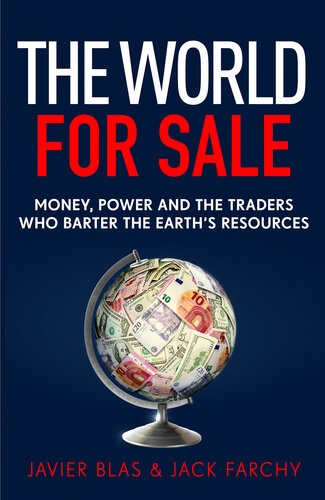
The World for Sale: Money, Power, and the Traders Who Barter the Earth's Resources
About this book
Javier Blas and Jack Farchy trace firms including Philipp Brothers, Marc Rich + Co., Glencore, Vitol, and Trafigura through decades of upheaval. Traders connect producers with buyers, finance cargoes, store materials, and profit from differences in place, time, information, and risk.
Their flexibility made them useful during oil shocks, the collapse of the Soviet Union, wars, embargoes, and China’s industrial expansion. The same opacity allowed deals with authoritarian governments, intermediaries, and politically exposed actors that public companies or banks might avoid.
The book explains physical trading through ships, mines, contracts, credit, and personal networks rather than treating commodities as ticker symbols. It also shows how concentrated knowledge of flows can become political influence without the visibility attached to major oil companies.
The World for Sale is reported business history by two former commodity journalists. It covers events through its publication period; readers assessing a current trader, sanction, or ownership structure should verify later filings and enforcement records.
Read a sample
5,173 words
Plain text
From the opening
INTRODUCTION
THE LAST SWASHBUCKLERS
The plane banked hard as it started its descent.
Far below, the placid waters of the Mediterranean had given way to a barren expanse of North African desert. Columns of smoke dotted the horizon. Inside the small private jet, the occupants were stony-faced, bracing against their seats as they descended in a series of stomach-churning corkscrew turns.
This wasn’t a normal business trip, even for Ian Taylor. In four decades trading oil, Taylor had set down in plenty of hot spots, from Caracas to Tehran. Yet this journey – destination Benghazi, Libya, in the midst of a civil war – was a new experience.
Taylor only had to look out of the window to be reminded of the risks he was running. A thousand feet below, a lonely NATO drone was chaperoning his plane. Taylor, chief executive of Vitol, the world’s largest oil-trading company, found himself wishing his contacts in the British government had sent a proper fighter jet to escort him.
It was early 2011, and the entire region was in the throes of a wave of popular uprisings that came to be known as the Arab Spring. In Libya, forces revolting against the forty-two-year dictatorship of Colonel Muammar Gaddafi had just taken control of Benghazi, the most important city in the east of the country, and founded their own government.
The rag-tag army of rebels had a big problem, however. It was running out of fuel. The rebels urgently needed diesel and gasoline for their military vehicles and heavy fuel oil to run their power stations. Libya’s own refineries had been shuttered by the war, leaving only a trickle of fuel entering the country via hundreds of trucks making the arduous trip from Egypt.
If anyone could take the risk of supplying a rebel army in the middle of a bloody war, it was Ian Taylor.1 Bald, wiry and tireless, Taylor had transformed Vitol from a mid-sized fuel distributor into an oil trading giant. In the process, he had made it a potent force in the global economy, handling enough oil every day to supply Germany, France, Spain, the UK and Italy combined.2 Now in his mid-fifties, he combined the easy charm of a member of the British establishment with the taste for adventure that was a prerequisite for an oil trader. He had never been afraid to lead Vitol to places where others feared to tread. And, in a world where oil and money go hand in hand with power, he was not one to shy away from deals that carried wider geopolitical significance.
When, a few weeks earlier, the possibility of a deal with the Libyan rebels had come up, Taylor hadn’t hesitated. Vitol’s team in the Middle East had received a call from the government of Qatar. The small gas-rich Gulf state had become a key political and financial backer of the Libyan rebels, acting as a go-between for them with Western governments and supplying them with weapons and cash. But buying tankers full of refined oil products and delivering them into a war zone was beyond Qatar’s capability. It needed the help of a commodity trader. The Qataris wanted to know if Vitol could supply diesel, gasoline and fuel oil to Benghazi.
Vitol had four hours to think about it, and respond. The trading house only needed four minutes to say yes.
But there was a big catch. The rebels had no cash. Instead, Vitol would have to take payment in the form of crude oil from the few oilfields that the rebels controlled. In theory, that shouldn’t have posed a problem: Vitol could deliver fuel across the Mediterranean to the port of Benghazi, while receiving crude oil via a pipeline to the coastal city of Tobruk, near the Egyptian border and far away from the fighting (see map on page 331).
Taylor and the rest of Vitol’s top brass quickly put together a proposal. It was nothing new for a big trading house like Vitol to barter one commodity for another, particularly when facing a cash-strapped customer. Indeed, other traders were also vying to take part in the deal with the Libyan rebels. But Vitol was more aggressive: it was willing not only to handle the shipments of fuel, but also to extend credit to the Libyan rebels, effectively lending them money.3
The company had another advantage: its political connections in London and Washington. Taylor, a gifted social operator with the charisma of a born politician, was a leading donor to the ruling Conservative Party. His contact book in London’s business and political elites was second to none. Only a few months later, he would join other financiers at a dinner with the prime minister at 10 Downing Street. ‘Obviously, I got permission from the Brits to go in,’ Taylor later recalled.4
In the UK, a covert ‘Oil Cell’ at the Foreign Office worked to prevent Gaddafi’s forces from obtaining fuel or selling crude internationally. Washington granted a sanctions waiver to allow US companies to buy Libyan oil from Vitol. And, of course, there was the NATO drone.
But while London and Washington were supportive of Vitol’s mission, they weren’t prepared to intervene too overtly on its behalf. As Taylor descended into what was still a war zone, he knew that, if something went wrong, he was on his own.
The possibility of anti-aircraft fire from Gaddafi’s forces meant that a conventional landing was too dangerous, so the pilot descended as fast as the jet could dive. Taylor was alone in the small plane apart from a pair of hired bodyguards and Chris Bake, a thick-set New Zealander who ran Vitol’s operations in the Middle East.
Continue reading the sampleClose the sample
If the descent made his stomach turn, Taylor didn’t get much comfort from what he found on the ground. In the spring of 2011, Benghazi was lawless and unstable. The city, a collection of dusty concrete buildings clustered around a fetid lagoon, was located just a few hundred kilometres from the frontline of a conflict that was still raging. The air was thick with the sounds and smells of war. Putrid-smelling hospitals were overflowing with amputees and other casualties. The dusty streets were filled with men and boys with Kalashnikov assault rifles strapped to their backs.
At night, random blackouts left the city without electricity for hours at a time. Patrols of heavily armed youths set up checkpoints at roads around the city. Out of this lawless environment would emerge the armed mob that, a year later, stormed the US consulate and killed Chris Stevens, the ambassador to Libya.
Benghazi’s citizens, exhausted by decades of dictatorship and months of war, cowered in their homes. Saif al-Islam, Gaddafi’s son, took to state television to make a bloodcurdling speech in which he promised further carnage: ‘We will fight until the last man, the last woman, the last bullet.’5
Benghazi had long been the hub of Libya’s oil industry. The country’s richest oil reserves were located in uninhabited expanses of desert in the country’s east – nearer to Benghazi than Tripoli, the capital, which was still firmly under Gaddafi’s control. Most of the oilfields had been abandoned as fighting swept the country, and Libya’s top geologists and oil engineers would meet in the evenings in Benghazi’s main square to discuss their country’s plight. A couple of kilometres away, the regional headquarters of the national oil company of Libya stood next to the blackened shell of a former police station that had been torched by the rebels in the first days of their uprising.
This was where Taylor and Bake headed once their plane had touched down. The man waiting to meet them was Nuri Berruien. A veteran engineer, Berruien had been preparing for retirement before the civil war broke out. By spring 2011 he was running the rebel branch of Libya’s national oil company, cutting the deal that could save the revolution.
If Taylor was going to deal with the rebels, he wanted to know who was on the other side of the transaction. He knew from decades of experience in the Middle East that a personal assurance could matter more than a carefully drafted contract. And, in any case, a contract would be of little use when dealing with a rebel government operating in makeshift ministries a thousand kilometres from the country’s capital.
Taylor was satisfied. The man on the other side of one of Vitol’s riskiest deals ever was not some war-crazed loon, but an oil industry pro. He shook hands and returned to London. ‘It was a gamble, but it was a reasonable gamble,’ he later said. On the other side, Berruien was also content: Vitol had offered him ‘the best terms’ and had not even bothered to ask for war insurance.6
Almost immediately, Vitol’s intervention shifted the balance of the war. Securing sufficient fuel had always been a crucial determinant of victory in North Africa’s empty stretches of desert. It was here in the Second World War that the army of Erwin Rommel, the German general popularly known as the ‘Desert Fox’, foundered after running out of fuel.
Now Libya’s rebel army had enough fuel to avoid Rommel’s fate. Thanks to Vitol, it could power its tanks and ‘tacticals’ – the improvised combination of a pick-up truck with a machine gun welded to its flatbed, which was the rebel military’s vehicle of choice.7
Despite air support from NATO and financial aid from Qatar, the rebels had failed to advance beyond their stronghold in the area around Benghazi. By the time of Taylor’s visit in spring 2011, their territory encompassed only the eastern region of Benghazi and a strip of coastline for a further 150 km southwest.
The key strategic goal was to take the oil towns further west – Marsa al-Brega, Ras Lanuf and Es Sider – through which Gaddafi loyalists still controlled access to Libya’s oil riches. Following the first deliveries of fuel from Vitol, Marsa al-Brega fell to the rebels on 17 July. Within weeks, they had taken Ras Lanuf and Es Sider, and from there seized control of the inland oilfields of the Sirte basin, the spot where oil had first been discovered in Libya in 1959.
By October, they had cornered Gaddafi loyalists in a small area to the west of Sirte. One day, a group of rebel fighters surprised Gaddafi’s convoy and the man who had ruled Libya with an iron fist for four decades fled, seeking shelter in a drainpipe. The rebels dragged him out and beat him to death – a gruesome moment of triumph that was filmed on a mobile phone and broadcast around the world.
For Vitol, though, triumph was still far away. The company’s plans had started going awry only a few days after Taylor and Berruien had shaken hands in Benghazi in the spring. Despite a promise that the existence of the deal would remain a secret, it soon became public that the rebels had agreed to sell their oil and receive fuel in exchange. In response, Gaddafi’s forces sent men across the desert to blow up the key Sarir–Tobruk pipeline, which linked the oilfields controlled by the rebels with an export terminal on the Mediterranean coast – the site where Vitol had anticipated taking delivery of the crude oil it was accepting as payment. ‘That was the end of their crude exports for a while,’ Bake recalls, grimly.8
Taylor had a dilemma. There was no longer any way for Vitol to get paid with crude shipments. Every cargo of fuel the trading house delivered now represented an ever-growing financial exposure to the rebels, who had no government, no central bank and little standing internationally. If Taylor continued supplying them, he was effectively betting his company that the rebels would win the war.
He decided to risk it. By then he’d spent thirty years building a network in the Middle East. If he walked away from the deal with Libya’s rebels, he’d not only be letting them down, but also his longstanding contacts in Qatar – a country that had long been a lucrative source of business for Vitol.
Rival traders believe there may have been another reason why Taylor felt comfortable sticking with his deal with the Libyan rebels: Gaddafi had billions of dollars frozen in Western bank accounts. Had the war ended badly for Vitol’s deal, Taylor’s friends in Western governments could have ensured that the trading house would be repaid from those frozen assets. (In September 2011, $300 million in Libyan assets in the West was unfrozen in order to help pay Vitol.)9 ‘We had no guarantees from anybody,’ insists David Fransen, chairman of Vitol in Switzerland and one of Taylor’s longest-standing partners. ‘We just got a few “You’ll be alright, do its”.’10
Over the coming months, Vitol’s tankers shipped cargo after cargo. The boats slipped into Libya’s ports at night, with orders to complete unloading and steal away again before dawn. At times, fighting was raging within earshot of the ship’s crew, who were standing on top of hundreds of thousands of barrels of highly flammable fuel.
With every shipment, the stakes grew higher for Vitol. Over five months, the trading house shipped thirty cargoes of gasoline, diesel, fuel oil and liquefied petroleum gas to Libya. At one point, as everyone waited for the war to end and oil production to restart, the amount owed by the rebel government to Vitol ballooned to more than $1 billion – a sum large enough to threaten the trader’s survival, and that it would have struggled to recover if the war had ended differently. ‘It was a deal which, to be honest, got much larger than it should have,’ Taylor said. ‘It could have gone very, very badly wrong.’11
It’s impossible to say how the Libyan civil war would have turned out if Vitol hadn’t taken on the deal to deliver fuel to the rebels, and then continued delivering even after it couldn’t be repaid. Perhaps another commodity trader would have taken Vitol’s place? Perhaps the Qatari government would have found another way to get fuel to the rebels?
But one thing is hard to dispute: without $1 billion of fuel in their moment of need, the rebels would have certainly been defeated. ‘The fuel from Vitol was very important for the military,’ Abdeljalil Mayuf, an official at rebel-controlled Arabian Gulf Oil in Benghazi, said in 2011.12 It was not the first time an oil trader had shaped the history of the Middle East, and wouldn’t be the last.
For Libya, however, the story didn’t have a happy ending. In the years after Taylor flew into Benghazi, the country lurched from one conflict to another. Gaddafi’s death didn’t end the fighting: local warlords in the country’s west and east continued to battle over its oil resources. In 2014, Libya descended into a second civil war – which, at the time of writing, is still smouldering. And the fall of Gaddafi had wider destabilising effects across the whole region, as the Libyan army’s arsenal was smuggled out to conflict zones including Syria, where the terrorist group Islamic State was beginning to gain a foothold.13
As the dead bodies piled up in Libya and the effects of its civil war rippled across the Middle East, Taylor came to question the wisdom of his intervention. ‘It’s hard to know whether we got it all right,’ he told an interviewer in 2019. ‘I was thinking about Libya the other day and was really upset about it – maybe we shouldn’t have done that one.’14
Vitol’s deals in Libya are a demonstration of the enormous power that commodity traders wield in the modern world. Few of us experience their might as directly as the Libyans, but whether or not we know it, we are all their customers. Most of us take for granted the ease with which we can fill up our cars, buy a new smartphone or order a cup of Colombian coffee. But underpinning almost all of our consumption is a frenetic international trade in natural resources. And underpinning that trade, from their offices in sleepy towns in Switzerland or New England, are the commodity traders.
Little noticed and little scrutinised, the commodity traders have become essential cogs in the modern economy. Without them, petrol stations would run out of fuel, factories would grind to a halt and bakeries would run out of flour. They are, in the words of Ludwig Jesselson, one of the industry’s pioneers, an ‘international clearing-house for essential goods’.15
Their influence is not limited to the economy: the commodity traders’ control over the flow of the world’s strategic resources has also made them powerful political actors. To grasp the interplay of money and power in the modern world, to see how oil and metals flow out of resource-rich countries and cash flows into the pockets of tycoons and kleptocrats, you need to understand the commodity traders. They usually say they are apolitical, motivated by profit rather than the pursuit of power. But there is little doubt that, as Vitol’s deals with Libya’s rebels show, they have shaped history.
In Iraq, the commodity traders helped Saddam Hussein to sell his oil, bypassing UN sanctions; in Cuba, they swapped sugar for oil with Fidel Castro, helping to keep the Communist revolution alive; and they secretly sold millions of tonnes of US wheat and corn to the Soviet Union, propping up Moscow at the height of the Cold War. When Igor Sechin, the boss of Russian oil giant Rosneft and an ally of President Vladimir Putin, needed to raise $10 billion in short order, whom did he call? The commodity traders.
They are the last swashbucklers of global capitalism: willing to do business where other companies don’t dare set foot, thriving through a mixture of ruthlessness and personal charm. But while the importance of the commodity traders has grown in recent decades, their numbers have remained relatively small: a large share of the world’s traded resources is handled by just a few companies, many of them owned by just a few people. The five largest oil trading houses handle 24 million barrels a day of crude and refined products, such as gasoline and jet fuel, equivalent to almost a quarter of the world’s petroleum demand.16 The seven leading agricultural traders handle just under half of the world’s grains and oilseeds.17 Glencore, the largest metals trader, accounts for a third of the world’s supply of cobalt, a crucial raw material for electric vehicles.18 But even those numbers understate the traders’ role: as the fastest and most aggressive participants in the market, it is often their trades that set the price.
As journalists covering natural resources over the past two decades, we have been struck by the power and influence that is concentrated in just a few commodity traders’ hands, and equally surprised by how little is known about them – particularly by regulators and governments. To some extent that’s by design. For the most part, the commodity traders are privately owned companies, with less obligation to disclose information about their activities than their publicly listed counterparts. Many have traditionally viewed their superior access to information as a competitive edge – and so have gone to great lengths to avoid giving out any information about themselves. As Ian Taylor, who died in 2020, said as he sat down with us for an interview for this book: ‘We would prefer you not to write it.’19
So the industry has remained in the shadows, barring the odd flurry of interest – usually when prices surge or when scandals break. In three-quarters of a century, only a handful of books has been written about it. And journalists have, with a few exceptions, given up on trying to write about companies who greet their questions with a wall of silence (and, occasionally, threatening legal letters).
That’s something we experienced at first hand working for the Financial Times and Bloomberg News. When we started writing about commodities in the early 2000s, we were intrigued by the traders. Many people in the natural resources industry seemed to believe they were the hidden hand behind moves in prices or political events. Yet they almost never appeared in public, or in the pages of the newspapers. Few of our colleagues had ever heard of them, let alone spoken to them.
Our curiosity only grew when we first tried to make contact. Glencore had deputised one of its in-house financiers to tell journalists, politely but firmly, that they could take their questions elsewhere. His first tack was to try to persuade us that our interest was misplaced. (Glencore was, at that time, already the world’s largest commodity trader.) ‘We are a little company of no interest to anyone,’ the person said. We would do better to spend our time writing about more interesting companies, he recommended.
Louis Dreyfus, one of the largest agricultural commodity traders, employed an even simpler technique. It gave journalists the email address and phone number of an executive to contact with questions. But the phone was never answered, and the emails were never returned. When, after weeks of fruitless attempts, the elusive executive finally answered the phone, he said that, yes, of course he had seen our emails. Why, then, had he not responded, even with ‘no comment’, long the favourite response of a stonewalling PR man? His lack of response, he replied enigmatically, should have been seen as a form of response in itself. And then he hung up.
This book grew out of a desire to understand and explain these enigmatic companies and individuals. We were lucky with our timing: our interest came at a moment when the commodity traders were coming out of the shadows. Most strikingly, Glencore went public in 2011, in the largest ever flotation on the London market – a move that forced it to start opening up about its finances, and submitting itself to questions from investors and the media. Its competitors, too, started hiring PR consultants, publishing information about their finances and giving interviews to journalists.
In over a year of research for this book, we’ve interviewed more than one hundred active and retired commodity traders. Some have turned us down, but many more have been willing to talk, perhaps encouraged by the passage of time to open up their world to outsiders. We’ve spoken to more than two dozen current and former Glencore partners, to every living founder of Trafigura, and to a dozen current and former executives of Vitol. The process of carrying out the interviews has offered its own insights into the riches that the commodity trade has generated. We interviewed Andy Hall, who has a good claim to being the world’s most famous living oil trader, at his 1,000-year-old castle, bedecked with modern art, near Hanover. Another retired oil trader invited us to his stud farm in the English home counties. A third hosted us at his chalet in an exclusive Swiss ski resort.
Many of the current crop of commodity traders were more guarded in their interactions with us, although every major trading house offered us a meeting, with the exception of Archer Daniels Midland. The chief executives of each of the largest oil, metals and agriculture traders gave us an interview. Some were more forthcoming than others. Ivan Glasenberg, the boss of Glencore, whose company was at the time of research being investigated by the US Justice Department in a corruption and money-laundering probe, invited us to an interview on the top floor of his company’s boxy Swiss headquarters. Then, with his lawyer on one side and his PR man on the other, he parried our questions for five combative hours, insisting that large swathes of our conversation could not be quoted.
The history recounted in this book is based primarily on all those interviews. Where we’ve recounted historical events or encounters, we have based them on the accounts of at least one person who was involved. Where different people differ in their recollections of the details, we’ve noted that in the text.
Have the traders always been entirely honest with us? We’ll leave the reader to judge. When it comes to the more dubious corners of the business of commodity trading, we’ve received a variety of responses. One former Glencore trader began his conversation with us with the words: ‘What I’m going to tell you is not going to be the whole truth and nothing but the truth. There are things I’m just not going to tell you.’ Another trader shut down the conversation whenever it turned to the more scurrilous moments of his career. But he would not have made a good poker player. When we asked how he had managed to secure such a lucrative oil deal in Nigeria or Iran, a smile flickered across his face and his eyes twinkled with everything left unsaid.
We haven’t relied solely on the traders’ own accounts of themselves. This book is the product of twenty years of learning about the commodity traders. In that time we’ve not only met and interviewed hundreds of traders, but also travelled to dozens of countries, from war-torn Libya to the US farm belt, to talk to the people who do business with the traders, the government officials who interact with them, and the ordinary citizens who are affected by their activities. We’ve also gathered thousands of pages of documents, many of which have never been published, detailing the traders’ finances, the networks of companies they own, and the structure of their deals.
*
The term ‘commodity trader’ conjures a variety of different images, from the roaring trading pits of Chicago to the banks of computer screens on a Wall Street trading floor. But the focus of this book is the companies and individuals whose business is buying and selling physical commodities. It is they who control the flow of natural resources around the world; it is in their hands that an almost unique type of political and economic power is concentrated.
That definition excludes the Wall Street banks and hedge funds that bet vast sums on moves in prices without ever coming close to an actual barrel of oil, a bushel of wheat or a tonne of copper. It also excludes the big miners and oil companies that have sophisticated networks around the world to sell their iron ore, copper or oil, but wouldn’t consider it their business to buy and sell commodities they hadn’t produced.
Of course, the category of commodity trader is somewhat blurry around the edges: some large oil companies, such as BP and Shell, are also major traders above and beyond the oil that is produced at the fields they own. Banks like Goldman Sachs and Morgan Stanley have, at various points in history, also been significant traders of physical commodities. Japan too has a long history of general trading companies, the sogo shosha, whose principal role has been to secure the natural resource imports needed by Japanese manufacturers, but which have also dabbled in international commodity trading – occasionally with disastrous consequences.
While some of these feature occasionally in our story, our focus is on the companies and individuals whose main activity is neither producing nor consuming commodities, but trading them. These are the companies sometimes known as the ‘independent traders’ or the ‘trading houses’. Even then, we can’t hope to provide an exhaustive account of every trader of every commodity in history. Instead, we have focused on the companies that have dominated the traded markets in oil, metals and agriculture over the past seventy-five years, and which have had a critical role in the development of the global economy.
Many of those companies belong to a single corporate dynasty. While Glencore dominates commodity trading today, in the 1980s it was Marc Rich + Co that played the dominant role, and, in the 1960s and 1970s, Philipp Brothers. The companies have an almost familial connection: Marc Rich was a senior trader at Philipp Brothers before he left to found the company that bore his name; and Marc Rich + Co was renamed Glencore when the top traders ejected Rich from the company he had founded.
Today, Glencore is the largest metals trader, a top-three oil trader, and the world’s largest wheat trader. The company has emerged from Marc Rich’s shadow to become a blue-chip stock. From an unassuming building in a quiet Swiss town, it has interests stretching from Canadian wheat to Peruvian copper and Russian oil. Here, the traders are mirror images of their boss, Glasenberg – they talk in the same clipped tones, they join him on morning runs, and quite a few of them are, like him, South Africans with a training in accounting. And they match the tireless work ethic of a man who thinks nothing of calling a journalist at 6 a.m. on a Sunday morning to discuss a story.
Trafigura belongs to the same dynasty. It was started by a group of disaffected former Marc Rich employees who struck out on their own in 1993. The company, now the world’s second-largest oil and metals trader, has held on to its underdog mentality, as well as a French sense of style inherited from its founder, Claude Dauphin.
In oil, the leading trader is Vitol, whose executives exude the confidence of the British establishment – as befits a firm whose office is just a few metres away from Buckingham Palace, and whose long-time CEO Ian Taylor was a regular visitor to 10 Downing Street.
In agriculture, Cargill is king. The US company, the world’s largest trader of grains, carries itself with the quiet self-assurance of the generations of Midwest wealth on which it was built. As the major trading house that has been at the pinnacle of its industry the longest, it is also the most corporate – with its own archivist and its own authorised company history, which runs to three volumes, at a total length of 1,774 pages.
Within these companies there is an extraordinary cast of characters: manically hard-working, fiercely smart, disarmingly personable, and singularly focused on making money. One thing there is not much of in the commodity trading industry is women. The commodity trading companies make Wall Street banks look progressive on gender diversity. Glencore was the last member of the UK’s FTSE 100 index of leading companies to have an all-male board, before it appointed its first female director in 2014.20 Fewer than one in twenty senior executives in the commodity trading industry are women.21 Some of the largest commodity traders, such as Vitol and Trafigura, don’t have a single woman among their top executives. Glencore, in its annual report published in March 2020, said it wouldn’t hit a target set by investors to have a third of its senior management made up of women by the end of the year: ‘Still today we find it challenging to fill senior positions … by women.’22 It’s not just on gender diversity that the commodity traders fall down: their upper echelons are not only overwhelmingly male, but also overwhelmingly white.