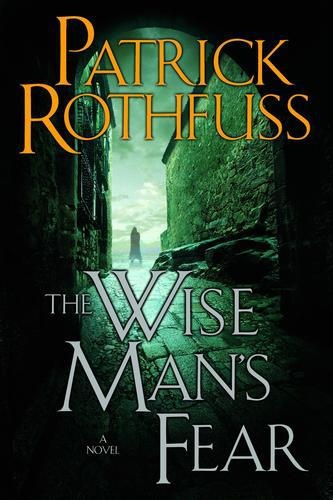
The Wise Man's Fear
About this book
At the Waystone Inn, Kvothe resumes the second day of his account while the world outside shows signs of a wider collapse. The confident legend and the quiet innkeeper remain visibly the same man, though the path between them is still incomplete.
Young Kvothe struggles with tuition, rival Ambrose, music, and his unresolved search for the Chandrian. An opportunity in Vintas takes him from the University into the service of the Maer, whose court offers influence and another form of danger.
The journey expands through the Eld, the Fae, and Ademre. Kvothe collects skills and stories that later become legend, but his own narration keeps showing how intelligence, pride, poverty, and incomplete knowledge distort the victories he remembers.
The Wise Man's Fear is the second Kingkiller Chronicle novel. Its episodic travels deepen the world's languages and myths while preserving the frame's central unease: the hero telling the story no longer seems able to perform the feats attached to his name.
Read a sample
5,040 words
Plain text
From the opening
PROLOGUE
A Silence of Three Parts
DAWN WAS COMING. The Waystone Inn lay in silence, and it was a silence of three parts.
The most obvious part was a vast, echoing quiet made by things that were lacking. If there had been a storm, raindrops would have tapped and pattered against the selas vines behind the inn. Thunder would have muttered and rumbled and chased the silence down the road like fallen autumn leaves. If there had been travelers stirring in their rooms they would have stretched and grumbled the silence away like fraying, half-forgotten dreams. If there had been music . . . but no, of course there was no music. In fact there were none of these things, and so the silence remained.
Inside the Waystone a dark-haired man eased the back door closed behind himself. Moving through the perfect dark, he crept through the kitchen, across the taproom, and down the basement stairs. With the ease of long experience, he avoided loose boards that might groan or sigh beneath his weight. Each slow step made only the barest tep against the floor. In doing this he added his small, furtive silence to the larger echoing one. They made an amalgam of sorts, a counterpoint.
The third silence was not an easy thing to notice. If you listened long enough you might begin to feel it in the chill of the window glass and the smooth plaster walls of the innkeeper’s room. It was in the dark chest that lay at the foot of a hard and narrow bed. And it was in the hands of the man who lay there, motionless, watching for the first pale hint of dawn’s coming light.
The man had true-red hair, red as flame. His eyes were dark and distant, and he lay with the resigned air of one who has long ago abandoned any hope of sleep.
The Waystone was his, just as the third silence was his. This was appropriate, as it was the greatest silence of the three, holding the others inside itself. It was deep and wide as autumn’s ending. It was heavy as a great riversmooth stone. It was the patient, cut-flower sound of a man who is waiting to die.
CHAPTER ONE
Apple and Elderberry
BAST SLOUCHED AGAINST THE long stretch of mahogany bar, bored. Looking around the empty room, he sighed and rummaged around until he found a clean linen cloth. Then, with a resigned look, he began to polish a section of the bar.
After a moment Bast leaned forward and squinted at some half-seen speck. He scratched at it and frowned at the oily smudge his finger made. He leaned closer, fogged the bar with his breath, and buffed it briskly. Then he paused, exhaled hard against the wood, and wrote an obscene word in the fog.
Tossing aside the cloth, Bast made his way through the empty tables and chairs to the wide windows of the inn. He stood there for a long moment, looking at the dirt road running through the center of the town.
Bast gave another sigh and began to pace the room. He moved with the casual grace of a dancer and the perfect nonchalance of a cat. But when he ran his hands through his dark hair the gesture was restless. His blue eyes prowled the room endlessly, as if searching for a way out. As if searching for something he hadn’t seen a hundred times before.
But there was nothing new. Empty tables and chairs. Empty stools at the bar. Two huge barrels loomed on the counter behind the bar, one for whiskey, one for beer. Between the barrels stood a vast panoply of bottles: all colors and shapes. Above the bottles hung a sword.
Bast’s eyes fell back onto the bottles. He focused on them for a long, speculative moment, then moved back behind the bar and brought out a heavy clay mug.
Drawing a deep breath, he pointed a finger at the first bottle in the bottom row and began to chant as he counted down the line.
Maple. Maypole.
Catch and carry.
Ash and Ember.
Elderberry.
He finished the chant while pointing at a squat green bottle. He twisted out the cork, took a speculative sip, then made a sour face and shuddered. He quickly set the bottle down and picked up a curving red one instead. He sipped this one as well, rubbed his wet lips together thoughtfully, then nodded and splashed a generous portion into his mug.
He pointed at the next bottle and started counting again:Woolen. Woman.
Moon at night.
Willow. Window.
Candlelight.
This time it was a clear bottle with a pale yellow liquor inside. Bast yanked the cork and added a long pour to the mug without bothering to taste it first. Setting the bottle aside, he picked up the mug and swirled it dramatically before taking a mouthful. He smiled a brilliant smile and flicked the new bottle with his finger, making it chime lightly before he began his singsong chant again:Barrel. Barley.
Stone and stave.
Wind and water—
A floorboard creaked, and Bast looked up, smiling brightly. “Good morning, Reshi.”
The red-haired innkeeper stood at the bottom of the stairs. He brushed his long-fingered hands over the clean apron and full-length sleeves he wore. “Is our guest awake yet?”
Bast shook his head. “Not a rustle or a peep.”
Continue reading the sampleClose the sample
“He’s had a hard couple of days,” Kote said. “It’s probably catching up with him.” He hesitated, then lifted his head and sniffed. “Have you been drinking?” The question was more curious than accusatory.
“No,” Bast said.
The innkeeper raised an eyebrow.
“I’ve been tasting,” Bast said, emphasizing the word. “Tasting comes before drinking.”
“Ah,” the innkeeper said. “So you were getting ready to drink then?”
“Tiny Gods, yes,” Bast said. “To great excess. What the hell else is there to do?” Bast brought his mug up from underneath the bar and looked into it. “I was hoping for elderberry, but I got some sort of melon.” He swirled the mug speculatively. “Plus something spicy.” He took another sip and narrowed his eyes thoughtfully. “Cinnamon?” he asked, looking at the ranks of bottles. “Do we even have any more elderberry?”
“It’s in there somewhere,” the innkeeper said, not bothering to look at the bottles. “Stop a moment and listen, Bast. We need to talk about what you did last night.”
Bast went very still. “What did I do, Reshi?”
“You stopped that creature from the Mael,” Kote said.
“Oh.” Bast relaxed, making a dismissive gesture. “I just slowed it down, Reshi. That’s all.”
Kote shook his head. “You realized it wasn’t just some madman.You tried to warn us. If you hadn’t been so quick on your feet . . .”
Bast frowned. “I wasn’t so quick, Reshi. It got Shep.” He looked down at the well scrubbed floorboards near the bar. “I liked Shep.”
“Everyone else will think the smith’s prentice saved us,” Kote said. “And that’s probably for the best. But I know the truth. If not for you, it would have slaughtered everyone here.”
“Oh Reshi, that’s just not true,” Bast said. “You would have killed it like a chicken. I just got it first.”
The innkeeper shrugged the comment away. “Last night has me thinking,” he said. “Wondering what we could do to make things a bit safer around here. Have you ever heard the ‘White Riders’ Hunt’?”
Bast smiled. “It was our song before it was yours, Reshi.” He drew a breath and sang in a sweet tenor:Rode they horses white as snow.
Silver blade and white horn bow.
Wore they fresh and supple boughs,
Red and green upon their brows.
The innkeeper nodded. “Exactly the verse I was thinking of. Do you think you could take care of it while I get things ready here?”
Bast nodded enthusiastically and practically bolted, pausing by the kitchen door. “You won’t start without me?” he asked anxiously.
“We’ll start as soon as our guest is fed and ready,” Kote said. Then, seeing the expression on his student’s face, he relented a little. “For all that, I imagine you have an hour or two.”
Bast glanced through the doorway, then back.
Amusement flickered over the innkeeper’s face. “And I’ll call before we start.” He made a shooing motion with one hand. “Go on now.”
The man who called himself Kote went through his usual routine at the Waystone Inn. He moved like clockwork, like a wagon rolling down the road in well-worn ruts.
First came the bread. He mixed flour and sugar and salt with his hands, not bothering to measure. He added a piece of starter from the clay jar in the pantry, kneaded the dough, then rounded the loaves and set them to rise. He shoveled ash from the stove in the kitchen and kindled a fire.
Next he moved into the common room and laid a fire in the black stone fireplace, brushing the ash from the massive hearth along the northern wall. He pumped water, washed his hands, and brought up a piece of mutton from the basement. He cut fresh kindling, carried in firewood, punched down the rising bread and moved it close to the now-warm stove.
And then, abruptly, there was nothing left to do. Everything was ready. Everything was clean and orderly. The red-haired man stood behind the bar, his eyes slowly returning from their faraway place, focusing on the here and now, on the inn itself.
They came to rest on the sword that hung on the wall above the bottles. It wasn’t a particularly beautiful sword, not ornate or eye-catching. It was menacing, in a way. The same way a tall cliff is menacing. It was grey and unblemished and cold to the touch. It was sharp as shattered glass. Carved into the black wood of the mounting board was a single word: Folly.
The innkeeper heard heavy footsteps on the wooden landing outside. The door’s latch rattled noisily, followed by a loud hellooo and a thumping on the door.
“Just a moment!” Kote called. Hurrying to the front door he turned, the heavy key in the door’s bright brass lock.
Graham stood with his thick hand poised to knock on the door. His weathered face split into a grin when he saw the innkeeper. “Bast open things up for you again this morning?” he asked.
Kote gave a tolerant smile.
“He’s a good boy,” Graham said. “Just a little ditherheaded. I thought you might have closed up shop today.” He cleared his throat and glanced at his feet for a moment. “I wouldn’t be surprised, considering.”
Kote put the key in his pocket. “Open as always. What can I do for you?”
Graham stepped out of the doorway and nodded toward the street where three barrels stood in a nearby cart. They were new, with pale, polished wood and bright metal bands. “I knew I wasn’t getting any sleep last night, so I knocked the last one together for you. Besides, I heard the Bentons would be coming round with the first of the late apples today.”
“I appreciate that.”
“Nice and tight so they’ll keep through the winter.” Graham walked over and rapped a knuckle proudly against the side of the barrel. “Nothing like a winter apple to stave off hunger.” He looked up with a glimmer in his eye and knocked at the side of the barrel again. “Get it? Stave?”
Kote groaned a bit, rubbing at his face.
Graham chuckled to himself and ran a hand over one of the barrel’s bright metal bands. “I ain’t ever made a barrel with brass before, but these turned out nice as I could hope for. You let me know if they don’t stay tight. I’ll see to ’em.”
“I’m glad it wasn’t too much trouble,” the innkeeper said. “The cellar gets damp. I worry iron would just rust out in a couple years.”
Graham nodded. “That’s right sensible,” he said. “Not many folk take the long view of things.” He rubbed his hands together. “Would you like to give me a hand? I’d hate to drop one and scuff your floors.”
They set to it. Two of the brass-bound barrels went to the basement while the third was maneuvered behind the bar, through the kitchen, and into the pantry.
After that, the men made their way back to the common room, each on their own side of the bar. There was a moment of silence as Graham looked around the empty taproom. There were two fewer stools than there should be at the bar, and an empty space left by an absent table. In the orderly taproom these things were conspicuous as missing teeth.
Graham pulled his eyes from a well-scrubbed piece of floor near the bar. He reached into his pocket and brought out a pair of dull iron shims, his hand hardly shaking at all. “Bring me up a short beer, would you, Kote?” he asked, his voice rough. “I know it’s early, but I’ve got a long day ahead of me. I’m helping the Murrions bring their wheat in.”
The innkeeper drew the beer and handed it over silently. Graham drank half of it off in a long swallow. His eyes were red around the edges. “Bad business last night,” he said without making eye contact, then took another drink.
Kote nodded. Bad business last night. Chances are, that would be all Graham had to say about the death of a man he had known his whole life. These folk knew all about death. They killed their own livestock. They died from fevers, falls, or broken bones gone sour. Death was like an unpleasant neighbor. You didn’t talk about him for fear he might hear you and decide to pay a visit.
Except for stories, of course. Tales of poisoned kings and duels and old wars were fine. They dressed death in foreign clothes and sent him far from your door. A chimney fire or the croup-cough were terrifying. But Gibea’s trial or the siege of Enfast, those were different. They were like prayers, like charms muttered late at night when you were walking alone in the dark. Stories were like ha’penny amulets you bought from a peddler, just in case.
“How long is that scribe fellow going to be around?” Graham asked after a moment, voice echoing in his mug. “Maybe I should get a bit of something writ up, just in case.” He frowned a bit. “My daddy always called them laying-down papers. Can’t remember what they’re really called.”
“If it’s just your goods that need looking after, it’s a disposition of property,” the innkeeper said matter-of-factly. “If it relates to other things it’s called a mandamus of declared will.”
Graham lifted an eyebrow at the innkeeper.
“What I heard at any rate,” the innkeeper said, looking down and rubbing the bar with a clean white cloth. “Scribe mentioned something along those lines.”
“Mandamus . . .” Graham murmured into his mug. “I reckon I’ll just ask him for some laying-down papers and let him official it up however he likes.” He looked up at the innkeeper. “Other folk will probably be wanting something similar, times being what they are.”
For a moment it looked like the innkeeper frowned with irritation. But no, he did nothing of the sort. Standing behind the bar he looked the same as he always did, his expression placid and agreeable. He gave an easy nod. “He mentioned he’d be setting up shop around midday,” Kote said. “He was a bit unsettled by everything last night. If anyone shows up earlier than noon I expect they’ll be disappointed.”
Graham shrugged. “Shouldn’t make any difference. There won’t be but ten people in the whole town until lunchtime anyway.” He took another swallow of beer and looked out the window. “Today’s a field day and that’s for sure.”
The innkeeper seemed to relax a bit. “He’ll be here tomorrow too. So there’s no need for everyone to rush in today. Folk stole his horse off by Abbot’s Ford, and he’s trying to find a new one.”
Graham sucked his teeth sympathetically. “Poor bastard. He won’t find a horse for love nor money with harvest in mid-swing. Even Carter couldn’t replace Nelly after that spider thing attacked him off by the Oldstone bridge.” He shook his head. “It doesn’t seem right, something like that happening not two miles from your own door. Back when—”
Graham stopped. “Lord and lady, I sound like my old da.” He tucked in his chin and added some gruff to his voice. “Back when I was a boy we had proper weather. The miller kept his thumb off the scale and folk knew to look after their own business.”
The innkeeper’s face grew a wistful smile. “My father said the beer was better, and the roads had fewer ruts.”
Graham smiled, but it faded quickly. He looked down, as if uncomfortable with what he was about to say. “I know you aren’t from around here, Kote. That’s a hard thing. Some folk think a stranger can’t hardly know the time of day.”
He drew a deep breath, still not meeting the inkeeper’s eyes. “But I figure you know things other folk don’t. You’ve got sort of a wider view.” He looked up, his eyes serious and weary, dark around the edges from lack of sleep. “Are things as grim as they seem lately? The roads so bad. Folk getting robbed and . . .”
With an obvious effort, Graham kept himself from looking at the empty piece of floor again. “All the new taxes making things so tight. The Grayden boys about to lose their farm. That spider thing.” He took another swallow of beer. “Are things as bad as they seem? Or have I just gotten old like my da, and now everything tastes a little bitter compared to when I was a boy?”
Kote wiped at the bar for a long moment, as if reluctant to speak. “I think things are usually bad one way or another,” he said. “It might be that only us older folk can see it.”
Graham began to nod, then frowned. “Except you’re not old, are you? I forget that most times.” He looked the red-haired man up and down. “I mean, you move around old, and you talk old, but you’re not, are you? I’ll bet you’re half my age.” He squinted at the innkeeper. “How old are you, anyway?”
The innkeeper gave a tired smile. “Old enough to feel old.”
Graham snorted. “Too young to make old man noises. You should be out chasing women and getting into trouble. Leave us old folk to complain about how the world is getting all loose in the joints.”
The old carpenter pushed himself away from the bar and turned to walk toward the door. “I’ll be back to talk to your scribe when we break for lunch today. I en’t the only one, either. There’s a lot of folks that’ll want to get some things set down official when they’ve got the chance.”
The innkeeper drew a deep breath and let it out slowly. “Graham?”
The man turned with one hand on the door.
“It’s not just you,” Kote said. “Things are bad, and my gut tells me they’ll get worse yet. It wouldn’t hurt a man to get ready for a hard winter. And maybe see that he can defend himself if need be.” The innkeeper shrugged. “That’s what my gut tells me, anyway.”
Graham’s mouth set into a grim line. He bobbed his head once in a serious nod. “I’m glad it’s not just my gut, I suppose.”
Then he forced a grin and began to cuff up his shirt sleeves as he turned to the door. “Still,” he said, “you’ve got to make hay while the sun shines.”
Not long after that the Bentons stopped by with a cartload of late apples. The innkeeper bought half of what they had and spent the next hour sorting and storing them.
The greenest and firmest went into the barrels in the basement, his gentle hands laying them carefully in place and packing them in sawdust before hammering down the lids. Those closer to full ripe went to the pantry, and any with a bruise or spot of brown were doomed to be cider apples, quartered and tossed into a large tin washtub.
As he sorted and packed, the red-haired man seemed content. But if you looked more closely you might have noticed that while his hands were busy, his eyes were far away. And while his expression was composed, pleasant even, there was no joy in it. He did not hum or whistle while he worked. He did not sing.
When the last of the apples were sorted, he carried the metal tub through the kitchen and out the back door. It was a cool autumn morning, and behind the inn was a small, private garden sheltered by trees. Kote tumbled a load of quartered apples into the wooden cider press and spun the top down until it no longer moved easily.
Kote cuffed up the long sleeves of his shirt past his elbows, then gripped the handles of the press with his long, graceful hands and pulled. The press screwed down, first packing the apples tight, then crushing them. Twist and regrip. Twist and regrip.
If there had been anyone to see, they would have noticed his arms weren’t the doughy arms of an innkeeper. When he pulled against the wooden handles, the muscles of his forearms stood out, tight as twisted ropes. Old scars crossed and recrossed his skin. Most were pale and thin as cracks in winter ice. Others were red and angry, standing out against his fair complexion.
The innkeeper’s hands gripped and pulled, gripped and pulled. The only sounds were the rhythmic creak of the wood and the slow patter of the cider as it ran into the bucket below. There was a rhythm to it, but no music, and the innkeeper’s eyes were distant and joyless, so pale a green they almost could have passed for grey.
CHAPTER TWO
Holly
CHRONICLER REACHED THE BOTTOM of the stairs and stepped into the Waystone’s common room with his flat leather satchel over one shoulder. Stopping in the doorway, he eyed the red-haired innkeeper hunched intently over something on the bar.
Chronicler cleared his throat as he stepped into the room. “I’m sorry to have slept so late,” he said. “It’s not really . . .” He stalled out when he saw what was on the bar. “Are you making a pie?”
Kote looked up from crimping the edge of the crust with his fingers. “Pies,” he said, stressing the plural. “Yes. Why?”
Chronicler opened his mouth, then closed it. His eyes flickered to the sword that hung, grey and silent behind the bar, then back to the red-haired man carefully pinching crust around the edge of a pan. “What kind of pie?”
“Apple.” Kote straightened and cut three careful slits into the crust covering the pie. “Do you know how difficult it is to make a good pie?”
“Not really,” Chronicler admitted, then looked around nervously. “Where’s your assistant?”
“God himself can only guess at such things,” the innkeeper said. “It’s quite hard. Making pies, I mean. You wouldn’t think it, but there’s quite a lot to the process. Bread is easy. Soup is easy. Pudding is easy. But pie is complicated. It’s something you never realize until you try it for yourself.”
Chronicler nodded in vague agreement, looking uncertain as to what else might be expected of him. He shrugged the satchel off his shoulder and set it on a nearby table.
Kote wiped his hands on his apron. “When you press apples for cider, you know the pulp that’s left over?”
“The pomace?”
“Pomace,” Kote said with profound relief. “That’s what it’s called. What do people do with it, after they get the juice out?”
“Grape pomace can make a weak wine,” Chronicler said. “Or oil, if you’ve got a lot. But apple pomace is pretty useless. You can use it as fertilizer or mulch, but it’s not much good as either. Folk feed it to their livestock mostly.”
Kote nodded, looking thoughtful. “It didn’t seem like they’d just throw it out. They put everything to use one way or another around here. Pomace.” He spoke as if he were tasting the word. “That’s been bothering me for two years now.”
Chronicler looked puzzled. “Anyone in town could have told you that.”
The innkeeper frowned. “If it’s something everyone knows, I can’t afford to ask,” he said.
There was the sound of a door banging closed, followed by a bright, wandering whistle. Bast emerged from the kitchen carrying a bristling armload of holly boughs wrapped in a white sheet.
Kote nodded grimly and rubbed his hands together. “Lovely. Now how do we—” His eyes narrowed. “Are those my good sheets?”
Bast looked down at the bundle. “Well Reshi,” he said slowly, “that depends. Do you have any bad sheets?”
The innkeeper’s eyes flashed angrily for a second, then he sighed. “It doesn’t matter, I suppose.” He reached over and pulled a single long branch from the bundle. “What do we do with this, anyway?”
Bast shrugged. “I’m running dark on this myself, Reshi. I know the Sithe used to ride out wearing holly crowns when they hunted the skin dancers. . . .”
“We can’t walk around wearing holly crowns,” Kote said dismissively. “Folk would talk.”
“I don’t care what the local plods think,” Bast murmured as he began to weave several long, flexible branches together. “When a dancer gets inside your body, you’re like a puppet. They can make you bite out your own tongue.” He lifted a half-formed circle up to his own head, checking the fit. He wrinkled his nose. “Prickly.”
“In the stories I’ve heard,” Kote said, “holly traps them in a body, too.”
“Couldn’t we just wear iron?” Chronicler asked. The two men behind the bar looked at him curiously, as if they’d almost forgotten he was there. “I mean, if it’s a faeling creature—”
“Don’t say faeling,” Bast said disparagingly. “It makes you sound like a child. It’s a Fae creature. Faen, if you must.”
Chronicler hesitated for a moment before continuing. “If this thing slid into the body of someone wearing iron, wouldn’t that hurt it? Wouldn’t it just jump out again?”
“They can make you bite. Out. Your own. Tongue,” Bast repeated, as if speaking to a particularly stupid child. “Once they’re in you, they’ll use your hand to pull out your own eye as easy as you’d pick a daisy. What makes you think they couldn’t take the time to remove a bracelet or a ring?” He shook his head, looking down as he worked another bright green branch of holly into the circle he held. “Besides, I’ll be damned if I’m wearing iron.”
“If they can jump out of bodies,” Chronicler said. “Why didn’t it just leave that man’s body last night? Why didn’t it hop into one of us?”
There was a long, quiet moment before Bast realized the other two men were looking at him. “You’re asking me?” He laughed incredulously. “I have no idea. Anpauen. The last of the dancers were hunted down hundreds of years ago. Long before my time. I’ve just heard stories.”
“Then how do we know it didn’t jump out?” Chronicler said slowly, as if reluctant even to ask. “How do we know it isn’t still here?” He sat very stiffly in his seat. “How do we know it’s not in one of us right now?”
“It seemed like it died when the mercenary’s body died,” Kote said. “We would have seen it leave.” He glanced over at Bast. “They’re supposed to look like a dark shadow or smoke when they leave the body, aren’t they?”
Bast nodded. “Plus, if it had hopped out, it would have just started killing folk with the new body. That’s what they usually do. They switch and switch until everyone is dead.”
The innkeeper gave Chronicler a reassuring smile. “See? It might not even have been a dancer. Perhaps it was just something similar.”
Chronicler looked a little wild around the eyes. “But how can we be sure? It might be inside anyone in town right now. . . .”
“It might be inside me,” Bast said nonchalantly. “Maybe I’m just waiting for you to let your guard down and then I’ll bite you on the chest, right over your heart, and drink all the blood out of you. Like sucking the juice out of a plum.”
Chronicler’s mouth made a thin line. “That’s not funny.”
Bast looked up and gave Chronicler a rakish, toothy grin. But there was something slightly off about the expression. It lasted a little too long. The grin was slightly too wide. His eyes were focused slightly to one side of the scribe, rather than directly on him.
Bast went still for a moment, his fingers no longer weaving nimbly among the green leaves. He looked down at his hands curiously, then dropped the half-finished circle of holly onto the bar. His grin slowly faded to a blank expression, and he looked around the taproom dully. “Te veyan?” he said in a strange voice, his eyes glassy and confused. “Te-tanten ventelanet?”
Then, moving with startling speed, Bast lunged from behind the bar toward Chronicler. The scribe exploded out of his seat, bolting madly away. He upset two tables and a half-dozen chairs before his feet got tangled and he tumbled messily to the floor, arms and legs flailing as he clawed his way frantically toward the door.
As he scrambled wildly, Chronicler darted a quick look over his shoulder, his face horrified and pale, only to see that Bast hadn’t taken more than three steps. The dark-haired young man stood next to the bar, bent nearly double and shaking with helpless laughter. One hand half-covered his face, while the other pointed at Chronicler. He was laughing so hard he could barely draw a breath. After a moment he had to reach out and steady himself against the bar.