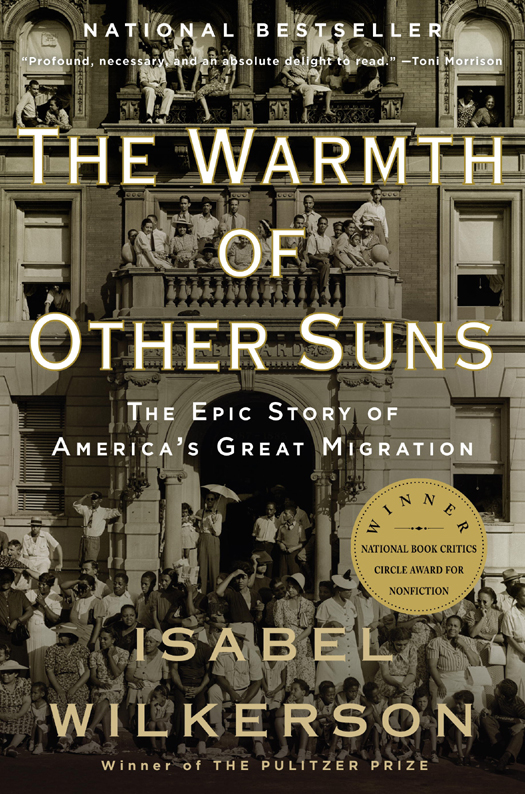
The Warmth of Other Suns
About this book
Between roughly 1915 and 1970, almost six million Black Americans left the South for cities in the North and West. The Warmth of Other Suns treats this Great Migration as a collection of individual decisions made under segregation, violence, labor control, and the hope of another life.
Isabel Wilkerson follows three migrants: Ida Mae Brandon Gladney from Mississippi to Chicago, George Swanson Starling from Florida to New York, and Robert Joseph Pershing Foster from Louisiana to Los Angeles. Their routes, work, marriages, and disappointments remain distinct.
More than a thousand interviews, archival records, demographic research, and years spent with the three central figures connect private lives to national change. The migration reshaped neighborhoods, politics, music, labor, and the racial geography of American cities.
Published in 2010, The Warmth of Other Suns combines history with close biography. Its scale shows both the force of a mass movement and the uncertainty of leaving: no migrant could know in advance what the receiving city would permit them to become.
Read a sample
5,056 words
Plain text
From the opening
LEAVING
This land is first and foremost
his handiwork.
It was he who brought order
out of primeval wilderness …
Wherever one looks in this land,
whatever one sees that is the work of man,
was erected by the toiling
straining bodies of blacks.
— DAVID L. COHN, God Shakes Creation
They fly from the land that bore them.
— W. H. STILLWELL
1 CHICKASAW COUNTY, MISSISSIPPI, LATE OCTOBER 1937 IDA MAE BRANDON GLADNEY
THE NIGHT CLOUDS were closing in on the salt licks east of the oxbow lakes along the folds in the earth beyond the Yalobusha River. The cotton was at last cleared from the field. Ida Mae tried now to get the children ready and to gather the clothes and quilts and somehow keep her mind off the churning within her. She had sold off the turkeys and doled out in secret the old stools, the wash pots, the tin tub, the bed pallets. Her husband was settling with Mr. Edd over the worth of a year’s labor, and she did not know what would come of it. None of them had been on a train before—not unless you counted the clattering local from Bacon Switch to Okolona, where, “by the time you sit down, you there,” as Ida Mae put it. None of them had been out of Mississippi. Or Chickasaw County, for that matter.
There was no explaining to little James and Velma the stuffed bags and chaos and all that was at stake or why they had to put on their shoes and not cry and bring undue attention from anyone who might happen to see them leaving. Things had to look normal, like any other time they might ride into town, which was rare enough to begin with.
Velma was six. She sat with her ankles crossed and three braids in her hair and did what she was told. James was too little to understand. He was three. He was upset at the commotion. Hold still now, James. Lemme put your shoes on, Ida Mae told him. James wriggled and kicked. He did not like shoes. He ran free in the field. What were these things? He did not like them on his feet. So Ida Mae let him go barefoot.
Miss Theenie stood watching. One by one, her children had left her and gone up north. Sam and Cleve to Ohio. Josie to Syracuse. Irene to Milwaukee. Now the man Miss Theenie had tried to keep Ida Mae from marrying in the first place was taking her away, too. Miss Theenie had no choice but to accept it and let Ida Mae and the grandchildren go for good. Miss Theenie drew them close to her, as she always did whenever anyone was leaving. She had them bow their heads. She whispered a prayer that her daughter and her daughter’s family be protected on the long journey ahead in the Jim Crow car.
“May the Lord be the first one in the car,” she prayed, “and the last out.”
When the time had come, Ida Mae and little James and Velma and all that they could carry were loaded into a brother-in-law’s truck, and the three of them went to meet Ida Mae’s husband at the train depot in Okolona for the night ride out of the bottomland.
2 WILDWOOD, FLORIDA, APRIL 14, 1945 GEORGE SWANSON STARLING
A MAN NAMED ROSCOE COLDEN gave Lil George Starling a ride in his pickup truck to the train station in Wildwood through the fruit-bearing scrubland of central Florida. And Schoolboy, as the toothless orange pickers mockingly called him, boarded the Silver Meteor pointing north.
A railing divided the stairs onto the train, one side of the railing for white passengers, the other for colored, so the soles of their shoes would not touch the same stair. He boarded on the colored side of the railing, a final reminder from the place of his birth of the absurdity of the world he was leaving.
He was getting out alive. So he didn’t let it bother him. “I got on the car where they told me to get on,” he said years later.
He hadn’t had time to bid farewell to everyone he wanted to. He stopped to say good-bye to Rachel Jackson, who owned a little café up on what they called the Avenue and the few others he could safely get to in the little time he had. He figured everybody in Egypt town, the colored section of Eustis, probably knew he was leaving before he had climbed onto the train, small as the town was and as much as people talked.
It was a clear afternoon in the middle of April. He folded his tall frame into the hard surface of the seat, his knees knocking against the seat back in front of him. He was packed into the Jim Crow car, where the railroad stored the luggage, when the train pulled away at last. He was on the run, and he wouldn’t rest easy until he was out of range of Lake County, beyond the reach of the grove owners whose invisible laws he had broken.
The train rumbled past the forest of citrus trees that he had climbed since he was a boy and that he had tried to wrestle some dignity out of and, for a time, had. They could have their trees. He wasn’t going to lose his life over them. He had come close enough as it was.
Continue reading the sampleClose the sample
He had lived up to his family’s accidental surname. Starling. Distant cousin to the mockingbird. He had spoken up about what he had seen in the world he was born into, like the starling that sang Mozart’s own music back to him or the starling out of Shakespeare that tormented the king by speaking the name of Mortimer. Only, George was paying the price for tormenting the ruling class that owned the citrus groves. There was no place in the Jim Crow South for a colored starling like him.
He didn’t know what he would do once he got to New York or what his life would be. He didn’t know how long it would take before he could send for Inez. His wife was mad right now, but she’d get over it once he got her there. At least that’s what he told himself. He turned his face to the North and sat with his back to Florida.
Leaving as he did, he figured he would never set foot in Eustis again for as long as he lived. And as he settled in for the twenty-three-hour train ride up the coast of the Atlantic, he had no desire to have anything to do with the town he grew up in, the state of Florida, or the South as a whole, for that matter.
3 MONROE, LOUISIANA, EASTER MONDAY, APRIL 6, 1953 ROBERT JOSEPH PERSHING FOSTER
IN THE DARK HOURS OF THE MORNING, Pershing Foster packed his surgery books, his medical bag, and his suit and sport coats in the trunk, along with a map, an address book, and Ivorye Covington’s fried chicken left over from Saturday night.
He said good-bye to his father, who had told him to follow his dreams. His father’s dreams had fallen apart, but there was still hope for the son, the father knew. He had a reluctant embrace with his older brother, Madison, who had tried in vain to get him to stay. Then Pershing pointed his 1949 Buick Roadmaster, a burgundy one with whitewall tires and a shark-tooth grille, in the direction of Five Points, the crossroads of town.
He drove down the narrow dirt roads with the ditches on either side that, when he was a boy, had left his freshly pressed Sunday suit caked with mud when it rained. He passed the shotgun houses perched on cinder blocks and hurtled over the railroad tracks away from where people who looked like him were consigned to live and into the section where the roads were not dirt ditches anymore but suddenly level and paved.
He headed in the direction of Desiard Street, the main thoroughfare, and, without a whiff of sentimentality, sped away from the small-town bank buildings and bail bondsmen, the Paramount Theater with its urine-scented steps, and away from St. Francis Hospital, which wouldn’t let doctors who looked like him perform a simple tonsillectomy.
Perhaps he might have stayed had they let him practice surgery like he was trained to do or let him walk into the Palace and try on a suit like anyone else of his station. The resentments had grown heavy over the years. He knew he was as smart as anybody else—smarter, to his mind—but he wasn’t allowed to do anything with it, the caste system being what it was. Now he was going about as far away as you could get from Monroe, Louisiana. The rope lines that had hemmed in his life seemed to loosen with each plodding mile on the odometer.
Like many of the men in the Great Migration and like many emigrant men in general, he was setting out alone. He would scout out the New World on his own and get situated before sending for anyone else. He drove west into the morning stillness and onto the Endom Bridge, a tight crossing with one lane acting like two that spans the Ouachita River into West Monroe. He would soon pass the mossback flatland of central Louisiana and the Red River toward Texas, where he was planning to see an old friend from medical school, a Dr. Anthony Beale, en route to California.
Pershing had no idea where he would end up in California or how he would make a go of it or when he would be able to wrest his wife and daughters from the in-laws who had tried to talk him out of going to California in the first place. He would contemplate these uncertainties in the unbroken days ahead.
From Louisiana, he followed the hyphens in the road that blurred together toward a faraway place, bridging unrelated things as hyphens do. Alone in the car, he had close to two thousand miles of curving road in front of him, farther than farmworker emigrants leaving Guatemala for Texas, not to mention Tijuana for California, where a wind from the south could blow a Mexican clothesline over the border.
In our homes, in our churches,
wherever two or three are gathered,
there is a discussion of what is best to do.
Must we remain in the South
or go elsewhere? Where can we go
to feel that security which other people feel?
Is it best to go in great numbers or only in several families?
These and many other things are discussed over and over.
— A COLORED WOMAN IN ALABAMA, 1902
THE GREAT MIGRATION, 1915–1970
THEY FLED as if under a spell or a high fever. “They left as though they were fleeing some curse,” wrote the scholar Emmett J. Scott. “They were willing to make almost any sacrifice to obtain a railroad ticket, and they left with the intention of staying.”
From the early years of the twentieth century to well past its middle age, nearly every black family in the American South, which meant nearly every black family in America, had a decision to make. There were sharecroppers losing at settlement. Typists wanting to work in an office. Yard boys scared that a single gesture near the planter’s wife could leave them hanging from an oak tree. They were all stuck in a caste system as hard and unyielding as the red Georgia clay, and they each had a decision before them. In this, they were not unlike anyone who ever longed to cross the Atlantic or the Rio Grande.
It was during the First World War that a silent pilgrimage took its first steps within the borders of this country. The fever rose without warning or notice or much in the way of understanding by those outside its reach. It would not end until the 1970s and would set into motion changes in the North and South that no one, not even the people doing the leaving, could have imagined at the start of it or dreamed would take nearly a lifetime to play out.
Historians would come to call it the Great Migration. It would become perhaps the biggest underreported story of the twentieth century. It was vast. It was leaderless. It crept along so many thousands of currents over so long a stretch of time as to be difficult for the press truly to capture while it was under way.
Over the course of six decades, some six million black southerners left the land of their forefathers and fanned out across the country for an uncertain existence in nearly every other corner of America. The Great Migration would become a turning point in history. It would transform urban America and recast the social and political order of every city it touched. It would force the South to search its soul and finally to lay aside a feudal caste system. It grew out of the unmet promises made after the Civil War and, through the sheer weight of it, helped push the country toward the civil rights revolutions of the 1960s.
During this time, a good portion of all black Americans alive picked up and left the tobacco farms of Virginia, the rice plantations of South Carolina, cotton fields in east Texas and Mississippi, and the villages and backwoods of the remaining southern states—Alabama, Arkansas, Florida, Georgia, Kentucky, Louisiana, North Carolina, Tennessee, and, by some measures, Oklahoma. They set out for cities they had whispered of among themselves or had seen in a mail-order catalogue. Some came straight from the field with their King James Bibles and old twelve-string guitars. Still more were townspeople looking to be their fuller selves, tradesmen following their customers, pastors trailing their flocks.
They would cross into alien lands with fast, new ways of speaking and carrying oneself and with hard-to-figure rules and laws. The New World held out higher wages but staggering rents that the people had to calculate like a foreign currency. The places they went were big, frightening, and already crowded—New York, Detroit, Chicago, Los Angeles, Philadelphia, and smaller, equally foreign cities—Syracuse, Oakland, Milwaukee, Newark, Gary. Each turned into a “receiving station and port of refuge,” wrote the poet Carl Sandburg, then a Chicago newspaper reporter documenting the unfolding migration there.
The people did not cross the turnstiles of customs at Ellis Island. They were already citizens. But where they came from, they were not treated as such. Their every step was controlled by the meticulous laws of Jim Crow, a nineteenth-century minstrel figure that would become shorthand for the violently enforced codes of the southern caste system. The Jim Crow regime persisted from the 1880s to the 1960s, some eighty years, the average life span of a fairly healthy man. It afflicted the lives of at least four generations and would not die without bloodshed, as the people who left the South foresaw.
Over time, this mass relocation would come to dwarf the California Gold Rush of the 1850s with its one hundred thousand participants and the Dust Bowl migration of some three hundred thousand people from Oklahoma and Arkansas to California in the 1930s. But more remarkably, it was the first mass act of independence by a people who were in bondage in this country for far longer than they have been free.
“The story of the Great Migration is among the most dramatic and compelling in all chapters of American history,” the Mississippi historian Neil McMillen wrote toward the end of the twentieth century. “So far reaching are its effects even now that we scarcely understand its meaning.”
Its imprint is everywhere in urban life. The configuration of the cities as we know them, the social geography of black and white neighborhoods, the spread of the housing projects as well as the rise of a well-scrubbed black middle class, along with the alternating waves of white flight and suburbanization—all of these grew, directly or indirectly, from the response of everyone touched by the Great Migration.
So, too, rose the language and music of urban America that sprang from the blues that came with the migrants and dominates our airwaves to this day. So, too, came the people who might not have existed, or become who they did, had there been no Great Migration. People as diverse as James Baldwin and Michelle Obama, Miles Davis and Toni Morrison, Spike Lee and Denzel Washington, and anonymous teachers, store clerks, steelworkers, and physicians, were all products of the Great Migration. They were all children whose life chances were altered because a parent or grandparent had made the hard decision to leave.
The Great Migration would not end until the 1970s, when the South began finally to change—the whites-only signs came down, the all-white schools opened up, and everyone could vote. By then nearly half of all black Americans—some forty-seven percent—would be living outside the South, compared to ten percent when the Migration began.
“Oftentimes, just to go away,” wrote John Dollard, a Yale scholar studying the South in the 1930s, “is one of the most aggressive things that another person can do, and if the means of expressing discontent are limited, as in this case, it is one of the few ways in which pressure can be put.”
By the time it was over, no northern or western city would be the same. In Chicago alone, the black population rocketed from 44,103 (just under three percent of the population) at the start of the Migration to more than one million at the end of it. By the turn of the twenty-first century, blacks made up a third of the city’s residents, with more blacks living in Chicago than in the entire state of Mississippi.
It was a “folk movement of incalculable moment,” McMillen said.
And more than that, it was the first big step the nation’s servant class ever took without asking.
The passenger train came wheezing through the north Georgia mountains after the colored school let out, and when it passed through the hill town of Rome, Georgia, back during the Depression, a little girl would run down the embankment and wait for it to rush past the locust trees. She would wave to the people in the metal boxes on wheels, the important people, their faces looking away, and dream of going wherever it was they were rushing to.
Years later, she got on a train herself, heading north. The railcar was filled with the expectant faces of people hoping for all the rights and privileges of citizenship. She stepped off at Union Station in the border city of Washington, D.C. It was the start of the North, filled as it was with grand squares and circles named after northern heroes of the Civil War—Ulysses S. Grant, William Tecumseh Sherman, George Henry Thomas, David G. Farragut—names, to this day, reviled in the South. She made her way to the address she had been given and settled onto the fold-out sofa in the front room of a second cousin she barely knew. Soon afterward, she performed a ritual of arrival that just about every migrant did almost without thinking: she got her picture taken in the New World. It would prove that she had arrived. It was the migrant’s version of a passport.
The picture is sepia, two by three inches, from the forties. Two young women sit on the front steps of a row house on R Street in Washington, looking very Bette Davis. Stacked heels and padded shoulders, wool coats brushing their knees. They are new in town. Childhood friends from Georgia meeting up now in the big city. Their faces give no hint of whatever indignities the South had visited upon them. That was over now. Their faces are all smiles and optimism. The one in the pearls used to greet the train when she was little and dream of going with it. She would become a teacher and, years later, my mother.
As a girl, I found the picture in a drawer in the living room, where many of those artifacts of migration likely ended up. I stared into the faces, searched the light in their eyes, the width of their smiles for clues as to how they got there.
Why did they go? What were they looking for? How did they get the courage to leave all they ever knew for a place they had never seen, the will to be more than the South said they had a right to be? Was it a braver thing to stay, or was it a braver thing to go? What would have happened if she had not gone north and met and married the Tuskegee Airman from Virginia, a migrant himself, who would become my father? Would I (and millions of other people born in the North and West) have even existed? What would have happened had all those people raised under Jim Crow not spilled out of the South looking for something better? If they had not gone north, what would New York look like? What would Philadelphia, Detroit, Pittsburgh, Chicago, Los Angeles, Washington, and Oakland look like? What, for that matter, would the South look like? Would it have changed on its own? Or did the black exodus force the South to face itself in ways no one could ever have thought possible?
“What would have happened if I’d stayed?” my mother asked out loud, repeating a question put to her one day. “I don’t even want to think about that.”
She never used the term “Great Migration” or any grand label for what she did nor did she see her decision as having any meaning beyond herself. Yet she and millions of others like her were right in the middle of it. At one point, ten thousand were arriving every month in Chicago alone. It made for a spectacle at the railroad platforms, both north and south.
“I went to the station to see a friend who was leaving,” Emmett J. Scott, an official at Tuskegee Institute in Alabama, wrote shortly after the Migration began. “I could not get in the station. There were so many people turning like bees in a hive.”
Those millions of people, and what they did, would seep into nearly every realm of American culture, into the words of Ralph Ellison and Toni Morrison, the plays of Lorraine Hansberry and August Wilson, the poetry and music of Langston Hughes and B. B. King, and the latter-day generation of Arrested Development and Tupac Shakur. It all but consumed the work of Richard Wright, the bard of the Great Migration. He gave voice to the fears and yearnings of his fellow migrants through his novel Native Son and his autobiography, Black Boy. He had been a sharecropper’s son in Natchez, Mississippi. He defected to the receiving station of Chicago, via Memphis, in December 1927, to feel, as he put it, “the warmth of other suns.”
Yet for all of its influence, the Migration was so vast that, throughout history, it has most often been consigned to the landscape, rarely the foreground. Scholars have devoted their attention to the earliest phase of the Migration, the World War I era. “Less has been written about the more massive sequence of migration that began during World War II,” the historian James N. Gregory wrote in 2005, “and a comprehensive treatment of the century-long story of black migration does not exist.”
This book addresses that omission. The stories in this book are based on the accounts of people who gave hundreds of hours of their days to share with me what was perhaps the singular turning point in their lives. They were among more than twelve hundred people I interviewed for this book in New York, Chicago, Los Angeles, Milwaukee, and Oakland. All of them journeyed from the South during the Great Migration, and it is their collective stories that inform every aspect of this book.
For the three main characters—Ida Mae Brandon Gladney, George Swanson Starling, and Robert Joseph Pershing Foster—and for others like them, the circumstances of their migrations shaped who they were and defined the course of their fortunes or misfortunes and the lives of their descendants. The events were thus easily recounted when the participants were called upon to do so. Official records corroborated those details that were indeed verifiable. But it is the larger emotional truths, the patient retelling of people’s interior lives and motivations, that are the singular gift of the accounts in this book. With the passing of the earliest and succeeding generations of migrants, it is these stories that have become the least replaceable sources of any understanding of this great movement of people out of the South to the American North and West.
This book covers a span of some one hundred years. As the narrative moves through time, the language changes to retain the authenticity of each era. The word “colored” is used during the portion of the book in which that term was a primary identifier for black people, that is, during the first two-thirds of the twentieth century, as evidenced by the colored high schools the people attended and the signage that directed them to segregated facilities. As the narrative moves into the 1960s, it shifts to the use of the term “black,” after it gained popularity during the civil rights era, and then to both “black” and “African American” in the current era.
Over time, the story of the Great Migration has suffered distortions that have miscast an entire population. From the moment the emigrants set foot in the North and West, they were blamed for the troubles of the cities they fled to. They were said to have brought family dysfunction with them, to more likely be out-of-work, unwed parents, and on welfare, than the people already there.
In the past twenty years, however, an altogether different picture has emerged from ongoing research by scholars of the Great Migration. Closer analysis of newly available census records has found that, contrary to conventional thought, black migrants were actually more likely to be married and to raise their children in two-parent households, and less likely to bear children out of wedlock. “Compared with northern-born blacks,” writes the sociologist Stewart E. Tolnay, a leading expert on the Migration, “southern migrants had higher rates of participation in the labor force, lower levels of unemployment, higher incomes, lower levels of poverty and welfare dependency.” The lives of the people in this book bear out this more complex understanding of the Great Migration and, based on the new data, represent the more common migrant experience than many previous accounts.
Despite the overlapping of time and place in the text, the three main people in this narrative never met or knew one another. Their paths never crossed except through their experiences with me and metaphorically through the interlocking chapters of this book. The narrative portrays the phenomenon through people unknown to one another, in the way that migrants moving along different currents would not have intersected, their anonymity a metaphor for the vast and isolating nature of the Migration itself.
The actions of the people in this book were both universal and distinctly American. Their migration was a response to an economic and social structure not of their making. They did what humans have done for centuries when life became untenable—what the pilgrims did under the tyranny of British rule, what the Scots-Irish did in Oklahoma when the land turned to dust, what the Irish did when there was nothing to eat, what the European Jews did during the spread of Nazism, what the landless in Russia, Italy, China, and elsewhere did when something better across the ocean called to them. What binds these stories together was the back-against-the-wall, reluctant yet hopeful search for something better, any place but where they were. They did what human beings looking for freedom, throughout history, have often done.
They left.
PART TWO BEGINNINGS
This was the culture
from which I sprang.
This was the terror
from which I fled.
— RICHARD WRIGHT,
Black Boy
IDA MAE BRANDON GLADNEY
CHICAGO, 1996
FROM THE OPEN DOOR IN THE VESTIBULE, I see her. She is sitting in a cotton housedress on a baby blue, plastic-covered easy chair by the window. She is looking through a parting of the curtains at the street circus below. There they are, all scuffling beneath her: urban drug dealers, falling-down sweatpants pooling at their feet, now bent over the driver’s-side window of a late-model sedan from the suburbs; fourth-graders doing lookout for men who could be their fathers; young girls with their stomachs swelling already; middle-aged men living out of their Pontiacs; gangsters who might not make it to the weekend.
She lives on the second floor of a three-flat on the South Side of Chicago. She taps her foot and moves closer to the sill. This is not what she had come to Chicago for, nor was it what she expected it to be. But here she is, and this is what it has become, a place so dangerously absurd that it is living entertainment in her old age. She knows the street names and the code words for all the hustlers and pushers playing out their lives beneath her window, and even though they may have just shot a rival or just got out on parole, they look out for her and greet her kindly—you watch yourself now, Grandma—because there is something sweet and kind about her, and she is from the Old Country and has survived a life of fear and privation they will never know.
She has an endearing gap in her teeth, which go just about any which way they please, and her hair is now as soft and white as the cotton she used to pick not particularly well back in Mississippi. She is the color of sand on a beach, which she had heard of growing up but had never seen for herself until she arrived in Chicago half a lifetime ago. She has big searching eyes that see the good in people despite the evil she has seen, and she has a comforting kind of eternal beauty, her skin like the folds of a velvet shawl.