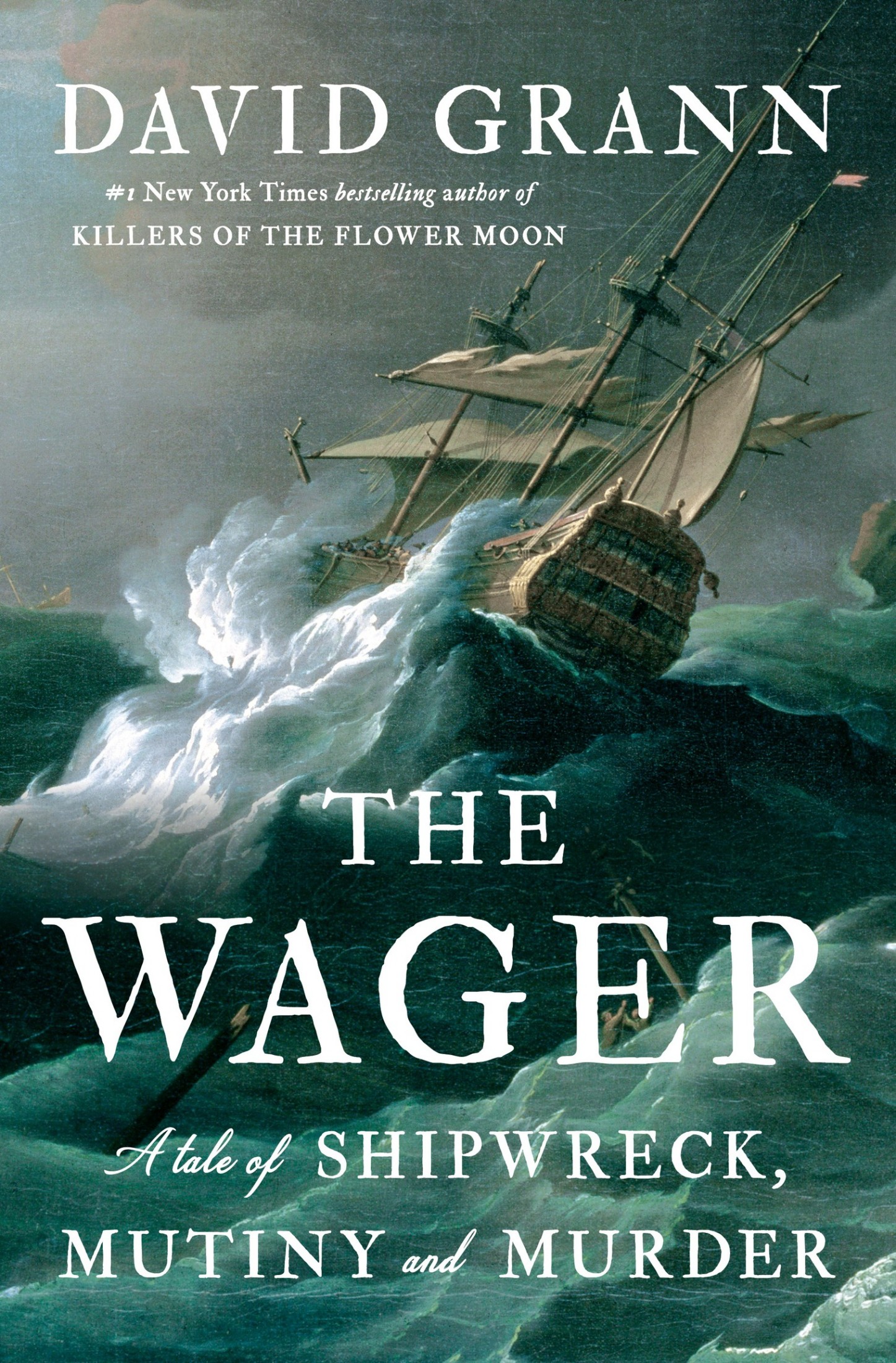
The Wager: A Tale of Shipwreck, Mutiny and Murder
About this book
HMS Wager left England in 1740 as part of a squadron sent to attack Spanish interests during the War of Jenkins' Ear. After storms, illness, navigation failures, and shipwreck, the crew struggled to survive on a desolate island.
Scarcity destroyed the hierarchy that naval discipline was meant to secure. Separate groups attempted extraordinary voyages in improvised craft, and those who reached home presented incompatible explanations of command, loyalty, and violence.
Grann draws on logs, journals, official records, and later testimony to reconstruct both the ordeal and the contest over its meaning. The court-martial becomes a battle over which narrative the British Empire can afford to recognize.
The Wager is maritime history with the pace of an adventure story. Beneath the survival narrative lies a study of authority, testimony, and the stories nations tell about the people acting in their name.
Read a sample
5,073 words
Plain text
From the opening
Prologue
The only impartial witness was the sun. For days, it watched as the strange object heaved up and down in the ocean, tossed mercilessly by the wind and the waves. Once or twice the vessel nearly smashed into a reef, which might have ended our story. Yet somehow—whether through destiny, as some would later proclaim, or dumb luck—it drifted into an inlet, off the southeastern coast of Brazil, where several inhabitants laid eyes upon it.
Above fifty feet long and ten feet wide, it was a boat of some sort—though it looked as if it had been patched together from scraps of wood and cloth and then battered into oblivion. Its sails were shredded, its boom shattered. Seawater seeped through the hull and a stench emanated from within. The bystanders, edging closer, heard unnerving sounds: thirty men were crammed onboard, their bodies almost wasted to the bone. Their clothes had largely disintegrated. Their faces were enveloped in hair, tangled and salted like seaweed.
Some were so weak they could not even stand. One soon gave out his last breath and died. But a figure who appeared to be in charge rose with an extraordinary exertion of will and announced that they were castaways from His Majesty’s Ship the Wager, a British man-of-war.
When the news reached England, it was greeted with disbelief. In September 1740, during an imperial conflict with Spain, the Wager, carrying some 250 officers and crew, had embarked from Portsmouth in a squadron on a secret mission: to capture a treasure-filled Spanish galleon known as “the prize of all the oceans.” Near Cape Horn, at the tip of South America, the squadron had been engulfed by a hurricane, and the Wager was believed to have sunk with all its souls. But 283 days after the ship had last been reported seen, these men miraculously emerged in Brazil.
They had been shipwrecked on a desolate island off the coast of Patagonia. Most of the officers and crew had perished, but eighty-one survivors had set out in a makeshift boat lashed together partly from the wreckage of the Wager. Packed so tightly onboard that they could barely move, they traveled through menacing gales and tidal waves, through ice storms and earthquakes. More than fifty men died during the arduous journey, and by the time the few remnants reached Brazil three and a half months later, they had traversed nearly three thousand miles—one of the longest castaway voyages ever recorded. They were hailed for their ingenuity and bravery. As the leader of the party noted, it was hard to believe that “human nature could possibly support the miseries that we have endured.”
Six months later, another boat washed ashore, this one landing in a blizzard off the southwestern coast of Chile. It was even smaller—a wooden dugout propelled by a sail stitched from the rags of blankets. Onboard were three additional survivors, and their condition was even more frightful. They were half naked and emaciated; insects swarmed over their bodies, nibbling on what remained of their flesh. One man was so delirious that he had “quite lost himself,” as a companion put it, “not recollecting our names…or even his own.”
After these men recovered and returned to England, they leveled a shocking allegation against their companions who had surfaced in Brazil. They were not heroes—they were mutineers. In the controversy that followed, with charges and countercharges from both sides, it became clear that while stranded on the island the Wager’s officers and crew had struggled to persevere in the most extreme circumstances. Faced with starvation and freezing temperatures, they built an outpost and tried to re-create naval order. But as their situation deteriorated, the Wager’s officers and crew—those supposed apostles of the Enlightenment—descended into a Hobbesian state of depravity. There were warring factions and marauders and abandonments and murders. A few of the men succumbed to cannibalism.
Back in England, the principal figures from each group along with their allies were now summoned by the Admiralty to face a court-martial. The trial threatened to expose the secret nature not only of those charged but also of an empire whose self-professed mission was spreading civilization.
Several of the accused published their sensational—and wildly conflicting—accounts of what one of them called the “dark and intricate” affair. The philosophers Rousseau, Voltaire, and Montesquieu were influenced by reports of the expedition, and so, later, were Charles Darwin and two of the great novelists of the sea, Herman Melville and Patrick O’Brian. The suspects’ main aim was to sway the Admiralty and the public. A survivor from one party composed what he described as a “faithful narrative,” insisting, “I have been scrupulously careful not to insert one word of untruth: for falsities of any kind would be highly absurd in a work designed to rescue the author’s character.” The leader of the other side claimed, in his own chronicle, that his enemies had furnished an “imperfect narrative” and “blackened us with the greatest calumnies.” He vowed, “We stand or fall by the truth; if truth will not support us, nothing can.”
We all impose some coherence—some meaning—on the chaotic events of our existence. We rummage through the raw images of our memories, selecting, burnishing, erasing. We emerge as the heroes of our stories, allowing us to live with what we have done—or haven’t done.
But these men believed their very lives depended on the stories they told. If they failed to provide a convincing tale, they could be secured to a ship’s yardarm and hanged.
Continue reading the sampleClose the sample
Part One
THE WOODEN WORLD
CHAPTER 1
The First Lieutenant
Each man in the squadron carried, along with a sea chest, his own burdensome story. Perhaps it was of a scorned love, or a secret prison conviction, or a pregnant wife left on shore weeping. Perhaps it was a hunger for fame and fortune, or a dread of death. David Cheap, the first lieutenant of the Centurion, the squadron’s flagship, was no different. A burly Scotsman in his early forties with a protracted nose and intense eyes, he was in flight—from squabbles with his brother over their inheritance, from creditors chasing him, from debts that made it impossible for him to find a suitable bride. Onshore, Cheap seemed doomed, unable to navigate past life’s unexpected shoals. Yet as he perched on the quarterdeck of a British man-of-war, cruising the vast oceans with a cocked hat and spyglass, he brimmed with confidence—even, some would say, a touch of haughtiness. The wooden world of a ship—a world bound by the Navy’s rigid regulations and the laws of the sea and, most of all, by the hardened fellowship of men—had provided him a refuge. Suddenly he felt a crystalline order, a clarity of purpose. And Cheap’s newest posting, despite the innumerable risks that it carried, from plagues and drowning to enemy cannon fire, offered what he longed for: a chance to finally claim a wealthy prize and rise to captain his own ship, becoming a lord of the sea.
The problem was that he could not get away from the damned land. He was trapped—cursed, really—at the dockyard in Portsmouth, along the English Channel, struggling with feverish futility to get the Centurion fitted out and ready to sail. Its massive wooden hull, 144 feet long and 40 feet wide, was moored at a slip. Carpenters, caulkers, riggers, and joiners combed over its decks like rats (which were also plentiful). A cacophony of hammers and saws. The cobblestone streets past the shipyard were congested with rattling wheelbarrows and horse-drawn wagons, with porters, peddlers, pickpockets, sailors, and prostitutes. Periodically, a boatswain blew a chilling whistle, and crewmen stumbled from ale shops, parting from old or new sweethearts, hurrying to their departing ships in order to avoid their officers’ lashes.
It was January 1740, and the British Empire was racing to mobilize for war against its imperial rival Spain. And in a move that had suddenly raised Cheap’s prospects, the captain under whom he served on the Centurion, George Anson, had been plucked by the Admiralty to be a commodore and lead the squadron of five warships against the Spanish. The promotion was unexpected. As the son of an obscure country squire, Anson did not wield the level of patronage, the grease—or “interest,” as it was more politely called—that propelled many officers up the pole, along with their men. Anson, then forty-two, had joined the Navy at the age of fourteen, and served for nearly three decades without leading a major military campaign or snaring a lucrative prize.
Tall, with a long face and a high forehead, he had a remoteness about him. His blue eyes were inscrutable, and outside the company of a few trusted friends he rarely opened his mouth. One statesman, after meeting with him, noted, “Anson, as usual, said little.” Anson corresponded even more sparingly, as if he doubted the ability of words to convey what he saw or felt. “He loved reading little, and writing, or dictating his own letters less, and that seeming negligence…drew upon him the ill will of many,” a relative wrote. A diplomat later quipped that Anson was so unknowing about the world that he’d been “round it, but never in it.”
Nevertheless, the Admiralty had recognized in Anson what Cheap had also seen in him in the two years since he’d joined the Centurion’s crew: a formidable seaman. Anson had a mastery of the wooden world and, equally important, a mastery of himself—he remained cool and steady under duress. His relative noted, “He had high notions of sincerity and honor and practiced them without deviation.” In addition to Cheap, he had attracted a coterie of talented junior officers and protégés, all vying for his favor. One later informed Anson that he was more obliged to him than to his own father and would do anything to “act up to the good opinion you are pleased to have of me.” If Anson succeeded in his new role as commodore of the squadron, he would be in a position to anoint any captain he wanted. And Cheap, who’d initially served as Anson’s second lieutenant, was now his right-hand man.
Like Anson, Cheap had spent much of his life at sea, a bruising existence he’d at first hoped to escape. As Samuel Johnson once observed, “No man will be a sailor who has contrivance enough to get himself into a jail; for being in a ship is being in a jail, with the chance of being drowned.” Cheap’s father had possessed a large estate in Fife, Scotland, and one of those titles—the second Laird of Rossie—that evoked nobility even if it did not quite confer it. His motto, emblazoned on the family’s crest, was Ditat virtus: “Virtue enriches.” He had seven children with his first wife, and, after she died, he had six more with his second, among them David.
In 1705, the year that David celebrated his eighth birthday, his father stepped out to fetch some goat’s milk and dropped dead. As was custom, it was the oldest male heir—David’s half brother James—who inherited the bulk of the estate. And so David was buffeted by forces beyond his control, in a world divided between first sons and younger sons, between haves and have-nots. Compounding his upheaval, James, now ensconced as the third Laird of Rossie, frequently neglected to pay the allowance that had been bequeathed to his half brothers and half sister: some blood was apparently thicker than others’. Driven to find work, David apprenticed to a merchant, but his debts mounted. So in 1714, the year he turned seventeen, he ran off to sea, a decision that was evidently welcomed by his family—as his guardian wrote to his older brother, “The sooner he goes off it will be better for you and me.”
After these setbacks, Cheap seemed only more consumed by his festering dreams, more determined to bend what he called an “unhappy fate.” On his own, on an ocean distant from the world he knew, he might prove himself in elemental struggles—braving typhoons, outdueling enemy ships, rescuing his companions from calamities.
But though Cheap had chased a few pirates—including the one-handed Irishman Henry Johnson, who fired his gun by resting the barrel on his stump—these earlier voyages had proved largely uneventful. He’d been sent to patrol the West Indies, generally considered the worst assignment in the Navy because of the specter of disease. The Saffron Scourge. The Bloody Flux. The Breakbone Fever. The Blue Death.
But Cheap had endured. Wasn’t there something to be said for that? Moreover, he’d earned the trust of Anson and worked his way up to first lieutenant. No doubt it helped that they shared a disdain for reckless banter, or what Cheap deemed a “vaporing manner.” A Scottish minister who later became close to Cheap noted that Anson had employed him because he was “a man of sense and knowledge.” Cheap, the once-forlorn debtor, was but one rung from his coveted captaincy. And with the war with Spain having broken out, he was about to head into full-fledged battle for the first time.
The conflict was the result of the endless jockeying among the European powers to expand their empires. They each vied to conquer or control ever larger swaths of the earth, so that they could exploit and monopolize other nations’ valuable natural resources and trade markets. In the process, they subjugated and destroyed innumerable indigenous peoples, justifying their ruthless self-interest—including the reliance on the ever-expanding Atlantic slave trade—by claiming that they were somehow spreading “civilization” to the benighted realms of the earth. Spain had long been the dominant empire in Latin America, but Great Britain, which already possessed colonies along the American eastern seaboard, was now on the ascendance—and determined to break its rival’s hold.
Then, in 1738, Robert Jenkins, a British merchant captain, was summoned to appear in Parliament, where he reportedly claimed that a Spanish officer had stormed his brig in the Caribbean and, accusing him of smuggling sugar from Spain’s colonies, cut off his left ear. Jenkins reputedly displayed his severed appendage, pickled in a jar, and pledged “my cause to my country.” The incident further ignited the passions of Parliament and pamphleteers, leading people to cry for blood—an ear for an ear—and a good deal of booty as well. The conflict became known as the War of Jenkins’ Ear.
British authorities soon devised a plan to launch an attack on a hub of Spain’s colonial wealth: Cartagena. A South American city on the Caribbean, it was where much of the silver extracted from Peruvian mines was shipped in armed convoys to Spain. The British offensive—involving a massive fleet of 186 ships, led by Admiral Edward Vernon—would be the largest amphibious assault in history. But there was also another, much smaller operation: the one assigned to Commodore Anson.
With five warships and a scouting sloop, he and some two thousand men would sail across the Atlantic and round Cape Horn, “taking, sinking, burning, or otherwise destroying” enemy ships and weakening Spanish holdings from the Pacific coast of South America to the Philippines. The British government, in concocting its scheme, wanted to avoid the impression that it was merely sponsoring piracy. Yet the heart of the plan called for an act of outright thievery: to snatch a Spanish galleon loaded with virgin silver and hundreds of thousands of silver coins. Twice a year, Spain sent such a galleon—it was not always the same ship—from Mexico to the Philippines to purchase silks and spices and other Asian commodities, which, in turn, were sold in Europe and the Americas. These exchanges provided crucial links in Spain’s global trading empire.
Cheap and the others ordered to carry out the mission were rarely privy to the agendas of those in power, but they were lured by a tantalizing prospect: a share of the treasure. The Centurion’s twenty-two-year-old chaplain, Reverend Richard Walter, who later compiled an account of the voyage, described the galleon as “the most desirable prize that was to be met with in any part of the globe.”
If Anson and his men prevailed—“if it shall please God to bless our arms,” as the Admiralty put it—they would continue circling the earth before returning home. The Admiralty had given Anson a code and a cipher to use for his written communication, and an official warned that the mission must be carried out in the “most secret, expeditious manner.” Otherwise, Anson’s squadron might be intercepted and destroyed by a large Spanish armada being assembled under the command of Don José Pizarro.
Cheap was facing his longest expedition—he might be gone for three years—and his most perilous. But he saw himself as a knight-errant of the sea in search of “the greatest prize of all the oceans.” And along the way, he might become a captain yet.
Yet if the squadron didn’t embark quickly, Cheap feared, the entire party would be annihilated by a force even more dangerous than the Spanish armada: the violent seas around Cape Horn. Only a few British sailors had successfully made this passage, where winds routinely blow at gale force, waves can climb to nearly a hundred feet, and icebergs lurk in the hollows. Seamen thought that the best chance to survive was during the austral summer, between December and February. Reverend Walter cited this “essential maxim,” explaining that during winter not only were the seas fiercer and the temperatures freezing; there were fewer hours of daylight in which one could discern the uncharted coastline. All these reasons, he argued, would make navigating around this unknown shore the “most dismaying and terrible.”
But since war had been declared, in October 1739, the Centurion and the other men-of-war in the squadron—including the Gloucester, the Pearl, and the Severn—had been marooned in England, waiting to be repaired and fitted out for the next journey. Cheap watched helplessly as the days ticked by. January 1740 came and went. Then February and March. It was nearly half a year since the war with Spain had been declared; still, the squadron was not ready to sail.
It should have been an imposing force. Men-of-war were among the most sophisticated machines yet conceived: buoyant wooden castles powered across oceans by wind and sail. Reflecting the dual nature of their creators, they were devised to be both murderous instruments and the homes in which hundreds of sailors lived together as a family. In a lethal, floating chess game, these pieces were deployed around the globe to achieve what Sir Walter Raleigh had envisioned: “Whosoever commands the seas commands the trade of the world; whosoever commands the trade of the world commands the riches of the world.”
Cheap knew what a cracking ship the Centurion was. Swift and stout, and weighing about a thousand tons, she had, like the other warships in Anson’s squadron, three towering masts with crisscrossing yards—wooden spars from which the sails unfurled. The Centurion could fly as many as eighteen sails at a time. Its hull gleamed with varnish, and painted around the stern, in gold relief, were Greek mythological figures, including Poseidon. On the bow rode a sixteen-foot wooden carving of a lion, painted bright red. To increase the chances of surviving a barrage of cannonballs, the hull had a double layer of planks, giving it a thickness of more than a foot in places. The ship had several decks, each stacked upon the next, and two of them had rows of cannons on both sides—their menacing black muzzles pointing out of square gunports. Augustus Keppel, a fifteen-year-old midshipman who was one of Anson’s protégés, boasted that other men-of-war had “no chance in the world” against the mighty Centurion.
Yet building, repairing, and fitting out these watercraft was a herculean endeavor even in the best of times, and in a period of war it was chaos. The royal dockyards, which were among the largest manufacturing sites in the world, were overwhelmed with ships—leaking ships, half-constructed ships, ships needing to be loaded and unloaded. Anson’s vessels were laid up on what was known as Rotten Row. As sophisticated as men-of-war were with their sail propulsion and lethal gunnery, they were largely made from simple, perishable materials: hemp, canvas, and, most of all, timber. Constructing a single large warship could require as many as four thousand trees; a hundred acres of forest might be felled.
Most of the wood was hard oak, but it was still susceptible to the pulverizing elements of storm and sea. Teredo navalis—a reddish shipworm, which can grow longer than a foot—ate through hulls. (Columbus lost two ships to these creatures during his fourth voyage to the West Indies.) Termites also bored through decks and masts and cabin doors, as did deathwatch beetles. A species of fungus further devoured the ship’s wooden core. In 1684, Samuel Pepys, a secretary to the Admiralty, was stunned to discover that many new warships under construction were already so rotten they were “in danger of sinking at their very moorings.”
The average man-of-war was estimated by a leading shipwright to last only fourteen years. And to survive that long, a ship had to be virtually remade after each extensive voyage, with new masts and sheathing and rigging. Otherwise, it risked disaster. In 1782, while the 180-foot Royal George—for a time the largest warship in the world—was anchored near Portsmouth, with a full crew onboard, water began flooding its hull. It sank. The cause has been disputed, but an investigation blamed the “general state of decay of her timbers.” An estimated nine hundred people drowned.
Cheap learned that an inspection of the Centurion had turned up the usual array of sea wounds. A shipwright reported that the wooden sheathing on its hull was “so much worm eaten” that it had to be taken off and replaced. The foremast, toward the bow, contained a rotten cavity a foot deep, and the sails were, as Anson noted in his log, “much rat eaten.” The squadron’s other four warships faced similar problems. Moreover, each vessel had to be loaded with tons of provisions, including some forty miles of rope, more than fifteen thousand square feet of sails, and a farm’s worth of livestock—chickens, pigs, goats, and cattle. (It could be fiercely difficult to get such animals onboard: steers “do not like the water,” a British captain complained.)
Cheap pleaded with the naval administration to finish readying the Centurion. But it was that familiar story of wartime: though much of the country had clamored for battle, the people were unwilling to pay enough for it. And the Navy was strained to a breaking point. Cheap could be volatile, his moods shifting like the winds, and here he was, stuck as a landsman, a pen pusher! He badgered dockyard officials to replace the Centurion’s damaged mast, but they insisted the cavity could simply be patched. Cheap wrote to the Admiralty decrying this “very strange way of reasoning,” and officials eventually relented. But more time was lost.
And where was that bastard of the fleet, the Wager? Unlike the other men-of-war, it was not born for battle but had been a merchant vessel—a so-called East Indiaman, because it traded in that region. Intended for heavy cargo, it was tubby and unwieldy, a 123-foot eyesore. After the war began, the Navy, needing additional ships, had purchased it from the East India Company for nearly four thousand pounds. Since then, it had been sequestered eighty miles northeast of Portsmouth, at Deptford, a royal dockyard on the Thames, where it was undergoing a metamorphosis: cabins were torn apart, holes cut into the outer walls, and a stairwell obliterated.
The Wager’s captain, Dandy Kidd, surveyed the work being done. Fifty-six years old, and reportedly a descendant of the infamous buccaneer William Kidd, he was an experienced seaman, and a superstitious one—he saw portents lurking in the winds and the waves. Only recently had he obtained what Cheap dreamed of: the command of his own ship. At least from Cheap’s perspective, Kidd had earned his promotion, unlike the captain of the Gloucester, Richard Norris, whose father, Sir John Norris, was a celebrated admiral; Sir John had helped to secure his son a position in the squadron, noting that there would be “both action and good fortune to those who survived.” The Gloucester was the only vessel in the squadron being swiftly repaired, prompting another captain to complain, “I lay three weeks in the dock and not a nail drove, because Sir John Norris’s son must first be served.”
Captain Kidd bore his own story. He’d left behind, at a boarding school, a five-year-old son, also named Dandy, who had no mother to raise him. What would happen to him if his father didn’t survive the voyage? Already Captain Kidd feared the omens. In his log, he wrote that his new ship nearly “tumbled over,” and he warned the Admiralty that she might be a “crank”—a ship that heeled abnormally. To give the hull ballast so the ship wouldn’t capsize, more than four hundred tons of pig iron and gravel stones were lowered through the hatches into the dark, dank, cavernous hold.
The workers toiled through one of England’s coldest winters on record, and just as the Wager was ready to sail, Cheap learned to his dismay, something extraordinary happened: the Thames froze, shimmering from bank to bank with thick, unbreakable waves of ice. An official at Deptford advised the Admiralty that the Wager was imprisoned until the river melted. Two months passed before she was liberated.
In May, the old East Indiaman finally emerged from the Deptford Dockyard as a man-of-war. The Navy classified warships by their number of cannons, and, with twenty-eight, she was a sixth-rate—the lowest rank. She was christened in honor of Sir Charles Wager, the seventy-four-year-old First Lord of the Admiralty. The ship’s name seemed fitting: weren’t they all gambling with their lives?
As the Wager was piloted down the Thames, drifting with the tides along that central highway of trade, she floated past West Indiamen loaded with sugar and rum from the Caribbean, past East Indiamen with silks and spices from Asia, past blubber hunters returning from the Arctic with whale oil for lanterns and soaps. While the Wager was navigating this traffic, her keel ran aground on a shoal. Imagine being shipwrecked here! But it soon dislodged, and in July the ship arrived at last outside Portsmouth harbor, where Cheap laid eyes upon her. Seamen were merciless oglers of passing ships, pointing out their elegant curves or their hideous flaws. And though the Wager had assumed the proud look of a man-of-war, she could not completely conceal her former self, and Captain Kidd beseeched the Admiralty, even at this late date, to give the vessel a fresh coat of varnish and paint so that she could shine like the other ships.
By the middle of July, nine bloodless months had gone by since the war began. If the squadron left promptly, Cheap was confident that it could reach Cape Horn before the end of the austral summer. But the men-of-war were still missing the most important element of all: men.
Because of the length of the voyage and the planned amphibious invasions, each warship in Anson’s squadron was supposed to carry an even greater number of seamen and marines than it was designed for. The Centurion, which typically held four hundred people, was expected to sail with some five hundred, and the Wager would be packed with about two hundred and fifty—nearly double its usual complement.
Cheap had waited and waited for crewmen to arrive. But the Navy had exhausted its supply of volunteers, and Great Britain had no military conscription. Robert Walpole, the country’s first prime minister, warned that the dearth of crews had rendered a third of the Navy’s ships unusable. “Oh! seamen, seamen, seamen!” he cried at a meeting.
While Cheap was struggling with other officers to scrounge up sailors for the squadron, he received more unsettling news: those men who had been recruited were falling sick. Their heads throbbed and their limbs were so sore they felt as if they’d been pummeled. In severe cases, these symptoms were compounded by diarrhea, vomiting, bursting blood vessels, and fevers reaching as high as 106 degrees. (This led to delirium—“catching at imaginary objects in the air,” as a medical treatise put it.)
Some men succumbed even before they had gone to sea. Cheap counted at least two hundred sick and more than twenty-five dead on the Centurion alone. He had brought his young nephew Henry to apprentice on the expedition…and what if he perished? Even Cheap, who was so indomitable, was suffering from what he called a “very indifferent state of health.”
It was a devastating epidemic of “ship’s fever,” now known as typhus. No one then understood that the disease was a bacterial infection, transmitted by lice and other vermin. As boats transported unwashed recruits crammed together in filth, the men became lethal vectors, more deadly than a cascade of cannonballs.
Anson instructed Cheap to have the sick rushed to a makeshift hospital in Gosport, near Portsmouth, in the hope that they would recover in time for the voyage. The squadron still desperately needed men. But as the hospital became overcrowded, most of the sick had to be lodged in surrounding taverns, which offered more liquor than medicine, and where three patients sometimes had to squeeze into a single cot. An admiral noted, “In this miserable way, they die very fast.”
After peaceful efforts to man the fleets failed, the Navy resorted to what a secretary of the Admiralty called a “more violent” strategy. Armed gangs were dispatched to press seafaring men into service—in effect, kidnapping them. The gangs roamed cities and towns, grabbing anyone who betrayed the telltale signs of a mariner: the familiar checkered shirt and wide-kneed trousers and round hat; the fingers smeared with tar, which was used to make virtually everything on a ship more water-resistant and durable. (Seamen were known as tars.) Local authorities were ordered to “seize all straggling seamen, watermen, bargemen, fishermen and lightermen.”